

Apple Flash Crash Brings the Worst out of Stock News Websites
Apple stock experienced a flash crash yesterday morning, dropping 3% in one minute on extremely heavy volume. With Apple trading near all-time highs, market pundits have become increasingly eager to point out why Apple's stock dropped. CNBC ran an article yesterday titled, "Here's why Apple shares took a dive: Pros". With such a headline, I knew what I was getting myself into and I wasn't disappointed as the article contained six reasons, impressively none of which were related to each other, that explained why Apple's stock had crashed.
Reason 1: Morgan Stanley Downgrade
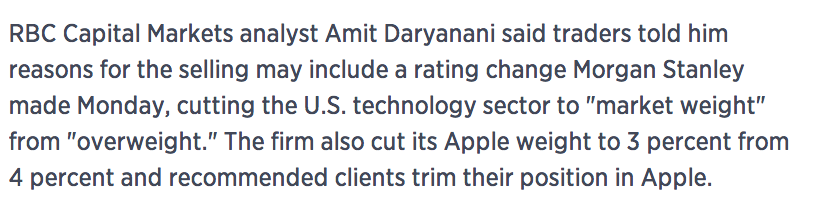
Daryanani got on the phone with his trading desk to find out what they were seeing. It's a common occurrence on Wall Street for sell-side analysts to periodically check-in with their trading desk to see if there is anything unusual with the incoming buy and sell orders. In reality, the traders are just reading blogs and AOL IM themselves looking for reasons a stock is up or down since they don't know either.
Reason 2: Program Selling

After getting off the phone with his traders, maybe Daryanani got some incoming calls from clients that actually knew what was going on. CNBC gives the reason one sentence.
Reason 3: Technical Analysis

People sold Apple because it crossed a random moving average.
Reason 4: Profit-Taking

Apple is down 3% in one minute and Basenese concludes that it resulted from long-term investors deciding now is the time to sell. It is just a coincidence that everyone decided to sell at exactly the same second...literally.
Reason 5: Stock Upgrade

Basenese also thinks a stock upgrade may have caused Apple's stock to crash. I assume a stock downgrade would cause Apple's stock to pop?
Reason 6: Weak Black Friday Sales

I assume this reason came in from traders with little to no knowledge about Apple or that Black Friday sales metrics were largely irrelevant because of retailers holding sales during the week leading up to Black Friday.
The CNBC article has 143 comments so I assume it accomplished its goal of attracting page views. Meanwhile, Reuters published an article yesterday about Apple's flash crash, listing one primary explantation: algorithmic and high-frequency trading.
Reason 1: Algorithmic Trading
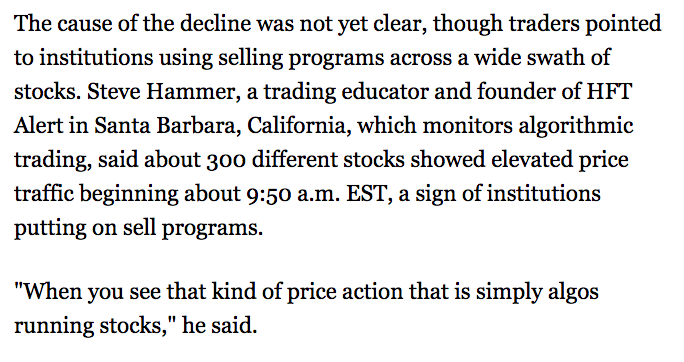
Similar to the 2010 Flash Crash, yesterday's flash crash impacted over 300 stocks, not just Apple. The U.S. Securities and Exchange Commission (SEC) and Commodity Futures Trading (CFTC) looked into the 2010 Flash Crash and concluded that one trader initiated a sell program to sell S&P 500 futures contracts. High-frequency trading firms saw the order and started selling the contracts they had just bought from this one trader. A resulting liquidity vacuum (lack of buyers) formed and then spread into the equity markets. I suspect something along those lines impacted the stock market yesterday morning. Of course, this theory doesn't lead to the most exciting headlines and stories, so when the next flash crash occurs (and it will), I'm confident we will see new articles from the "pros" giving us six explantations for why Apple crashed.
Apple's Share Repurchases Have Benefited Shareholders by $80 Billion
With Apple having completed 75% of it's current share repurchase program, and a recent increase in chatter concerning whether share repurchases are the best use of Apple's cash, it is a good time to review Apple's share buyback program and assess its logic and success. It is important to first understand what a stock repurchase program is and how companies use buyback as a signaling mechanism when framing Apple's decision to initiate the largest capital management program in history. I estimate Apple's ongoing share repurchase program has added $80 billion of price to Apple's stock, benefitting current shareholders as the gap between Apple's stock price and value has narrowed. Despite committing to $90 billion of share repurchases and having $22 billion of buyback authorization remaining, Apple has kept all of its options open for creating additional shareholder value through funding sensible M&A and capital expenditures.
What are Share Repurchases?
A share repurchase program, often called share buyback, is the process of a company buying back its own shares either through the public market or private transactions. Share repurchases, along with cash dividends, are two of the primary ways companies can return excess cash to shareholders. The mechanism of share repurchases are not controversial; as shares are repurchased, a company's outstanding share count declines, thereby boosting each remaining share's ownership percentage. Consequently, each remaining shareholder that did not sell shares to the company would then have a higher share of earnings and cash flow. Exhibit 1 demonstrates this process as a hypothetical 10% share buyback lowers shares outstanding, while having no impact on earnings, leading to higher EPS and a higher overall ownership share for the top shareholder assuming no shares were sold. I assume it was an all-cash share buyback in a low-yielding environment with no loss of investment income.
Exhibit 1: Hypothetical Share Repurchase Program's Impact on Top Shareholder Ownership and EPS
The principal-agent dynamic underlying publicly-traded companies drives capital management decisions. Executives (agents) are hired with the goal of utilizing a company's assets in order to earn a return on shareholders' (principals) investment. The board of directors are elected by shareholders to monitor that management is considering shareholders' best interests. Management teams determine if share repurchases or dividends are appropriate when a company is sitting on excess capital, which may negatively impact financial metrics such as return on assets and equity, while the board of directors officially authorizes capital management actions.
This principal-agent relationship doesn't always work in shareholders' best interest as conflicts and differing incentives complicate matters, as seen with the recent string of corporate boardroom raiding by hedge funds. It's in this setting that Tim Cook is tasked with balancing Apple's long-term well-being with Apple shareholders' best interests in terms of excess cash on the balance sheet.
Share repurchases also have a "signaling effect", impacting how investors view a company's future. By initiating a share repurchase program, it is believed that management views its shares as undervalued and its future is bright enough to part with excess cash. Share repurchases have increased in popularity in recent years as capital gains are often taxed at lower rates than dividends, there is less risk of management teams wasting excess cash on M&A (which there are numerous examples of in the technology sector), and there are fewer side-effects from slowing or stopping buyback programs compared to dividends.
Apple's Share Repurchase Program
Apple has the largest share repurchase program in history, which stands as a testament to the company's successful products. Exhibit 2 highlights the pace at which Apple has repurchased shares. Since 2012, Apple has spent $68 billion on buyback repurchasing approximately 10% of common shares outstanding, with approximately $22 billion remaining in the current authorization.
Exhibit 2: Apple Share Repurchases - Open Market and Accelerated Share Repurchase (ASR)
Logic for Apple Share Repurchase; How Shareholders Have Benefited by $80 Billion
Using today's stock price, Apple's $68 billion of shares repurchased over the past two and a half years would be worth approximately $108 billion, or nearly 40% higher. In reality, this return is hypothetical since Apple does not benefit from previously repurchased stock rising in value, but it does help break apart the thesis that Apple has squandered money on buyback. If one was to look at the impact that Apple's buyback has had on the company's reported financials, EPS has risen approximately $0.50/share, all else equal, as depicted in Exhibit 3. Similar to Exhibit 1, I assume cash was invested in low-yielding short-term investments that did not produce significant income.
Exhibit 3: Share Repurchase Impact on Apple's Net Income, Shares Outstanding, and EPS
Taking this additional $0.48 of EPS resulting from fewer shares outstanding and multiplying it by Apple's current 15x forward P/E multiple would result in approximately $7/share of additional stock price. However, one also needs to take into account any change in P/E multiple as a result of the buyback. Obviously, this part of the exercise is up for debate given different variables impacting valuation multiples, including higher EPS revisions resulting from iPhone strength. Apple's forward P/E multiple has expanded from 13x to 15x since the stock buyback program was put into place. Giving equal weight to buyback and iPhone strength as causing the P/E multiple to rise, another $5-$7/share of stock price can be attributed to buyback (2 (P/E multiple expansion) x $5.97 (Apple's 2014 EPS without EPS accretion resulting from buyback) x 0.5 (to reflect iPhone strength's impact on higher P/E multiple)). Said another way, the market has assigned approximately $13/share of additional price ($80 billion) to Apple's stock due to share repurchases.
Stock buyback shouldn't have much, if any, impact on Apple's value, aside from lowering the cost of capital if there have been corresponding debt issuances. However, the gap between Apple's stock price and value is closing because of the ongoing share buyback program.The marketplace went from not appropriately valuing Apple's cash to now willing to pay more for Apple's cash and additional capital management actions that may lie in the future.
While Apple's shareholders have benefited by buyback, has Apple, the company, benefited? To answer this question, one has to consider other options Apple could have taken with the $68 billion funneled into buyback.
A) Large M&A. Management could spend excess cash on a few large acquisitions. As I explained in my article "Large M&A is Not in Apple's DNA: Case Study of Why Apple Won't Buy Tesla", Apple's product success is built on collaboration and design and reinforced by Apple's organizational structure, leaving no room for large M&A. Instead, Apple continues to be an active acquirer, having bought approximately 35 smaller companies since the beginning of 2013, most of which were never made public. Apple looks at acquisitions as a way to fill talent and resource holes that could only be addressed in a timely manner by acquisition (such as Authentic and fingerprint sensor technology).
B) Dividends. Apple could issue a special one-time dividend or increase its quarterly cash dividend. Obvious drawbacks to issuing dividends include shareholder tax implications and negative signaling that management doesn't view it's stock as undervalued and worthy of share repurchases.
Instead, Tim Cook and the board are using Apple's $150 billion of cash to fund dividends and buyback, while keeping enough ammunition to create shareholder value through organic and M&A possibilities, including significant capital expenditures, which topped $11 billion in 2014 and is expected to reach $13 billion in 2015.
Stock Buyback's Long-term Implications on Apple
As I wrote in my article, "AAPL and $700 Billion", short-term stock price swings don't give much indication as to how Apple, the company, is faring due to many moving variables involved in how a stock's price is determined. While the market was concerned about Apple's iPhone business and declining margins in late 2012 and 2013, Apple was busy developing the Apple Watch. Apple's stock underperformance had little to no impact on Apple's R&D and future plans. While I will admit that a company's stock serves as an incentive mechanism for employee morale, I believe any short-term reactions tend to correct themselves overtime, limiting the long-term impact on employee morale.
Apple's stock buyback program highlights that Tim Cook and the Apple board are fostering a shareholder-friendly environment, which stands in contrast to a few tech behemoths with anti-shareholder voting structures. Despite the $68 billion spent on share repurchases since 2012, Apple still has more than $150 billion of cash, thanks in part to $29 billion of debt issuances. Ultimately, Apple's long-term buyback plans will depend on how the product pipeline materializes. It wouldn't be a stretch to assume Apple will utilize share buyback during periods of stock price underperformance and low valuation, while buyback is limited during periods of stock price greed and optimism. Given the current environment and product portfolio, as well Apple's stock valuation, Tim Cook and the board are doing the right thing buying back shares.
This report was produced by Neil Cybart on December 1, 2014.
Receive my exclusive analysis and perspective about Apple in a daily email containing 2-3 stories (10-12 stories a week). For more information and to sign up, visit the membership page.
This week's Above Avalon podcast (Episode 4: Let's Talk about Apple Stock) discusses this article. RSS is available.
Embracing Selfie Innovation
Apple's Beats by Dre released a new ad titled 'Solo Selfie'. Take a look. I liked it.
As Abdel Ibrahim pointed out to me on Twitter, the ad was inspired by a video from Karen Cheng, uploaded to YouTube last month. Here is her 'Donut Selfie' video tutorial:
Karen earned a spot in the Beats ad and can be seen at the 0:25 mark. I found it interesting that Karen's Donut Selfie video was focused more on iPhone's camera capabilities, but instead Apple/Beats adapted the video to highlight Beats' new Solo2 headphones. The whole thing is just simply fun.
AAPL and $700 Billion
Apple just crossed the $700 billion market cap threshold. I thought it was a good time to put this event into perspective.
- What does this tell us about Apple's future? Nothing.
- What does this tell us about Apple's past? Nothing.
- What does this tell us about Apple? Nothing.
A stock's valuation is simply the value point at which the demand for a company's stock is equal to the supply of that company's stock. Any discussion around a stock's price, or any guessing as to where a stock price is headed, needs to focus on a stock's supply and demand. Luckily, analyzing a stock's supply is relatively easy.
- Determine who wants to sell their shares.
- Determine why they want to sell their shares.
- Determine at what price are they willing to sell their shares.
- Analyze the business landscape to determine if the company will need access to additional capital.
- Determine if raising more public equity would be in the company's best interest.
Once that analyses is complete, even more straight-forward analyses needs to be done to determine a stock's demand.
- Determine who wants to buy shares.
- Determine why they want to buy shares.
- Determine at what price are they willing to buy shares.
- Predict what that company's detailed capital management plans will look like for the next few years.
- Analyze the business landscape to determine if the company will decide to buy back its own shares.
- Determine if another company will be interested in buying the company's shares.
Once these eleven points have been answered or analyzed, one can then make predictions as to where a stock price is headed.
In reality, it's impossible to analyze most of these points, and I'm sure I left out a dozen more. Since investors don't like the unknown, commentators and pundits focus on developing an interesting story around why a stock is performing a certain way in an effort to remove unknowns from the equation.
The more appropriate type of analyses ignores day-to-day stock fluctuations and instead focuses on the company behind the stock. By analyzing a company, many of the above unknowns dealing with that company's stock melt away or become irrelevant.
Apple crossed the $700 billion market cap threshold and this told us just as much about Apple today that it did yesterday: nothing.
Estimating Apple's Record iPhone Sales in 1Q15
Apple will not only report record iPhone sales for the current quarter (FY 1Q15), but it may beat the previous quarterly high by as much as 30%. Several factors will combine to produce a perfect storm for strong iPhone sales growth in 1Q15. I expect iPhone 6 and 6 Plus popularity, China Mobile, and a slight addition to channel inventory will lead to Apple reporting 68M iPhone sales for the current quarter, representing 34% year-over-year (yoy) growth.
Above Avalon Accuracy
Over the past two and a half years, I have published seven AAPL earnings previews that included iPhone estimates, with an average error of 500 basis points, as depicted in Exhibit 1. For the four most recent earnings reports, my average iPhone estimate error was 275 basis points.
Exhibit 1. Above Avalon Historical iPhone Estimates
Management Commentary
Tim Cook categorized iPhone demand as "staggering and geographically broad-based, markedly higher in every single country where we've launched compared to the iPhone 5s a year ago." Apple is unsure when iPhone demand and supply will be in equilibrium. Despite being on sale for only 12 days, iPhone 6 and 6 Plus contributed to 17% iPhone unit sale growth yoy in the U.S., 20% growth in Western Europe, 32% unit sell-through growth in Greater China despite no iPhone launch in China, greater than 50% growth in Latin America and the Middle East, and greater than 100% growth in Central and Eastern Europe. Apple sells the iPhone in over 200,000 locations and expects to bring the new iPhones to more than 115 countries by the end of the year.
Breakdown of 68M iPhone Estimate
I estimate Apple will sell 68M iPhones in 1Q15. Exhibit 2 compares 1Q iPhone sales for the past three years as well as channel inventory information.
Exhibit 2. Apple iPhone Quarterly Data Matrix
Using Apple's observed global Phone growth rates during FY4Q14 as a proxy for supply, I added 10.2M to the 51M iPhones Apple sold in 1Q14 to reflect 20% yoy growth in overall iPhone strength. I added 5M units to reflect China Mobile's impact on overall sales, which would not be reflected in 1Q14 results. Finally, I added 2M units to reflect an increase in channel inventory to get Apple within its previous 4-6 week channel inventory target range (management increased the range to 5-7 weeks). The resulting 68.2M iPhones sold estimate implies 34% yoy growth, which would be the strongest quarterly growth in over two years.
This report should be used to understand where I stand on iPhone 1Q15 sales, especially when I discuss the item in my daily email, AAPL Orchard, or in other Above Avalon reports. Over the coming months, if new data becomes available, I will update my estimates accordingly. This report is not meant to be used as investment advice. Downside risks to my estimates include: iPhone supply issues and weaker-than-expected customer demand. Upside risks to my estimates include: Stronger-than-expected customer demand, especially in China. This report was produced by Neil Cybart on November 25, 2014.
I publish a daily email about Apple called AAPL Orchard. Click here to subscribe.
Luxury Watch Industry Planning to Use Lawsuits to Delay Smartwatch Era
I don't think the next couple of years will be fun for luxury watchmakers. Instead of thinking of their customers and innovating, TorrentFreak is reporting that luxury watchmakers are forming a type of consortium to send cease and desist notices to people giving away free knock-off watch face downloads for smartwatches. While a company has a right and obligation to protect its trademarks, I find it quite amusing that high-end watchmakers think sending cease and desist letters is going to hold off the tsunami that is about to hit them over the coming years as smartwatches go mainstream.
Jean-Claude Biver, CEO of Swiss luxury watchmaker Hublot, did a great job at describing the paradox facing high-end watchmakers and the coming smartwatch era when he said, "[a] smartwatch is very difficult for [Hublot] because it is contradictory... Luxury is supposed to be eternal... How do you justify a $2,000 smart watch whose technology will become obsolete in two years?"
In four months, Apple will not only begin selling a luxury smartwatch that will cost well over $2,000, but also a mass market $349 smartwatch that could sell in the 10s of millions of units annually. Apple Watch will combine luxury with personalization and technology; something that current luxury watchmakers are incapable of doing.
I just don't see a place for a luxury "dumb" watch in a luxury "smart" watch world.
Samsung's Issues Look Weirder by the Day
The WSJ is reporting ($) that Samsung is considering a significant management shake-up to address slumping Galaxy S5 sales and an overall deteriorating mobile device outlook.
I have the following thoughts/questions:
- The WSJ, citing sources, reported that Samsung management mistakes and errors contributed to a significant Galaxy S5 inventory buildup "forcing Samsung to increase marketing expenditures to unload the devices". That line sounded odd to me given that Samsung had just come off of a record year for marketing costs, spending $14B in 2013, nearly 14x more than Apple on a dollar basis. Considering most of Samsung's 2013 phone sales involved some portion of this marketing/carrier promotion, were continued 2014 phone promotions actually a result of management incorrectly estimating demand or did Samsung simply carry-over some of these now dependent promotion practices from 2013 to maintain sales momentum?
- The article says 12M Galaxy S5 smartphones were "sold to consumers" in the first three months following launch. That figure seemed low to me, especially when I think back to prior WSJ articles, around the time the Galaxy S5 launched, discussing Samsung's bullish prospects and sales figures. After a few minutes of searching, I found($) the WSJ's "Samsung Says New Galaxy S5 Is Off to Strong Start" article in which Samsung Mobile Chief J.K. Shin was interviewed. He said sales of the Galaxy S5 were 11 million in the first month, outselling the Galaxy S4 by a million. Shin went on to say S5 sales were "much stronger than the Galaxy S4". How did the number of Galaxy S5 phones go from 11 million for the first month of sales to 12 million for the first three months? I assume it once again comes down to the "ship" vs. "sold" dynamic, where Samsung's sell-through sales were much weaker than units shipped to carriers, but that doesn't give me much comfort as Shin even went out of his way and commented that S5 sales were much stronger than S4. I am left wondering if Shin was lying or if this is a case of Samsung losing touch with reality and not even having data as to how their phones were selling.
- Galaxy S5 sales were down 50% in China versus Galaxy S4 during the first six months of sales, while the U.S. was the only major market where S5 sales were better than S4. Low-end Chinese smartphone competitors are impacting Samsung much more than third-tier phone vendors in the U.S., where Samsung faces slightly less competitive pressure on the low-end and subsidies mask some of the price differential. I suspect promotions are still playing quite an active role in the U.S. as well.
All of this stands in stark contrast to Apple's iPhone strategy where product sell-through numbers don't diverge much from shipped figures, especially when Apple is experiencing a supply/demand imbalance, and if there is a difference, Apple will clearly indicate the change in the earnings conference call. Apple's now notorious relationship with carriers, which include sometimes aggressive iPhone sales benchmarks and contracts, compare to Samsung's reliance on carriers for data about its products and markets. With Samsung overshooting Galaxy S5 demand by 40%, either management misread the market incorrectly or other opportunities and products served as a distraction. Given all of the turmoil, it's fair to start wondering if Samsung's response to the Apple Watch, if there will be one, is delayed or at least put on hold as a result of the company's mobile struggles.
Assessing Apple Watch's Primary Risk
Last week I published my Apple Watch sales projections. Some of the feedback I received dealt with how I can be confident that Apple Watch won't have build-quality issues or other performance problems. Taking into account Apple's product-focused structure and the way risk is mitigated, I think a more appropriate criticism would be to question Apple Watch's biggest risk: consumer acceptance.
Apple's Risk Mitigation
Much of Apple’s recent success can be explained by the company's organizational structure mitigating internal risk, such as lack of attention or motivation, and ineffective collaboration, leaving only external risk embodied by consumer demand. I went into this phenomenon in greater detail in my article, “Making Big Beats and Controlling Risk – How Apple Succeeds." Apple's structure allows decision makers (upper management) to come in contact with everything that is shipped to consumers and, more importantly, everyone who is in charge of the product (designers, marketers, engineers). Within the past four years, Apple's executive team has seen nearly 50% turnover, including a new CEO, and yet Apple is still functioning, showcasing how this process is built to last beyond its current operators.
For many companies the concept of mitigating internal risk and leaving the consumer as the biggest unknown variable is underappreciated, since such an action positions a company to rely on marketing and storytelling to sell a well-designed product. The iPad is a prime example of this strategy as Apple's marketing team was tasked with addressing the last remaining risk factor: customer demand. Consumers needed to hold and play with the device in order to understand its magic and eventually find a need for it in their lives. If the device wasn't ready to ship due to hardware or software issues, Apple would have delayed the launch. On the other hand, Apple Maps is a good example of when the Apple Machine isn't well-oiled and risk is kept internally with nasty politics possibly getting in the way of Apple's product-focused strategy.
Apple Watch's Risk
Apple Watch's biggest risk is consumer acceptance, not poor material design or bad software. Will consumers envision an Apple Watch fitting in their daily schedule? Over the past few weeks I've laid out several use cases that I think make a compelling argument for how the Apple Watch can function alongside an iPhone, all of which invoke the same theme: breaking the "problem" into more granular tasks, with the more complicated and power-hungry steps kept to iPhone, while Apple Watch tackles the finishing touches. Apple's primary job to address consumer demand risk is to focus on marketing, showcasing Apple Watch in various settings outside the tech world and installing Apple Watch demo units throughout the Apple retail distribution network, allowing consumers to wear and test the product.
Word-of-mouth marketing is another variable that is left largely out of Apple's control. With an addressable market numbering in the 10s of millions of iOS users, these early Apple Watch adopters will play a role in determining what kind of adoption rate the Apple Watch experiences in its first few years on the market. If internal risk factors are mitigated during the product development cycle, a well-engineered device is created with consumer demand left as the biggest risk.
Estimating Subscribers for a Revamped Beats Music Streaming Service
With three publications reporting Apple is looking to bundle Beats Music into iOS in 2015, it's prudent to start thinking about the size of an Apple music streaming service.
U.S. Market Opportunity
A Beats Music streaming service bundled into a future iOS update has the potential of being the largest paid subscription music service in the U.S. assuming Apple adopts a free ad-supported tier as well as a $5/month or $60/year paid tier. I reach this hypothesis by taking iTunes Radio adoption and growing it to account for a much better streaming Beats service (using the current product as a base). Exhibit 1 includes my estimates for U.S. paid and total subscribers as well as my rationale behind the estimates marked in red.
Exhibit 1: Beats Music Streaming Sub Potential - U.S.
Global Market (Including U.S.) Opportunity
One of the big unknowns is if Beats Music will eventually have the same global footprint as Spotify. Assuming Beats Music is bundled in iOS and is available in many countries, I suspect Apple's music streaming service could be bigger than Spotify. I reach this hypothesis by using Spotify's global to U.S. paid subscriber ratio and assuming Beats carries a more U.S.-centric focus, detailed in Exhibit 2.
Exhibit 2: Beats Music Streaming Sub Potential - Global.
Running further with revenue assumptions would quickly reveal that a Beats Music streaming service bundled into a future iOS update would not have a significant impact on Apple's income statement. Nevertheless the potential of Apple holding off competitors and remaining on top of the music relevancy chart has the potential of being much more valuable.
Interesting iPhone/Sapphire Tidbit from the WSJ
Event: Information about Apple's sapphire usage was tucked within the WSJ's fascinating look into the troubled Apple and GT Advanced Technologies sapphire deal. - Link ($)
From the WSJ:
"Apple consumes one-fourth of the world’s supply of sapphire to cover the iPhone’s camera lens and fingerprint reader. Early last year, the company began looking for a much larger supply, to cover the iPhone’s screen."
Apple's intention with sapphire and the iPhone is becoming clearer: With sapphire already being used for the iPhone camera lens and fingerprint reader, and now the iPad fingerprint reader, Apple needed a significant amount of sapphire supply to come onto the market if it wanted to use the material for iPhone screens. Sapphire's biggest benefit is being scratch resistance, as seen in this video, while negatives include weight and cost (which Apple looked to alleviate by having GT innovate in terms of production). Due to the combination of managerial mishaps at GT and changing Apple requests, the sapphire being produced did not meet Apple's strict standards.
From all indications Apple is still interested in using sapphire for iPhone screens (would have served as a nice upgrade feature for the more expensive 6 Plus), but for now any near-term plans seem to be on hold. There is no reason to assume Apple is facing a sapphire supply issue for Apple Watch (the Apple Watch and Apple Watch Edition collections use sapphire crystal) considering GT was geared towards sapphire for iPhone screens. I estimate Apple will sell approximately 30 million Apple Watch and Apple Watch Edition collection units over the first two years on the market (out of a total 60 million Apple Watch units). The sapphire supply needed for 30 million Apple Watch screens over the next two years pales in comparsion to the approximate 400 million iPhones that will be sold during the same time period.
iPhone 6 vs. iPhone 6 Plus Sales Update
With the new iPhones on the market for a little over two months, I'm able to make some initial comments as to how the iPhone 6 is selling in comparsion to the iPhone 6 Plus.
What the data says: The iPhone 6 was initially outselling the iPhone 6 Plus by approximately 6 to 1 at launch, but over the last nine weeks as iPhone 6 Plus supply has ramped up and the new iPhones launched in China, the iPhone 6 is now outselling the Plus by approximately 3 to 1 according to Mixpanel and Fiksu. Tech analyst Ben Bajarin reported Baidu/Umeng data suggests a similar breakdown between iPhone models in China.

What the data doesn't say: We still don't know how iPhone demand/supply imbalance is impacting consumer purchasing decisions. Are consumers choosing the model that is in stock in-stores or with a shorter wait time online? In the Apple U.S. online store, the 16GB iPhone 6 Plus ships in 7-10 business days while the 16GB iPhone 6 ships in 5-7 business days.
Looking ahead: I wouldn't be surprised if the iPhone 6 to iPhone 6 Plus ratio trends towards 2.5 to 1 suggesting approximately 70% of consumers are choosing iPhone 6 and 30% are choosing iPhone 6 Plus. Why? The iPhone 6 Plus may represent a good compromise for consumers deciding between a phone and tablet. I can envision a scenario where some consumers not interested in the latest tech gadget actually prefer the iPhone 6 Plus because it is easier to read text and watch video on compared to the iPhone 6. Offsetting this trend, the Plus' higher price tag may make the iPhone 6 a more popular choice for parents buying phones for their children or budget-conscious customers that don't want an iPhone 5s or 5c.
Apple Impact: The iPhone 6 Plus has a higher margin than the iPhone 6 which should help Apple's financials. I still view iPad cannibalization at the hands of iPhone 6 Plus as a long-term positive for Apple given the higher iPhone margin and the customer remaining in the iOS ecosystem.
The App Store's Search Problem is Actually A Discovery Problem
Mobile apps are finally starting to fix web search. The side effect is trying to wade through 1.2 million apps in Apple's App Store. In solving one search problem, a new one has formed, only this time the answer isn’t to improve app search, but introduce better app discovery.
With the App Store honeymoon phase over and some of its coolness factor long gone, consumers' daily usage has settled on 12-24 apps with dozens more used sporadically. A few apps have done quite a good job at repackaging web content (WhatsApp, iMessage, email, Twitter, Facebook, Snapchat, Instagram) into an easily digestible format. As the number of apps available in the App Store exploded, the cries of a growing app search problem grew louder, but the main issue with this logic isn’t that users can’t find useful apps, it’s that users don’t know what they should even be searching for. If I hear about a specific app, I’m able to find it relatively quickly in the App Store. I rarely search for generic terms like “stock research” or “food” in the App Store primarily because there is no reason to search for apps like that, just as there is no reason to search the web like that.
The next phase in app discovery will be that same type of personalization we see now with how apps like Twitter are fixing web search, but this time combined with location data. Many apps are location-determinant as they have specific use cases in a certain environment: education, enterprise, sporting events, the list goes on. In iOS 7 Apple introduced the “Popular Near Me” feature, which shows apps that are popular near my current location. In my case, I am shown five local news apps. Am I interested in those apps? No, but at least it’s a start. In iOS 8, Apple introduced location-based app suggestions on the lock screen, but I rarely have seen real-world instances of this besides having a retail store app pop-up when I’m within a few hundreds yards. In these two instances Apple is addressing the problem of finding apps, but not through better search, but rather better discovery.
A more useful method to foster app discovery is to combine continued location-based app suggestions with personalization. Knowing that I am interested in stocks and following certain people on Twitter, and seeing I’m in a bank, I can be given app suggestions that not only are related to finance, but have some connection to app developers I follow on Twitter or I have shown some liking in the past through other social platforms. My app suggestions are tailored just to me. Apps are personal expressions of the world. Some of us will like certain apps while others won’t. Bucket-type “apps near me” don’t work, just as location-based suggestions using nothing but my location doesn’t fully solve the app discovery problem either. Once location and personalization are combined to give me relevant app suggestions, I will be able to look at the App Store's 1.2 million apps with a little bit less confusion and anxiety.
P.S. Imagine if Ping was unveiled for the App Store instead of iTunes so that you can “follow” apps and developers while getting the much-requested app previews and free trials? Would make personalization that much more interesting because I would bet if a consumer likes one developer, chances are good they may like other apps that developer "likes" or is friends with.
Finding Apple Strategy Clues in Apple Watch's Human Interface Guidelines
With over 40 tech blogs reporting on Apple's WatchKit release yesterday, there has been no shortage of designer and developer tidbits to digest including screen resolutions and fully native Apple Watch apps arriving in late 2015. I read the Apple Watch Human Interface Guidelines (HIG) with a different goal; to find clues as to how Apple will market Apple Watch.
During Apple's September Apple Watch keynote some observers thought Apple failed to demonstrate why someone should buy an Apple Watch. Instead of picking a few key selling points, Apple had VP of Technology Kevin Lynch go on stage and play with various apps and a confusing beehive-like layout of tiny icons. I disagreed as I thought Apple touched upon a few selling points that normal users might be interested in (maps, photos, communication) and the overall messaging was that the Apple Watch's full potential will be realized with third-party iOS apps.
From my piece "Apple Keynote Notes":
"Apple didn't go into much detail about why someone should use an Apple Watch, instead demoing a few features that seemed cool or at least interesting. I think most of this is taken from the iPad playbook - show users various things you can do with the device and then step back and see what sticks. At one point Apple even mentioned there is much more to say about the device, but there wasn't enough time."
Apple laid out three overarching design themes for Apple Watch in the HIG released yesterday: personal, holistic, and lightweight. Each not only helps describe Apple Watch, from its size to functionality, but also sheds some light on how Apple will market the device in relation to the iPhone.
Personal - Apple goes out of its way to remind developers that the Apple Watch is something that is worn and therefore requires a level of personalization that has yet to be seen in the tech space. The device's personal communication aspect (Digital Touch and the Taptic Engine) stands out as something that an iPhone just isn't able to accomplish.
Holistic - A few days after purchasing my iPad, I knew the device was going to be a hit as the hardware seemingly melted away whenever I touched the screen.
From my piece "iOS App Innovation and iPad 2 Design Lead to Magic":
"Remove the intermediary and let users interact directly with innovation."
Apple is following a similar path with Apple Watch by stressing that the software must make the hardware disappear during usage. Such a requirement is made even more important due to the device being worn all day.
Lightweight - The Apple Watch is meant to display small snippets of information and data. Instead of thinking of the device as a mini-iPhone, Apple wants developers to rethink how an Apple Watch user can consume data in a completely new way. Apple stressed key words that contained descriptive imagery, such as "briefly", "frequently", and "small display".
I think these three Apple Watch design tenets go a long way in describing how Apple could market an Apple Watch. Apple will walk a thin line because if too much focus is put on the need to connect Apple Watch to an iPhone, consumers may look at the Apple Watch as an overpriced iPhone accessory, but overhype Apple Watch's capabilities and users may think they don't need the latest and greatest iPhone.
How can Apple sell Apple Watch? Position the device as a way of improving one's iPhone. A device that can take iPhone's drawbacks and repackage the problem into new solutions. A few real-world examples of this strategy:
- Communication. One of iPhone's communication problems is that the device needs to be both within the user's line-of-sight and reach to initiate or continue communication with someone. With Apple Watch, the user will be able to communicate only by touch (Taptic Engine) while the iPhone is tucked away in a pocket or purse, or lying on the passenger car seat. Granted, that type of communication is rudimentary when compared to iPhone's capabilities, but in certain contexts it is both efficient and effective. Users now have two distinct forms of communication: iPhone and Apple Watch.
- Maps. The iPhone can be used to get turn-by-turn navigation to reach a parking lot or destination, but once the user is near that location on foot, the iPhone's utility diminishes as the need to actively look for real-world visual clues, as well as weaving in-and-out of pedestrian foot traffic, makes it difficult to have an iPhone in hand. An Apple Watch can be used via quick glances to determine if the destination is one block ahead or on the other side of the street while the iPhone is kept in a back pocket or backpack. Users now have two devices to use directions to reach a destination: iPhone for the sheer grunt work, Apple Watch for the nuance details at the end of the trip.
- Apple Pay. While Apple Pay and iPhone seem to work flawlessly, having to take your iPhone out of pocket and then hold it up to a POS terminal is not the most efficient process. Instead if users can rely on iPhone to manage payment information as well as retailer loyalty programs, but use Apple Watch to complete the retail transaction at POS. The iPhone remains safely in pocket or purse throughout the transaction, simplifying the process.
In each case, both the Apple Watch and iPhone are required to accomplish a task, but the process of working through the "problem" is broken down into more granular tasks, with the more complicated and power-hungry steps kept on iPhone, while Apple Watch tackles the small finishing touches. Over time, it's not hard to see Apple Watch gaining more capabilities, but in the near-term the Apple Watch and iPhone can work together to improve one's efficiency. Apple's job in marketing Apple Watch will be to demonstrate how the iPhone's sheer power and capabilities produces some annoyances and then explain how Apple Watch can help solve those inconveniences.
Apple Watch Sales and Earnings Projections
Apple will start selling Apple Watch in early 2015 and based off of my analyses, I estimate Apple will sell 20-30 million Apple Watches bringing in $11 billion to $17 billion of revenue and $0.70-$1.00 of EPS over the first 12 months on the market.
Apple Watch Addressable Market
Analysts are relying on various methods to arrive at Apple Watch's addressable market including surveys, prior Apple product launch sales trends, and current watch market data. I disagree with those methods since they contain significant issues or error-prone variables.
- Surveys. Customer intention patterns do not correspond well with actual behavior.
- Previous Apple Product Launches as a Proxy. My biggest issue with this method is that it ignores the passage of time and ecosystem changes.
- Current Watch Industry Data. As Apple has shown over the years it is pointless to use existing pre-Apple industry market data as a proxy for future Apple sales.
I extrapolate Apple's addressable market for Apple Watch from iOS adoption rates. I use the share of iOS devices that upgraded to the latest iOS release by the end of the first full day after release as a proxy for Apple's most loyal customer base. I classify these users as a fair approximation of Apple's initial addressable market for an Apple Watch. Using a 2.4-year iPhone replacement cycle, I estimate there are approximately 400 million iPhones in use today. Since there are older devices resold or passed down to children and relatives, I would label the 400M data point as a base case estimate.
I consider a user that upgrades to the latest iOS release within the first full day after release as someone who is more interested in their phone and consequentially Apple. Why? These users are actively seeking out, and then upgrading, their iOS software which demonstrates an interest in their device or a willingness to try the latest software product. The steep adoption rate drop-off from iOS7 to iOS8 suggest there wasn’t much of an impact from Apple automatically sending a download notification to devices on the first day of a major software release this year. Exhibit 1 displays adoption rate estimates for the previous three iOS version launches.
Exhibit 1: Apple iOS Adoption Rates
Using the average between Mixpanel and Fiksu, I arrive at 13%, however Mixpanel has historically tracked closer to Apple's reported adoption rates, therefore I increased the 13% average to 15% to reflect a greater weighting for Mixpanel. I then multiplied that percentage by the 400 million iPhones out in the wild to arrive at approximately 60M core iPhone users that serve as a prime target to sell Apple Watch (which requires an iPhone 5, 5c, 5s, 6, or 6 Plus). It is important to note, as Apple VP Greg Joswiak said recently at the Code/Mobile conference, the Apple Watch is geared for everyone and not just those interested in technology. However, due to the requirement of owning an iPhone, I think 60 million is a fair estimate of the number of people interested in buying an Apple Watch from Day 1. Another variable is since adoption rates reflect iOS devices, there may be an impact from the same user upgrading all of his or her iOS devices at the same time. Considering the steep adoption rate drop off from iOS 7 to iOS 8, this impact doesn't worry me too much as I consider my 15% estimate to be a base case as there were many users who could not upgrade to iOS 8 on the first day because of a lack of storage.
Apple Watch Sales Projections
With my 60M estimate for the addressable Apple Watch market, I assume everyone in this group buys an Apple Watch over the first 12-18 months. Taking into consideration Apple Watch prices, a certain amount of time may be needed before a purchase is made therefore I backloaded sales into the second year to arrive at 20-30M units sold in Year 1 and 30-40 million units sold in Year 2.
Exhibit 2: Apple Watch Sales Projections
Apple Watch Average Selling Price Estimate
I estimate the Apple Watch average selling price (ASP) to be $563, as shown in Exhibit 3. While the $349 price for Apple Watch Sport has been announced, I included estimated selling prices for the other two watch collections. My estimates do not include additional Apple Watch band revenue. I am estimating a $7,500 estimate for a supply constrained Apple Watch Edition. I wouldn't expect much of a difference in demand moving from $3,000 to $7,500, so in order to maintain its exclusivity, I expect Apple to set a high price. The obvious risk to my logic is if Apple prices the Edition collection closer to $1500 and includes a viable replacement program, driving much more in the way of sales, but even then the ASP would only change by approximately 15%. I expect China to be a big variable when estimating Apple Watch Edition sales, but for now I am including a limited production schedule at least in the first few quarters of release.
Exhibit 3: Apple Watch Collection Breakdown and ASP Estimate
Apple Watch Sales and EPS Estimates
Exhibit 4 includes my estimates for a few Apple income statement line items. I estimate Apple Watch margins will come in less than iPhone, but higher than iPad with economics of scale adding a few hundred basis points of margin over time. Obviously this is an inexact science and watch accessories can help boost margin. Estimates reflect continued share buyback through 2016.
Exhibit 4: Apple Watch Revenue and EPS Estimates
Conclusions
I suspect Apple may have a hit on their hands with Apple Watch. Running with a 15% iPhone base penetration rate, I estimate Apple will be able to sell upwards of 60 million Apple Watches over the first 24 months on the market with more risk to the upside given Apple's strong iPhone guidance for this quarter. From an EPS perspective, Apple Watch can add between $0.70-$1.00 in the first 12 months after launch.
This report should be used to understand where I stand on Apple Watch especially when I discuss the product in my daily email, AAPL Orchard, or in other Above Avalon reports. Over the coming months, if new data becomes available, I will update my estimates accordingly. This report is not meant to be used as investment advice. Downside risks to my estimates include: Apple Watch supply issues and weaker-than-expected customer demand. Upside risks to my estimates include: Stronger-than-expected customer demand, especially in China. This report was produced by Neil Cybart on November 18, 2014.
I publish a daily email called AAPL Orchard containing interesting Apple-related links and analyses. Click here to subscribe.
UnionPay Received an Apple Press Release
Event: Customers in China can now use UnionPay for App Store purchases.
1) Apple has issued 48 press releases YTD in 2014, all of which have a certain level of importance and noteworthiness, which stands at contrast to many other companies of Apple's size.
2) I judge an Apple press release's importance by its Apple executive quote. Apple SVP Eddy Cue in announcing UnionPay support: "The ability to buy apps and make purchases using UnionPay cards has been one of the most requested features from our customers in China" and "China is already [Apple's] second largest market for app downloads, and now we're providing users with an incredibly convenient way to purchase their favorite apps with just one-tap." I really wouldn't read much more into the announcement. Apple expects this deal will boost app purchases in China, simultaneously boosting the iOS ecosystem.
3) China is an interesting topic when analyzing Apple. Many assume that China represents untapped potential where Apple will win simply by opening retail stores and selling new product. In reality, Apple has been working extremely hard and has faced numerous challenges in China. Greater China (Hong Kong, Taiwan, and the mainland) currently represents approximately 15% of Apple's revenue. This UnionPay press release embodies one small victory that when combined with years of work will likely lead to China being Apple's largest market.
Samsung's White Flag
Samsung's battle with Apple in the high-end consumer tech space is likely over. This past February I wrote a piece titled, "Samsung's Crisis of Design 2.0" referencing Samsung's utter lack of direction and focus with half-baked smartwatch ideas and subpar smartphone industrial design. The first "crisis" occurred when Samsung was unsure how to compete with the iPhone's user experience back in 2010. Now in an effort to find growth Samsung is focused on the Internet of things despite software being the company's weak point. Engineers are being shuffled around, management tension is building, and the company is still trying to find something that will stick against the wall. Two months ago Tim Cook was on Charlie Rose and when the question about Apple's competitors came up, Tim Cook quickly responded "Google" and then mentioned how Google enables other hardware companies, like Samsung. The message was clear: Samsung was already placed in Apple's irrelevant bucket. I suspect Samsung will give the low-end smartwatch space another try once the Apple Watch is released, but with design and software being Samsung's weak points, my expectations are set pretty low.
Large M&A Is Not in Apple’s DNA: Case Study of Why Apple Won’t Buy Tesla
Apple’s Beats acquisition raised questions pertaining to Apple’s attitude towards acquisitions. The $3 billion price tag was approximately five times higher than that of its previous largest acquisition, NeXT in 1997, after adjusting for inflation. Was Beats the start of a new era in which Apple would follow other large tech companies and use some of its $150 billion cash pile to fund larger acquisitions? While Apple may alter its outward appearance in reaction to the environment, large M&A is not part of Apple’s DNA. With Apple’s product success built on collaboration and design and reinforced by Apple’s organizational structure, there is no room for large M&A. Using this theory to address a real case study, Apple will not buy Tesla because of the low probability of long-term value creation.
Acquiring Beats
Beats did not represent a change in Apple’s acquisition strategy. The $3 billion price, while large on paper, is a bit misleading because Apple acquired a significant amount of intangible assets, including brand and human capital, which I discussed in my piece titled “What the Beats is Going on? Thoughts on Apple Acquiring Beats” published soon after the rumor broke. With only 700 employees, Beats was not a large company. Approximately 200 employees were not given long-term Apple employment according to Bloomberg, leaving roughly a 500-person team, or a team the size of a small Apple division. If additional personnel are shifted to other departments over time, Apple is left with a 300-person team that can easily fit into Apple’s way of doing business. Beats ends up looking very similar to many other Apple acquisitions. I look at the Beats deal as Apple reacting to the changing music industry with no underlining change to its philosophy of avoiding large acquisitions, just as someone can change his or her physical appearance, despite having the same personality and DNA.
Apple’s Keys to Success
Apple SVP of Design Jony Ive isn’t one to shy away from describing how Apple has been so successful, and that trend continued last week with a talk he gave at Design Museum in London. To Jony, success is born from complete collaboration and focus, which at Apple means something more unique than at other companies.
Apple’s 18-person core industrial design team remains very loyal and tight-knit with no deflections over the years. The group’s small size and the benefits that arise from that make Jony hesitant to grow the group much more. It is that family-like bond that contributes to Apple’s success as products are created over a multi-year period with conversations in the earliest stages often determining where the next steps will lead. Jony told the audience at Design Museum, “[p]articularly at the beginning of ideas, we have to have incredible discipline to listen really hard. To realise we can end up somewhere very different if we make these decisions…[product design] always starts off as a conversation and a thought.”
Collaboration
Collaboration manifests itself elsewhere in Apple’s structure as major initiatives take resources from different departments. An analogy I like to use associates an upcoming Apple product with a Macy’s Thanksgiving Day Parade balloon float. The rope handlers (those who help guide the balloon) represent resources from different Apple departments. If a few aren’t on the same page, the float may veer of course or become unsteady. Once the float has navigated the parade route safely, the rope handlers (employees) can move on to the next balloon (product). Bloomberg had reported that the Apple Watch had “hundreds of engineers, designers, and marketing people” working together over the span of two years. How can big M&A fit into this required collaboration to create additional value?
Design
Even if a company can find the secret to bottle collaboration, success is still not guaranteed as the keystone; intuitive design, is missing from the arch of success. Design and collaboration go hand-in-hand, not just for consumer tech hardware companies, but for any company selling a product. Jony explained this trend when he said, “I think it’s much harder for good design to come out of an organization and to come from that as a driving force. [Apple’s] goal is to desperately try to make the best products we can.” Adding in new teams, resources, and ideas to a very tightly controlled equation raises the risk of failure without adding much in the way of upside. With Apple being a product-focused company, this delicate combination of intuitive design and collaboration makes it that much more difficult to add large M&A into the mix.
Apple’s Existing M&A Strategy
Apple has been quite active on the acquirer front, with approximately 35 acquisitions since the beginning of 2013, most of which were never made public. A few commonalities amongst these companies: small, focused, bolt-on type transactions. Apple looks at acquisitions as a way to fill talent and resource holes that could only be addressed in a timely manner by acquisition. Tim Cook has often said while Apple has a significant amount of cash, Apple does not have unlimited resources in terms of human capital and will have holes that become apparent either in the areas of software deficiencies or hardware design.
Apple M&A Case Study: Tesla
BI Deputy Editor Jay Yarow published an article last week titled, “Apple Should Buy Tesla,” containing four reasons why Apple should acquire Tesla:
Apple can afford to spend $60 billion on Tesla so it should spend the cash.
Apple knows how to manufacture complex objects like phones and tablets, so a car shouldn’t be that much different.
Elon Musk could focus on other ventures besides cars.
Apple executives Eddy Cue, Phil Schiller, and Jony like cars.
While I assume some of these reasons are a bit tongue-in-cheek, and Yarow primarily is looking at Tesla’s popular Model S vehicle and the inability to meet demand due to manufacturing “troubles” as reasons for Apple to acquire the company, does Tesla pass the litmus test for representing a key Apple acquisition target? Three reasons lead me to conclude no; a Tesla acquisition would make little sense for Apple.
1) Tesla doesn’t bring enough value to the table. I struggle to see the value Tesla would provide Apple especially when compared to the value Tesla is creating on its own concerning energy generation, storage, and distribution.
Does Tesla have design talent? Yes. Does Apple need a significant infusion of design talent? No.
Does Tesla have a great product? Yes, the Model S. Does Apple need to have that product to offset a weaker product portfolio or missing hole in its ecosystem? No.
Does Tesla provide any strategic benefits to current Apple products? No (excluding possibly some aspects of battery R&D).
Does Tesla have headwinds or negatives that may continue after an acquisition? Yes. Regulatory roadblocks concerning vehicle sales as well as consumer limitations with electric cars.
2) Tesla is too large and complex. With approximately 10,000 employees, a 5.5 million square foot assembly facility in Fremont, California, and now a $5 billion advanced battery factory being built in Nevada, Tesla would not be easy company to fold into Apple. Add in the financial complexity from building cars and owning such significant level of assets, and the financial impact on Apple quickly becomes just as ugly. Apple has traditionally outsourced manufacturing and assembly, and with Tesla that would be drastically altered as Tesla is known for its ability to turn raw materials into a finished product all in the same plant – one reason contributing to the vehicle’s high price.
3) Apple doesn’t need Elon Musk. Steve Jobs’ greatest product was Apple: a company built to allow complete collaboration and focus. At this point in Apple’s history, the company doesn’t need an Elon Musk figure, whose aspirational dreams concerning transportation and civilization may cause friction within Apple. That type of overarching reach and generalization could lead to significant issues for Apple and its product-led, design-focused goal where end products may end up having just as big impacts on society as some of Musk’s reaches, but without the fanfare during the development stage.
In a situation where Tesla did have value to bring to the table, such as incorporating CarPlay into its vehicles or battery technology, a partnership with Apple would make more sense, similar to Apple’s recent IBM enterprise partnership for getting more iOS devices into the corporate world. In addition, even though Apple already has R&D dedicated to transport and vehicles, primarily on the side of energy production and efficiency, it’s not clear what the automotive industry will look like in 5-10 years and if there is a need for Apple to enter the space. It may be more likely that Apple gets involved in automobiles at a point where the industry has shifted to a position where a new entrant with a different way of looking at the world and automobiles can enter the space to create a great product.
Apple’s M&A Going Forward
I wouldn’t expect any slowdown in Apple’s acquisition pace as the company continues to push the envelope with various products such as more powerful mobile devices, innovative industrial design, and new services for content (music, video, apps, and communication). By remaining “focused” on a few products, Apple does leave itself exposed to holes where outside talent may be needed, but with $150 billion of cash and a company DNA that doesn’t include large M&A, Apple has significant resources to accomplish the goal of making great products.
Receive my analysis and perspective on Apple throughout the week via exclusive daily updates (2-3 stories per day, 10-12 stories per week). Available to Above Avalon members. To sign up and for more information on membership, visit the membership page.
Week in Review; Most Popular Daily Email Links
I look back at the most popular links found in the AAPL Orchard daily email this past week. To receive this daily email containing Apple-related links and analysis, please subscribe here.
Most Popular Links of the Week:
1) Apple SVP of Design Jony Ive's talk at Design Museum in London. The talk focused on the issues with the way designers are educated and the lack of focus on making physical products. I thought Jony's comment on “careless” products from other companies and designers was pretty interesting: "If you expect me to buy something where all I can sense is carelessness, actually I think that is personally offensive...It's offensive culturally, because it shows a disregard for our fellow human." Jony spoke for an hour and covered a range of topics. Dezeen took splendid notes. If you are interested in Apple or design, I recommend finding 10 minutes today and taking a read. - Dezeen
2) Apple Has a New Product: $300 Wireless Beats Headphones. They actually look pretty nice. It makes it even more amazing how Apple was able to turn generic white EarPods that came free with iPods and iPhones (and cost a few bucks to make) into such a powerful marketing tool up until a few years ago. - MacRumors
In a follow-up post, it seems like initial reviews are positive. - MacRumors
Related: My four main takeaways from Beats' new $300 headphones. - Above Avalon
3) Apple's $3 Billion Bet on Reinventing the Music Industry. I had been mulling Apple and music for a number of weeks and over the past few days the increasing number of music-related news items actually makes my piece quite timely. There’s a lot to think about in the post, and I add more perspective and color on the subject in the upcoming Above Avalon podcast which will be published in the coming days. I think all music will eventually be free, but the music industry first needs its own “App Store” moment where a software platform can reset how the music industry makes money and Beats can be that platform. Similar to software post-App Store launch, music creation, distribution, and monetization can be revolutionized by a new platform where there are minimal barriers between fans and content creators. - Above Avalon
Reminders:
Podcast. The first episode of the Above Avalon podcast was published earlier this week containing introductions and comments about Apple Pay. Each week I will focus on one Apple-related topic. Listen and subscribe (for iTunes and Overcast) here. A new episode will be published in the coming days.
Four Interesting Things About Apple's New $300 Beats Headphones
Event: Beats announces new $299 Solo2 Wireless on-ear headphones.
1) These headphones are the same price as an iPad mini 2. Higher-end Beats headphones go for $399; the price of iPad mini 3. The iPad mini will likely go down as having the lowest margins out of any mainstream Apple product in recent years (closer to 25-30% vs. iPhone's 55-60%). I would venture a guess that these Beats headphones probably have margins closer to iPhone (if not exceeding) and that is before taking into account any savings from Apple buying the company.
2) Beats is using color as a price differentiator. Red, black, white, and blue costs $299, while Stone Grey, Hunter Green, Imperial Violet, Blush Rose, and Sapphire Blue costs $199. Reminds me a little bit of iPhone 5c. Interestingly, the red is only available at Verizon (I assume some prior business partnership?) Edit: Looks like the five additional colors is actually for the wired Solo2. Color still being used as differentiator but for different models.
3) I estimate Apple will sell around 2-3M Beats headphones in 2015. A high estimate would be around 4M. With an average selling price of around $285, Apple may bring in $600-800M of annual revenue, or 10% of Apple's old "accessory" revenue which is not a big line item when compared to overall revenue. These headphones will not move any financial needle for Apple. Instead these devices are all about brand positioning and mindshare (getting people to see them and talking about them).
4) Looking at $299 headphones makes it that much more amazing to think how Apple was able to turn generic white EarPods that came free with iPods and iPhones into such a powerful marketing tool up to a few years ago.
Bonus: I expect to see more interesting things come from the wireless on-ear/in-ear headphone space.
Yale Researcher Inadvertently Helps Market the Apple Watch
Craig Palsson looked at the way the iPhone 3G was launched exclusive to AT&T, tying the subsequent 3G roll-out in the U.S. to nearby hospital data. He found that injuries to children under five increased 10% from 2005 to 2012 while there was no discernible increase for older children. The full report can be found here. Palsson theorizes that parents are more distracted since they can do more work around the house on their iPhone resulting in lower parental supervision.
I don't view the iPhone, or any smartphone for that matter, as the most efficient device for consuming information. If I'm not actively interacting with the device, swiping left and right or tapping various buttons, then the device isn't providing much data and information. I am also forced to jump through hoops just to get the same small bits of information throughout the day such as a stock ticker, email, or location marker.
Enter: Apple Watch.
Apple Watch will excel at displaying cursory information on a display that is always in line-of-sight. How would you know when to briefly look down at your wrist? Taptic Engine (produces haptic feedback). We can take it even further and the Taptic Engine may remove the need to actually look at the device. Your significant other can let you know they are on their way home by three quick taps. By streamlining the way we consume data using new sensory signals, the Apple Watch will not only usher in the era of personalized technology but also a new form of personal communication.
Less time focused on our gadgets and more time viewing the world around us.