
Apple Doesn't Sell Phones
In the eight years since Apple introduced the iPhone, traditional business and industry analysis has failed miserably at predicting Apple's approach to technology. Ben Thompson, writing at Stratechery, articulated three reasons why tech observers misunderstand Apple. I think the heart of the issue was briefly touched upon by his third point dealing with Apple's stated goal of making great products. Apple has actually been playing a completely different game than everyone else for years. Apple has been successful at building iPhone momentum in the face of what seems to be insurmountable obstacles because Apple doesn't sell phones, but rather experiences. The best selling experience is called iPhone.
Apple is a company built in such a way as to be a product-driven organization. When trying to define Apple's products, a somewhat savvy observer would answer: hardware, software, apps and services. In reality, Apple is selling much more than tangibles. The combination of those elements into one device creates emotion. Apple's primary products are experiences. From videotaping themselves unboxing new Apple products to vividly recalling the day they bought their first iPhone at an Apple store, people crave experiences, and Apple has been focused on selling such a product for years.
An iPhone represents something different to each of the 400 million current users. For some, it is a remarkable symbol of design, while for others it embodies hard work and accomplishment. It may also just be a device used to take pictures and send Snaps on Snapchat. Regardless of what the device represents, the experience of using an iPhone on a daily basis for years creates a bond. It is that bond that Apple is focused on nurturing and maintaining over time. A bond that is so strong that 9 out of 10 iPhone buyers decide to buy another iPhone. A look at other companies selling handsets would show a completely different paradigm. Samsung is so removed from the consumer, management wasn't even aware that people weren't buying the latest flagship Galaxy phone until the mobile carriers complained of unsold inventory.
Once the iPhone is thought of as an experience and not a phone, the mobile industry begins to look very different, and much of the mystery surrounding Apple's decisions fade away.
Competition. Apple's biggest competitor in the phone industry is the previous year's iPhone. The implications of this are significant, helping to frame why Apple never seems to follow industry protocol or respond directly to competitors. As an Apple competitor, this strategy is hard to counter because Apple is always one step ahead, as shown with Samsung's current lack of direction in mobile.
Two other examples of this strategy were Apple's AuthenTec acquisition and the decision to hold off on large screen iPhones. Apple turned fingerprint scanning from a gimmick feature into an enjoyable experience and competitors have so far been unable to find an answer. Meanwhile, Apple SVP of design Jony Ive's decision to hold off on larger screens for the iPhone was Apple's attempt at getting it right, instead of being first. Apple had plenty of experience with larger screens since the iPhone was born from the concept that eventually became the iPad. Jony Ive waited in order to make sure the experience was just right. Judging by Samsung's recent struggles, being the first to market a feature or idea, such as large screens, doesn't guarantee success.
Since the previous iPhone represents the competition to beat, Apple doesn't get distracted by features on competing phones that amount to little more than smoke and mirrors, as seen with most of Samsung's features, and pretty much the entire Amazon Fire Phone feature list.
Addressable Market. Following Apple's record 193 million iPhones sold in 2014, it would be easy to rely on smartphone shipment data to figure out iPhone's remaining addressable market in the premium Android space. In reality, that strategy is prone to error as it fails to describe how Apple views the landscape. Apple wants to sell experiences to as many people as possible. Take a look at Apple's renewed product strategy and it's clear that Apple isn't content on just selling these experiences to a certain segment of the population. Apple comes up with new products with the goal of appealing to all consumers, not specific tiers or layers of a market.
Price. Many consumers face price obstacles when wanting to buy an Apple experience. However, Apple has shown that roadblocks are meant to be overcome. Apple doesn't look at low prices as motivation to come up with an inferior experience, instead Apple positions the ultimate iPhone experience as an aspirational goal, while reducing the cost of older iPhones (which at their time were the best experiences on the market). By reducing older iPhone prices, Apple is able to accomplish the goal of selling a great experience at a lower cost, while keeping a different, newer experience as something to desire. Apple has also shown the ability to address price in different ways other than just selling older experiences at a lower price. Apple's iPad mini continues to sell relatively well, with very strong satisfaction rates, and has proved to be quite an attractive proposition for those who want to experience iOS for much less than the cost of an iPhone.
Apple Retail. In the context of selling experiences, Apple's retail plans take on a much more strategic importance and is the primary reason why I look at the retail stores as a key competitive advantage for Apple. A look at Apple's current retail push into China would suggest that management is focused on selling the iPhone experience, not just a merely a phone. Many people go to flagship Apple stores, which some have described as museums, just to visit and take in the environment, a rather remarkable feat when other retailers struggle to even get attention.
Apple knows what kind of experiences it wants to sell years ahead of time. Features, components, and designs included in Apple's current product lineup are often included as groundwork for what is to come. By recognizing that Apple's primary products are experiences, management's strategy in terms of pricing, marketing, and product direction begin to make more sense. Of course, selling experiences is much harder than selling hardware gadgets or software. Even Apple has failed to deliver a great experience from time to time. The key is to do less and concentrate all available resources on building few, but very meaningful, experiences. As long as Apple doesn't just sell a phone, the iPhone will see continued success.
Luck or Vision
Following Apple's earnings release earlier this week, there seems to be a rather twisted and intellectually dishonest argument gaining steam that Apple is becoming a risker company simply because the iPhone is so successful. Bernstein analyst Toni Sacconaghi did a great job at summing up this prevailing attitude with the following quote given to The New York Times:
“There’s always the risk of another paradigm shift. Who knows what that might be, but Apple is living and dying by the iPhone. It’s a great franchise until it isn’t.”
According to Sacconaghi, it sure sounds like Apple is lucky that the iPhone has been so successful and Tim Cook should be concerned that his luck can run out overnight. Another paradigm shift may come along and make the iPhone irrelevant, with only Apple feeling the brunt of this shift. Sacconaghi has a $135 target price and Outperform rating for Apple, so his quote isn't so much a bad stock call turning into sour grapes. Instead, his comment symbolizes the confusion that exists in the marketplace concerning Apple.
Has Apple's successes over the past 15 years been due to sheer luck or effective vision? One way of answering this question is to analyze a company that was actually lucky: Blackberry. The company was able to take initial successes in mobile technology and turn it into a $83 billion market cap as little competition and unwavering enterprise support drove years of strong growth and success. However, a quick look at the product portfolio would tell a different story. Compare a Blackberry phone from 2004 with one from 2010 to see what luck looks like. Even after Apple introduced the iPhone and then eventually the App Store, Blackberry shrugged it off, showing little understanding of its market and customer base. Missing a feature here and there can be costly, but manageable. However, missing an entire era can be lethal. Blackberry's luck had run out.
Meanwhile, compare the iPhone 6 and 6 Plus to the original iPhone. Apple's focus is on making great products with often the only limiting factors being of a technological nature. Every other year Apple has focused on not only changing the iPhone's form factor for the sake of change, but to improve the user experience. As screens have become bigger, battery life has gotten better, and devices have gotten thinner. Apple has then used the "S" cycle off years to introduce updated components to the iPhone, and in the case of iPhone 5S, new features like TouchID.
Jony Ive, Apple SVP of design, back in October at a Vanity Fair event, discussed how Apple had iPhone prototypes that included large screens in an effort to see what would make the best product. In the end, design challenges pushed off large screens for a few years. Today Apple is shipping iPhones with larger screens and Apple continues to see 15-20% of iPhone buyers come from other smartphone platforms. Just as an Apple critic can claim Apple may have dragged their feet a year or two too long to introduce larger iPhones in response to competitors, the discussion can be quickly turned around to reflect how Apple added a fingerprint sensor to iPhone in 2013, a feature that was considered a gimmick up to that point. Apple has also been very successful in understanding its next marginal iPhone buyer and not shipping phones with features that over serve the market. If this type of forward-thinking is simply luck packaged in a pretty box, then most of Apple's peers wish Tim Cook would share some of that luck.
Despite reporting a record quarter, Apple still has risk factors. Apple includes these risk factors in its 10-Q and 10-K filings. One risk factor in its 10-Q filed earlier this week seemed to apply to this luck versus vision discussion:
“The Company’s ability to compete successfully depends heavily on its ability to ensure a continuing and timely introduction of innovative new products and technologies to the marketplace. The Company believes it is unique in that it designs and develops nearly the entire solution for its products, including the hardware, operating system, numerous software applications and related services. As a result, the Company must make significant investments in R&D. The Company currently holds a significant number of patents and copyrights and has registered and/or has applied to register numerous patents, trademarks and service marks. In contrast, many of the Company’s competitors seek to compete primarily through aggressive pricing and very low cost structures, and emulating the Company’s products and infringing on its intellectual property. If the Company is unable to continue to develop and sell innovative new products with attractive margins or if competitors infringe on the Company’s intellectual property, the Company’s ability to maintain a competitive advantage could be adversely affected. ”
Management is pretty clear on why it thinks it has been successful. Not only does Apple simply ship new products every year, but Apple:
- designs hardware
- develops operating systems
- creates numerous software applications
- introduces new services
- invests in R&D
- registers for patents and copyrights
Apple's biggest risk isn't that the iPhone makes up 60% of revenue, but rather failing in any of the preceding bullet points. Claiming that Apple is too dependent on iPhone implies that Apple got to where it is by luck. I don't think that is genuine criticism. Instead, Apple got to where it is today by executing on its vision. Failure to stand by that vision represents Apple's biggest risk factor.
Jeff Williams: Apple CEO Material
One thing became abundantly clear after analyzing Apple's recent earnings report: Jeff Williams is doing a phenomenal job. As senior vice president of Operations, Williams is tasked with making sure the Apple machine is well-oiled and in tip-top shape, not only capable of producing more than 100 million iOS devices in a quarter, but building flexibility into the system to handle annual hardware updates that would make most hardware companies quiver with fear. I considered Jeff Williams as Tim Cook's successor before Cook finished his first day as CEO, and I feel even more confident about that today. Regardless of what the future brings, people need to start watching Jeff Williams because he is executing at levels that few are able to achieve.
A look at Jeff Williams' background would quickly bring up a comparsion to Tim Cook. Both Williams and Cook earned an MBA from Duke, spent time working at IBM, and joined Apple in 1998. Cook was Apple's Chief Operating Officer (a position Apple never filled once Cook was promoted to CEO), while Williams was vice president of Operations, seeing a promotion to SVP after Antennagate. Fortune called Williams: "Tim Cook's Tim Cook."
Williams is in charge of Apple's immense supply chain and production process. More granular duties include overseeing Apple's relationships with suppliers, like Foxconn, and negotiating supplier contracts that are so large, the broader tech industry is often crippled as a result (HP TouchPad comes to mind). Williams also oversees product quality across the company.
I don't think there are many people that would object to the notion that Jeff Williams is CEO material. From being able to work through problems to motivating others, there probably aren't many hardware companies that would pass up the opportunity to be led by Williams. Why is Jeff Williams Apple CEO material?
1) Values Collaboration. Apple is run by committee comprised of a small group of top Apple executives. This structure has been around for years, with the primary objective of fostering collaboration between groups and departments. If a new iPhone is to be announced in a few weeks, having the entire company (via SVPs) focused on that product can lead to better results. I view this type of structure as supportive of someone with Tim Cook's personality and management style; characteristics that Williams share. Listening to varying viewpoints and guiding direction, while focusing on more typical CEO-like duties, such as building company culture and representing the company to the public, would match a operations-minded individual focused on day-to-day operations much better than a product person thinking of the next big thing.
2) Understands Products. Running Apple's operations leads to copious amounts of time with products and trying to think of ways to source, collect, and then assemble components into finished goods. To do this while maintaining excruciatingly difficult quality standards makes the job that much tougher. Products are very important to Apple and Williams is likely the most qualified candidate in this area.
3) Embraces Details. One of the key differences between Apple and other companies is the degree to which executives are involved with the details at Apple. It reportedly was the reason Mark Papermaster's tenure was cut short at Apple, and most likely represents the biggest hurdle for outside talent embracing the Apple philosophy. Having led worldwide operations for iPod and iPhone for years, Williams is well-trained and accustomed to focusing on details, while not losing perceptive of the big picture.
Judging by Apple's financials, as well as Apple's ability to attract top hires from various industries, Tim Cook is successfully leading Apple. Looking over the next 5-10 years, keen Apple observers can begin to see where Apple is headed, and there is no reason why anyone other than Tim Cook (and Jony Ive) will lead Apple in that direction. As a public company, good corporate governance would require Apple's board to have a CEO succession plan in place for obvious reasons. I suspect that Jeff Williams is indeed on that list. While the board would also look outside Apple, on behalf of shareholders, just to leave no stone unturned, I have low confidence that someone without a few years of Apple experience will see much success leading Apple.
While there are literally thousands of people that contributed to Apple's very strong holiday quarter, Jeff Williams stood out as executing at the highest level for driving such strong unit production growth without sacrificing quality. With the Apple Watch launch approaching, I'm sure Williams will continue to play a key role in overseeing the process of turning a collection of components into a finished product . Williams' stock is on the rise inside Apple.
Receive my analysis and perspective on Apple throughout the week via exclusive daily updates (2-3 stories per day, 10-12 stories per week). Available to Above Avalon members. To sign up and for more information on membership, visit the membership page.
Video - Reviewing Apple's 1Q15 Earnings
I published a short video about Apple's strong 1Q15 results. You can take a look at the full report here.
Apple's Record Earnings
Apple was firing on all cylinders last quarter, reporting:
- 74M iPhones
- 21M iPads
- 5.5M Macs
- $75B of total revenue
- $24B of operating income
- 500M visitors to Apple retail stores (physical and online)
Listening to management's earnings conference call, two questions stood out. One was what many analysts were thinking: "How is it possible that a company can report such strong numbers?" The other was one that a few asked Tim Cook: "Is this sustainable?" The second question on sustainability is maybe the most important question to ask, not only for the stock, but for Apple and the iOS ecosystem. Are we at some type of peak or is this a new era at Apple? I contemplated these questions for a few hours last night. I ended up looking at Apple's product philosophy for the answer.
How Is This Possible?
Jony Ive, SVP of Design at Apple, gave a talk at the Vanity Fair New Establishment Summit in San Francisco this past October. It was a wide-ranging discussion (and I highly recommend taking a look). The question of why Apple moved back to curved edges for larger iPhones was brought up. Here was Jony's response:
“Many years ago, we made prototypes of phones with bigger screens. We made notebooks with bigger screens; it was a concept that we were familiar with. There were interesting features having a bigger screen, but the end result was a really lousy product because they were big and clunky like lots of the competitive phones are still…And we thought there is a danger you are seduced by a feature at the expense of making a great product. And so years ago we realized well this is going to be important that we have larger screens, but we needed to do a lot of things to make that larger screen yield a really competitive product.
It was very important to making [a phone with bigger screen] comfortable and actually feeling less wide than in reality it was.”
Instead of shipping an iPhone with a large screen years ago just to be the first to cross an item off the feature list, Apple took a type of tick-tock approach with incremental step ups in screen size every two years, holding off on the 4.7-inch and larger screens until late 2014. The decision to wait paid off as Apple not only beat 1Q15 consensus on record iPhone sales, but reported the highest level of quarterly operating income in corporate history. The combination of pent-up demand for bigger iPhones and Apple's supply chain prowess, led to 75M iPhones being sold (up 46% year/year), well above expectations of close to 65M units, and even my 69M estimate. Heading into the quarter, the primary risk to the iPhone number was inadequate supply. Instead, having the best supply chain in the industry, under the leadership of Jeff Williams, allowed Apple to increase iPhone production to such a level as to sell the device in 130 countries within three months of launch.
The iPhone 6 and 6 Plus are increasingly looking like game changers in the smartphone industry, an industry that some declared set in stone with the iPhone destined to the top 10-15% share. iPhone unit sale growth was up 44% in the U.S. last quarter, with even stronger growth elsewhere, including 100% growth in China, Brazil, and Singapore. Countries where critics thought the iPhone would do poorly are ending up representing very attractive opportunities for Apple.
Is This Sustainable?
The iPhone is now supported by 375 carriers, representing 72% of the mobile phone subscriber base. In a rather remarkable display of Apple's growing size and power, it would likely require an additional 10M iPhones just to get iPhone channel inventory within the 5-7 week target range set by management. Tim Cook mentioned that the Android switcher rate is the highest it has been in the three previous years (likely around 15-20%) and the number of customers new to iPhone is greater with iPhone 6 and 6 Plus than any other iPhone launch. These data points serve to frame the heart of the argument surrounding iPhone sales sustainability. Having 20% of iPhone buyers come from competing platforms may be the most important figure to be taken out of Apple's earnings conference call. The iPhone 6 and 6 Plus remove the biggest feature difference that had developed in the phone market: screen size. Looking ahead, Apple will target the 100s of millions of consumers that bought Android smartphones over the past few years and will soon be looking for a new smartphone. Tim Cook also disclosed that approximately 10-15% of the iPhone user base upgraded to iPhone 6 and 6 Plus, implying the iPhone user base stands at 400-420M. Considering the average iPhone user holds onto their phones for 2-3 years, Apple expects continued momentum from iPhone upgrades through 2015.
1Q15 Highlights
Apple reported record revenues of $75 billion, up 30% from 1Q14, which is remarkable on a number of fronts, including the large revenue base Apple had to work off from, the overall global economic picture where any growth is considered good growth, and FX trends that have weighed on results from other multinational companies. With the Apple Watch launching in April (3Q15), Apple is on track to report 25% revenue growth for full-year 2015.
Apple's gross margin, once considered the most important piece of the puzzle to AAPL investors, continues to move higher as the iPhone makes up a larger portion of the overall business. Apple's current operating margin is approximately 41%, excluding FX impact, up from a low of 37% in 2012. Not only is Apple growing revenue by 30%, but margins are moving higher.
Management's 2Q15 guidance looks strong with revenue of $52-$55B ($55.8B expectation) and gross margins of 38.5%-39.5% (39.4% expectation), despite a 500 basis point impact on revenue and 100 basis point impact on margin from FX movements. The Chinese New Year will likely bring continued momentum for Apple product sales in 2Q15.
Exhibit 1 includes all of the major line items from Apple's income statement, compared to 1Q14 results and Above Avalon's expectations. Interestingly, research and development expense continues to remain elevated, rising 43% year-over-year to $1.9B last quarter.
Exhibit 1: Apple 1Q15 Results Compared to 1Q14 and Above Avalon Expectations
Exhibit 2 highlights Apple's product sales in 1Q15 versus 1Q14 and Above Avalon's expectations. Strong iPhone unit sales and ASP (thanks to the iPhone 6 Plus and reconfigured storage tiers) more than offset weakness in iPad and relatively in-line Mac results.
Exhibit 2: Apple 1Q15 Results Compared to 1Q14 and Above Avalon Expectations
Additional Themes
iPad Is Finding It's Purpose. Tim Cook essentially gave guidance for the iPad in 2015 by saying he did not expect much change in iPad sales momentum. During the quarter, the company shipped 21.4M iPads, beating my 19.5M estimate, but down from 26.0M last year. iPad continues to find its proper role within the Apple ecosystem. Tim Cook announced 12 additional MobileFirst iOS apps related to the IBM partnership will be released this quarter, which will go along with the 10 apps recently released. Apple is increasingly positioning enterprise as a key market for iPad, which makes a rumored iPad Pro geared towards content creators that much more interesting. First-time buyer rates for iPad remain high with upwards of 50% of iPad sales going to new customers, including a 70% first-time buyer rate in China. iPad ASP continued to decline suggesting that the iPad mini is replacing the iPod touch as the popular entry-level price iOS device. Overall, there wasn't much in the iPad results to suggest any significant changes in my expectations.
All Eyes Are on China. In what may be the clearest signal of Apple's bullishness on China, Tim Cook mentioned Apple will have 40 stores in China by mid-2016, implying 50% store count growth in a little over a year. We are already seeing the beginning roll-out of this renewed retail focus in China with new stores in Hangzhou and Chongqing. In terms of the Apple online store (now over 350 cities), online revenues in China last quarter were more than the sum of the previous five years. Apple's recent high-profile hires from Burberry (Angela Ahrendts and Chester Chipperfield) would certainly make sense if considering China's importance to Apple and considering Burberry is in the midst of a similar retail expansion program in China.
Jeff Williams Performing at Highest Level. Apple's SVP of Operations Jeff Williams continues to position himself to be Tim Cook's successor as Apple CEO. While I don't expect any change at the top for many years, Williams is only 50 years old (Cook is 53 years old), and quarterly results like the one Apple just reported show that Williams is executing at the highest levels imaginable.
Apple's Retail Weapon. It is rather remarkable how Apple is doubling down on its retail efforts (including physical stores), while peers are either scaling back or staying out of the mix. Apple's investments in its retail operations (447 total stores, 182 of which are outside the U.S.) may be one of the most important bets the company has taken over the past 15 years. Looking ahead at the upcoming Apple Watch, having hundreds of retail locations with trained staff represents a significant competitive advantage for Apple.
Cash and Capital Management. Apple has $178 billion ($31/share) of cash and marketable securities, up $23 billion from last quarter. Apple currently has $33 billion of long-term debt and $4 billion of commercial paper (short-term debt). Management repurchased 53M shares last quarter for between $5-$6 billion (roughly in-line with expectations). Apple has approximately $16B of share buyback authorization remaining and will likely increase the buyback program, along with raising the quarterly cash dividend, in April.
Valuation: Investors Searching for Earnings Sustainability. Apple is currently trading at a 16x trailing P/E and a 12x forward P/E. Obviously, such valuation metrics (as well as more granular metrics such as price/free cash flow) would suggest the shares are undervalued given the company's growth metrics, but that has been the case for years. It is much more important to focus on investor's comfort level around Apple's EPS growth and sustainability. Unfortunately, as a consequence of the industry it operates in, Apple's earnings and growth are looked at with more skepticism than peers growing at a much slower rate. Looking ahead, the Street seems to be expecting continued strong iPhone demand and a decent Apple Watch launch. What will make investors feel more comfortable with earnings sustainability? Diversification, additional service revenue, and more clarity on how Apple product users treat ecosystem paid upgrades, such as iCloud storage). In the meantime, management will likely continue to be in the market buying back AAPL shares.
Looking Ahead
Apple is likely entering a new round of revenue growth on the heels of continued follow-through strength of iPhone 6 and 6 Plus in 2015, as well as the impact from Apple Watch revenue beginning in 3Q15, as shown in Exhibit 3.
Exhibit 3: Apple TTM Revenue (Blue = Reported, Grey = Estimated)
Apple's decision to wait to sell iPhones with large screens until the product was ready will likely go down as a turning point for iPhone. Market share gains will help position the iOS ecosystem to benefit from new services such as Apple Pay, and eventually music streaming, video, health, home, car, and other endeavors. Management often reiterates that Apple is a product company. Record 1Q15 earnings demonstrated that commitment.
This report was produced by Neil Cybart on January 28, 2015 and is not meant to be used as investment advice. I publish a daily email about Apple called AAPL Orchard. Click here for more information and to subscribe.
Video - Apple 1Q15 Earnings Preview
I published a short video of my Apple earnings preview. You can take a look at the full report here.
The Battle for Mindshare
Microsoft surprised us earlier this week when a Windows 10 event geared toward the press turned into a full demonstration of the company's augmented reality computing platform. Judging by headlines, those in attendance were impressed.
- The Verge: "Up close with the HoloLens, Microsoft's most intriguing product in years"
- The New Yorker: "HoloLens: Microsoft Finally Does Something Interesting"
- Business Insider: "I Just Tried Microsoft's Remarkable Holographic Headset - Here's What It's Like"
- Fast Company: "Hands on with Microsoft's HoloLens: Windows in its most daring and unexpected form"
- The New York Times: "Microsoft HoloLens: A Sensational Vision of the PC's Future"
Microsoft was after one thing by revealing Windows Holographic and HoloLens: relevancy. In that regard, the event was a success. To be part of the conversation and debate over the future of computing was more valuable than anything else announced during the presentation. The Verge produced a good 4 minute video of the event, and it only took 25 seconds before the discussion turned towards HoloLens. The most popular video on Microsoft's YouTube channel was the HoloLens introduction with 7 million views, 100x more views than the Windows 10 highlight video. Not only has Microsoft been using this tactic for years (from the CES keynote playbook), but it is becoming a trend across the tech industry as there seems to be uneasiness over what will be the next big thing.
Mindshare represents accomplishment in consumer technology. Google's success in search turned the company name into a verb describing the act of searching the web or simply looking for information. Instagram's name became synonymous with uploading and sharing photos. Amazon spent years buying competitors in an effort to stay financially on top of the growing e-commerce mindshare game. Apple's iPod, iPad, and to an extent, iPhone, became household names used interchangeably with competing products from the same gadget category. However, like most things, mindshare evolves over time. The ideas of search and e-commerce are changing in a mobile world. Digital music trends are shifting, as seen with Apple buying Beats.
We are now at a point where the giants are looking to take the next big step, but instead of figuring it out when no one is looking, many of them have resorted to using a megaphone to announce their intention loudly and clearly regarding where they are stepping and why they are on the right path. Does the next "big thing" deal with virtual reality, augmented reality, Internet of Things, or all of them? The current debate doesn't even seem to be about the technology, but rather about the players and who will lead the way. Larger companies are battling to remain part of the conversation and to demonstrate that relevancy hasn't been stolen by smaller, more nimble companies. Does fighting for mindshare with early prototypes and ideas that aren't quite ready for prime time take the place of execution, intuition, and design when it comes to success? In the race for mindshare, many companies seem to be forgetting where the finish line is located.
1Q15 Apple Earnings Preview
Apple will likely report strong 1Q15 earnings on Tuesday. The iPhone 6 and 6 Plus have resonated with consumers across the world and will help propel iPhone unit shipments to a record quarterly high. Partially offsetting some of the iPhone strength is continued weak iPad shipments as the product finds a more steady sales run-rate. The strong dollar is serving as a headwind and will likely impact 2Q15 guidance, although Apple's foreign exchange hedging program will mitigate some of the negative impact. The combination of continued share repurchases, an updated product lineup, and additional revenue from Apple Watch, will likely result in Apple reporting 20%-30% EPS growth in 2015.
Exhibit 1: Above Avalon's AAPL 1Q15 and 2Q15 Estimates
Things to Consider
- Revenue and Margin Guidance. I will be looking for clues as to how the iPhone 6 and 6 Plus are expected to sell January through March, and if the Apple Watch will launch in March. Keep in mind, the strong dollar may impact revenue and margin guidance a bit, so the conference call may be required to get the full picture. Any negative impact from foreign exchange will likely be backed out and considered non-operating.
- Management Commentary on iPhone. Any insights as to upgrade versus new user trends for iPhone, as well as China sales will help in terms of modeling.
- iPhone ASP. With additional moving parts in the iPhone line (storage capacity mix shift and two current iPhone models), the iPhone ASP is likely to see an increase ($660 estimate, up from $637 last year). Any significant change from $660 would likely change my forward revenue estimates.
- iPad Sales and ASP. Unit sales are expected to be down year-over-year for iPad, but is there any evidence of stabilization in sales trends? Would a lower than expected ASP suggest the iPad mini is more popular than expected?
- Share Buyback. Was there any change in share buyback momentum during the quarter ($5 billion/quarter estimate)?
Revenue and EPS
I am calling for a slight revenue beat to both consensus and guidance on strong iPhone 6 and 6 Plus sales. Working through an above consensus revenue expectation and 38.5% margin estimate (in-line with guidance), I am expecting Apple to report EPS of $2.62, slightly higher than consensus of $2.59.
Exhibit 2: Apple Revenue and EPS Expectations
Guidance
My current 2Q15 estimate includes $56B of revenue and 39.4% gross margin. If management guides to $50B-$53B of revenue, I would't expect much change to my forward estimates. Anything under $50B of revenue and I would likely need to lower my iPhone estimates. If the Apple Watch is launched at the end of March, then guidance will likely reflect the corresponding $1-$2 billion of additional revenue.
Product Unit Sales
Even though I provide unit sales estimates for modeling purposes, it is more appropriate to consider ranges when looking at quarterly product unit sales. Exhibit 3 details my iPhone, iPad, and Mac unit sales expectation meters. My estimate is highlighted in white, while the grey area represents unit sales that would be close enough to my estimate to not elicit much of a surprise. Anything in green would be much stronger than expected, while red would indicate weaker than expected.
Exhibit 3: Apple Product Unit Sales Expectation Meters (1Q15)
One way to think of Exhibit 3 is that my thoughts about iPhone, iPad, Mac would need to be adjusted if actual product sales fell in the green or red zones. If the results fall in the grey zone, than my current expectations are mostly intact.
iPhone
Nearly every data point and customer survey over the past three months have supported the view that iPhone 6 and 6 Plus are selling quite well with lack of supply being the biggest risk to 1Q15 sales estimates. My 68.9M iPhone unit estimate suggests 35% year-over-year growth. There are still supply and demand imbalances in certain countries, which would suggest the number Apple reports on Tuesday will simply represent the amount of iPhones that were able to be shipped. The implication of this is that any iPhone shipment number (no matter how low) will likely be given a pass as investors focus on the next quarter. There has been no significant change to my iPhone estimate since November. I take the 51M iPhones sold in 1Q14 and apply 20% sell-through growth (matching Apple's stated growth trends in 4Q14). I then add 5M unit to reflect China Mobile and 2M for channel inventory build.
iPad
I am expecting weak iPad sales of 19.5M, representing a 25% year-over-year decline in unit shipments as the product continues to find its place within the Apple ecosystem. Earlier this week, I discussed how Apple is likely repositioning the iPad in relation to the iPhone and Mac, which ultimately suggest we are in the process of finding iPad's normalized sales run-rate. My iPad estimate reflects a combination of analyzing Fiksu iPad model share trends (U.S. and Europe focus) from September to December, in addition to a 1.5M channel build estimate.
Mac
All indications point to another solid quarter for Mac with IDC and Gartner suggesting 5-6.5 million units as a likely sales estimate. Mac sales may be continuing to bounce back as iPad sales cool, suggesting MacBook Air models remain a popular purchase.
Services/Other Products
Given Apple's revised reporting segments, my expectations for Services (iTunes/software/services and Apple Pay) is $4.8 billion, while I am modeling $2.3 billion for Other Products (iPod, Beats headphones and speakers, Apple TV, and peripherals and accessories for iPhone, iPad, Mac, and iPod).
Valuation
Apple is currently trading at a 17x trailing twelve month (TTM) P/E. Exhibit 4 shows that Apple has traded within a trailing P/E range of 12-18x (using year-end data) since the U.S. financial crisis. While Apple's P/E remains at a discount to the overall S&P 500, the gap has been closing. Using my 2015 and 2016 estimates, Apple's forward P/E currently stands at 13.4x for 2015 and 10.9x for 2016, which suggest there is some market pessimism that Apple will be able to meet my estimates (likely due to questions surrounding iPhone 6s sales in late 2015 and 2016 and Apple Watch sales).
Exhibit 4: Historical P/E (TTM)
Exhibit 5 includes different valuation scenarios assuming various 2015 EPS estimates. My $8.50 estimate column is highlighted in yellow.
Exhibit 5: AAPL Valuation Matrix
In terms of valuation, the iPhone continues to be the primary focus for Apple investors, while the Apple Watch remains a wildcard as expectations target 15-20M unit sales in the first 12 months.
This report was produced by Neil Cybart on January 23, 2015 and is not meant to be used as investment advice. I publish a daily email about Apple called AAPL Orchard. Click here for more information and to subscribe.
Apple's Plan for iPad in an iPhone World
The iPad was introduced five years ago when iPhones were smaller and MacBooks were larger. Apple was able to market the iPad's larger screen as a reason to not only own a smartphone and PC, but also a tablet. In the past, Apple positioned products in separate silos geared for a particular buyer. Apple has begun taking a new direction where each device is merely a piece of the bigger puzzle in which a customer chooses products based on their personality and lifestyle. The change has significant implications not only for iPad, but also for how Apple looks at future product iterations, including wearables. The iPad was crowned the future of computing. In reality, iOS is the future of computing. The iPad is now positioned to take a supporting role to iPhone as Apple expands the iOS ecosystem.
iPad in 2010
When the iPad was introduced, many were unsure if a new product category was needed between a phone and a laptop. In very simple and plain language, Steve Jobs listed seven tasks that can be handled better with a device that sits between an iPhone and MacBook.
Exhibit 1: iPad Use Cases in 2010
Source: Apple
The expectation was for people to buy both a smartphone and a tablet, and that's exactly what happened for the first few years. Sales of the iPad over the first four years on the market exceeded iPhone's initial sales during the same period. With a 3.5-inch screen, the iPhone simply was unable to beat the iPad in terms of browsing the web, checking emails, viewing photos, watching video, and reading ebooks. Meanwhile, MacBooks lacked the magical multi-touch interface and apps that came with the iPhone and iPad.
iPad in 2015
Five years later, are there still things that iPad is better at than the iPhone and Mac? While I can look at Exhibit 1 and update that list, what has happened since 2010 is people have developed different habits and lifestyles around their gadgets. For some, an iPhone 6 Plus handles email better than an iPad, while others still prefer a larger iPad Air. Over the past few months, I've been thinking of a way to describe the iPad, and I think the product has become a bit awkward when considered as a stand alone product category independent of iPhone and the Mac. When considered as part of iOS, the iPad would appear to be simply finding its place (which may very well be at a lower sales rate). Apple sold 68 million iPads last year and while sales momentum has disappeared in recent quarters, Apple is still expected to sell 50-60 million units in FY2015.
Four-Quadrant Product Grid Drawbacks
The notorious Apple four-quadrant product grid introduced by Steve Jobs in 1998 has been well publicized and discussed. As depicted in Exhibit 2, to simplify the product line and realign focus, Steve wanted a product in each of the four boxes, representing different target markets.
Exhibit 2: Apple Four-Quadrant Product Grid (1998)
Source: Above Avalon
The same kind of product analysis no longer works.
1) Apps have blurred the distinction between the consumer and professional columns.
2) Screen size and mobility have replaced desktop and laptop as the primary differentiator. There is no longer a one size fits all description for what screen size is geared for a particular segment. Small-screen iPhones have infiltrated enterprise and education, while MacBooks can be found in consumer and enterprise.
Exhibit 3 was what many would have come up with analyzing Apple's current product line, and in such a grid, having iPad by itself in the upper left corner exposes the product to incomplete analysis because the product is no longer targeted to only one type of buyer or customer.
Exhibit 3: Faulty Apple Product Analysis Four-Quadrant Product Grid (2014)
Apple's New Personalization Product Analysis
Instead of product quadrants, a new type of analysis is needed to measure Apple's long-term objective and strategy. In Exhibit 4, I highlight how Apple views its current product line where screen size and mobility are the primary differences between products. Now each device can appeal to consumers in various segments of the market from education to enterprise to content creation and content consumption. Personalization is becoming a much bigger factor. In this table, the iPad's role is to serve as a placeholder for those who want technology with a slightly bigger screen than an iPhone or someone who wants a more simple and interactive device than a MacBook. While some may enjoy the iPad, there will be others that have no use for such a device.
Exhibit 4: Apple Personalization Product Analysis
Exhibit 5 depicts what I would call an Apple Product Screen Personalization analysis, which includes unit sales estimates for every major Apple product ranked according to screen size. Over time, while the peaks may shift left or right, I think the general shape will remain true as the iPhone remains the top seller and other devices fall in line.
Exhibit 5: Apple Product Screen Personalization Analysis (2015)
The primary takeaway from Exhibit 5 is that future product innovation will largely be based on Apple continuing to ship a product line that appeals to different lifestyles. The iPad is merely a part of the Apple product lineup designed to appeal to lifestyles where a touchscreen ranging from 7 to 12 inches makes sense. Looking at quarterly unit sales by total iOS devices may make more sense than looking at iPad sales down 25%, but iPhone up 35%.
Over time I would expect Apple to continue to refine screen sizes. For now, it would seem like consensus has landed on 4.7 inches for iPhone and 9.6 inches for iPad. In the future, the phone may continue to get bigger, which will force Apple to push a larger iPad Pro more, so the line in Exhibit 5 will shift to the right a bit, but the overall iOS product line stays intact. The Apple Watch at the far left may also see some interesting sales trends, causing another peak at that part of the line.
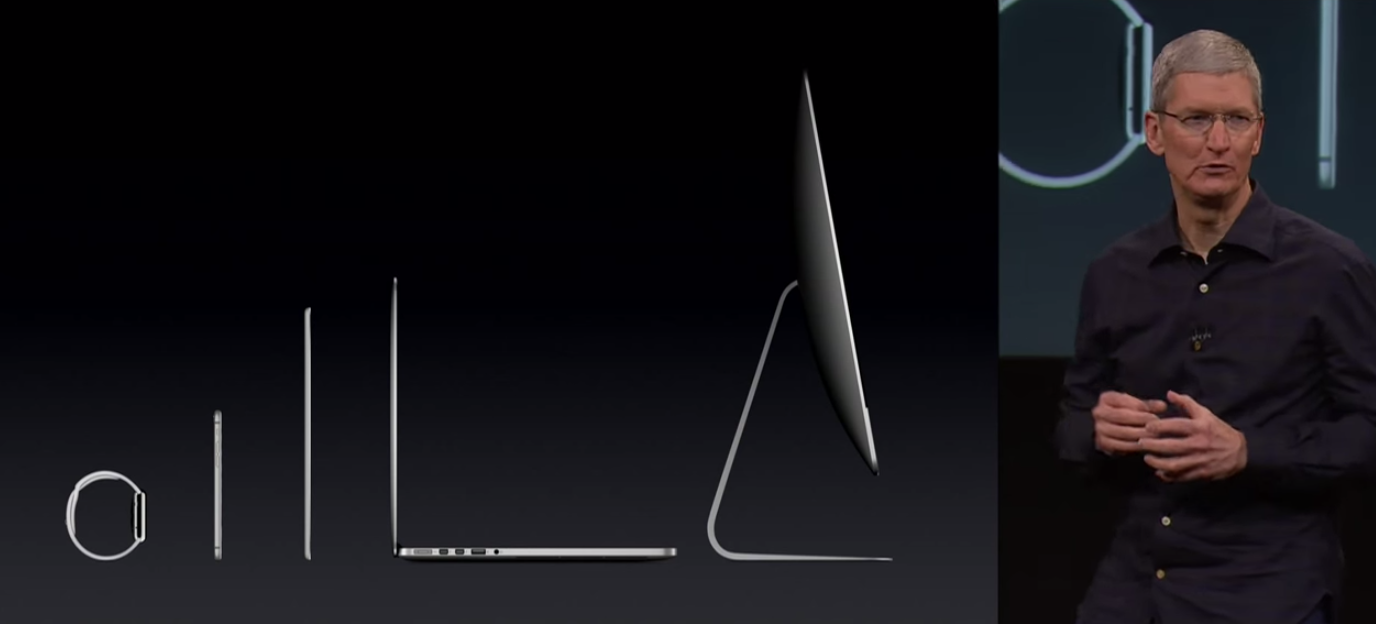
Apple visualized this analysis in a slide from the iPad keynote this past October, shown in Exhibit 6.
Exhibit 6: Apple Product Screen Personalization Visualized (2014)
Source: Apple
Here is Tim Cook describing the keynote slide from Exhibit 6:
“This is the strongest line-up of products that Apple has ever had. And we believe that each one of these play a very important role. People need different types of technology for the way they live their lives. We all do different things.
In fact, many of us and many of our customers use more than one of our products every day. Sometimes you want to sit at your desk in front of a huge beautiful immersive screen, packed with powerful technology. And we’ve made that much better today with the Retina 5K screen for iMac.
Sometimes you want to take that powerful technology with you wherever you go, and we’ve made our notebooks even better this year with MacBook Air and MacBook Pro.
Sometimes you want to be close to your content, touching it and we’ve made that experience even better today with the iPad Air 2, more powerful and incredibly thin.
Sometimes you want to hold that powerful technology in the palm of your hand and there’s no better thing for your hand than the iPhone 6 and iPhone 6 Plus.
And soon, you can wear that powerful technology right on your wrist...
They are designed to be incredible products individually but they are also designed to work together seamlessly.”
Apple has moved beyond product grids and quadrants as the combination of hardware and software have created a vibrant device ecosystem suited for various lifestyles.
iPad's Role Going Forward; Time to Reset Expectations
The iPad will likely be repositioned to appeal to consumers looking for that larger iOS companion device that may make video better to watch, Twitter easier to use, or ebooks more relaxing to read. In addition, a new iPad Pro would be geared toward content creators that may be unsatisfied with the Mac's capabilities. Accordingly, I suspect sales will likely reflect this new status. I don't view the iPad as on a trajectory to outsell iPhone, but at the same time, there will likely be buyers that need a computing device that is bigger than an iPhone with a 5.5-inch screen, but more nimble than a MacBook.
I see two factors serving as the primary buying variables going forward across the Apple product lineup: screen size and price.
Screen Size
We are still in the phase of figuring out which size of glass we want to carry in our pockets or hold in our laps in bed. I would expect continuing shifts in trends, especially once the Apple Watch goes on sale and consumers interact with a small screen on the wrist.
Price
As depicted in Exhibit 7, Apple now sells five iPad models at five prices, which isn't exactly the easiest thing to decipher when buying. Why is Apple doing this? The iPad does a great job at addressing price umbrellas.
Exhibit 7: Apple's Current iPad Line - This Is Getting a Bit Awkward (2014)
Source: Apple
By selling older iPad models for $249-$399, Apple is appealing to those consumers that value price over certain features or components. Apple doesn't want competitors to ship capable devices that may undermine some of these smaller iOS screens. The iPhone "subsidy" in many countries complicates this a bit for the iPhone line since there are already phones being sold for free (but with a monthly fee or a subsidy). As smaller devices continue to outsell Macs by multiples, I would expect this trend of Apple relying on iPad to address the low-end of the market to continue, and eventually the same strategy may spread to Apple Watch in a few years. Meanwhile, the MacBook and iMac lines don't have the same type of price umbrellas given that iPhones and iPads address the lower-end of the market.
Currently, the $199 iPod touch is likely selling around 1-2M units a quarter. Combined with the 2-3M older iPad minis, Apple is selling around 20M iOS devices a year, or roughly 8% of total iOS devices, for less than $300.
Software Moves to Middle
One likely theme going forward is that software differences between iOS and Mac will continue to move to the middle, which will call for some new and different things where the iPad meets the MacBook. What works great on an iPhone will likely not work great on a laptop, so a solution that takes the best of both worlds may be needed in that big tablet/small laptop area. Incidentally, Apple is rumored to have a new iPad and a new MacBook Air in the pipeline, so that intersection would appear to be an exciting one in 2015.
Next Marginal Apple Product Buyer
Even though the probability is that Apple's next marginal buyer into iOS is likely an iPhone buyer from Greater China (looking at current sales), from Apple's perspective, it doesn't matter if a new user enters iOS by buying an iPhone 6, iPad mini, iPhone 6 Plus, or iPad Air. Devices have matured to such a degree and are now positioned in such a way that consumers don't need to buy 3-4 Apple products. While certain products are more universal such as iPhone, others are more personal, such as iPad. Accordingly, the shift to a more personalized product line based on screen size and mobility would suggest there will be continued effort and innovation across the product line, despite some products selling at a fraction of others. For iPad, the spotlight may continue to dim a bit, especially when compared to iPhone, as the product finds its place within the Apple ecosystem.
This report was produced by Neil Cybart on January 20, 2015 and is not meant to be used as investment advice. I publish a daily email about Apple called AAPL Orchard. Click here for more information and to subscribe.
Apple Rethinking the Pen: Initial Thoughts on 'Apple Pen'
Apple analyst Ming-Chi Kuo is out with a new report suggesting Apple will launch a stylus in a few months alongside a new, larger 12.9-inch "iPad Pro." Judging by the sheer volume (over 30+) of patents for a stylus going back to the iPad launch, I don't think the question has ever been about whether or not Apple has been working on such a device, but instead if Apple would ever release such a product. Would a stylus receive one of Apple's rare "yes" votes and make it to the marketplace?
A quick glance at Apple's patents for what I call the "Apple Pen" would suggest that such a device is not simply a stylus used to draw on an iPad, but a comprehensive solution for reinventing the modern-day writing instrument. Apple would be reinventing the pen. The use cases are broad and extensive:
- Enterprise. There are many situations in the corporate world in which a keyboard is not appropriate for taking notes. Whether it is used during a formal board meeting or a quick brainstorming session, a laptop often hinders discussion and interaction. In that same vein, an iPad doesn't offer any additional benefits and very often makes it even harder to record notes or thoughts. Instead, paper and pen continue to be utilized (or third-party styli with iPads) because it is much easier to record notes and thoughts in free-form on paper or a tablet. An Apple Pen would find a nice fit in this type of setting. Additionally, if the Apple Pen can be used to capture information such as distance, shape, texture, and angles, the implications expand into many different industries such as industrial and into various commercial settings from Fortune 500 companies to independently owned and operated businesses.
- Education. Obvious implications for an Apple Pen would include taking notes, but deeper applications involve content creation in the arts and sciences including math, chemistry, physics, and biology, where a keyboard (or finger) is less effective than a fine point writing instrument. As Chromebooks gain ground in education, a touch-screen device with an accompanying smart pen would stand out as adding to the classroom not only utility, but also new forms of creativity and imagination.
- Consumer. Imagine tasks for which a pen and paper are still used such as creating shopping lists and writing letters. In each of these cases, a smart pen can increase utility.
I still have more questions than answers regarding an Apple Pen. How much would an Apple Pen cost? Would the device be initially compatible with just an iPad Pro in order to boost sales of the device, or would the smart pen work with any iOS device? How many functions would such a device include in the first version?
I see an Apple Pen being positioned not only to replace the modern-day pen, but also to serve as a new way to gather and input data. I can see an Apple Pen eventually work without the need for even an iPad or iPhone as a screen isn't necessary to capture data. As sales of third-market devices show, there is already demand for a stylus. An Apple Pen would eventually be positioned as a device that we can't imagine living without. In reference to competing products that came with a stylus, Steve Jobs once said, "if you see a stylus, they blew it." He was right. An Apple Pen wouldn't be a stylus. It would be a data collector and interpreter that just happens to take quick notes and drawings on a screen.
I publish a daily email about Apple called AAPL Orchard. Click here for more information and to subscribe.
Apple Pay Enrollment Trends
Bank of America reported yesterday that 800,000 of its customers had registered with Apple Pay. Since Bank of America is the second largest bank in the U.S. according to assets (third in terms of deposits), this new data point suggests early Apple Pay enrollment trends look strong. I estimate 10-15% of iPhone 6 and 6 Plus owners in the U.S. (2-3 million people) have registered cards with Apple Pay.
Exhibit 1 highlights the top ten banks in the U.S., ranked by total assets. Total deposits are also included to get a better idea of customer base rank. The top four banks clearly have a larger asset footprint than peers, representing 40% of deposits in the U.S. Most of the larger banks in the U.S. now support Apple Pay.
Exhibit 1: Largest U.S. Banks - Total Assets
Exhibit 2 highlights the top banks in the U.S. according to branch footprint, which shows some slight reshuffling in rank from Exhibit 1, although the top players still support Apple Pay.
Exhibit 2: Largest U.S. Banks - Retail Branches
In order to reach Apple Pay enrollment estimates, I added the roughly 15 million iPhone 6 and 6 Plus units sold globally in 4Q14 to the expected 50 million iPhone 6 and 6 Plus units sold in 1Q15 (Apple is still selling iPhone 5s and 5c), implying Apple has sold around 65 million iPhone 6 and 6 units globally, with approximately 35% attributed to the U.S, or 23 million units. Running with that number, Exhibit 3 highlights three possible Apple Pay enrollment scenarios predicated on the percentage of total iPhone 6 and 6 Plus users represented by Bank of America.
Exhibit 3: Apple Pay Enrollment Estimates
Running with a conservative estimate of the percent of Apple Pay users Bank of America (50M total banking customers) represents, Apple Pay enrollment rates in the U.S. would stand at 8%. If using aggressive metrics, Apple Pay enrollment would be 16%. I estimate 10-15% of iPhone 6 and 6 Plus owners in the U.S. have registered with Apple Pay. As a reminder, this does not mean that 10-15% of iPhone 6 and 6 Plus owners are using the service at retailers or within apps. Having users add cards to Apple Pay is the first major hurdle Apple has to overcome to get Apple Pay usage off the ground. By adding a card (even if it's already included in iTunes), users demonstrate trust in Apple and the Apple Pay service. In the coming months, Apple's focus in the U.S. will continue to be on adding banks (close to 90% of card credit transaction volume is supported by Apple Pay) and additional retailers. International expansion is also expected in the coming months with reports indicating Britain and Canada as possible targets for the next Apple Pay rollout. It is still early, but Apple Pay enrollment trends in the U.S. look strong.
Apple Watch Isn't a Luxury Watch
Many people are trying to analyze Apple Watch with the assumption that the device is just another luxury watch only with additional customization and features. I think this type of thinking misses the big picture. An Apple Watch will be just as much a watch as an iPhone is a phone.
Last week, I discussed how I thought Apple will sell Apple Watch by positioning it as a watch with customizable faces and bands. By keeping the message simple, anxiety and uneasiness will be removed from the buying decision. Most consumers, even if they don't wear a watch, understand what a watch is and what it does. However, the comparsion of Apple Watch to a luxury watch needs to stop there as once a user begins to rely on Apple Watch for communication, health and fitness tracking, and mobile payments, the idea that it is just another luxury watch will no longer apply.
The Apple Watch and its strengths shouldn't be compared to luxury watches, and more importantly, luxury watch strengths. Timelessness, or lack thereof, seems to be at the top of the list of lingering questions about Apple Watch. If a luxury watch can last the test of time and be passed down from generation to generation, how would Apple Watch compete? Who would pay thousands of dollars for a device that won't stand the test of time? Timelessness won't matter for Apple Watch since the Apple Watch isn't a luxury watch. Instead, Apple Watch is a mobile computing facilitator worn on the wrist. The users will have just as much motive and desire to pass the device down to children or family as they would with an iPhone or iPad. By discussing price in context of luxury watches, I suspect many are jumping to the conclusion that the only reason someone will pay thousands of dollars for an Apple Watch is to wear it forever as a status symbol. Instead, people will pay thousands of dollars in order to have the opportunity to buy an Apple product that can be worn. The desire to upgrade to a newer, more advanced version in the future will likely be just as strong as it is with iPhone.
Apple understands its user base very well and correctly sees that there is a market for very high-end tech gadgets. This buyer takes an iPhone and its lack of personalization, puts thousands of dollars into the device to truly make it his or her own, and then will eventually upgrade to a newer iPhone just like everyone else. The Apple Watch Edition collection is Apple's first attempt at addressing this segment of the market.
Just as with fashion, technology evolves. The Apple Watch isn't a luxury watch, but rather a fashionable communication facilitator worn on the wrist.
I publish a daily email about Apple called AAPL Orchard. Click here for more information and to subscribe.
iPad Observations Heading into Apple Earnings
In connection with establishing iPad sales, margin, and average selling price (ASP) expectations for 2015, I complied a few observations, including thoughts on the iPad mini, upgrade cycles, and the iPad's placement within the Apple ecosystem.
iPad Mini
I'm increasingly becoming confident in my theory that the iPad mini was a product released with a mission: serve as a hedge against low-end Android tablets in the beginning years of the tablet market. With Apple still selling the original iPad mini for $249, a quick comparsion between iPad mini prices and the rest of the iOS lineup (Exhibit 1) would suggest that the iPad mini exists for more than just to sell more iPads, but instead serve as a defense for the iOS ecosystem. Steve Jobs infamous "price umbrella" quote, which was initially said with the iPhone in mind, can be used to describe the iPad mini. Apple is relying on the iPad mini as one of the lower-cost entry points into iOS (let's not ignore the iPod touch just yet) in order to prevent Android from establishing a position under Apple's prices. By not selling an inexpensive iPad, Apple risked mediocre Android tablets grabbing enough share of the market to squeeze Apple out. While Android tablets are selling for under $100, their use cases have proven to be more rudimentary than true table computing. Exhibit 1 depicts iOS device price levels in the U.S. as of January 2015. Note that the iPhone 4s (not included in table) is still being sold in select emerging markets, like India.
Exhibit 1: iOS Device Prices (Unsubsidized) - January 2015
With the iPad mini positioned at the low-end (grey columns in Exhibit 1), the lack of a significant update this past October shouldn't stand out as too meaningful given that the expected iPad mini buyer has different value priorities than an iPad Air buyer. There have been a few scattered rumors of a mid-cycle iPad mini 3 refresh. I am beginning to question my initial hypothesis from last year that the iPad mini would be discontinued in the near-term, unless Apple is planning to launch a new product that would fill the price layer that the mini currently occupies. While a revamped iPod touch with a 5.5-inch screen would surely sell, the price would suggest it wouldn't be an iPad mini replacement.
Data from mobile ad analytics company Fiksu suggest the iPad mini still represents approximately 30% of iPad sales. Reported ASP and margins will help confirm if the iPad mini is indeed selling as Fiksu would suggest.
Upgrade Cycle
One of the bigger questions plaguing iPad is whether the replacement cycle is to blame for slowing sales momentum, or if the tablet market is saturated. Tim Cook addressed the question on Apple's last earnings call:
“[I]if you look at our top six revenue countries, in the country that’s sold the lowest percentage of iPads to people who have never bought an iPad before that number is 50%. And the range goes from 50 to over 70. And so when I look at that number, our first time buyer rates in that area, that’s not a saturated market. You never have first time buyer rates at 50% and 70%. What you do see is that people hold on to iPad longer than they do a phone. And because we’ve only been in this business four years, we don’t really know what the upgrade cycle will be for people.”
Cook sounds confident that given roughly 50-70% of iPads are sold to new customers, the lack of unit growth is due to the dearth of repeat buyers. As a frame of reference, according to Apple, 25% of customers that bought iPhone 5s in the U.S. were buying their first iPhone. In that context, one can understand why Apple thinks slowing iPad sales momentum is more like a speed bump. What is iPad's average upgrade cycle? Using data from Fiksu, Exhibit 2 highlights the breakout of iPad devices currently in use, which leads to a 2.4-year rudimentary estimate as to the average life of an iPad. It is important to note one can not distinguish between new and used iPads using Fiksu data and with the iPad Air and iPad mini on the market for only 1.25 years, average life figures remain skewed. Another way to look at the data is approximately 1 out of 4 iPad users have owned their iPad for nearly four years (iPad 2).
Exhibit 2: Current Breakout of iPad Devices in Use as of January 5, 2015
Exhibit 3 charts the iPad's initial sales success compared to iPhone's more gradual sales levels. The iPad is now facing a leveling off of sales, while the iPhone is seeing accelerating sales growth. Based off of Tim Cook's comments on iPad upgrade cycle and new customers to iPad, Exhibit 3 depicts the big question for iPad: What is causing sales growth to slow?
Exhibit 3: iPhone vs. iPad Sales
Where do iPad sales go from here? Exhibit 4 highlights three possibilities: 1) increase and start to track iPhone adoption, 2) remain relatively steady to slightly down until a more sustainable sales level has been reached, 3) decline due to other reasons. My 2015 iPad estimates run with a scenario that falls somewhere between options 2 and 3.
Exhibit 4: Possible iPad Sale Trajectories
If iPad sales (red line in Exhibit 4) continue to trend down gradually, and do not fall precipitously, than there would be a higher likelihood that the extended upgrade cycle is the primary culprit impacting iPad. If sales decline momentum worsens rather quickly in 2015, than I would position iPhone 6 and 6 Plus popularity, including the Mac, as primary culprits for iPad's weakness.
Finding iPad's Niche Within Apple's Ecosystem
I continue to think we are in a period where the iPad is finding its niche markets, as well as its place within Apple's ecosystem. Recently, iPad has been included in Apple marketing campaigns like "Start Something New" alongside the iPhone and Mac, suggesting that management may have recalibrate iPad expectations over recent months and now position iPad as being able to fill certain demand holes that the iPhone and Mac are not able to fill on their own, such as an inexpensive video player and email machine (iPad mini) to high-end mac-like devices for creation (iPad Air and eventually iPad Pro). No longer is the iPad destined to the space between the iPhone and Mac.
In such a scenario, a larger iPad Pro continues to make sense for being able to stand out from an iPhone 6 Plus, while also setting itself apart from the Mac, especially the rumored new MacBook Air, due to a touch interface. While the device wouldn't seem to have characteristics of being a mass-market hit like iPhone due to a high price and large-screen form factor, the iPad Pro may help keep some customers interested in the iPad, and more importantly, iOS. On the low-end, iPad mini may in some ways represent the "cheap" iPhone for consumers that position price as the determining factor for a purchase.
Expectations for 2015
With Apple's upcoming earnings report in two weeks, and given the greater level of uncertainty when establishing iPad expectations for 2015, I asked myself two basic questions:
1) Will there be any catalysts that would change iPad's sales decline momentum from 2014?
2) What are Apple's goals with iPad?
The iPad's sale trajectory is not clear (Exhibit 4). In my Apple Questions for 2015 post, I mentioned looking at iPad average selling price (ASP) as a way of figuring out how the iPad mini is selling. I continue to think that data point will give hints as to what Apple will ultimately do with the mini. I'm also assuming that the iPad Pro will help maintain the current iPad trajectory, rather than improve it.
I estimate Apple sold 19.5M iPads for the three months ending December 2014 (FY1Q15), down 25% from 2014. As shown in Exhibit 5, my unit sales growth estimate improves through 2015 due to easier year-over-year sales growth comparisons (iPad sales were weaker in the back half of 2014), and a slight pick-up in demand related to an iPad Pro (reflected mostly in 3Q15). Obviously, if the iPad Pro does not materialize, my estimates would need to be adjusted a tad downward.
Exhibit 5: Above Avalon iPad Sales Expectations
My estimates were reached by a combination of analyzing Fiksu iPad model share trends from September to December, in addition to taking Apple's comments about expanding the supply chain (1.5M channel build estimate). Given the high degree of uncertainly, I would position Pad unit sales of 17-21 million units as my wider expectation range. If sales come in weaker than 17 million than it is likely that other iOS devices are being bought in place of iPad. If sales are stronger than 21M than the iPad is likely suffering more from a longer replacement cycle with core sales trends holding up well.
Another way to put my estimates in context would be comparing my growth expectations with iPad's historical growth rates, highlighted in Exhibit 6. After two years of strong growth, the iPad is now bouncing around double-digit unit sales percentage declines.
Exhibit 6: iPad Quarterly Growth Rates
As my 1Q15 quarterly sales decline estimate shows, the iPad is still in flux. Apple's upcoming earnings release on January 27 represents the next event that may provide additional clues and data points as to how to think about iPad.
This report was produced by Neil Cybart on January 12, 2015 and is not meant to be used as investment advice. Risks to my estimates primarily include customer demand. I publish a daily email about Apple called AAPL Orchard. Click here for more information and to subscribe.
Selling Apple Watch
Many people are overthinking Apple Watch. For Apple, the hardest part won’t be telling people why they should use the device, but rather getting people to use the device. There is a subtle difference.
One of Apple’s secret weapons for selling Apple Watch will be its retail stores and the ability to see and touch the device. Trying to appeal to a potential customer’s wants and desires begins by positioning the product so that they simply want to use it. While Apple certainly will rely on a more complicated marketing message that positions certain use cases over others, I don’t think that message will be the thing that sells Apple Watch. Apple’s goal is merely to get a potential customer to want to use the device. Only after the Apple Watch purchase does a revolutionary user interface and a few well thought-out features, shown through marketing, help nurture a user's relationship with Apple Watch.
Why people will buy an Apple Watch:
- It’s a cool watch. The Apple Watch is a watch with a customizable digital face and a selection of interchangeable bands.
- It looks nice. The Apple Watch has a clean, fresh, design that strikes a balance between luxury and technology.
- It’s made by Apple. The Apple Watch is designed in California by the same company that is responsible for the iPhone, iPad, and Mac.
Over the past few months, I’ve learned to change the way I explain Apple Watch to friends and family. Instead of starting out with a list of reasons why they may enjoy an Apple Watch, I now begin with a pretty simply explanation: Apple is making a watch with customizable faces and bands. I then let that person respond, and depending on their answer, I mention how Apple Watch can serve as a communication device, a health and fitness tracker, or a mobile payment facilitator. As a result, I now get a much more open response from people that want to see and learn more about Apple Watch. That is how Apple will sell Apple Watch.
We recently saw this play out with iPad and competing tablets, where Apple’s strength was having iPads available to play with in its retail stores. Meanwhile, competitors used advertisements to push all of the features their product had that the iPad lacked. In the end, people picked iPad.
There has been a tendency to mock people that want to buy products simply because a certain company makes them. Some will say this type of buyer is being guided by marketing, or is just a follower, but in reality it comes down to trust. Many people trust Apple. It is this very important connection with users that will likely get people to at least try the Apple Watch, and for Apple that is the best outcome they can wish for.
I publish a daily email about Apple called AAPL Orchard. Click here for more information and to subscribe.
Larger iPhones May Be a Game Changer
The latest phone sales share data from Kantar Worldpanel paints a bright picture for Apple with iOS gains in most countries, but diving deeper into a few countries would lead to some interesting questions. Are the iPhone 6 and 6 Plus game changers, propelling Apple past its "niche" smartphone status in developed markets such as U.S. and Great Britain? The answer may have far-reaching consequences for services like Apple Pay, Beats Music streaming, app developer innovation, wearables, smart home, and connected cars, not to mention other tech companies like Google and Amazon.
Some industry analysts have been pushing the idea that phone market share questions are yesterday's news with iPhone destined to the top niche of the market and Android representing everything else. I'm becoming increasingly uncomfortable with that assertion, especially given some underlying trends occurring in the smartphone market following the iPhone 6 and 6 Plus launch. I have little confidence that the current phone market as it appears today will look the same for years to come.
In the U.S., the iPhone nearly outsold Android during the three months ending November 2014, as seen in Exhibit 1, which also includes Android and iOS share of sales in the U.S. going back to 2012. Obviously an iPhone launch helps boost share as loyal iPhone users upgrade their phones, but the current upgrade cycle is different.
Exhibit 1: iOS and Android Smartphone Sales Share - U.S.
According to recent Kantar data, iPhone 6/6 Plus sales share in the U.S has surpassed iPhone 5s/5c and is now tracking very close to the iPhone 5. Up to now, this would not suggest that larger iPhones are a game changer as the sales patterns are following the typical iPhone upgrade effect. However, today's smartphone market is indeed different with Apple now selling a 4.7-inch and 5.5-inch iPhone. Large screens were the key differentiator for Samsung, the leading hardware manufacturer for Android, for the better part of the past three years. Add what seems to be a lack of innovation with Samsung's latest Galaxy offerings, including the company's recent comments about 2015 being another troubling year for Samsung phones in face of Apple's latest offerings, and the iPhone 6 and 6 Plus may represent a game changer for the U.S. smartphone market with iOS outselling Android.
In Exhibit 2, iPhone 6 and 6 Plus sales share can follow two primary routes: A or B. Route A would reflect increased sales share approaching 60% at the expense of Android as the iPhone 6 and 6 Plus are true game changers. Route B would reflect the typical decline in share following an iPhone launch as the iPhone upgrade cycle slows and Android users do not switch to iPhone. Next month's Kantar sales report will be quite telling as any continued share gain (or even flat share) at the expense of Android will stand out versus the iPhone 5, 5s, and 5c reiterations, suggesting that the upgrade cycle is indeed continuing to be strong and users are switching from Android to iOS.
Exhibit 2: iOS Smartphone Sales Share and Possible Share Trajectories - U.S.
Why is this important? Isn't market share an old topic? The ramifications of iPhone representing close to 60% of smartphone sales in the U.S. has dramatic implications in terms of Apple Pay adoption, Beats Music subscription services, and other areas including app developer focus, smart devices, and wearables. I continue to think that owning the most lucrative 30-40% of the smartphone market is enough to warrant sustainability as developers remain invested in the ecosystem. However, if iPhone can capture 60%+ share, the argument changes rather dramatically for services with which adoption is more easily assured by the sheer number of users and not just the top portion. For example, with iPhone representing 60% of U.S. smartphone market, Apple Pay has a significant leg up on CurrentC, Beats Music (if pushed to all iOS devices) would gain more power over competing streaming services, and Apple Watch would be even that more compelling as a communication medium. Not to mention, iMessage, FaceTime, and Photo Stream would serve as lucrative communication channels. In addition, iOS and the connected home and car take on more meaning if iOS becomes the dominant mobile platform in the U.S. in terms of volume.
Concerning U.S. mobile carrier pricing plans, in reality, as carriers move away from hidden built-in subsidy plans, and instead push $0 down, 24-month installment plans, the "iPhone subsidy boost" topic is losing relevancy as consumers are now more aware of how much their phone really cost. Despite this trend, iPhone sales share pre-iPhone 6 and 6 Plus has tracked very similarly to previous years, which would go against consensus that iPhone's strength was primarily dependent on full-blown subsidies masking the iPhone's high price. In retrospect, the ability to buy new iPhones sooner (which the new plans promote) may pose as another benefit to Apple as well.
In Great Britain, the iPhone 6/6 Plus would appear to already be a game changer, clearly reaching all-time smartphone share levels. While the iPhone refresh cycle is certainly helping, approximately 20% of iPhone buyers during the three months ending November 2014 had switched from Android according to Kantar.
Exhibit 3: iOS Smartphone Sales Share - Great Britain
Of course, China's smartphone growth potential cannot be ignored, and iOS sales share is indeed lower in China than other countries, including U.S. and Great Britain. As shown in Exhibit 4, iOS sales share has been on the rise recently and jumped 2.4 points from October to November, this despite the new iPhones launching in mid-October. China Mobile began offering iPhone in January 2014, but the delayed boost can be seen as iOS sales share started to pick up in June. I estimate customers are now buying 5-7 million iPhones a quarter through China Mobile. Tim Cook mentioned on Apple's earnings call that 80% of iPhone sales in China do not involve a subsidy. Despite the lack of subsidies, iPhone share is approaching 18-month highs and the iPhone 6 and 6 Plus will likely lead to continued share gains.
Exhibit 4: iOS Smartphone Sales Share - China
As many tech and mobile analysts focus on China, India, and emerging markets to determine how the next billion users will join the mobile era, some have said that the major questions surrounding mobile in developed markets have been answered. I disagree. The iPhone 6 and 6 Plus introduction has the potential to be a game changer as iOS nears a majority of sales in a few countries, a marked step-up from previous iPhone reiterations. Implications on ecosystem services dealing with payments, music, apps, cars, and connected devices cannot be underestimated. The big question now is as the iPhone 6/6 Plus upgrade cycle slows (which has been the pattern going 3-4 months out from launch), will Android converts drive iOS share even further? Sales share data over the next few months will be very telling. Samsung's smartphone troubles have been well publicized, but only now are we starting to see the impact, and Apple looks to be the primary beneficiary in many countries. Apple may be in a sweet spot here. If iPhone 6/6 Plus don't bring many from Android, the iOS ecosystem is now vibrant enough to be self-sustaining. However, if Android switching becomes a theme, the iOS ecosystem value increases in terms of messaging, communications, and services.
While China, India, and developing markets represent the unknown in mobile, I think we need to keep an eye on developed markets in which Apple is gaining strength.
This report was produced by Neil Cybart on January 7, 2015 and is not meant to be used as investment advice. I publish a daily email about Apple called AAPL Orchard.
The Next Marginal Customer
Being a niche player has led Apple to much success, as resources are funneled into the most profitable and lucrative segments of a market. However, this doesn't mean that Apple isn't focused on new customer acquisition. I suspect some of Apple's recent troubles with software quality over the past two years has been related to tradeoffs created by acquiring the next marginal customer.
Apple is a growth company. Accordingly, marketing takes on a more vital role at Apple than at a mature company where user acquisition is not a primary goal. Apple relies on marketing (and design) in an attempt to appeal to the marginal customer, the next user to buy into the Apple ecosystem. This drive leads to new and exciting software features shown in retail stores and in marketing campaigns. However, because of the tight schedule Apple has adhered to, as well as the sheer volume of change taking place, features are not receiving the needed attention. In this context, core users (the ones likely to use all of these new and exciting features) feel the downside, and become increasingly vocal with their complaints, while new users largely avoid much of the frustration. This dynamic may help explain how management is insulated a bit from some of the backsplash as financial trends depict no major issues. Former early Apple employee Bruce Tognazzini similarly discussed how Apple's user interface also suffers from management's focus on new users at the determent of power users.
What's the solution? Time. Apple's approach to new customer acquisition is correct. Apple knows its next marginal customer very well. Instead, I suspect as we move past the Apple Watch launch, and the first few quarters of sales, Apple will be in a better position to address some of the recent software shortcomings. Apple would then have marketable features that new customers would enjoy, while still appealing to core users with reliable functionality. How can the two groups be satisfied with the same product or feature? Design. This is where Jony Ive's leadership and vision will need to be utilized. I hear some say, "if it just worked, it would be great," referring to Apple software, which tells me Apple is on the right track in terms of design implementation.
For Apple, the ability to shift directions and funnel resources into a new product is one of the most misunderstood and undervalued aspects of the company. In this context, Apple Watch, and all that remains untold and misunderstood about the device, and Apple's move into personalized hardware, may play a crucial role in understanding what Apple has been planning with its unrealistic pace of development in recent years. The game may have changed, but I suspect Apple wrote the new playbook, and has been away practicing. With the company nearly ready to return, with Apple Watch in tow, the question is will early adopters show up for the game? I suspect the answer may surprise some Apple critics.
1,000
Today's AAPL Orchard daily email went out to 1,002 subscribers. If there is a number worthy of its own post and reflection, I suspect 1,000 would be at the front of the line. My goal in writing AAPL Orchard is to provide a layer of context that sits on top of the Apple news and rumor world. While I have been quite surprised at how quickly the email has grown, the much bigger success measure has been the diversity found in the subscriber base. Not only do I have substantial representation from Wall Street and academia, but a growing number from the music and film industries, a solid representation from biomedical and mechanical engineering fields, and of course there are those in the technology sector (app developers, investors, VCs, executives, and journalists). Maybe most exciting to me is how despite many people having careers, hobbies, and lifestyles in fields completely unrelated to technology, everyone shares a commonality in wanting to both stay informed and to learn about Apple. It is that drive and demand for useful Apple information that represents the core of AAPL Orchard.
While I have crafted a particular process to scan and monitor many different content venues throughout the day, I am currently working on building up my ability to find interesting Apple-related content on smaller, independent sites or blogs. Readers have been submitting links/posts, and if you have something that would be enjoyed by AAPL Orchard readers, please keep me in mind. You can submit your story/link via Above Avalon or reply to any of the daily emails. For more information and to subscribe to AAPL Orchard, click here.
I'm excited to see AAPL Orchard grow and look forward to the future.
- Neil
Apple Watch's Potential Impact on Apple Earnings
While speculation as to how well the Apple Watch will sell is kicking into high gear, I wanted to frame the discussion a bit differently by publishing EPS matrices covering approximately 50 different Apple Watch sales scenarios. While the definition of success is largely subjective, and mostly dependent on how Apple frames the Apple Watch story, the device's impact on Apple's financial picture, given a set of parameters, is less open to debate.
The easiest way to read a matrix is to start at one axis (margin or average selling price), and then move down the column, or across the row, until aligned with the alternative metric (margin or ASP). For example, if I wanted to see the EPS impact from Apple selling 10M Apple Watch units at $550 ASP and 40% margin, I would start at the 40% margin column in Exhibit 1 and then move down until I reach the $550 row, leading to $0.28 of EPS.
Exhibit 1: Sample EPS Matrix
In Exhibit 2, the first set of matrices depict Apple Watch's impact on EPS assuming 10 million units are sold in the first 12 months. Depending on average selling price (ASP) and margin, Apple Watch would contribute $0.17 to $0.58 of EPS (add 2% to 7% to 2015 EPS).
Exhibit 2: EPS Matrices for 10 Million Apple Watch Units
In Exhibit 3, the second set of matrices depict Apple Watch's impact on EPS assuming 25 million units are sold in the first 12 months. Depending on ASP and margin, Apple Watch would contribute $0.44 to $1.45 of EPS (add 5% to 17% to 2015 EPS).
Exhibit 3: EPS Matrices for 25 Million Apple Watch Units
In Exhibit 4, the third set of matrices depict Apple Watch's impact on AAPL EPS assuming 40 million units are sold. Depending on ASP and margin, Apple Watch would contribute $0.70 to $2.23 of EPS (add 8% to 28% to 2015 EPS).
Exhibit 4: EPS Matrices for 40 Million Apple Watch Units
The easiest way to interpret these matrices is that at sales of 10M, Apple Watch's overall impact on AAPL EPS will be relatively modest (approximately 4% of 2015 EPS.) At 25M, Apple Watch would represent around 10% of 2015 EPS, still modest and easily overshadowed by iPhone sales fluctuations. If Apple shipped 35-40M Apple Watches, the impact on EPS becomes more sizable, potentially reaching 15-20% of overall EPS.
These matrices also make it easier to convert consensus Apple Watch unit sales into an estimated level of EPS "built" into consensus EPS. If consensus is around 20-25M Apple Watches sold in the first year (I'm at 20-30M), then that implies analysts have around $0.70-$0.90 of Apple Watch EPS built into consensus EPS estimates. If Apple were to ship 40M Apple Watches instead of 25M, this would lead to Apple Watch EPS of around $1.20-$1.30, $0.40-$0.50 higher than consensus. Vice versa, if Apple Watch sales are weaker than 20-25M and instead closer to 10M, then this would imply EPS is overstated by about $0.40/share.
Over the coming weeks as the debate regarding how many Apple Watches Apple could sell continues, I will be relying on these matrices to help frame how various sales scenarios will impact Apple.
For this exercise, 2015E EPS represents Above Avalon's FY3Q15 - FY2Q16 EPS to match the probable first 12 months of Apple Watch sales, and EPS figures are after-tax (assuming a 25% tax rate). I view R&D and SG&A costs as sunk costs in this report. I also include continued share buyback through 2015 to obtain shares outstanding estimates. This report was produced by Neil Cybart on January 5, 2015 and is not meant to be used as investment advice. I publish a daily email about Apple called AAPL Orchard.
Apple Questions for 2015
In recognition of the beginning of a new year, I want to share my running list of questions that I have been keeping for Apple in 2015. By no means is this an exhaustive list, but rather things that I know to be on the lookout for.
Apple Watch
Actual Usage. I'm most interested in seeing the device in use, and not just by initial reviewers. Will people be attracted to any particular feature? Will families buy a few Apple Watches at once for communication purposes? Will teenagers want to wear the device as a status symbol? Will athletes find the device appealing? How strong will word of mouth be?
Health Sensors. There have been consistent rumors that Apple has a bit more to show off in terms of health and Apple Watch. What does Apple have left to unveil about Apple Watch 1.0 and health tracking, and will medical professionals be interested in the device?
Pricing. What will be Apple Watch and Apple Watch Edition collections (the middle and upper tier) pricing, as those remaining data points will help estimate overall Apple Watch sales mix and average selling price (ASP). How much would individual watch bands cost?
Unit Sales. Will Apple release Apple Watch unit sales? Management is planning on lumping Apple Watch financials into "other products" for earnings, but there is still a possibility Apple will announce opening weekend sales or even quarterly sales figures, just not revenue numbers. Apple Watch unit sales estimates currently range from 10M to 40M in the first 12 months, which is the difference between selling like an Apple TV (a few million a quarter) and iPad (10M+ a quarter).
Sales Channel. Will Apple utilize new department store retailers, such as Macy's and Bloomingdale's, to sell Apple Watches next to traditional luxury watches? Apple would be able to reach a brand new target market with such a development.
Apps. Will independent developers support Apple Watch? What will WWDC 2015 look like in terms of WatchKit?
iPhone
ASP and Margins. I'm much more interested in iPhone's ASP and margin in 2015. The addition of a more expensive iPhone, along with reconfigured storage capacities, means that iPhone ASP may see a relatively substantial change compared to previous years while margins have room to expand.
4-Inch iPhone Mini. A new 4-inch iPhone model may be one of the more interesting iPhone rumors in 2015. I suspect there is indeed 15-20% of the iPhone target market that may enjoy the old iPhone 4-inch display form factor, and 15-20% of a big number is a big number.
iPhone 6s. It seems like a better screen, camera, and processor are the leading candidates for selling points for new iPhones in 2015. I generally like the idea of using the "S" refresh years to introduce practical and functional internal upgrades as well as cosmetic changes to the outside in terms of color and finish. Will Apple update the external color and finish beyond silver, gold, and space grey?
iOS 9. Along with WatchKit, it is assumed Apple will announce new features for iOS at WWDC 2015. What will be the primary selling features of iOS 9? At this point the list of leading candidates is comprised of wanted features that did not make it in iOS 8.
iPad
ASP. Similar to my thoughts on the iPhone, I'm much more interested in looking at iPad's ASP trying to decode how the iPad Air is selling versus the iPad mini as that will help shed some light on how much the iPhone 6 and 6 Plus are cannibalizing iPad. Stronger iPad Air sales and weaker iPad mini sales (shown by a higher overall iPad ASP) would support the thesis that iPad is similar to Mac with a longer refresh cycle. Sales trends would track accordingly.
iPad Pro. Will Apple introduce its rumored larger iPad model in the first half of 2015? Will it be geared towards specialized use cases in order to differentiate the iPad from iPhone 6 and 6 Plus? Will the device accompany any change to the way Apple thinks of iOS and iPad?
iPad Mini. Will Apple stop selling the iPad mini given that the iPhone 6 and 6 Plus may be reducing the demand for such a device?
Apple Pay
MCX. Will there be any signs that fringe members of the Merchant Customer Exchange (MCX) consortium have changed their mind and are now interested in supporting Apple Pay?
International Rollout. How fast will Apple Pay be rolled out to new markets?
Loyalty/Reward Cards. Will we see loyalty/reward cards, possibly related to Passbook, be incorporated into Apple Pay in some fashion as a means of getting more retailers to support Apple Pay?
Disclosures. Will Apple Pay retailers use the opportunity to publicize how Apple Pay has impacted their businesses?
Mac
12-inch Retina Macbook. Will Apple ship a new Mac form factor that may eventually replace the Macbook Air?
Beats
New Streaming Service. Obvious questions would focus on price, geographical boundaries for the service, and differences from current offerings in the marketplace.
Branding. How will Apple handle the Beats brand, including both the streaming service and hardware?
Jimmy Iovine. Does Iovine's role within Apple extend beyond just music?
Retail
Angela Ahrendts. What changes does Ahrendts have in mind for Apple retail stores, as well as third-party retailers, including how the Apple Watch will be sold? One can argue it is time for the Apple retail store concept to be rethought to better reflect Apple's product line and current customer base.
Apple TV
Apple TV Box. Will Apple update the Apple TV box with a newer processor?
Financials
Share Buyback Pace. Instead of wondering if Apple will increase its share buyback authorization in 2015, a more appropriate question would be to ask if there will be any significant change in pace in share buyback in FY2015 from FY2014 ($45B)?
Dividends. Tim Cook has mentioned cash dividends will be increased on an annual basis, but by how much?
Debt. Instead of wondering if Apple will issue debt, I think a better question is how much debt will Apple raise in 2015, especially if rates remain low?
M&A. Will Apple continue buying smaller, specialized companies in bolt-on acquisitions, or will a bigger opportunity present itself while still fitting into Apple's M&A criteria?
Random Musings
Marc Newson. Is it a given that Newson is working part-time on future Apple Watch designs, or is he working on a different product?
Jeff Williams. Will Apple SVP Operations Jeff Williams get more press exposure in 2015?
Management Turnover. With the Apple Watch launch in the rearview mirror, will Apple experience any high-level management turnover in the second half of 2015?
Scott Forstall. He still may represent a wildcard as to what he has to say about the circumstances leading to his dismissal in 2012.
iPod Touch: Apple is selling around 1-1.5 million iPod touch units per quarter. Will the device see one possible last major update in 2015?
Apple Pen. I have no doubt that Apple has some type of smart pen/stylus in the labs, but I have more uncertainty in determining if the need for such a product (in conjunction with an "iPad Pro") is enough to receive one of Apple's rare "yes" decisions for going to market.
I would classify the Apple news events that aren't reflected in any of these bullet points as the unexpected. Apple looks to have a busy year ahead.
Receive my analysis and perspective on Apple throughout the week via exclusive daily updates (2-3 stories per day, 10-12 stories per week). Available to Above Avalon members. To sign up and for more information on membership, visit the membership page.
Apple in 2014: Thinking Differently
Apple spent 2014 marching to a different beat than the rest of the tech industry. While others spent the year publicizing research and development efforts and M&A quests to find future business models, Apple spent the year doing what it knows best: thinking differently. Several Apple highlights in 2014 included:
- Rethinking the wristwatch, a product that has been around for over 100 years.
- Rethinking how mobile payments can be made easier using the existing banking/payments infrastructure.
- Investing in brick and mortar retail with a high profile (and expensive) retail hire despite everyone moving to E-commerce.
- Funneling development efforts into Mac despite everything moving to mobile.
- Investing in music by acquiring Beats in an attempt to regain mindshare and rethink music.
- Listening to Wall Street and shareholders, while other tech companies have become more anti-shareholder in terms of voting structure and capital management.
The expectations game was set quite high for Apple in 2014, with Tim Cook predicting in 2013 that Apple would have new products across 2014. Most of the year was also filled with anticipation of Apple’s entry into a new product category, which turned out to actually be two categories: watches and mobile payments. Eddy Cue added to the buzz by going on stage at Re/code in May to say that Apple’s upcoming product pipeline was the strongest in 25 years. While time will tell if Cue was right, it's not up for debate that the Apple machine was fully operational in 2014. Yes, Apple still faces shortcomings in certain areas, and 2014 saw little in the way of improvement in those initiatives (I have my own theory on why this may be, but that is for another time), but Apple spent 2014 building a solid foundation for 2015 with updates across nearly the entire product line and new initiatives and products meant to skate where the puck will be, positioning Apple for the next phase of mobile. Apple spent 2014 thinking differently.