
Apple's Cash Dilemma
With approximately $200 billion of cash on the balance sheet, Apple's financial strength has never been stronger. However, Apple has a growing dilemma on its hands concerning its cash and capital return program. Apple is unable to keep the pace of share buybacks and dividends in-line with its foreign cash generation. As a result, excess cash that is not needed to run Apple's business continues to build on the balance sheet. While labeling a company with $200 billion of cash as having a cash dilemma seems like hyperbole, Apple's valuation metrics will likely be negatively impacted in the coming years if Apple is unable to return this excess cash to shareholders.
Apple's Total Cash Continues to Increase
Apple currently has $194 billion of cash, cash equivalents, and marketable securities. Not only is this a record in terms of cash held by a single company, but it represents approximately 10% of all cash held on corporate balance sheets. Given Apple's business model, it does not need all of this cash to run its business. With an enterprise value of $583 billion, Apple would theoretically be able to repurchase 30% of itself using the cash on its balance sheet. In reality, things are much more complicated as most of this cash is not able to be used for share buyback because it is held offshore and would be liable for additional tax if returned to the U.S.
Exhibit 1: Apple's Total Cash, Cash Equivalents and Marketable Securities
Most of Apple's Cash is Held Offshore
Apple's foreign cash continues to comprise a growing portion of Apple's overall cash. In the eight years since the iPhone was released, Apple's foreign cash has grown to $171 billion from $7 billion and now accounts for 89% of Apple's total cash, up from 44% in 2007. With approximately 70% of annual revenue coming from outside the U.S., Apple's foreign cash will continue to grow at a much faster pace than its U.S. cash. Apple has been content with keeping foreign cash offshore in order to avoid paying additional tax if it was brought back to the U.S.
Exhibit 2: Apple's Total Cash, Cash Equivalents and Marketable Securities (Foreign vs. U.S.)
Apple has been using some of its foreign cash for organic growth initiatives, including component procurement, international retail and facility expansion, and clean energy initiatives. Even after all of these expenses, cash generation continues to exceed what management needs to run the business.
This past quarter, Apple sold more iPhones in China than in the U.S. for the first time. Rather than this being an isolated event, China will only become a bigger piece of the iPhone sales pie given social-economic trends and an untapped market of more than 600 million phone users. The end result is Apple's foreign cash generation will continue to vastly outpace U.S. cash generation.
Apple's U.S. Cash is Being Depleted
With foreign cash being kept offshore, Apple is forced to use its U.S. cash to fund the capital return program. As a result, Apple has a more "modest" $22 billion of cash available in the U.S., which reflects the impact of more than $40 billion of debt issuance over the past three years. Without issuing debt, Apple would only be able to rely on U.S. free cash flow generation of approximately $20-$25 billion a year to fund buyback and dividends. It is important to remember that Apple needs a certain level of available cash in the U.S. to take care of routine business expenses, not to mention have cash on hand to take advantage of M&A opportunities. It is not prudent to allow this cash total to fall too low, and management has shown the willingness to slow share buybacks instead of depleting U.S. cash reserves.
Exhibit 3: Apple's Cash, Cash Equivalents and Marketable Securities (U.S.)
The Dilemma
Apple's cash dilemma is straight-forward: Apple is generating cash internationally at a much faster rate than it is able to spend on stock repurchases and cash dividends in the U.S. As China continues to make up a larger portion of Apple's product sales, boosting total free cash flow, management is facing some limits as to the amount of available funds used for stock buyback and dividends. The following exhibit shows how the amount of free cash flow (red line) is expected to outpace the amount of cash spent on buyback and dividends (blue line) in the coming years. China is increasingly causing the red line to slope upward as time goes on while the blue line is being pinned as the U.S. is becoming a smaller piece of the overall cash generation pie. In an ideal world, there would no gap between the red and blue lines as most of Apple's free cash flow would be spent on buyback and dividends.
Exhibit 4: Apple's Cash Dilemma
Apple's Options
Management does not have many available options at its disposable for solving its cash dilemma.
- Lobby for U.S. Tax Law Changes/Holiday. The preferred option would be returning cash currently held offshore back to the U.S. in an environment with a lower tax rate (15% or less), or during a special tax holiday similar to 2004. Obviously, Apple would want a rate in the single-digits, but Washington politics may make any change to tax policy a long shot. If the tax rate was lowered, Apple would be able to bring back $140-$150 billion of foreign cash and then buy back up to 20% of itself in relative short-order through a public tender offer. At a forward price/earnings ratio of 12x and a free cash flow yield of 6%, Apple management likely views AAPL's current valuation as attractive for such a tender offer.
- Continue Issuing Debt to Fund Capital Return. Apple is currently using a combination of debt and U.S. free cash flow to fund share buyback and dividends. As Apple's foreign cash grows, Apple can continue to borrow additional debt. However, Apple's cash dilemma will not be solved as foreign cash generation will still likely outpace the rate of capital return even after considering a realistic amount of debt issuance each year. Eventually, Apple would be holding $400-$500 billion of cash, almost all of it offshore, and $150 billion of debt, all of which would have been spent on the capital return program. Apple would then need to manage its debt obligations, only straining its U.S. cash needs even more. Management may begin to cool to the idea of issuing significant amounts of debt if interest rates rise or if Apple's business slows, further making this option somewhat unsustainable in the long run.
- Do Nothing. Management could also slow debt issuance and simply spend less on share buyback. This option would be taken with balance sheet preservation in mind. If Apple slowed all buyback activity, both U.S. and foreign cash would increase and Apple would likely reach $400 billion of total cash in relative short-order. The risk to this option is Wall Street's reaction to Apple sitting on too much excess capital, a scenario that had begun to play out in 2011-2012, and some can argue, is still playing out today.
How is Holding too Much Cash a Dilemma?
Apple's market valuation is obtained in the marketplace at a price where AAPL buyers and sellers are willing to trade shares to each other. If there is greater demand for shares at a certain price, the price will rise until demand and supply are in equilibrium. Investors buying Apple shares are interested in owning a piece of the company's assets used to generate cash in the future. Since a company's value is obtained by discounting future cash flows and excess cash is not involved in future cash generation, the market is forced to include the cash in its Apple valuation. The end result is there is a high likelihood of either Apple's cash being valued incorrectly, or much more likely, Apple's underlying business being valued at a discount. This is the fundamental logic behind those that have been pushing Apple to use its excess cash to buy back more stock.
Unless foreign cash is brought back to the U.S. in order to boost the magnitude of share buyback, Apple's excess cash will continue to grow, and the valuation metric that the market is giving Apple will continue to be suppressed. This is one likely reason why Apple is trading at a 12x forward P/E multiple. Apple CFO Luca Maestri has quite the dilemma on his hands.
Receive my exclusive analysis and perspective about Apple in a daily email containing 2-3 stories (10-12 stories a week). For more information and to sign up, visit the membership page.
Members have access to the Above Avalon stock buyback primer which can be used to become familiar with Apple's share buyback.
Apple Is Playing Offense at WWDC
Apple is on the offensive. This is not a company content with standing by and letting Google, Facebook, Spotify and a handful of other third-parties take over critical elements of the user experience of approximately 500 million iPhone users. Instead of just swinging a sword and trying to compete with everyone indiscriminately, Apple is carefully positioning its resources and the overall iOS platform to stress value propositions at which Apple has historically excelled. These include personalization, emotion, and privacy. WWDC highlights how battles are being chosen meticulously as Apple's mission is clear: reducing its dependency on others. With the News app, Apple is trying to change users' habits in terms of how they get content. Apple Music is a test in how successful Apple will be once again in not just getting customers to pay for something that is free elsewhere, but rethinking the music industry. Siri and Spotlight are being positioned as Apple's method for rethinking search. Instead of sitting back and letting third-parties have all the fun, Apple wants more.
The Chess Game Heading into WWDC
Apple had the wind at its back headed into this year's WWDC. The iPhone 6 and 6 Plus have resonated with consumers across the world, especially in China, leading to more than 40% unit growth year-to-date in 2015. One metric that Tim Cook has reiterated on recent earnings conference calls is the Android switcher rate, or the percent of iPhone sales that can be attributed to former Android users. Recent Kantar data and Above Avalon estimates would suggest that approximately 20-25% of iPhone sales in 2015 have come from customers new to iOS, which totals to nearly 25-30 million users entering the iOS ecosystem for the first time.
The iOS platform has hit critical mass; it is large enough to sustain app innovation and developer interest. Nearly every major third-party consumer-facing technology company, including Google, Apple's primary competitor, have all but guaranteed support for the iOS platform, a noteworthy reversal from years of doubt and cynicism from those who warned Apple's smartphone 10% market share may eventually be outmatched by Android's massive reach. The problem with that logic turned out to be that Apple actually has 70%+ market share in the premium smartphone market which includes those who are very likely to use apps and services.
On top of that, Google and Facebook have business models that depend on obtaining data at scale, and Apple's highly engaged users are a prime target. It would be difficult, if not impossible, for Google and Facebook to ignore 500 million iPhone users.
Given the current environment, one would assume Apple is feeling pretty good. Executives could push out an iOS refinement update, watch iPhone sales roll in, and coast along until WWDC 2016. In reality, Apple is more nervous now than ever before.
This nervousness is not born from weakness, but rather strength. Apple is nervous about the unknown, the low probability event, the Black Swan that we can't even imagine. It is with this nervousness that Apple positioned certain new OS X and iOS 9 features as preemptive moves on the hypothetical chess board.
Apple wants to be in a position where it can counter the scenario of Google, Facebook, or another powerful third-party taking over such a large amount of the user experience that Apple's relationship with the user is harmed. People are spending an increasing amount of time on social networks while music streaming is taking over. Even though both of these activities are not directly hurting Apple's financials, it's clear management wants to be better positioned to respond to each trend.
While there are very few, if any, credible competitors that can truly ship software, services, and hardware at scale, it would be theoretically possible for a company to take user engagement on iOS and try to leverage it into a new direction using their own differentiated hardware. If Apple can position itself more strategically as a counter to third-party offerings, reducing its dependency on others, Apple could be in a better position to maintain the user experience and battle third-party apps and services in the future.
Fighting for Your Attention
Although Apple may be seeing success in terms of smartphone sales, a fierce battle has been occurring for our attention once we turn on our gadgets. Press and hold the iPhone home button and the battleground emerges: our home screen. Software and services companies are each angling for our attention. Tech pundits often say Facebook's greatest threat is Google. Instead, Facebook's greatest threat is our short attention span. Services that largely do similar things are increasingly fighting for mind share in the areas of messaging, email, photo storage, and entertainment. When considering that a service can benefit from a network effect, the battle is only intensified as the apps and services with the most users achieve the best quality, thereby making it that much easier to attract new users.
Whereas hardware manufacturers measure success by the 10s of millions of users, for software, success is now measured in 100s of millions. As more people spend more time on smartphones, the battle for our attention is only intensifying. It is for this reason that iOS is such an attractive proposition for companies craving reach and scale amongst premium users.
In the early days of the iPhone, it was common to see a smartphone with lots of apps, each possessing a specific duty or job role. I created separate folders for social apps and news. Today, I still open my social app folder every day, but now my news folder has become irrelevant as I get most of my news from Twitter. This type of fierce competition for my attention is still playing out in area of social platforms and media brands, but it's clear that given the finite amount of attention, there will be winners and losers.
With a suite of over 20 apps, Apple has relied on its vertical integration of shipping hardware, apps and services. In 2012, Apple jumped into maps. In 2014 Apple launched its health, fitness, and payments initiatives. And at this week's WWDC, Apple launched new News and Music apps, with rumors of a video service arriving sometime later this year or 2016. All of these services share one purpose: controlling our time and experience. They are meant to represent tasks or things that we do each day and to which Apple can add differentiation. One should not expect Apple to try to be the answer to everything, such as entering social media or other services that are inherently less fundamental to Apple's product line-up.
News
Apple's News app isn't so much a competitive jab at Facebook, but instead a hook for grabbing people's attention. Apple's description of the new app is quite clear: "News conveniently collects all the stories you want to read, from top news sources, based on topics you're most interested in - so you no longer need to move from app to app to stay informed." With News, Apple is trying to keep our attention just a little bit longer. Take a look at Facebook's Instant Articles and Snapchat's Discover to see what the war over attention is leading to. Technology companies are trying to shift commoditized news into a differentiated service meant to keep you within their properties.
This type of attention-holding strategy isn't new. In brick-and-mortar retail, Walmart includes various stores within its stores, such as vision centers, fast food restaurants, and medical clinics in an effort to get you inside a Walmart. Similarly, Facebook wants people to spend more time within its apps by offering additional services, like news.
I don't view Apple as necessarily trying to rethink news or put other companies out of business. Instead, it is looked at as a tool to enrich the iOS platform while maintaining a closer relationship with the user.
The risk in the strategy is that many users still have to go to Facebook, regardless of reading news. Going back to the Walmart analogy, it would be the equivalent of having to go to Walmart regardless of which medical clinic you visited. Chances are good you will end at the clinic inside Walmart rather than going across town to the stand-alone clinic. At the end of the day, the easiest path usually wins. It is for this reason that I think caution needs to be held before assuming News will be a runaway hit. Instead, I look at it as Apple moving a piece on the chess board, trying to gain a better competitive position in the future.
Apple Music
Apple's ambitions in music are underestimated. As Eddy Cue and Jimmy Iovine have made it very clear, Apple Music is not about music streaming, but rather a new music ecosystem meant to offer listeners across the world (100+ countries at launch) a place to not only access music, but become part of something bigger, interacting with musicians and receiving recommendations. Eddy Cue and Jimmy Iovine don't say it, but Apple Music is inherently built to keep your attention rather than just engage you in the physical act of listening to music. Technically speaking, Apple is now getting into content creation with its 24/7 radio station, Beats 1, as Zane Lowe will have a music show that contains interviews and other content.
Connect, which will serve as a venue for musicians to connect with their fans, while distinct enough from the Ping disaster, contains just enough social media to make people begin wondering if there may be a bit more that meets the eye, where Connect can become a musician's first stop for sharing content. It is important to point out that despite Apple introducing new features that undoubtedly chase people's attention, the company is not being hostile to third-parties. Connect allows sharing through Facebook and Twitter.
Apple Music is competing with the free streaming services of the world, including YouTube. While Apple may have indeed gotten people to pay for music once around (iTunes), it will be challenging for Apple to completely rethink the music industry without a free, ad-supported streaming option. Nevertheless, Apple is going to give it a try, positioning service and a new culture-defining internet radio option, as reasons customers will be willing to give Apple Music their attention and pay for something that can be gotten for free in the next app over.
Siri and Spotlight
We saw hints of Apple's ambitions in search last year, but this year's WWDC all but confirmed that Apple is quickly looking to distance itself from Google search.
Apple's intentions on reducing its dependence on third-parties is not just limited to apps and software. All of Apple's new announcements related to an improved Siri and Spotlight, not to mention a new search API, are meant to have us move past Google dependence. In the process, Apple is able to build on its relationship with the user and not necessarily collect troves of data. Apple feels very confident that it doesn't need all of your data to produce "magic" as Phil Schiller described it. In reality, what Apple is suggesting is that it can produce an enjoyable environment that doesn't let technology overwhelm the user, yet still position the iPhone as a personal assistant. Apple calls it "intelligence," which is appropriately quite different from the connotations surrounding Google's "machine-learning" initiatives.
Pushing Forward with iPad and Apple Watch Software
Apple’s mission hasn’t changed from its founding in the 1970s. As Jony Ive put it at the Condé Nast International Luxury Conference this past April, Apple has always been about making technology more personal. The primary way Apple will be able to continue going down that path is if they control our time and attention by selling gadgets filled with apps and services that we increasingly use to navigate the world.
Nowhere is this strategy more apparent than Apple’s current product line-up, pieces of glass ranging from the Apple Watch to the iMac. At every stage in between, each product possesses a different function or role. This is the primary reason why Tim Cook hasn’t sounded the alarm about the iPad despite the product losing all of its sales momentum. For Apple, the iPad still has a role in the world. It’s just that a greater number of people are able to get their jobs done using iPhones and Macs. At WWDC, Apple all but assured us that a larger 12.9-inch iPad Plus will be released in the future with Split View, Slide Over, and picture-in-picture video. An iPad Plus isn't meant to turn around the iPad line, but instead serve a particular set of needs that can be answered with a multi-touch Force Touch-enabled large display. Some of Apple's products are simply more popular than others, based on screen size and mobility. Success isn't determined by the number of unit sales, but instead how effective a product is in addressing a particular set of problems.
From Apple’s perspective, positioning the iPhone as a computer in our pocket is central to controlling our time because of how we are able to bring the iPhone mostly everywhere we go. Taking things further, in a quest to control even more of our time, what better way than to sell a computer that is literally on us? The Apple Watch is Apple's first personalized piece of technology that can be worn. The outlook for native apps able to tap into much of the advanced components found in the Watch only validates Tim Cook's claim that the wrist is indeed a very interesting place. The day is still early with wearables, but Apple isn't waiting to push the envelope on what can be done on the wrist.
WWDC 2016 and Beyond
When considering Apple’s future, take a look at your daily calendar and at the activities that take up significant portions of your day. Anything from sleeping, watching TV, and commuting to and from work likely represent areas of interest for Apple. Of course, management is quite selective and as Tim Cook mentioned last year, executives actually spend most of their day debating what not to do. Apple is built on a model of placing very few big bets that can change the world, not lots of little bets very likely to fail but not likely to have much long-lasting impact. Apple's offensive strategy was on display at this year's WWDC including additional Siri capability, new and updated apps meant to hold user's attention, and a new Music platform positioned to regain music mindshare. Such tactical maneuvering is indicative that Apple is not pausing despite its improved market positioning when compared to Android. Apple is playing offense.
If you enjoyed this article, you would love becoming an Above Avalon member. Receive exclusive analysis and perspective about Apple (10-12 articles a week delivered via a daily email). For more information and to become a member, visit the membership page.
Apple's Metaio Acquisition Could Be a Game Changer (Above Avalon Premium Sample)
Along with weekly Above Avalon posts accessible to everyone, I write 2-3 stories about Apple each day covering a range of topics delivered exclusively via email ($10/month or $100/year). The following story was included in the email sent on June 1, 2015. To sign up, visit the membership page.
While most think Apple is asleep at the wheel, busy spending all of its cash on share buybacks, evidence continues to add up that Apple is planning for the future. News broke late last week that Apple bought Metaio. Even though Apple confirmed the deal by providing the typical PR response about buying small companies from time to time, signs point to this Metaio acquisition being a bit different. There is evidence to suggest this is a big deal in terms of implications on future products and services.
Metaio is a leader in augmented reality (AR) and co-founders Thomas Alt and Peter Meier are considered some of the industry's pioneers. Even though Metaio is called a "start-up," the company has been around for over a decade and actually had its founding as a research initiative from VW back in 2000. In one keynote, Alt introduced Metaio with "we've been around forever." Metaio even organized the biggest AR conference each year. Simply put, I have a hard time seeing Metaio selling to Apple without something significant coming from this. That theory is also supported by Apple's track record with M&A where they typically buy companies and technology with a clear goal in mind, often to plug a hole in product strategy.
Last year, Thomas Alt gave a talk that touched on a few reasons why I suspect he may have went on to sell to Apple. 1) monetization remains hard in the field 2) it is becoming increasingly more difficult with the resources Metaio had to track unknown, or outdoor environments, and not just a closed, indoor environment. Said another way, Metaio may have run its course as an independent company and needed a bigger partner to reach its future goals, including the much bigger mission of getting the AR industry off the ground.
The impressive thing about Metaio is the entire vertical chain of products that they offer from Metaio SDK/Creator/Cloud and Junaio (an AR browser across platforms). The company has 140,000+ developers (many of which aren't happy with this sudden news of an acquisition), 1000+ B2B customers including eight automakers, 130 employees, and a patent and IP portfolio.
What can AR be used for? Metaio had previously marketed itself to industrial clients for the following use cases: digital manuals, training education, monitoring, accessories and spare parts (think cars), customer service, inspection, and remote maintenance.
AR has a very basic premise: interact with the world. The problem I have had with many AR use cases (and increasingly much of the hardware developed for AR) is that it is very obtrusive and distorts reality to such a degree that I think side effects are created. If there is a way to position AR as a way of actually improving reality and not just adding more noise, I can see Apple moving forward with such initiatives.
It is very easy to see that Metaio has been heavily involved in the auto market and the concept of the augmented city. There are many interesting possibilities around this use case, building off of AR's primary value of helping to navigate the world. Add this acquisition to Apple's Primesense acquisition (which one of Metaio's co-founders had previously classified as interesting), and I think the concepts of both indoor (and outdoor) mapping where depth and mobility are present start to head in the direction Apple may be headed.
Metaio's developer tools and prior discussion around AR's biggest road block being the lack of relevant content would suggest that Apple may look to bring developers into the fold which would not only give AR a big shot in the arm, but support Metaio's vision of getting AR off the ground.
One theme that is apparent these past few months: there are a growing number of signs that Apple is building and planning for future (unannounced) initiatives. This acquisition firmly places Apple in the augmented reality game, and I suspect the end goal is much bigger than just gaming and other gimmicky demos.
In addition to the preceding post, Above Avalon members received the following articles this past week (100 percent related to Apple). To read these stories and to receive future stories via email, sign-up at the membership page.
- Tim Cook's Stance on Privacy Isn't Actually About Your Data
- The Chess Game Heading into WWDC
- Odds of Apple Replacing Google as Default Search in Safari Going Up
- Apple Music is Sounding More Interesting
- A Closer Look at Apple's Services Business Segment
- New iPhone Ads
- iPhone Sales Share - April Update
- Jay Blahnik Touting Apple's Health Strategy
- Next Phase of Apple Watch Retail
- Google I/O
- IBM Loves MacBooks
The Apple vs. Google Battle Has Changed
The biggest takeaway from Google I/O 2015 was how different Apple and Google are approaching mobile, each guided by their own mission statement and strategy. After years of fierce competition for smartphone market share, the battle between the two companies has changed. Google's ambitions include connecting the next billion users and obtaining scale across its suite of services which requires supporting an iPhone user base quickly moving towards 500 million users. Apple's ambitions are aimed at making technology more personal and lessening its dependency on Google, its primary competitor. The next battle in mobile has begun and it may be just as fierce as the initial rounds. The battle is moving beyond the smartphone and is now based on which platform is more successful in occupying a user's time with the best experience.
Since the iPhone launch in 2007, the Apple vs. Google battle has not remained constant, instead going through distinct stages, beginning with an arms-race for market share, followed by an Android OEM consolidation phase led by Samsung, and now the large screen iPhone renaissance ushering in the current phase where the battle is moving beyond the smartphone.
Battling over Daily Activations (2009-2011)
The early days of the smartphone war were all about market share. The daily beat of the tech press was focused on which mobile operating system was doing better in terms of sales. Google, and Andy Rubin especially, prided themselves on periodically announcing Android daily activations. One of the rare times Steve Jobs was on an Apple earnings conference call with analysts occurred in 4Q10 to put some cold water on Android activations news. The mission was clear: promote iOS as a platform worth developing apps for. Here was Jobs:
"Last week, Eric Schmidt reiterated that they are activating 200,000 Android devices per day. And have around 90,000 apps in their App Store. For comparison, Apple has activated around 275,000 iOS devices per day on average for the past 30 days with a peak of almost 300,000 iOS devices per day on a few of those days. And Apple has 300,000 apps on its App Store.
Unfortunately, there is no solid data on how many Android phones are shipped each quarter. We hope that manufacturers will soon start reporting the number of Android handsets they ship each quarter. But today that just isn't the case."
The battle was not only fought in the marketplace and press, but also in the court room as Apple began setting up its patent litigation offense against various hardware companies using Android to compete with Apple. Apple's goal with litigation wasn't about the money, but rather pride and to slow competitors down in the marketplace. Market share was everything in the early days of the smartphone race.
Samsung's Reign (2012-2013)
The 2012-2013 time frame was interesting for Apple as Samsung was able to make very strong inroads within the Android ecosystem, capitalizing on the lack of a large-screen iPhone in the high-end of the market and lack of proper competition in the low-end. While there was never much in the way of widespread defections of iOS users fleeing to Samsung, the ability for one hardware manufacturer with such immense distribution network to grab so much power within the Android ecosystem was alarming to Apple. The battle was aired on TV in the form of a very successful line of Samsung commercials mocking Apple customers, not to mention continued battles in the courtroom.
As evidence of how seriously Apple took the Samsung threat, in 2012, Phil Schiller tried to preempt Samsung's big Galaxy S4 keynote in NYC by talking with the WSJ the day prior in order to discredit Android and provide some counter balance to the overwhelmingly positive press coverage given to Samsung. Schiller went on to say:
"Android is often given as a free replacement for a feature phone and the experience isn't as good as an iPhone...When you take an Android device out of the box, you have to sign up to nine accounts with different vendors to get the experience iOS comes with."
It is important to note how Apple positioned Samsung as merely the preferred hardware competitor at the moment. Google, not Samsung, was the ultimate long-term threat as Apple saw that Samsung was gaining market share purely on the back of Android. Without Android, Samsung phones would not be viable competition for the iPhone.
The New Battle
Apple now finds itself with an iPhone user base approaching 500 million users, and strong market positions in key geographic territories including the U.S. (40% sales share), U.K (40% share), and China (25% share). Any concerns related to iOS being crowded out by Android OEMs in a repeat of the Windows era have likely been put to bed. Apple's iOS platform now has critical mass, or the ability to entice developers and third-parties, including Google, Facebook, and Twitter, to support iOS users.
One of the clearest themes from Google I/O 2015 was that Google needs iOS and its 475 million highly-engaged iPhone users for Google's business model to succeed. Looking ahead a few years and assuming continued 10-20% iPhone unit sales growth, it will be nearly impossible for a third-party with a business model dependent on achieving scale to ignore what has the potential to be a 600-700 million user ecosystem (if not larger).
While one can make an argument that Google made a strategic misstep by limiting Google Maps on iOS a few years ago, which ended up pushing Apple into developing its own maps initiative, hindsight is 20/20. Google may have thought it was worth taking the bet at that time as iOS was a very different, and weaker, platform in 2012 than today.
The Apple vs. Google battle has now moved beyond the smartphone. Walk into a carrier store and given the choice between an iPhone or Android-powered smartphone (the two most likely options), Google's services will be found on each. In addition, the prices between an iPhone and high-end Android-powered phone will be roughly the same. While Google may be excelling at machine learning-based cloud initiatives, it is not being positioned as a factor for buying an Android phone instead of an iPhone. Given the limited distribution behind Nexus devices, it is difficult to have much confidence in that line of Android hardware representing a viable alternative for most consumers.
Instead, the smartphone buying decision is likely related more to the other pieces of glass either being worn (smartwatches), in one's purse or backpack (tablets), or at home and on the work desk (desktops/laptops). Extend the exercise further to incorporate third-party devices in the home and driveway, and the entire iOS or Android ecosystem is becoming the much bigger deciding factor for what will be your next smartphone.
Apple's Strategy
Apple wants to be at the intersection of technology and liberal arts. Producing personalized technology experiences will require Apple to maintain control over the variables that come together to create experiences for the user. A key component will be owning critical technologies and services that may otherwise rely or require scale in future initiatives. A prime example would be avoiding the debacle over maps where functionality was limited by a third-party. In the future, mapping will likely be a required core competency for personal transport ambitions. If iOS represents a minority share of the automobile market, such a market position may pose a competitive risk in terms of relying on third-partners for map data.
The same thinking applies to Apple controlling the experience for providing content like movies and music to consumers. Notice how Apple doesn't need to own or produce the content in order to accomplish its goal. Instead, being the broker between the content owner and the consumer provides Apple room to add something new to the experience. Apple could then extend this experience to Android to further entice people to make the switch to iOS (as is planned with Apple Music).
Another way Apple can maintain its consumer experience is to embrace the emotion and feeling found with luxury. As seen with the Apple Watch, relying on materials and looks as the primary differentiation between a $400 and $17,000 device produces certain emotions that would be hard to match on Android or a competing platform where the virtues of luxury don't exist.
Google's Strategy
Google's ambition for its cloud-based services is increasingly competing more with Facebook than Apple as Google's business model is based on solving technological problems by accessing the world's data. Google wants all smartphone users to use its products, regardless if on Android or iOS. Similarly, Facebook is after the same data. Just like how Facebook unbundled its core app into a suite of apps, Google seems to be following a similar path, transforming into a suite of services and apps. Google wants to be at the intersection of technology and computer science. Judging by its engineering talent, I don't think anyone doubts Google will continue to push the envelope with such initiatives.
Going Forward
Google I/O made it clear that Google needs Apple and iOS. To ignore such a vibrant base of highly-engaged users, especially when other companies like Facebook enjoy a prominent place in the platform, would be highly destructive to Google's ambitions. On the other hand, Apple also needs Google as its services remain very popular among iOS users. However, judging from Apple's prior actions and mission statement to personalize technology, I would expect Apple will continue to try to minimize its dependence on Google as such a situation represents a long-term threat to Apple's mission.
Similar to how the Nexus experience provides the closest thing to pure Android, I suspect Apple wants to continue down the path of being in a position to ship an iPhone and suite of apps and services that make it possible to live within the Apple ecosystem without much interference from Google. While most consumers will end up settling somewhere in the middle, using both Apple and Google products and services, it is this quest to control the entire user experience that ultimately validates the competition between Apple and Google as genuine.
The probability of a world where Android excels as a direct result of iOS faltering is becoming more remote as time goes on. Instead, Google is becoming more reliant on a healthy iOS platform, which improves the chances of iOS continuing to grow and gain additional power. Meanwhile, the Android platform continues to become splintered and less effective at Google's mission of positioning services in such a way as to reach scale.
The primary question is now focused on how successful Apple will be in loosening its dependency on Google services. There are signs that we may see a more aggressive stance from Apple towards replacing many Google services with homegrown alternatives. This motivation will likely come to represent the driving factor for the continued battle between the two companies. While we may see skirmishes from time to time over individual features and services, the much bigger battle is clear: Apple and Google are built on a fundamentally different view of the world and each will now fight to occupy a user's time with the best experience. The battle has moved beyond the smartphone.
Want to read more posts like this? I write an exclusive daily email about Apple (10-12 stories a week). For more information and to subscribe, visit the membership page.
Apple Watch is Making Luxury Watchmakers Uncomfortable - Above Avalon Premium Weekly Recap
The following post is the sample story used to demonstrate the type of stories sent daily to Above Avalon Premium Members. The following story was sent on May 25th, 2015.
Apple Watch is Making Luxury Watchmakers Uncomfortable
The luxury watch industry still can't understand why someone would buy an Apple Watch.
Here's Alexander Schmiedt, managing director for watches at Montblanc, speaking with Bloomberg: "Our products should have very long life cycles. In modern technologies the life cycle is exactly the opposite. It may be the hottest thing today, and in one year it's already outdated, and in two years you're made fun of for still using it."
Montblanc will be selling a $390 "e-Strap," a stainless steel display designed to be attached to the watch band and worn on the underside of the wrist. Functionality is pretty limited compared to something like Apple Watch.
And here's Johann Rupert, owner of Montblanc: "I love Apple, but just when I've gone and set everything up for an iPhone 5, the iPhone 6 is coming out and the cords change. That is not to say the Apple Watch is not a great product. I predict it will do very well, but I don't think that customers are going to be ecstatic to throw away watches in one to two years when the technology is obsolete."
I thought those two quotes summed up the luxury watch industry's reaction to Apple Watch pretty well. Jean-Claude Biver of TAG Heuer has said something similar, unsure how to compete with something that isn't timeless. It's not that technology is foreign to luxury watchmakers, but I suspect software and the fast-pace of change found in technology are creating headaches. An iPhone 5 doesn't become obsolete in two years on its own, but rather a legitimately better device in the market helps to make it obsolete. The same dynamic is not found in the watch market.
Such uneasiness towards Apple Watch originates from the changing value proposition found in the luxury watch industry. With Apple Watch, consumers can begin valuing utility on the wrist. A luxury watch's timelessness was something that you were required to value if you wanted high-end jewelry for the wrist.
I suspect we are entering an era where people are still going to want the jewelry aspect found in their old watch, including the craftsmanship, but no longer place the same kind of value on a device's timelessness. For an industry built on timelessness, you can start to see how the Apple Watch spells trouble.
The other common reaction that I'm seeing related to Apple Watch is that the product increases awareness for other timepieces and wearables, almost like the Apple Watch is a gateway drug for "real" watches. I'm not so sure about that. After using Apple Watch, I don't have a greater appreciation for wearables or traditional luxury watches. If anything, the feeling is less. I just don't look at the Apple Watch as a watch.
If I craved something that looked more refined or polished, I could just upgrade from the Sport to Watch collection or change watch bands, and that type of reasoning is why I think Apple will actually keep the innovation and updates pretty vibrant for the higher-end Watch models. The Watch and Edition collections will likely account for 80% of Apple Watch profits despite only accounting for 20% of sales.
Consensus already assumes the low-end luxury Watch market (watches selling in the $200-$1000) is in trouble, but very few people will go on record and discuss how the overall watch market, including watches sold at higher prices, is in trouble because of devices that add utility to the wrist. The problem may not necessarily be that their current customers will run out and buy an Apple Watch, but that young professionals end up valuing utility over the traits the luxury watch market have traditionally marketed.
If new money stops flowing to the luxury watch market, the environment will become very difficult.
Receive my exclusive analysis and perspective about Apple throughout the week (2-3 stories a day, 10-12 stories a week). For more information and to sign up, visit the membership page.
The Jony Ive Promotion
Apple announced on Monday that Jony Ive will be promoted to Chief Design Officer, relinquishing his day-to-day managerial duties to Richard Howarth and Alan Dye. Reaction to the news has been mixed, with some thinking this announcement is the beginning of the end for Jony at Apple. I disagree. I look at this news as paving a sustainable path for Jony Ive to continue guiding Apple. In the process, we also now know the future leaders of Apple's design efforts. When we understand how Apple turns ideas into products, it becomes clear that Jony's new role is the closest thing yet to the unofficial role Steve Jobs held at Apple. We are in the midst of Jony Ive's Apple.
A Well-Planned and Intelligent Promotion
When Scott Forstall was removed from his position as VP of iOS software at the end of 2012, Tim Cook positioned the move as an effort to increase collaboration. In reality, much of the resulting executive shuffling was done with the near-term in mind. Apple was kicking off the Apple Watch project, and iOS needed a rethinking. Along with maintaining his leadership over the Industrial Design team, Jony was given leadership over Human Interface, which is not a trivial amount of additional responsibility and more importantly, time. While everything over the next two years appeared to go relatively smoothly (Apple software critics would disagree with that assertion), the managerial duties were likely taking their toll on Jony.
In the well-read The New Yorker Jony Ive profile published in February, Ian Parker made it seem like Jony was absolutely exhausted from the Apple Watch development. I just don't think Jony's job responsibilities and workload were sustainable. Here's Parker:
"[Jony] was a few days from starting a three-week vacation, the longest of his career. The past year had been 'the most difficult' he'd experienced since joining Apple, he said later that day, explaining that the weariness I'd sometimes seen wasn't typical. Since our previous meeting, he'd had pneumonia. 'I just brunt myself into not being very well,' he said. He had discouraged the thought that Newson's appointment portended his own eventual departure, although when I spoke to [Laurene] Powell Jobs she wondered if 'there might be a way where there's a slightly different structure that's a little more sustainable and sustaining.'"
Evidence would suggest that Jony's promotion was a long-time in the making and not due to some recent event or sudden decision. Not only is the Apple Watch launch now in the rear-view mirror, but both Howarth and Dye had been positioned in the press going as far back as late 2014. This move is made from a position of strength. Ultimately, promoting Jony to Chief Design Officer is a long-term solution to positioning Jony in a spot where he can do what he does best: make complicated technology more personal.
Titles Are Overrated
While the Chief Design Officer title may cause some to scratch their head with bewilderment as to what it means or doesn't mean, it is important to not get too caught up trying to match Apple corporate titles with importance and job duties. I've long felt Jony is the most powerful person at Apple, despite him not having the CEO title next to his name. As SVP of Design, I think Jony's current title went a long way in seemingly minimizing his influence at Apple. Jony was merely one of eight other SVPs, a comparison that likely was far from the truth.
I look at the title of Chief Design Officer as mostly ceremonial, not indicative of any less willingness by Jony to continue working on future Apple products. Tim Cook couldn't be more clear when explaining Jony's new role:
"Design is one of the most important ways we communicate with our customers, and our reputation for world-class design differentiates Apple from every other company in the world. As Chief Design Officer, Jony will remain responsible for all of our design, focusing entirely on current design projects, new ideas and future initiatives. On July 1, he will hand off his day-to-day managerial responsibilities of ID and UI to Richard Howarth, our new vice president of Industrial Design, and Alan Dye, our new vice president of User Interface Design."
Those job duties not only sound awfully similar to the role Jony has been doing for years as SVP of Design, but they sound incredibly ambitious, effectively giving Jony reign across Apple.
I suspect one issue that many pundits are having when analyzing this news is they are getting too caught up with titles, assuming Chief Design Officer is codeword for "Chairman" or something similar which does indeed have a connotation of transitioning more to a part-time or supervisory role. Similar to how Steve Jobs held the CEO title while Tim Cook performed most of the CEO duties, I think Jony Ive got a new fancy title for no other reason than to show recognition and appreciation for his past accomplishments.
New Leaders Add Clarity
While most were preoccupied with Jony's new job role, Tim Cook added a large amount of known to the sensitive subject of succession planning by announcing two new leaders in Apple design (Richard Howarth, VP of Industrial Design, and Alan Dye, VP of User Interface Design). As Jony's public profile increased over the years, the murmur of "Who will replace Jony?" grew louder and louder. While Wall Street has historically had a weak spot when it comes to valuing Apple design and understanding Jony's importance to the company, the greater level of clarity and certainty when dealing with a company's succession planning, the better.
There is not much public information about Howarth and Dye other than they have been at Apple for years (Howarth for 20 years). Both were successful in prior Apple projects, earning their dues and subsequent promotions. Upper mobility is not common at Apple, so I tend to think Tim Cook and Jony Ive must have really been impressed with these two gentlemen.
Apple's industrial design team should be considered more of a family than a collection of co-workers. The 19 industrial designers aren't at Apple for the money or fame. If they were, they would have left years ago. Instead, they believe in and care about solving problems and making great things. They work very well together, judging by the lack of turnover, and they have seen much success turning raw ideas into finished products. Such an environment and background leads me to think these new managerial appointments won't likely usher in a round of corporate politics and changing group dynamics. It certainly is something to watch for, however, with company departures as the clearest evidence of such a situation occurring.
Leading vs. Managing
With Howarth and Dye serving as Jony's two lieutenants in terms of managing day-to-day aspects of Apple design, what would such a dynamic look like and where would Jony fit into the picture? I consider Jony's new role to be much more about leadership while Howarth and Dye handle the more corporate side of things - the actual management of teams. The amount of additional time and attention that Jony can spend on entirely new projects, while leaning on his two right hands to make sure that schedules are being met and projects are receiving all of the resources they need, goes a long way in describing Apple's strategy over the next few years.
I see an environment in which Jony's potential can be unleashed even more now than the world has already seen. Similar to how Steve Jobs was known to head down to Jony's design lab to hang out, I suspect in some ways, Jony wants to do the same - check out of the day-to-day executive grind and lose himself in research and design elements on whatever topic or subject he choses. By being positioned in more of a leadership role than a managerial role, Jony could maybe be more like Jony.
Future Design Projects and Marc Newson
In his Telegraph article, Stephen Fry briefly mentions what Jony Ive will be up to once his promotion takes place: "Jony will travel more, he told me. Among other things, he will bring his energies to bear - as he has already since their inception - on the Apple Stores that are proliferating around the world. The company's retail spaces have been one of their most extraordinary success."
Take a look at Jony's travel itinerary the past few months, and it is no surprise that he will indeed be traveling more. While Fry positions Apple Retail stores as a likely focus for Jony, the truth is he could end up traveling to various countries, meeting and working with different people or simply researching different aspects of the world. While this may represent a change from what some may be used to at Apple, since when was change automatically a bad thing?
Apple's product road map will likely revolve around two major trends: wearables and personal transport initiatives (not to mention iPhones, iPads, Macs). I look at Jony's new role, along with Marc Newson's recent hire as a London-based member of Apple's design team, as the clearest sign yet that these two gentlemen have some big things planned for the future. Here's Marc Newson in a Telegraph article from 2014:
"[T]he world of automobiles I just find completely heinous...I have old cars but I rarely drive them anywhere. I must confess we do have a Peugeot people-carrier thing that I really hate going in. But car design, is driven by marketing, by people that are not designers. And it's just a completely sort of myopic approach...One of biggest sources of inspiration as a designer is basically looking at things and hating them. I have other designer friends who feel the same way, like Jony Ive."
I recently began to lay out the rationale for why Apple will enter the automobile industry and I do think this Jony Ive promotion is a way for projects like an Apple electric car to go forward, not to mention rethinking the Apple Store experience to better match this new product roadmap.
Moving Closer to the "Steve Jobs" Role
Not only will Steve Jobs never be replaced, but Apple should never think that someone needs to fill the role that Steve Jobs held. Steve had specific strengths and weaknesses that make any comparison to someone else illogical. Instead, I think the much more appropriate way of thinking about this subject is to ask who would be the best person to make sure that Apple's culture remains alive and well while ideas are allowed to mature from raw form to finished product, virtues that Steve Jobs oversaw.
In announcing Jony's promotion, Tim Cook talked about how Jony would have less managerial responsibilities. Typically, one would assume a promotion goes the other way around, leading to more oversight over teams. In reality, I suspect Jony's promotion involves overlooking Apple's mission much more closely, with more flexibility than ever before. Jony Ive will still be Jony Ive, but I think this promotion positions him much more closely to the role Steve Jobs had: making sure the product always comes first.
Receive my analysis and perspective on Apple throughout the week via exclusive daily emails (2-3 stories a day, 10-12 stories a week). To sign up, visit the membership page.
Analyzing the iPhone User Base - Above Avalon Premium Recap
The following article was sent to Above Avalon members on May 19th, 2015.
Analyzing the iPhone User Base
One data point that I find increasingly important to keep track of is the current iPhone user base. This information isn't just useful when talking about the iPhone upgrade cycle, but it becomes critical when referring to adoption rates for services such as Apple Pay, and soon, Apple Music, and Apple's video streaming service.
Apple is actually somewhat good about disclosing financial information, or at least the right kind of data to reach educated estimates about most pieces of its business. You just need to have all the pieces of the puzzle in hand.
Last month, Tim Cook said on Apple's earnings call that 20% of the "active [iPhone] installed base" had upgraded to the iPhone 6 and 6 Plus. This data point compares to Cook's commentary back in January that approximately 13-14% of the iPhone installed base had upgraded (his exact quote was "mid-teens" or "barely in the teens").
Since we know Apple sold 61 million iPhones last quarter, we make an assumption as to what percent of the total were iPhone 6 and 6 Plus. I have long felt that 80% of total iPhone sales is a fair estimate for the newest iPhone model(s) on the market. Therefore, I estimate approximately 48 million iPhone 6 and 6 Plus units were sold January through March.
Running basic arithmetic with that 48 million number and Tim Cook's comments about the installed base, I get an iPhone installed base of approximately 475 million users. Is this an exact number? No. Is this a good estimate of roughly the number of people with an iPhone (all models)? Yes.
With this estimate in hand, we can start to break out the iPhone base by model. iPhone 6 has been outselling 6 Plus by approximately 2.5x, while both have been outselling the iPhone 5s and 5c by nearly 4-to-1. Taking into account these ratios, I suspect the current iPhone user base breakout looks something like:
iPhone 6: 85 million users
iPhone 6 Plus: 35 million users
Older (5s, 5c, 5, 4s): 355 million users
Total: 475 million users
That 355 million user base of iPhone 5s and older phones represents the key number to look at when determining the prime market for iPhone owners looking to upgrade to a new iPhone this coming fall. But 355 million is still a very big number. Using Fiksu data and adjusting for its U.S. and Eurocentric tendencies, my best estimate of the current iPhone user base is:
iPhone 6: 85 million users
iPhone 6 Plus: 35 million users
iPhone 5s: 125 million users
iPhone 5c: 50 million users
iPhone 5: 80 million users
iPhone 4s: 60 million users
iPhone 4 and earlier: 40 million users
Total: 475 million users
There is a lot that can reached by using that data, but I struggle seeing how someone can look at that breakout and not think similarly to Tim Cook when he says there is still a significant number of iPhone users in the market for an iPhone upgrade. Then take into account Apple's growing presence in China, and you can start to see how Apple can realistically sell more than 250 million iPhones in FY2016 (they are on track to sell 230 million in FY2015).
Bonus: One easy way to come up with a quick geographical mix of iPhone sales? If the number of iPhones sold in Greater China now outpaces the U.S., we know the U.S. has represented a consistent 35-40% of total Apple sales. That would suggest iPhone sales mix is something like: Greater China 37%, U.S. 35%, Other 28%.
In addition to the preceding post, Above Avalon members received the following articles this past week (100 percent related to Apple):
- Apple and Uber Well-Positioned to Lead Automobile Industry
- Apple and Auto Industry M&A
- Icahn Invests in Lyft
- Carl Icahn is Still on Tim Cook's Side
- Spotify Wants Your Time
- Apple Television Plans Put On Ice
- Weak Apple Watch Demand?
- Android Switchers
- Verizon/AOL vs. Apple
- Clinkle Turned Down Apple's Acquisition Offer?
- Apple Buys a GPS Company
- Tony Fadell is Concerned about Wearables Battery Life
Become a member ($10/month or $100/year) to read these stories and 2-3 new stories each day via an exclusive email (10-12 stories/week). A weekly email option is also available. In the process, you will also be supporting Above Avalon and receiving priority email access. Your support is greatly appreciated. For more information and to sign-up, check out the membership page.
Uber, Not Tesla, Will Be Apple's Competition in the Automobile Industry
We are quickly approaching a pivotal moment in Apple's history as technology and mobile are on a collision course with the automobile. While most would conclude Elon Musk's Tesla and a few of the strongest automakers are the leading contenders of this new automobile era, Apple and Uber are the two companies best positioned to rule the new era of the automobile.
The Auto Industry Is Ripe for Change
Timing is everything. A few years too early and even the best product will fail to catch on with the consumer, while a few years too late and the best product will likely have already shipped. We are quickly moving towards a period where the auto industry is positioned for change.
Many are still not convinced Apple will enter the automobile industry because of doubt Apple can come up with a product that leapfrogs the best-ranked vehicle on the road today: Tesla's Model S. The problem with that thinking is that "better," when thinking about the future automobile, won't be defined by performance such as battery range, speed or acceleration. Instead, the primary innovation that will hit the auto industry will be shifting dynamics in which power moves from traditional auto manufacturers and car dealerships to technology companies that empower the consumer. Convenience and personalization will outweigh traditional performance metrics.
To rethink the automobile, one has to attack the current industry structure. Apple has had prior success with rethinking the way industries operate. The iPod, despite a revolutionary input method, did not become a mass-market success until Apple convinced the music industry to move to a $0.99 per song download model for long-term survival. The iPhone's biggest innovation may have been shifting the balance of power in the mobile phone industry from the carriers to Apple, something few analysts and pundits thought was possible. At the end of the day, Apple was able to position its products as the catalysts of change. This same type of "breakthrough" moment will occur in the automobile industry. Owning the manufacturing infrastructure capable of producing millions of cars will shift from a source of power to a liability. Instead, the power in the automobile industry will be found by the company owning the mobile ecosystem that empowers the consumer.
While many think Tesla is pushing the envelope in terms of altering the automobile industry, a closer analysis would reveal that Tesla is actually largely residing within the same structure, facing identical limitations to any other automaker, especially in terms of capital requirements and growth. Instead, companies like Uber are not only positioned to wreak havoc in the auto industry, but they are already causing much change. Uber isn't just a ridesharing app, but an aggregated demand phenomenon. Said another way, Uber is using the smartphone to match demand and supply for automobiles efficiently and cheaply. Uber is not alone as Lyft, its closest competitor, has seen some levels of success as well.
Many assume Uber will be the best taxi service in the world, but there are more important underlying trends taking place in the auto market. The automobile's value proposition is changing and few current automakers will be able to respond and remain relevant. Apple's ability to build experiences around style and a thriving ecosystem and Uber's ability to shift power back to the consumer represent the changes that will shake up the auto market the most since the Model T's introduction in the early 1900s.
Using the Model T to Determine the Future
Henry Ford had a very simple goal with the Model T: set the world free. Up to then, personal transportation was for the rich and privileged, which severely limited society's potential. The Model T was cheap, reliable, and utilitarian. These attributes were seen just by looking at the vehicle and its high-quality parts and high ground clearance to navigate a world with very few paved roads. Ford sold the Model T for the equivalent of what is around $5,000-$10,000 in today's dollars (the average price for a new car today is $33,000), a byproduct of pricing the automobile low to stoke demand, thereby making it cheaper to produce through economies of scale.
1917 Ford Model T Photo courtesy (Boldride).
At the high point in 1923, Ford was selling 2 million Model Ts a year, representing approximately 50% of the vehicles on the road. The automobile was a tool for getting from Point A to Point B. Ford nailed the value proposition, and it seemed that the future was in his hands. However, there was one thing that he did not expect to happen.
Chevrolet introduced something that ultimately marked the end of Ford's dominance: different car styles. The automobile moved beyond just a utilitarian vehicle as people were buying new automobiles according to how they looked. Over the next 80 years this trend has only intensified. We now have an auto industry hungry for sales, segmenting the market according to not just style, but also performance and price. We went from a world where one model accounted for a majority of the cars on the road to one where buyers can spend months finding cars that best suit them.
Changing Value Proposition
The primary reason technology will alter the the automobile industry's power structure is that the automobile's value proposition will shift. We already see signs of this shift taking shape. The New York Times highlighted how teenagers can't wait until they turn 16 so that can have their own Uber. The way we value the automobile is changing. People who have never owned or driven a car may indeed hold the purest form of vehicles: tools to get us from Point A to Point B. Car ownership has likely corrupted those that have a car in the driveway, leading us to ignore the negatives and instead focus on the "positives" such as having a car at our disposal. Uber is beginning to expose those "positives" as thin attempts at finding purpose behind a large monthly expenditure.
There are outliers to this dynamic, such as high-end performance cars, but they aren't for the masses and don't represent the overall trend that is occurring across the world.
We are soon entering a period where a car's primary value will resemble that of the Model T, utility. People are once again starting to look at cars as devices that move them from Point A to Point B. However, technology has made it possible to improve on Ford's concept. The smartphone and software will make it possible to position convenience and personalization as the primary value attributes of personal transport.
Convenience
Uber is currently at the forefront of offering convenient personal transport. Using a smartphone (or Watch) to indicate demand for an automobile and then track the approaching vehicle on a map in real-time goes a long way in turning the vehicle into a commodity. Uber begins to question whether car ownership is the most convenient way of getting from Point A to Point B. The frustration with parking, maintenance, and the actual act of driving has its limitations.
This is bad news for automakers as the idea of ridesharing causes consumers to think beyond factors and attributes that automakers have spent decades building and marketing as reasons to buy their product. This shock to the system has similarities to the cell phone market when the iPhone altered what people expect and want out of a smartphone. One can now make the argument that the same thing is happening in the luxury watch market following the launch of Apple Watch. I'm convinced many other industries will follow a similar path as technology and software upend the status quo.
Personalization
There is one thing that Apple has the potential to excel at with an automobile: using hardware, software and services to personalize the driving experience. The ability to have the driver and passenger compartment adapt to one's lifestyle and personality is something that the world has never seen or even thought about.
Every subsequent technological breakthrough found in an Apple product has included a move towards becoming more personal. That trend will continue with the automobile.
Having a car be able to adapt to whoever is sitting in it, which makes more sense in a world where car ownership is on the decline, will be one of the most revolutionary developments the automobile has ever experienced. We are used to a certain level of customization in automobiles such as different seat positions, but personalization will add much more in the way of software to customization to produce an entirely new experience. A family with four kids and luggage has different needs than a commuter headed to work. Having a car that can adapt to both of these users in terms of seating, amenities, and not to mention technological needs and luxuries will be much more important than having a car that has fast acceleration or longer driving range.
Succeeding in Land of Disdain
If Uber's success and popularity aren't enough evidence that the world is ready for a new way of personal transport, consider the complete destruction of car culture in the U.S., where most of today's car loyalists still look at the 1950s and 1960s as the pinnacle of car fandom. Today people buy vehicles because they need to. There is now a certain level of disdain in the automobile buying market.
I have little confidence that the current fleet of automakers will be able to compete in an industry built on a different value proposition. Companies born in a mobile era such as Uber and Lyft are best positioned because they can extract value from a sea of commodity, where all of the cars are the same in and out. Mobile companies wouldn't be limited by car manufacturing which will represent a ball and chain. This is the primary reason why I fear Tesla, a pioneer in electric vehicles, may remain a pioneer because of its manufacturing facility.
Apple. The company that excels at selling experiences will rely on pages from previous playbooks with the automobile. Design will play a crucial element of any product from Apple with Jony Ive, Marc Newson, and the industrial design team playing a role in every piece that goes into the vehicle. Apple will rely on third-party contract manufacturers to assemble the actual electric vehicle. Mapping and other telemetrics will combine with a revolutionary personalization system to position the car to handle additional autonomous features including accident avoidance. I haven't even mentioned the innovation in terms of materials. In a sea of commodity, Apple knows how to build a pretty cool-looking vessel.
Uber. While a network effect has given Uber an increasingly valuable proposition for drivers (and users), I would expect the company to continue moving towards controlling key technologies that play a role in the Uber experience, such as mapping technology and navigation. The risk for Uber is being locked out of smartphones or operating systems in the future, the same fears held by Amazon and Facebook. This dynamic is made that much more interesting in an era where the entire automobile will controlled by an operating system. Uber's response may include eventually producing the entire automobile, relying on strong cash flow from ride-sharing to contract with a third-party to produce pretty generic commoditized vehicles.
Why Not Tesla?
Tesla's approach is largely confined within a legacy industry which represents its biggest challenge. While Tesla clearly has a lead in terms of software compared to other automakers, there are doubts that the company has enough resources to truly move beyond just performance-based metrics and begin to create an overall personal transportation experience.
Self-Driving Cars and Car Ownership
The automobile's value proposition will change regardless of self-driving cars. While there is strong evidence that truly autonomous cars are still many years off, the much more important aspect is that convenience and personalization (the new value drivers for the automobile industry) can be achieved in stages. A growing number of people already consider Uber as more convenient than owning a car, and this is in a world with no autonomous cars.
If self-driving cars do become a reality, then car ownership trends and the overall auto industry and will undergo such change in short order, it is difficult to truly conceptualize how many existing companies will lose relevancy overnight.
What About CarPlay?
Many people still think Apple's primary ambitions in the automobile industry are related to an expanded CarPlay where our iPhones will sync with a car's dashboard and infotainment system. On the surface, that plan sounds a lot easier than rethinking the entire car. However, there are several issues that are not being addressed. Putting CarPlay in a car not built by Apple is the equivalent of Apple putting iTunes on a Motorola phone in 2004. There are fundamental issues with not controlling the entire experience as the car manufacturer has a different value proposition than Apple.
Car manufacturers have not shown any willingness to lose major aspects of their vehicles dashboards and diagnostics to technology companies. Much of this is moot anyways because the overall auto industry structure is not altered one bit by just controlling the dashboard. To truly change the world, which is the only thing Apple would be focused on doing by entering the automobile, they need to embrace convenience and personalization and alter the way value is extracted from the automobile industry. That is only possible by owning the entire automobile including contracting out manufacturing to a third-party and owning the retail distribution.
The Next 10 Years Will Determine the Next 100 Years
The themes we see playing out over the next 10 years in the automobile industry will serve as the foundation for the next 100 years of personal transport. This likely means that Apple has no choice but to enter the automobile industry. The change that the auto market will undergo will have a number of important implications including the way cities are laid out, how we function as society, and how the car is just the beginning of how technology can impact our lives. Simply put, having technology companies control personal transport will be the start of controlling the home and other large portions of our lives.
Receive my analysis and perspective on Apple throughout the week via exclusive daily updates (3 stories per day, 12 stories per week). Available to Above Avalon members. To sign up and for more information on membership, visit the membership page.
Introducing Above Avalon Membership and a New Premium Email
Today marks a new chapter for Above Avalon. I am excited to launch a new daily premium email exclusively for members. Over the past six months, my primary focus has been on building a strong foundation for my Apple analysis and perspective. I am happy to report that interest in the site exceeded my expectations since launching this past November with 10,000 plus subscribers.
Above Avalon will be 100 percent supported by its readers, and I'm very excited about that model. I am confident this will assure that Above Avalon will continue to serve as a vibrant, independent source of unique perspective on Apple for a very long time.
Whether for your own personal knowledge, a hobby or career-related interests, this site was designed with you in mind: my perspective and analysis on Apple is meant to inform, enlighten and provide an alternate viewpoint.
I have been guided by one mission over the years: understand as much as I can about Apple and how to look at the world with a different perspective. If it is of interest to Apple, it is something I pay attention to. If you have read or been intrigued by Above Avalon posts, you will love becoming an Above Avalon member.
Membership Privileges
Exclusive Analysis. Receive my daily email containing analysis and perspective, 100% related to Apple.
Member Archive. Access all previous analyses and stories sent to members.
Member Forums. Interact with other members in the Above Avalon team in Slack.
Priority Email Access. Receive timely responses to all email inquiries.
Above Avalon Weekly Posts via Email. Receive the weekly posts via email. This feature is only available to members.
Above Avalon Support. Play an active role in supporting Above Avalon as an independent voice and resource.
Membership Options
Members can choose either a monthly or annual subscription. Payment is hosted and secured by MoonClerk and Stripe. You will receive a confirmation email that includes a link to update your information and subscription in the future.
Please contact me directly if you would like to purchase multiple subscriptions (five or more) for your team or company.
Significant R&D Increase Suggests Apple is Working on Something Big
Apple goes to great lengths to maintain secrecy around future products. As was the case with iPod, iPhone, iPad, and Watch, Apple knows that being able to introduce a product to the world for the first time on stage is one ingredient for success. Consumers love surprises and Apple is a master magician. While much of that secrecy comes in the form of employee non-disclosure agreements, extra security, and new doors around Apple HQ, the amount of money Apple is spending on developing these new products is public, listed as research and development (R&D) in its financial statements. Taking a look at the increased amount of money Apple has been pouring into R&D beginning last summer, it is looking increasingly likely management gave the green light for Apple's next big project. I suspect Apple has begun work on battery, telematics, and autonomous driving initiatives related to personal transport.
Apple has been a very consistent R&D spender, reporting increased R&D expenditures each year since 1998, with sequential quarterly declines in R&D spend in only six out of the past 38 quarters. Apple is now spending close to $2 billion per quarter on R&D, an amount that is downright remarkable when considering Apple's very lean product line-up can still fit on just one of Jony's wooden design studio tables.
Exhibit 1: Apple Annual R&D Expense (1996 - 2016E)
From a modeling perspective, R&D as a percent of sales is the traditional metric used to judge Apple's R&D pace. Exhibit 2 highlights how Apple has allocated additional resources to R&D in recent years as R&D as a percent of total revenue has been increasing. When considering that much of Apple's recent revenue increase has been due to carrier expansion for the iPhone, and not a broad company-wide expansion in product offerings, the recent rise in R&D as a percent of total revenues stands out that much more.
Exhibit 2: Apple Annual R&D Expense as Percent of Revenue (1996 - 2016E)
While pretty straight-forward, R&D as a percent of revenue can be misleading, making it difficult to comprehend how much money is being funneled into R&D. A more relevant and informative way to analyze Apple's R&D spend is to look at the actual dollar increase from year to year. This method is more sensible because Apple has a functional organizational structure with a culture based on placing few, but extremely large, product bets. There is little evidence to suggest that Apple has altered the way it approaches new product development and R&D expenditures. In the past, the bulk of Apple's R&D program has been focused on specific projects and goals. This stands at contrast with a strategy of setting up a number of R&D labs with no clear directive other than to find future products. If Apple is spending R&D, it is a good bet they have a specific goal in mind for those dollars.
As shown in Exhibit 3, starting last summer, Apple's quarterly R&D expense has increased $500 million from the previous year. This pace is up from the $200-$300 million quarterly increase during the Apple Watch development phase. For perspective, it has been estimated that Apple spent just $150 million developing the iPhone, which can actually be seen in Exhibit 3 when looking at R&D increases in 2005 and 2006. Looking at the recent jump in R&D, I suspect we are seeing the early stages of Apple beginning to add talent and processes for future personal transportation initiatives.
Exhibit 3: Apple Year-Over-Year (YOY) Quarterly R&D Expense Increase (3Q05 - 4Q15E)
The primary reason I attribute Apple's increased R&D expense to personal transport initiatives is most of the evolutionary updates to iPhone, iPad, and now Apple Watch would have a difficult time being classified as R&D. Once a project's commercial viability has been established, it becomes that much more difficult to classify manufacturing or evolutionary product updates as R&D expense. In addition, real estate construction costs related to general corporate usage, such as cafeterias, or even design labs where some R&D elements may take place, can not be categorized as R&D. It is even questionable to what degree Apple could have classified Apple Watch manufacturing following the September 2014 introduction keynote as R&D because of questions surrounding commercial viability.
Even though there are a number of accounting guidelines as to what can or can't be classified as R&D, there is often wiggle room as to whether an expense is classified as an operating or R&D expense and run immediately through the income statement, or marked as a capital expenditure and amortized or depreciated over the life of the asset. With that said, the number of explanations for what the recent R&D increase can represent is not long and likely not related to products currently being sold.
In terms of battery technology, Apple may be building up resources and talent in an attempt to push the boundaries as to what can be done with batteries, and not just approach the problem from an improved battery management system, like Tesla. While details on Apple's goals remain few and far between, it is not hard to imagine selling an electric car with a battery that ends range anxiety, or the fear of having insufficient range to reach a destination, is in Apple's best interest. Apple reportedly hired a team of battery experts from A123 Systems last summer to develop "a large-scale battery division", which is likely not just a coincidence with the increased R&D expense at approximately the same time. The other major focal point for R&D may be positioning the automobile for autonomous driving. While a driver may still be required for years, the initial software and technology that can be put into an automobile for accident avoidance is enough to warrant expenditures and research into more autonomous features.
Over the next few years, other than employee hires and fires, the clearest sign of Apple moving forward with a brand new product will likely come down to R&D. I would expect R&D increases to remain lumpy going forward, in conjunction with the progress being made (or lack thereof) with new ideas and processes. As Apple CFO Luca Maestri said on Apple's recent earnings conference call, "[Apple is] developing some core foundational technologies more in house now than we were in the past. And of course we're also spending ahead of some of the products that will generate revenues in the future....Research and development is the core of the company. Innovation is the core of the company." While most people may hear Maestri and think of new smartphone cameras or Force Touch on iPhone, I'm thinking Apple has much bigger and bolder ideas in mind.
Apple's $10 billion annual R&D pace is an indicator that management is looking to move beyond phones, tablets, and watches in a quest to find another industry that Apple can bring coolness to, where the status quo has resulted in our expectations for what is possible to be lowered. An industry where Apple can surprise consumers with something new.
Receive my exclusive analysis and perspective about Apple in a daily email containing 2-3 stories (10-12 stories a week). For more information and to sign up, visit the membership page.
China Mobile Is a Game Changer for Apple
Apple reported record 2Q15 earnings with revenue up 27% on strong iPhone sales. While the iPhone 6 and 6 Plus continue to sell well across the world, it is clear that China Mobile is driving Apple's recent financial resurgence. Relying on data from Apple's 2Q15 earnings report and 10-Q, I estimate Apple earned $2 billion of operating income from selling 10 million iPhones to China Mobile customers last quarter.
Despite being told for years that China would become a very important country for Apple, there had been little to show for it in Apple's financial statements. China's second and third largest mobile carriers, China Unicom and China Telecom, respectively, were selling iPhone but with sales starting at such a low base, the growth wasn't a factor when compared to Apple's other operating segments. In December 2013, after years of negotiation and business talks, China Mobile and Apple announced an agreement for the world's largest mobile carrier to sell iPhone. It took a number of months for momentum to build, but all signs now point to China Mobile being a very significant partner for Apple.
While it can be difficult to put China Mobile's size in perspective, we are able to get a good approximation of just how significant the largest carrier in the world is by looking at customer data. It is important to segment China Mobile's 815 million customers by 2G, 3G, and 4G subscribers in order to better understand the number of customers that are realistically in a position to buy an iPhone (denoted in blue in Exhibit 1). China Mobile's 378 million 3G and 4G customer base is 50% larger than the combined 254 million subscriber base for AT&T and Verizon.
Exhibit 1: Total Customers for Largest Chinese and U.S. Mobile Carriers
Heading into this week's earnings, I was confident Apple would sell more iPhones than consensus was expecting because Tim Cook had previously disclosed that iPhone supply/demand was not in equilibrium until February. In addition, given how close China Mobile's iPhone launch was in January 2014 to the Chinese New Year that year, this year's Chinese New Year would see a much bigger boost from China Mobile selling iPhone. Cook reiterated this as a key driver to the strong quarter on the earnings call Monday evening.
We are seeing the result of Apple pushing iPhone into previously untapped territories in China thanks to its China Mobile relationship. Apple is confident its products are making headway into China's middle class. Exhibit 2 highlights how the addition of China Mobile now brings the realistic target market for iPhone in China to 654 million customers. If one were to assume the top 10-15% of these customers buy an iPhone, similar to iPhone's share of the global overall smartphone market, Apple would sell 60 to 100 million iPhones in China. Taking into account the average iPhone lifecycle (2-3 years), Apple would eventually be in a position to sell 25 to 40 million iPhones in China each year to this loyal customer base.
Exhibit 2: Apple's Target Market for iPhone in China (3G/4G Customer Mix)
However, recent data from Kantar suggests that iPhone sales share is not 10-15% in China, but closer to 25% and climbing. Accordingly, such data would suggest Apple is selling upwards of 60 to 70 million iPhones in China each year, with China Mobile representing close to 60% of that total. It is possible China Mobile is selling 10 million iPhones a quarter, nearly 15% of Apple's global iPhone sales. Exhibit 3 highlights how China Mobile likely accounted for 40% of Apple's iPhone unit growth this past quarter. Excluding the impact from China Mobile growth, iPhone unit sales would have been up 24% year-over-year, still stronger than the growth experienced in 2014, but a bit less than the reported 40% growth.
Exhibit 3: Where is iPhone Growth Coming From?
Apple likely made close to $2 billion of operating income from China Mobile last quarter. As disclosed in Apple's latest 10-Q, Apple reported a 90% year-over-year increase (up $3 billion to $6.7 billion) in operating income in Greater China. I suspect China Mobile was the primary driver of that growth.
Even though iPhone sales growth remains robust in various countries including Korea, Singapore, Taiwan, Vietnam, Canada, Mexico, Germany, and Turkey, I suspect they pale in importance to the type of unit growth numbers coming from China Mobile in recent quarters. The iPhone's near-term sales trajectory will largely be determined by the iPhone upgrade cycle and Apple's success with selling the iPhone to China Mobile's 378 million 3G and 4G customers. China Mobile has become Apple's most important business partner.
Receive my exclusive analysis and perspective about Apple throughout the week (2-3 stories a day, 10-12 stories a week). For more information and to sign up, visit the membership page.
Apple Watch: What Did Apple Just Roll out Here?
Reviewing an Apple Watch three days after launch in any traditional sense has as much long-term value as publishing an iPhone review on July 2, 2007 would have had. Instead, I am going to try a better approach. This post will be the start of what will become an ongoing series about my Apple Watch thoughts and observations with a focus on how the product will impact the world.
What is important?
What isn't important?
Financial implications.
Longer-term ideas and viewpoints.
I've already written a few words about Apple Watch, and I continue to think they provide a good foundation for beginning to analyze the device and wrist wearable product category.
The Apple Watch Journey Begins
42mm Apple Watch Sport with Solar watch face.
I am convinced Apple Watch is not a watch. Positioned as my personal assistant who just began on-the-job training, the Watch has potential. While it isn't quite able to monitor and guide me through the world, the product has a coolness level that makes me want to wear it all day and begin incorporating it into my lifestyle. From Apple's point of view, I suspect that is a best case scenario for a new product category.
I ordered a 42mm Apple Watch Sport with the white sports band. I knew almost instantly when the Apple Watch was introduced, back in September 2014, that I wanted that particular model. I am a long-distance runner so I knew a Watch collection named "Sport" would be up my alley. In addition, I've owned and worn a regular watch for years, so I wanted something that did not remind me of a regular watch.
UPS Delivery and Extensive Packaging
My Apple Watch experience started off with a memorable exchange this past Friday:
UPS delivery man [holding a "heavy" Apple Watch box at my door]: "What did Apple just roll out here?"
Me: "Apple Watch. You have a lot of these boxes?"
UPS delivery man: "Oh yeah. Couldn't figure out what it was."
I vividly recall the first time I first held iPhone and iPad. For iPhone, it was at an Apple store following a nightmarish visit to an AT&T store the day prior. For iPad, it was after picking up the device at the local shipping depot because I missed the delivery earlier in the day. I've always felt that the first time one sees and holds a product is quite telling as it can be used to judge not just the connection to a product, but also brand and company. There are companies besides Apple that have a similar ability to create such emotional connections, but it's rare for a company to mean so much to so many people.
Extensive packaging for Apple Watch Sport.
As part of that introduction, the packaging that a product comes in plays a crucial role as the experience begins at delivery or purchase. I've always been intrigued by Apple packaging because of the time and effort put into something that will never look as perfect as when it is first opened. The Apple Watch Sport packaging is no different. Weighing in at a pound, the box had a noticeable and substantial weight to it. I would go so far as to say Apple Watch packaging was the most extensive, and thought-provoking, I have seen out of any Apple product in a very long time. No wonder the UPS delivery man mentioned how heavy the Watch box felt. Most of the weight is due to the white elongated case that Apple Watch comes in. I'm still not quite sure what to make of it; is it a carrying case or a cradle for my Watch while charging? The one I have is a less fancy version of the Watch collection case and a very distant cousin of the Edition case. However, even this case represented a faint connection or similarity that Apple relied on between Watch and traditional watches. Only watch wearers would be able to discern the familiarity.
The Apple Watch came with a number of instructions, such as how to put the watch band on one's wrist, which I thought symbolized how people have tuned out modern-day watches to the point of not even knowing how to put one on.
The overall Apple Watch setup and pairing process with my iPhone will be fine for anyone comfortable using an iPhone. I did not encounter any issues. For those with a bit more hesitation, I think Apple holding special Apple Watch introduction sessions at Apple Retail locations is a smart move as it may be a bit overwhelming.
The Watch Band
One trend that has taken place over the past few weeks is the Watch bands getting the most attention out of the entire Watch discussion. The interesting aspect of that is the band has very little to do with technology. I don't think that is by mistake. Of course, the bands are indeed a byproduct of manufacturing technology and innovation, but for the average consumer, the Watch bands are about fashion and personalization.
Apple hit a home run with this initial sports band. It looks and feels great. Even putting the Watch on extra tight to see if there was any impact to my wrist's circulation, I was unable to have it leave any marks. I suspect the way the band connects to the Watch case, leaving a small amount of space between the case and skin on each side, is the primary reason I have a hard time having the band leave any marks. The slight protrusion at the bottom of the Watch where the heart rate monitor is allows me to enjoy the feeling of a nice tight band on my wrist without most of the negatives, such as perspiration, usually associated with such a thing. I can wave my arms and the watch will not move, which produces a certain kind of calm and relaxation. Even during a run, the Watch band performed well with no discernible markings while my previous running watch band would indeed leave marks because I had to wear it tightly in order to have it remain in place. I suspect the rubber band will change shape somewhat as time goes on, but with a small/medium band piece also included in the box, I am not concerned about the band becoming more loose as time goes on.
One interesting thing is that when I look at myself in a mirror with the Watch, the aluminum case melts away, and it looks like I have a white band with a black piece in the front of my wrist. It is hard to see that I have a watch case connected to a band. They just look like one piece. I suspect this is the primary reason why the Apple Watch doesn't look quite like a smartwatch even though it is a rectangular piece of glass attached to a watch strap. I have definitely become more doubtful in recent days that circular smartwatch faces are anything but a calculated bet to grab sales from traditional watch owners that are familiar with a watch's circular look.
Watch Faces and Notifications
I have long thought that the wrist is an interesting place for technology, breaking down some of the more complex tasks found in an iPhone to easier to digest bits of information. That doesn't mean that we take iPhone apps and shrink them down, keeping the same thought and design process, but applying it to a watch. Everything needs to be rethought. I've downloaded a few third-party Watch apps (or should I say extensions of iPhone apps?) and there really isn't much to write about. While some are adequate, I just couldn't find any that really got my imagination running. However, after only 12 hours of use, a few value-add uses for the Watch became apparent.
One thing I am discovering is I really don't want to look at my watch screen too much. I could very well go a full evening at home with barely looking at Apple Watch. I don't look at that as a negative. While things can (and certainly will) change, I have no desire to sit on the couch and play with my watch while my iPhone is somewhere else in the house. Instead, I am finding myself wanting to feel notifications, or at the very least just turn my wrist periodically and look at the watch screen and see what I need to know quickly. The information can be as trivial as time or temperature.
The Watch has two very valuable ways of displaying or giving information.
Watch faces
Notifications
Turning my wrist and being able to see my selected Watch face automatically means that the ability to customize Watch faces to put specific information on that initial screen would be an incredible value proposition. It is no surprise that third-party app developers (as well as Apple) sense the untapped opportunity. The iPhone home screen displays nothing until the home button is pressed, and even then initially just time, data, and the slide to unlock button are displayed. In contrast, the Watch face provides much more valuable information without the need to do anything besides look at the Watch. I could also open an app on Watch and it will remain displayed on the watch screen (like a running app), however the hierarchy is still built around Watch faces.
Modular, Solar, and Utility Apple Watch faces.
In addition, the tapping and sounds from notifications, followed by a prominent position on the Watch as someone goes to check the notification by looking at their watch, represent additional valuable attention and location for information. While Glances are indeed easy to reach with just one swipe up from the Watch Face, the sheer number of them may limit their value a bit. I consider the Glances to be equivalent to apps on an iPhone home screen: easy to reach, but still one among a few.
Apple Watch Use Cases
Apple is aware of this type of attention hierarchy and will act accordingly by, I suspect, retaining much of the power around Watch faces for the foreseeable future because it impacts the user's experience to such a degree. But the implications of this hierarchy are indeed interesting for what the Watch can be used for.
The Apple Watch will excel at:
Recording aspects of my behavior/movement and then providing feedback. Track miles run, sending me taps after each mile, or monitoring health vitals and then creating recommendations.
Real-world notifications. Notify via tap or sound that a shower or thunderstorm will be at my current location in ten minutes.
Identification. Use Apple Watch to enter my office and home, unlock a car, as well as contain information that is inaccessible when Watch is removed from the wrist.
While there are other devices, including the iPhone, that can do most of these tasks, it is the ability to have it on the wrist in a more ergonomic fashion, void of additional distraction, that makes things interesting. In addition, the aspects of maintaining identity once the Watch is attached to my body is, in a weird way, incredibly refreshing and reassuring.
A few hours after my Apple Watch arrived via UPS, I took it out on a seven-mile run. I don't take my iPhone on runs or any physical exercise that involves motion, so I was going to just use the Watch as a timer, knowing it didn't have its own GPS. Around eight minutes into my run, I received a slight tap on the wrist, I lifted my wrist up, and it said I had ran one mile. Having run this same route for years, I knew it was spot-on. Throughout my run I was getting accurate mile readings. How is this possible when the watch doesn't have GPS? Apple had previously asked me a few questions during the Fitness app set-up including my height, weight, and age. In addition, since I have been running for years, I have a pretty consistent stride. I suspect that consistency is what gave the Watch the ability to measure my stride to produce mileage and be so accurate without any iPhone calibration.
The ability for the watch to give me information (mile readings) without needing to look at it (taps) was incredibly valuable to me and my needs as a runner, especially with not having to carry a bulky iPhone. I actually found myself every so often lifting my wrist up to see other metrics such as my mileage pace. The Watch is essentially taking elements that I used to rely on a few devices for and combining them into a device where fitness and health is just one feature. This is why there is something more behind Apple Watch.
Early Signs of Behavioral Pattern Change
While it is early to reach any conclusions about long-term behavioral change, I have noticed that I have an urge to see why my Watch is tapping me or making a noise. I had very few vibration and sound alerts for my iPhone, so it may just be a realization that allowing some kind of notification through the filters could prove to be valuable. In addition, I have this weird urge to keep the watch on regardless of what I am doing once I put it on each morning. If I am washing my hands or am wrist deep in food preparation, I don't think twice about keeping my Watch on. It's not so much an annoyance to take it off that is the primary culprit, but I am starting to sense a little bit of connectivity as I am wanting to not miss something. Having it be so comfortable helps in this regard.
Apple Watch Is Definitely Not a Watch
There is no question in my mind that the Apple Watch is not a watch. The way I use the device is nothing like the way I would use a watch. While Apple is undoubtedly taking certain elements of the watch world to sell Apple Watch, much of that is merely due to providing some level of comfort and recognition to avoid consumer backlash and risk aversion. It is much easier to position the Watch as a better watch than an ancillary iPhone screen. The Watch is something different.
Receive my analysis and perspective on Apple throughout the week via exclusive daily updates (2-3 stories per day, 10-12 stories per week). Available to Above Avalon members. To sign up and for more information on membership, visit the membership page.
Apple 2Q15 Earnings Preview: Another Strong Quarter Driven by iPhone in China
Apple will likely report a 2Q15 beat to consensus EPS of $2.14 this coming Monday on strong revenue growth (up 24% from last year) and margin trends (41.0% vs. 39.3% last year). The iPhone will be the primary focus as investors look for any indication of continued above average sales trends compared to previous iPhone cycles. While recent iPhone sales share in the U.S. and Europe appear slightly ahead of previous years, strong sales in China will be the primary driver behind 35% growth in iPhone unit sales. In addition to earnings, Apple is expected to announce an updated capital return program. The Mac and iPad are becoming less of a factor for earnings as those two product categories now represent a smaller percentage of Apple's overall business. It will be difficult to get Apple Watch sales expectations from guidance, but management may give commentary on how the Watch launch is proceeding. Similar to last quarter, the impact from a strong dollar will be reflected in management's revenue and margin guidance for 3Q15.
iPhone: The Big Story for the Foreseeable Future
Representing close to 70% of Apple's quarterly revenue and 80% of gross profit, the iPhone will likely remain the primary focus for Apple investors until new Apple products gain enough momentum to account for a bigger piece of the financial pie. While there is nothing inherently wrong with this situation, it does serve as a reminder that the iPad and Mac are becoming less of a factor on earnings day. The following exhibits highlight the changing revenue and gross profit mix over the past two years as the iPhone's share has grown, while iPad and Mac share have declined.
Exhibit 1: Apple's Shifting Revenue Mix (2Q13 vs. 2Q15)
Exhibit 2: Apple's Shifting Gross Profit Mix (2Q13 vs. 2Q15)
I estimate Apple sold 60 million iPhones last quarter, which would represent 37% growth from last year. On last quarter's earnings call, management noted that global iPhone supply/demand remained out of balance for most of January. Accordingly, I am assuming Apple sold as many units as it was able to produce for one-third of the quarter (24 million units in January). Once supply/demand was in equilibrium in February, I am running with a 20-25% reduction in shipments (19 million units in February and 17 million in March). Apple will need to ship millions of iPhones just to get channel inventory into an acceptable range, but management noted this will be done over time. As shown in Exhibit 3, I would consider iPhone sales between 57 million and 63 million to be relatively in-line with my estimate and not causing much change to my forward iPhone estimates.
Exhibit 3: iPhone Unit Sales Expectation Meter (2Q15)
Capital Return Program Revision Expectations
The board is expected to announce an increase to the quarterly cash dividend and additional authorization for the share buyback program. Last month, I went into detail on prospects for both the quarterly cash dividend increase and share repurchase program. I expect the quarterly cash dividend to be increased approximately 8% to $0.50/share to $0.51/share. The share buyback authorization will likely be increased $35 to $45 billion, bringing total authorization to $125 to $135 billion. It will be important to watch for any change in commentary and tone regarding the capital return program, especially as Apple is currently near the maximum buyback pace that it can sustain given its U.S. free cash flow and debt issuances. Consensus already expects a pretty significant change to the buyback ($30-$40 billion increase), so it may take an increase of more than $40 billion to move the stock specifically related to the buyback news.
Guidance
I currently have $47 billion of revenue estimated for 3Q15. A revenue guidance range of $43-$46 billion would suggest that my estimates are on track. Apple's guidance will include Apple Watch revenue, although the data will be lumped in with the "Other Products" category. I still think it will be possible to arrive at some conclusions as to how many watches Apple sold since the Watch will make up a good portion of "Other Products". While it remains very difficult to judge Watch supply over the next two months (3Q15), I would expect the Watch to contribute around $2 billion of revenue from April 24th to the end of the quarter in June.
iPad and Mac: No Significant Changes
As discussed by management, there won't be much change to continued weak iPad sales momentum. The entire tablet category is facing increased competition from larger smartphones. The iPhone 6 and 6 Plus, in addition to a strong MacBook line-up, continues to pressure iPad sales. I expect iPad unit sales to decline 22% to 12.8 million, which would track close to the decline seen last quarter (18%). iPad channel inventory was already at sufficient levels coming into 2Q15. The iPad is still in the process of finding its normal sales run-rate, but that level may still be quite a bit lower than current sales levels. For perspective, the iPad is outselling the Mac by nearly three-to-one.
Exhibit 4: iPad Unit Sales Expectation Meter (2Q15)
Mac sales will likely continue to follow the 10-20% growth experienced over the past five quarters as the current product mix resonates with consumers that want a more powerful machine compared to the iPad Air or iPhone 6/6 Plus.
Exhibit 5: Mac Unit Sales Expectation Meter (2Q15)
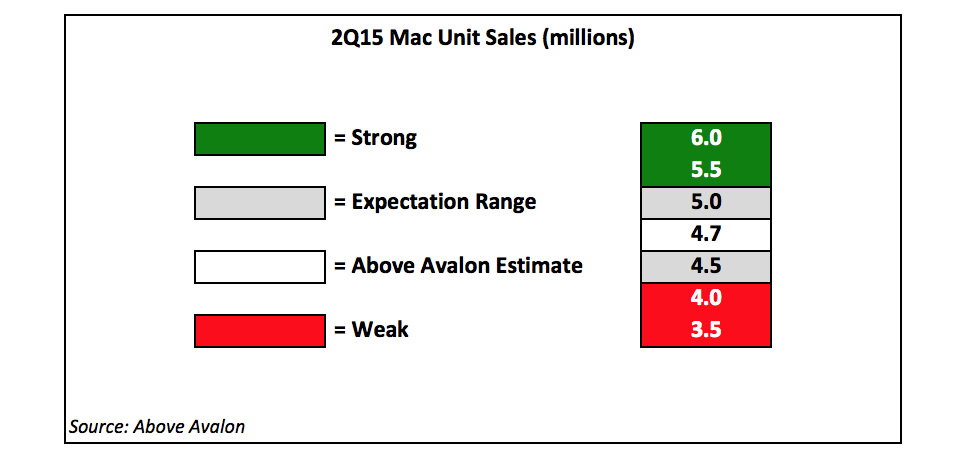
Other Thoughts
Given the current point in the iPhone cycle, it's fair to assume the average selling price will decline a bit (to around $650 from $687), but some of this decline should be offset by an increase in profit margins. Apple's guidance will reflect the impact from the stronger dollar, but with trends stabilizing in recent weeks, management may be able to get a better handle on foreign currency trends.
Similar to last quarter, all eyes will be on iPhone on Monday. For every one million iPhones sold, Apple EPS is impacted by $0.04/share. The difference between 55M and 60M iPhone unit sales explains most of the Street's EPS estimate variation. It looks increasingly likely that China will once again prove to be the quarter's primary revenue driver.
This report was produced by Neil Cybart on April 22, 2015 and is not meant to be used as investment advice.
Want to read more posts like this? I write an exclusive daily email about Apple (10-12 stories a week). For more information and to subscribe, visit the membership page.
Betting Big on the Camera
The camera's primary role has changed from capturing memories to becoming a full-fledged communication tool. Apple's recent $20 million acquisition of LinX serves as a reminder that the camera is positioned to be not only one of the most important smartphone components, but also a tool that will play a major role in how technology impacts society. Instead of betting on mobile platforms, a bet on the camera will likely pay more consistent dividends.
The Camera's Expanding Job Title
The camera's original use case was straightforward: capture memories. Moments in time ranging from a birthday party, graduation, or wedding were chronicled in order to tell a story in the future. Discretion was taken as to what subject or event should be captured as both film and the process of getting film developed were expensive. A week-long trip abroad would likely result in a splurge of maybe eight or nine rolls of film and a total of 200-300 pictures, of which a handful ended up being worth including in a photo album.
Everything changed in 2010 when Instagram was able to successfully position the photograph as a communication medium in the mobile era. Up to that point, phone cameras had been underwhelming with many people needing to carry both a phone and camera. In 2010, the world had just been introduced to the iPhone 4 and Android smartphones were starting to take off. In other words, it was the right time for something like Instagram to start pushing the camera beyond just memory capture.
Instagram's popularity was based on taking photographs with mediocre image quality and turning them into something cool by often making them look even older and grainier by applying fun filters. Users were then able to share their creations with others. In a world dominated by text-based Facebook and Twitter, Instagram represented a refreshing alternative.
Instead of using our smartphone camera just to capture momentous occasions in life, we began to use them to capture everything from the breakfasts we ate, to the magazines and books that we read. The camera was turning into another pair of eyes, and an internet connection allowed others to see the world through those eyes.
The camera's changing role wasn't confined to just software companies. With an initial mission to take photographs while surfing, GoPro was started as a way of have point-and-shoot cameras handle extreme environments. GoPro eventually experienced the same advancements in camera technology and social trends benefitting Instagram, where the camera was turning into a way of sharing unique vantage points and not just memory capture. The camera's expanded job title turned GoPro from a niche camera company into a $6 billion hardware and content company with even bigger plans of becoming a media powerhouse.
Apple and the iPhone Camera
We now find ourselves in a world where cameras are becoming ever more capable in a smaller footprint. Apple's LinX acquisition is all about multi-aperture cameras, suggesting the desire to fit more power in a smaller form factor using sensors and software to capture multiple images simultaneously. The result is better quality, and more importantly, depth and three-dimensional capabilities.
We have reached the point where the camera found in one's smartphone is likely to be the best camera they have ever owned. As Apple continues to push the boundaries on iPhone innovation, the camera will be positioned as one of the likely components that will not only drive iPhone upgrades, but expand the iPhone's use case. While the camera has been used by third-party developers to accomplish various tasks such as scanning barcodes in stores or using augmented reality to display travel directions or public transit, Apple's primary near-term goal will be to improve the camera's ability to take photos and video in various settings to foster an even greater reliance on non-text communication.
Cameras in the Future
Three primary use cases demonstrate how the camera will continue to change the world.
Memory Organization. While we will still use cameras to capture important moments in our lives, much of the focus will be on the software required to navigate the thousands of pictures found on our smartphones, likely taking up precious phone storage if we haven't signed up for a photo cloud service. New capabilities to catalog photographs as they are taken and then search through old digital photographs will serve as features deserving of a keynote slide or two. I suspect Apple and other software companies would be able to contribute much in this area in the coming years, assuming they give the topic enough attention and resources. One issue is that memory capture is simply unable to grab the hearts and minds like it once did. This area will not entice the high valuations from venture capitalists as memory capture has more of a connection to yesterday than the future. While we will still have start-ups trying to fill the niche, the camera's bright future isn't built around simply capturing memories.
Communication. The camera's new functionality as a communication tool is impacting billions of lives, drawing a great deal of attention from investors and users. It is all too obvious by Snapchat's success and the modern-day mobile video boom including Periscope, Meerkat, Facebook, YouTube, Twitter, and various messaging platforms, that the world has moved beyond text to tell stories. Photographs and video are occupying a larger role in our daily lives which by its very nature reduces the desire to hold on to so many reminders of relative mundane aspects of our day, summing up Snapchat's appeal.
Interpretation. While there is still plenty of innovation left with how we use cameras to communicate with others, the camera's most exciting role will be utilizing software to help us interact with and navigate the world. The camera will become an input device for software to interpret clues in various settings at home, the office, or school. The camera essentially becomes a pair of intelligent eyes that goes beyond simple image capture.
The camera's changing role has brought up important discussions concerning how technology impacts humanity. With some companies selling the idea to film one's entire day by wearing cameras on the face or body, questions around privacy and morality will need to be addressed. At what point does obtrusive technology do more harm than good?
The camera discussion has usually been about Kodak, and other camera companies from yesterday, missing the mobile bandwagon. We have now moved to a point where such a story is no longer relevant. The software that turned cameras into critical pieces of communication would have never have been created by traditional camera makers. The camera's potential was unleashed by mobile as smartphones were primarily cameras with a mobile connection. The camera's ability to not only capture the world around us, but begin interpreting that world, suggests the camera's impact on society is still being underestimated. There's still time to place a big bet that the camera will play a much bigger role in our lives in the future.
Want to read more posts like this? I write an exclusive daily email about Apple (10-12 stories a week). For more information and to subscribe, visit the membership page.
Apple's Watch Strategy Embraces the 80-20 Rule
We are starting to get early reads on how Apple Watch pre-order mix is trending and there are a number of surprises. It is obvious why Apple will not disclose Apple Watch revenue data. By knowing which Watch collections are selling and at what price, it would be easier for competitors to reach conclusions on customer preferences. Using early pre-orders reports and a few long-standing theories, the Apple Watch will likely be loosely guided by the premise behind the 80-20 rule, where approximately 80% of Apple Watch profits will come from 20% of Apple Watch customers. In essence, the Apple Watch and Edition collections will likely account for a small portion of sales, yet play a much bigger role in terms of Apple Watch profit. The implications are significant when contemplating how management will treat the Apple Watch line in subsequent years.
Sport is the Most Popular Collection by a Wide Margin
The two most popular Watch models have been space gray aluminum with black sport band and silver aluminum with white sport band. Using U.S. pre-order data from Slice, and extrapolating across the world, these two models could represent close to 70% of Apple Watch pre-orders. There will be millions of wrists with a black or white sports band in the coming months. The sheer popularity of these two models suggest there may be something more at play, possibly related to customers not wanting to spend more than $400 and these particular options representing the most popular color choices.
Majority of People Are Not Valuing Stainless Steel and Sapphire Screen for $200
Most consumers are not valuing the stainless steel case and sapphire crystal screen at an additional $200. The easiest way to see this is compare the black and white sport band models in the Sport and Watch collections, with the only difference being the watch face (sapphire vs. Ion-X glass) and watch case (stainless steel vs. aluminum). When given the choice between a $399 Apple Watch Sport - black band and $599 Apple Watch - black band, pre-order data would suggest customers are overwhelmingly choosing the Sport by a magnitude of 5-10x.
This isn't to suggest that sapphire and stainless steel aren't worth the extra $200, but rather consumers are not reaching that conclusion. Apple Watch try-on appointments may give consumers the best opportunity to make a more informed decision between the two collections, resulting in a slight shift in sales trends.
One theory is that many consumers pre-ordered the Sport for the first version and plan on upgrading to a better watch in 2016 or 2017. This may be true, but the impact may be overshadowed by new Apple Watch buyers deciding to go with the Sport. In essence, the sales mix will likely remain the same, regardless of first-generation owners upgrading their watches over time.
Demand for Expensive Watch Bands is Niche
Even though much attention has been given to the higher-quality watch bands, it would appear that the majority of people are opting for the sports bands. At least judging by pre-order data from Slice, there is tepid demand for higher-end watch bands made of metal and leather. The Milanese Loop would appear to be the best selling watch band out of the non-Sport options, which may give Apple confidence that consumers will value band innovation that moves away from traditional watch bands. The leather band options will likely remain quite niche. My Apple Watch observations would back these claims as I actually thought the sport bands were more comfortable and bold than some of the leather bands.
Financial Impact from Watch Bands
The conventional wisdom is that Watch bands will play a crucial role in Watch financials. I think it will be a bit more complicated.
- One can make a strong case that customers will update their Apple Watches every 2-3 years. In this scenario, the Apple Watch will experience an update cycle that mirrors the iPhone more than iPad. Since each purchase will come with a new band, consumers may not see the need to spend money buying another watch band. Watch average selling price (ASP) and revenue will be driven more by case upgrades ($399+), not additional bands.
- With most people opting for the Sport over Watch, I have difficulty envisioning the majority of customers buying expensive additional watch bands. Instead, there may be demand for cheap, but fun, third-party bands ($29-$49). While such bands may have attractive margins, from a dollar perspective, Watch cases will still account for a majority of the Watch category's profit.
- I suspect 10-20% of Apple Watch owners may be willing to buy an additional high-quality watch band. This is the part of the market where watch bands may become an attractive revenue and margin proposition. Apple will likely want to compete in this lucrative segment of the market, which may include traditional luxury brands.
The 80/20 Rule
The Apple Watch is being sold as the most personal device with 25 distinct styles, yet four options (all with black or white sports bands) comprised a clear majority of pre-orders in the U.S. on the first day according to Slice. On the surface, that would suggest the other models aren't important and Apple should just concentrate on the sports bands. However, in reality, the exact opposite is true. When looking at profits, I suspect the 20% of customers opting for the Watch and Edition collections will likely represent 70-80% of Apple Watch profits. A few equations will help demonstrate what is happening:
- Revenue: One $17,000 Apple Watch Edition = 42 $400 Apple Watch Sport
- Profit: One $17,000 Apple Watch Edition = 75 $400 Apple Watch Sports
Karl Lagerfeld's custom Apple Watch with gold link bracelet. Source: Instagram
The implications from this are far-reaching. Apple will likely dedicate significant attention and resources to updating higher-end Apple Watch models and bands. Rumors had indicated a platinum option priced higher than the current gold Edition models. Karl Lagerfeld's custom Apple Watch with gold link bracelet will likely be available one day for more than $50,000. Marc Newson's schooling and experience with jewelry design will likely play a major role in this effort. In essence, Apple would be catering to the 20% of the iOS customer base that values exclusive personalization, which will boost revenues and margin.
Longer-Term Watch Implications
As long as the Watch is considered an iPhone accessory, I'm not convinced the majority of people are willing to spend more than $500 for one, which will position the Sport collection as the most popular option by a good margin. Meanwhile, the Watch and Edition collections will continue to represent approximately 20-25% of sales, but account for a clear majority of profits, and this ratio may even become more pronounced as Apple introduces additional high-quality bands with higher margins.
Apple is now a premium mass market luxury brand. The Apple Watch Sport is positioned for mass market consumption, reflected by the lowest entry-level price of any new Apple product category. Meanwhile, the Watch, and especially the Edition, are produced with luxury in mind, catering to the 20% of Apple consumers that have been craving personalization. Apple's Watch strategy will cater to both types of consumers, balancing well-crafted, yet practical mass-market items where price matters, and extravagant opulence where price doesn't factor into the purchasing decision. Welcome to the wearable market.
Want to read more posts like this? I write an exclusive daily email about Apple (10-12 stories a week). For more information and to subscribe, visit the membership page.
Apple Watch is Cool, Just like iPhone
After spending time with Apple Watch, it became abundantly clear why people will like the device: it's new and cool. A device that can fit into one's life, but still seemingly blend away when not in use, shares many similarities to the iPhone. While coolness may not be enough to use as the conclusion of a 5,000-word product review, and it certainly won't cause the general public to run out to an Apple store and spend $400+ on a watch, it will lead to imagination. Apple Watch's long-term success will depend on the people pre-ordering the device today; the trailblazers who view the Watch's potential with the same eye that saw iPhone's potential in its early years.
Apple Watch's coolness transcends the much more complex and important topic of technology. The Apple Watch needs to become a better device. While this may sound like a stern warning, it is a necessity that simply describes the path of technology, exemplified by the iPhone over the past eight years. Not only did the iPhone become thinner and lighter over the years, but the fundamental way we used the device changed, thanks in part to more powerful components and third-party developers. From a device used to access the internet when we were away from our computer, the iPhone is now our computer.
The same process will occur with Apple Watch. Today, the Apple Watch is a cool device that can show the time when we look at our wrist, track how many steps we walk each day, and send tap messages to friends. As the device gains additional sensors, better battery technology, and revolutionary materials and components, the use cases will expand as developers utilize the device's potential.
Apple Watch will use coolness to sell itself until people find that utility. As developers understand what the Watch is, and more importantly isn't, apps will improve, taking information once destined for the iPhone and repackaging it for the wrist. In many ways this is what early adopters do, buy things that they think are cool and interesting and then spend time tinkering and thinking. Saying a product is for early adopters isn't an insult, even though many have equated the two in recent years.
Watching people of all ages try on and interact with the Apple Watch, the impression I got was that most saw it as an interesting watch. That is to be expected considering the wrist was ruled by the watch for decades and anything destined for the same spot on our bodies will likely be initially compared to a watch. This is one reason why I heard a few complaints about the screen turning off when not pointed at the wearer, or having to charge it each night. Regular watches don't have those "tradeoffs". The same was said about iPhone "drawbacks" such as not having a keyboard and needing to charge it more frequently compared to feature phones. Even though the iPhone was introduced as the best smartphone in the market, in many ways it made for a suboptimal phone. Over time, our demands for a phone changed. The same will occur with what we consider to be Apple Watch negatives, and ultimately, what we want out of a watch.
The bet that Apple is making with Apple Watch is that in an environment of smart glasses, virtual and augmented reality goggles, and other wearable devices, it is the wrist that has a long runway with an immense level of untapped innovation, and more importantly, void of many roadblocks to reach that innovation. Apple knew that consumers wanted to wear and play with something that looked cool, while every other smartwatch maker was too concerned about first answering the utility question. Why else are Apple Watch bands, which have little functionality besides being a fashion accessory, the most talked about Apple Watch feature?
The Apple Watch represents potential. I suspect that is one reason why Apple executives can't hold back a smile whenever Apple Watch comes up in conversation. With an iPhone, although there is still plenty of innovation left, exemplified by Apple's recent $20 million acquisition of LinX, people now understand the iPhone is a computer. The level of excitement or surprise will never be the way it used to be. We now demand our iPhone to take over the world. The Apple Watch possesses similar traits to when we first saw the iPhone. There isn't just a level of excitement around the device, but also intrigue and mystery. We don't know what will happen to Apple Watch in a few years. We are told Apple Watch will never work on its own. We are told it will always be an iPhone accessory and companion. People are buying it today because subconsciously they want to see if those statements are true. We want to know if the Apple Watch is the future. Just like the iPhone, a very good case can be made that the answer is yes and it starts with being cool.
Receive my exclusive analysis and perspective about Apple throughout the week (2-3 stories a day, 10-12 stories a week). For more information and to sign up, visit the membership page.
My Apple Watch Try-On Experience
For the past seven months we have been told how the Apple Watch is the most personal device Apple has ever created. This past Friday, the general public had its first chance to find out what Apple meant as Apple Watch try-on appointments were rolled out. I selected one of the first time slots at my local Apple store as in many ways I was more interested in the way Apple had set up these try-on appointments than actually trying out the device. Needless to say, I ended up learning quite a bit.
While I have some constructive criticism and suggestions, I found the entire try-on process enjoyable. Despite following the Apple Watch beat for the past seven months, I still found there to be surprises. I can only imagine how someone not familiar with Apple Watch would likely feel overwhelmed by this new gadget for the wrist.
Going into the try-on I thought the Apple Watch Sport will be the most popular model, possibly by a pretty wide margin, and the black and white sports bands will be the most popular bands by a significant number. That view was only reinforced after trying on all of the different options.
No Lines and Limited Try-On Models
Despite Apple encouraging customers to make an appointment to try on the Apple Watch, I ended up simply walking in and getting taken care of as there were open try-on slots available. The store had been open for an hour, but things still seemed pretty quiet. While my specialist was friendly, helpful, and approachable, there was little in the way of agenda or questioning. "Which would you like to see?" was the first, and basically the only question asked of me during my appointment. Fortunately, I was already well aware of each band choice. Unfortunately, the store only had one size of each available watch band, often with the smaller 38mm case, which I found odd. I asked one of the workers why so many models were missing, and he said that was all they had received. Strange, but honest answer.
Tough Choice Between 38mm and 42mm Watch Case
A 38mm Apple Watch on the left compared to a 42mm Apple Watch on the right. It was a close call between which one looked more appropriate on my 140mm wrist.
I came into Friday with the assumption that the 38mm Watch case was being sold just to push the 42mm version, with few people actually opting for the 38mm. After Friday, I actually think the 38mm is indeed the right size for a certain percentage of the buying population. Recent data from Slice would seem to support that view, with their analysis pointing to approximately 30% of pre-orders in the U.S. going with the 38mm. The Apple specialist even said the 38mm looked better on my 140mm wrist, although I responded I wanted the extra screen real estate that came with the 42mm. It honestly was a close call between the two, as seen in the attached image.
The Watch collection stainless steel cases certainly had the finish of a higher quality product compared to the Sport collection, but I actually didn't look at the aluminum Sport as cheap or a toy compared to its more expensive counterpart. Instead, I think Apple was successful in having the Sport give off a more active vibe. I'm not sure I would feel as comfortable running with a stainless steel Watch.
Sports and Leather Watch Bands Were Most Comfortable
In what I just label as first-time jitters, I had quite a bit of trouble putting on nearly every watch band, especially the Sport. I didn't come away with any lasting concerns from this, but rather just thought it was interesting.
The bands are truly all about personal preference. I enjoyed the fluoroelastomer (sports band) followed by the stone leather loop. I found both to be the most comfortable on the wrist and the easiest to forget I was wearing a watch. The Milanese loop and link bracelet definitely had a more solid feel to them, reminding me of a regular men's watch, something I actually was trying to avoid with Apple Watch. The modern buckle didn't stand out to me as something I would be interested in wearing. With fitness and exercise in mind, I would have little interest in wearing anything other than the sports band. I wouldn't label any of the bands as inferior, so I think Apple succeeded with this first round of watch bands. I would be interested to see where things go from here concerning the bands.
Random Trying-On Musings
Apple Watch try-on station, showing Apple Watch supply issues and the official Apple Watch rag.
Not following any agenda, I continued trying on every watch model that they had in stock, often wearing two at a time for comparsion. All the while, the specialist was super careful to not have any of the watches fall on the ground. I had to keep my wrist above the counter, especially when I was taking a watch on and off. My only thought was that Apple must be very nervous about tight supply as the store was probably told to make these first demo units last. The other noticeable activity was the near-constant wiping down of both Apple Watch try-on units and the Apple Watch display table that had a large piece of glass covering all of the Apple Watch models. There is something off-putting with seeing someone clean something you just had on your wrist right in front of you.
The Apple Watch security guard was also hard to ignore, making sure that no one ran off with a non-functional $399 Apple Watch Sport.
Apple Watch Demo Unit
After I ended my try-on session by declaring "I guess I tried every watch you have here," I preceded to use one of the Apple Watch demo units on the other side of the store. I was able to quickly observe what some had said was a interface that took some getting used to, but over the span of 15-20 minutes that awkwardness went away. To be completely honest, I am a bit disappointed that so many early reviewers from the Watch keynote demo made such a big deal out of this issue. I think it was blown way out of proportion.
The only thing that I needed help with was changing the utility watch face to solar. After being shown that a Force Touch was the answer, I then spent the next 15 minutes engulfed in the various watch face options. I actually found this feature to be the most interesting. There really is something mesmerizing about the various watch faces including the motion options.
As a sign of how ingrained my iPhone and iPad usage is, I gravitated towards using my finger on the Watch screen instead of the Digital Crown. While some of that may be due to the fact that the watch wasn't on my wrist, I was thinking that the Digital Crown was more of a required feature in order to use the watch, instead it would appear to just be one way of gaining more precision.
I found all of the demo apps worked flawlessly with no noticeable lag or hiccups. After 45 minutes of trying the demo Apple Watch, I noticed the store was getting more crowded and the available demo units were dwindling, so I moved over to play with the new MacBook.
Remaining Nimble
The thing that struck me the most during my try-on was that Apple was doing something completely new (selling a wearable product) with the same retail strategy that Apple Store has come to be known for. Instead of renovating each store or creating a special Apple Watch area with a new layout, Apple stuck with the well-known large rectangular wooden table scheme. This process even extended to Apple's store-in-a-stores in Tokyo, London, and Paris.
Apple Watch display table on left with try-on and demo table on the right. Additional try-on and demo spots were located alongside each wall.
The Apple Watch area in the store I visited comprised a demo/try-on station table, an adjacent Watch display table, and then additional try-on stations on one wall and demos on the opposite wall. In total there were eight try-on stations and eight demo stations. Considering this was one of the smaller stores in Apple's retail footprint, I would imagine bigger stores had multiple times the number of demo stations.
Ultimately, I view the effort to remain nimble as the guiding principle behind the Apple Watch try-on process. Apple had given us clues not to expect anything too dramatic with the way the stores would look with Apple Watch as Apple's recent financial filings indicated there wouldn't be many store renovations and we got a look at Jony's new Watch display table at Colette in Paris this past September, looking very similar to the now iconic wooden tables but with a cut out in the middle covered by glass.
I noticed that most of the Apple store employees were still somewhat in awe of the Watch display table, so I asked when it arrived. Just a little while ago was the answer. It is important to keep in mind that all of this Apple Watch try-on sales process was installed in nearly 400 Apple stores overnight, or in some cases that morning. I wonder if this gives us clues as to how Apple will sell new products in the future, relying on the same wooden table theme.
Would I Change Anything?
Having gone through the try-on process, I asked myself if there was anything I would have changed. Surely, each step was created by Apple's retail and marketing teams (not to mention Jony and his team), so I spent some time figuring out the pros and cons of the major decisions that went into the process.
The Apple Watch demo unit.
Apple is accomplishing two goals with these Apple Watch try-ons: having people test the various watch models and then being able to interact with a working Apple Watch. Apple chose to split these two goals, which I suspect is more related to practicality and timing. It would be hard to have people not only try various watch bands on, but also play with the device on their wrist. For example, I spent 15 minutes trying on various watch bands, but then 45 minutes playing with the demo unit. With the current layout, customers can also play with a demo unit while waiting for a try-on appointment, which is an added benefit of splitting the two. I really didn't have a problem with interacting with the watch on a table versus on my wrist. Having demo units on a table also made it easier for an Apple Store employee to help with any questions that I had about the Watch interface or an app, in addition to having more than one person look at the same watch demo unit.
As for the actual trying-on process, there are two fundamental preference tests: watch case sizes and watch bands.
- I would have liked to see a more formal process with answering which watch case (38 mm or 42mm) was a better fit for me. A few people on Twitter told me there is indeed a way to tell what is right or wrong for watch sizing. The specialist did comment on what he thought looked better on me after I showed a bit of confusion, but I was still left a bit unsure. While this comes down to personal preference, I would have liked a bit more help.
- As for the bands, I would have preferred a set up where I know more about the watch bands. Simply going up to a demo unit and being asked which band I wanted to see isn't going to work for most people. I was well aware of the watch going into the process, having memorized all of the models. I would suspect most consumers wouldn't know the first thing about the band options. While much of this process could be discussed by the specialist instead of having printed material or a display, I think there was room to explain the bands a bit more.
I suspect the whole concept of having the specialist stand next to me instead of across from me over a watch case like in every other retailer was a byproduct of Apple trying to make the try-on fit in with the current store layout. For the Edition, a conference room was used for demos in some cases while other stores simply relied on a quiet back corner, which doesn't exactly sound as an ideal option for a "luxury" experience. While having a "watch bar" with chairs and a team of Apple Store employees behind the bar sounds interesting, I think it all goes back to Apple simply being unable to incorporate such change into the current footprint without a lot of additional work. I also am not sure if a "watch bar" would make it easier to assist customers with putting on various watch bands.
Ultimately, I think Apple did a great job with my try-on appointment. While going through the process early Friday morning revealed some early jitters on the part of the Apple Store specialists, backed up by others who told me they were repeatedly given incorrect information about the watch, I thought the overall process worked fine.
Takeaways
Over the next two weeks, Apple will be in a position to give hundreds of thousands of consumers the chance to try Apple Watch. It cannot be overstated how important these try-on appointments are for Apple Watch's success. They give Apple a competitive advantage against others that will undoubtedly enter the wearable space. I would expect Apple to fine-tune the process over time, but at least on Day One, I had a great time trying on Apple Watch. It is rather amazing how the average Apple retail store employee's job description has changed with Apple Watch. The involvement and personal interaction required when helping people try on various Apple Watches supports the idea that the retail store employees play the most crucial role out of the entire experience.
Looking at the crowd, I actually didn't get an early adopter vibe that we have assumed would be the only ones interested in the device. Obviously, going on a weekday morning resulted in the lack of children and teenagers, but I would say the crowd interested in Apple Watch was generally in-line with any other day at the Apple store. I was able to talk with a few "non-early adopter" people about their first impressions about the device. Interestingly, their first comment was that it was a cool watch, with fun customizable watch faces. I go back to when Apple first introduced the watch and I was explaining the device to people, even then the watch faces were the primary talking point. I really think there is something to be said with how normal people look at Apple Watch as primarily a watch that can do other things. I also received a comment about going to see the device made them want it even more, an obvious goal that Apple had in mind with the try-on appointments.
When I left the Apple Store, I asked myself how would I describe the device in one sentence. Without much thought I said, "It's cool." I've been very adamant that people have been overthinking the watch for the past seven months. When it comes down to it, the watch is simply a cool device and my try-on experience reinforced that view.
Receive my exclusive analysis and perspective about Apple in a daily email containing 2-3 stories (10-12 stories a week). For more information and to sign up, visit the membership page.
I went into more detail on my trip to the Apple Store for Apple Watch on Above Avalon Podcast Episode 20.
Product Reviews are Broken
Apple Watch reviews were published yesterday. The majority of reviewers thought the Apple Watch was a great device and has potential to be a game changer in how they use technology. The problem is that unless you read every review, you wouldn't have known that. Instead, the collective conclusion from the web yesterday was that the Apple Watch flopped with early reviews. There were 21 Apple Watch reviews published, but the 4 reviews that were more critical of the device got the most attention, leaving the 14 glowing reviews behind. Meanwhile, most of the important features of the Watch such as watch bands and durability were either not included or buried within lots of other text. Simply put: product reviews are broken. There needs to be a better way to review products.
Product Reviews Have Lost Their Luster
I couldn't help but think how the product review has changed over the years. Whereas a company's primary benefit from a product review was to win precious space in newspapers and magazines, product reviews are still mostly a marketing ploy, but the review itself has become a commodity, with people pulling the most interesting and juicy quotes (using iPhone screenshots) from various sites, and combining them into a new "Review Round-Up" post. The rest of the narrative, and the actual review, is left far behind. This process has been occurring for a few years, but lately it is getting much worse. This is the primary reason why so many people thought the Apple Watch was panned by reviewers while in reality, most people enjoyed the product. Out of thousands of words written about Apple Watch, most will only remember a small fraction and even a smaller fraction will be included in these problematic "review summary" posts.
We now get our news and information from social networks where the desire to be noticed in a sentence or two has led to much more noise with sporadic bouts of greatness. In the process, the product review has lost its luster. Whereas in the past we may have turned to the WSJ for the definitive Walt Mossberg product review, we now are exposed to 20+ reviews that are all trying to be the one to stand out from the pack. While we still have talented people writing most of these reviews, they are increasingly gearing them toward their core audiences. Apple realized this long ago and expanded the number of review units accordingly, effectively watering down the review and in doing so, diffusing the voice of a few into a dull rumble of many.
In a quest to stand out, we now have some reviews turning into full-fledged productions. The Verge's Apple Watch review involved 31 people. Meanwhile, other reviews have remained largely unchanged from yesterday, basically a few paragraphs of generalized statements.
There is still a Place
I still think the world needs independent product reviews. There is enough prior misbehavior on behalf of companies to suggest such third-party reviews can serve a purpose by giving consumers value. The problem is that many reviewers don't know what kind of value that is. The move into personalized wearables has largely turned the traditional tech gadget review into an artifact from a begone era. The nature of the tech review should have changed, but many tech reviewers haven't adapted their review process to this new wave of technology. While adding video may represent a new dimension to the review, the underlying premise of the review needs to be rethought.
Path to Fixing the Review
There are two ways to start putting the review on the right path.
1) Embrace the Current Environment. Video. Video. Video.
One of the more effective Apple Watch reviews came courtesy of Mashable. It wasn't their couple thousand word review intertwined with various high-quality photos but their six-second Vine clip that didn't include any words. I found the clip to be amusing and interesting because it: 1) showed Apple Watch packaging 2) briefly revealed watch bracelets being resized 3) revealed the mechanism of how the watch bracelet worked. I wasn't able to get that information from any other Apple Watch review. Of course Apple could have had the same video on their website, but this is where the independent product review's value shines: legitimacy. There is value in seeing someone not connected to Apple show off its technology in a real-world setting.
Video is an effective medium for much of this to take place because it's 1) easily shareable 2) able to retain its message. One of the biggest's problems facing text reviews is the ease in simply taking a few words out of context. But a six-second Vine? It would be pretty hard to shrink that down any further.
Pharrell Williams published his seven-second Apple Watch "review" Tuesday on Instagram. Similar to Mashable, it showed one aspect of the watch that most people would actually find interesting: how the watch face turns on when one's wrist is turned.
I think one of the better Apple Watch reviews would have been comprised of 10 Vine or Instagram clips that highlight features of Apple Watch that would likely show how we would use the device. Johanna Stern at WSJ did a four-minute video for her Apple Watch review which was entertaining but ultimately too long and missing the larger point of Apple Watch: it means something different to each user. The answer to that isn't simply to do every single thing possible with the watch and then complain at the end that the watch does too many things.
2) Redefine a Review. As technology products become more personal, it is becoming more critical to redefine what a product review should be. Instead of videotaping oneself doing 20 different things with Apple Watch during a typical day, focus on aspects of the device that are universal: quality, craftsmanship, durability, and the simple tasks everyone will have to do.
- Does the Apple Watch screen scratch easily?
- What happens if you get grease on Apple Watch? What about sweat?
- What if you keep the Apple Watch on for long periods of time? Any rash?
- Is it easy to charge?
- How do you replace bands?
Very few reviews addressed those talking points, with only a few even mentioning watch bands, arguably one of the more important deciding factors when it comes time to purchase the watch. Each one of those questions could be answered with a six-second Vine. The product review essentially becomes a test as to whether a company's claims about a product are true. There is a different time and place to talk about the larger implications of how Apple Watch will or won't change the world. A product review isn't necessary the right place to go into theories about technology or nit-pick on why turning on all notifications results in too many notifications being sent. People are going to buy Apple Watch if it looks cool. The review should try to help answer that question.
Taking into account Apple's changing retail strategy, reviewers will need to understand how Apple.com and the Apple Store iOS app are going to become more crucial information sources for consumers. It is important to embrace the change and not brush it off. Apple will have 10 Guided Tours for various Apple Watch features. How about using Instagram video to compare the most important parts of Apple's multi-minute videos to real-life reenactments?
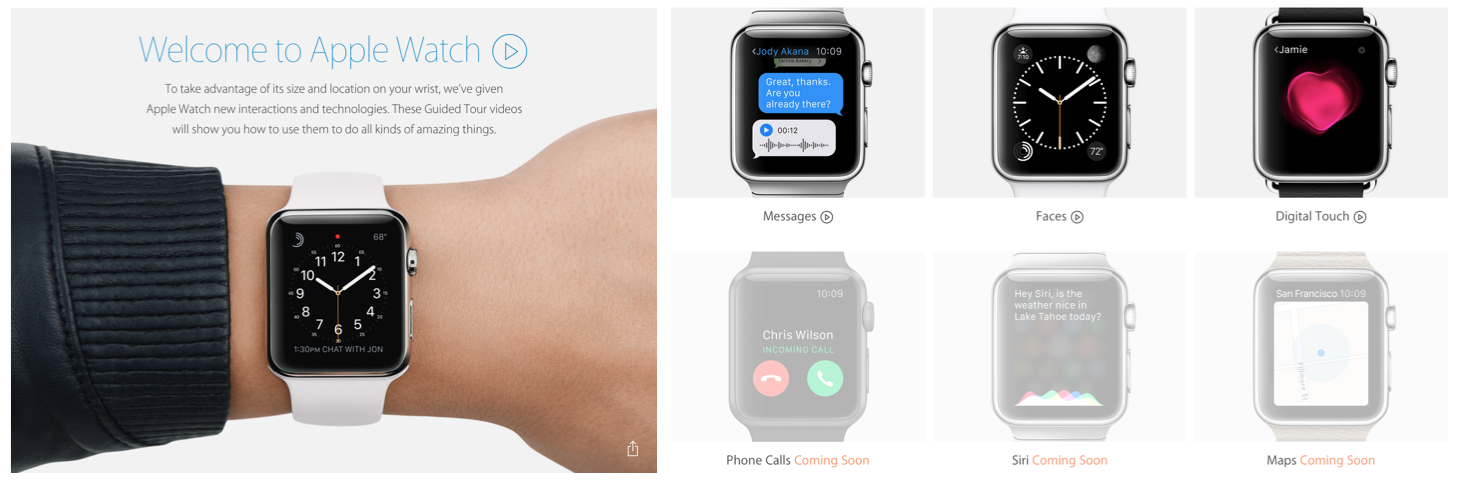
Apple's New Apple Watch Guided Tours
The product review will be rescued when it is understood that the consumer should make the final decision of whether a product is good or bad. The product review should be one variable in the much bigger buying process that likely will involve family, friends, time, and a bank account. The product review has a bright future for giving valuable information and insight to consumers. It just needs some help getting there.
Want to read more posts like this? I write an exclusive daily email about Apple (10-12 stories a week). For more information and to subscribe, visit the membership page.
It's Time for the Watch
"Apple decided to make a watch and then set out to discover what it might be good for..." - Wired
With one sentence, Wired perfectly described the Apple Watch, Apple's first product designed specifically to have a purpose dependent on the user. Today it is a watch. Tomorrow it will be something else. Next year it may be completely different. After years of development, the next phase of Apple Watch has arrived with preorders beginning on Friday. Just as was the case when the product was introduced in September, many are overthinking the watch, turning Apple's refrain about making great products into a complex business theory that risks missing the obvious keys to success. By overthinking the watch and ignoring the clues we received over the past few years, it is too easy to miss what Apple Watch actually is: freedom to do different things with technology.
iPod Nano
Phil Schiller announcing new clock faces for iPod nano in 2011.
While it is hard for any outsider to pinpoint when the idea for Apple Watch first started to percolate, according to Apple executives, the project had its official beginning in late 2011, soon after Steve Jobs' death. However, it was clear at a much earlier time that Apple was at least thinking about a watch.
Back in 2010, Apple shipped an "instantly wearable" new iPod nano that had a multi-touch user interface. Possibly due to some inclination that people may use it as a time piece, Apple included a few watch faces. Steve Jobs even said one of Apple's board members was going to clip it on an arm band as a watch (which got chuckles from the audience). Soon enough, people began to use the device as a wrist watch. Apple embraced the trend and in 2011 went so far as to create new clock faces. It was fun and cool. There were limiting factors for a more advanced gadget at that time, including a new user interface and better battery, but that didn't matter. Apple was a different company in 2010, having just launched the iPad and iPhone 4. Simply put, Apple had more important things to focus on than a watch, but the idea was there. There was something about the wrist.
Tim Cook Gave Us Clues
One of the key questions after Tim Cook became CEO was if Apple would be able to come up with new product categories. The question took on renewed vigor given a few years of evolutionary iPhone and iPad updates. While product secrecy continues to be a very important intangible asset for Apple, the company has historically given a few clues as to areas of interest, and Cook was no different judging by his public appearances in the years leading up to the Watch launch.
2012: Tim Cook at D10 conference. "I think there's some cool things that can be done [with wearables] and I think it's an interesting area...The book hasn't been written on that yet. If it's just a cool thing to know, it will fade, but if it can really drive someone to act differently, to behave differently, then I think it can be pretty cool, and so I think the verdict is out. It will largely be determined by how much innovation is in that area. I think there are some good companies that are working on this."
2013 : Tim Cook at D11 conference. "I think wearables is incredibly interesting, and I think it could be a profound area for technology...there's lots of things to solve in this space, but it's an area where it's ripe for exploration. It's ripe for for us to get excited about...I see it as something, as another very key branch of the tree...I'm interested in a great product...The wrist is interesting."
The Apple Watch Sales Pitch
Tim Cook introducing the three main marketing tentpole features for Apple Watch: a timepiece, communication device, and health/fitness tracker.
As 2014 began, it was becoming increasingly likely that Apple was indeed up to something with a wearable, if nothing else due to the fact that so many other companies were coming out with subpar smart watches. Each device had severe limitations lacking fashion or personalization cues.
In September 2014, Tim Cook introduced the Apple Watch with the following sales pitch: a personal device that could be used to tell time, communicate with people, and track one's health and fitness.
In the preceding weeks and month, the official Apple Watch marketing campaign took shape with the main refrain remaining largely the same, focused on the three primary use case tentpoles. In addition, it gave more insight as to the overall design process behind the Watch and Apple's product-first culture.
2014: Tim Cook during interview with Charlie Rose. "The Apple Watch is the most personal device we've ever created. I think it takes us into a whole different area. We had an intense team working on this for three years...As the product came to fruition it became not only the timepiece that you would expect, but a device that can do many different things include really a whole new way of communicating and connecting with people and also it has a health and fitness component that we think could be profound."
2014: Jony Ive at Vanity Fair. "One of the advantages of being part of the design team that's been around for a long time is that we haven't the luxury and opportunity to develop out process, and so one of the things we do is we meet religiously as the creative team three or four times a week...I'm still so excited about just the nature of the process. I feel so absurdly lucky to be part of a creative process where you know on one day, on Tuesday, there's no idea. We don't know what we are going to do. There's nothing. And then on Wednesday, there's an idea that was created and invariably the idea is a thought that becomes a conversation, and so that we design to start with is to talk and it's fairly exclusive..involves a few people...and a remarkable thing happens in the process, and it's the point in the process where there is the greatest change and it's when we give form to an abstract idea."
2015: Tim Cook at Goldman Sachs Technology Conference. "We want to change the way you live your life. And just like this iPad has changed the way you work, and hopefully the way you live, and the iPhone has done that. We see the Apple Watch doing that...There's just an enormous number of things that it will do, and I think you're going to find it something that you're going to think, 'Wow, I can't live without this anymore!'"
2015: Jony Ive in The New Yorker: "We always thought that glasses were not a smart move, from a point of view that people would not really want to wear them. They were intrusive, instead of pushing technology to the background, as we've always believed...We always thought it would flop, and, you know, so far it has...[Apple Watch] isn't obnoxious. This isn't building a barrier between you and me..."
2015: Alan Dye in Wired: "There was a sense that technology was going to move onto the body...We felt like the natural place, the place that had historical relevance and significance, was the wrist."
The prevailing message illustrated in the above comments was that Apple looked at the wrist as something special with the primary idea of a watch that could change your life serving as the start of everything. More refined use cases and ideas around watch bands came at a later time.
Apple's New Marketing Strategy
Judging from Apple's Watch marketing strategy over the past seven months, it is clear that Apple is taking a new route. The Katie Cotton era of public relations is over. With most new things, there are risks, and I suspect we are seeing one of those risks play out as some company observers are having trouble with an Apple that gives out so much information. If Steve Jobs represented a firewall for Apple marketing, Apple's primary risk now is not filtering the message enough.
Apple's new marketing strategy has relied heavily on positioning Jony Ive as leader of an industrial design team that uses collaboration to create products. Photo: Vogue
Apple is relying on a new marketing strategy because it no longer has the showman that introduced the iPod, iPhone, and iPad to the world. Instead, Apple is forming the narrative around a range of individuals involved with product development, led by Jony Ive and Tim Cook. Apple likely feels it has reached a point where its size and social awareness make it difficult for just one person to control the entire marketing campaign, and management is right. Apple is different today. The news cycle is ever more busy and filled with noise. While it is critical to make sure that the narrative stays on point and coalesces, Apple's strategy is fundamentally the same: get people to want to use the product. To accomplish that goal, Apple is relying on a shock and awe type of public relations strategy to elevate Apple Watch awareness to extreme levels.
It's All about the Product
One theme that management has taken very seriously with Apple Watch marketing is that Apple strives to make great products, and that is the primary theme Apple has tried to showcase with its marketing by using interviews and various high-profile write-ups. I suspect many technology observers have simply gotten used to Apple executives repeating the refrain, ignoring what that phrase really means. One secret to Apple's success is keeping product development behind closed doors, leaving the final, well-polished product to be seen in a retail store. While much strategy is involved in determining what products to work on or what industries to get involved in, strategy alone will lead to failure. At the end of the day, if the product isn't good, nothing else matters, even if the strategy is on point.
When David Pierce talked about Apple deciding to produce a watch first and then thinking of use cases second in his Wired piece, he correctly described Apple's product-first strategy. One theme that has become apparent in mobile is that a product's use case changes over time. It is much more important to focus on the big picture first, positioning a product that can take advantage of major computing themes, not something that checks off a few use cases on a list.
- Apple wants to make a product that has the potential to change the way we live our lives. Management is interested in owning the core technologies that underlie such a product. Management has commented that much time, and anxiety, is spent on this part of the equation.
- The wearable space had become interesting, not because of smart watches, but due to fitness bands. Meanwhile, phones were becoming more powerful as time went on, to the point of being able to replace laptops and desktops for some. Was there room for a simpler device able to turn the complex into the simple?
- Judging from decades of watch use, and now fitness bands, it was clear the wrist contained some value. However, watches were not able to unlock that value due to their lack of utility. It was reported that Jony started to research the history of the watch, including the reasons the wrist was so valuable. The focus was first on the device itself.
- With the idea in mind (don't forget about lessons learned from the iPod nano), it was then time to develop use cases for a device destined for the wrist. With a workable user interface, there can be attention given to what can be done with the device. Taking a look at the iPhone and iPad, it's clear the initial use cases designed for a device aren't even that important. Instead, the technical capabilities (and the runways of such technologies) are much more important.
In the future, the watch may begin to take on more iPhone functions, or it may not. The much more important goal for Apple is to make sure that each new model is better than the previous one. Looking at the iPad, although sales momentum has stalled, Apple is still concerned with shipping the best iPad each year. Market dynamics may not always work in an Apple's product favor, but management hopes to be the reason such market changes impact its product line.
Too Busy Finding a Story
One problem that is becoming a theme in the ever-increasing news cycle is overthinking things by needing to add a new twist or take. While such overarching theories may make for an interesting weekly column or Medium post, in reality, I suspect the truth is much more simple and rudimentary.
Looking back at the iPad and iPhone, many have developed elaborate stories around those products in order to address the mystery. In reality, they were simply great products that relied on a revolutionary multi-touch user interface. After launching at a too-high price (and different business model based on mobile revenue sharing) and without an app store, it took Apple and the iPhone three years and additional features and changes before hitting mass-market awareness. However, the legend was that Apple foresaw the coming mobile app revolution. Stories are told to provide answers to the unknown. The problem occurs when those answers are fabricated. Apple is launching the watch as a fun, personalized iPhone accessory with different use cases dependent on the user. If one doesn't leave the complicated stories and theories at the door, it will be difficult to see the Apple Watch for what is and, more importantly, isn't.
Judging Success
Apple's goal is to make a great product. With Apple Watch, success will be straightforward. Will people want to use it? A few days ago, I asked on Twitter what will be Watch's likely "-gate" controversy, similar to iPhone 6 and "Bendgate." As expected, I got responses ranging from waterproofing issues to scratching and rashes. One of the more serious public relations problems that could impact the watch is drawer-gate or nightstand-gate. If people forget to wear the Watch, not seeing a point in putting it on for their run, the trip to the grocery store, or to attend parent teacher night, the device won't be able to impact someone's life. One of the reasons the iPhone has done so well, including having a strong upgrade cycle, is that it is literally on us all day, every day. If people enjoy wearing Apple Watch, the product will be a success.
Freedom
The Apple Watch is the first Apple product designed from the beginning to be worn and have a purpose dependent on the user. For some, it is the best way to listen to music on a run. For others, it is a revolutionary way to communicate with the kids or keep track of appointments. This is the primary reason why so many people are struggling to understand the Apple Watch. The Apple Watch doesn't mean the same thing to everyone.
We don't know what the Apple Watch will become as we have never experienced personalized technology worn on the body. Personalization doesn't just mean getting to choose between a white or blue wristband, but having a product mean something different and special to each user.
The Apple Watch is an attempt at giving users freedom to do various things with technology suited to their lifestyles. It has been three years since Apple came up with the idea for a cool device for the wrist. On Friday, the era of personalized technology will enter the next phase as Apple Watch pre-orders signal the start of something new.
Want to read more posts like this? I write an exclusive daily email about Apple (10-12 stories a week). For more information and to subscribe, visit the membership page.
Apple's Music Strategy Looks Increasingly Risky
Apple is late to the music streaming game. In what could be seen as a rare sign of Apple ignoring a product for too long, Jimmy Iovine and company are still putting the finishing touches on their shift from paid downloads to paid music streaming. While Apple will most likely have a specific marketing plan in place to become the biggest paid music streaming service in the world, the overall risk to the strategy remains elevated. Being forced into something is a new experience for Apple and one has to wonder if becoming the most popular paid music streaming service is just a near-term prerequisite for a company with much bigger music initiatives.
The sea change in music continues unabated. Paid music sales are declining as music streaming is growing in popularity, built primarily on a freemium model where advertisements are used to annoy listeners to the point of driving paid upgrades. Spotify has 15 million paid members, equivalent to less than 5% of the overall iPhone user base, while YouTube serves billions of songs, masked as videos, for free. In such a volatile landscape, Apple's rumored plans for music streaming seems rather simple and, to a certain degree, refreshing. One tier, charged at a monthly rate, with users able to listen to music across a range of products and even operating systems.
Apple's strategy with music streaming continues to be a work in progress, but from what we know, curation and discovery will be two main tenets of a service that uses music exclusives as a carrot to entice users. In what could be a major negative, Jimmy Iovine reportedly was unable to get the cost for this music streaming service down to $5/month, with record labels demanding Apple remain steady at the "me-too" $9.99/month price. The primary problem with this chain of events is that music executives are hardly in a position to be dictating pricing and business strategy in an industry that may be fundamentally broken, yet again, by technology.
Music streaming is split into free and paid and there is risk that without a free offering, Apple may not reach enough scale to force consolidation among streaming services. A $5/monthly price was thought to alleviate some of this risk, but with Apple possibly needing to ship at $9.99/month, one has to wonder if management is pleased with how the product is shaping up.
One theme that permeates this discussion is Apple's forced hand. With iTunes Radio, a seemingly "me-too" product compared to Pandora, Apple has seen moderate levels of success, but nothing that would jump out to an observer as ground-breaking. Apple risks a very similar fate with a paid music streaming service: garnering enough success to warrant respect with the endeavor (mostly because the bar is set so low), yet unable to capture the music industry like it was 2005 again. In essence, Apple would be stuck in catch-up mode.
At $9.99/month, Apple will still likely be able to sign up millions of iOS users (and a few Android users) to its music streaming service. However, the elephant in the room would remain untouched: YouTube. What are the longer-term implications if Apple is unable to fundamentally change the music industry with its paid streaming offering? Is additional M&A for streaming mindshare the answer? Using less than 0.1% of Apple's cash to force extra long music exclusives? Does any of this resemble the "Apple way" of putting the product first?
Being forced into something presents problems as one is not able to skate to where the puck will be, but instead focus resources and attention in trying to simply make sure it is indeed a puck that is being chased. Set in this backdrop is Jay Z's recently purchased Tidal music streaming service, which is relying on his publicity to boost membership numbers. The venture is actually based on a few solid ideas, despite not having a viable business model. Jay Z spoke to Billboard about Tidal and his thought process towards artist exclusives:
“You know, there’s a thing now, it’s called the album cycle. You put your single out, promote it, then another single — I think that now for an artist an album cycle doesn’t have to end. They’re on Instagram and Twitter and all these things, so we’re talking about ways of extending that album cycle, and it could be anything. What if it’s a video offering tickets to the next concert, or what if it’s audio or video of the recording process? If could be anything. It could be them at home listening to songs that inspire them. Anything they want to offer, you know; just be as creative as possible, that’s the only charge, really. Make it look really good and make everyone that consumes it think, ‘Man, I got something really great.’ Treat the people with respect; make it memorable.”
I continue to see Apple wanting to get to a point that takes some of what Jay Z described (and which has been talked about for years by others, including at Above Avalon) and then build a viable and sustainable business model around it. Such a place may very well include paid and free streaming, in which case Apple's rumored paid music streaming is considered more of a stepping stone to a bigger initiative where music is mostly free, but listeners obtain value from a breakthrough user interface (think: App Store, but for music).
Over the next few months, many will position the music streaming battle between Apple and Spotify. Instead, Apple will be going up against free music streaming. The irony in this whole saga is that Apple's longer-term initiative may very well embrace free music streaming, but only when music artists and fans will be able to use software to monetize content beyond music sales. Apple is being forced into music streaming and the question remains if Apple can once again harness the music industry in a such way as to form a strong enough stepping stone to begin mapping where the music puck is headed.
Want to read more posts like this? I write an exclusive daily email about Apple (10-12 stories a week). For more information and to subscribe, visit the membership page.