
Apple M&A Is Entering a New Phase
Apple's mergers and acquisitions (M&A) strategy is misunderstood. Consensus has settled on the view that Apple needs to change its rigid philosophy towards M&A and begin using its $233 billion of cash to buy larger competitors and find new sources of revenue. These suggestions are misplaced. Apple's M&A strategy has actually seen quite a bit of change over the years, and there is evidence that we are about to see even greater change going forward. Apple's investment in Didi Chuxing marks the official start of Apple M&A entering a new phase as the company pivots into transportation.
Apple M&A Activity
The best way to begin analyzing Apple's M&A strategy is to look at the company's acquisition activity. There is a perception that Apple does not acquire many companies. The numbers tell a different story. Since 1997, Apple has acquired more than 70 companies. When including the smaller transactions that were never disclosed, Apple's acquisition list likely exceeds 80 companies over the past nineteen years. Exhibit 1 breaks out Apple's publicly disclosed acquisitions by year.
Exhibit 1: Apple Acquisitions (Publicly Disclosed)
One reason why it seems like Apple has not kept pace with its peers in terms of M&A is that Apple often purchases technologies and small teams of talent. A consequence of this strategy is that Apple's acquisition activity doesn't garner the same type of press coverage as a big, headline-grabbing transaction would receive. In addition, no single M&A transaction has ended up representing a significant percentage of Apple's cash levels, which leads many to conclude that Apple is not placing as significant of a bet with any one acquisition. To quantify these statements, I turned to Apple's cash flow statements.
Each quarter, Apple discloses the amount of cash spent on M&A as "payments made in connection with business acquisitions." While the line item may not catch the full amount spent on acquiring teams of talent and assets when taking into account stock-based compensation, or intangible assets like patents, and of course investments in machinery, it does a good job at estimating the amount spent to acquire companies. As shown in Exhibit 2, while Apple has clearly been spending more on M&A in recent years, the absolute totals are still low compared to Apple's growing cash levels.
Exhibit 2: Apple M&A Activity (Business Acquisitions Payments)
Note: Inflation adjusted
* Includes $1 billion investment in Didi
Apple M&A Observations
After analyzing 19 years of Apple M&A activity, I reached two primary observations that are useful for determining where Apple's M&A strategy is headed.
Apple M&A Is Evolving. Contrary to popular belief, Apple M&A has actually experienced quite a bit of change over the years. The first major difference is that management has increased the M&A pace. Apple acquired more companies from 2013 to 2015 than they did in the previous 16 years leading up to 2013. When looking at the amount spent on M&A, the purchases between 2013 and 2015 accounted for 70% of the total amount Apple spent on M&A since 1997.
Another example of a changing M&A strategy involves price. Apple management is not opposed to paying a large sum of money for an acquisition. Apple's $3 billion Beats acquisition in 2014 was six times as large as the second-highest price paid for a company (NeXT in 1997). In fact, Beats represents 40% of the total spent on M&A over the past nineteen years. Excluding Beats, the average price paid per acquisition was less than $30 million.
Management's M&A Strategy Is Very Focused. Despite a changed strategy, there is evidence that management is still guided by the same principles and ideals when acquiring companies. There is no evidence that Apple purchases companies in order to directly boost revenue or earnings. Instead, acquisitions continue to be used to enhance Apple products. This product-focused mindset is one reason why most Apple acquisitions are eventually incorporated into Apple's product line. While some deals, such as Quattro Wireless, a mobile advertising company, may not pan out exactly as management envisioned, there are very few acquisitions that have turned out to be failures leading to significant write downs. In addition, there are no signs that Apple management has used M&A for pet projects or to appease foreign governments or regulators.
M&A Phases
Given that Apple's M&A strategy has undergone a significant change in recent years, I took a closer look to find the fundamental driver behind this change. Adding a bit more context to the first exhibit ended up providing much clarity. The iPhone was the catalyst that ended up driving much of the change in Apple M&A. As seen in the table in Exhibit 3, which categorizes each Apple acquisition by the product category it ended up benefiting, there have been two distinct M&A phases (Mac and iOS) with the iPhone's launch in 2007 marking the bridge between the two.
Exhibit 3: Apple Acquisitions Categorized by Product Category
For 10 years starting with the NeXT acquisition in 1997, all but one Apple acquisition were related to strengthening the Mac platform. While this may not come as a complete shock given Apple's product line at the time, it is noteworthy that M&A was not used for the iPod or to expand into other product categories or industries.
Apple then experienced five years of limited to no M&A activity from 2003 to 2007. While the outside world did not know it at the time, this "buffer" zone ended up being pivotal years for iPhone development.
Since acquiring P.A. Semi in 2008, every acquisition but one has been focused on strengthening the iPhone and broader iOS platform. This new iOS focus ushered in a significant increase in both the pace of M&A and the amount of cash spent buying companies. In addition, Apple has shown an appetite for a wider range of target acquisitions to enhance iOS ranging from intelligent assistants, music streaming, and maps to mobile processors, cameras, and fingerprint sensors.
Connecting the Apple M&A Dots
Taking what we know about Apple's M&A activity and the significant change that has taken place as the iPhone ushered in a new iOS-focused M&A phase, there are a few logic explanations that help explain Apple's changing M&A strategy.
Apple's M&A strategy is built much like the company's functional organizational structure in which the product is placed above all else. Management's primary goal for M&A is to support Apple's evolving product line. As the company moves from industry to industry, management relies on M&A to purchase new core competencies. The end result is that Apple M&A does indeed undergo changes in terms of pace, amount spent and scope. However, similar to how Apple's culture remains intact despite a different product line, Apple still relies on the same underlying philosophy when it comes to acquiring companies.
In the early 2000s, Apple's M&A activity was dedicated to enhancing software that supported its Mac-as-the-hub product strategy. Apple acquisitions focused on video and photo editing in addition to music and other forms of content that were meant to strengthen the Mac and make it the center spoke for a range of peripheral devices. Once Apple pivoted into the phone industry with the iPhone, management began to use M&A to buy new core competencies in mobile. There was only one acquisition before the iPhone was unveiled in January 2007 (FingerWorks in 2006) that went on to play a major role in iOS development.
Management saw at a very early stage that owning the core technologies found in iPhone would end up giving Apple a competitive advantage over its peers. Some of this thought process was a carryover from the Mac. In order to have the Mac stand out from Windows in terms of content creation, Apple acquired Raycer Graphics. Similar motivation led to a number of acquisitions meant to set the iPhone (and iPad) apart, including P.A. Semi (mobile processors), Siri (natural language processing) and AuthenTec (fingerprint sensors). Instead of placing revenue generation as the primary motivation to own these companies, management's goal was to expand Apple's capabilities with mobile devices and strengthen the iOS platform.
As iOS devices began to handle a growing percentage of our daily computing tasks, Apple's M&A pace sped up to include a wider range of areas including search, mapping, and recently, AR, VR and AI. Each one of these fields represents a new chapter for Apple, something with which Apple may not have had much experience, and positioned M&A almost as a learning tool used to buy teams of talent and technology.
The New M&A Apple Phase
Despite the iOS platform having plenty of runway left with Apple investing heavily in new wearables, Apple TV and continued iPhone and iPad updates, we are already seeing the beginning stages of a new Apple M&A phase.
Apple's $1 billion investment in Didi earlier this month marks the newest phase of Apple M&A (I went over the Didi deal in detail here.) The deal doesn't stand out because of its financial arrangements. Apple has purchased stakes in companies in the past with mixed results. In 1999, Apple invested $12.5 million in Akamai, a Internet content delivery service, making a sizable profit on its investment during the dot-com bubble. Also, in 1999, Apple invested $100 million in Samsung to help the company with flat panel display production. In 2000, Apple invested $200 million in EarthLink, an Internet service provider, leading to a business arrangement in which Apple would benefit from a Mac user subscribing to EarthLink. Apple later had to write down its investment. Apple also held a significant investment in ARM Holdings for years during the 1990s and early 2000s.
The Apple/Didi deal is intriguing because it is the first M&A signal that Apple is beginning to pivot into transportation. We know Apple is working on an electric car with Project Titan and I actually place the odds of Apple selling an electric car as much higher than most people assume. By investing in Didi, Apple is not only interested in gaining an early foothold in the Chinese auto industry, but also beginning to think about a likely source of demand for an eventual Apple Car.
This next M&A phase will likely first include Apple buying additional stakes in ridesharing companies ahead of an Apple Car release. The most obvious candidates are those that have entered into a strategic partnership with Didi, including Lyft in the U.S., Grab in Southeast Asia, and Ola in India. Combined, these four ridesharing companies represent the vast majority of today's ridesharing industry as measured by drivers and rides given each day.
The primary reason Apple would buy smaller, minority stakes in these companies instead of just forming business partnerships or alliances is that the ridesharing industry is still very much in the early innings where startups need capital to compete and gain market share. Along with gaining access to Apple's $230 billion of cash, having Apple has a strategic investor gives these companies an advantage over their peers. Meanwhile, at the other end of the spectrum, there is no clear rationale for Apple to acquire large, controlling stakes in these ridesharing companies.
By investing in ridesharing companies, Apple would be looking to form a demand source for an eventual Apple Car, similar to how they work with mobile carriers to sell iPhones. Ridesharing is changing how the world moves from Point A to Point B, and once electric cars with full level 4 autonomy become a reality, car ownership models will come under pressure. Ridesharing companies are not just taxi hailing services but transportation logistics companies. A case can me made that Apple is getting an early start investing in a core technology for the automobile: demand and supply logistics.
Once an Apple Car has been released, Apple will then use M&A to further expand its core competencies in the auto space, and this new M&A phase will likely go on to last for decades.
Apple M&A Embraces Change
Apple's culture embraces change. The only way Apple will remain relevant is to reinvent itself. Similarly, Apple M&A has displayed a similar type of change over the years, and this trend will only intensify when an Apple Car platform is introduced. Instead of buying a company such as Tesla to enter the auto industry with a new product, Apple will instead rely on Project Titan and its own resources to design and sell an electric car. Once a product has shipped, Apple will be in a better position to observe the biggest holes in its product offering and strategy. M&A will then enter the equation in earnest.
One of the bigger unknowns entering this new M&A phase involves the degree to which Apple can transplant its expertise with iOS into a car. We already know Apple's focus on acquiring mapping assets will play a crucial role in its move into transportation. The same will likely apply to Apple's recent transactions with AR, VR, and AI acquisitions.
Similar to the FingerWorks acquisition in 2006 (for iPhone in 2007) and Passif Semiconductor in 2013 (for wearables in 2014), Apple's Didi investment will eventually be looked at as evidence of Apple preparing to enter a new industry. The fact that Apple's stake in Didi marks the first time Apple has taken a stake in a company since Imagination Technologies in 2008 foreshadows how Apple M&A is going to change to reflect a new industry.
Receive my analysis and perspective on Apple throughout the week via exclusive daily updates (2-3 stories a day, 10-12 stories a week). To sign up, visit the membership page.
Above Avalon Is Officially Sustainable
It has been one year since I launched Above Avalon memberships and began writing my daily updates about Apple. I wanted to take this momentous occasion to recap the first year and look toward the future.
I had two goals in launching Above Avalon memberships back on May 13, 2015.
- Put Above Avalon on a path to sustainability.
- Begin to form a thriving community based on a different kind of Apple analysis.
I am happy to report that I accomplished both goals over the course of the past year. Above Avalon is officially sustainable (and has been for a few months). In addition, I'm now getting to know quite a few Above Avalon members through daily interactions over email and the discussions taking place in the Above Avalon team in Slack.
Officially Sustainable
There are two parts to sustainability for a company like Above Avalon. The first is tangible: the number of Above Avalon readers and podcast listeners becoming members. This number plays a big role in keeping the lights on at night. Not only was I able to meet my one-year membership sign-up goal in a few months, but I was also able to meet my revised goal. A big thank you goes out to everyone who has become an Above Avalon member over the past year. Members play an important role in making Above Avalon possible.
The second aspect to sustainability is a bit more intangible: a publishing schedule that contains longevity and vigor. After publishing 200 daily updates for members in the past year, each containing two to three stories, I feel I have found a good balance between the amount of time spent writing about Apple and researching various topics and subjects.
The Daily Updates
My goal for starting Above Avalon was to introduce a different kind of Apple analysis in which all research and perspective originates from understanding how Apple thinks about the world. Only then should analysis focus on the broader Apple operating environment, including competitors. Over the course of the past year and a half, I am more confident than ever that this framework is the best way to analyze Apple given its unique culture. In addition, it has contributed to Above Avalon research and perspective being one of the more accurate and informed sources available.
I feel very confident that my perspective on key issues impacting Apple's future, including prospects of an Apple Car, Jony Ive's promotion to Chief Design Officer, and Apple's continuing investments in future products and technologies, were a result of dedicating all of my time and resources to understanding how the product guides Apple. At the same time, critical analysis has led me to be more hesitant and skeptical about certain parts of Apple's business, including iPad and iPhone unit sales growth.
New Archive & Slack Team
One way to foster an Above Avalon community is to establish a place for members to communicate with each other and discuss Apple trends. Four months ago, I created an Above Avalon team in Slack. I am quite pleased with how things have turned out and feel even more confident today that Slack is the future of team communication. With the member archive and various channels placed within Slack, members now have an easy and convenient way to access previous updates and meet other members.
Positioning the Slack team as an optional feature for Above Avalon members turned out to be the right call as I have been able to maintain the value of every Above Avalon membership regardless of participation in the Slack team.
Goals for Year Two
While the past year has been great for Above Avalon, there are a few things that I plan on focusing on over the next year.
1) A new kind of Apple financial analysis. Above Avalon members have experienced four Apple earnings cycles. While I am confident that each has proven to be quite valuable and enriching, one goal for the next year is to develop a new kind of Apple financial analysis that does a better job of judging how Apple is performing in relation to its goals. Wall Street is guided by narratives and near-term expectations while Apple is guided by intangible factors such as product satisfaction and long-term thinking. This division produces friction, and I want to work on removing some of this friction when analyzing Apple's financial trends. This process begins by determining the numbers and data points that matter and creating new ways of measuring and analyzing that data.
2) Continue to learn about Apple. On one hand, Apple is a creature of habit, using pages from the same playbook that have gotten the company to where it is today. However, there are plenty of signs that changes are afoot and that the Apple of tomorrow is going to look quite different than the Apple of today. The more I learn about Apple, the greater appreciation I have that this is a company that is reinventing itself every day. There are plenty of aspects of the company that I want to dedicate much more time and energy to better understanding.
3) Increase value found with Above Avalon memberships. I am convinced that Above Avalon's future goes hand in hand with building a strong membership base. While a growing number of people agree that Above Avalon memberships contain an incredible amount of value ($10 per month or $100 per year) , I want to focus on making memberships even more valuable going forward. One method for accomplishing this goal is continuing to focus on relevant topics and subjects pertaining to Apple's business and future. The daily update format gives me a great avenue for fostering this discussion over an extended period of time and using current news events to augment the discussion and assess changes to strategy.
As Apple begins to pivot into new industries, there has never been a more exciting time to study the company.
The past year flew by, and I am excited to begin the second year and look forward to welcoming new faces as Above Avalon members. (More information on membership can be found here.)
Thank you for a great first year.
Neil Cybart
Apple R&D Reveals a Pivot Is Coming
People are focusing on the wrong thing when analyzing Apple's path forward in the face of slowing iPhone sales. Instead of debating how much Apple will try to monetize the iPhone user base with services (not as much as consensus thinks), the company is instead planning its largest pivot yet. There are only a handful of logical explanations for Apple's current R&D expense trajectory, and all of them result in a radically different Apple. In a few years, we are no longer going to refer to Apple as the iPhone company.
Apple R&D: By the Numbers
As I pointed out last May, Apple's R&D expense saw a significant bump up beginning in mid-2014. It was clear Apple was up to something big. However, after looking at Apple's 2Q16 results, it appears I underestimated the situation. As depicted in Exhibit 1, Apple is now on track to spend more than $10 billion on R&D in 2016, up nearly 30% from 2015 and ahead of even my aggressive estimate. This is a remarkable feat considering that Apple was spending a little over $3 billion per year on R&D just four years ago.
Exhibit 1: Apple R&D Expense (Annual)
One of the more interesting aspects of Apple's R&D expense trajectory in recent years is that the increase has been outpacing revenue growth. As seen in Exhibit 2, given my current iPhone sales expectations for FY16 and FY17, Apple is on track to approach a multi-decade record in terms of amount spent on R&D as a percent of revenue.
Exhibit 2: Annual Apple R&D Expense (Percent of Revenue)
Unusual R&D Perceptions
The most shocking aspect about the amount of money Apple is spending on R&D is how little attention it has garnered in Silicon Valley and on Wall Street. Other than my R&D post last year, there is rarely any mention of Apple's R&D, and this doesn't seem to make much sense.
I suspect most of this has been due to the fact that Apple does not draw attention to its product pipeline and long-term strategy, choosing instead to embrace secrecy and mystery. Now compare this to Mark Zuckerberg laying out his 10-year plan for Facebook. It is easy and natural for people to then label Facebook as innovative and focused on the future. The same principle applies to Larry Page reorganizing Google to make it easier for investors to see how much is being spent on various moonshot projects. Jeff Bezos is famous for his attitude towards failing often and in public view, giving Amazon an aura of being a place of curiosity and boldness when it comes to future projects and risk taking.
Meanwhile, Tim Cook has remained very tight-lipped about Apple's future, which gives the impression that Apple isn't working on ground-breaking ideas or products that can move the company beyond the iPhone. Instead of labeling this as a mistake or misstep, Apple's product secrecy is a key ingredient of its success. People like to be surprised. Another reason Apple takes a much different approach to product secrecy and R&D is its business model. Being open about future product plans will likely have a negative impact on near-term Apple hardware sales. Companies like Facebook and Google don't suffer from a similar risk. The end result is that there is a legitimate disconnect between Apple's R&D trends and the consensus view of the company's product pipeline. Apple is telling us that they are working on something very big, and yet no one seems to notice or care. I find that intriguing.
Logical Explanations for Apple R&D
Even though Apple remains tight-lipped about its dramatic increase in R&D expense, there are three logical explanations for what may be happening.
1) Apple's expanded product line requires additional R&D. This theory represents the most straightforward explanation. Essentially, because Apple has grown significantly over the years, the company needs to spend more on R&D just to keep up with its more expansive product line and greater competition. The company is now invested in four hardware categories (iPhone, iPad, Mac and Apple Watch), not to mention various software and services initiatives.
2) Apple plans on doing more. Keeping with another simple explanation, Apple's increased R&D spend could signal that the company is willing to try its hand at more things. The expectation would be that Apple will begin releasing a greater number of products in terms of hardware, software and services.
3) Apple is looking to pivot. Apple is ramping up R&D because they have a few big bets that require a massive increase in investment. The two most logical areas for these bets are wearables and personal transport initiatives. In both cases, Apple is moving well beyond its comfort zone of selling pieces of glass that can be held in one's hand. Instead, Apple is literally building a new company with additional capabilities and strengths.
The Most Likely Explanation
After analyzing the three preceding possible explanations for Apple's R&D increase, we can conclude the only one that actually makes sense is the third choice: Apple is looking to pivot. The first two theories fail to hold much water since they do not mesh with Apple's functional organizational structure. Since each senior Apple executive is in charge of his or her domain across Apple's product line, it is not possible for Apple to simply keep expanding the product line without negative consequences. At a certain point, Apple's resources are just stretched too thin to be effective. Some have argued that Apple had experienced some of this resource strain towards the end of Apple Watch development. In reality, Apple is constantly suffering from this resource strain despite having $233 billion of cash and cash equivalents on the balance sheet.
It is this functional organizational structure that explains why Apple management talks about the need to remain focused and saying no to certain products and industries even though Apple could conceivably see much success. This rules out the explanation that Apple is spending more on R&D with the intent of doing a greater number of things. Apple's R&D follows a similarly focused mantra. While there are always scattered teams of people focused on far-fetched ideas and products, these activities do not amount to much of Apple's $10 billion budgeted for R&D in 2016. Instead, sudden and dramatic increases in Apple R&D are a result of new product initiatives.
One way of validating the claim that R&D is very much product focused is to graph the year-over-year change in R&D in absolute terms. As shown in Exhibit 3, a step pattern becomes apparent over the past 10 years. There have been two discernible increases in R&D expenses followed by periods of flat growth. When taking this step pattern and then overlaying it with Apple product launches, three product development stages become apparent: iPhone and iPad in the mid-to-late 2000s, Apple Watch beginning in 2012, and something new beginning around the Spring 2014. I suspect this latest item is primarily related to Apple working on its own electric car (Project Titan).
Exhibit 3: Apple R&D Expense Growth (Quarterly)
Apple Will Pivot
Apple is not spending $10 billion on R&D just to come up with new Watch bands, larger iPads, or a video streaming service. Instead, Apple is planning on something much bigger: a pivot into the automobile industry.
The word "pivot" has become a buzzword lately, often misused to simply mean change. In reality, pivoting is actually a sign of strength as a company takes what it learns from one business model in one market and applies it a new one with a different business model. Apple would be taking lessons learned from its long-standing view on the world based on the Mac, iPod, and broader iOS lineup to begin selling an electric car.
This sounds incredibly ambitious and bold, and that is the point. Apple wants to move beyond the iPhone. In this regard, pivot seems like the wrong word to use since the iPhone is a very successful product generating more cash flows than the rest of Apple's product line put together times two. However, it is this success that ultimately serves as the greatest motivation for Apple management to figure out the next big thing.
In terms of how Apple can physically pivot, Apple's functional organizational structure needs to once again enter the conversation. An ability to pivot is the primary reason Apple has a rare functional organizational structure in the first place. By allowing management to put all of its attention on the product, and not internal politics, Apple's organizational structure is a major strength, not weakness. Apple is designed to move from product to product, industry to industry. We see the company do just that by entering the smartphone market, followed by the wearables market and soon, the auto market.
Project Titan: A Finished Product is Likely
It seemed like many in Silicon Valley and on Wall Street spent most of 2015 debating if Apple even wanted to design its own car. (The answer was obvious: yes.) The discussion has now turned to whether Apple will actually end up selling a car or if management will conclude there isn't enough there to actually lead to a finished product. While Apple does indeed say no to most products and projects, Project Titan is not just any R&D project.
In reality, people are grossly underestimating the odds that Project Titan will lead to Apple actually shipping an electric car. At this point, I peg odds of Apple selling its own electric car to be at least 80 percent. There is one very simple reason for my high degree of confidence: Project Titan is a long-term pivot. I don't consider Titan to be just another project that Apple has been tinkering around with in the lab for years like an Apple television set or Apple Pencil. Instead, Project Titan is much more about building a foundation for Apple that will literally represent the company's future.
It was recently revealed that Apple has set up a web of Project Titan buildings and infrastructure spread across Santa Clara, Sunnyvale and San Jose. This means that it is incorrect to think of Project Titan as just being about one product or one feature. Instead, Apple is building an entire start-up focused on the electric car industry, giving me a high level of confidence that Apple's efforts will lead to products. When diving deeper into Project Titan, this is where there is greater unknown as to whether a certain technology will ever ship, such as various autonomous driving features, different features for new internal passenger compartments, unique car materials, and the list goes on. Each one of those items should be thought of as an individual project that may not see the light of day.
Apple has likely spent upwards of a few billion dollars on Project Titan so far when including real estate and stock-based compensation. When considering that Apple will likely be spending upwards of $14 billion per year on R&D by 2017 or 2018, Project Titan could easily end up being a $10-$15 billion project before Apple even ships a product. This is uncharted territory not just for Apple, but for the entire auto industry.
There is much to be discovered from tracking just one line item on Apple's income statement. R&D expense tells me that Apple is planning its most significant pivot yet.
Receive my analysis and perspective on Apple throughout the week via exclusive daily emails (2-3 stories a day, 10-12 stories a week). To sign up, visit the membership page.
iPhone Warning Signs
Apple has spent years proving iPhone doubters wrong. Those who made a habit of calling for the iPhone's demise have watched the product go on to bring Apple over $600 billion of revenue and close to $250 billion of gross profit over the years. Ironically, just when it seemed like iPhone skeptics had thrown in the towel and accepted the iPhone's supremacy, warning signs are beginning to appear in the iPhone business.
Apple's 2Q16 earnings report was not pretty. (I reviewed the full report and management's conference call here and here.) Not only did iPhone sales decline year-over-year for the first time, but management issued alarming guidance for 3Q16, suggesting another very difficult quarter for iPhone sales. In addition, Apple expects iPhone average selling price (ASP) and margin to deteriorate due to the recently introduced $400 iPhone SE. On top of it all, Apple will take a historically large $2 billion inventory adjustment related to the iPhone 6s due to sales coming in below expectations. While some are optimistic that the iPhone 7 and 7 Plus will turn things around in a few months, it's time to become skeptical. The iPhone growth story is breaking apart, and management does not seem to be in control of the situation.
Slowing iPhone Growth
The iPhone business is slowing. When looking at iPhone sales on a quarterly basis (Exhibit 1), it is difficult to see the true extent of the slowdown.
Exhibit 1: Quarterly iPhone Unit Sales
Graphing sales on a trailing twelve months (TTM) removes the cyclical nature associated with annual iPhone launches and enables us to reach a clearer view of the iPhone's growth profile. As seen in Exhibit 2, the recent iPhone sales slowdown becomes quite visible. Apple's 3Q16 guidance implies Apple will report its first quarterly iPhone sales decline when looking at sales on a TTM basis. This is a noteworthy development.
Exhibit 2: Quarterly iPhone Unit Sales Growth (TTM)
Some have argued that recent iPhone sales weakness is due to the iPhone being on a two-year cycle. Accordingly, if the very popular iPhone 6 and 6 Plus are excluded from sales trends, the iPhone's long-term growth trajectory would still be in tact. The numbers tell a different story. When looking at iPhone sales on a trailing 24 months, which helps diffuse some of the outsized impact from the iPhone 6 and 6 Plus, the iPhone business is about to experience its slowest growth yet. As seen in Exhibit 3, while sales growth remains positive, recent trends are cause for concern with the iPhone business quickly approaching no growth territory on a trailing 24 months basis.
Exhibit 3: Quarterly iPhone Unit Sales Growth (Trailing 24 Months Basis)
Caught by Surprise
The most alarming aspect of the iPhone's recent growth troubles has been that Apple management appears to have been caught off guard. The company thought the iPhone 6s and 6s Plus would build off of the sales level associated with the very successful iPhone 6 and 6 Plus. Instead, Apple is seeing iPhone sales fall 15% to 20% in 2016.
Rumors from Apple's supply chain had indicated iPhone component orders were cut soon after the iPhone 6s and 6s Plus launch. This was soon followed by additional rumors that Apple had cut iPhone production by 30%. While it is difficult to position these reports as concrete evidence that Apple overestimated iPhone demand, there are clearer signs that suggest management has not been able to completely get ahead of a deteriorating iPhone demand environment.
On October 27th, 2015, Tim Cook mentioned on Apple's 4Q15 earnings conference call that he expected iPhone unit sales to grow year-over-year in 1Q16. Cook based this assessment on the percentage of iPhone sales attributed to Android switchers and the iPhone upgrade rate, or the percentage of the iPhone installed base upgrading to a new iPhone. Three months later, Apple reported total iPhone sales of 74.8 million units, only 311,000 more than the previous year. To make matters worse, the only reason Apple was able to report any growth in iPhone sales was due to 3.3 million iPhones being added to channel inventory. Apple also just barely met its own revenue guidance for the quarter.
Cook has also given recent comments regarding iPhone sales that proved to be too optimistic. On Apple's 1Q16 earnings conference call, Cook said that he did not think iPhone unit sales would decline more than 15% in 2Q16 (in reality sales fell 16%). Cook then said that iPhone declines would trough in 2Q16 with better results during the back half of FY2016 given an easier sales comparison to prior year results. Apple's weak 3Q16 guidance proved that comment to be grossly optimistic. These types of miscalculations are not common for Apple and demonstrate that management has been unable to completely grasp the full extent of slowing iPhone demand.
Warning Signs
On Apple's 2Q16 earnings call, management positioned pent-up demand for the iPhone 6 and 6 Plus and the weak global economy as the two primary reasons for slowing iPhone sales. While there is tangible evidence to support a portion of that claim, I'm skeptical that the iPhone's slowing growth is strictly related to two iPhone models, currency fluctuations and weaker economic conditions.
Instead, there are a number of warning signs beginning to appear in the iPhone business indicating underlying deterioration:
Longer iPhone Upgrade Cycle. Much of the iPhone's current success has been a result of iPhone users regularly upgrading their devices every two years. However, there are signs that this upgrade rate is actually much longer than two years. Over the course of the past year, Cook has provided updates as to the percent of the iPhone installed base as of September 2014 that had upgraded to a larger iPhone (6, 6 Plus, 6s, or 6s Plus). At the end of 2015, 60% of the iPhone installed based as of September 2014 had not upgraded to a larger iPhone. That data point is not representative of an iPhone business on a two-year upgrade cycle. Instead, the iPhone installed base is, at a minimum, on a three-year cycle.
Much more concerning for Apple is that the longer the remaining 60% of the installed base delays an iPhone upgrade, the longer the upgrade cycle is extending. It is not unreasonable for the iPhone installed base to extend out to four or even five years. Not surprisingly, these trends were never accurately captured in consumer survey research reports. This is unchartered territory for Apple.
iPhone Growth Catalysts Are Disappearing. While there are legitimate reasons for explaining some of the iPhone's recent sales declines, much more concerning is how the largest multi-year growth catalysts for the iPhone business are either disappearing or turning out to be much less attractive than first thought.
Mobile carrier expansion is slowing. A significant contributor to iPhone sales growth over the years has been mobile carrier expansion. As Apple brought the iPhone to new mobile carriers, the device's addressable market continued to expand. In early 2014, China Mobile began selling the iPhone for the first time, opening up the iPhone to hundreds of millions of new consumers of which tens of millions were in a position to buy an iPhone right out of the gate. There are no additional carriers like China Mobile waiting in the wings where Apple can expand the iPhone's addressable market. Most of the world's population is now on a mobile carrier that sells iPhone.
India is not the next China. India has recently been positioned as the next big growth engine for iPhone. However, it is becoming clear that this optimism has been grossly misplaced. Cook even admitted on Apple's 2Q16 earnings call that India's smartphone market is where China was seven to ten years ago. That comment is not too reassuring for anyone thinking India would pick up the sales slack from a slowing China market. The country is just not in a position to represent a significant driver for iPhone unit sales given Apple's current pricing strategy.
High smartphone saturation rates. High smartphone saturation rates in the U.S. and other developed countries have removed feature phone users as an iPhone growth catalyst.
Declining number of premium Android switchers. Apple has been very successful over the past year and a half appealing to high-end Android switchers craving larger iPhones. However, there are signs that the easy growth in terms of Android switchers is ending. There are only so many premium Android users in the marketplace, and Apple will need to begin appealing to Android users in lower price brackets to achieve the same kind of user growth. During 2015, there were approximately 1.2 billion people that bought a non-iPhone smartphone, up from a little more than 1 billion in 2014. Of that total, approximately 100 million were likely in a position to even buy a flagship iPhone. This does not exactly leave much room for Apple to grow the number of Android switchers year after year.
ASP and Margin Pressure. During Apple's 2Q16 conference call, management attributed a portion of its weak guidance to the iPhone SE impacting iPhone ASP and margins. Over the past two years, both of those metrics had held up remarkably well despite Apple peers facing increasingly deteriorating conditions. The combination of a higher priced "Plus" iPhone model and iPhone storage configurations provided a significant tailwind for maintaining attractive iPhone ASP and margin trends. The iPhone SE introduces a new headwind into the mix as the more successful the iPhone SE sells, the more pressure overall iPhone ASP and margin will face.
Apple Has an iPhone Growth Problem
When looking at all of these iPhone warning signs, it is becoming clear that Apple has a significant iPhone growth problem on its hands. The combination of a slowing iPhone upgrade rate and declining number of growth catalysts for expanding the iPhone's addressable market will make it very difficult for management to report unit sales growth going forward given its current strategy. In addition, the iPhone SE highlights how any strategy to fix some of these issues will likely end up jeopardizing iPhone ASP and margin trends.
It is important to note that the iPhone business is not imploding. Satisfaction rates and loyalty trends remain industry-leading. Apple has a very attractive iPhone installed base numbering close to 550 million users with additional users purchasing an iPhone in the grey market. Each quarter, Apple is still bringing new people to the iOS ecosystem. Instead, it is becoming much more difficult for Apple to grow iPhone unit sales each year.
How Did This Happen?
All of this seems a bit surreal. Apple just recorded its best quarter for iPhone sales in 1Q16. How can there now be so many iPhone warning signs only a few months after this milestone to the point that even Apple management was caught off guard?
The iPhone 6 and 6 Plus masked deteriorating iPhone trends. While those two iPhone models ushered in a wave of sales from both existing iPhone users and consumers new to iOS, upon closer examination the iPhone installed base had become much more diverse than first thought when it comes to thoughts on upgrading. In addition, the sheer success associated with launching iPhone on China Mobile made it that much more difficult to see an even greater amount of success in subsequent years. When dealing with unit sales growth, Apple needs to bring in many new consumers just to break even each year. At a certain point, it is just not sustainable.
Finding the Path Forward
Apple needs to get ahead of this deteriorating iPhone demand environment. There are a few key elements to such a strategy:
1) Throw out all existing conventions about upgrade cycles. Management cannot assume that iPhone users will upgrade to new iPhones like they have in the past. This will have an impact on how Apple approaches iPhone development schedules. It was clear that the iPhone "S" cycle ended last year, and current iPhone trends all but confirm that to be the case. It is now time to get rid of the "S" iPhone nomenclature as well. A case can even be made that it is time for Apple to change its entire iPhone numbering nomenclature given changing device upgrade behavior.
2) Keep a pulse on the iPhone user base. It is becoming more critical than ever for Apple to understand the average iPhone customer. There is much change going on within the iPhone user base with a more diverse collection of thoughts towards technology and smartphone features. With Apple rumored to push ahead at the premium end with a differentiated iPhone Plus model later this year, Apple can no longer assume that iPhone users will follow the company in a similar direction. Greater focus needs to be placed on the risk that Apple ends up over serving the market by introducing certain features. It may sound odd, but Apple may end up slowing the introduction of certain new iPhone features and instead focus on other items that consumers are truly craving.
3) Recognize the iPhone SE's power. The iPhone SE has the power to impact Apple ASP and margins much more than Apple management initially thought. There is an increasing level of risk that there may be unintended consequences associated with the iPhone SE including greater cannibalization of higher-end iPhone models.
At a certain level, none of this should surprise Apple. The company's long-standing iPhone strategy involved it beginning at the high end of the market and slowly making its way down market, capturing as much profit share as possible at each subsequently lower price tier. At a certain point, this strategy enters a phase where growth slows and the business enters a much more mature product trajectory. The various warnings signs flashing in the iPhone business indicate that point has arrived.
The good news for Apple is that the company is organized in such a way as to handle these iPhone warning signs better than most other companies. There are signs that Apple has been working to move beyond the iPhone for well over a year with Project Titan and other wearable devices representing the company's future. The one thing management needs to work on is moving the Apple narrative away from iPhone unit sales growth.
One Steve Jobs quote displayed at Apple HQ will end up doing a great job of describing Apple's path forward for iPhone: "If you do something and it turns out pretty good, then you should go do something else wonderful, not dwell on it for too long. Just figure out what's next."
Receive my analysis and perspective on Apple throughout the week via exclusive daily updates (2-3 stories per day, 10-12 stories per week). Available to Above Avalon members. To sign up and for more information on membership, visit the membership page.
AAPL 2Q16 Earnings Expectation Meters
During Apple's 2Q16 earnings conference call, management will continue to sow a new narrative around the company. With hardware unit sales slowing across the board, management is focusing on recurring revenue streams and iOS customer transaction values.
Exhibit 1: Above Avalon's AAPL 2Q16 Estimates
The details and rationale/methodology behind all of my estimates are available in my 2Q16 Earnings Preview available here for Above Avalon members. (Click here for more information on membership.)
Given management's revenue guidance, Apple will report its first quarterly iPhone unit sales decline. The only question remaining is, just how bad was the drop? As seen in Exhibit 2, an iPhone unit sales decline of 10% to 17% would fall within my expectation range with the center point being a 13% drop from last year. It is important to note that the iPhone SE will be a 3Q16 earnings event given the device's launch timing.
Exhibit 2: 2Q16 iPhone Expectation Meter
The unit sales declines are expected to extend to both iPad and Mac. Given my analysis regarding recent iPad sales mix, my 9M iPad unit sales estimate implies a dramatic 27% drop in sales from last year. This is made that much more worse considering the 12.9-inch iPad Pro was released a few months ago, not to mention the iPad category had already fallen 23% last year. The iPad business has essentially been cut in half. Similar to the iPhone SE, the 9.7-inch iPad Pro will be a 3Q16 earnings event given its launch timing. As for the Mac, it is still possible Apple may just barely squeak out unit sales growth.
Exhibit 3: 2Q16 iPad and Mac Expectation Meters
Regarding Apple Watch, Apple's pattern has been to not disclose any actual revenue or unit sales data. Instead, management has chosen to provide subtle clues or hints as to how Apple Watch has performed. It is possible we may get a broad comment as to how Watch sales have done in the new year. As shown in Exhibit 4, Apple's "Other Products" revenue line item can be converted into Apple Watch unit sales. The usual caveat is that this table assumes an Apple Watch ASP of $425 (lower than previous quarters) and that accessories revenue amounted to $1.6 billion.
Exhibit 4: 2Q16 Other Products and Apple Watch Expectation Meters
As is the case with every Apple earnings report, most investor attention and focus will be put on management's guidance for 3Q16. Expectations over the past few months had Apple's 2Q16 showing the weakest year-over-year revenue performance from an optics perspective. However, in recent weeks, there has been growing concern that Apple's 3Q16 would also show a substantial revenue decline. My expectation is for Apple to guide revenue to -5% and -11%.
Exhibit 5: 3Q16 Revenue and Gross Margin Guidance Expectation Meters
As seen by my 2Q16 AAPL earnings expectation meters, Wall Street is expecting an all-around weak earnings report from Apple. Accordingly, investors will be looking for any surprises that help shed light on how current iPhone sales have been trending following the iPhone SE launch. The $400 iPhone 5s successor may end up representing the one bright spot in an otherwise difficult stretch for Apple regarding hardware unit sales growth.
Receive my exclusive analysis and perspective about Apple throughout the week (2-3 stories a day, 10-12 stories a week). For more information and to sign up, visit the membership page.
Above Avalon members received my detailed earnings preview (available here) and will receive my exclusive earnings reaction note containing all of my thoughts and observations on Apple's results this Wednesday following Apple's earnings release.
The Car's "iPhone" Moment
The iPhone has never stood out for its voice calling capabilities. A feature phone from 2005 is able to make just as clear of a voice call as an iPhone 6s. Instead, the iPhone went on to do something much more profound than just improve the voice call. The iPhone showed the world that there was another way to think about the phone. Fast-forward nine years, and there are questions about whether the auto industry will experience its own "iPhone" moment. Will a new product or service come along that changes our perception of a car? Is autonomous driving the technology that will ultimately change how we think about cars? Will Uber and other ridesharing companies be able to rethink personal mobility? Does Apple think it has an answer for rethinking the car? Did Elon Musk already change the car's definition with Tesla? The journey to find all of these answers begins by looking at how Apple rethought the phone with iPhone.
Rethinking the Phone
The iPhone was born from a different kind of inspiration. Instead of looking at Blackberries and Motorola RAZR, the most popular phones at the time, Apple used the iPod as an example for what it wanted to achieve with its own phone.
While Blackberry, formerly called Research in Motion, was seeing remarkable success in enterprise by selling a smartphone with a keyboard that gave each letter its own dedicated hardware key, Apple looked at such a feature as a drawback. A smartphone's dedicated hardware keyboard ended up holding back the smartphone's potential. By taking multi-touch technology originally targeted at a large screen and seeing if it could work on a smaller screen, Apple ended up changing the smartphone's trajectory by not just removing the hardware keyboard but replacing it with an alternative that helped to rethink our perception of a phone.
Of course, the iPhone didn't just add chaos to the smartphone industry because of its hardware design. Apple's existing capabilities when it came to software turned what was a phone in our pocket into a computer. In addition, working exclusively with AT&T gave Apple the flexibility to think outside the box. Even though the strategy was not looked at as a strength in 2007, Apple's control over phone hardware and software made it possible to rethink the phone.
Cars Are Like Phones
Given the iPhone's level of success, it is has become too easy to look at everything through an iPhone lens. Taking what worked with the iPhone and then applying it to other products and industries is a recipe for disaster. However, there are a few reasons that the automobile industry is much more similar to the smartphone industry than what first meets the eye.
Using a smartphone and sitting in a car both revolve around a relationship between the user and product. For a smartphone, this relationship is straightforward: interacting with hardware in order to utilize software. The feel, look, and sound of a smartphone matter to the user. The car contains many of these same attributes. By simply sitting in an automobile, we are taken into a different environment in which a number of our senses are driven into overload including smell, touch, sight and sound. Both a smartphone and car are capable of containing and fostering unique experiences. Accordingly, it is possible to improve or alter the product in an attempt to create a better experience.
Tesla's success can be attributed to the relationship consumers have with their Model S and the broader experience of buying and driving an electric car direct from Tesla. Uber's success is a result of the experience created by easily getting from Point A to Point B in a safe and comfortable vehicle.
Similar to how hardware and software come together to contribute to a smartphone's experience, a similar dynamic is beginning to take over the auto industry. While it is difficult to call today's car dashboard experience pleasant, products such as CarPlay help to alleviate some of the friction points while autonomous features like Tesla's AutoPilot only exemplify the significant role software and hardware have to play in the car's future.
Rethinking the Car
Since cars and smartphones share a few important characteristics, the best way to discover the car's "iPhone" moment, or a new product or service that changes the long-standing perception of a car, is to look at our relationship with the automobile. What aspect of today's modern car has the potential to fundamentally change how we perceive and think about cars?
Internal Combustion Engine? Replacing an internal combustion engine with an electric powertrain seems like a good way to improve various aspects of an automobile. Not only are we able to help the environment, but using battery power for propulsion leads to fewer moving parts to maintain on a regular basis. However, an electric powertrain by itself doesn't rethink the car. As the Model S and X have shown, while an electric car is capable of providing a much more enjoyable driving experience than many gas-powered cars, at the end of the day, it is still a car, albeit one of the better cars on the road. The primary reason electric powertrains are being positioned for a comeback is that the price of batteries continue to fall, making electric cars much more economical.
Human Driver? Having software control a car will certainly change how we use cars. However, people have been sitting in the back seat of cars and having someone else drive them around for a very long time. Uber and the broader taxi industry serve as prime examples for why autonomous driving doesn't fundamentally alter a car's definition. Similar to electric powertrains, autonomous driving features may lead to a better car experience, but more is needed to actually rethink the car.
Dashboard? Many have positioned a car's dashboard as the modern day version of a Blackberry keyboard - a collection of overly complicated buttons and switches that take away from the experience of driving or simply sitting in a car. Following this thought through, some have argued that allowing our smartphone to integrate with our car's dashboard will provide the familiarity that consumers demand. Unfortunately, improving a car's dashboard does not change our perception of a car.
At a fundamental level, the dashboard is an interface used to control a car. Simplify a car's propulsion system by replacing an internal combustion engine with an electric powertrain, and the need for a complicated dashboard is instantly reduced. Go further and add software that handles everything from autonomous driving features to cabin temperature, and the result is the Tesla Model 3. Replacing a complicated assortment of dashboard buttons with one large tablet screen marks a milestone for the car. However, a self-driving, electric car with a tablet as a dashboard does not fundamentally transform how we think about a car. It is still a box, albeit a much smarter box on wheels that gets us from Point A to Point B.
The Car's Friction Point
If electric powertrains, autonomous driving, and software dashboards don't change how we perceive a car, it would appear that the auto industry may lack an iPhone moment in the traditional sense of the term. That is unless the answer has been literally sitting beneath our noses for decades.
While it may seem like of one the most boring parts found in a car, the seat represents the biggest barrier to rethinking the car. If a company can rethink the car seat, our perception of a car will change, and ultimately, the entire auto industry will be impacted. The car seat is the car's version of the smartphone hardware keyboard.
Seats play the largest role in our in-car experience. Everything from how we feel to where we are looking and what we are doing is determined by a car seat. Given these important roles, it is shocking that the car seat has seen very little change over the years, as depicted in the following pictures.
If cars are nothing more than boxes on wheels, the primary way to rethink the car is to change how we think about the "box." Similar to how the iPhone was inspired by the iPod and not the leading smartphones at the time, the best inspiration for rethinking a car's passenger compartment comes from the mobile products in our pockets and on our wrists, not the best-selling cars on the road.
Smartphones, tablets, and wearables are all about personalization. We want our iPhones and Apple Watches to be specifically suited to our personalities. Both hardware and software help accomplish that goal. With cars, the same type of personalization is nowhere to be found. The average car buyer has a finite number of options available to create an experience specifically suited to them. Once a car is delivered, future modifications and changes are pretty much nonexistent. What if there was a way we could rethink what it means to personalize our car experience?
It all begins with the seats. By no longer thinking of seats as stationary benches facing forward, we can begin to come up with a way of creating different experiences inside a car based on our mood or merely the time of day. Of course, we have seen examples of this in the real world when it comes to the family car, such as the 2008 Dodge Caravan (pictured below).
However, there is a reason why consumers never embraced this type of setup in numbers: It was clumsy and aggravating to set up, and it was far from personalized. What if there was a way to create a certain kind of car compartment layout for one situation but then be able to switch layouts with an iPhone or even Apple Watch? Or how about creating a seating arrangement on our iPhone for one car, saving it, and then loading that same arrangement in a different car? The way we perceive a car will change. Instead of being just a box on wheels, the car will become a room on wheels.
By relying on software to create our own unique experience and then taking that experience from car to car, we would have essentially recreated an iPhone-like experience on wheels.
Competitive Landscape
There are very few automobile companies in a position to combine hardware and software to rethink the car seat. Ironically, the cars that have historically been the closest to delivering this kind of vision have been either large boxes on wheels like Dodge Caravans or an ultra-luxury car like a Rolls-Royce. Even then, the offerings still pale in comparison to what can truly be accomplished with software.
Despite very high customer satisfaction rates, Tesla doesn't seem close to moving in this direction as it continues to position performance as the primary reason to buy a Tesla Model 3. In fact, the inside of a Tesla is often regarded as the vehicle's weak point. Meanwhile, the Model X internal compartment design is very conservative. This leaves Apple and Project Titan.
Project Titan
It is no secret that Apple's strength is not just hardware and software integration but the design behind the experience created from combining the two. Along those lines, while very little has been said about Apple's rumored electric car project, there are a number of clues to suggest where Apple is likely looking. Marc Newson, the newest member of Apple's industrial design team, has tried his hand at seemingly everything at least once, but one of his most well-known designs was a concept car for Ford commissioned back in 1999 (seen below with orange seats). While the car has ended up being quite a polarizing object over the years, the takeaway from his design was the importance of rethinking conventional wisdom all the way down to how we would enter or exit the car.
In addition, a company reportedly attached to Project Titan shipped a 1957 Fiat Multipla 600 (the yellow car below) to the U.S. in 2014. Don't focus on that exact car. Instead, consider how the internal compartment would certainly mesh well with the concept of rethinking car seats and turning a box on wheels into a room on wheels.
In fact, Marc Newson has a pretty extensive history of turning boxes into rooms. He designed the internal compartment of a private jet interior as well as a Qantas A330.
Add it all up, and it would look like Project Titan has the resources to spend much more time rethinking a car's interior than an electric powertrain or driving performance.
The Car Seat Opens Doors
If a company can rethink the car seat and the kind of experience possible inside a car, our definition of a car wouldn't just change, but we would be able to fully utilize car features like electric powertrains and autonomous driving.
If a car becomes fully autonomous, what happens to the driver seat? Does it make sense for everyone to face forward when the car is moving? These types of questions don't have clear answers if the car seat isn't rethought. Instead, we are merely occupants in a box that drives itself. Bring in the topic of ridesharing and being able to "load" our individual car compartment settings for a car just about to pull up to our pickup zone, and the possibilities created by rethinking the car seat begin to materialize. While it may seem like safety regulations and state laws may curtail the possibilities in this area, rethinking the seat may actually end up improving safety inside moving cars. The main reason why car companies have not embraced new ideas for the seat is limited customer acceptance. However, instead of it being a roadblock, it should serve as an opportunity for new companies to approach the problem from a different angle.
The car's "iPhone moment" will likely end up being an idea - thinking of cars as extensions of our homes - personalized rooms on wheels. While most think the way to build such a product is to simply add software to a car dashboard, the answer is actually found by rethinking the most important part of a car - the seat.
Receive my analysis and perspective on Apple throughout the week via exclusive daily updates (3 stories per day, 12 stories per week). Available to Above Avalon members. To sign up and for more information on membership, visit the membership page.
Examining Apple's Dividend Strategy
Apple's board is expected to authorize an increase in the company's quarterly cash dividend later this month in conjunction with 2Q16 earnings. Ahead of this event, I examined Apple's dividend strategy. All signs point to Apple relying on a stable dividend policy in which dividend expense follows an existing long-term growth trajectory rather than near-term earnings volatility. By finding this dividend growth trajectory, it is possible to for look subtle shifts in trajectory going forward. These shifts will provide clues as to how management views long-term business prospects and profit opportunities.
Dividend Growth
In order to find Apple's future dividend growth trajectory, we must first take a look at the company's historical dividend growth rate. After a 17-year hiatus, Apple reinitiated its quarterly cash dividend in 2012. Since that time, Apple has paid out $42 billion ($6.84 per share) of dividends while the share price increased approximately $26. Accordingly, the dividend has been responsible for approximately 20% of an AAPL shareholder's total return.
Apple has increased its quarterly cash dividend annually beginning in 2012:
- 2012: $0.38
- 2013: $0.44
- 2014: $0.47
- 2015: $0.52
In order to calculate Apple's historical dividend growth rate year-over-year, we take quarterly cash dividends per share and convert them into an annual total, keeping in mind that Apple increases the quarterly dividend midway through its fiscal year:
- 2013: $1.64
- 2014: $1.82
- 2015: $1.98
We can now calculate the year-over-year growth rate for total dividends per share paid on an annual basis:
- 2014: 11%
- 2015: 9%
Apple discloses in its financial filings that it intends to increase the quarterly dividend annually. It would appear from looking at 2014 and 2015 growth trends that Apple management is on a trajectory in which it will increase its quarterly dividend by approximately 10% each year. However, there is more to the story.
Apple's share buyback is playing a significant role in defraying the total cost of these 10% dividend increases. As Apple buys back its shares, the number of shares outstanding is reduced. This leads to Apple paying out fewer dividends, all else equal. As long as Apple buys back shares, management will continue to have greater leverage when it comes to raising the quarterly cash dividend. Said another way, current shareholders are seeing an indirect benefit from the share buyback by receiving higher dividend payments per share.
To see how share buybacks have made it cheaper for Apple to pay higher cash dividends per share, consider the amount Apple spends on cash dividends annually:
- 2013: $10.6B
- 2014: $11.2B
- 2015: $11.6B
Since these totals exclude the impact from share counts, we can calculate the growth rate in Apple's annual dividend expense:
- 2014: 6%
- 2015: 4%
Even though the Apple board has been increasing the quarterly cash dividend by approximately 10% over the past two years, the total growth in Apple's dividend expense has actually been only approximately 5% per year. The reduction is due to a lower share count produced by Apple's share buyback. We can now use this 5% dividend expense growth rate as the base line when plotting Apple's future dividend growth trajectory. However, we first need to measure Apple dividend sustainability.
Dividend Sustainability
In order to judge how sustainable it is for Apple to increase its dividend expense by 5% each year, we need to look at Apple's dividend payout ratio. As the name implies, a dividend payout ratio shows the percentage of a company's total net income that is paid to shareholders in the form of cash dividends.
Apple's dividend payout ratio (dividends / net income) has been trending down:
- 2013: 29%
- 2014: 28%
- 2015: 21%
The declining dividend payout ratio is a sign of improving dividend sustainability because it suggests Apple has remained conservative with its dividend growth policy even in the face of strong earnings growth. When compared to industry averages, Apple's 21% dividend payout ratio is only marginally higher. This is a byproduct of Apple following a stable dividend policy in which the company strives to maintain a certain level of consistency when it comes to dividend expense growth. Even though Apple saw a boost in earnings in 2014 and 2015, management will likely follow its existing strategy of running with a modest 5% increase in dividend expense. There are a few reasons to do this with the main one being that investors value predictability. Apple avoids having to make sudden dividend swings in the future, including cutting the dividend when earnings slow.
The primary takeaway is that future Apple cash dividends will not be determined solely by the company's earnings. Instead, Apple dividends will be based on a stable growth policy in which management targets a consistent dividend growth rate that does not follow the cyclical nature of its business. By selecting a dividend that appears to be well within their capability of paying, management is indicating they are comfortable increasing their dividend expense by 5% each year. Going forward, management can use the dividend payout ratio as a periodic check to make sure that the company is not playing it too safe with its dividend or vice versa, putting itself in financial distress.
Charting Apple's Dividend Trajectory
Since we now have a sustainable, dividend expense growth rate in hand, it is time to plot Apple's future dividend trajectory. We assume Apple maintains its 5% growth rate in dividend expense going forward (represented by the blue line in Exhibits 1 and 2) because of Apple's stable growth dividend policy. In addition, two other dividend expense growth scenarios are plotted in Exhibits 1 and 2, including a more robust 10% growth trajectory (green line) and a weaker 2% growth trajectory (red line).
Exhibit 1: Apple Dividend Expense Trajectory ($ billions)
Exhibit 2: Apple Quarterly Cash Dividend Trajectory (Per Share)
Assuming Apple increases its dividend expense by 5% each year and the current pace of share buyback is maintained, we now have five years of expected dividend expense:
- 2016E: $12.2B
- 2017E: $12.8B
- 2018E: $13.4B
- 2019E: $14.1B
- 2020E: $14.8B
Converting these totals into quarterly dividends per share (keeping in mind share buyback will lower the share count as time goes on), we arrive at:
- 2016E: $0.58
- 2017E: $0.63
- 2018E: $0.69
- 2019E: $0.75
- 2020E: $0.82
This would suggest that when Apple announces a dividend increase later this month, my expectation is for a 12% increase to $0.58 per share per quarter. When converting these quarterly dividends into annual totals, we get:
- 2016E: $2.20
- 2017E: $2.42
- 2018E: $2.64
- 2019E: $2.88
- 2020E: $3.14
Trajectory Shifts
Of course, a company's dividend strategy does not operate in a vacuum. If the business environment changes, management will need to reassess whether or not the change will result in a permanent increase or decrease in industry attractiveness and profitability. A weaker outlook may lead management to cut its dividend growth trajectory in order to conserve operating income. Vice versa, a stronger outlook could give management room to increase its dividend which would benefit current shareholders, including Apple employees.
This is where we can use Apple's likely dividend growth trajectory to our advantage by monitoring whether or not management veers off its current course (blue line). Exhibit 3 highlights how a shift in dividend growth can be either classified as a positive trend (green shaded area) or negative trend (red shaded area).
As an example, if Apple reports dividend expense between $12.8 and $14.0 billion in FY2017, then it would fall in the green positive trend area and indicate that Apple management has increased its dividend expectations. If dividend expense is between $12.0 and $12.8 billion, then Apple reduced its dividend expectations. Apple could certainly report dividend expense that is above and below even the shaded regions, which would obviously indicate somewhat major shifts in management attitudes toward Apple's prospects.
Exhibit 3: Apple Dividend Expense Trajectories
Dividends Matter
Wall Street understands that Apple's earnings are volatile. It is rational to assume that over time, there will be earnings peaks and troughs depending on Apple's current product line at any given moment. Given this volatility, Apple's dividend strategy is aimed at adding a bit of continuity and predictability to the mix. This is just another reason why it is in Apple's best interest to maintain a steady dividend growth rate that can survive the ups and downs of Apple's product line.
While paying a small $0.58 per share quarterly dividend may not seem like a big deal, if Apple grows its dividend expense by 5% each year and continues to buy back shares, Apple will pay nearly $3.15 of dividends per share annually by 2020. At Apple's current stock price, this would equate to a very attractive 2.8% dividend yield. If we assume Apple maintains its current 1.9% yield, Apple's stock price would trade at $165 per share. These two examples show the power behind a dividend, even if it experiences modest growth from year to year. Apple dividends are going to matter much more than many people think.
Receive my exclusive analysis and perspective about Apple throughout the week (2-3 stories a day, 10-12 stories a week). For more information and to sign up, visit the membership page.
Apple Watch's Future Will Include Smart Watch Bands
Expectations surrounding Apple Watch continue to decline. Given slowing sales growth at some of the leading wrist wearable companies, including Fitbit, there is a feeling that the wrist wearable category has been one giant head fake, a fad that just doesn't contain much potential beyond tech enthusiasts. This view not only ignores reality given the number of Apple Watches sold to date, but also fails to understand the path wrist wearables will follow. The Apple Watch's future will not be found just with better Watch cases updated on an annual schedule like an iPhone. Instead, Apple Watch bands deserve more attention going forward as they begin to incorporate technology and gain additional importance for wearable computing. A smarter Watch band will play a crucial role in Apple Watch's future as a personal technology device.
Apple Watch's First Year
Apple sold approximately 10 million Apple Watches during the first eight months on the market, placing the Watch as the second best-selling new product category in Apple's history. For perspective, Apple sold 15 million iPads during its first three quarters on the market. The majority of Watch sales occurred in the U.S., and the lowest-priced Watch Sport collection, which was responsible for a majority of the sales, had seen significant customer interest around the holidays given Best Buy and Target sales promotions. In terms of Watch bands, the Sport Band has proven to be the clear choice with consumers.
The Apple Watch has undergone an expectations reset over the past year. The device was initially positioned as a mini iPhone on one's wrist. The expectation was that we would use a series of apps positioned in a honeycomb pattern on a small piece of glass worn on our wrist to get through our day. After only a few weeks of use, it became clear that this vision was not going to be the primary use case for most people. The introduction of watchOS 2 in September didn't change the trajectory.
Apple contributed to these initial Watch expectations in the way they unveiled the device in September 2014 and yet again in March 2015. While Apple's positioning of the Watch as a great way to display small amounts of text and information was on point, management's broader focus on third-party apps hasn't materialized. While some may attribute lackluster developer interest as the primary reason app usage has trended differently than expected, the much bigger reason was that Apple likely tried overselling the Watch. In reality, consumers saw value in a few simple daily tasks like receiving notifications from their favorite apps. Instead of involving searching and then interacting with apps like we would on an iPhone, the Watch required a new, much simpler way of interacting with apps.
The Watch's future is not found by simply taking the way we use our iPhone and putting it on a smaller screen on our wrist. Instead, the Watch will gradually handle tasks we used to give to our iPhones. We already see this taking place in terms of sending and receiving messages and paying for things in stores. In addition, the Watch is beginning to handle new tasks like tracking our health. The commonality among all of these tasks is the need for evolutionary updates and improvements in order for Apple Watch to be positioned to handle many more tasks as time progresses.
Apple Watch Bands
While Apple Watch app usage has trended differently than Apple initially positioned, watch bands were one aspect of the Watch that Apple seemed to get right from the beginning. The wide variety of available Watch bands has contributed significantly to Apple Watch's success. As it is a personal device worn all day, every day, the ability to add personality to one's Watch with different bands has proven popular. Tim Cook recently pointed out that one third of Apple Watch owners regularly change their Watch bands. This amounts to more than three million people buying at least $150 million of what amounts to an Apple Watch fashion accessory. While this may pale in comparison to revenue from Apple's other products, early trends contain much promise.
As a sign that Apple expects Watch bands to play a crucial role in Apple Watch's future, Apple had a new range of Watch bands ready for sale only five months after launching Apple Watch. At the same time, the Hermès partnership was announced, positioning luxury leather bands as the centerpiece of a new Watch collection. Last month, Apple unveiled additional Watch bands for its "Spring collection." The motivation behind these moves was clear: New Watch bands add a sense of freshness to the product category. A new phenomena developed and instead of buying different Watches from more than one collection, consumers were buying multiple Watch bands and switching them on and off depending on the occasion. It was difficult to miss Jony Ive coordinating his Watch band selection with whatever he was wearing at various Apple keynotes and events. There was something with Watch bands that caught consumers' attention much more than even the Watch cases themselves.
My Experience
Over the past 12 months, my Apple Watch experience has reflected many of these larger themes that sum up Apple's entry into the wrist wearable category. The Watch's value proposition has revolved around three primary items for me: notifications, timekeeping and fashion.
- Notifications. Apple positioned sending and receiving notifications as a key Apple Watch attribute from the start and with only a few exceptions, this has largely proven true. There is value and convenience in being able to easily see iMessages, incoming phone calls, tweets, and other short reminders without having to retrieve my 5.5-inch iPhone 6s Plus from a pocket or nearby room.
- Timekeeping. Even though it sounds comical, I use my Apple Watch for timekeeping. As there is convenience found with receiving notifications on my wrist, there is value in not needing to find my iPhone to see the time. However, as a sign that Apple Watch is something more than just a watch, I never used my traditional watch to tell time. This may be attributed to the fact that I prefer Apple Watch faces over a traditional watch face.
- Fashion. There is no question that the only reason I wear my Apple Watch every day is because of the Sport band. There is value in forgetting I am actually wearing the Watch thanks to the Sport band's comfort and design. Watch bands play an important role in positioning Apple Watch not just as a personal technology device, but also as a fashion accessory. This was the primary reason I previously wore a traditional watch - not because of its usefulness, but to simply put something on my bare wrist.
When combined, these three use cases help show not only how effective the first edition Apple Watch has been in serving as an iPhone accessory, but also where Apple can push to bring the device to the next level. One obvious next step involves looking beyond just the Watch case and instead, thinking about my entire wrist.
It's All About Wrist Real Estate
After looking at my three primary Watch use cases, a few things stood out to me. I enjoy having some type of display on my wrist that is capable of showing me more than just the time. Simple plastic wrist bands or pieces of smart jewelry not having the capability to display text, pictures, and yes, even emoji, don't represent the future of wearable computing. Instead, these devices will forever remain accessories to other screens in our lives.
The need for some type of display with a clear line of sight means Apple Watch's rectangular display sitting on top of the wrist will remain for the foreseeable future with periodic updates that include faster processors, improved sensors, and evolutionary design changes. I think the Apple Watch case is still a bit thick. The eventual inclusion of GPS and cellular connection will likely represent significant shifts in trajectory for Apple Watch adoption.
Expectations currently point to the first major Apple Watch case revision being unveiled in September. However, instead of looking at these periodic Watch case changes as the extent of Apple Watch's future, there is actually more potential found with Apple Watch bands.
Success for wrist computing involves taking the finite amount of real estate on our wrists and using it to make technology more personal. This doesn't mean just taking technology and putting it closer to our bodies, but rather it means using a device's design to introduce new capabilities. Wearables make it possible to extract additional power from technology without having it take over our lives. One example is paying for an item in a store by using Apple Pay with just an arm swing and double press of a button. Another is turning a gentle tap on the wrist into a form of communication. This quest for making technology more personal has been Apple's singular mission over its 40-year history.
In terms of wrist real estate, as shown in the picture below, the Apple Watch Sport band takes up nearly four times as much wrist area as a Watch case.
The M/L Apple Watch Sport band takes up four times as much area on the wrist as the Watch case.
Obviously, this ratio will change depending on the user, but the primary point is that simply utilizing the top of our wrist is not optimal for wrist wearables. While the top part of the wrist is ideal for viewing data, the rest of our wrist can still be used for other purposes.
Including additional sensors, battery volume, and other components directly into Watch bands will better utilize wrist real estate. Instead of having the Watch case be the only "smart" piece, Apple will likely begin selling Watch bands that go much further than just representing pieces of fashion. The fact that thinner Watch cases would seem to stand at odds with the need for additional battery space and the eventual inclusion of GPS and cellular connection may further stand as motivation for pushing certain components into Watch bands.
We likely got a glimpse of this future when looking at the New Yorker's profile of Jony Ive which mentioned that he admitted much of Apple's Watch R&D was focused on the bands and not the rectangular Watch case.
There are a number of ways Apple could incorporate technology into Watch bands, including even a modular approach, which Apple has patented. One real-world example of this type of setup is consumers' ability to swap out Watch bands for ones with built-in battery, extending the Watch's usability. The user would then be able to further refine the band, adding or removing links containing extra battery. The same can be done for health-related bands containing certain sensors that require a cuff-like product to work properly. This is where Apple could theoretically apply for FDA approval for specific Watch bands marketed to treat or diagnose various diseases and conditions. In this scenario, Apple would avoid putting the entire Apple Watch through the FDA approval process.
Sales and Price Implications
The addition of smart Watch bands will have major implications for Apple Watch financials. One likely scenario is that customers will use Watch cases for an extended period of time. Meanwhile, smart Watch bands would be positioned as items worth upgrading more frequently. In fact, Apple has already begun positioning Watch bands as something worth purchasing multiple times a year based on the season.
This would suggest that the number of Apple Watch users would be a much more important metric to track than the number of Apple Watches sold. As the number of Apple Watch users increase, the addressable market for various smart Watch bands will expand. In a few years, selling a $199 smart Watch band into an Apple Watch installed base of 30 to 40 million users will lead to much success even if a small fraction of Watch owners buy the band.
In terms of pricing, instead of highlighting three Watch collections based on Watch case materials (aluminum, stainless steel, gold), Apple could position Watch bands as the primary pricing variable. It appears Apple is already moving in this direction based on their new Watch interactive gallery available on Apple's website (shown below) where there isn't much distinction between the Sport and Watch collections.
Apple's New Apple Watch Interactive Gallery.
Product Implications
While a rectangular piece of glass sitting on the top of the wrist is an adequate way to to display data today, the Watch band itself will likely one day be able to display data. Over time, Apple Watch could be nothing more than a smart wrist band with a flexible AMOLED display containing a mix of personal technology and fashion. As with its Hermès partnership, Apple could work with existing luxury companies to build Watch bands that contain precious metals and minerals. If watch manufacturers were already concerned about Apple Watch, the move away from dedicated watch cases and to flexible bands capable of displaying information would represent even greater anxiety.
A Hybrid Approach
It is easy to think of Apple Watch case development in terms of iPhone and iPad. Each year, or in the case of iPad, approximately every 18 months, Apple releases an evolutionary update containing various amounts of hardware and software improvements. However, the iPod may end up serving as a better example for how Apple Watch bands will evolve. Comparing the very first iPod released in 2001 to today's iPod touch conveys the message that the product saw not only incremental design changes, but also fundamental shifts in feature sets based on new technology. This would suggest Apple Watch will likely take the hybrid approach. Watch cases will retain much of their familiarity and see more evolutionary changes while Watch bands will become much smarter over time and capable of eventually replacing even Watch cases. While the Apple Watch continues to be underestimated, Watch bands rather than Watch cases will prove to possess the larger amount of surprise.
Receive my exclusive analysis and perspective about Apple throughout the week (2-3 stories a day, 10-12 stories a week). For more information and to sign up, visit the membership page.
iPhone SE Is Apple's $30 Billion Bet on 4-Inch Screens
Instead of representing a seismic shift in iPhone strategy, the iPhone SE is a byproduct of Apple's current screen size differentiation strategy. Apple has given the iPhone SE a very specific mission: succeed the iPhone 5s and entice a portion of the 240 million iPhone users still using a small screen iPhone to upgrade to newer hardware. Apple is placing a $30 billion bet that a 4-inch iPhone with a four-year old design, updated with newer components, will help accelerate the iPhone upgrade cycle. The iPhone SE is a "special" opportunistic bet set within Apple's existing strategy to expand the iPhone line.
Background
The best way to understand why Apple introduced the iPhone SE is to look at the iPhone business over the past few years. In September 2014, the iPhone 6 and 6 Plus not only kicked off Apple's entry into multiple screen size iPhone development (4.7-inch and 5.5-inch screens), but also began a global sales bonanza as pent-up demand for larger iPhones, combined with the iPhone rollout at China Mobile, resulted in strong 37% year-over-year growth in iPhone sales for FY2015.
However, in recent months, a few negative developments began to appear in the iPhone business. While Apple was still bringing new customers into the iOS ecosystem at a steady clip, the rate at which existing iPhone users were upgrading to newer iPhones was beginning to slow. Specifically, 3.5-inch and 4-inch iPhone users were showing hesitation towards getting larger screens. While the reasons for this hesitation vary with some preferring smaller screens and others simply being content with their current small iPhone, Apple had a growing dilemma on its hands: how to get these users to upgrade to newer iPhones. The motivation isn't just found with hardware profits, but also with services revenue since roughly 40% of the iPhone user base is using an iPhone that does not support Apple Pay in retail stores.
To make matters worse, Apple stopped selling its low-cost iPhone 5c (an OK seller) this past September, which meant the iPhone 5s was Apple's last remaining 4-inch screen iPhone. With the device getting long in the tooth and its third anniversary quickly approaching, Apple would need to make tough choices regarding not just the iPhone 5s, but also its broader 4-inch screen strategy. It was time for Apple to place a few bets.
The Keynote
Apple VP Greg Joswiak had one objective when announcing the iPhone SE: explain to the press why Apple is selling a new 4-inch iPhone when the trend had been towards larger screen iPhones. Obviously, he couldn't say that Apple needed a way to get existing 3.5-inch and 4-inch iPhone users to upgrade, so instead he framed the narrative that small screens were still popular among iPhone users in addition to serving as an iOS entry point for new users. Specifically, Joswiak pointed out that 13 percent of iPhones sold in 2015 (more than 30 million units) were 4-inch iPhones. Since Apple sells more than 200 million iPhones per year, even a small sales percentage like 10-15 percent is a significant number of iPhones.
After saying that people (current iPhone users) asked and pleaded with Apple to keep a small 4-inch iPhone in the lineup, Joswiak spent the rest of his time on stage explaining that Apple was going to do just that. Instead of facing the prospect of the 4-inch iPhone form factor possibly becoming extinct in a few months, Apple would take an iPhone 5s and future proof it by adding some of the latest technology to the same "beloved aluminum design" familiar to hundreds of millions of customers.
Slide after slide, Joswiak ran with the message that the iPhone SE was better than the iPhone 5s. Specifically, Joswiak focused on the features that would matter most to existing iPhone 5s users thinking of upgrading, discussing how the SE was faster than the 5s, had better battery life, included better cameras, and of course, supported Apple Pay.
Apple spent most of the iPhone SE slides comparing the device to the iPhone 5s.
The message couldn't be clearer. Apple is positioning the iPhone SE as a "special edition" model targeting the 240 million existing iPhone users still on smaller screens. If the SE ends up also appealing to feature phone users or Android users in emerging markets, then the model will have done even better than expected, but this is not Apple's primary target.
Within just five minutes, Joswiak was able to explain the iPhone SE. The presentation's brevity was due to the device being an iPhone 5s with some 6s internals. The iPhone SE isn't quite an iPhone 6s in smaller form factor as it contains the same screen and home button as the 5s resulting in no 3D Touch or second-generation Touch ID. Meanwhile, the front-facing camera is the same one included in the iPhone 6 and 6 Plus. Instead, Apple picked a component set that would not only appeal to existing iPhone users, but also be able to last for an extended period of time in an iPhone line that would see updated components in six months with new flagship iPhones.
Future-proofing the iPhone SE.
Price
From Apple's perspective, having 30 million people buy a 4-inch iPhone in 2015 suggested that smaller iPhones still had a future. However, a key question remained. How much of this small iPhone demand was due to the iPhone 5s (and 5c) having a small screen or low price? During the first nine months of 2015, Apple sold the iPhone 5c for $450 while the iPhone 5s went for $549, followed by a $101 price reduction this past September. The fact that a greater percentage of smaller rather than larger iPhone sales went to first-time iPhone users didn't do much to answer the fundamental question concerning screen size versus low price.
Apple was very deliberate in choosing the iPhone SE's $399 price. The device is not priced as a cheap iPhone 6s, but as an iPhone 5s successor. This means that in a world where a year-old 4.7-inch iPhone retails for $549, a 4-inch iPhone with a four-year old design needs to be priced aggressively to appeal to existing small iPhone owners.
Pricing a new iPhone at $399 is a significant change for Apple because for the first time, a consumer could own the latest iPhone technology at a 40% discount from the traditional $649. However, instead of this change being a transformational shift in Apple pricing strategy, the move is actually based on Apple's screen size differentiation strategy kicked off in 2014 with the iPhone Plus. Apple has been positioning screen size as a way to determine an iPhone's price. The iPhone SE is the first 4-inch model to go through this differentiation strategy. As seen in Exhibit 1, the iPhone SE is positioned within the iPhone line as Apple's less expensive 4-inch iPhone 5s successor. Come September, the iPhone SE will have year-old technology and be in line with year-old $549 4.7-inch and $649 5.5-inch models.
Exhibit 1: The iPhone SE's Place Within the iPhone Line (September 2016)
Similar to how an iPhone Plus is priced at a premium to the flagship 4.7-inch model, a 4-inch model would be priced at a discount to the flagship iPhone model. The iPhone SE's borrowed iPhone 5s design allowed Apple to hit this $399 price without destroying profit margins. In addition, the iPhone SE is still priced at a premium internationally, similar to other iPhone models, suggesting Apple is not looking at the iPhone SE as its "cheap iPhone" emerging markets trojan horse. Instead, the iPhone SE is a special edition 4-inch model geared toward existing iPhone users that crave small iPhones.
The $30 Billion Bet
Apple is making a significant bet with the iPhone SE as billions of dollars in revenue are put at stake by discontinuing the iPhone 5s and positioning the iPhone SE as its only small iPhone.
Over the next two years, Apple thinks it will be able to use an updated iPhone 5s to entice a certain percentage of the 240 million iPhone users still using small iPhones to upgrade. From a sales perspective, if the iPhone SE can continue to grab the same sales share as the iPhone 5c and 5s in 2015, then the device will bring in $7 billion of revenue in FY2016 (two quarters remain), as shown in Exhibit 2.
However, with the iPhone SE displaying qualities characteristic of a model that will stay around in the lineup for a while, Apple's bet could escalate to $30 billion of revenue over the span of the next two years. Of course, it is conceivable that at $399, the iPhone SE will sell even better than Apple expects and represent as much as 25% of iPhone sales, which would contribute nearly $40 billion of revenue to Apple's top line over the next two years. On top of it all, much of this revenue would be related to iPhone sales that may not have occurred if it wasn't for a new 4-inch model.
Exhibit 2: Potential iPhone SE Unit Sales and Revenue (FY2016 and FY2017)
If the iPhone SE sells well at $399, then Apple will gain confidence with future 4-inch screen pricing strategy, especially for a completely new 4-inch screen iPhone (likely priced at $499). This pricing strategy would largely be based off of Apple's ongoing screen size differentiation strategy in which larger iPhones are sold for more while smaller iPhones are sold for less.
A poor performing iPhone SE at $399 will provide even greater insight to Apple. If the iPhone SE doesn't sell well, then Apple knows consumers likely prefer a completely revised iPhone and not just an older iPhone with newer components. The fact that 240 million are still using small iPhones despite being able to upgrade to newer, larger models, suggests there is some level of demand for a small iPhone, even if it represents only 10-15% of the iPhone user base (translates to an eventual 50 to 100 million users).
Apple's iPhone Strategy
Apple employs a business strategy of selling a select number of iPhone models at significant volumes and premium prices in order to maximize profit. Beginning at the high-end, Apple squeezes as much profit out of the smartphone market as possible, gradually working down market, grabbing whatever profit is available at each subsequently lower price tier. The end result is that Apple holds 90 percent smartphone profit share but 15 percent sales share.
Historically, $649 was the lowest price at which Apple was willing to sell the latest iPhone technology. Meanwhile, older iPhone models with dated technology were offered at $450 and $549. However, these prices were for an iPhone line that lacked screen size diversification. As the iPhone line matures and Apple embraces multiple screen sizes, larger iPhones are priced at a premium while Apple is pricing newer, smaller iPhones at a discount. This dynamic is now taking place with the iPhone SE.
Heading into last week's keynote, expectations were for the iPhone SE to be priced at $399 or $449, so its $399 price is not so much a shock, but rather a sign that Apple is confident it can manufacture the device quite efficiently. Given its four-year old "beloved" design and the fact that all of its components are already being produced at scale and will be included in nearly 200 million iPhone 6s and 6s Plus units sold in FY16, Apple is able to sell the iPhone SE at $399 and still retain respectable profit margins.
Apple is essentially utilizing screen size differentiation as the next step in its long-standing iPhone strategy of maximizing profit by moving downmarket. At $399, Apple would be pushing consumers in the $199-$299 price range to move up and purchase the iPhone SE. This moving up process results in value creation within the smartphone market as consumers are willing to spend more on an iPhone - a byproduct of Apple's existing strategy.
While the iPhone SE is fundamentally different than the iPhone 5c, both devices share a few characteristics. Instead of each representing a fundamental shift in iPhone strategy, the 5c and SE are targeted Apple bets aimed at addressing friction points within the iPhone business. The iPhone 5c served as a way to sell iPhone 5 technology in a less expensive shell and also differentiate the more expensive iPhone 5s. With the iPhone SE, Apple is answering the dilemma posed with aging iPhone 5s and iPhone users still showing interest in a 4-inch screen. There is no question that the iPhone SE is a different kind of iPhone, but being different does not automatically suggest a fundamental shift in strategy.
The iPhone SE's Future
It's too early to determine the iPhone SE's future. Since the "special edition" nomenclature denotes the device's goal of bringing in iPhone upgraders, the iPhone SE's popularity may ultimately play a factor in how long Apple keeps the SE on the market and at what price. It would seem likely that the iPhone SE will continue to be sold beyond September when Apple introduces new iPhones. There is no indication that Apple will begin selling another 4-inch iPhone at that time. This would serve as another piece of evidence that the iPhone SE is not a shift in iPhone strategy, but rather a targeted bet. If Apple continues to sell the iPhone SE well into 2017, it is not unfathomable that we would eventually see a $50 or $100 price drop as the device would then be based on a five-year-old design and year-and-a-half old technology.
Given the iPhone's increased role in people's lives, there will likely be demand for iPhones with a compact design meant to be used differently than larger iPhones. The iPhone SE is essentially Apple's first step with smaller screens set within its screen size differentiation strategy. Eventually, this strategy will create a space for Apple to introduce new smaller iPhones alongside larger siblings. These smaller iPhones would then retain the iPhone SE's low price relative to larger models.
Receive my exclusive analysis and perspective about Apple throughout the week (2-3 stories a day, 10-12 stories a week). For more information and to sign up, visit the membership page.
A Facebook Experiment
I deleted Facebook off of my iPhone six months ago. I had one simple reason in mind: I thought I would be able to analyze Facebook more accurately and completely by not using it or its companion apps, cold turkey. Purchasing an iPhone 6s Plus at launch gave me the perfect opportunity to begin my experiment. My initial assumption proved true. In just the first eight weeks, I learned more about Facebook, Instagram, WhatsApp and Facebook Messenger, than the last eight years. I've reached a number of observations over the past six months on Facebook's value and vulnerabilities and a definite answer to what was once a seemingly difficult question: Are Facebook and Apple becoming competitors?
Observations
I had five overarching observations from not using Facebook properties for the past six months:
1) Facebook is a habit, not an addiction. Within a few hours of not using Facebook, it was easy to see how much time I had been dedicating to Facebook. I began grabbing my iPhone but not knowing what exactly to do with it. Typically, I would open the Facebook app and waste a "commercial" amount of time - a minute or two of taking in random content from friends. Instead of downloading a few iOS games to keep my attention, Facebook had become my go-to game. If I was at a doctor's office waiting to be seen, Facebook would serve as that perfect attention filler. I now needed to find something else to occupy my time.
During the first few weeks of my Facebook experiment, I did have an urge to find my old iPhone 5s (which still had the Facebook app installed on it) and take a quick peek at my News Feed. However, this desire never got to the point of interrupting my daily routine, a prerequisite for a form of addiction. Instead, I realized Facebook had become a habit. As time went on, the solution to handling my Facebook habit was simply to find other apps that would fill my time. Those apps turned out to be Apple News and Twitter (and eventually Slack). Each one of those apps would offer different forms of content capable of grabbing my attention.
2) Facebook is no longer a social network. Facebook stopped being a social network years ago. Up until this past September, I had used Facebook daily for more than 10 years. I was among one of the early Facebook users relying on the site to literally see who lived next door. As the years went by, my Facebook wall became a News Feed and with the change, Facebook changed from being about what my friends and I were doing to what my friends thought was interesting around the web. I discovered that those two things produce very different kinds of content. Facebook lost all resemblance of a social network with the presence of brands, ads and algorithms.
3) My core communication was never on Facebook. After I stopped using Facebook Messenger, I wasn't sure if my communication with family and friends would deteriorate. Instead, I discovered that my most important communication channels were never on Facebook properties to begin with. I still used the phone app on my iPhone for most communication while iMessage also continued to play a significant role. For other forms of communication that were indeed found with Facebook, I reverted back to relying on word of mouth. The events and occasions that I needed to know I ended up finding out about, just through a third-person. The type of communication that did suffer by not using Facebook was the email variety, or messages to acquaintances with little real-world connection.
4) I'm less informed of the local world around me. There is no denying that I am less aware of what is going on around me in terms of random daily news and events by removing myself from Facebook. I am still keenly aware of global news thanks to Twitter and apps like Apple News. In fact, I've had more time to follow those kinds of news stories since deleting Facebook. However, I have lost touch with much of the local news likely to impact my daily routine. Facebook had turned into my local paper, all the way down to nearby high school sports scores and recaps. Instead of reporters relaying the information, parents would upload pictures and stories of how their children did at the game. Not having access to that type of news makes me feel a bit more disconnected to the community around me since there is no other app or source capable of recreating that news medium other than a traditional paper or news periodical sent through the postal mail (which is still the only way I know the bare essentials of what is happening around me).
5) Facebook's success is dependent on my time. I used to think that Facebook's success was dependent on me being an active participant by uploading content or sharing links. Instead, Facebook simply needs me to open a Facebook property for the company to remain relevant. With news organizations and other content sites now relying on Facebook for traffic, I turned from an active participant uploading content daily to a passive observer that paid Facebook with my time (and data). Facebook's transformation from a site that required me to spend time and energy to create a profile and engage with others to an app that fed me content from around the web without me needing to do much is why Facebook has become so quintessential to so many people.
Takeaways
After not using Facebook for six months, I was able to clearly see why Facebook is so incredibly popular around the world, the guiding motivation behind Mark Zuckerberg's actions, and where the company is headed tomorrow.
What is Facebook? Facebook is a curated version of the web. Having 1.6 billion people participate in building this new version of the web is ultimately why Facebook had become a habit for me and so many other people using smartphones. There is literally a never-ending stream of information and content to consume. Talk about the advantages of having massive scale. Using the Safari or Chrome app on a smartphone to surf various websites is a pain, not to mention energy-consuming, which explains Facebook's aggressive moves in recent years to bring even more content into the News Feed. If Facebook wants to turn habits into addictions, they need to include the most sticky portions of the web including news, videos, and eventually live sports and make it remarkably easy to consume content. This explains the motivation behind Instant Articles and marketing the feature as accessing and reading news quickly and effortlessly.
There is one very important takeaway from Facebook being a curated version of the web. Some people won't be interested in consuming this version of the web, and as I have shown by having not used Facebook for the past six months, there are other versions of the web available. Creating a non-Facebook version of the web involves more effort and dedication, but it is possible. I have found a handful of apps and websites (Apple News, iMessage, Twitter, Slack) that have contributed to a new curated version of the web. This helps explain why the 50% of the connected world that is not on Facebook can get by just fine without it and probably will not be embracing Facebook's version of the web anytime soon. If there is still any mystery as to why Facebook cares so much about connecting the rest of the world's seven billion people to the internet, look no further than those people representing Facebook's growth engine where additional users leads to a stronger version of the web and consequentially more advertisers.
The reason Instagram has become so incredibly popular is similar to how the News Feed offers a curated version of the web within the traditional Facebook app. Instagram is moving down the same path only with pictures. This opens so many more doors since photos and cameras have played an integral role in the smartphone boom. We now use our smartphones as tools to capture and interpret the world around us. Taking these photographs and then using the massive scale with hundreds of millions of users produces another version of the web that is even easier and more enjoyable to consume than compared to the traditional Facebook News Feed.
Messaging Apps. Once the iOS versus Android war matured to a point where there were no longer the same fierce battles between the two platforms, many tech pundits and analysts turned to messaging as an answer for where consumer tech trends and interest were headed. For Facebook, both Messenger and WhatsApp were positioned as potential threats not only to iOS, but also to Android. Grandiose visions of everything and anything being put into Facebook Messenger and then crowding out competing platforms ended up being the subject of countless blog posts around the web. In reality, this messaging vision has been grossly exaggerated and like much of the tech analysis, void of reality. While 800 million people use Facebook Messenger and a billion people use WhatsApp, we rely on multiple communication channels throughout the day. The simple fact that many (most) young people are addicted to Snapchat shows that there is room for multiple messaging apps since we segment our communication channels according to our social network. And we haven't even discussed the Lines and WeChats of the world.
When I stopped using Facebook, it became clear that iMessage, not Facebook, was the place I kept 100% of my family communication. This trend has only intensified in recent years as additional family members have purchased iPhones. While messaging will indeed continue to advance and be able to handle much more in the way of delivery content and utility, the industry is not a winner-take-all, but rather a handful of winners with the possibility of new start-ups coming in and also becoming a winner in terms of communication (hello Slack).
Facebook vs. Apple. Facebook and Apple are unequivocally not competitors. In fact, Facebook and Apple are partners. Facebook's curated version of the web requires hardware, and Apple is a key player selling smartphones, tablets, and laptops/desktops. Instagram's growth has been fueled by smartphone camera innovation, which Apple has played a major role in. Add in Messenger and WhatsApp, and it's clear that Apple's 640 million iPhone users play a role in Facebook's success (and vice versa as many Apple consumers enjoy using Facebook properties on their iOS devices).
However, it would be incorrect to assume the degree of competitiveness found within this Facebook and Apple relationship has remained static. Upon closer examination, Facebook and Apple are increasingly chasing similar goals. For both companies to remain relevant over time, they will need to occupy a greater share of our time and attention. Up to now, both companies are able to accomplish this goal without harming the other. A user reading an Instant Article in Facebook on his or her iPhone 6s Plus would be considered a win for both Facebook and Apple. However, listen to Mark Zuckerberg's vision for Facebook, and it's not difficult to see Facebook competing more directly with Apple.
At first glance, Mark Zuckerberg's ideas on Facebook and virtual reality (VR) seem far-fetched, but when considering how Facebook is a curated version of the web, wanting to deliver immersive video content to users makes plenty of sense. According to Zuckerberg, instead of using our smartphone or tablet to open the Facebook/Instagram app and scrolling through a timeline of content, we can put on a pair of glasses/goggles to get a much more engaging and encompassing view of the world through VR. In essence, we would be able to see the world through other people's eyes. I still hold an incredible amount of hesitation and doubt that we will be willing to wear computers on our face throughout the day, but there is no denying that Facebook is betting big on a future beyond using Facebook on a smartphone.
The key development in Facebook's virtual reality bet has been its Oculus acquisition. With Oculus, Facebook entered the difficult world of hardware development, placing itself that much closer to taking on Apple as a more direct competitor. Of course, hardware is notoriously difficult, and I am skeptical Facebook's culture meshes well with prerequisites needed to succeed in hardware. While things are extremely early, a world where Facebook-branded VR glasses begin to take up users' time instead of iPhones or iPads would obviously mark a new type of competition. However, Apple isn't standing still and is not only investing in VR, but also showing interest in moving into entirely new categories such as personal transport and jewelry.
While one of Apple's biggest competitors is itself (an iPhone's greatest competition is its year-old sibling), any company that is trying to build an experience out of the combination of software, hardware and services needs to be monitored. Facebook as of today does not meet the criteria for being classified as a formidable Apple competitor. However, a world in which Facebook continues to invest in hardware (much easier said than done) and begins to embrace ideals that go beyond software and hardware would certainly keep Apple executives up a few more nights.
Facebook Success
Mark Zuckerberg didn't position Facebook to replace the web. We don't use Facebook to search for something akin to a traditional Google search. Instead, Zuckerberg was interested in creating a new version of the web based on a different kind of search, one initially powered by our social fabric. For now, Wall Street and Silicon Valley seem to think both Facebook and Google can coexist peacefully despite what seems like obvious overlap in capabilities and ambition. Google's new corporate identity built around Alphabet certainly plays a role in showing that Google is looking for a future beyond search.
The primary takeaway from my Facebook experiment over the past six months is that while Facebook's popularity is unmatched on the web, the company is not invincible. Facebook's success will depend on its ability to deliver a compelling content consumption experience to its 1.6 billion users. As long as Facebook can occupy users' time, the company will do well with advertisers, helping to fund future endeavors. However, there continues to be a world outside of Facebook where billions of people live and enjoy technology with no regrets of not using a Facebook property. This world remains a vibrant place for both innovation and different ideas, leading to startups like Snapchat and Slack which begin to attract a growing amount of time and attention once given to Facebook. All the while, Apple's quest to embrace a new form of luxury will likely cap any potential near-term rivalry between Facebook and Apple.
Receive my analysis and perspective on Apple throughout the week via exclusive daily updates (2-3 stories per day, 10-12 stories per week). Available to Above Avalon members. To sign up and for more information on membership, visit the membership page.
The Changing iPhone User Base
A new 4-inch iPhone is coming. The best way to understand why Apple is releasing a new 4-inch iPhone in 2016 is to look at the changing iPhone user base. Apple is now selling iPhones to an installed base of more than 550 million users with a multitude of wants, needs, and desires regarding their smartphones. Apple is making a bet that it is time to expand iPhone development to three different screen sizes in order to appeal to the 20% of the user base that prefer single-handed iPhone usage over larger screen options. Releasing a new 4-inch iPhone would be an admission by Apple that the only way to maintain a vibrant iPhone upgrade cycle is to expand the iPhone line.
The Old iPhone User Base
Over the span of nine years, the iPhone user base has undergone a significant transformation with much of the change taking place in just the past year and a half. In the early years, the iPhone user base was a relatively "small" group numbering in the tens of millions. The base displayed monolithic tendencies toward technology trends and Apple's mission with the iPhone. Even when the iPhone base grew, the homogenous nature of the user base remained quite resilient. As depicted in Exhibit 1, even though the iPhone has gone on to represent a quite sizable 15 percent of the smartphone market, this 15 percent has been concentrated at the high-end of the market characterized by higher average selling prices and stronger profit margins.
Exhibit 1: Smartphone Industry Price Pyramid (iOS vs. Android)
By targeting the premium segment of the market, Apple spent years developing a loyal iPhone base of hundreds of millions of users willing to spend an above average amount of money and time on their iPhones. This trend stood in stark contrast to the vast majority of smartphone sales taking place at the low-end of the market where consumers used their phones very differently.
The high level of loyalty and usage trends found within the iPhone user base was apparent when looking at hardware and software upgrade patterns. Once Apple released a new flagship iPhone model each year, a significant portion of the iPhone user base showed a willingness to upgrade to the latest device over the following year. A similar phenomenon occured whenever Apple released a new iOS version. Within a few weeks, the vast majority of users upgraded to the new release. In such a world, the belief was that wherever Apple went in terms of iPhone product decisions, be it larger screens or new features, the user base would follow in its entirety.
The New iPhone User Base
Beginning in early 2015, the iPhone user base showed signs of change. After 590 million cumulative iPhone sales, the base was no longer acting monolithic. Even though Apple was still targeting the same premium segment of the market, iPhone users were beginning to show a broader range of opinions and preferences concerning technology and Apple product decisions. The days when the vast majority of iPhone users upgraded to the newest iPhone model in relative short order were over.
One way to highlight the change that has taken place within the iPhone user base is to look at the difference in iPhone mix between the run-up to the iPhone 6 and 6 Plus launch in September 2014 and Apple's most recent quarter. As shown in Exhibit 2, the iPhone user base consisted of two groups in early September 2014: 3.5-inch screen users (iPhone 4s, 4 and 3GS) and 4-inch screen users (iPhone 5s, 5c and 5). In such a world, the difference between the two groups (and screen sizes) were rather minor.
Exhibit 2: iPhone Mix by Screen Size - Early September 2014 (Total User Base)
Jump ahead 15 months, and the current iPhone mix now looks like a cornucopia with four different screen sizes as shown in Exhibit 3. Despite 4.7-inch and 5.5-inch screen phones being in the market for well over a year, approximately 50% of iPhone users are still using either a 4-inch or 3.5-inch screen. In fact, 11% of the iPhone user base is using an iPhone that was released more than four years ago and discontinued in 2014.
Exhibit 3: iPhone Mix by Screen Size - December 2015 (Total User Base)
Factors Driving iPhone User Base Change
While some may look at a changing iPhone user base as merely a byproduct of Apple's move to larger screen iPhones or the result of the iPhone upgrade cycle getting longer, those developments are not the primary drivers of what is taking place within the user base.
iPhone's Changing Role. The iPhone is occupying a much greater role in users' lives, handling additional tasks formerly given to Macs and PCs. Accordingly, the way users look at their iPhones has become more varied. A large 5.5-inch screen may be preferred by those who treat an iPhone as their primary computer while other users place greater value in single-handed use found with a 4-inch screen. This divide marks quite a difference from the early iPhone years when most users treated their small screen iPhones similarly. As the iPhone gains additional functionality and capability, there is much more diversity of opinion found within the user base in terms of what makes for the perfect device. This environment certainly strengthens the argument that a new 4-inch iPhone is needed as not everyone is interested in fitting a 4.7-inch and 5.5-inch screen iPhone into their lives.
Used/Leased iPhones. Apple currently has an iPhone installed base of 554 million users. However, when including iPhones purchased in the grey market and hand me downs, there are well over 600 million iPhone users in the wild (the complete methodology behind how these numbers were derived is available for Above Avalon members here). With Apple moving quickly into iPhone recycling programs and annual upgrade programs, there has been an increasing supply of one and two-year old used iPhones that have eventually found their way back into the wild. This trend has resulted in the iPhone user base becoming more diversified in recent years when it comes to opinion and philosophy towards technology.
With used iPhones effectively serving as the "cheap" iPhone, Apple has begun addressing lower price segments with less expensive iPhones. As a result, the uniformity in ideas and preferences found within the iPhone user base concerning iPhone screen size and usage is disappearing. Apple now has a wider range of users that crave vastly different things from their iPhones.
It's Time for a New 4-Inch iPhone
Similar to how the iPad Pro was rumored to be released for well over a year, Apple has been rumored to be working on a new 4-inch iPhone ever since introducing 4.7-inch and 5.5-inch screen iPhones in 2014. Why has Apple given the green light for a new 4-inch iPhone now? Management's attitude towards 4-inch screens has changed. The verdict is in: the iPhone user base has not fully embraced larger screens. Over the past year, Tim Cook has provided a crucial metric for measuring how many iPhone users have upgraded to a larger iPhone. Exhibit 4 highlights the rate iPhone users have upgraded to either an iPhone 6, 6s, 6 Plus or 6s Plus.
Exhibit 4: iPhone Upgrade Rate to 4.7-Inch or 5.5-Inch Screen (Installed Base)
According to Cook, approximately 60% of the roughly 400 million users that made up the iPhone installed base in early September 2014 have still not upgraded to 4.7-inch or 5.5-inch screen iPhones. This number is likely higher than management was expecting, especially when considering that the average iPhone upgrade cycle is approximately 20 months. The evidence would seem to suggest that approximately 20% of the user base has no interest in moving to larger screen iPhones. As a result, iPhone sales have taken a hit, the iPhone upgrade cycle appears to be getting longer, and a significant portion of the iPhone user base does not have access to new Apple services such as Apple Pay due to sticking with old 4-inch screen iPhones.
For some, the thought of using a 4-inch screen iPhone instead of its 5.5-inch screen sibling makes little sense. To these users, the 4-inch iPhone's small form factor makes the device look and feel like a toy. Meanwhile, other users look at a 4.7-inch iPhone as simply too large for single-handed use, not to mention mobility. These users consider the 5.5-inch screen iPhone more like a tablet than phone. It is this varying degree of opinion that is new to the iPhone base as the differences between 3-inch, 3.5-inch and 4-inch screen iPhones were never too significant over the years.
Apple's decision to release a new 4-inch screen iPhone is an admission that the only way to get everyone to upgrade their iPhone is to expand the iPhone line. More than 200 million users have continued to use their iPhone 5, 5c, and 5s instead of buying a larger iPhone. Instead of looking at that as a sign that the iPhone business is trouble, it is a clue that the iPhone business is maturing, and it is time for Apple to increase screen size options in order to appeal to as many users as possible.
This diversification in screen size perference is the same reason why Apple is simultaneously moving just as fast at the high-end of the iPhone line with the iPhone Plus model. In the future, it is not unfathomable for the larger screen iPhone to see greater differentiation compared to its siblings, and the possibility of Apple releasing an even larger iPhone is no longer a stretch.
The Future
The iPhone line will eventually consist of a range of screen sizes each having their own strengths and weaknesses. For a 4-inch iPhone, single-handed use and mobility will be the marquee features. The iPhone 5 ad narrated by Jeff Daniels concerning a 4-inch screen appearing to be perfectly sized for thumb use may still have relevancy in today's market. Meanwhile, at the other end, Apple could play up the 5.5-inch screen iPhone as being a different kind of productivity device where the additional screen real estate comes in handy. As shown in Exhibit 5, there will likely be dedicated segments of the iPhone user base that prefer different sized screens.
Exhibit 5: Future iPhone Mix by Screen Size
While the iPhone nomenclature will likely change in the coming years, the idea of Apple selling at least three different iPhone screen sizes will continue. We will get a pretty good look at this future when Apple unveils a new 4-inch iPhone.
Receive my exclusive analysis and perspective about Apple throughout the week (2-3 stories a day, 10-12 stories a week). For more information and to sign up, visit the membership page.
Additional commentary and analysis on defining and estimating the iPhone installed base and iPhone user base is available for Above Avalon members here.
The Tim Cook Legacy
Tim Cook's message to customers last week regarding iPhone security will mark a defining moment for his legacy as Apple CEO. While the legal and technological ramifications resulting from the San Bernardino iPhone case will take months and years to play themselves out, the business implications are already visible. One of the major questions facing Apple in the post-Steve Jobs era was how the company would be managed in such a way as to maintain its unique culture while keeping the product front and center. By remaining true to his promise regarding security and privacy, Tim Cook continues to build his legacy of strengthening the Apple experience by embracing principles and values that transcend hardware and software.
The Apple Experience
There have been a handful of events since 2011 that have served as key milestones in Cook's tenure as CEO. The Apple Maps debacle, Apple Retail turmoil, Apple supply chain working conditions, environmental activism, and data privacy and security, have each played a role in laying the groundwork for Tim Cook's legacy. With Jony Ive focused on Apple's product vision, Tim Cook has been playing to his strengths dedicating much of his attention to nurturing the Apple experience by focusing on six values: security and privacy, trust, equality and ethics, and environmental responsibility. The following diagram highlights how Jony Ive's product vision is combined with Cook's value-oriented focus to create the Apple experience.
For each of these six values, there have been specific events where Cook's actions demonstrated his leadership style and vision.
Security and Privacy
Tim Cook's long-standing stance on security and privacy were thrown into the public circle last week with the U.S. Department of Justice getting a federal judge to order Apple help them break into an iPhone involved in the San Bernardino terror case. Cook's hard-line stance against such an order should not have come as a surprise. Since becoming CEO, Cook has embarked on an unwavering campaign to regard security and privacy as human rights. This position is not just different from other technology companies, but is downright remarkable given the amount of risk Cook is willing to take on by believing so firmly in those stances.
Last year, Cook gave a speech at the Electronic Privacy Information Center's Champions of Freedom event where he came down harshly on companies monetizing user data and not doing enough to educate customers as to how their personal information is being used. While some thought Cook was being a hypocrite by not recognizing what is seemingly the contradiction found with Apple's future and greater data collection, Cook's message regarding privacy was focused on the customer. The number one priority is to let the customer know what data is being collected and how it is being used. Apple knew that type of practice is simply not found in Silicon Valley, and Cook was determined to keep Apple on a different course.
Another incident highlighting Cook's passion regarding security and privacy was on display when he sat down with Charlie Rose following the iPhone 6 launch (and a few weeks after the iCloud celebrity hacking incident). When referring to rumors that Apple had created a backdoor to its servers, Tim Cook exclaimed to Rose, "they would have to cart us out in a box" before Apple created a backdoor. The message was clear. Apple was going to fight for its users and would be willing to go as far as the U.S. Supreme Court (which now seems quite likely).
Trust
Another key attribute to Tim Cook's legacy has been trust. Over the years, two events have come to demonstrate Cook's intense belief that customer trust is one of the most important values behind the Apple experience: the Apple Maps debacle and Apple Retail turmoil.
In 2012, following the botched Apple Maps launch which saw a mapping service in rough shape in terms of accuracy and usefulness, Tim Cook took it upon himself to issue an apology to Apple customers. The first and last paragraphs of the apology letter highlighted Cook's underlining motivation:
"To our customers,
At Apple, we strive to make world-class products that deliver the best experience possible to our customers. With the launch of our new Maps last week, we fell short on this commitment. We are extremely sorry for the frustration this has caused our customers and we are doing everything we can to make Maps better...
Everything we do at Apple is aimed at making our products the best in the world. We know that you expect that from us, and we will keep working non-stop until Maps lives up to the same incredibly high standard."
It has been reported that Scott Forstall, who oversaw iOS software and Apple Maps, was fired due to his refusal to officially apologize for an inferior Apple Maps product. From Cook's perspective, Forstall's actions posed a threat to the Apple experience with trust at the heart of the issue. Apple had spent years building goodwill with customers with the end result being hundreds of millions of users trusting Apple that its products would lead to a top-notch experience. With Apple Maps, Forstall put this Apple experience at risk, and Cook took decisive action. This intense focus on the Apple experience soon became Tim Cook's primary motive in everything he has since done leading Apple.
Cook's focus on nurturing customer trust was also seen in his handling of Apple Retail. After Ron Johnson left as head of Apple Retail in 2011, Apple's retail operations entered a tumultuous period. The iconic stores were still seeing incredible levels of traffic and sales per square foot, but the customer experience was deteriorating. Cook ended up making one of his biggest blunders to date by hiring John Browett to take over Apple Retail. Instead of focusing on the experience produced by the Apple Retail stores, Browett looked at physical Apple Retail locations as profit centers.
After being on the job for just 10 months, Cook fired Browett. Along with the Apple Maps fiasco, Browett's quick dismissal showed that Cook was comfortable admitting mistakes and taking swift action to correct those mistakes. More importantly, Cook learned from those mistakes. A year later, Angela Ahrendts was brought on board to lead Apple Retail. Her success at Burberry was a result of taking the luxury retail playbook and ripping it up by embracing technology. Ahrendts placed the experience above all else. In fact, Ahrendts has publicly mentioned she doesn't consider herself "a great retailer" but instead someone who understands people and the importance of building the right kind of retail team. This caught Cook's attention. He knew that Apple Retail stores were a great tool to build customer trust in terms of the personal touch that Apple Retail employees provide such as sales support, service and workshops.
Equality and Ethics
In 2012, The New York Times published its "The iEconomy" series, which took a closer look at the negatives associated with globalization. Apple's supply chain was thrown into the spotlight. Apple's reliance on its supply chain was illustrated through descriptions and tales of unacceptable working conditions. It has been reported that Cook thought The New York Times investigative series was not accurate and very misleading. Instead of being content with the progress Apple had already been making with its supply chain, the iEconomy series seemed to reenergize Cook. He was on a mission to place Apple as the champion of human rights that went well beyond what other companies were doing. He wanted Apple to be the undisputed leader.
Cook placed Jeff Williams as the executive monitoring third-party contract manufacturer and supplier working conditions. While there is still much progress to be made, Cook's focus on human rights issues once again relates back to the Apple experience. There is a story behind every Apple product, including how it is made, and Cook understood that the Apple experience began all the way back with the raw materials at factories and mines.
In addition, Cook has pushed for equality in other parts of daily life, becoming much more vocal in current political affairs by using Apple's power and standing to extend his reach. While it may be hard to find the direct relationship between these actions and Apple products, Tim Cook's motivation is clear: Apple is a company that stands for everyone.
Environmental Responsibility
Apple's aggressive stance on green initiatives has been well chronicled in the press, but the motivation behind the actions are still being underestimated. Whether it was creating working forests in Maine and North Carolina, or building extensive solar projects in China, Cook has embarked Apple on a mission to minimize its impact on the environment. Cook hired Lisa Jackson, former Environmental Protection Agency chief, in 2013 to oversee Apple's environmental practices. It's not that this focus on being environmentally-focused started with Cook's imagination, especially since we can look back at how Apple embarked on more environmental friendly decisions in its product lineup under Steve Jobs. However, Cook felt that Apple's leadership status in the global economy placed it in an unique position to serve as an example for others.
The Product
Apple's mission is to create products that people love. When judging Tim Cook's performance, the mistake many people have been making is analyzing the Apple CEO position as a seat that has to be filled with a product visionary like Steve Jobs. Not only is this faulty logic, but it fails to comprehend Cook's strengths. Tim Cook is Apple's CEO because he is not a product visionary.
Apple's current success was not due to Steve Jobs carrying the company on his shoulders. Thanks to Apple's revamped public relations strategy, we have gotten a better look at how the Apple machine actually operates. There is much more going on behind the scenes than a dictator not allowing debate, disagreement, discussion and collaboration.
Even though Cook is not a product person, this fact does not take anything away from Apple or his legacy since Jony Ive is purveyor of Apple's product mission. In fact, evidence would suggest Jony Ive has actually been the purveyor of Apple's product philosophy for over 15 years. Cook is confident that the executive team he has assembled will promote debate and discussion, just like in the past, leading to products that people love. Meanwhile, Cook dedicates his time and energy to overseeing the management team responsible for this debate and discussion while strengthening the Apple experience by looking at values that go beyond the tangible product.
A Defining Moment
Tim Cook's message to customers last week regarding iPhone security will go down as one of the defining moments of his tenure as CEO because it perfectly encapsulated Cook's motivation as CEO. According to Cook, the best way to keep Apple's mission statement focused on the product is to embrace and strengthen ideals that strengthen the relationship with customers.
One paragraph from Cook's letter stood out: "While we believe the FBI's intentions are good, it would be wrong for the government to force us to build a backdoor into our products. And ultimately, we fear that this demand would undermine the very freedoms and liberty our government is meant to protect."
Cook's letter wasn't just about an iPhone 5c or encryption. Instead, Cook took a stand protecting the very same ideals that the U.S. government is tasked to protect. Apple is known as the iPhone company today but could very well be known as a personal transportation business in 20 years. Despite this changing product mix, Cook knows the ideals he is focused on promoting within Apple's culture will remain unchanged. The Tim Cook legacy will one day be remembered as the era in which these ideals were established and engrained into the Apple experience. Even though the product will always be at the center of it all, hardware and software can only go so far in advancing humanity.
Receive my analysis and perspective on Apple throughout the week via exclusive daily updates (2-3 stories per day, 10-12 stories per week). Available to Above Avalon members. To sign up and for more information on membership, visit the membership page.
Standing on Tesla's Shoulders
Elon Musk's goal for Tesla is amazingly simple yet incredibly difficult: create sustainable transportation. When combined with SpaceX, Musk is dedicating all of his time and energy to pursuits aimed to advance humanity. Even though Musk's ambitions and motivation are not up for debate, the degree to which Tesla will be able to complete Musk's goals are once again being drawn into question following Tesla's recent earnings report. As long as Tesla remains an automobile manufacturer, Apple is the best positioned company to rethink personal transportation. Instead of buying Tesla, Apple will look to stand on Tesla's shoulders.
Tesla, the Pioneer
Much to critics' disappointment, Tesla will forever be known as a pioneer in personal transportation. The company didn't just build an electric vehicle, which is not too difficult to achieve, but successfully designed and manufactured an electric car that was able to produce an emotional connection with its driver. Tesla made electric cars cool. Electric cars were once cast off as boring vehicles that were purchased as an act of charity to the environment. However, Tesla was able to show what technology and software can do when added to a legacy industry where there hadn't been any successful new U.S. entrants in 50 years.
It is this focus on product that has served as fuel for the "Apple should buy Tesla" suggestions that began to pop up a few years ago. As tech enthusiasts bought the Model S and experienced the same emotional connection with a car that they had with their iPhone, something felt wrong. These Model S owners wondered why Apple didn't create the Model S. Tesla seemingly beat Apple to the automobile punch. Accordingly, in order to fix this cognitive dissonance, the theory was that only after Apple bought Tesla would the world once again make sense with Apple selling the best smartphone and car.
Of course, that type of thinking is not just grossly misguided, but intellectually dishonest. There is no rule or law that says every great product must come from Apple just as it is incorrect to assume Apple should or needs to buy a company simply because it has a product that people love. Unfortunately, this focus on Apple & Tesla M&A has led to many ignoring two important trends: Tesla is facing a growing dilemma as an automobile manufacturer, and the auto industry is showing signs of incredible change that will question the car's definition.
Many have pointed to Tesla being not only an automobile company, but also a software start-up or energy company. While that claim contains some truth, as seen with Tesla's Gigafactory, Supercharger network, and Powerwall systems, one can not ignore the fact that at the end of the day, Tesla is building its own cars. Raw material enters Tesla's Fremont factory at one end, and Model S and Model X vehicles come out the other. Unless this dynamic changes and Tesla moves away from building its own cars, the company is an auto manufacturer and risks remaining a pioneer.
Tesla's Dilemma
For the past few years, Tesla has been able to sprint forward on the energy associated with the Model S launch. Good press and reviews led to growing consumer interest and a subsequent increase in sales. It would appear Tesla made it. As shown in Exhibit 1, Tesla has been able to ramp up production each year by healthy percentages. In 2015, the company shipped approximately 50,000 Model S and Model X vehicles, which was less than Elon Musk's 55,000 initial goal.
Exhibit 1: Tesla Vehicle Deliveries (Model S and Model X)
While all may seem strong, under the hood, things are much more concerning. Tesla appears to be operating with a very slim margin of error. With $1.2 billion of cash on the balance sheet and capital requirements totaling $400 million to $500 million per quarter, Tesla does not have much excess capital, a critical ingredient for Musk's current strategy to create sustainable transportation. On the company's most recent conference call, management considered $1 billion to be the minimum amount of cash the company can hold in order to run the business.
Tesla faces a cash dilemma, and nowhere is this more apparent than management's very own production guidance. Tesla is targeting 500,000 car deliveries by 2020. On the surface, this may seem like any other aggressive goal that a young company sets for itself, but dig a bit deeper, and this target seems problematic.
Exhibit 2: Tesla Vehicle Delivery Estimates
Note: Vehicle delivery estimates for 2016 and 2020 are from Tesla.
The company will need to find a way to increase automobile production by 10x in just five years in order to meet its delivery goal, all the while having very little excess cash. It's not that this day wasn't predicted to happen by nearly every legacy auto executive, but an increasing number of observers thought Elon Musk would find some way around it, where "it" was the inevitable. An auto manufacturer needs immense levels of capital in order to produce a profit, and Tesla's strategy for reaching that type of profitability is being drawn into question.
Tesla's game plan was to use Model S and Model X cash flows to fund production of a mass market car, the Model 3. Once this Model 3 hit the market, Tesla would be able to reach profitability by having additional scale. Producing 50,000 vehicles a year just isn't going to cut it at Tesla's current prices. However, Model X production issues, specifically with the Falcon Wing doors, have led to delays and additional questions about how effective the Model X will be in terms of funding Tesla's production expansion. Whether customers would even want a lower-priced Tesla electric vehicle with fewer bells and whistles than the Model S and Model X hasn't even entered the equation and doesn't play a role in Tesla's dilemma. It is assumed that the demand will be there, and this may end up being grossly optimistic. Instead, Tesla's issues are related to the realities of being an automaker.
The Changing Auto
There is no denying that the Model S and Model X rethink what an electric car can be, but they don't rethink what a car can be. Auto manufacturers currently compete on three attributes: performance, style and price. For Tesla, performance is how the Model S and Model X stand out. Elon Musk may have been able to beat BMW and Mercedes Benz in terms of performance, but the Model S and Model X remain firmly entrenched in the legacy auto industry. The addition of software and autonomous features doesn't change this fact.
However, there are signs that the way consumers think of automobiles is changing. In the future, convenience and personalization will trump performance. We see the early stages of this with Uber as consumers now have an easier way of getting from point A to point B. Similar to how the iPhone altered the cellphone's trajectory, a new kind of car will do the same to the automobile, but the Model S and Model X are not the answers.
While many in tech have been quick to focus on autonomous driving and new car ownership models as the interesting things to watch in the auto space, there will be more important developments to monitor early on. As automobiles include additional cameras and sensors, the car will begin to morph into a different kind of machine capable of capturing the world around us. The car will begin to handle new roles in our lives. Beginning to think of a car as a smart room on wheels naturally leads to the importance of having a fleet of similar "rooms" on the road in order to refine software and build neural networks (deep learning technology). Tesla's Autopilot is an example of software benefiting from having a fleet of 100,000 Tesla vehicles on the road. Accordingly, the important variable in this dynamic is the quantity of cars. Having a large fleet of cars will be essential regardless of car ownership trends. The process of overseeing the mass production of rooms on wheels will be the single most important variable to monitor in the auto space.
Apple's Interest in Personal Transport
It has been a year since the first reports of Apple's electric car project, Project Titan, were published. In that time, although we have gotten additional clues as to Apple's interest in personal transportation, there still has been very little said of Apple's long-term plans for getting into the automobile industry.
Apple's motivation for entering the automobile industry will be to fundamentally rethink what it means to use a car and alter the competitive advantages reside in the auto industry. The current auto industry is not set up to handle automobile production where product cycles are measured in weeks and months, and design plays a much bigger role in the production process. Instead, Apple is best positioned to capitalize on this change as the company now has more than a decade of experience using third-party contract manufacturers to produce mass-market personal technology devices. Simply put, owning car factories and producing cars will become a liability, not a strength, in the auto industry.
Apple will not enter the auto industry if it lacks confidence that it can oversee enough car production to change the industry. Along those lines, Tesla's 50,000 to 100,000 vehicle annual production rate would simply not be significant enough for Apple. In fact, even Tesla's 500,000 vehicles per year goal would not be large enough. Apple is likely thinking how to design and build millions of vehicles per year. As shown in Exhibit 3, a hypothetical 2.5 million annual vehicle delivery rate for Apple nine years after launch would be five times more aggressive than Tesla's already lofty goal. Apple would be using a completely different sales scale to eventually have a multi-million car fleet of smart rooms on wheels.
Exhibit 3: Tesla Vehicle Delivery Goal vs. Hypothetical Apple Car Sales Target
Selling 2.5 million vehicles per year would represent approximately three percent of the global automobile market. How can Apple reach that goal? Have a lot of cash and rely on third-party contract manufacturers. There is no other company in the world with as much cash as Apple. In addition, Apple has been gathering an incredible amount of experience from working with contract manufacturers to build 230 million iPhones per year (the smaller the device, the more difficult it is to design and manufacture at scale).
Apple Doesn't Need to Own Tesla
There is no need for Apple to own an auto manufacturer in order to come up with its own electric car. This would be the equivalent of Apple owning a smartphone manufacturer in order to come up with the iPhone. Accordingly, the strategy Tesla is following in which it produces its own cars is not something that would be of interest to Apple. This isn't to take anything away from the Model S and Model X as top cars on the road, but Apple's automobile plans do not require owning car production facilities.
Even though Apple doesn't need to buy Tesla to change the auto industry, there may be a place for Apple to use Tesla as a supplier. Depending on how effective Apple is in its R&D efforts, Tesla's upcoming Gigafactory may prove to be a viable battery source for an electric Apple Car. In addition, Tesla may end up proving to be a good partner for supplying larger portions of the electric powertrain. Over time, Apple would work to limit the dependency on any one partner and control all major technologies found in the car, but relying on a high-quality supplier in the beginning would contain some validity.
For Elon Musk, having Tesla serve as a supplier to Apple is not a stretch or loss since such a reality would still align with his long term goals of reaching sustainable transportation. In addition, Musk has gone on record to welcome new companies to the electric car space. With Apple's contract manufacturing partners potentially using parts produced in a Tesla factory, there would be no need for Apple to own its own automobile assembly plants, similar to how Apple doesn't need to own key iPhone assemblers.
Apple will look to stand on Tesla's shoulders by not entering the low-margin vehicle production and assembly businesses and instead focusing on hardware and software design. Tesla laid the path for rethinking electric cars, and Apple will learn from Tesla's early decisions to rethink the car.
Receive my analysis and perspective on Apple throughout the week via exclusive daily updates (3 stories per day, 12 stories per week). Available to Above Avalon members. To sign up and for more information on membership, visit the membership page.
The iPhone Reality Distortion Field
The iPhone has not only changed the definition of success for Apple, but has altered the perception required to properly sense reality. Similar to the dynamic that exists between rivaling siblings, having the iPhone become the single-most successful consumer technology product in history has produced an environment in which every subsequent Apple product decision has failed to meet the expectations set by iPhone. As a consequence, questions and doubts surrounding new Apple products and services have emerged even though there are tangible signs of success and progress being made. The iPhone has produced a new type of reality distortion field around Apple.
Reality Distortion Fields
What was once a term used to denote Steve Jobs' charisma and ability to turn the seemingly impossible or improbable into something achievable, the term "reality distortion field" has taken on a few meanings over the years. One of the more recent examples was used by competitors to negatively point out Apple's ability to seemingly compete under different, more hospitable terms. While the term usually took on a negative tone, it always contained positive connotations related to Apple either winning or succeeding in some form. However, in recent years, a new kind of reality distortion field has taken shape and unlike every version before it, this one has negative connotations. The iPhone has produced a type of twisted reality where perception does not accurately measure the amount of success being achieved with new products. Much of this augmented reality is experienced by those closely involved with Wall Street and Silicon Valley.
The Older Sibling
The iPhone's sheer success has changed the way we perceive new Apple products, services and apps. Similar to the rivalry that may exist between siblings, the iPhone is the older sibling who has achieved a multitude of milestones and successes, altering the very definition of success for others following in its footsteps. The major takeaway isn't that the bar has been lowered for new products, but rather that progress and achievement are not being accurately measured and milestones are not being recognized.
Path to Success
It is difficult to argue the iPhone shouldn't change the definition of success for Apple. If management's singular goal is to remain relevant, then a natural extension of that goal is for Apple to build off of the iPhone's success. Some may call this a burden. Others will say it is a gift. However, the dilemma that has formed over the years is that the iPhone's sheer success has altered the way we perceive success and the path needed to achieve greater success. People want Apple to introduce new products just as successful as the iPhone only without the multi-year timeline and version reiterations that the iPhone went through.
Even though the iPhone was released only nine years ago, much of the product's history has been rewritten through subsequent stories and tales. Many now think the iPhone was a raging success out of the gate, adopted by the masses overnight as everyone from high school students to corporate executives saw the device's potential at first sight. Reality was vastly different.
The iPhone was introduced at a time when it was still taboo to own a Mac on a college campus. The Blackberry was just beginning to take off as the luxury of having work email on a phone was too much for people to pass up. The average consumer was only starting to think about whether it was worth paying for a mobile data plan each month. After launching with one carrier in one country in 2007, it took three years for the iPhone to hit the mainstream with the iPhone 4 launch, highlighted in Exhibit 1.
Exhibit 1: iPhone Unit Sales (Quarterly)
As a sign of the iPhone Reality Distortion Field in full effect, when looking back at the iPhone's nine year journey, observers often shorten and condense the long path to success into a much shorter timeline and then look for new products to follow a similarly quick path to mainstream success.
Case Studies: iPhone Reality Distortion Field
We have three case studies for how the iPhone Reality Distortion Field has impacted perceptions of new Apple products: Apple Watch, Apple Music, and Apple accessories.
Apple Watch
Even though the Apple Watch has been compared to the iPhone for most of its short life, the true extent of this juxtaposition has been underestimated. In reality, pretty much every single aspect of Apple Watch has been judged through an iPhone filter. From the moment the Watch was introduced in September 2014, the device has been compared to the iPhone all the way down to management's keynote slides being judged as less clear than those found in the iPhone keynote introduction seven years earlier.
When the initial wave of Watch reviews were published, the device was panned as being less useful as an iPhone and not bringing up the same kind of feelings that people apparently had when the iPhone was introduced. Circling back to the older sibling example, the Watch was born into a world where early expectations were nearly impossible to meet.
When management announced that Apple Watch sales revenue would not be broken out in financial statements, the natural next thought among many was that such an action was due to the Watch not being as big of a deal as the iPhone, the single-most financially attractive product in Apple's history. Initial Wall Street sales estimates for Apple Watch were based on iPhone user numbers. Initial Watch upgrade cycle estimates were based on iPhone upgrade cycles. Launch weekend Watch sales were based on launch weekend iPhone sales. As each one of these events turned out to be quite different for Apple Watch, disappointment soon took the place of excitement.
We know Apple sold at least 10 million Apple Watches in the first eight months on the market, with a high probability of that number being closer to 11 million, highlighted in Exhibit 2. But many haven't stopped comparing Apple Watch to the iPhone long enough to add much-needed perspective to those sales numbers.
Exhibit 2: Apple Watch Sales (Above Avalon Estimate)
One way of reframing Apple Watch sales is to consider that Apple sold at least 10 million wrist watches, with an average selling price of approximately $475, at at time when large swaths of the population had tuned out watches, let alone spent a few hundred dollars on one. In just eight months, Apple is selling 50 different Watch models grouped into four collections. Add in extra bands and watch faces, and Apple literally offered millions of unique Watch combinations...at launch. Despite these facts, much of this success has been brushed aside because the Watch doesn't have an app experience like an iPhone and was not a good "replacement" for an iPhone. The word "replace" does a poor job at explaining the whole point of Apple Watch in relation to the rest of Apple's product line.
Apple Music
In just 18 months, Apple went from buying Beats for $3 billion to having a music streaming service available in 113 countries with more than 10 million members paying for music content that is available for free elsewhere. Apple recently launched Apple Music in China and on Android, which will add to that 10 million figure. Despite this success, many have written off Apple Music as a buggy Apple service that shouldn't even exist.
It may be difficult to see, but Apple Music has also fallen victim to the iPhone Reality Distortion Field. The service's path to success has been warped to such a degree that reality is no longer viewable. Whereas Spotify took eight years to reach 10 million paid users, Apple did it in six months. Many respond that Apple Music's membership total is the result of being a default app on iPhone and Apple having stronger brand recognition. This is evidence that the iPhone Reality Distortion Field is in full effect. Any Apple service that is found on an iPhone is expected to turn to gold overnight with few bugs or problems.
Apple Accessories
In recent months, Apple has released a series of accessories for Apple Watch, iPad and iPhone. Positioned to play off the intangibles associated with luxury, accessories are meant to make something more useful or versatile, while also helping to create a different kind of emotion that would otherwise cease to exist. However, there has been pushback against some of these accessories as people wonder why Apple is dedicating resources to such minor products that will not sell at the same magnitude as iPhone. Whether it is a $79 Apple Watch charging dock, $99 Apple Pencil, or $99 iPhone battery case, Apple's motivation isn't to sell tens of millions of each accessory, or drive significant amounts of revenue, but to enhance the experience. The iPhone Reality Distortion Field is at the root of the problem as people tend to discount minor products with a small financial impact as nonessential and irrelevant.
Management's Response
How should management work around the iPhone Reality Distortion Field? Instead of spending time in Luca Maestri's office going over Apple financials, the best way to counter this twisted sense of reality is to spend time in Jony's lab. By focusing on product and not financials, it is easier to assess product development success and milestones.
The root cause of the iPhone Reality Distortion Field is found with the iPhone's immense success. The stronger the iPhone becomes, the more it resembles a black hole, where reality and perspective are twisted. Fortunately for Apple, the immense level of success and opportunity provided by iPhone represents a gift. The more successful the iPhone becomes, the stronger the motivation for Apple to recognize the success but then work to move beyond the iPhone.
Back in 2012, Jony Ive discussed the motivation behind the work taking place at Apple: "Our goal isn't to make money. Our goal absolutely at Apple is not to make money. This may sound a little flippant, but it's the truth. Our goal and what gets us excited is to try to make great products. We trust that if we are successful people will like them, and if we are operationally competent we will make revenue, but we are very clear about our goal."
Jony's comments demonstrate Apple's strategy for dealing with the iPhone Reality Distortion Field: let the products do the talking. By focusing on product, Apple can create a development framework for reiteration and improvement, two ingredients for long-term success.
Receive my exclusive analysis and perspective about Apple throughout the week (2-3 stories a day, 10-12 stories a week). For more information and to sign up, visit the membership page.
Apple's Broken Narrative
Tim Cook and Luca Maestri had one goal for last week's earnings conference call: convince Wall Street to begin thinking differently about Apple. For the past two decades, Apple's success has been judged by hardware unit sales growth, a metric that is now becoming increasingly at odds with the long-term strategy being pushed by Jony Ive. Management now finds itself searching for a new Apple narrative as iPhone sales growth slows. Wall Street has effectively declared the old Apple narrative broken.
Narratives Are Important
Wall Street is ruled by narratives. By coming up with stories, investors and analysts use narratives to understand how companies are performing. When a publicly-traded company reports earnings, the narrative surrounding the company plays a major role in how analysts and investors think about the results. This is why a company may report seemingly weak results yet still have a stock that reacts well. As long as the company performs well in relation to its narrative, Wall Street is in a position to reward management. A company's narrative is the primary way a management team balances near-term demands associated with being a public company with long-term goals aimed at value creation. If a company suffers from a broken narrative, Wall Street struggles to properly judge the management team. The company's valuation suffers as a result.
Amazon represents a perfect example of how important a narrative can be to a company. While many are quick to point to Amazon's sky-high valuation when using earnings multiple metrics, Wall Street has historically judged the company differently, often using either cash flows or a more aggressive form of income to measure management's progress. Narratives can also change on Wall Street depending on a company's performance. Facebook's narrative turned from being a social network with a mobile problem to the single-most promising destination for advertisers in the mobile world. For Microsoft, the narrative was about moving away from Windows. It was this change that provided the company room to report deteriorating sales and earnings trends as management put resources into more attractive businesses.
Management teams certainly play a role in nurturing their own narratives, often disclosing certain data points in order to help Wall Street understand the narrative. It is when management teams try to change a narrative without proper explantation that volatility ensues, like when Netflix, back in 2011, tried to split its business in two.
The Old Apple Narrative
While some are convinced Apple has lacked a proper narrative on Wall Street, in reality, the company has long been judged as a hardware manufacturer selling personal technology gadgets. Accordingly, Apple's success had traditionally been judged by product sales, specifically high-margin hardware unit sales growth. As long as Apple reported strong unit sales growth, the Apple story remained intact. The remarkable thing is that over the past 15 years, Apple was able to do exactly that, transitioning between a number of products in such a way as to never let the narrative break, despite a few speed bumps.
As seen in Exhibit 1, the Apple narrative based on hardware sales steadily grew from the Mac to iPod and then iPad and iPhone.
Exhibit 1: The Old Apple Narrative - Hardware Unit Sales (2000-2015)
One of the more amazing business transitions in the modern technology era occurred when Apple introduced the iPhone. In just two years, the former Mac and iPod company became the iPhone company. Apple certainly played a role in this transition, going so far as to change its corporate name from Apple Computer Inc. to Apple Inc. in 2007 to reflect the fact that its product line was changing.
Soon after the iPhone was launched, Apple then began selling the iPad which only helped to boost the narrative of selling lots of devices. Even when the iPad began to face sales trouble, the iPhone's growth was positioned in such a way as to replace any missed iPad sales. Apple's old narrative was all about shipping new hardware and by all measures, the company was experiencing new levels of success.
Apple's Narrative Is Broken
There are now signs that the Apple narrative is completely broken. The iPad has essentially been written off by investors with the business having declined by more than 40% since peaking in 2013. Management guidance implies iPhone unit sales will decline this quarter for the first time. Apple Watch shipments remain too small for investors to get excited about, and the Mac is barely growing.
For additional evidence that the Apple narrative is broken, AAPL's valuation contains plenty of clues. Apple's stock has had a very difficult past 12 months. After significantly underperforming peers and the broader market in 2015, AAPL shares took another dive following 1Q16 earnings last week. Apple shares are now trading like a junk bond with a free cash flow yield exceeding 15%. Either the market expects Apple's cash flow to decline substantially within the next few years, or there is a fundamental problem with the Apple narrative.
While there is no denying that Apple's earnings growth will slow in the coming quarters, the pessimism priced into Apple shares would seem to point to investor anxiety over Apple's long-term hardware strategy. This type of doubt is representative of a narrative problem. Investors are no longer sure how to judge Apple's results.
Wall Street has already declared Apple's old narrative dead. This is how Apple can be trading at such a low valuation yet still be the most valuable company in the world. Apple's top stockholders have taken it upon themselves to come up with their own Apple narrative. However, there is no one single Apple narrative out there that Wall Street can get behind.
A New Narrative
Apple management appears to be ready to push a new narrative on Wall Street. With management's revenue guidance implying iPhone unit sales will decline 10-15% and iPad sales will fall another 15-20%, it is clear Apple is entering a period of slowing hardware unit sales growth. While it is still possible for growth to return, it is in Apple's best interest to focus on establishing a new narrative. Apple has a base of more than 650 million users with loyalty that is unmatched in technology. There is value found with this user base, but management needs a new way to explain it to Wall Street.
Management is positioning the reoccurring nature of its services revenue as the critical piece of a new narrative. In an attempt to strengthen its services story, management used last week's earnings report and conference call to introduce new disclosures meant to get Wall Street to focus on business metrics other than slowing hardware unit sales growth. Apple disclosed there are one billion devices that have engaged with Apple services over the past 90 days. In addition, management introduced a new services revenue total called Installed Base Related Purchases, which reflects the total amount spent on content and services in the Apple ecosystem, including the revenue remitted to third-party app developers and certain digital content owners. Exhibit 2 highlights management's first attempt at forming a new Apple narrative that moves beyond hardware unit sales.
Exhibit 2: Apple's First Attempt at a New Narrative
Whereas in the past, Apple's earnings contained one of the more straight-forward reports in tech with investors simply checking a few sales numbers to make sure the company was on track, Apple issued a supplemental packet with 1Q16 earnings, a sign of a more complicated narrative being formed.
While some have classified this new narrative as "Apple, the services company," management likely has a different goal by focusing on services revenue. Since Apple still makes 95% of its operating income from hardware sales, management is likely trying to get Wall Street to think differently about its existing user base. One way of doing that is to emphasize how financially lucrative the user base can be by looking at the amount of money the average Apple user is spending on services such as iTunes, the App Store, Apple Music, and Apple Pay.
"Apple, the Services Company" Narrative Problems
Apple management faces an uphill battle trying to position Apple as a services company. Wanting Wall Street to focus on services revenue makes sense on paper because services revenue is one of the few Apple income line items still growing. Instead of talking about numbers that are declining, focusing on the only thing driving growth seems practical.
However, by talking up services revenue, management is moving away from Apple's strength at the intersection of hardware, software, and services. Positioning Apple as a services company would also mean that Apple's competitor list just got a lot longer with a slew of new players including Facebook, Netflix, Spotify and Hulu. This comparsion seems highly problematic for Apple since the company is known to have limited resources, and to not have a new narrative built around one of its strengths is questionable.
Ingredients for a Successful Luxury Narrative
When thinking about a successful new narrative for Apple, it is important to focus on a few key ingredients.
Growth. This may seem obvious, but it is important to point out that growth is a crucial element in any Wall Street narrative. Apple management needs to find the right kind of variable that can effectively demonstrate growth over time. Along those lines, one metric stands out as something to monitor: relevancy. For management to remain successful in the future, Apple needs to remain relevant. One way of including relevancy into a new narrative is to focus on metrics such as time spent on Apple products or amount of money spent on Apple products (notice management moving down this route last week). Engagement levels may also represent a useful metric to measure relevancy. A metric that may seem important but contains incredible risk for building a narrative around is user base. For a company that has taken on a much more refined strategy built around luxury themes, championed by Jony Ive, Apple's success is likely not aligned with the need to constantly expand the user base over time.
Hardware. Apple's strength is hardware, and a long-term narrative should include hardware in some respect. Considering that Apple's mission statement revolves around coming up with new products, hardware is very important. Instead of focusing on hardware unit sales growth, Apple could look at adoption rates within its user base as a metric to monitor. If there is evidence that a new hardware product, such as Apple Watch, is seeing steady adoption within the Apple user base, the takeaway could be that Apple is succeeding with its mission statement. This metric would also go a long way in validating Apple relevancy and user loyalty.
A Personal Technology Company
A long-lasting narrative for Apple needs to reflect ideals pushed by Jony Ive. There are signs of a refined Apple strategy playing out in nearly every product category. Apple is pushing much farther and faster at the high-end of each market (iPhone Plus, iPad Pro, the new MacBook, Apple Watch). Given a user base of more than 650 million people, Apple is showing a willingness to hold the line on margins and instead build the intangibles surrounding the Apple brand. Management is now in a position to turn slowing iPhone unit sales growth into a strength by moving past a broken narrative on Wall Street and instead building a new narrative for Apple. By focusing on relevancy and engagement levels, in addition to user adoption rates, success will be measured by management's ability to come up with new products that people love: the one metric that will determine Apple's long-term success as a personal technology company.
Receive my exclusive analysis and perspective about Apple throughout the week (2-3 stories a day, 10-12 stories a week). For more information and to sign up, visit the membership page.
Apple 1Q16 Earnings Preview
Investor anxiety heading into Apple's upcoming earnings report is at a multi-year high. Fears surrounding slowing iPhone 6s and 6s Plus sales have morphed into broad questions about the iPhone's long-term viability. While investors are looking for answers that won't likely be provided this week, management has a very clear goal with its 1Q16 earnings report and conference call: set expectations for 2016.
Overall
My 1Q16 estimate reflects a record quarter for Apple with all-time highs for revenue, operating income, earnings per share, iPhone sales, and Apple Watch sales. My full estimates are highlighted in Exhibit 1.
Exhibit 1: Above Avalon Estimate for Apple's 1Q16
iPhone
On Apple's previous earnings call, Tim Cook discussed his expectation that iPhone sales would increase year-over-year during 1Q16 on a both a revenue and unit sales basis. Since this unofficial guidance was provided nearly one month into the quarter, it would have taken quite the unexpected slowdown in iPhone shipments for Apple to report anything less than 74 million units. As seen in Exhibit 2, my expectation range is for Apple to report between 75 million and 79 million iPhones with the mid-point of that range representing my 77.2 million estimate.
Exhibit 2: iPhone Unit Sales Expectation Meter
iPad/Mac
The iPad category still faces significant structural headwinds despite the iPad Pro going on sale two months ago. With 1Q14 being the last quarter that Apple reported iPad unit sales growth, expectations for the iPad category continue to be at all-time lows with few expecting near-term growth. Exhibit 3 highlights my narrow 17 million to 19 million expectation sales range for iPad and my expectation for Apple to report modest Mac sales growth.
Exhibit 3: iPad and Mac Unit Sales Expectation Meters
Apple Watch
Apple sold approximately six million Apple Watches during the first five months on the market from April 2015 through the end of September. Judging by the Watch's expanded retail distribution during the holiday quarter, including $100 promotions at Best Buy and Target, Apple Watch was one of the top gifts of the holiday season. Apple lumps Apple Watch sales in with Other Products. As seen in Exhibit 4, approximately $5 billion of Other Products revenue would convert to my 5.5 million Apple Watch unit sales estimate. Every $500 million increment in Other Products revenue is equal to one million Apple Watches.
Exhibit 4: Apple Watch Unit Sales Expectation Meter
Guidance
Apple's 2Q16 may end up representing the weakest quarter of the year. Accordingly, it should not be a surprise if Apple guides to a year-over-year decline in revenues. Given that Apple beat its 2Q15 revenue guidance of $52 billion to $55 billion by a sizable amount last year, that same range may end up being a realistic target for Apple's 2Q16 revenue guidance. Along with revenue guidance, Exhibit 5 contains my expectations for margin guidance. Apple continues to be in a positive margin cycle with no near-term signs that margins are at risk of experiencing significant deterioration.
Exhibit 5: Guidance Expectation Meters
Additional Earnings Commentary and Perspective
Over the past week, I published additional commentary and perspective on Apple's upcoming earnings, including the reasoning and logic behind my product unit sales estimates. The following analyses was sent to Above Avalon members:
- January 18th - iPhone Sales Estimates (a discussion of the major themes guiding iPhone sales)
- January 19th - Apple Watch, iPad and Mac Sales Estimates
- January 21st - ASP, Revenue and Margins
- January 25th - Threading the AAPL Expectations Needle (thoughts on 2Q16 guidance)
Become a member to access this additional earnings commentary and receive future Apple analysis in a daily email containing 2-3 stories (10 - 12 stories a week). For more information on membership and to sign up, click here.
Apple Is Moving Beyond the iPhone
There are signs that something interesting continues to unfold within Apple when it comes to wearables. While the tech industry's response to wearables remains lukewarm, with Facebook, Microsoft and Google showing greater interest elsewhere, Apple has been thinking very differently about where consumer trends are headed. With the Apple Watch launch in the rearview mirror, Apple's bet on wearables will grow, not shrink. Silicon Valley is underestimating wearables while Apple has spent the past four years planting the seeds for doing the seemingly impossible: moving beyond the iPhone and positioning itself as the driver of the next technological era.
The iPhone Company
Apple is currently the iPhone company. With the product representing 65% of Apple's annual revenue and an even larger share of its operating income, the iPhone is crucial to Apple's current financial success. Exhibit 1 highlights the iPhone's growing share of Apple's revenue and operating income since launch.
Exhibit 1: iPhone's Share of Apple Revenue and Operating Income
One consequence of Apple's growing dependency on the iPhone has been increased Wall Street jitteriness at any sign of slowing or softening iPhone demand. With Apple's near-term cash flows and earnings heavily impacted by iPhone sales, investors have turned decidedly more pessimistic about the the company's long-term prospects given slowing iPhone growth trends as shown in Exhibit 2.
Exhibit 2: iPhone Unit Sales Growth (Trailing Twelve Months)
While Wall Street may have turned negative on the iPhone business, when looking at the smartphone landscape, it is easy to see that the iPhone is actually continuing to gain power. China Mobile has proven to be a game changer for Apple, leading to a record number of new users entering the iPhone ecosystem. All the while, Apple continues to hold a monopoly-like grip on smartphone industry profits. Apple finds itself with an extremely lucrative business that has never been stronger, albeit with slowing growth prospects.
What's next for the iPhone company? If going by business textbooks, Apple should cut iPhone pricing in an effort to expand market share and chase growth, especially in emerging markets. However, there are clues that Apple not only has little interest in that strategy, but has already been thinking of new products in an effort to move beyond the iPhone. Management is aware that iPhone growth will not continue indefinitely and that at a certain point Apple's resources will be better spent coming up with new products that can do an even better job at making technology more personal.
Laying the Groundwork
Management has spent years planting the seeds for an era in which Apple will no longer be known as just the iPhone company. While that statement may seem comical today considering how dominant of a force the iPhone is in Apple's business, Apple is no stranger to the process of coming up with new products despite selling much more lucrative and popular devices. We got our first glimpse of those first small steps of moving beyond the iPhone back at the Flint Center in September 2014. The hype surrounding the event was quite high, primarily built-up by Apple, with the anticipation coming second only to the iPhone keynote seven years earlier.
When compared to the iPhone keynote, the Apple Watch unveiling seemed a bit lacking. This uneven comparsion between the iPhone and Apple Watch launches have come to symbolize the Apple Watch's first year on the market. When compared to the iPhone, the Apple Watch looks very inconsequential. The fact is that when comparing anything to the iPhone, it is nearly impossible to match the iPhone's popularity. This is not a sign that the iPhone will forever remain the most important device in our lives, but that a new device will appear lacking for many tasks, but attractive for a few dedicated uses.
Apple has been laying the groundwork for its vision of a world where our growing dependency on smartphones actually creates possibilities for new devices to enter the equation, similar to how smartphones didn't replace laptops and desktops but began to handle certain tasks once given to larger and more powerful PCs. The only way for Apple to plant the seeds for a post-iPhone era is to ship a product that seems woefully inadequate for replacing the iPhone today, but remarkably intriguing in how it can make technology more personal. The goal for this new product is not to "replace" the iPhone, but instead to be able to handle a growing number of tasks once given to the iPhone.
The Strategy
Apple's strategy to look beyond the iPhone depends on a few steps that may seem extremely counterintuitive but are essential for driving consumers to embrace new forms of personal technology.
1) Increase our dependency on iPhones. The best way to move beyond the iPhone is to give the iPhone an even greater role in our lives. This process has been occurring for years, but Apple needs to push even harder in positioning the iPhone as the most valuable computer in our lives.
2) Begin addressing friction points created by greater iPhone dependency. By giving the iPhone a larger role in our lives, there is a much greater likelihood that friction points will develop around small, seemingly inconsequential tasks like checking the time, reading messages, paying for items in a store, using maps to find a destination, and communicating with friends and families. It's not that iPhones can't do any of these tasks, but because the iPhone is positioned as our primary computer, there is room for a simpler device to handle these tasks in a much more efficient and easy way.
3) Embrace luxury and fashion themes. The iPhone is the most personal computing device for hundreds of millions of users. Therefore, one way of coming up with even more personal devices tasked with handling simpler tasks is to remove any remaining barriers between the user and technology. As soon as we talk about devices worn on the body, new themes around luxury and fashion have to be considered. This is where the technology industry is finding much difficulty as very often these themes are intangible and more of an art than a science.
4) Nurture new use cases. Despite the iPhone's growing popularity, there are certain things that the smartphone form factor will never be optimized to handle, including health monitoring and biometric identification.
5) Give software room to breathe. Apple needs to develop a platform for third party developers that embraces new ideas and methods. Much like how the app revolution changed the smartphone's trajectory, having developers embrace new types of devices will give the category that much more potential. It's still too early to say if wearables will have a similar "app" moment. A convincing argument can be made that the very fundamental nature of an app will change for wearables given a vastly different user input method (no software keyboard) and smaller form factor (much less screen real estate).
Apple has already spent a great deal of resources on the the first three steps on this list. Steps four and five are very much a work in progress.
Early Signs of Success
Judging by 2015 trends, Apple's strategy of looking beyond the iPhone is seeing some early success. Contrary to much of what has been reported in the tech press, consumers spent the year embracing wrist wearables. The two market leaders of the industry, Fitbit and Apple, likely sold approximately 35 million wearable devices for the wrist in 2015. On a revenue basis, the two companies brought in close to $7 billion for devices worn on the wrist. For Apple, we will get a better look at Apple Watch sales with earnings next week, but there is no question that Apple sold at least nine million Apple Watches in the first eight months on the market, with the possibility of up to 12 million.
While these numbers pale in comparsion to smartphone sales, that type of comparsion misses what is happening at a ground level. Tens of millions of consumers are finding a place in their lives for technology on the wrist, an area of the body that was once controlled by watchmakers and other fashion players. The fact that a growing number of consumers were choosing not to wear anything on their wrist likely told Apple there was potential for change. A more appropriate measure is to compare Apple Watch sales to early iPhone sales after launch. By that measure, the Apple Watch is the second best selling Apple product out of the gate.
Exhibit 3: Early Apple Product Sales
Some have looked at Apple Watch's widespread availability, especially when compared to the limited launches of iPad and iPhone, as evidence that Apple Watch adoption is not as strong as absolute sales may suggest. While that argument is valid, it fails to recognize the Watch's primary objective, which is to handle a few tasks currently given to the iPhone. Such a dynamic produces a situation in which Watch adoption may be artificially low in the beginning.
If additional evidence is needed to demonstrate early success with wrist wearables, the luxury watch industry, and in particular those companies with products in the same price range as Apple Watch, look to be in downright panic mode with nearly every data point coming from the industry since summer of 2015 showing deteriorating market conditions.
Thinking Differently
The buzz surrounding smartphones has declined. While there is still plenty of innovation left for the small computers in our pockets both in terms of hardware and software (the iPhone home button is turning into a limiting factor), evidence is growing that Apple has been thinking about "what comes next" for years. One would think that many of Apple's competitors are just as focused on embracing this next era and the idea of wearables beginning to handle a growing number of tasks given to our smartphones, but reality is very different.
While no one is outright ignoring or betting against wearables, very few are showing the focus or interest in wrist and other "non-eye" wearables like Apple. Google has Android Wear and is showing continued fascination with smart glasses, as demonstrated by Tony Fadell's increased involvement, but for a company that is all about conducting R&D in public view, the lack of progress is noteworthy. The same can be said for Facebook and Microsoft, companies that have shown much greater interest in augmented and virtual reality glasses. When considering how so few companies are even capable of doing much in the wearables space given either a shortcoming when looking at hardware, software, or both, not to mention luxury and fashion expertise, the lack of excitment surrounding wearables is understandable.
One of the most remarkable things about Apple looking beyond the iPhone is that on paper it makes little sense. The iPhone is the single most successful consumer tech product in history, bringing in more than $150 billion of revenue a year. Why should Apple come up with something that will eventually replace the iPhone? Exhibit 4 highlights how the iPhone went from being just a footnote next to iPod sales in 2007 (chart on the left) to making ten million Apple Watches look like a footnote just eight years later (chart on the right).
Exhibit 4: Apple Footnotes (iPhone in 2007 vs. Apple Watch in 2015)
However, Apple thinks differently. Apple knows that one day the world will move beyond the iPhone. That day won't be tomorrow, next month, or even next year. It may not even be for another five years. Apple could very well make another trillion dollars of revenue from the iPhone. But it is inevitable that the iPhone will eventually lose relevency. Apple knows the best way of navigating such a future is to be the one that makes the iPhone irrelevant.
Exhibit 5: Apple's Long-Term Game Plan
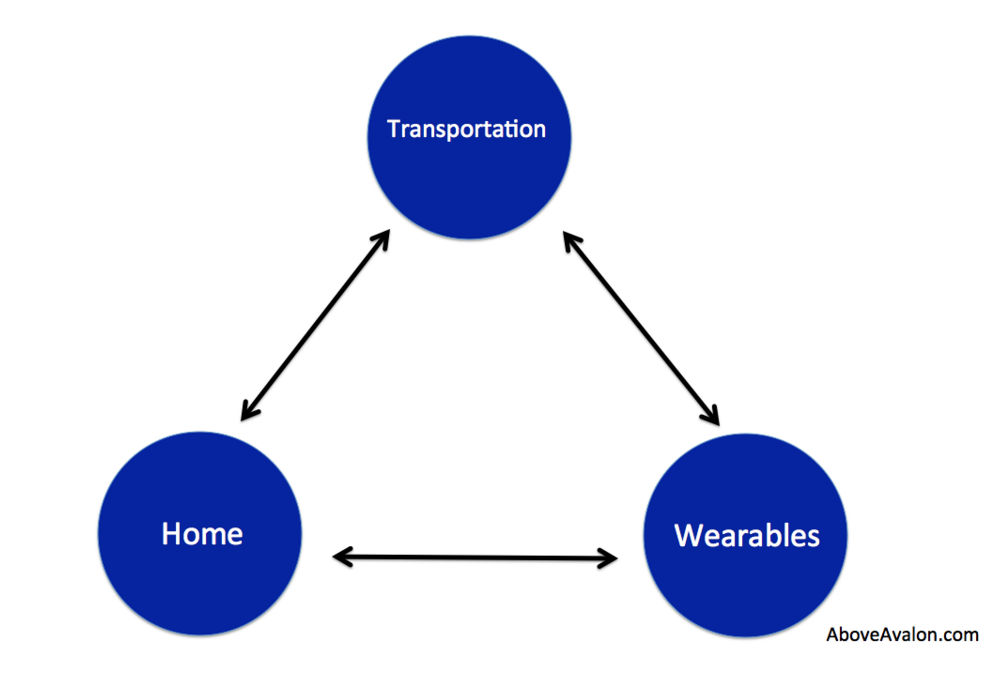
While the world is still preoccupied with wondering what comes after smartphones, notice how much progress Apple has made in moving beyond the iPhone (Exhibit 5). The Apple Watch is on the market, and signs point to Apple coming up with additional devices for different parts of the body. Meanwhile, Apple is busy building its largest startup ever. The iPhone company is planning for a day when it is no longer the iPhone company.
Receive my analysis and perspective on Apple throughout the week via exclusive daily updates (2-3 stories per day, 10-12 stories per week). Available to Above Avalon members. To sign up and for more information on membership, visit the membership page.
The Two Apples
There are two Apples: AAPL, the stock, and Apple, the company. While it would seem logical that one is merely a reflection of the other, in reality, the two are guided by vastly different parameters. Over the long run, Apple and AAPL will likely be at odds with each other due to the very nature of Apple's long-term mission of making products that people love. It is the classic Wall Street vs. Silicon Valley battle, and 2015 was likely just a taste of what is to come.
AAPL's 2015
It would be an understatement to say that AAPL had a weak 2015. When looking at stock price performance, AAPL's underperformance was quite striking. While GOOG, FB, and AMZN saw strong double-digit stock price increases, AAPL reported a rare 3% decline, the first annual decline since 2008. Even more striking, AAPL's performance meant that the market removed $46 billion of market cap from AAPL in 2015, whereas AMZN and GOOG were given nearly $350 billion of additional market capitalization. Exhibit 1 highlights the dramatic performance difference between AAPL and its large cap tech and mobile peers as well as the major indices.
Exhibit 1: AAPL Underperformance in 2015
Apple's 2015
Even though AAPL shares recorded a remarkably weak year, Apple, the company, had a much more successful 2015. As it did in 2014, the Apple machine spent most of the year operating at full speed. In what should not come as much of a surprise, Apple updated the vast majority of its product line. The iPhone's continued rollout at China Mobile led to a large wave of new users entering the iOS ecosystem in 2015, leading to iOS making further inroads in its battle against Android. Apple unveiled the iPad Pro and related accessories as a way of defining the iPad's category future.
While Apple's services were said to have experienced more of a mixed bag in 2015, it is difficult to call Apple's new products flops. The Financial Times reported Apple Music having 10 million paying subscribers in six months, positioning the service well in its long-term goal of finding sustainability for the music industry. Meanwhile, Apple Pay saw a successful rollout in the U.K., although retailer support in the U.S. remains disappointing. New services such as Apple News were positioned as a way to keep users' attention hooked on Apple properties while using Apple gadgets.
Apple launched its first new product category last year with Apple Watch, and despite the tech press not quite understanding the device, the device's early sales success reveals Apple has a hit on their hands.
However, the primary takeaway from Apple's 2015 wasn't related to any one particular product but rather the transformation Apple began to show in terms of embracing a new type of luxury. The ramifications from this change will likely play themselves out over the next 5-10 years. Once Apple began selling a $17,000 Apple Watch, the company was never going to look the same. This change will manifest itself in terms of Apple's ongoing quest to make technology even more personal.
Given all of these constructive long-term fundamentals, how did AAPL register such a weak 2015, underperforming its peers by a wide margin? AAPL, the stock, and Apple, the company are each guided by vastly different ideals and parameters.
AAPL: The Story
At a very fundamental level, a share of company stock provides an investor a way to own that company's balance sheet, including income-producing assets. The degree to which these assets can be utilized to generate future cash flows helps investors determine how much a share should be worth. With every investor having different expectations and required returns from a company, a stock's ultimate value is determined in the marketplace as the point at which demand for those shares (buyers) equals supply (sellers). In 2015, the marketplace determined that Apple was worth $46 billion less at the end of the year compared to January 2, 2015.
Stories are important on Wall Street, and the story surrounding AAPL took a decidedly negative turn in 2015. While some will point to concerns surrounding slowing iPhone 6s and 6s Plus sales as leading to AAPL's first annual stock price decline in years, there are likely other, much more significant issues at play. Wall Street wants predictability or at least the appearance that things will be predictable in the future. AAPL has very rarely been able to give investors that sense of predictability. Just look at the sources of Apple's revenue over the past 15 years. Apple has gone from being the "iPod company" to the "iPhone company," and now there are genuine questions as to where the company goes from here.
Meanwhile, just as skepticism around AAPL began to take over, the stories developing around some of Apple's largest peers grew noticeably more optimistic in 2015. It should not be ignored that much of this renewed optimism surrounded founder-led companies: Alphabet, Facebook, and Amazon. For Alphabet and Facebook, the narrative switched to how the two companies are able to make money from giving away products for free, a strategy in which each party to the transaction is paying in different ways. For advertisers it is cash, while for users it is time and attention (not to mention data). Meanwhile, Amazon took the bear case surrounding its stock and flipped it on its head by purposely showing that Amazon could be much more profitable if management chose to be. Not to mention, the company is seeing sheer success in terms of e-commerce.
Where does AAPL fit into all of this? What is the narrative surrounding the stock on Wall Street? Apple is the company searching for the next big thing. There continues to be skepticism that management will be able to grow profits from hardware in a world being overtaken by software and cloud services. Investors are also showing a lack of confidence that iOS and Mac users will stay within the Apple ecosystem, paying for new services and buying new products. AAPL investors need confidence that Apple will be able to utilize its balance sheet to supply a particular level of cash flows in the future. The belief is that AAPL will have trouble maintaining its current success. Even though Apple may be strong today, Wall Street has concerns about the Apple of tomorrow.
Apple: Embracing the Unknown
Just as Wall Street is nervous about AAPL's changing revenue sources, Apple's ultimate success is built on that very ideal. Even though Apple was the "iPod company" yesterday and the "iPhone company" today, management's goal is to make sure that Apple will one day be known as something else, such as the "car company" or the "personal transport company." This isn't to suggest that Apple will change its culture and mission statement depending on where growth can be found. Instead, management looks to enter product categories that make it possible to advance Apple's goal of making technology more personal. In the beginning, such a goal was achieved with the Mac but soon included the iPod, then iPhone and iPad, and now Apple Watch. Exhibit 2 highlights Apple's changing revenue mix since 2002.
Exhibit 2: Apple Revenue Mix
Note: Adjusted revenue excludes revenue from non-core product groups.
When news broke that Apple was interested in designing its own electric car, reactions seemed to fall into two buckets. Some saw what had to be faulty reporting or a company that is unsure where to turn next in the face of slowing smartphone sales. Many seasoned tech industry watchers could not come to believe the thought of Apple, the maker of pocketable gadgets, designing a car. The "expanded CarPlay" narrative spread like wildfire, almost as a way to make sense of the Apple Car madness, even though that reasoning demonstrated a fundamental misunderstanding of Apple. Meanwhile, the other type of reaction was based more on how Apple actually looks at the world, searching for opportunities to rethink how things are done.
Apple management has one goal: make products that people love. The iPod met that goal just as the iPhone and iPad went on to do the same. Evidence is now pointing to the automobile industry as being ripe for Apple to place a big bet. Throughout 2015, we learned of Apple's developing interest in cars as Apple was meeting with contract manufacturers in Europe, talking with BMW, looking into autonomous testing centers, hiring automotive personnel, and of course, beginning to leave more subtle hints in interviews and keynotes. We saw the early signs of Apple laying out its future.
Meanwhile, there has been no denying that the Apple Watch was put through the expectations wringer in 2015. From being labeled as Apple's next big thing since iPhone, something Apple didn't do much to tamp down, expectations quickly did a 180 degree turn and focused on how the Apple Watch seemed like a flop. In reality, Apple's prior success altered the definition of a flop.
Apple's long-term success is based on not being afraid to embrace the unknown. The willingness to place big bets in industries outside their historical core competency is management's strategy for keeping Apple relevant.
The Divide
While AAPL investors look at changing revenue sources and Apple entering new industries as risk factors, for Apple such characteristics are normal business and according to plan. It is this divide that will likely continue indefinitely, suggesting it is unwise to expect AAPL to one day begin to follow Apple. Just as a declining AAPL stock price is no indication of a struggling Apple, there will likely come a time when AAPL outperforms peers even though Apple, the company, may be struggling.
One may ask if this type of divide between the two Apples exists with other companies. While it is is true that every stock is ultimately guided by different parameters as opposed to the company it represents, there are very few companies that are trying to follow Apple's strategy. Competitors may say they are interested in following the Apple path of keeping as many mistakes as possible in the design labs, leaving just a very few big bets for the public marketplace, but few practice the strategy. In addition, there are few companies with the corporate structure and culture needed to back up such claims.
From a historical perspective, very few companies have been able to do what Apple is striving to do: remain relevant. While companies like Nike and Disney are often used as models for Apple, in reality, they aren't the best examples. Instead, a company like Sony does a much better job at showing what Apple is trying to avoid: losing sight of the hockey puck and not knowing where it is headed. To accomplish this goal, Apple will need to reinvent itself. If that wasn't difficult enough to do, to expect Wall Street to get behind Apple and such reinvention is overly optimistic.
Management's Plan of Attack
If this divide between AAPL and Apple is expected to continue indefinitely, management doesn't need to just sit by idly. Capital management actions can be positioned to utilize this ongoing divide between how the world looks at AAPL and Apple's quest for the next big thing.
If Apple is all about moving from product to product, there will undoubtedly be periods when Wall Street will turn sour on the company. It will be at these times that Apple should use capital management tools to take advantage of what management deems market dislocations. The key to buying back shares is to do so at a valuation that management thinks the market is incorrectly reaching. When it comes to Apple, the time at which this condition will best be met is when Apple thinks it has found the next big thing while Wall Street continues to doubt. We saw this play out in early 2014 when Tim Cook disclosed to the WSJ that management had been buying a record amount of AAPL shares after reporting a "lackluster" earnings report. Taking a look at the subsequent Apple Watch launch seven months later, it is not difficult to see that management was well aware that Apple Watch would be soon launching, and management felt confident this would be the first new product category under Tim Cook.
If there is one consistency with Wall Street it is that stories change. There will come a time when investors turn more positive on AAPL. Instead of thinking investors finally "got it," in reality, that will be the time when it is even more important to analyze Apple's quest to remain relevant. Estimating future cash flows may be a science, but coming up with products that people love is an art.
Receive my exclusive analysis and perspective about Apple throughout the week (2-3 stories a day, 10-12 stories a week). For more information and to sign up, visit the membership page.
Introducing New Membership Features and a Slack Team
I'm excited to announce a number of new features attached with Above Avalon memberships. Last May, I began writing daily analysis and perspective about the world of Apple and sending it exclusively to members. How have memberships been going? Great. Things have exceeded my expectations. With members from 38 countries, holding various backgrounds and areas of expertise, a vibrant member community has been formed in just eight months. In terms of numbers, I'm fortunate to have recently raised my one year subscriber goal.
New Features for Members
Archive. Beginning this week, Above Avalon members now have access to all previous analysis and perspective sent to members. While Daily Updates sent to members are timely and focused on current news events, they include stories that are also quite valuable for future reference. In addition, an archive makes it possible for me to seamlessly link back to previous articles, which was not possible before.
The archive is found within the Above Avalon team in Slack.
New Above Avalon Team in Slack. Let me cut to the chase. Slack is the future, available today. I'm not a fan of web forums for many reasons, so I never had an interest in having an Above Avalon member forum. However, after jumping with both feet into Slack, it quickly became obvious that this is something with which I want to associate with Above Avalon. Since more than a few Above Avalon members were already familiar with Slack, I knew the transition would be easy. Over time, I think most teams as well as subscriber and hobby groups will be on Slack. With great iOS apps available for iPhone and iPad and a nice web interface for Mac and PC, Slack has everyone covered.
The Above Avalon team in Slack is a great place to meet and communicate with members from various industries including tech and finance circles. There are four primary channels or "forums":
- dailyupdates_archive - An archive of Daily Updates sent to members.
- dailyupdates_comments - A place to talk about the Daily Updates with the group.
- intros - A place to introduce yourself to the group.
- random - A place to chat about various topics.
- thursday_qa - An opt-in channel for asking questions to be answered in Thursday Q&A, a feature where I answer a few member questions each Thursday.
It was very important to me that these new features be positioned to increase the value of Above Avalon memberships. This means that joining the Above Avalon team in Slack is optional. All of my analysis and perspective can be found in the daily emails throughout the week. I will not post exclusive content in Slack. If you don't join the Above Avalon team in Slack, you will still receive much value with your Above Avalon membership. That was a key consideration to make Slack opt-in and not a mandatory signup.
Additional Ways to Consume Analysis. While all Daily Updates will continue to be written for easy email consumption and sent daily via email, members now have additional ways to consume stories including RSS, Twitter and Slack.
RSS: Available here (membership is required to read content)
Twitter: Available here (anyone can follow, but membership is required to access full content)
Members continue to have the option of a consolidated weekly version of the daily emails for those who prefer to have everything in one spot delivered right to their inbox.
Subscribe
Membership is the only way to get the full Above Avalon experience and receive all my exclusive analyses and perspective on Apple. My Apple analysis is focused at the intersection of Wall Street and Silicon Valley. I am a former Wall Street analyst with a finance/engineering background. Accordingly, topics will range from Apple financial modeling to product marketing and business strategy. In addition, I cover all of Apple's competitors and the industries Apple is either operating in or looking to enter in the near future.
A subscription costs $10/month or $100/year. For more information, click here. There is also a membership FAQ here. You can subscribe using the signup forms below.
Please contact me directly if you would like to purchase multiple subscriptions (five or more) for your team or company.
Apple Questions for 2016
I'm not a fan of prediction posts at the start of each year. Instead, the much more valuable way to prepare for the new year is to embrace the unknown. By formulating and organizing a series of questions, it becomes that much easier to assess a company's strengths, weaknesses, priorities, and opportunities over the next twelve months. Here are my Apple questions for 2016:
Apple Watch
Apple Watch 2. The Apple Watch has become a litmus test for Apple's ability to create compelling new product categories. What features will Apple look to improve when the Apple Watch is updated in a few months? There is low-hanging fruit in terms of features that can see improvement, including an Apple S2 chip and slightly better battery, although the device's small footprint should be taken into consideration when thinking of realistic near-term advancements. Will Apple push ahead with health and fitness and include additional health-related sensors in Apple Watch 2? In addition, how much change will Apple push in terms of the device's physical design attributes?
New Watch Bands. Management has been very vocal in pushing the theme of buying additional watch bands to personalize Apple Watch. After only five months on the market, Apple unveiled a range of new Sport bands this past September, including a new leather band option. Will Apple come out with a range of new Watch band options for both the Sport and Watch collections alongside updated Apple Watch cases? It is important to remember that the Watch bands themselves will likely one day contain sensors and play a more vital role than just being a fashion item.
Pricing. Will Apple maintain its current Apple Watch pricing? With the vast majority of Watch sales attributed to the Sport collection, the $349 and $399 entry-level models will be the key ones to watch going forward. It is not a given that Apple will keep selling the original Apple Watch alongside Apple Watch 2. There would be historical precedent for Apple to stop selling the original Apple Watch once the new Apple Watch is released, similar to what occurred with the iPhone and iPad. This has a major implication on Apple Watch pricing as Apple would not have a year-old model to sell at a lower price like we see with the iPhone and iPad in recent years. At the same time, Apple likely has fresh data on how Watch sales fare at lower prices considering Best Buy and Target had $100 off Watch promotions.
Sales Disclosure. Will Apple begin to break out Apple Watch sales numbers in 2016? It is not a question of "if" but "when." From management's viewpoint, there are pros and cons to not revealing Watch sales but at a certain sales point, the material nature of the sales will be too much to keep hidden in the "Other Products" line item.
Marketing. Where does Apple plan on taking Apple Watch marketing? We have already seen some changes in the way Apple describes the Watch with its TV ads, moving away from the "iPhone on your wrist" messaging and embracing a fun device that can do a number of small, convenient tasks.
Apple Watch Edition. Leading up to the Apple Watch launch last year, the Apple Watch Edition collection received an oversized amount of attention. However, in recent months there has been little press attention given to the collection. Will Apple sell new Watch case materials, such as platinum or white gold, for the Edition collection? When considering that success for the Edition collection is not measured by unit sales, Apple is likely judging the collection by other factors including material design and allure. Will we get any evidence to suggest if management is pleased with how the world has embraced the Edition collection?
New Luxury Partnerships. Will Apple launch another Apple Watch partnership? Apple's Hermès partnership may end up being one of the sleeper hits of Apple Watch's debut year, as Apple combined the worlds of traditional luxury with personal technology. Additional partnerships involving luxury brands holding notoriety around precious metals would be a logical next step.
iPhone
The 4-inch iPhone. Is Apple planning on positioning a new 4-inch iPhone as a way to entice iPhone 5/5s/5c users to upgrade? There is no question that iPhone unit sales growth will slow in 2016 compared to 2015, a byproduct of strong iPhone 6 and 6 Plus sales in 2015 and what appears to be a slower iPhone upgrade cycle with the 6s and 6s Plus. A new 4-inch iPhone would be positioned as a catalyst to get current 4-inch screen iPhone users to make the jump.
iPhone 7. Similar to every other annual iPhone release, Apple will strive to have three or four headline features with the iPhone 7. Will Apple remove extra bezel from the iPhone in order to make current screens feel a bit better in hand? In addition, an iPhone without a home button seems like an evolutionary next step, although it may be too big of a jump to take in the near-term with current iOS software. The biggest questions surrounding new iPhones relate to the Plus model. Will Apple begin to differentiate the iPhone Plus model beyond just screen size? Adding greater differentiation within the iPhone line would help in terms of ASP trends as well as better position the iPhone as a PC/Mac replacement.
iPhone Upgrade Program. The highlight from Apple's "Hey Siri" keynote this past September was the iPhone Upgrade Program. Creating a process for users to easily buy a new iPhone every year directly from Apple has very significant ramifications in terms of the iPhone upgrade cycle. Currently the service is only available in Apple Retail stores in the U.S. Will Apple extend the iPhone Upgrade Program to additional countries, in addition to bringing the service online?
iPad
New iPad Pro. The iPad Pro was the most noteworthy development for iPad in years. A 12.9-inch screen, combined with four stereo speakers, and productivity accessories, position the iPad Pro as the iPad's future. The iPad Pro pushes the larger iOS multi-touch tablet category forward by distinguishing itself from larger iPhones and smaller Macs. Will Apple push an iPad Pro update in 2016 or should we expect a longer update cycle?
iPad Sales. Will we see early signs of iPad sales bottoming in 2016? The addition of the Pro model to the lineup will help offset some of the iPad mini sales declines, although the much bigger trend of larger iPhones cannibalizing iPad mini will continue.
iPad Air 3. Apple did not update the iPad Air in 2015. Accordingly, does Apple plan on updating the Air in 2016?
Apple Pencil. Will Apple ship a new Apple Pencil and extend Apple Pencil support to other iOS devices? The Apple Pencil is the most intriguing Apple accessory in 2015 with a clear directive of being used to mark, draw, or write, and not navigate. Such tasks may end up serving as a clue that Apple does not plan on expanding Apple Pencil support to other iOS devices in the near term.
iOS
iOS 10. What will be the main features in iOS 10? The iOS home screen has been a crucial part of the iPhone user experience from the beginning. However, there are certain elements that are starting to feel a bit dated. I'm using the Spotlight search screen more frequently, and the addition of 3D Touch adds a new element to the conversation. Is Apple planning on rethinking the iOS home screen in iOS 10? Look at the iPad Pro's Springboard, and it becomes easier to conclude: yes, Apple may have something new planned for the home screen.
App Store Debate. Up to now we really haven't seen much of a debate concerning the App Store (across all platforms). Developers have been increasingly vocal with their concerns surrounding app developer sustainability, while Apple has followed its playbook closely, listening much more than acting. With Phil Schiller now overseeing the managerial aspects of the App Store, one would expect Apple to increase its communication efforts with developers leading to an actual debate where we hear two sides of the argument.
Mac
Trickle Down MacBooks. Apple's new $1,299 MacBook was the Mac highlight of 2015. The major theme to watch is Apple bringing features found in the new MacBook to other models in the Mac lineup.
ARM-Based MacBook. Will Apple announce an ARM-based MacBook running an iOS derivative? There have been clues that such a move may be in the pipeline.
Project Titan (Apple's electric car)
Construction/Real Estate. Apple acquired a significant amount of land in North San Jose through a series of closely guarded transactions in 2015. My theory is that this land is related to R&D facilities for Project Titan. Will we see Apple's plans for this North San Jose land begin to materialize in 2016? The level of progress seen in North San Jose may provide clues as to Project Titan's timeline.
Employee Hires & Fires. One of the more tangible ways of monitoring Project Titan progress is to look at employee moves. Will Apple have any additional high-profile Project Titan hires in 2016? Contrary to consensus expectations, Apple may turn to the legacy auto industry for talent, similar to hiring Doug Betts from Chrysler. Even though Apple is focused on rethinking what it means to build and sell an automobile, such legacy auto hires have experience and background that will prove helpful for Apple.
Regulatory Filings. The automobile space is unique compared to previous industries Apple has operated in given the much higher level of government regulation. Apple will need to adapt to these regulations, possibly providing a few early Project Titan clues for those closely monitoring Apple's every move.
Services
Apple Music. All indications point to Apple Music currently appealing to a small base of iOS users (5-10M members) and to a lesser extent, Android users. Will Apple lobby the record labels to lower the $9.99 monthly membership price in order to attract a wider base and compete with Spotify?
Apple Video. Bloomberg reported that Apple suspended its plans to launch a slimmed-down cable bundle. Will content companies have second thoughts and be willing to cooperate with Apple in order to launch some type of new package?
Apple Pay. Despite improved financial institutional support, retailer support is still lacking, especially when it comes to reaching universal support. How will Apple increase customer awareness of Apple Pay, in addition to achieving much broader retail support?
Financials
Share Buyback. Management spent the second half of 2015 buying as many AAPL shares as possible with the stock price declining in the face of slowing economic growth in China and concerns surrounding iPhone 6s and 6s Plus sales. Given Apple's current valuation of 10.8x forward earnings (6.9x forward earnings excluding cash and cash equivalents), how will management and the board respond when it comes time to update Apple's buyback authorization in April?
Dividends. Apple's board is expected to increase the quarterly cash dividend in April. What payout ratio does the board feel comfortable targeting given Apple's cash needs for organic growth?
Foreign Tax Reform. In what is turning into a reoccurring question, will we see any U.S. tax reform regarding taxation of overseas profit? Apple currently has $187 billion of cash and cash equivalents held overseas.
EU Tax Investigation. The European Commission is expected to announce its decision regarding Apple/Ireland's tax dealings sometime in 2016. What financial impact, if any, will Apple face? If using the recently announced Apple settlement with Italian authorities regarding taxation as a barometer, the European Commission's investigation into Ireland's Apple tax treatment may result in some type of payment from Apple. Overall, there is skepticism that any judgment against Apple would result in long-term headwinds for the company or stock.
R&D Expense. Apple's R&D expenditures increased dramatically during the summer of 2014 and remained elevated throughout 2015. Should we expect Apple's R&D to continue to outpace revenue growth in 2016?
Management
Jony Ive. It has been approximately six months since Jony Ive officially relinquished day-to-day managerial control over Apple's industrial and software design teams. How will this change manifest itself in Apple product development in the long-run? There is little to no evidence to suggest much will change. However, additional time is the only way to confirm that the managerial change has been effective.
Executive Turnover. With Apple Watch's debut now completely in the rearview mirror and the next big thing (Project Titan) likely at least two years away, will any senior Apple executives decide now is the time to retire/take a break? On the surface, no one executive comes to mind as being close to the exit door. Phil Schiller was recently given additional responsibilities while Cue, Federighi, Maestri, and Ahrendts are only now hitting their stride.
Project Titan Leadership. Similar to Jeff Williams being put in charge of the Apple Watch team, when will Apple place a senior executive to oversee Project Titan? The logical choice is once again Jeff Williams, although this appointment may end up occurring in 2017 or later.
Jeff Williams. Speaking of Apple's new COO, his stock is on the rise within Apple. Given Williams' increased visibility in 2015, should we expect Williams to play an even bigger role in Apple keynotes and the company's public image?
Kevin Lynch. Will Kevin Lynch's stock continue to rise in Apple? The leader of Apple Watch software appears to be in a position of increasing power within Apple, and any continued move into wearables will only result in additional attention being given to Lynch.
Wildcards
New Marketing Direction. Apple's hire of Tor Myhren as VP of Marketing Communications is intriguing on many levels. What should we expect from Myhren? With such a well-regarded and surprising senior hire, it is safe to expect something big in terms of Apple marketing campaigns from this development.
Carl Icahn / Shareholder Activism. The longer a public company sits on a strong balance sheet while experiencing a declining valuation and languishing stock price, the more likely investors will become agitated. Even though Carl Icahn continues to pledge his support for Tim Cook and the rest of the management team, it would not be surprising to see individual Apple shareholders become a bit more vocal with "suggestions" for Apple on how to increase its valuation.
M&A. In what areas does Apple feel the need to bolster its resources in 2016? Apple has been quite active on the M&A front in recent years and after considering Apple's product pipeline, continued M&A activity related to augmented reality and personal transport seems likely.
A New Kind of Wearable Device. With a finished product from Project Titan still a few years out and the Apple machine busy cranking out iPhone, iPad, and Mac updates, the wearables category represents the best wildcard for a completely new Apple product. The leading candidates for new Apple wearables include a ring and wireless EarPods, both of which would be positioned as health-related iPhone accessories.
The Apple news, products, and events not reflected in any of these bullet points represent the unexpected.
Receive my analysis and perspective on Apple throughout the week via exclusive daily updates (2-3 stories per day, 10-12 stories per week). Available to Above Avalon members. To sign up and for more information on membership, visit the membership page.