


Above Avalon Year in Review (2021)
Heading into 2021, Apple had just gone through one of the more tumultuous years in its existence. As discussed in last year’s Year in Review, the pandemic turned 2020 into a steady stream of unexpected challenges for Apple. Expectations that 2021 would be much smoother turned out to be optimistic. While society did largely open up halfway through the year, which allowed Apple’s retail apparatus to return to normal operations, Apple continued to face once-in-a-few-decades challenges when it came to the supply chain, product manufacturing, and navigating its 154,000 employees through a pandemic.
According to my estimate, Apple experienced $10 billion of unmet demand in 2021 as a result of supply chain issues. This total is on top of lingering demand issues associated with wearables that arose from the pandemic.
Despite the challenges, 2021 was a record year for Apple on a number of business fronts:
Apple sold 260M+ iPhones - a record high for a 12-month period.
Apple sold 25M Macs - a record high for a 12-month period.
The Apple Watch installed base surpassed 100 million people.
Articles
In 2021, I published 10 Above Avalon articles. In looking through the articles, which are accessible to all, there was one overarching theme: Apple’s ecosystem continues to gain strength and is ready for the next major product category launch (a mixed reality headset).
Here are a few of my favorite articles published in 2021 (in no particular order):
Apple Has a Decade-Long Lead in Wearables. AssistiveTouch allows one to control an Apple Watch without actually touching the device. A series of hand and finger gestures can be used to control everything from answering a call to ending a workout. The technology is just the latest example of how Apple’s lead in wearables is still being underestimated. The evidence points to Apple having a wearables lead of not just a few years, but more like a decade.
Apple Won the Share Buyback Debate. I receive many questions about Apple from Above Avalon readers, listeners, and members. In previous years, one topic has been far ahead of any other as a source of questions. Everyone wanted to know about Apple’s share buyback program. Something interesting happened in 2020. I received far fewer questions about Apple’s share buyback program. To be precise, I didn’t receive an incoming question about buyback in nine months - from when the stock market put in a bottom in April 2020 to the start of 2021. What explains such a dramatic change? The Apple share buyback debate ended, and Apple was declared the winner.
Apple’s Extremely Quiet Year for M&A. While going through Apple’s 10-K for FY2021, one number jumped out at me. It wasn’t the record iPhone sales, strong margins, or phenomenal free cash flow. Instead, it was the lack of cash spent on M&A. In 2021, Apple spent just $33 million on business acquisitions (M&A). That’s a record low for Apple with Tim Cook as CEO. It’s a number that deserves further investigation as Apple’s M&A strategy and philosophy play a big role in how Apple was able to get to where it is today.
The five most popular Above Avalon articles in 2021, as measured by page views, were:
Podcast Episodes
There were 11 episodes of the Above Avalon podcast recorded and published in 2021, totaling 4.5 hours. The podcast episodes that correspond to my favorite articles are found below:
Charts and Exhibits
The following charts and exhibits found in Above Avalon articles published in 2021 were among my favorites.
Apple Wearables Unit Sales (2017 to 2021) - from Apple Has a Decade-Long Lead in Wearables
According to my estimate, Apple is on track to sell 105 million wearable devices in 2021. That total represents 40% of the number of iPhones sold during the same time period. Unit sales don’t tell the full story, however. On a new-user basis, Apple is seeing more people enter the wearables arena than buy a new iPhone for the first time.

Note: Apple wearables include Apple Watch, AirPods, and select Beats headphones.
Percentage of Apple Revenue Through Direct Distribution Channel - from The Future of Apple Retail
The percentage of sales going through Apple’s direct distribution has gradually increased in recent years. The increase in sales percentage has likely been boosted by services revenue, more sales going through Apple’s website, and more iPhone upgrading taking place through Apple.

Note: Direct distribution channel includes Apple’s website, Apple stores, and direct sales force.
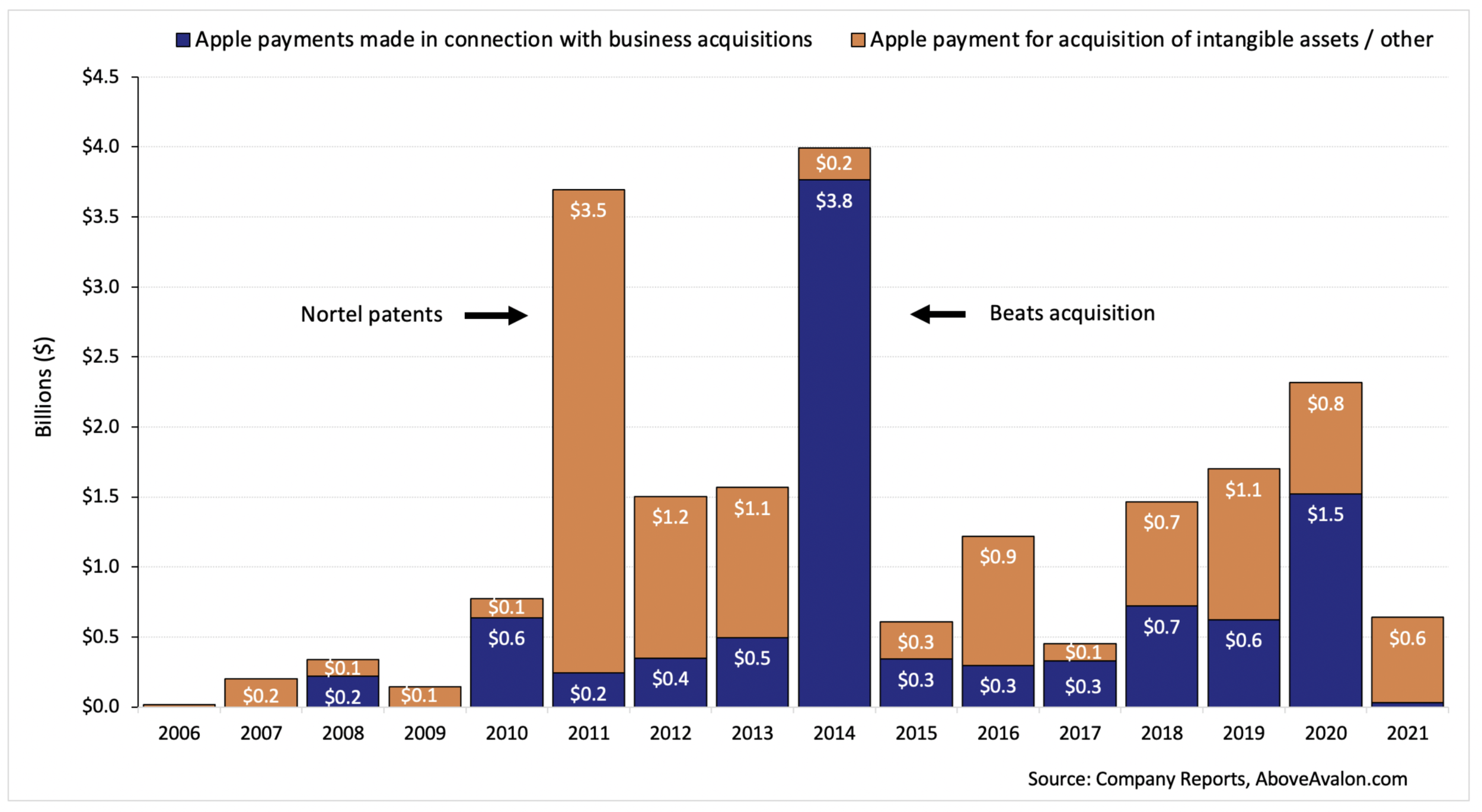
Apple M&A (Cash Payments) - from Apple’s Extremely Quiet Year for M&A
Since 2006, Apple has spent $20.6 billion on M&A with about half of the total tied to “business acquisitions.” The median is $1 billion per year. However, in 2021, Apple spent just $33 million on business acquisitions. That is the lowest amount since 2009 when Steve Jobs was still Apple CEO.
Daily Updates
In 2021, I published 182 Above Avalon Daily Updates that were available exclusively to Above Avalon members. With each update coming in at approximately 2,000 words, 182 updates are equivalent to five books. This continues to be an industry-leading number when it comes to the amount of Apple business and strategy analysis published.
When looking over the topics discussed in this year’s daily updates, a few sub themes become apparent:
Project Titan Moving Forward
Along with mixed reality and AR, transportation is one of the largest areas of opportunity when thinking of future Apple products and services. The year turned out to be the busiest one yet when it came to Project Titan news as Apple began to seek supply chain and manufacturing partners.
Hyundai Confirms Talks With Apple, Apple Considering Car Factory in Georgia, Making Sense of Apple and Hyundai News (Jan 12, 2021)
Apple Car and the Last Mile, Revisiting an Apple Campus Shuttle Service, Thursday Q&A (Feb 4, 2021)
Apple’s Kevin Lynch Joins Project Titan, Apple Car Implications, Apple Watch Implications (Jul 19, 2021)
Doug Field Leaves Apple for Ford, Project Titan’s Trajectory and Leadership, Silicon Valley vs. Detroit (Sep 8, 2021)
Kevin Lynch Tapped to Lead Project Titan, Disillusionment in the Auto Space Is Setting In, Ted Lasso Wins Big at the Emmys (Sep 20, 2021)
Changes in Paid Video Streaming Land
Given the rush of new players into the paid video streaming space in 2020, there was quite a bit of movement in 2021. AT&T’s decision to spin off WarnerMedia was an industry-shaking event. As the months went on, it became clear that many content distribution services were experiencing something equivalent to a pandemic air pocket as subscriber trends became noisy. Netflix and Roku ran into friction while the true new kid on the block (Apple TV+) regained momentum with new shows and movies coming online in the back half of the year.
AT&T to Spin Off WarnerMedia, HBO Max’s Future, Apple Implications May 17, 2021
WarnerDiscovery and Apple M&A, Ranking Paid Video Streaming Leaders, Netflix Contemplating Move into Gaming May 26, 2021
The App Store’s Day in U.S. Court
The well-publicized Epic Games vs. Apple trial resulted in a resounding legal victory for Apple. It ended up being difficult to grasp just how poor of a job Epic Games did in trying to paint Apple as a monopoly. While the court did order Apple to change its anti-steering provision in the U.S., Apple won a stay by a court of appeals. The outcome with the highest probability is for the anti-steering provision to remain as is which would signal Apple’s very strong legal footing as it pertains to the App Store.
Epic Games vs. Apple, Epic's Arguments Against Apple, Epic’s Motivation Apr 27, 2021
Thoughts on the Epic Games vs. Apple Ruling Sep 13, 2021
When looking at my daily updates published in 2021, selecting a few favorites out of 196 updates was not easy. The following updates stood out to me (in no particular order):
Warren Buffett’s Annual Letter, Apple Isn’t Buffett’s Token “Tech” Stock, Apple, Buffett, and Buyback. We kick off today’s update with my thoughts on Warren Buffett’s 2020 letter to Berkshire Hathaway shareholders. Berkshire is Apple’s largest individual shareholder. The discussion then turns to why I don’t agree with those claiming Apple is Buffett’s token tech stock. We conclude by looking at share buyback and how the capital return mechanism leads to a wealth transfer event. (Mar 2, 2021)
Peloton Recalls All of Its Treadmills, The At-Home Fitness Revolution Needs a Reset, Apple, Fitness Machines, and Gyms. Today’s update will be focused on the at-home fitness industry. It’s a market that Apple moved deeper into a few months ago with Apple Fitness+. A good argument can be made that at-home fitness impacts other Apple devices as well especially Apple Watch and Apple TV. We kick things off with my thoughts on Peloton recalling all of its treadmills. The discussion then turns to why I think the at-home fitness industry needs a reset. The update concludes with how fitness equipment safety, or the lack thereof, impacts Apple and why I continue to think there will be a role for gyms to play in the future. (May 6, 2021)
Tesla Buys Bitcoin, Apple and Bitcoin, Apple and Crypto Exchanges. Today’s update will be focused on bitcoin. We begin with news of Tesla buying $1.5B of bitcoin. We then turn to my thoughts on whether or not Apple should follow Tesla into bitcoin. The update concludes with a closer look at RBC Capital Market’s suggestion that Apple should move into cryptocurrency exchanges. We go over why I don’t think the firm’s analysis passes the small test. (Feb 10, 2021)
Apple’s Services Journey, A Different Way of Thinking of Apple One, Apple Services Evolution. For the first time in what feels like a long time, the Apple news cycle is taking a breather. This provides us with an opportunity to pursue some original topics. We kick off today’s update with my thoughts on the narrative surrounding Apple’s Services business. Things are starting to change. The discussion then turns to how I think about Apple’s Apple One bundle and how reframing Apple One leads to some interesting questions and ideas as it pertains to the competition. The update concludes with my thoughts on the future factors determining where Apple Services are headed. (Jul 13, 2021)
Niantic CEO Pours Cold Water on the Metaverse, Meta Buys Within, The Mistake People Are Making With the Metaverse. We kick things off with my thoughts on Niantic CEO John Hanke’s interview with The Verge’s Nilay Patel on his Decoder podcast. Hanke discussed some of the more intriguing topics and concepts found in the AR/VR/metaverse space. The discussion then turns to Meta (Facebook) buying Within. We go over two items that jumped out at me about the acquisition. The update concludes with the mistake that I see consensus making when it comes to metaverse analysis. (Dec 16, 2021)
The Amazon Event, Amazon’s Play for Neighborhoods, Amazon Astro. Today’s update will be focused on Amazon’s product event. We kick things off with my thoughts regarding Amazon’s product strategy involving ambient intelligence. The discussion then turns to Ring’s outsized presence throughout Amazon’s presentation. We go over Amazon’s play for neighborhoods and what is at stake. The update concludes with a closer look at the Amazon Astro. (Sep 29, 2021)
Here are the five most popular daily updates published in 2021 based on page views to AboveAvalon.com. There is naturally a tendency for updates published earlier in the year to outrank more recent updates.
Apple Designer Eugene Whang Left Apple, Apple Industrial Design Turnover, Spotify’s WSJ Op-Ed Against Apple (May 19, 2021)
Peloton Acquires Wearables Company, Peloton vs. Apple Watch, Facebook Talks Up Smartwatch as AR Controller (Mar 23, 2021)
Tesla’s Bitcoin Problem, Apple and Bitcoin Mining, Introducing My FY2022 Estimates for Apple (Feb 11, 2021)
Target to Open Mini Apple Stores, Apple’s Retail Store Growth Strategy, Thursday Q&A (Feb 25, 2021)
Apple Contemplating Apple Watch Explorer Model, Thinking About the Apple Watch Line, Apple Watch Partnerships (Mar 29, 2021)
Just 13% of the daily updates published in 2021 are highlighted in this article. The full archive consisting of all 182 daily updates is available here. Above Avalon membership is required to access the updates.
Daily Podcast
This was the first full year for the Above Avalon Daily podcast, the private podcast available to members who attached the podcast add-on to their membership. A total of 182 episodes were published, totaling nearly 40 hours of audio. The podcast allows members to consume the daily updates in new and different ways while around the house, on a walk, or in the car. Since launch, reception of the daily podcast has exceeded my expectations with very positive listener feedback. More information on the daily podcast, including a few sample episodes, is found here. Once an Above Avalon member signs up for the daily podcast, all prior episodes become available for listening in podcast players that support private podcasts.
Inside Orchard (Launched in 2021)
In March, I launched InsideOrchard.com as a home to my unique perspective on technology and its impact on society. Over the past nine months, 40 essays and corresponding podcast episodes were published. Although distinct from the analysis and discussion found with Above Avalon, the two sites can be thought of as siblings. A bundle consisting of both an Above Avalon membership and Inside Orchard subscription, with an accompanying price discount, was purchased by a good percentage of the Above Avalon member base.
Here’s to 2022
A big thank you goes out to readers, listeners, and members for making 2021 another successful year for Above Avalon. Have a safe and relaxing Christmas, holiday season, and New Year. See you in 2022. - Neil
Above Avalon Podcast Episode 188: Apple Closed Its M&A Wallet
(Episode 188 was published on November 20th.)
While going through Apple’s recently-filed 10-K for FY2021, one number jumped out at me. It wasn’t the record iPhone sales, strong margins, or phenomenal free cash flow. Instead, it was the lack of cash spent on M&A. In episode 188, we discuss the key takeaway found with Apple spending just $33 million on business acquisitions (M&A) in FY2021. The discussion includes Neil’s thinking as to what may be behind the multi-year low for M&A and an overview of Apple’s M&A strategy.
To listen to episode 188, go here.
The complete Above Avalon podcast episode archive is available here.
Subscribe to receive future Above Avalon podcast episodes:
RSS Feed (for your favorite podcast player)

Apple’s Extremely Quiet Year for M&A
While going through Apple’s recently-filed 10-K for FY2021, one number jumped out at me. It wasn’t the record iPhone sales, strong margins, or phenomenal free cash flow. Instead, it was the lack of cash spent on M&A. In 2021, Apple spent just $33 million on business acquisitions (M&A). That’s a record low for Apple with Tim Cook as CEO. It’s a number that deserves further investigation as Apple’s M&A strategy and philosophy play a big role in how Apple was able to get to where it is today.
Every quarter, Apple reports the amount of cash spent on M&A in the cash flow statement via “Payments made in connection with business acquisitions” within investing activities. The company also reports the amount of cash spent on acquiring intangible assets like patent portfolios via “Other” or “Payment for acquisition of intangible assets.” It is important to note these totals do not reflect payments tied with capital expenditures (property, plant, and equipment). For a company as secretive as Apple, these lines items are among the first things to check out when 10-Qs and 10-Ks are published. Only a fraction of Apple’s acquisitions are ever announced or known via press release or blog post. However, as the saying goes, cash flow doesn’t lie - whatever Apple spends on acquisitions will appear for all to see.
Exhibit 1 shows the amount of cash Apple spent on both business acquisitions (what most people commonly refer to as M&A) and acquiring intangible assets/other going back to 2006.
Exhibit 1: Apple M&A (Cash Payments)
Since 2006, Apple has spent $20.6 billion on M&A with about half of the total tied to “business acquisitions.” The median is $1 billion per year. However, in 2021, Apple spent just $33 million on business acquisitions. That is the lowest amount since 2009 when Steve Jobs was still Apple CEO.
I also examined Apple’s M&A history to count the number of deals by year. There is a major caveat found with such an exercise - I am limited to the number of known acquisitions. Given Apple’s secrecy, a number of acquisitions are never disclosed. To be fair, these unknown acquisitions tend to be small and usually involve teams of talent.
Exhibit 2: Apple M&A (Number of Deals)
Why was 2021 such a quiet year for Apple M&A activity? For many, the pandemic will probably be positioned as a logical explanation. With most teams working from home for a good portion of the year (Apple’s fiscal year starts in October), the environment may not have been right for M&A.
Diving deeper into that explanation, a number of logic holes appear. During the pandemic, there has been no overall decline in M&A activity in tech land. In fact, industry numbers point to a 50%+ increase in M&A activity as measured by deal count. A number of major acquisitions were also announced in FY2021 including Square/Afterpay, Microsoft/Nunance, and Salesforce/Slack. One could make the case that work from home actually contributed to an M&A bonanza as mid- and senior-level executives see and experience shortcomings in product portfolios.
My suspicion is that 2021 was a quiet M&A year for Apple given where the company finds itself from a product pipeline perspective. For the better part of the past five years, Apple’s mixed reality/AR plans have been the catalyst behind approximately 20% of Apple’s M&A deals. Apple’s foray into face wearables is now right around the corner - so close that the company likely has the main ingredients to get a V1 and V2 out the door without the need for additional M&A. Meanwhile, long-term R&D projects like Project Titan are still too far away to lead to a sudden M&A rush. Over the past five years, only three Apple acquisitions can be tied to its automotive ambitions.
We can’t underestimate another factor behind Apple’s quiet M&A year - Apple is doubling down on its long-held M&A philosophy. Apple does not use M&A to acquire revenue, users, or even products. Instead, Apple uses M&A as a tool to acquire talent and technology. There is a very simple thought process behind this philosophy. Apple feels that the product development processes already in place within the company lead to the best products capable of delivering premium experiences. Management is not interested in circumventing these proven processes by acquiring established products that have already gone through another company’s development process phase. Instead, Apple is looking to fill talent and technology holes that may become apparent during the product development process.
Apple’s Beats acquisition in 2014 wasn’t about Apple getting its hands on a wired headphones business. Rather, it was about music streaming assets (and the people behind such assets).
The Shazam acquisition in 2018 wasn’t about acquiring a network of users but rather about content recognition technology that could come in handy for AR and mixed reality.
Dark Sky wasn’t about acquiring App Store revenue via a paid weather app but rather about building the Dark Sky API (hyperlocal weather) into its wearables platform.
Beddit wasn’t about acquiring a sleep tracking accessory but rather about the complicated algorithms related to ballistocardiography - the method of detecting heartbeats and breathing rhythm from small movements like cardiac contraction force.
The reason Apple’s M&A strategy works so well for the company is that it keeps management focused on developing great products and not trying to quickly grow the user base or revenue. Such items (users and revenue) are byproducts of a successful product development process. Said another way, the way for Apple to succeed from a product and financial perspective is to bet on itself and the processes that it has developed over the past two decades.
This thinking plays a role in Apple’s share buyback strategy as well. For years, Apple has been criticized by outsiders for using excess cash to buy back shares instead of buying other companies. The suggestion that Apple should have bought Instagram, Disney, Spotify, Fitbit, Tesla, Peloton, and Netflix all miss a crucial point - they never consider how Apple thinks about the world. The way forward for Apple isn’t to use M&A to expand its product line with established products designed to stand on their own. Instead, it’s to use M&A to reinforce its product development processes by filling asset holes that will inevitably show up as Apple looks to enter new industries.
Listen to the corresponding Above Avalon podcast episode for this article here.
Receive my analysis and perspective on Apple throughout the week via exclusive daily updates (3 stories per day, 12 stories per week). Available to Above Avalon members. To sign up and for more information on membership, visit the membership page.
The Above Avalon Daily Update Recap (3Q21 Edition)
I publish exclusive daily updates all about Apple throughout the week. The updates contain my perspective and analysis on Apple’s business, product and financial strategy, and competitive relationships with a range of companies. The updates have become widely read and influential in the world of Apple and tech and are ideally suited to executives, investors, project managers, and hobbyists. When combined with the periodic articles and podcast episodes, which are accessible to everyone, the updates provide the full Above Avalon experience throughout the week.
During the third quarter of 2021 (July to September), 48 Above Avalon daily updates were published, chronicling both noteworthy industry and Apple-specific stories as well as my Apple research. The major themes discussed during the quarter included:
Developments in the App Store regulatory space (South Korea, Japan, Epic Games Vs. Apple trial).
Apple TV / paid video streaming industry developments.
Apple unveiling its Child Sexual Abuse Material (CSAM) detection plan and the resulting fallout.
Project Titan leadership changes and developments in the EV space.
The Above Avalon Daily Update Recap (3Q21 Edition) goes over these major themes and the corresponding daily updates.
(To access the following updates, become a member and then request access to the daily updates archive found in Slack.)
Developments in the App Store Regulatory Space (South Korea, Japan, Epic Games Vs. Apple trial)
After years of discussion and debate regarding Apple’s handling of the App Store, there was notable movement on the App Store legal and regulatory fronts. During 3Q, Apple notched two App Store victories in U.S. courts, South Korea rushed an anti-App Store bill through, and Apple began to loosen its grip on some of the more controversial App Store guidelines.
Apple Settles Class-Action Suit from U.S. Developers, Why Settle Now?, The iOS Developer Divide (Aug 30, 2021)
Thoughts on the Epic Games vs. Apple Ruling (Sep 13, 2021)
Peloton Earnings, South Korea Passes App Store Payments Bill, Apple Acquires Primephonic (Aug 31, 2021)
Sonos 3Q21 Earnings, Anti-App Store Legislation Introduced in Senate, The Bill’s Privacy and Security Exemption (Aug 12, 2021)
Apple TV / Paid Video Streaming Industry Developments
The paid video streaming industry continues to intrigue as it expands and evolves. There were a number of noteworthy events and developments during 3Q including Netflix’s move into gaming, a “Ted Lasso” bonanza, and the Netflix vs. Disney dynamic. I also went over my estimate for the number of Apple TV+ subscribers.
Netflix Moving Forward with Gaming, Entertainment Bundles Will Win, This Time Is Different for Games (Jul 15, 2021)
Netflix 2Q21 Earnings, Netflix Is Feeling Competitive Pressure, Netflix’s Video Gaming Strategy (Jul 21, 2021)
Apple’s Return to the Office Brouhaha, Apple Searching for Hollywood Hub, The Ted Lasso Effect (Jul 20, 2021)
Disney Earnings, Disney Will Surpass Netflix, Roku Earnings (Aug 23, 2021)
EU’s Vestager Threatens Apple, Video Streaming Box Market Shares, Peacock Signs Universal Deal (Jul 7, 2021)
Apple and the NFL, Disney’s Black Widow Opening Weekend, A Laptop Revival (Jul 12, 2021)
The Apple TV Debate Rages On, Apple’s Home Strategy, Smart Homes and Ecosystems (Aug 11, 2021)
Apple Unveiling Its Child Sexual Abuse Material (CSAM) Detection Plan and the Resulting Fallout
In August, Apple lit a firestorm of a debate by announcing a plan to combat child sexual abuse. The plan ended up drawing into question a number of philosophical questions as to Apple’s role in society and the company’s reason for being.
Apple Announces Expanded Protections for Children, Thoughts on Apple’s CSAM Detection, Apple CSAM and the Slippery Slope (Aug 9, 2021)
Apple Head of Privacy Talks CSAM Detection, CSAM Detection FUD, Apple and the Privacy High Ground (Aug 10, 2021)
Apple Releases Security Threat Model Review of CSAM Detection, Apple Doing Damage Control, Genuine Pushback to Apple’s CSAM Detection (Aug 16, 2021)
Project Titan leadership changes
Apple’e electric car project continued to move forward with a major leadership change as Apple Watch software chief Kevin Lynch replaced Doug Field as Titan head.
Doug Field Leaves Apple for Ford, Project Titan’s Trajectory and Leadership, Silicon Valley vs. Detroit (Sep 8, 2021)
Apple’s Kevin Lynch Joins Project Titan, Apple Car Implications, Apple Watch Implications (Jul 19, 2021)
Tesla Earnings, Elon Musk Goes After Apple Again, Musk Steps Away from Earnings Calls (Jul 27, 2021)
Follow the Tech Capex, Apple’s Reliance on Chinese Suppliers Increases, Foxconn Moving Forward With Car Factories in U.S. (Aug 18, 2021)
A few additional updates published between July to September stood out to me.
The Amazon Event, Amazon’s Play for Neighborhoods, Amazon Astro (Sep 29, 2021)
Square Acquires Afterpay, Square vs. Apple, The Future of Credit (Aug 3, 2021)
Apple’s Services Journey, A Different Way of Thinking of Apple One, Apple Services Evolution (Jul 13, 2021)
Above Avalon membership is required to read the preceding daily updates. There are two membership options available: $20/month or $200/year. The annual option amounts to a $40 discount. Payment is hosted and secured by MoonClerk and Stripe. Apple Pay is accepted. You can update your payment information and membership status at any time on this page.
Above Avalon Podcast Episode 187: Thoughts on Apple Watch Series 7
In episode 187, Neil discusses his initial observations wearing an Apple Watch Series 7. The episode also goes over Apple Watch strategy, puts the Series 7 into perspective, and discusses why Apple continues to sell Apple Watch Series 3.
To listen to episode 187, go here.
The complete Above Avalon podcast episode archive is available here.
Subscribe to receive future Above Avalon podcast episodes:
RSS Feed (for your favorite podcast player)

The Apple Watch Series 7 Is Great
Shortly after Apple’s virtual event last month concluded, some people wondered out loud if the Apple Watch Series 7 was a placeholder. The rumor hill was confident that Apple was going to extend the design language found with the iPhone and iPad by announcing an Apple Watch with flat edges. Instead, Apple unveiled an Apple Watch Series 7 display with curved edges. The apparent lack of other noteworthy features was then used by some as evidence of Apple rushing the Series 7 to unveil something in front of the holidays.
Nothing could be further from the truth.
For the past few days, I’ve been using an Apple Watch Series 7 (45mm - Aluminum Green). The best descriptive words regarding the Series 7 that come to mind are fun, fulfilling, and endearing. The Series 7’s targeted updates help to advance computing on the wrist while addressing some known friction points that had accompanied daily usage. There is nothing like the Apple Watch in the market, and Apple continues to run forward with a device ushering in a paradigm shift in computing.
The following are my initial impressions from using an Apple Watch Series 7.
Larger Screen. Apple Watch Series 7 marketing is anchored around the larger screen - and for good reason. Much to my surprise, reducing the display borders by 40% gives the Series 7 a completely different kind of Apple Watch experience. Instead of using the Series 7’s larger screen (20% larger than the Series 6) to include more text and information, Apple leveraged the additional screen real estate to make buttons and text larger. This was a smart decision. Instead of having Series 7 owners spend more time looking at their wrists, the larger screen makes it easier to quickly gather information and not get lost in the watch.
One way of describing the Apple Watch’s screen size changes over the years is that the Series 4 went after the low-hanging fruit. There was value found in simply fitting more stuff on a bigger screen. The Series 7 screen (50%+ larger than the Series 3) feels like the refinement step, focusing more on the finer things like larger font and click areas that end up having a larger impact on daily usage.
Larger Footprint. Apple Watch Series 7 has a slightly larger form factor than the Series 6 (45mm and 41mm vs 44mm and 40mm). The larger size on the wrist was not noticeable. The Series 7 Aluminum doesn’t feel heavier than the Series 6 either despite weighing 7% more. Weight becomes a bigger issue when moving to the Stainless Steel from Aluminum. As someone who has worn the Aluminum regularly for years, the Stainless Steel is too heavy for my taste. There will come a point at which the larger Apple Watch option starts to become unwieldy, but I don’t think we are at that point yet.
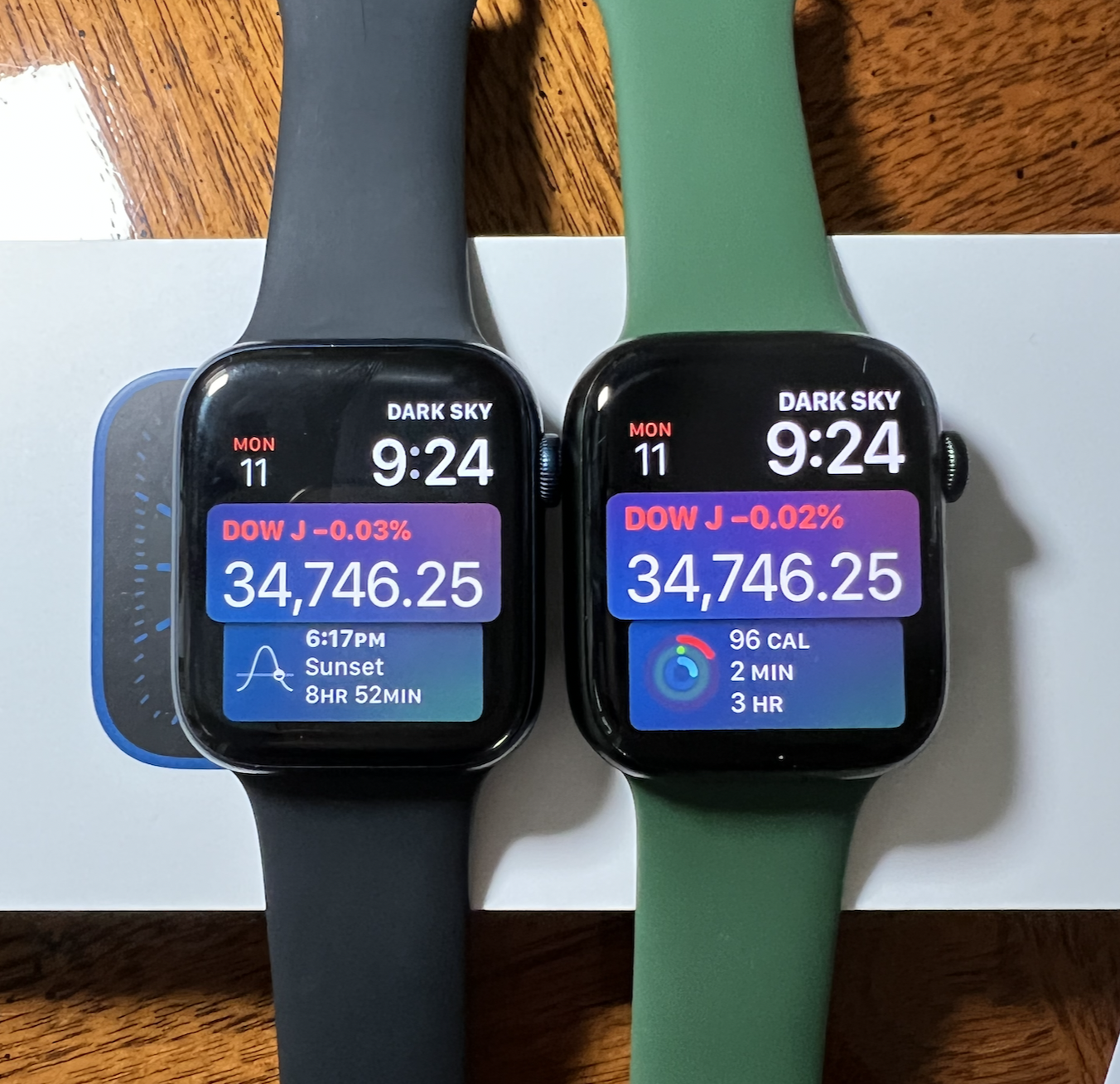
Apple Watch Series 6 (left) vs. Apple Watch Series 7 (right)
Setup. It took about 20 minutes to set up the Series 7 with an iPhone 13 Pro using Restore from Backup. Similar to how the iPhone setup process has become streamlined over the years, the days of needing to wait until the weekend to set up your new Apple Watch for fear of running into issues are over.
Brighter Screen. Similar to how the Series 7’s larger screen jumped out at me, the 70% brighter always-on screen was also noticeable. To the user’s eye, it pretty much seems like the Apple Watch screen has the same brightness regardless of one’s wrist position. With the Series 6, I found myself needing to tap the screen when in the “always-on” state and not in a direct line of sight because it wasn’t bright enough.
Color. Apple unveiled five new aluminum colors - Green, Blue, Product Red, Starlight, and Midnight. The green is very attractive, reminding me more of a greenish black. In certain light conditions, the Watch comes across as having a black case.
Battery Life. Apple has been following an “all day” battery life strategy for Apple Watch. Instead of removing Watch features to extend battery life to two to three days, Apple has strived to have Apple Watch battery life last as close to a full day as possible without the wearer needing a quick boost in the middle of the day. For the most part, Apple has been successful with that objective. Obviously, Apple Watch battery life is dependent on usage. Someone that goes heavy on workouts, podcast listening, and GPS will struggle getting through the whole day on a single charge. However, on average, the Apple Watch should last from a morning charge to getting ready for bed approximately 18 hours later.
In recent years, sleep tracking has complicated Apple’s battery goal for Apple Watch. It’s no longer enough for Apple Watch to last a full day. It also needs to last the subsequent night. Quick charge is Apple’s solution. In the amount of time someone takes to get ready for bed, an Apple Watch can get enough charge (~20%) to do six to eight hours of sleep tracking and then be ready for a longer (~45 minutes) charge in the morning.
Based on my rudimentary testing, the strategy holds true. Thanks to an updated charging architecture and fast-charging USB-C cable, I was able to charge the Apple Watch Series 7 from 0% to 82% in 45 minutes. That is favorable to Apple’s 80% battery charge in 45 minutes claim. As for Series 7 and Series 6 charging, I achieved 25% to 30% faster charging for the Series 7 using the same 20W USB-C power adapter for both the Series 7 and 6. Apple claims the Series 7 has “up to 33% faster charging” than the Series 6 when using a 20W USB-C power adapter with the Series 7 and a 5W USB power adapter with the Series 6.
In practice, does all of this battery life strategizing work for the average Apple Watch wearer? The short answer is “yes.” Most Apple Watch wearers will likely end up getting through the day and night on a single charge. A roughly 30 minute charge in the morning will then be enough to get through the following day. Of course, there is room for Apple to improve Apple Watch battery life. There will likely always be room for battery life improvement.
Full-Size Keyboard. Two words: scary good. I was impressed with Apple’s slide-to-text technology that relies on machine learning to predict what I’m typing. Heading into the Series 7, my view was that tapping or sliding on an Apple Watch screen to write messages or emails didn’t make much sense. Instead, dictation was the way forward. That idea hasn’t completely gone away for me. It’s still faster to dictate messages on the wrist instead of typing. However, using voice for dictation has its limitations, especially when it comes to privacy. It’s just not practical or useful to use voice to dictate messages when in meetings or public settings. By including a built-in full-size keyboard for the first time (third-party options were previously available), Apple has essentially given the Apple Watch a new user input.
In a related note, as discussed above, the larger touch areas made possible by the 20% larger screen really do make a difference. For example, it’s easier and more enjoyable using the calculator app.
Putting the Series 7 Into Perspective. As someone who has worn an Apple Watch daily for the past six years, the Series 7 is up there with the Series 4 as being the most noteworthy upgrade to date. It’s that good. That may come off as surprising given the lack of new features found with the Series 7. However, quality always trumps quantity when it comes to new features. The primary reason for the Series 7 receiving such a high honor is that a larger screen plays a very big role in my day-to-day Apple Watch experience. The wrist is among some of the most valuable real estate for computing, and a larger Apple Watch screen takes advantage of that premium real estate.
At the same time, Apple’s ongoing dedication to Apple Watch’s rectangular design heritage is appreciated. Apple could certainly go in different directions with Apple Watch case design, but the company’s continued commitment to positioning Apple Watch as a general computing device ends up being met with a screen designed to display text and information. Apple’s focus on maintaining all-day battery life despite larger power requirements, like a brighter and larger screen, is also something that can’t be ignored.
One Final Thing About the Series 3. Apple continues to sell the Apple Watch Series 3 alongside the flagship Series 7. Apple is relying on a different strategy here than with the iPhone and iPad. By not keeping last year’s Apple Watch series around, Apple ended up creating a larger gap in feature set between models. The end result is more people opting for the latest and greatest. When comparing the Series 7 to the Series 3, it’s no surprise that the Series 7 will grab the majority of sales. Interestingly, the Apple Watch SE (basically a rebranded Series 4) wasn’t updated last month either. This will only serve to funnel additional sales to the Series 7.
There are a few reasons for Apple to keep the Series 3 in the lineup. Price is a big one. For some users, budget is the most important purchasing consideration. The Series 3 is just $199 in comparison to $399 for Series 7 GPS. The Series 3 also prevents a price umbrella from forming under the flagship model. With the Series 3 still available for sale, it’s difficult for an Apple Watch competitor to gain traction in the $150 to $200 range. Despite being four years old, the Series 3 can still hold its own relative to the competition. That just goes to show how far Apple is with its wearables strategy.
As someone who has used both the Series 3 and now Series 7, the difference between the two models is like day and night. It’s hard to imagine going from a Series 7 back to a Series 3. The $200 price gap comes across as small. The thing is, the Apple Watch is a new user story. Unlike the iPhone, Apple Watch sales are driven by customers buying their first Apple Watch. A Series 3 still beats a bare wrist.
Listen to the corresponding Above Avalon podcast episode for this article here.
Receive my analysis and perspective on Apple throughout the week via exclusive daily updates (3 stories per day, 12 stories per week). Available to Above Avalon members. To sign up and for more information on membership, visit the membership page.
For additional discussion on this topic, check out the Above Avalon daily update from October 14th.
Above Avalon Podcast Episode 186: The iPhone 13 Has Arrived
Last week, Apple hosted a virtual event where it unveiled annual updates to the iPhone and Apple Watch. Updates to the iPad line and Fitness+ were also announced. Shortly after the event, Neil received an iPhone 13 Pro to try out. In episode 186, Neil discusses the iPhone 13 Pro in a way to add context to the broader iPhone business. The episode includes Neil’s initial impressions from using the iPhone 13 Pro.
To listen to episode 186, go here.
The complete Above Avalon podcast episode archive is available here.
Subscribe to receive future Above Avalon podcast episodes:
RSS Feed (for your favorite podcast player)
Hands-on with the iPhone 13 Pro
For the past few days, I’ve been using an iPhone 13 Pro (Gold - 1TB). In order to give the device a crash course in handling real world experiences, I took the device with me to the Big E, the third-largest state fair in the U.S.
Before we get to the iPhone 13 Pro’s day at the fair, there is value found in setting the stage a bit. In 2021, there are a handful of iPhone features and attributes that I truly care about and need:
Reliability. This item is designed to be a catch-basin feature that includes everything from performance-related items that allow me to get through my workflows with ease to good enough durability so that a drop or fall doesn’t lead to a cracked screen.
Consistent and carefree cameras. It’s been years since cameras evolved to be just as much about communication as memory capture. I want to be able to quickly take an iPhone out of my pocket and take fuss-free good photos. This includes everything from taking photos of static scenery to trying to capture my 5-year-old and 3-year-old boys (one of the hardest tests for cameras).
Good battery life. There is no worse friction point than having an iPhone turn off in the middle of the day because I forgot to charge it that morning.
I can base my iPhone 13 Pro impressions and reviews on how the device compares in those three categories to the iPhone 12 Pro. A list of objective items can be created to determine if the iPhone 13 Pro is “better” than its predecessor. For me, such an activity is incomplete since it doesn’t reflect what really matters - user experiences. We are very good at identifying good and bad experiences. Accordingly, a more realistic test is to simply use the iPhone 13 Pro for a few days and then ask myself if I would be OK with going back to my previous iPhone. If the answer to the preceding question is “yes,” Apple has a problem on its hands since the newest flagship is in essence leading to a worse user experience. If the answer is “no,” then the various multi-disciplinary teams responsible for developing iPhones succeeded this year and can continue putting the finishing touches on next year’s flagship.
After a few days with the iPhone 13 Pro, I’m perfectly OK with letting the iPhone 11 Pro Max and iPhone 12 Pro be ignored and collect dust. That is one of the best tests for determining that Apple has succeeded with the iPhone 13 Pro.
Here are my initial Impressions:
Setup. The days of needing to set aside a good hour or two for setting up a new iPhone and pairing it with an Apple Watch are over. Setting up the iPhone 13 Pro was a breeze. The number of onboarding screens has been cut significantly. The overall setup process (from iCloud) took about 15 minutes while pairing an Apple Watch Series 6 to the device took a few additional minutes. The biggest hassle was found with signing back into a handful of iOS apps (which isn’t a big deal).
The Front Notch. The iPhone 13 and 13 Pro have a 20% smaller TrueDepth Camera System with much of the volume reduction in the horizontal dimension. Since I never noticed the front-facing notch in the past, the 20% smaller notch was similarly hard to notice. (I watch my videos in landscape mode with black bars on either side.). The notch remains a total nonfactor for me, although I appreciate Apple’s efforts in making it smaller over time.
iPhone 13 Pro (left) vs. iPhone 12 Pro (right)
The Back Cameras Trifecta. While the front notch got smaller, the three cameras located on the back of the iPhone 13 Pro, a setup I’m referring to as the back cameras trifecta, got bigger. Noticeably bigger.

iPhone 13 Pro (left) vs. iPhone 12 Pro (right)
Camera physics adds credibility to the need for physically larger cameras. Apple is right in not trying to hide the camera budges by making the overall iPhone thicker. The thing is, depending on how you hold the iPhone 13 Pro in your hand, the back camera trifecta gets in the way. Based on the way I naturally hold iPhones, my index finger rests very close to the lowest camera. Using an iPhone 13 Pro case (a first-party leather one) actually helps A LOT given that it includes a small lip that my index finger rests on. One can’t help but wonder if Apple’s recent push with first-party cases is partially driven by this fact.
As for the actual cameras found on the iPhone 13 Pro, they are scary good. The era of computational photography involves having the iPhone itself do all the heavy lifting while I just point and tap.

Photograph taken on iPhone 13 Pro.
However, the iPhone 12 Pro and 11 Pro cameras were scary good too. Here is a comparison between the iPhone 13 Pro and 12 Pro. If you can tell the difference, let me know.

Cinematic Mode. By bringing depth of field to video, Cinematic Model is Apple’s latest effort to democratize photography and videography. Based on my tests using the performer Hilby The Skinny German Juggle Boy at the Big E, Apple’s ML and computational photography chops live up to expectations. Results were impressive. (Hilby appears at 8:48 in the video below.)
It is important to point out that the preceding video is a result of simply swiping to Cinematic Mode and pointing a camera at a moving subject. There was no additional work, effort, or knowledge required on my part. Hilby is a good 20 to 25 feet away for me, 3x optical zoom was utilized, and there is unknown in terms of what is going to happen both in terms of what will be filmed and how.
Cinematic Mode is not perfect. When objects, like knives and fire sticks, were added to the scene, I found that Cinematic Mode struggled to determine what to keep in focus. Not surprisingly, when it comes to capturing a scene that is more like 50 to 75 feet away, Cinematic Mode, while still available as a choice, did not produce any discernible focus / bokeh effect.
Another useful feature found with Cinematic Mode is being able to adjust the video after recording. Based on my testing, the edit functionality worked fine.

There is a minor learning curve involved in figuring out what exactly is going on and what to edit but aftera few minutes of playing around, and the average consumer should pick it up. Cinematic Mode feels very much like Portrait Mode in terms of usefulness and utility. My expectation is that I will use it just as much as Portrait Mode, which is pretty often.
ProMotion. For the first time, Apple brought ProMotion (120Hz adaptative refresh display technology) to the iPhone. Comparing an iPhone 13 Pro with ProMotion to an iPhone 12 Pro without ProMotion, I was not able to make out any discernable difference between the two. Even though I may not have noticed a difference visually, an added benefit found with ProMotion is power savings, which impacts all users in one way or another.
Battery Life. According to Apple, the iPhone 13 Pro has 1.5 more hours of battery life in real world usage. This means you will be able to get about 90 minutes more usage before needing a recharge. That exact claim was difficult for me to test based on the limited amount of time with the device. I was able to get about eight hours of battery life at the fair on Saturday, which included going to and from it, before clunking out. Nearly half of my battery usage consisted of use by the Photos app. I spent nearly an hour in this app. Since that is far from normal usage for me, I was not able to compare this performance to that of other iPhones.
Screen Size. When it comes to one of the most subjective debates found with the iPhone, screen size, I remain torn on the topic. I’ve been switching between a 6.5-inch and 6.1-inch screen for the past year. The additional screen real estate found with the iPhone Pro Max is great for video. However, the overall larger form factor needed to support that additional screen real estate is a negative for mobility. I totally understand why the iPhone Pro Max form factor is too large for most people.
Pricing. The iPhone 13 Pro starts at $45.79 per month (before trade-in). That’s $8 more per month than the iPhone 13 (or the price of two Starbucks coffees). For some users, the LiDAR Scanner (for Night mode portraits) or better battery life (22 hours video playback with the 13 Pro vs. 19 hours playback with the 13) are worth that difference.
The iPhone business is all about continuous refinement and advancement with new features aimed at improving the user experience. The iPhone business in 2021 is not dependent on year-over-over upgrades and changes that are so shocking and momentous that a billion iPhone users run out and upgrade. Apple would not be able to handle that kind of demand. In addition, it’s not reflective of the iPhone installed base’s heterogenous nature. What may be important to me may not matter as much to you. Trying to satisfy both of us in the same exact way is a fool’s errand.
Receive my analysis and perspective on Apple throughout the week via exclusive daily updates (3 stories per day, 12 stories per week). Available to Above Avalon members. To sign up and for more information on membership, visit the membership page.
Apple’s Big Bet on Memoji
One takeaway from this year’s WWDC had nothing to do with what was announced on the virtual stage. Instead, it was found in the (virtual) audience.
Apple kicked off this year's WWDC keynote with a surprising twist: Tim Cook walked out on stage inside Steve Jobs Theater to an auditorium filled with 600 Memoji. (Yes, I tried to count every Memoji.)
While the decision to include that opening scene may come off as just a way to add some fun to the keynote, my suspicion is it was part of a much larger, multi-year bet Apple is placing that amounts to using Memoji to prepare us for the upcoming mixed reality era.
What Is a Memoji?
The straightforward answer is that a Memoji is a digital representation of how we see ourselves. This explains why Apple launched Memoji with significant customization options and has continued to add seemingly every minor facial and head accessory tweak possible. Apple doesn’t want anyone to feel left out or unrepresented.
Born in the pre-AR era, Memoji were introduced in 2018 alongside iOS 12. One year prior, Apple had introduced Animoji (animated emoji) as a way of utilizing the iPhone X’s TrueDepth camera system.
The process used to create a Memoji provides clues as to how Apple sees them being used. It’s all about communication. One can navigate to the Messages app to create a Memoji. At the end of the Memoji creation process, sticker packs are offered to add more personality and touch to messages. Last year, Apple unveiled a Memoji app for Apple Watch allowing Memoji to be created on the wrist. Creating a Memoji is surprisingly fun, easy, and even relaxing. After just five minutes of customization, here is my Memoji:
One thing that caught my attention with Memoji is how they have a distinct look. It’s easy to pick out a Memoji from various other digital representations of oneself available via a growing number of third-party apps. In an interesting way, Memoji ends up being a form of Apple branding next to the Apple Watch’s distinctive rectangular watch face, the front-facing camera and sensor module on iPhone, and the iMac front-facing chin.
WWDC 2021
Apple continues to lay the groundwork for a move into mixed reality. The clues of this transition were found throughout this year’s WWDC keynote.
FaceTime SharePlay will have a big role to play in mixed reality as we consume content while simultaneously interacting with friends and family.
Live Text in Photos is an obvious feature destined to be used while wearing Apple face wearables.
Apple Maps received additional AR features that are perfectly suited for smart glasses.
Spatial audio is all about rethinking the way we consume (audio) content depending on our relationship between the physical and digital worlds.
There is plenty to talk about with each of the preceding items. Some of that discussion was found in my WWDC keynote review available here. However, there was one clue supportive of Apple’s transition to mixed reality that was not included in the preceding list or in anyone else’s “WWDC clues pointing to mixed reality” list: a heavy emphasis on Memoji.
Apple went all out with Memoji at this year’s virtual WWDC. We got an early hint of this with the WWDC keynote invites. As shown below, the invites included three Memoji looking at MacBooks. Last year’s WWDC keynote invite, also shown below, was similar.
Some may look at the invites as merely reflections of Apple hosting virtual WWDCs. However, that explanation is unsatisfying. The MacBooks being looked at are the references to WWDC going virtual due to the pandemic, not the Memoji themselves.
In addition, Apple updated its leadership page, shown below, to include everyone’s Memoji.
While revising the leadership page wasn’t unprecedented as Apple did something similar to mark world emoji day in 2018, comparing the two pages shows how Apple has been serious in improving Memoji. Apple SVPs also had their Twitter profile pictures converted to Memoji.
There was then the WWDC keynote’s opening scene, which could have benefited from a bit more commentary. Due to the pandemic, Steve Jobs Theater, Apple’s $100+ million 1,000-seat underground theater, has not hosted a product event since the second half of 2019. While the theater was shown in prior virtual events, there was something about having Tim Cook stand in front of an empty theater that just didn’t feel right. By including Memoji, Apple was able to add some life, albeit animated, to the theater.
Mixed Reality
As for why Apple’s Memoji push stands out to me, Memoji is a tool Apple is relying on to prepare users for mixed realty and completely rethought ways to consume content and communicate with others.
Most people are familiar with the terms augmented reality and virtual reality. However, such terms have become confusing when figuring out what they actually mean or describe. “Mixed reality” is a more encompassing term that simply refers to technology made available via comfortable head-worn visors and goggles. Instead of being worn all day, such devices would be designed to be used while seated.
Mixed reality will introduce the idea of sharing real-world experiences with others via a digital space. Examples include “attending” everything from live sports events and awards shows to theatrical plays from the comfort of one’s home. Given the right camera technology, any real-world event will likely one day be able to be consumed in mixed reality. Instead of these live events occurring in a digital world with a vibe similar to that of a video game like The Sims or Fortnite, the user will feel like they are actually attending the event seated in the front row at Madison Square Garden or the Staples Center.
Given how live events are all about communal experiences with friends and family, mixed reality has to be able to replicate shared experiences. This will require a method of representing oneself to others while “attending” the live event via mixed reality. Instead of using odd-looking avatars or actual portraits of ourselves that have been animated to appear life-like, Memoji is Apple’s answer for that digital representation.
By pushing Memoji now, prior to actually selling mixed reality devices to the public, Apple is looking to remove whatever awkwardness may be found with creating and using a digital representation of ourselves. Higher Memoji adoption will then make it easier for people to embrace mixed reality when it is time. Strong adoption for mixed reality would then help Apple’s efforts to develop a platform developers can use to rethink our communication and social activities.
Apple M&A Clues
Apple recently acquired two companies that were involved in sharing real-world experiences. NextVR played in the realm of using cameras to map the real world, creating a “virtual world that is painted with images of the real world.” The company had also begun work on placing elements of live experiences “into the viewer’s physical world,” to use NextVR’s own description.
These "virtual" experiences can be achieved by mapping indoor sports arenas, concert halls, or practically any room for that matter. The point in building indoor maps isn’t to take the user into some kind of imaginary world similar to Mark Zuckerberg’s Metaverse. Instead, it’s all about delivering enhanced experiences for consuming content. Although it’s difficult to portray this point using traditional video, the following example from the 2017 Wimbledon final (via NextVR) provides some ideas as to the possibilities.

Simply put, there is something compelling found there. Apple could take this technology and interlace it with Memoji to offer a new method of consuming live sporting events digitally with friends and family.
Last year, Apple also acquired Spaces, which was founded and incubated within DreamWorks Animation. The Spaces team has an interesting perspective to share in the entertainment space. The leadership team view themselves as game developers – which explains the company’s stated mission of focusing on experiences. Spaces worked with the National Geographic Society in offering an audience the ability to consume the same VR experience led by a presenter.
About the Metaverse
As for Zuckerberg’s vision involving the Metaverse in which people will spend time in a digital world instead of hopping between digital and the real life, the idea is flawed for one very simple reason. The Metaverse is at odds with a trend that has been unfolding for decades and will continue to unfold for decades to come. As technology has become more personal, the barriers between humans and technology have eroded. It’s hard to think of a larger barrier between technology and humans than what is being described as the Metaverse.
The value and promise found with mixed reality isn’t to remove us from the real world but to bring the real world to us. There will always be a limited number of front row seats available at a sports arena or concert hall. By allowing a sports game or concert to be consumed in mixed reality, everyone will be able to have that front row experience. Instead of merely watching Tim Cook walk out on stage to kick off a product event in Steve Jobs Theater, we will be able to experience what it’s like to sit inside Steve Jobs Theater.
Listen to the corresponding Above Avalon podcast episode (24 minutes) for this article here.
Receive my analysis and perspective on Apple throughout the week via exclusive daily updates (3 stories per day, 12 stories per week). Available to Above Avalon members. To sign up and for more information on membership, visit the membership page.
For additional discussion on this topic, check out the Above Avalon daily update from August 24th.
The Above Avalon 2Q21 Recap
In addition to publishing periodic essays and podcast episodes, which are accessible to everyone, I publish exclusive daily updates all about Apple. These emails contain my perspective and analysis on Apple business, product, and financial strategy, in addition to industry developments. The updates have become widely read and influential in the world of Apple.
During the second quarter of 2021 (April to June), 47 Above Avalon daily updates were published, chronicling the major industry and Apple-specific news stories. Major themes included Apple hosting a virtual WWDC, major developments in the paid video streaming space, bluetooth trackers being put front and center as Apple unveiled AirTags at a spring product event, and tech antitrust legislation / regulation developments.
The Above Avalon 2Q21 Recap begins by going over these major themes and the corresponding daily updates that went over the themes. The focus then shifts to the Above Avalon daily update of the quarter - a daily update that stood out for its Apple analysis.
Major Themes
WWDC 2021
Last month, Apple held its largest event of the year - WWDC. Similar to last year, WWDC 2021 was an impressive one. When considering the breadth of new features announced, no company is in a position to match Apple. By leveraging its ecosystem of products and services to sell premium experiences to a billion people, Apple continues to pull away from the competition.
Video Streaming Industry News
Last year was a big year for paid video streaming as Netflix began to face genuine competition with other paid video bundles. Based on the busy news flow so far in 2021, there continues to be much interest and intrigue found with paid video streaming. The two big industry events that occurred in 2Q21 were AT&T announcing its intention to spin off WarnerMedia with Discovery and Amazon offering $8.5B for MGM. The former is all about AT&T trying to get back to the basics while the latter is about Amazon reducing churn and keeping Prime users as video viewers.
Netflix Earnings, Netflix Is in Denial About Competition, Netflix Announces Share Buyback (May 5)
AT&T to Spin Off WarnerMedia, HBO Max’s Future, Apple Implications (May 17)
Comcast’s Video Streaming Strategy, Ad-Based Streaming Momentum, Revisiting M&A in Video Land (Jun 30)
AirTag / Find My Network / Location Layers
After more than a year of rumor head fakes, Apple finally unveiled its answer for bluetooth trackers at a virtual product event in April. AirTag and the broader idea of finding / locating devices in the physical world is a precursor to Apple building location layers, which will be crucial for the company’s move into AR.
Apple Expands Find My Network, Apple Is Building Location Layers for AR, What About AirTags? (Apr 8)
The Story Behind Apple and VanMoof, Find My Network vs. Tag My Network, Thursday Q&A (Apr 15)
Apple’s Impressive Event (Apr 21)
Amazon Partners With Tile, The Tile Dilemma, Apple Hires New PR Chief (May 10)
Antitrust Legislation / Regulation
Last month, focus was placed on Washington as six anti-tech bills moved from the antitrust subcommittee to the broader judiciary committee. Apple not only held behind closed door discussions with some lawmakers, but also unveiled its public response to the bills by publishing a white paper on iOS side loading and funding more analysis into the App Store ecosystem. As the bills progressed, it became easier to see where opposition to the bills will materialize.
Previewing Apple’s WWDC 2021, A $650B App Store Ecosystem, The App Store Breeds IPOs and M&A (Jun 3)
There were 30 additional updates which covered various Apple topics, tech industry developments, and ideas that were of interest to me. The following updates in particular stood out:
An Above Avalon membership is required to read the preceding updates. To become a member, sign up in seconds using one of the following signup forms:
After becoming a member, you will receive instructions on accessing the daily updates archive. Once you are set up, click on any of the updates above to be bought directly to that update.
More information on membership is available here. This includes customization options such as receiving the updates in podcast form and bundling an Inside Orchard subscription (my new site with tech-related analysis) at a special discounted rate.
Daily Update of the Quarter
In June, Apple unveiled Beats Studio Buds for $150. The move led me to investigate Apple’s broader headphones strategy. For non-members, the following update provides a great feel for the length, detail, and analysis that is found in every daily update.
The following was sent out to members on June 17th.
Hello everyone. Given how Beats Studio Buds continue to be on my mind, today’s update is going to be a bit different as we take a deeper dive into Apple’s headphones strategy. We will examine Apple's headphones line, discuss the strategy found with both AirPods and Beats headphones, and conclude with a look at Apple headphones financials.
Dissecting Apple’s Headphones Line
Apple sells three AirPods-branded products:
AirPods (includes H1 chip) for $159. Notes: The model with wireless charging case is $199.
AirPods Pro (H1 chip) for $249. Notes: Has a shorter stem than AirPods and includes active noise cancellation, transparency mode, spatial audio (with head tracking), and multiple size tips.
AirPods Max (includes two H1 chips) for $549. Notes: Comes in five colors and includes active noise cancellation, transparency mode, and spatial audio (with head tracking)
Looking at just those three headphones, AirPods Pro is likely the most popular and best-selling. Apple is now able to use AirPods Max as a price anchor, which makes the $249 for AirPods Pro look even more reasonable than before. The jump from AirPods to AirPods Pro is substantial not only because there is a visible difference between the two, which should not be underestimated as driving purchasing behavior, but also due to a notable expansion in features.
In addition to AirPods, Apple sells a number of Beats-branded headphones (all of which are available in multiple colors).
Beats Flex (includes W1 chip) for $50
Beats EP for $130. Notes: A wired pair of headphones.
Beats Studio Buds for $150. Notes: Truly wireless headphones that include active noise cancellation, transparency mode, spatial audio.
Powerbeats (H1 chip) for $150
Powerbeats Pro (H1 chip) for $170 promotional rate / $250 regular . Notes: Truly wireless headphones.
Beats Solo3 Wireless (W1 chip) for $200
Solo Pro (H1 chip)for $300. Notes: Includes active noise cancellation, transparency mode.
Beats Studio3 Wireless (W1 chip) for $350. Notes: Includes active noise cancellation.
Apple’s H1 chip is the successor to the W1 chip offering better power management, more talk time, faster connection times when switching between Apple devices, and Hey Siri integration.
The first thing that jumps out to me when comparing AirPods to Beats is how much broader the Beats portfolio is compared to the AirPods line (eight Beats models versus just three AirPods models). The other item that is noteworthy is the degree to which Beats headphones include either a W1 or H1 chip. After years of updates, just two Beats headphones, one of which was just announced, lack Apple silicon. This explains why pretty much all of Apple’s Beats revenue has been included within my “Apple wearables” unit sales and revenue estimates.
The fact that pretty much every Beats headphones model contains Apple silicon also shows why Beats Studio Buds present a challenge for me in terms of whether or not to change my “must include Apple silicon” requirement for a product to be included next to AirPods and Apple Watch as an Apple wearable.
One thing that is worth clarifying from yesterday’s update: Despite not including the H1 chip, Beats Studio Buds include Hey Siri integration. This is one of the main reasons for referring to Beats Studio Buds, along with every W1/H1 pair of Beats headphones, as an Apple wearable.
Apple’s Headphones Strategy
Controlling sound is one way of delivering impactful and memorable user experiences. This is a strategy that Apple has been developing for decades .The iPod changed the way we consumed music on the go, offering a much better experience than existing mobile listening options at the time. Then, the iPhone redefined what it meant to bring sound on the go to the mass market. Now, AirPods have been born out of the belief that there isn't a place for wires in a wearables world.
With each product category, the guiding principles are to deliver superior experiences. Along those lines, consider the following features that Apple has rolled out for AirPods over the past four years since launch:
Active noise cancellation
Transparency mode
Spatial audio (with head tracking)
Conversation boost (announced at WWDC 2021)
These features, some may also call them technologies, end up being experiences for sound on the go. This is a key reason why all Apple headphones with either a W1 or H1chip can be thought of as a platform. We are seeing Apple continue to announce new features for its audio platform.
Going forward, health tracking and monitoring capabilities are certainly worth investigating with wireless headphones in mind. In addition, third-party developer support for AirPods seems inevitable as we move into the AR and mixed reality era.
Beats headphones are also part of Apple’s sound-on-the-go strategy. However, Beats serves a different target market than AirPods, which ends up positioning Beats as a compliment to AirPods.
While there is likely some overlap between Beats and AirPods addressable markets, Apple is using the Beats brand to tap into markets that may want a bit more customization than what is found with AirPods. Even if Beats eats into AirPods sales, Apple is not going to be worried or upset as they would much rather be the one eating into AirPods sales than having competitors grab traction.
Turning to Apple’s headphones pricing strategy, if we take the granular information about Apple’s different headphone models from above and look at the line just in terms of prices, we arrive at the following:
$50
$150
$150
$159
$170
$200
$249
$300
$350
$549
The following graph makes it easier to analyze Apple’s headphone pricing spectrum:
Note: The $159 AirPods is included under $150 while the $170 Powerbeats Pro is marked under $175.
Two big observations from the preceding exhibit:
The sweet spot for Apple wireless headphones is in the $150 to $200 range. If you are competing against Apple (AirPods or Beats), it will be tough to price your product above this range. As for AirPods and Beats forming some kind of price umbrella for competitors to undercut Apple, AirPods are routinely available for less than $150 at third-party retailers. Best Buy currently has AirPods at $130 and AirPods Pro for $200. Weaker headphone brands have offerings in the $25 to $50 range but these products are not serious contenders to AirPods. One reason many people buy AirPods is to be seen wearing AirPods. It’s also not easy for companies selling $25 to $50 pairs of wireless headphones to make much money while also trying to match the overall user experience found with $130 to $160 AirPods.
The $549 AirPods Max sure do seem like an outlier going by price. Much of that dynamic likely reflects Apple running with unit sales assumptions for the number of people interested in over-ear headphones and pricing AirPods Max accordingly with the goal of maximizing overall gross margin dollars.
Sizing Up Apple’s Headphones Business
Here are my estimates for Apple headphones revenue (includes both AirPods and Beats headphones)
2017: $2.1B
2018: $3.8B
2019: $7.3B
2020: $12.0B
2021E: $14.5B
Note: The FY2021 total does not include Beats Studio Buds.
On a year-over-year basis, Apple headphones revenue is growing by 15% to 20%. This growth rate is lower than the ~30% seen last year. AirPods sales have slowed a bit due to a combination of factors including the pandemic impacting commuting and replacement sales, lack of updates, and a slowdown in upgrading.
In order to put the $14.5B of revenue in context, the total represents just 4% of Apple’s overall revenue in FY2021E. Compared to iPad or Mac, Apple headphones revenue is trending at about 40% of the revenue seen with those product categories. As for the Apple Watch versus AirPods revenue race, it looks like Apple Watch revenue still exceeds headphones revenue by about $1B per year.
Of the $14.5B headphones revenue total for FY2021E, $2.4B or 16% is from Beats headphones with a W1 or H1 chip. That may come as a surprise to some people who haven’t paid much attention to Beats. However, the Beats brand has been strong for many years, especially in certain verticals like sports. Customer awareness of the brand is up there, which is one reason why Beats headphones include the Beats logo. Since Apple has an even stronger brand relative to Beats, Apple device industrial design is increasingly becoming a type of logo (24-inch iMac, iPhone notch, Apple Watch, AirPods).
One quick note regarding how my Apple headphones revenue estimates are derived. For the past few quarters, Apple has compared the size of its wearables business to that of Fortune 500 firms. In the past, Apple even provided some clues regarding the year-over-year change in wearables revenue. These clues are very helpful in estimating Apple Watch revenue and unit sales and then backing into estimates for both AirPods and Beats. This is one reason why estimating Apple wearables financials is like putting together a giant puzzle.
Turning to unit sales, here are my estimates for the number of headphones Apple sold:
2017: 12M
2018: 24M
2019: 42M
2020: 60M
2021E: 70M
Note: The FY2021 total does not include Beats Studio Buds.
My ASP (average selling price) assumptions for AirPods has increased from about $150 out of the gate to more than $200 today. My Beats ASP assumption is a little over $200.
Seventy million headphones sold per year represents about 15% of the devices that Apple ships annually.
My estimate is that Apple headphones sales to new users is less than the ~75% seen with Apple Watch. This reflects a decent amount of AirPods owners either upgrading to AirPods Pro or simply getting a second (or third) pair. The heavier reliance on sales to upgraders exposes AirPods to more revenue and unit sales volatility than is seen with Apple Watch.
Above Avalon Podcast Episode 184: Let's Talk WWDC 2021
In episode 184, Neil discusses the big themes found with this year’s WWDC. The episode then takes a deep dive into watchOS direction and what Neil sees as missed opportunities for unleashing more of Apple Watch’s potential.
To listen to episode 184, go here.
The complete Above Avalon podcast episode archive is available here.
Subscribe to receive future Above Avalon podcast episodes:
RSS Feed (for your favorite podcast player)

Apple's Missed Opportunity at WWDC
For the third year in a row, Apple held an impressive WWDC (worldwide developers conference). The breadth of announcements across various product categories speaks to how Apple is successfully pulling away from the competition. No other company is able to match Apple’s ability to push so many distinct platforms forward yet simultaneously keep an eye on ecosystem cohesiveness. It was this ecosystem focus that ended up being one of the major takeaways from Apple’s WWDC 2021, as outlined in my WWDC review (available here for Above Avalon members).
With that said, it was hard to shake the feeling that Apple missed a big opportunity at this year’s WWDC to push its most personal product even further than it already has. There were three specific instances in which Apple had the chance to add functionality to the Apple Watch but instead chose to puts its focus on less robust alternatives. It is in Apple’s best interest to expand Apple Watch functionality in order for the device to handle an increasing number of tasks currently given to smartphones and tablets.
Focus
Along with unveiling revamped notifications, Apple announced a new initiative aimed at helping users avoid unwanted distractions. With Focus, users can now match their device usage to activities and mindset. Positioned as a type of enhanced Do Not Disturb, setting up a Focus gives users more control over how involved they can become with their devices at any given time. The features sure seem to be a direct result of Apple employees struggling with work from home directives over the past 15 months during the pandemic.

While some people will undoubtedly benefit from Focus, Apple missed a big opportunity to position the Apple Watch as a solution for iPhone information overload. Apple Watch wearers are already able to put down their other Apple devices but still feel connected by receiving important notifications or reminders. It was odd how Apple didn’t draw attention to such utility and look to add new controls to Apple Watch that allow us to engage with our other devices without becoming overwhelmed. Instead, Apple went so far as to imply the Apple Watch contributes to information overload. The entire Focus segment of the keynote came off as not fully thought out.
Smart Home
The smart home remains the Wild West. It is simply too early to declare winners or losers in the space. Companies are now reconfiguring their smart home strategies to focus on verticals seeing some kind of traction (security in the form of video cameras and video entertainment in the form of streaming video boxes and speakers).
During WWDC, Apple unveiled a few updates to its smart home strategy. One of the more strategic changes involves expanding Siri support to third-party smart home devices. Voice queries will be run through a homeowner’s HomePod or HomePod mini. While the feature may become popular with some users, Apple missed another opportunity to position the Apple Watch as a key differentiator when it comes to grabbing territory in the home.

At one point during the WWDC keynote, Apple’s Yah Cason said the following: “We believe Siri is most powerful when it’s available throughout your house.” Apple is right in making such a claim - a digital voice assistant is indeed more powerful and valuable when not confined to a stationary device. However, is having more stationary devices in the home the best solution for always having Siri nearby? Apple seemingly ignored how nearly 110 million of its users already have Siri always on them when at home by wearing an Apple Watch. Having Siri always available on one’s wrist via the Apple Watch means there is no need to worry about where a Siri-integrated device may be found in and outside the home. In addition, Apple Watch wearers have a screen to display Siri answers which is useful for things like weather queries, sports scores, and seeing how much time is left on a timer. Apple could be giving the Apple Watch a much larger role to play in its smart home strategy. We saw hints of this potential when Apple unveiled an updated Home app for Apple Watch. Much more could have been done.
Siri Watch Face Forgotten
For the third year in a row, Apple acted as if the Siri watch face didn’t exist. While Apple can technically use its fall event for unveiling new Apple Watch hardware to also announce updates to the Siri watch face, such a scenario doesn’t seem likely.
Unveiled at WWDC 2017, the Siri watch face pushes snippets of information and data to an Apple Watch wearer throughout the day. This information is contained in “cards” that change based on the time of day, location, and upcoming schedule. Apple announced a major update to the Siri watch face in 2018 when third-party cards and Siri shortcuts were made available. In a disconcerting development, Apple hasn’t announced any updates to the Siri watch face since.

Interestingly, despite no updates to the Siri watch face, Apple did bring similar functionality to the iPhone in 2020 via the Smart Stack widget. Even the design of the Focus app shares some functionality with the Siri watch face. Given these developments, the lack of updates to the actual Siri watch face ends up being that much more of a head scratcher.
Why?
It’s easy to write a blog post or record a podcast / video about how Apple is making a mistake and needs to adjust strategy. The value is found in understanding the “why” behind a particular Apple decision, which involves weighing both sides of a decision.
Why didn’t Apple push Apple Watch more when it came to reducing notification overload on iPhones and helping Apple users throughout the home? Why does Apple continue to ignore the Siri watch face?
There are two possible explanations for Apple’s actions:
1) Apple believes wrapping the Apple Watch around health makes the device an easier sell with consumers. Some of the biggest watchOS announcements unveiled at this year’s WWDC were once again related to health. This follows Apple’s multi-year strategy of adding health sensors to the Apple Watch. While Apple management knows that most Apple Watch wearers use the device for more than health monitoring, those other use cases are not used to anchor Apple Watch marketing. As seen with the following images from Apple’s Apple Watch webpage, it’s all about heath. Even fitness, which is more niche than health, takes a secondary position to health when it comes to selling Apple Watch.


There may be a “if it ain’t broke, don’t fix it” mentality at play with Apple Watch product marketing. Apple’s current Apple Watch strategy involving health (and fitness) seems to be connecting with customers as seen by Apple Watch unit sales (the following are my estimates):
2018: 22 million units
2019: 26 million
2020: 31 million
Accordingly, Apple may be bypassing certain features for watchOS that would fundamentally move the Apple Watch away from being an intelligent health companion device.
2) Apple is close to announcing its entry into face wearables. Apple may not want to spend years positioning Apple Watch as a certain kind of device only to have it be surpassed by a pair of lightweight smart glasses (AR / mixed reality). Instead, Apple is focused on pushing Apple Watch in a direction that it is confident will complement a pair of smart glasses. This results in Apple making a notable push on the health front from both a hardware (sensors) and software perspective while other functionality is kept on the back burner with the intention of having it show up in face wearables.
A Different Approach
Just as it’s easy to say that Apple is doing something wrong, the claim is worthless if counter suggestions aren’t given. If Apple needs to make a change with Apple Watch, what should that change be?
One issue that is starting to become noticeable is Apple not expanding Apple Watch’s functionality fast enough. Using health to anchor Apple Watch marketing may indeed be a good way for Apple to grab new Apple Watch users. For some, the Apple Watch makes for a great health / fitness companion and nothing more. Those users should be able to continue using Apple Watch for health monitoring without needing to mess or deal with extraneous software or features.
However, Apple is not pushing Apple Watch enough from the perspective of being an iPhone alternative. The Siri watch face is a bridge to the future and yet all signs point to few people using the face. The lack of updates certainly hasn't helped in improving adoption. There are signs of deeper issues at play. According to Apple, Photos is the most popular watch face. That may seem innocent enough. However, Apple Watch watch faces were once positioned as apps. This turned to watch face complications. Why then are Apple Watch wearers using the most simplistic and data-free watch faces such as Photos? This may be a sign that Apple needs to reexamine the concept of watch faces as apps. Users likely don’t want to interact with various complications or even watch faces. This doesn’t mean that users do not want additional functionality from Apple Watch. A more likely answer is that users like the ease and simplicity found with the Photos watch face. (With this, they are still able to receive all of their notifications, messages, and alerts).
Instead of pushing increasingly complicated Watch faces, legacy watch faces, or bringing a version of multitasking to Apple Watch, the additional functionality given to Apple Watch would materialize in the form of machine learning pushing more information and context to the wearer throughout the day. The only information one would need to see on their wrist would be based on one’s:
Daily habit (provide the upcoming weather each morning at the same time given prior habits, give driving time information to the local coffee shop frequented each morning).
Current activity (push news alerts while seated at the coffee shop).
Location (suggest items that may be of importance to the wearer’s current location).
Schedule ( provide information that is relevant to an upcoming meeting, reminder, or event).
Notice how all of those items involve action verbs - provide, give, push, and suggest. That is Apple Watch’s future - an intelligent assistant that helps people get through their day.
With an Apple Watch installed base quickly approaching 125 million people, even if only a portion of Apple Watch users are interested in this additional functionality, we are still looking at tens of millions of people, and that number will prove to be conservative over time. It’s not enough to anchor watchOS releases around new health features, a new portrait photos watch face, and GIF support in messages.
The Apple Watch already has the pieces required for handling additional functionality:
An always-on screen with superb line of sight for the wearer.
A smart digital assistant that increasingly knows more about the wearer’s past, current, and future activity. (This is where having an ecosystem of devices that is also home to the digital assistant will help.)
A developer base that is increasingly embracing Apple Watch and watchOS.
As for the idea that an eventual Apple Glasses launch should dictate how Apple positions the Apple Watch in 2021, a pair of lightweight glasses from Apple is likely still a few years away. It’s odd for Apple to put the Apple Watch on the proverbial ice when it comes to non-health initiatives in response to a product that is still years away. Even in a world with Apple Glasses, it is not a given that Apple Watch will even be a competitor. Glasses may not be the best form factor to push information to the wearer throughout the day, even if it’s through peripheral vision. Instead, Apple Glasses would be aimed at helping the wearer navigate the world while the Apple Watch would be more of a digital assistant / monitor focused on providing granular information throughout the day. Also, the Apple Watch is well-positioned to help power a pair of Apple Glasses given the amount of real estate available on the wrist for storing technology and sensors.
Giving the Siri watch face a much-needed reboot in watchOS 9 would be a great start at unleashing a new layer of Apple Watch functionality. Such a reboot can be wrapped around a series of new Watch faces that amount to pushing different kinds of information to the user throughout the day while retaining much of the simplicity found with the Photos face. Apple can increase the number of available cards in the Siri watch face and push card development as a key priority for watch developers interested in getting in front of users. In addition, a more concentrated focus on selling Siri on your wrist and enhanced notifications control will go a long way. This could set Apple up for eventually including a front-facing camera on Apple Watch for FaceTime calls (with software that auto-centers the subject so that one can’t tell you are using an Apple Watch to make calls).
One lesson from this year’s WWDC is that Apple isn’t just pushing individual product categories forward but rather using devices and services to push an ecosystem forward. For a product like Apple Watch, Apple’s goal should be positioning the device as both taking advantage of its unique design attributes while also helping to add value to other Apple devices. The Apple Watch is the most popular watch in the world. It’s time for Apple to begin unleashing more of Apple Watch’s potential.
Listen to the corresponding Above Avalon podcast episode for this article here.
Receive my analysis and perspective on Apple throughout the week via exclusive daily updates (3 stories per day, 12 stories per week). Available to Above Avalon members. To sign up and for more information on membership, visit the membership page.
For additional discussion on this topic, check out the Above Avalon daily update from June 24th.
Apple Has a Decade-Long Lead in Wearables
Last week, Apple quietly unveiled one of the more remarkable pieces of technology that has been developed in the past few years. AssistiveTouch allows one to control an Apple Watch without actually touching the device. Instead, a series of hand and finger gestures can be used to control everything from answering a call to ending a workout. The video below showcasing AssistiveTouch is quite impressive:
Just two months prior, Facebook went on a big PR push to show the world how it was in early R&D stages of working on technology that can also use hand and finger movements to control future gadgets. AssistiveTouch is just the latest example of how Apple’s lead in wearables is still being underestimated. The evidence points to Apple having a wearables lead of not just a few years but more like a decade.
Apple Wearables by the Numbers
According to my estimate, Apple is on track to sell more than 100 million wearable devices in 2021. That total represents nearly 40% of the number of iPhones that will be sold during the same time period. Unit sales don’t tell the full story, however. On a new-user basis, Apple is seeing more people enter the wearables arena than buy a new iPhone for the first time.
Exhibit 1: Apple Wearables Unit Sales (2017 to 2021)
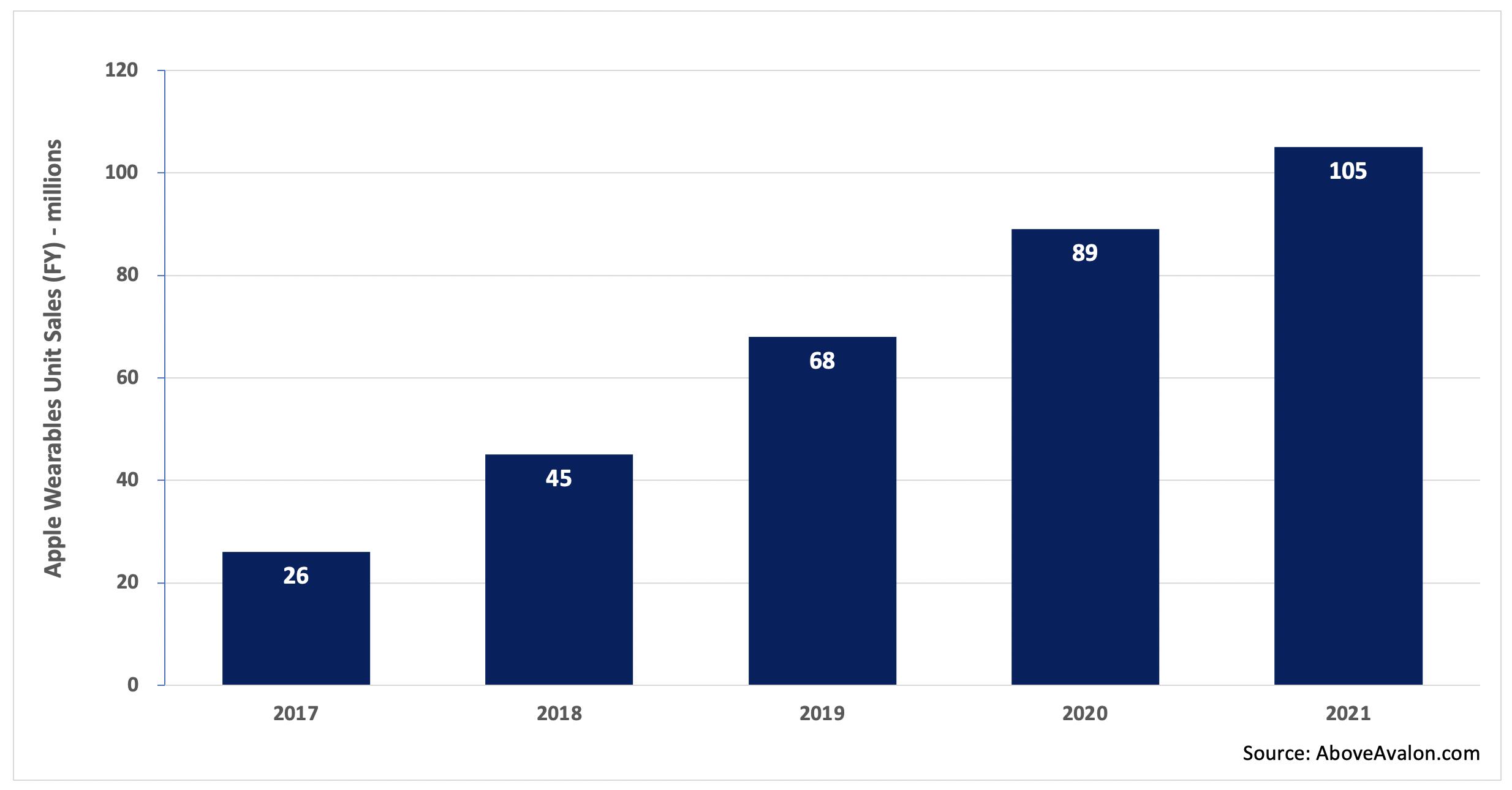
Note: Apple wearables include Apple Watch, AirPods, and select Beats headphones.
On a revenue basis, Apple Watch, AirPods, and select Beats headphones are a $30 billion per year business. That would rank Apple wearables on a combined basis just shy of a Fortune 100 company. Assuming continued Apple Watch and AirPods momentum, along with Apple expanding its wearables platform by getting into face wearables (AR/VR headsets and glasses), Apple wearables will likely be able to generate up to $50 billion of revenue annually within a few years.
Exhibit 2: Apple Wearables Revenue (2017 to 2021)

Note: Apple wearables include Apple Watch, AirPods, and select Beats headphones.
Measuring Apple’s Lead
When Apple unveiled the iPhone in January 2007, Steve Jobs famously said that the iPhone was “literally five years ahead of any other mobile phone.” He ended up being mostly correct. It took the competition a number of years, and a whole lot of copying, to catch up with what Apple had just unveiled.
With wearables, my suspicion is Apple’s lead is longer than five years. There are three components to Apple’s wearables lead:
Custom silicon / technology / sensors (a four to five-year lead over the competition, and that is being generous to the competition)
Design-led product development processes that emphasizes the user experience (adds three years to Apple’s lead)
A broader ecosystem build-out in terms of a suite of wearables and services (adds two years to Apple’s lead)
Apple has at least a four-to-five year lead over the competition when thinking about just the technology powering its wearables. Everything from custom silicon and health monitoring sensors to audio and AR-focused technologies come together to set Apple apart from the competition. Only a select number of companies will likely be able to even compete with Apple on the technology front. Others will be forced to pursue partnerships.
Apple’s wearables lead extends beyond four to five years when taking into account attributes that set wearables apart from mobile devices. Succeeding on the technology front is not enough. Wearables need to be designed so that people want to be seen wearing them for extended periods of time. A smartwatch or wireless pair of headphones must also be able to work seamlessly with other devices and services. A competitor needs to have not only an answer for effectively competing with Apple Watch on the wearables front, but also answers for various services available on AirPods and Apple’s other devices. Looking ahead, Apple’s entry into face wearables will only make the hill to climb that much steeper for competitors trying to go after Apple Watch and AirPods.
For competitors, the intimidating part is that the pieces needed to compete effectively with Apple wearables are unable to be worked on concurrently (at the same time). A company needs to first spend the required years developing and researching the core technologies before turning its focus on ensuring the right kind of collaboration exists between engineering and design. Product sales will then need to materialize before a company has the means of leaning on an ecosystem to sell additional wearable devices.
Apple M&A
A different way of measuring Apple’s lead in wearables is to look at the company’s M&A activity. Apple has been busy buying tech and talent for its upcoming face wearables play for the past six years. In wearables land, the days of new products taking only two to three years to develop are over. The required technology and R&D required to get such devices off the ground require much more lead time.
Metaio - AR (2015)
SensoMotoric Instruments – AR glasses (2017)
Vrvana – AR / hand & positional tracking technology (2017)
Akonia Holographics – AR glasses (2018)
NextVR – content platform for wearables (2020)
Spaces – content platform for wearables (2020)
Examples of Apple’s Lead
There are a number of real-world examples demonstrating Apple’s significant lead in wearables.
AssistiveTouch vs. Facebook Reality Labs. Two months ago, Facebook gave the press a peek at how it is researching using a smartwatch-like device as an input method for a pair of AR glasses. The research, centered on electromyography, looked to be in the pretty early stages with many years needed before seeing the technology in a consumer-facing product. The video was intriguing as it showed research that was thought to be at the forefront of what is going on in technology R&D today. Apple then shocked everyone by unveiling AssistiveTouch for Apple Watch. Instead of showing a behind-the-scenes look at an R&D project, Apple unveiled a technology ready for users today. The technology, relying on a combination of sensors and technologies to turn the Apple Watch into a hand / finger gesture reader, was designed for those in need of additional accessibility. Of course, the technology can go on to have other use cases over time, such as controlling a pair of smart glasses like the ones Facebook is working on. AssistiveTouch does a good job of showing just how far ahead Apple is on the wearables R&D front.
Google I/O 2021. At its 2021 developers conference, Google showed signs of finally taking wrist wearables seriously by ditching Wear OS and partnering with Samsung on a new OS. While it is fair to be skeptical that the effort will end up being successful, the announcement was a marked change from prior Google I/Os when wearables were all but ignored. Diving a bit deeper into Google’s announcement, it’s easy to see how far behind Google truly is in wearables. The company doesn’t even have an OS capable of powering a smartwatch. This may be excusable if Apple Watch was just unveiled. However, last month marked Apple Watch’s sixth anniversary.
Snap Spectacles 4 / Microsoft HoloLens / Magic Leap. While we see a handful of companies release various kinds of prototype hardware for the face (AR/VR/mixed reality), nothing has stuck with consumers. The feeling in the air is that they all lack something – design thinking. This is an item that is not easy to recreate with most companies simply not structured to emphasis design. Many companies will need to rethink their face wearables strategies once Apple enters the market. None have viable answers for smartwatches or wireless headphones either, which make their face-focused efforts look incomplete.
How Did This Happen?
Apple’s lead in wearables wasn’t driven by any one factor or item. Instead, a series of events came together to give Apple an advantage.
Apple was early. One way to build a big lead against the competition is to get an early start. Wearables represent a paradigm shift in computing, and few companies other than Apple saw it coming. As for how Apple was able to see it so early, wearables are all about making technology more personal - a mission Apple has been on for decades. In a way, Apple was built to excel with wearables. Apple’s lack of fear in coming up with new products that may potentially impact sales of existing products also helped the company run wrist-first into wearables in the early 2010s.
Voice computing distraction. Even after Apple began to unveil its wearables strategy, many competitors balked at following the company. Competitors thought the actual paradigm shift materializing was found with voice computing. Most of these companies didn’t have the hardware expertise to do well with wearables out of the gate, so they pinned their hopes on voice assistants being piped through stationary speakers. Once the stationary smart speaker mirage became apparent, companies found themselves years behind Apple on the wearables front.
Wearables require design expertise. It’s not enough to just throw together some leftover smartphone components and ship wearables. People want to wear devices that they are OK with being seen in. This is one reason why so many companies have looked at Apple Watch for design cues. The lack of design talent and ability remains a major roadblock for many companies.
Ecosystem and technology advantage. Wearables are the ultimate ecosystem play. On the technology front, Apple was able to utilize lessons learned from mobile devices to push wearables forward. Not many companies are able to do the same. Consolidation in the smartphone space has left only a handful of companies even in a position to have a wearables and mobile ecosystem. The probability of there being a wave of smartwatch OEMs utilizing something akin to Android remains low.
No price and feature umbrellas under Apple. One reason Android found oxygen in the smartphone space is that Apple left a pretty wide price umbrella under the iPhone. In addition, Android positioned itself as giving users features that iPhone users may not have had access to. No such umbrellas exist in wearables. Entry-level AirPods sell for $159 and are often available for less at third-party retailers. Apple Watch is available starting at $199. It is very difficult for a hardware manufacturer to sell wearables for less than Apple and turn a profit. Meanwhile, companies that would look to make money in other ways, such as through data collection, are still stuck with the requirement of wearables needing to look good enough to be worn in public.
Six years after releasing the Apple Watch, it’s still not clear who is going to represent genuine competition for Apple in the wearables space. Apple’s success in wearables is finally being noticed by others, as seen by the growing number of companies selling products for the body (Amazon, Microsoft, Facebook, Google, Samsung, Huawei, Xiaomi, Garmin, and the list goes on). However, none are in as strong of a position as Apple was in a few years ago, let alone today. Apple’s wearables lead stands to grow further once the company enters face wearables. The next few years will likely dictate the power structure in wearables for the next 10 to 20 years. When it comes to competitors figuring out a way to slow Apple in wearables, it’s now or never.
Listen to the corresponding Above Avalon podcast episode for this article here.
Receive my analysis and perspective on Apple throughout the week via exclusive daily updates (3 stories per day, 12 stories per week). Available to Above Avalon members. To sign up and for more information on membership, visit the membership page.
Above Avalon Podcast Episode 182: Apple’s Underestimated Manufacturing Apparatus
Apple is quietly and gradually showing us that the phase “Designed by Apple in California Assembled in China” will evolve. In episode 182, Neil goes over the changes taking place within Apple’s supply chain and manufacturing apparatus. The discussion includes a breakdown of where Apple products are manufactured and the relationship between Apple and its contract manufacturers.
To listen to episode 182, go here.
The complete Above Avalon podcast episode archive is available here.
Subscribe to receive future Above Avalon podcast episodes:
RSS Feed (for your favorite podcast player)

Designed by Apple in California, Not Assembled in China
One phrase that has become a fixture on Apple device boxes and some Apple products is “Designed by Apple in California Assembled in China.” Those eight words may not mean much to the average Apple consumer, but they sufficiently sum up how a company now worth more than two trillion dollars became one of the largest sellers of consumer gadgets. A gradual change to Apple’s supply chain and product manufacturing apparatus is now underway. One byproduct of this change is an increasing number of Apple product boxes that no longer contain “Designed by Apple in California Assembled in China.” The change has implications for how Apple will approach product manufacturing in the 2020s.
Designed by Apple
Most analysts and pundits have landed on Apple’s custom silicon efforts as the defining source of the company’s success – the single-most important factor in explaining how Apple has been able to stand out from its peers. While Apple’s silicon prowess is undoubtedly a key differentiator for the company, the decade-long bet isn’t the fundamental reason why the company is where it is today. Instead, one has to look at the processes and culture that made Apple’s silicon efforts possible in the first place.
Ultimately, Apple’s design-led culture is the single-most responsible factor behind the company’s ability to expand its installed base to more than a billion people. The relationships that Apple has formed with its customers aren’t just any connections but rather some of the strongest and most loyal connections in the corporate world. Apple placed a big bet on design (how we use products) and was proven right. Believing that technology is too powerful of a force to enjoy without acquired perception and natural intelligence made Apple an outlier. Other companies are now trying to emulate Apple’s design-led thinking and culture with varying degrees of success.
In California
While those residing in the U.S. may not make much out of the “in California” component of “Designed by Apple in California,” Apple’s roots and heritage are intertwined with Silicon Valley. Apple can be described as a headquarters-centered company. Despite announcing major expansion plans in Austin, and new presences / expansion in in a handful of U.S. cities including Seattle (poach Amazon employees), San Diego (poach Qualcomm employees), Culver City (poach Hollywood talent), Pittsburgh (autonomous systems), New York (media and publishing), Boston (robotics), Portland (hardware-related efforts), and Boulder (possibly related to health-related efforts), everything comes back to Apple Park in Cupertino, California. Apple Park remains the sun with all of these satellite offices and campuses revolving around it.
Taking a step back from Apple in particular, the era when it was either Silicon Valley or bust ended years ago. However, that doesn’t mean Silicon Valley has been displaced as one of the most concentrated sources of innovation and new age thinking in the world. Recent attempts by some to paint other parts of the U.S. such as Miami and Austin as new Silicon Valleys may make for great tweet threads and blog posts, but for every person “fleeing” Silicon Valley, there are multiple people ready to be a replacement.
Assembled in China
The controversial part of “Designed by Apple in California Assembled in China” is “Assembled in China.” For some products, Apple has relied on “Made in China.” In recent years, Apple’s extensive ties to China regarding its supply chain and manufacturing apparatus have been labeled as major liabilities. Headlines and narratives are universally slanted against Apple’s approach to China, home to approximately 15% to 20% of Apple’s users. Many pundits want Apple to simply close up shop in China and abandon its users in the country.
As relations between the world’s two economic powerhouses deteriorate, Apple has been described as being stuck in the middle. Of course, such a simplistic description lacks nuance. When it comes to China, Apple’s position is not nearly as perilous as western media wants people to think. Apple has been able to maintain its premium brand status in China and the brand remains heavily influential in China’s tech scene. It’s not outlandish to say that most non-iPhone smartphones sold in China are heavily “inspired” by the iPhone. The same can be said about wearables being “inspired” by Apple Watch and AirPods.
In addition to a strong brand, Apple has a few key things going for it when it comes to its power standing and positioning in China. Being ultimately the driver behind the largest private employer in China means something. Not only are Apple products destined for sale in China made in China, but the country has been responsible for manufacturing Apple products sent to other countries. Being home to Apple’s supply chain and manufacturing apparatus gives China power and standing in its economic battle with the U.S. and increasingly other countries, including India.
Not Assembled in China
In December 2020, I ordered two HomePod mini speakers shortly after Apple unveiled the lower-cost speaker. One of my initial observations about the speakers materialized before opening the boxes. The back of the HomePod mini box did not contain the usual “Designed by Apple in California Assembled in China” phrase. Instead, the following was printed on the box:
“Designed by Apple in California Made in Vietnam.”
Rumors had pegged the new HomePod mini as being assembled in Vietnam. Even then, seeing Vietnam on the box was an eye-opener. Taking a step back from the HomePod mini, we see Apple embark on a broader move away from China for product manufacturing. The following products are currently, or will be, assembled outside of China.
Vietnam: AirPods Pro, HomePod mini, AirPods (rumored), iPad (rumored), Mac (rumored)
India: iPhone, iPad (rumored)
Malaysia: Mac mini
U.S.: Mac Pro
(While the Mac Pro has been assembled in the U.S. for years, the device sells in such low numbers that it’s tough to say Apple has embraced U.S. manufacturing.)
A handful of countries in Southeast Asia are now in a position to manufacture Apple products. Some of this is due to governments increasingly accommodating foreign investment. Another factor is Apple’s long-time and vital business partner, Foxconn, showing a renewed effort to diversify its own business and footprint outside of China.
At the heart of this manufacturing transformation, one simple principle is guiding Apple: retaining power. By diversifying product assembly outside of China, Apple ends up pitting both governments and assemblers against each other. Apple stands to be one of the largest beneficiaries from increased economic rivalry between China, India, and Southeast Asia countries. Apple continues to take advantage of India’s more friendly and accommodating environment to bring a growing portion of iPhone production to the country.
As for some of the finer strategy details found with Apple’s move, instead of announcing a big change like “we are moving all iPhone production out of China,” which western media has been demanding for years, Apple is taking the more practical and intelligent approach. The company remains careful not to disrupt its existing assembly apparatus. The vast majority of product assembly remains in China. Apple has looked outside of China to handle assembly for newer products that sell in much lower volumes relative to the iPhone. Such decisions involve a comprehensive examination of not just product assemblers (Foxconn, Pegatron, Luxshare, Wistron) but also the ability of key suppliers to work with the diversification efforts. Apple benefits from having resources and assets close to assemblers.
Looking down the road, it is reasonable to expect a growing percentage of Apple products will be assembled outside of China. It is even likely that Apple will bring manufacturing back to the U.S. and we would be talking something much larger than the Mac Pro. Instead of iPhones and iPads being made in Alabama, Georgia, or Tennessee, it is more likely that Apple Cars will one day be produced in sprawling plants that are owned by third parties but contain Apple-owned machinery and equipment.
Evolution
Apple is quietly and gradually showing us that the phase “Designed by Apple in California Assembled in China” will evolve. The company remains heavily invested in China, and that likely won’t change in the near term. However, by gradually diversifying product assembly into other countries, Apple ends up showing the world that its supply chain contains much more optionality than critics imagined. The battle between the world’s top economic powers for Apple’s business will be a key theme to watch in the 2020s.
Listen to the corresponding Above Avalon podcast episode for this article here.
Receive my analysis and perspective on Apple throughout the week via exclusive daily updates (3 stories per day, 12 stories per week). Available to Above Avalon members. To sign up and for more information on membership, visit the membership page.
For additional discussion on this topic, check out the Above Avalon daily update from April 19th.
Above Avalon Podcast Episode 181: Let's Talk Apple Retail
When asked to identify Apple’s crown jewel, most will point to the iPhone or iPad. Apple’s retail operations probably wouldn’t be too high on many people’s lists. This is a mistake. In episode 181, Neil discusses Apple’s retail operations with a focus on where Apple Retail is headed and what changes are needed. Discussion topics include the three distinct phases that Apple Retail has experienced, the roles that Apple stores need to play going forward, and the three big bets that Apple is placing with its stores.
To listen to episode 181, go here.
The complete Above Avalon podcast episode archive is available here.
Subscribe to receive future Above Avalon podcast episodes:
RSS Feed (for your favorite podcast player)

The Future of Apple Retail
In recent weeks, there have been a number of intriguing developments in the retail space. Apple and Target announced a partnership that will bring mini Apple stores to 17 Targets. Last week, Disney announced it will close 20% of its stores. As a sign of just how much the pandemic impacted Apple’s brick and mortar retail, all U.S. stores are fully open for the first time in a year. While the Apple store celebrates its 20th anniversary this May, the pandemic causes many to question retail’s future amid changing consumer behavior. A close examination of Apple’s ecosystem shows both where the company’s retail operations are headed and what changes are needed.
A Crown Jewel
When asked to identify Apple’s crown jewel, most will point to the iPhone or iPad. Apple’s retail operations probably wouldn’t be too high on many people’s lists. This is a mistake. Along with Apple’s design-led culture and vertical integration strategy, the company’s direct retail operations have played a vital role in its expanding ecosystem.
Apple discloses the percentage of sales going through its direct distribution, which includes its website, retail stores, and direct sales force. As shown in Exhibit 1, the percentage of sales going through Apple’s direct distribution has gradually increased in recent years. The increase in sales percentage has likely been boosted by services revenue, more sales going through Apple’s website, and more iPhone upgrading taking place through Apple.
Exhibit 1: Percentage of Apple Revenue Through Direct Distribution Channel
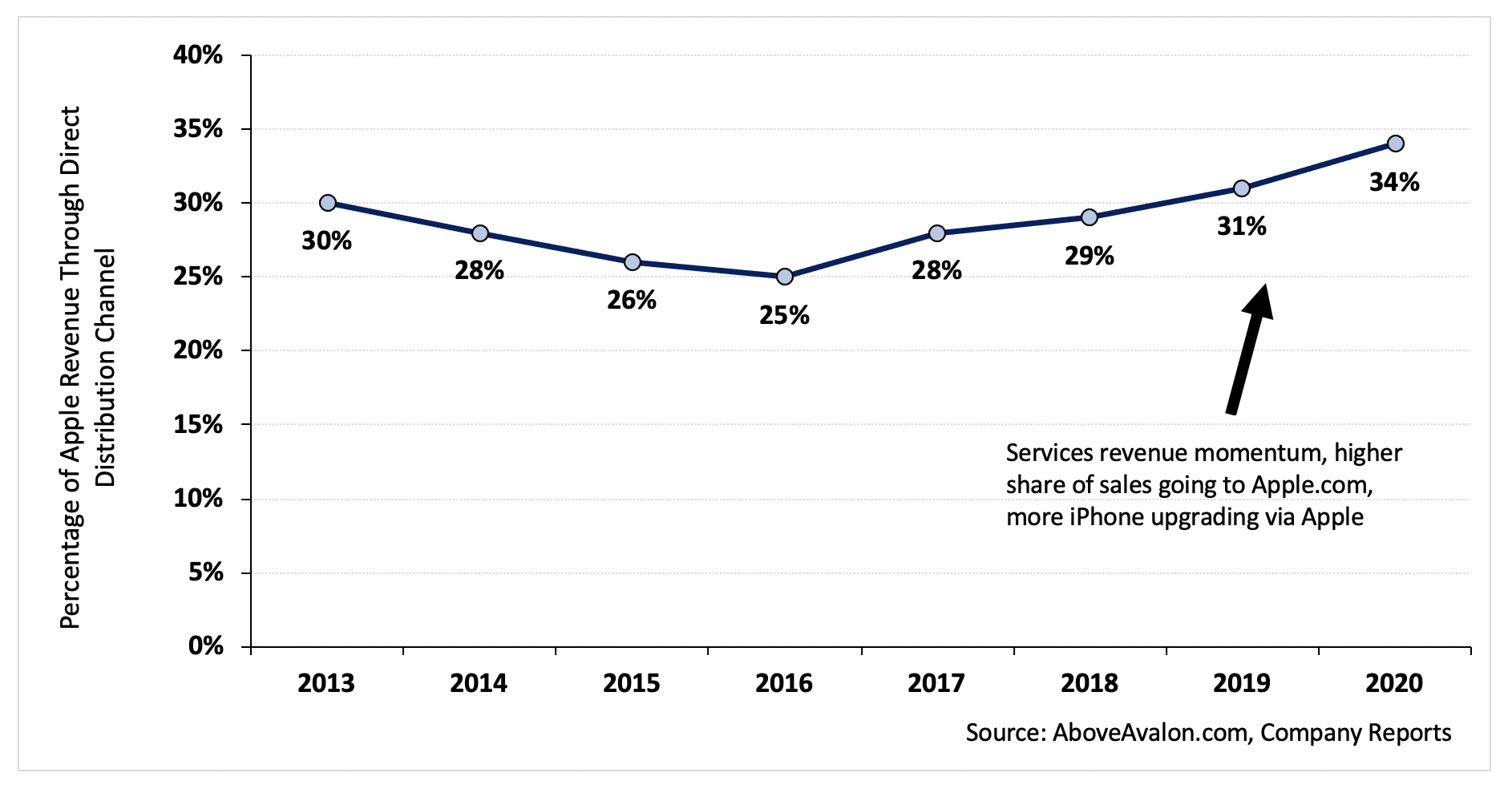
Note: Direct distribution channel includes Apple’s website, Apple stores, and direct sales force.
It’s difficult to gauge Apple retail’s importance by just looking at revenue. The figures do not show the significant role Apple stores play in allowing people to try and test the latest products, get questions answered, and seek product support. Nowhere is this seen more than with Apple’s wearables business. Store closures related to the pandemic have had a negative impact on Apple Watch and AirPods sales. While the product categories are still seeing revenue growth, the numbers would have been stronger with opened stores. Here’s Tim Cook explaining the situation on Apple’s 3Q20 earnings call:
“I think the [Apple] Watch in particular, like the iPhone, is more affected by store closures, because some people want to try on the Watch and see what it looks like, look at different band choices and those sorts of things. And so I think as stores closed, it puts more pressure on that.”
Apple Retail Store Phases
Apple opened its first retail store (shown in the video below) in Virginia on May 19th, 2001. Twenty years later, Apple now has 510 stores across 25 countries and territories.
When assessing how the Apple store has changed over the years, there have been three distinct phases:
Lifestyle Experience. In the beginning, Apple stores were locations to touch and see the Apple lifestyle experience. Since Apple only sold a few Mac models, the stores were designed around five core tenets: "Home" and "Pro" (containing Apple's products), solutions (music, movies, photos, and kids), accessories, software, and the Genius Bar. Another way of thinking about Apple stores was that they let people see what can be done with a Mac.
New Product Experience. As Apple's product line gradually expanded, the Apple Store turned into the best way for consumers to play with new products. Between 2010 and 2015, Apple’s installed base grew by 530 million people.
Customer Service / Product Support / Education. Starting around the mid-2010s, Apple stores embraced more of a customer service / product support feel as the number of users and devices continued to shoot higher. Between 2015 and 2020, Apple’s installed base grew by another 400 million people.
Head of Retail Succession
As head of Apple Retail from 2014 to 2019, Angela Ahrendts took over an operation that wasn’t too far away from collapse. The division had been leaderless for two years, and stores were feeling major strain under Apple’s ecosystem growth. Complaints of stores being too chaotic grew louder by the month. Average store traffic was declining. Things got so bad, many began to suggest Apple drop its unique retail thinking and embrace traditional ideas like cash registers and queues in an attempt to reduce the store craziness. After quickly admitting it had made a mistake hiring John Browett to lead retail, Apple went back to the drawing board and eventually landed on Ahrendts, a rising executive in the retail space that had transformed Burberry, to lead its retail stores.
Judging from reaction to her surprise Apple departure announced in early 2019, Ahrendts’ five-year tenure at Apple was massively misunderstood. One of her not-so-publicized achievements was modernizing Apple’s retail backend so that Apple’s website, online store, and in-store experience weren’t disconnected.
A more public objective for Ahrendts was managing a massive Apple store remodeling plan overseen by Jony Ive and Apple’s design team in addition to Foster + Partners. The store redesign included Apple moving away from its smaller store footprints, embracing more open spaces centered around “forums and “video walls,” and expanding the Genius Bar concept to handle more customers. Another goal for Ahrendts was defining Apple’s retail culture.
By choosing Deirdre O’Brien to be Ahrendts’ successor, Apple gave a pretty clear signal that it wanted to keep employee culture and morale at the center of its near-term retail strategy. Instead of new objectives in terms of the backend or store expansion plans, forward changes to retail operations would be more focused. Of course, the pandemic changed those plans in a very big way.
Store of the Future
It’s easy to say that brick-and-mortar retailers need to rethink the store concept and embrace experiences to compete with e-commerce. In practice, such a strategy is incredibly difficult, and few retailers will be able to pull it off. Microsoft thought adding Xbox consoles would turn its stores into experience centers. It didn’t work. The company made the right decision to get out of retail – it just took a pandemic for the company to reach that decision.
Disney’s recent announcement that it will close 20% of its stores is the latest sign that turning stores into experience centers may make for a good presentation but be extremely difficult to pull off. Disney stores aren’t turned into experience centers by just having some TVs play Disney+ while Mickey and Minnie stroll around the store. The company is likely coming to the realization that its customers prefer consuming Disney stories in the comfort of their own home rather than inside a store at the mall. For those who want Disney stories outside the home, vacations to Disney theme parks are in order. Similarly, Nike knows its experiences are going to be found not in mall stores, but with people using their products at home, at gyms, and outdoors.
Where does this leave Apple and its long-term strategy for brick-and-mortar stores? When assessing Apple’s current ecosystem and where the company needs to go in the future, Apple stores need to play three vital roles:
Brand Embassies. With the Apple installed base now exceeding 1 billion users, 87% of the world’s population doesn’t use any Apple products. Apple stores need to serve as the initial point of contact with the Apple brand for these 87% of people. Having control over someone’s first impression with the Apple brand plays a key role in that person’s likelihood of entering the ecosystem. There are two ways for Apple to reach the 87% of people who don’t own any Apple products – go to them by opening stores in India, China, Brazil, Africa, etc., or have them come to Apple as they visit the world’s largest cities for business and pleasure. As we will discuss shortly, the latter will likely be the option Apple chooses. Upward social mobility will be a defining social-economic trend for decades to come.
Ecosystem Support. Given how everyone is at a different stage when it comes to involvement with the Apple ecosystem, there is a strong need for Apple stores to represent different things to different people. After leaving Apple, Ahrendts commented that roughly a third of Apple store visitors were there to buy products, a third were there to get service for their Apple products, and a third were there to learn about the latest gadgets and attend Today at Apple sessions. Focusing Apple stores on just one of those tasks won’t work.
Distribution Hubs. It is essential that Apple remain a realist with the way shopping habits are evolving. Convenience determines where retail is headed. Using Apple stores as distribution hubs for same day or 2-hour delivery will prove valuable. Ordering a product online from Apple’s website and using an app to track the product being brought to you from the local Apple store via courier is up there with using Uber or Lyft for the first time. The experience makes you look at retail stores differently.
Retail Store Count
As shown in the following exhibit, Apple’s retail store count has plateaued at 510 stores despite continued growth in the installed base. Instead of creating large-scale store expansion plans involving dozens of new stores, Apple has been opening a few stores in a handful of the world’s top cities. The strategy was driven by Ahrendts’ bet on cities not countries, which came from her roots in high-end fashion.
Exhibit 2: Apple Retail Store Count
Source Link (2015 to 2019): 9to5Mac
There are a few key risks found with Apple changing course and pursuing a major expansion in its store count.
Store Size. It’s not practical for Apple to become like a mobile carrier and open thousands of smaller stores in shopping plazas throughout the U.S. or other countries. Such a store expansion strategy would amount to Apple stores being nothing more than sales kiosks which would go against the two first roles (discussed above) that Apple stores will need to play.
Locations. Apple has consistently gone after the most prized (and expensive) real estate in up-and-coming cities. The amount of cash that Apple spends on its retail stores would make any retailer blush. The strategy isn’t for the faint of heart, and nearly all retailers would stay away from the strategy as it can quickly lead to financial ruin. A major store expansion phase that involves locating stores in less optimal locations can raise the endeavor’s financial risk.
Employees. Apple has approximately 70,000 retail employees. Expanding its store footprint to fit the size of its ecosystem would require multiple times the number of employees. Such an expansion in employee count would present a completely different beast for Apple executives to oversee.
Logistics. With 510 stores, Apple is able to keep its retail footprint nimble while quickly responding to product launches and new initiatives. Trying to accomplish such feats with a store footprint that is multiple times the size would present its own unique set of challenges.
While it may not make sense for Apple to grow its store count in a big way from current levels, there are many Apple customers that can benefit from having physical stores in which to try products and get service. For Apple, an alternative to expanding its own store count is to continue partnering with third-party retailers to sell products, service devices, and accomplish other traditional retail tasks like offering different delivery options. By relying on third-party retail partnerships, Apple can establish more points of contact with customers and not worry about the long list of risks and problems found with operating its own stores.
Two weeks ago, Apple announced a partnership with Target to open mini Apple Stores in 17 locations. Some may worry that Apple is going down the wrong path with these partnerships. Apple’s initial move into retail 20 years ago was driven by shortcomings found with needing to go through others to reach customers. Wouldn’t similar shortcomings develop by going through third-party retailers to reach customers?
There is one big difference between the retail landscape of the 1990s and that of today: Apple now has the most powerful device ecosystem in the world. Apple no longer needs to fear having their products get lost in a sea of beige at an electronics store. Retail store employees are no longer incentivized to convince people to buy competing products. Instead, some of the world’s largest retailers are now placing big bets on Apple, hoping some of the company’s brand power will rub off on their own operations and financials.
Retail Bets
The bets Apple ended up placing with its retail stores didn’t end up having to do with selling iPhones and wearables or hosting educational classes. Instead, Apple stores are bets on three big themes:
Cities. Apple is betting that we will want to visit and live in the world’s top cities. This explains the store growth strategy being focused on cities, not countries.
People. Apple is betting that Apple store employees will remain the best ambassadors of the brand, introducing Apple to billions of new people. Having O’Brien, who also oversees Apple’s “People” team, be in charge of retail is an outward recognition of the key role given to Apple retail employees.
Experiences. Apple is betting that humans will continue to seek out premium experiences.
Apple Marina Bay Sands - Singapore. Source: Apple.
The Apple store of the future doesn’t have a specific layout or look. Instead, it ends up being an idea: evolution. We know retail isn’t going to remain static going forward. The way we buy products will continue to change as technology becomes closely intertwined with commerce. Apple’s retail apparatus, both online and brick and mortar, will only remain relevant in the future if it is built and designed to embrace change.
Listen to the corresponding Above Avalon podcast episode for this article here.
Receive my analysis and perspective on Apple throughout the week via exclusive daily updates (3 stories per day, 12 stories per week). Available to Above Avalon members. To sign up and for more information on membership, visit the membership page.
For additional discussion on this topic, check out the Above Avalon daily update from March 11th.
Above Avalon Podcast Episode 180: 100 Million Wrists
According to Neil’s estimate, 100 million people now wear an Apple Watch. This means that approximately 10% of iPhone users wear an Apple Watch. In episode 180, Neil discusses these installed base and adoption figures as part of a larger discussion regarding Apple Watch’s sales momentum, growth potential, and roles in Apple’s ecosystem
To listen to episode 180, go here.
The complete Above Avalon podcast episode archive is available here.
Subscribe to receive future Above Avalon podcast episodes:
RSS Feed (for your favorite podcast player)

Apple Watch Is Now Worn on 100 Million Wrists
More than 100 million people wear an Apple Watch. Based on my estimates, Apple surpassed the important adoption milestone this past December. The Apple Watch has already helped usher in a new paradigm shift in computing, and Apple is still only getting started with what is possible on the wrist. New services designed specifically for Apple Watch (such as Fitness+) are being released. The wrist’s utility continues to be unveiled thanks to new hardware and software features revolving around health monitoring.
The Numbers
It took five-and-a-half years for the Apple Watch installed base to surpass 100 million people. As shown in Exhibit 1, the installed base’s growth trajectory has not been constant or steady over the years. Instead, the number of people entering the Apple Watch installed base continues to accelerate. The 30 million new people that began wearing an Apple Watch in 2020 nearly exceeded the number of new Apple Watch wearers in 2015, 2016, and 2017 combined.
Exhibit 1: Apple Watch Installed Base
The next exhibit takes a look at Apple Watch adoption as a percentage of the iPhone installed base. Since an iPhone is required to set up an Apple Watch, the iPhone installed base is a good proxy for the size of Apple Watch’s addressable market. There are a few exceptions to this such as Family Setup, which allows family members who don’t have iPhones to get set up with their own Apple ID and cellular Apple Watch.
Exhibit 2: Apple Watch Adoption Percentage (Global)
As of the end of 2020, approximately 10% of iPhone users were wearing an Apple Watch. This is a high percentage given the diverse technological wants and needs of those in the iPhone installed base.
Since the U.S. has been an Apple Watch stronghold for years, adoption in the country has trended materially high in comparison to global figures. At the end of 2020, approximately 35% of iPhone users in the U.S. were wearing an Apple Watch. This is a shockingly strong adoption rate that should serve as a wake-up call to Apple competitors interested in the wearables space. Apple Watch turned Fitbit from a household name as the wearables industry leader into a company that will eventually be viewed as an asterisk when the wearables story is retold to future generations.
(The calculations and methodology used to reach my Apple Watch installed base estimates is available here for Above Avalon members.)
Installed Base Comparisons
At 100 million users, the Apple Watch is Apple’s fourth-largest product installed base behind the iPhone, iPad, and Mac. At the current sales trajectory, the Apple Watch installed base will surpass the Mac installed base in 2022. Surpassing the iPad installed base will take longer and likely be measured in a number of years based on the current sales trajectory.
Growth Potential
While Apple Watch adoption figures point to a product gaining acceptance and appeal around the world, the same numbers also speak to the product’s sales growth potential. There is nothing stopping Apple Watch from grabbing much higher adoption over time. Stronger adoption will serve as an Apple Watch sales growth engine for years.
Running with a few simple calculations, if 35% of iPhone users around the world one day wear an Apple Watch, the same adoption percentage found in the U.S., the Apple Watch installed base would exceed 350 million people. That’s 2.5x larger than the current installed base.
Of course, a 35% adoption figure when looking at the iPhone installed base may end up selling the Apple Watch far short. There is nothing preventing Apple Watch from being worn by an even higher percentage of iPhone users. More importantly, the Apple Watch’s future is one of true independency from the iPhone. Opening the Apple Watch up to non-iPhone users would expand Apple Watch’s addressable market by 2.5x overnight. A 10% adoption figure among all smartphone users around the world would amount to 350 million people wearing an Apple Watch.
What’s Driving Adoption?
As for the factors behind Apple Watch’s steady growth in adoption, there are four primary ones:
Wearables Fundamentals. Leveraging new form factors and design (how we use the products), wearables are able to make technology more personal. People are attracted to Apple Watch’s ability to handle some tasks currently given to more powerful devices like iPhones and iPads as well as entirely new tasks. Given its design, there is nothing inherently found in wearables that limits its addressable market to the point of making it smaller than that of mobile devices. Instead, wearables are one of the rare product categories that can have an even larger addressable market than smartphones - a difficult feat given such high smartphone adoption figures.
Wrist’s Appeal. Everything from a great line of sight for displaying snippets of text and data, to an opportunity to successfully monitor activity and vital signs makes the wrist a valuable space for bringing utility to the body. By selling intangibles like prestige and wealth on the wrist, the Swiss watch industry ended up missing the wrist’s true value. Wrist real estate was being underpriced, and Apple capitalized on the mispricing with Apple Watch.
The Cool Factor. People want to be seen wearing an Apple Watch. The Apple Watch brand has evolved to become cool yet approachable. The device has wide appeal across gender, age, occupation, and social status. Apple Watch wearers are able to add customization to the wrist through various Watch band, case, and face / complications combinations. Thanks to Apple Watch’s comfortable bands, it’s easy to wear the device all day, every day.
Apple Ecosystem. One of the Apple Watch’s secrets to success is how it ends up being just one part of a much larger Apple ecosystem - an ecosystem that is unmatched in the industry. The ability to work seamlessly with other Apple wearables like AirPods as well as other devices ranging from iPhones to HomePods gives Apple Watch additional appeal and staying power in our lives. The ability to consume Apple Watch Services like Fitness+ on other Apple products helps to solidify Apple Watch’s positioning within the ecosystem.
Future Roles
When assessing Apple Watch’s future roles within Apple’s product line, three in particular jump out:
Identity Checker. Wrist detection allows the Apple Watch to maintain one’s identification chain as long as it remains in contact with the wearer’s skin. This is something that is difficult and cumbersome for other Apple devices to handle since they aren’t likely to be physically in contact with our bodies throughout the day. We already see Apple embrace this functionality by allowing Apple Watch to unlock Macs and most recently, iPhones. Going forward, the Apple Watch’s ability to serve as an identity checker can end up being used throughout our day as we interact with different devices, rooms, and objects.
Digital Health Purveyor. The Apple Watch is able to seamlessly monitor our health and alert us to things that we should know without overwhelming us with lots of data and information. This gives the Apple Watch a key role in our lives that would be difficult for other devices to handle.
Support Device for Face Wearables. While the face is home to some of the most valuable real estate on our bodies, it’s not an ideal place for storing a lot of technology. In order for face wearables to go mainstream, devices as light, thin, and comfortable as a regular pair of glasses are needed. Not surprisingly, this is proving to be a difficult engineering problem to solve. The Apple Watch allows technology required for computing on the face to be placed in a far more convenient location on the body.
A Successful Bridge
Back in early 2018, I called the Apple Watch a bridge to the future - a device that was still very much based on our current user interface repertoire but beginning to lay the groundwork for the future when it comes to greater reliance on voice, audio, and digital identity. At the time, in the Above Avalon article, “Apple Watch Is a Bridge to the Future,” I wrote the following:
“Apple has a vision for how we will use the combination of voice and screens in the future. Unlike Amazon and Google, who are desperately trying to position voice as a way to leapfrog over the current smartphone/tablet and app paradigm, Apple is approaching things from a different angle. Instead of betting on a voice interface that may push some information to a stationary screen, Apple is betting on mobile screens that are home to a digital assistant. Apple is placing a bet that consumers will want the familiarity of a touch screen to transition to a future of greater AI and digital assistants. In addition, Apple thinks user manipulation via screen (fingers, hands, and eyes) will remain a crucial part of the computing experience for the foreseeable future.”
Three years later, I wouldn’t change a word in that paragraph. This scenario has materialized. In addition, the fact that Apple Watch is not a futuristic device struggling to handle tasks that we currently have has given the device a good portion of its appeal and momentum over the past five years. With Apple Watch now worn on more than 100 million wrists, Apple can turn to the next Apple Watch adoption goal: 200 million wrists.
Listen to the corresponding Above Avalon podcast episode for this article here.
Receive my analysis and perspective on Apple throughout the week via exclusive daily updates (3 stories per day, 12 stories per week). Available to Above Avalon members. To sign up and for more information on membership, visit the membership page.
For additional discussion on this topic, check out the Above Avalon daily update from January 16th.
The Above Avalon Daily Update Recap (January 2021)
Along with publishing periodic articles that are accessible to everyone, I publish daily updates all about Apple. These updates are 2,000-word emails that revolve around Apple business and strategy analysis, my perspective and observations on current news and Apple competitors, and comprehensive coverage of Apple earnings, product events, and keynotes. These daily updates have become widely read and influential in the tech sector and Apple universe. The updates are now also available in podcast form called Above Avalon Daily.
Since 90% to 95% of my time is dedicated to researching and writing the daily updates and recording the corresponding daily podcast, I am introducing a new Above Avalon product called The Above Avalon Daily Update Recap to make it easy for everyone to keep abreast of where my focus has been. Each curated recap of the prior month’s updates includes access to one story from a daily update that I particularly enjoyed writing in the previous month.
The daily updates are available exclusive to Above Avalon members. To sign up and for more information on membership, visit the membership page.
The following story was featured in the Above Avalon Daily Update published on January 14th, 2021 (prior to Apple reporting 1Q21 earnings).
Projections for Apple’s Buyback Pace
Apple has $79B of net cash on the balance sheet. By funding share repurchases and cash dividends, Apple has been gradually chipping away at that total (was $153B in FY17).
Based on my projections, Apple will be able to sustain the current pace of share buyback (approximately $70B per year) for an additional 11 to 13 quarters before net cash gets close to zero.
Where does my 11 to 13 quarters estimate come from?
There is a $25B delta between the amount of cash Apple is returning to shareholders each year ($90B) and annual free cash flow ($65B) - the amount of cash generation leftover after management has paid all of the bills and maintained / funded capital investments. Free cash flow is used to manage debt in addition to fund cash dividends and share repurchases. Meanwhile, Apple has $79B of net cash on the balance sheet. ($79B / $25B = 3.2 years or 13 quarters).
It is important to note that these are rough calculations. Apple’s cash needs will fluctuate year to year. This will have an impact on Apple's free cash flow. In addition, it would not be essential to know the exact moment net cash neutral is obtained, if Apple ever technically gets to that level, but rather when net cash is in the vicinity of $0.
Once Apple reaches a net cash neutral position, my estimate is Apple’s buyback pace will slow to something closer to $50B per year. This total is primarily derived from my Apple free cash flow projection ($70B per year) minus cash dividend expense ($15B per year). Over time, Apple's buyback pace can certainly increase to remain in line with free cash flow growth. The reverse is true as well - a slowdown in free cash flow may result in less buyback.
These estimates assume that Apple management continues to view share buyback as attractive at the current share price. That decision will ultimately be based on management's estimate of Apple's intrinsic value. Based on Apple's most recent buyback activity, management thinks Apple's intrinsic value is higher than $115 per share.
In January, a total of 15 daily updates containing 45 stories were published. Those 45 stories have been rearranged into the following categories:
Earnings / Financials
My Apple 1Q21 Estimates, Wall Street’s Expectations, The Apple Number to Watch (My Apple 1Q21 earnings preview)
Apple Earnings, The Most Important Apple Number, Apple Remains Misunderstood (My Apple 1Q21 earnings review)
Product Strategy
Business Strategy
Management / Leadership
Apple Peers and Competitors
Industry Analysis
Thursday Q&A (The following questions were submitted by Above Avalon members.)
Doesn’t Peloton make more sense as a health acquisition target for Google than Fitbit?
Are you still expecting double-digit iPhone unit sales growth in 2021?
What do you make of the rumors that Apple will remove the Touch Bar from new MacBook Pros?
What do you make of IDC and Gartner projecting huge growth numbers for Mac over the holidays?
All of the following stories are accessible to members via the Daily Updates archive. Access to the archive is a benefit attached to membership. For new members, information about accessing the archive will be sent to you after going through the signup process.
The daily updates are also available via a private podcast called Above Avalon Daily. In January, 14 podcast episodes were recorded for a total of 200 minutes of audio. The daily podcast is available as an add-on that can be attached to an Above Avalon membership. More information on the podcast is available here. All prior episodes will appear in your podcast player after you sign up for the Above Avalon Daily podcast.