

Apple's $460 Billion Stock Buyback
Share buybacks have once again come under fire. Some companies that were recent buyers of their shares now find themselves in financial distress and seeking bailouts due to economic fallout from the pandemic. Set within this environment and backlash, Apple is scheduled to provide an update next week on its capital return program, including its share buyback program. The announcement will provide clues for how the poster child of responsible share repurchases is financially navigating the pandemic.
Buyback Pace
Since kicking off its repurchase program in 2013, Apple has spent $327 billion to buy back 2.5 billion shares at an average price of $131 per share. The following exhibit shows Apple’s buyback activity on an annual basis:
Exhibit 1: Apple Share Buyback Pace (Annual - FY)
The pickup in Apple’s buyback pace in FY2018 and FY2019 was due to U.S. tax reform and Apple utilizing cash that had been in non-U.S. subsidiaries. Last year, Apple spent $55 billion buying back 283 million shares (at an $194 average price) in open market transactions. Adding this total to $12B of accelerated share repurchases, Apple spent a total of $67 billion on share buyback. To put that total in perspective, it’s more than the market capitalization of 85% of the companies in the S&P 500.
Buyback Authorization
Every April, Apple’s board of directors, in consultation with management, assesses business trends, the operating environment, and Apple’s financial position, to arrive at an appropriate level of capital return (share repurchases and quarterly cash dividends).
The board has authorized seven consecutive increases to Apple’s share buyback program since the program launched in 2012:
2012: $10 billion buyback authorization
2013: $60 billion (increase of $50 billion)
2014: $90 billion (increase of $30 billion)
2015: $140 billion (increase of $50 billion)
2016: $175 billion (increase of $35 billion)
2017: $210 billion (increase of $35 billion)
2018: $310 billion (increase of $100 billion)
2019: $385 billion (increase of $75 billion)
At the end of December 2019, Apple had $59 billion of share repurchase authorization remaining. Assuming Apple bought back at least $10 billion of shares in FY2Q20 (January to March 2020), the company likely had somewhere closer to $50 billion of authorization remaining at the end of March. This means that without additional authorization, Apple would have about seven months worth of share repurchases remaining. Accordingly, there is a strong likelihood of Apple’s board announcing the eight consecutive increase in share repurchase authorization next week.
My expectation is for Apple’s board to announce a $75 billion increase to buyback authorization next week. This would allow Apple to continue buying back shares at the same pace that it has for the past 24 months. Such an authorization would bring Apple’s total repurchase authorization since 2012 to $460 billion. In order to add flexibility to such authorization, especially given the current environment, Apple will likely have more than 12 months to utilize the authorization. This means that if operating conditions continue to deteriorate over the next 12 months, Apple will have the ability to slow down its share buyback pace and run with a higher level of untapped repurchase authorization.
Although companies are not under obligation to utilize share repurchase authorization, Apple has approached its authorization differently. Many companies announce a new share buyback program in order to benefit from the near-term stock price bump often associated with the announcement. These companies never actually intend to utilize the full buyback authorization. Meanwhile, Apple has been an aggressive repurchaser of its shares, which require material increases in buyback authorization every year.
Buyback Criticism
In recent weeks, share buyback has once again been put under a microscope. The act of taking cash on the balance sheet to buy back shares from shareholders willing to sell is no stranger to criticism. Prior to the pandemic, the most recent uproar regarding buyback occurred during the U.S. tax reform debate as some felt it wasn’t right for companies to use repatriated cash to repurchase shares (and pay cash dividends).
With passenger airline travel coming to a near halt, the airliners find themselves in a dire financial situation. Delta is burning through $60 million of cash a day. The airlines were quick to seek U.S. taxpayer-funded bailouts in the form of grants and loans. The entire episode has left a bad taste in many mouths as the airlines had been aggressive share repurchasers. Instead of establishing some kind of rainy day fund, the airlines used free cash flow to fund share repurchases at prices significantly higher than current stock prices.
Past financial crises have also provided examples of share buyback gone wrong. Some insurers who were busy buying back their shares in 2007 ended up needing to issue shares at significant discounts not long after due to holding toxic mortgage investments. The gas and energy industry turned to share repurchases when oil was at $100 a barrel.
With each example, we have boards and management teams who felt it was prudent in good economic times to buy back their shares. It’s fair to ask if some of these companies used share buyback primarily to hide financial and business shortcomings elsewhere. Bad actors can utilize share buyback for near-term manipulation either through improper signaling to the market or financial engineering. Reducing the number of shares outstanding via buyback results in higher earnings per share figures and return on equity percentages, all else equal.
The Poster Child
And then there is Apple. A very good argument can be made that Apple has become the poster child of responsible share repurchases. The company has relied on its stellar free cash flow to fund share repurchases over the years. Prior to U.S. tax reform and Apple keeping cash generated outside the U.S. in foreign subsidiaries, Apple issued debt at roughly the same pace as foreign cash generation. This resulted in Apple having $285 billion of cash, cash equivalents, and marketable securities on the balance sheet at the end of 1Q18. After two years of aggressive share repurchases, Apple’s cash total is now closer to $200 billion.
By funding buyback with free cash flow, share repurchases have had zero impact on the amount of cash Apple wants to spend on organic growth initiatives including R&D, M&A, and capital expenditures. Apple is using truly excess cash that it has no use for to repurchase its shares.
Partly to provide a buffer against adverse market conditions and to retain M&A flexibility, Apple is following a net cash neutral strategy which means that the amount of cash held on the balance sheet will eventually equal the amount of outstanding debt. Given Apple’s current debt holdings, this amounts to holding approximately a $100 billion cash cushion in the event of a rainy day. On top of that, given Apple’s unique capex-light business model, the company is able to generate tens of billions of dollars of free cash flow each year even with lower sales due to a global recession.
Since share buyback makes financial sense when repurchases are done at a share price that is less than a company’s intrinsic value, it is much harder to assess a buyback’s effectiveness, or the amount wealth transferred between shareholders selling and holding shares.
The Above Avalon Report, “Share Buyback 101: An Examination of Apple’s Share Repurchase Strategy” contains much more detail on the wealth transfer dynamic found with share buyback. The report is available exclusively to Above Avalon members.
In theory, management teams are in the best position to estimate their company’s intrinsic value. However, it’s easy to see hubris enter the situation with management teams overestimating their strengths while ignoring or downplaying weaknesses and risks. Since Apple is a design company tasked with making tools for people, having an inside view of the product pipeline plays a major role in estimating Apple’s intrinsic value. This may end up giving Apple management an advantage when it comes to assessing buyback’s effectiveness.
Buybacks and the Pandemic
The pandemic has changed the buyback discussion for every public company. Using Apple as an example, it’s not that the company’s intrinsic value, which reflects Apple’s cash flow generating capability in the future, has changed because of economic fallout related to the pandemic. Instead, market dislocations in credit markets have led to a renewed focus on liquidity and balance sheet preservation.
Apple has shown the willingness in the past to pause share repurchases based on adverse market trends. It is possible that Apple paused the buyback last month while credit markets were acting abnormal or the situation in China didn’t bode well for the rest of the world. However, given its stellar balance sheet, there likely is no company in a better position than Apple to buy back shares during a pandemic.
Harsh Reality
The harsh reality found with share buyback is that not every company should buy back their shares. While we can debate just how much of a financial cushion a company should keep in case of a pandemic or natural disaster, it’s much easier to say that overextending a balance sheet in order to buy back shares is unwise.
As the airline industry shows us, additional considerations that should be prioritized when assessing a share repurchase program are the company’s business model, ability to access capital in adverse market conditions, and difference between share price and intrinsic value. A company’s intrinsic value should reflect the sustainability, or lack thereof, of the future cash flow stream.
Share buyback is one of a handful of tools that boards and management teams have to properly manage balance sheets. While some companies have no purpose using the tool, others can benefit immensely from the same tool. Instead of simply casting off share repurchases as ineffective, inappropriate, or even dangerous, attention should go to assessing how a company is using share buyback.
Listen to the corresponding Above Avalon podcast episode for this article here.
Receive my analysis and perspective on Apple throughout the week via exclusive daily updates (2-3 stories per day, 10-12 stories per week). Available to Above Avalon members. To sign up and for more information on membership, visit the membership page.
Above Avalon Podcast Episode 166: Uncharted Territory
Apple and its peers find themselves in the most difficult operating environment they have ever faced. In episode 166, Neil discusses Apple’s strategy for navigating the coronavirus pandemic. Additional topics include the various challenges Apple is currently facing, Apple’s toolmaking mission, how society doesn’t stop during a pandemic, and why strong brands get stronger during difficult times.
To listen to episode 166, go here.
The complete Above Avalon podcast episode archive is available here.

Moving Forward in a Pandemic
More has happened in the past month from a global economic and health perspective than in the past ten years. We are in uncharted territory as 200 million people in 21 U.S. states find themselves facing “stay at home” directives while a growing list of countries including Italy, Spain, France, Australia, the U.K., and India are in complete lockdowns. Travel around the world has essentially come to a standstill.
Although it may be natural to search for comparisons between the coronavirus pandemic and prior crises, such an exercise will prove inadequate. Silicon Valley finds itself in the most difficult operating environment it has ever faced.
Apple’s strategy for navigating the coronavirus pandemic is centered around continuing to move forward, however difficult that is proving to be. Along those lines, management is taking recently learned lessons from how coronavirus trended in China, South Korea, and Japan to come up with a blueprint for what to do around the rest of the world.
Key Developments
Over the past two weeks, Apple has announced a number of initiatives and actions related to slowing the coronavirus pandemic in the U.S. and around the world. This includes helping those workers on the front lines.
Apple and its corporate peers were early in embracing social distancing and allowing employees to work from home.
Apple was the first major retailer to close its retail stores in the U.S. The decision wasn’t a light one as Apple stores are vital sources for customers looking to get help and service for their communication devices. A third of Apple store visitors are there for service.
Apple has joined most of its peers in donating medical supplies that had either been stockpiled to protect employees from California wildfires or were in some way connected to the company’s extensive supply chain and manufacturing apparatus.
The preceding actions are desperately needed and should be applauded and serve as a model for others to follow.
There were two other announcements from Apple that spoke volumes as to how the company planned to navigate the coronavirus pandemic:
Unveiling a reimagined and revised WWDC. With Apple historically holding its annual developer conference in June, the company had the time to turn misfortune into something positive by turning the cancellation of an in-person conference into a reimagined online-only WWDC (still scheduled to take place in June).
Unveiling a number of new products. Apple announced updates to the MacBook Air, Mac mini, iPad Pro, a new Magic Keyboard (with trackpad) for iPad, 20 new Apple Watch bands, and iPadOS 13.4 which brought system-wide support for cursors, trackpads, and mice.
As large portions of the U.S. hunkered down to combat the coronavirus and Apple’s board likely invoked certain provisions of its business continuity plans given the sudden deterioration in market and operating conditions, Apple went forward with plans for its biggest event of the year and its spring product release.
Along with doing its part to help combat the virus, Apple is also recognizing the reality that society doesn’t stop, even during a pandemic. That decision may come off as distant, or even careless, as if Apple isn’t willing to recognize the seriousness of the matter. However, this is a misreading of the situation.
By continuing to move forward, even during a pandemic, Apple is being true to itself. Apple is a toolmaker developing products capable of improving people’s lives. Such a mission never stops, even during a pandemic plaguing 180+ countries.
Anecdotal reports out of China point to sustained demand for iPads, despite lockdowns and quarantines, as families look for education tools to supplement children’s time away from the classroom. The U.S. now finds itself in a similar situation with some states having closed schools indefinitely. Employees are finding that work obligations haven’t disappeared, even in the face of new challenges in the form of closed schools, daycares, and the need to keep families safe.
In such trying times, we still need functioning tools in the form of smartphones, laptops, desktops, and even wearables, not to mention accompanying services and software powering those tools. One has to imagine FaceTime usage is at record highs as video calls replace face-to-face interactions.
Challenges
It would be an understatement to say that Apple faces challenges in its quest to continue moving forward in the midst of a pandemic.
Consider the following developments:
Stay at Home Directives. California is currently in a “stay at home” directive under which residents are urged to stay at home and only leave the house for essential needs such as food and medicine. California’s governor doesn’t think there will be any significant change to the order through at least mid-April.
Tim Cook, along with most other Silicon Valley CEOs, is following the order and working from home (as shown in the video clip below).
Google positioned the order as a key factor for canceling I/O, its annual developer conference, altogether. Apple’s announcement of running with a revised WWDC this June was announced prior to California’s stay at home order. It’s not entirely clear how Apple can create an online-only WWDC while employees are urged to stay at home. In a worst case scenario, will we see executives give presentations and product demoes from their homes?
Social Distancing. There is irony found with how social distancing efforts, which have been proven to be very effective in slowing the virus spread, stand at odds with the vision and goal behind Apple Park as a place for spontaneous collaboration. Even when stay at home directives are rolled back, Apple still faces a massive challenge in keeping employees safe from the virus at Apple Park and other corporate offices.
Retail Closures. Apple’s 460 stores outside Greater China have been closed indefinitely with most of Apple’s 70,000 retail employees unable to help hundreds of millions of Apple users. While Apple has announced plans to slowly reopen stores, the company is taking a localized (and cautious) approach to such openings.
Travel Restrictions. Apple’s massive supply chain and manufacturing apparatus require Apple employees to spend time with partners on the ground and to collaborate on product development. Last year, an unintentional leak from United Airlines showed that Apple was responsible for 20% of all business seats that fly between San Francisco and Shanghai. It’s an astounding percentage that speaks to the degree to which Apple’s design, engineering, and operation teams spend time in Asia. The coronavirus pandemic has resulted in a near halt in global travel, and it is logical to assume this will have an impact on product development timelines.
Operating Environment
A scenario that many people may not want to admit to is that the next 12 to 18 months may be the most difficult operating environment Silicon Valley will ever face. Even if the U.S. is successful at slowing the virus spread in hot spots, ongoing travel restrictions around the world will cause long-term headaches. There are then the possibilities of additional virus waves in the fall and winter. This may end up leading to permanent changes in how companies get work done.
Some of the challenges found with the coronavirus pandemic may very well lead to product launches being delayed. Despite having one of, if not the, most formidable supply chains in the world, Apple isn’t immune to disruptions. The products Apple unveiled last week were mostly ready to go prior to the coronavirus pandemic spreading around the world. As a general rule, the products Apple is working on today are targeted for release 12 to 18 months from now.
Despite having $40 billion of cash and cash equivalents and another $167 billion of marketable securities on the balance sheet, is it imperative that Apple recognizes market dislocations in short-term lending markets. There is then the potential financial fallout from a prolonged period of subdued customer demand. No one knows for sure whether or not customer demand will snap back in the U.S. and Europe once stay at home directives and lockdowns have been rolled back. China, South Korea, and Japan provide hope that the demand answer is yes. However, the U.S. is clearly attacking coronavirus differently and that may mean that the rebound will trend differently as well. Even stellar balance sheets can turn south in a prolonged pandemic.
While the preceding challenges are daunting, a realization that is only now starting to sink in is that the top five giants (Apple, Amazon, Microsoft, Alphabet, and Facebook) have business models that aren’t dependent on the public leaving their homes. It’s an observation that will have implications for decades to come.
Strong Brands
Apple finds itself at an advantage to most of its peers as it saw firsthand how China, South Korea, and Japan handled coronavirus (and are now working to keep the virus at bay). In terms of the supply chain, Tim Cook and his inner circle were at the company during the SARS outbreak in 2003. Jony Ive reportedly spent three months quarantined at Foxconn during the SARS outbreak, working on the Power Mac G5 Tower. The current executive team was also at Apple during the aftermath of September 11th, 2001 when Apple unveiled the iPod six weeks later. There are then the natural disasters that Apple’s supply chain works around. However, there is something about the coronavirus pandemic that is different. It’s a challenge like Apple has never faced.
Earlier this week, Nike reported earnings (which were better than consensus expected). Nike’s new CEO, John Donahoe, of eBay fame, said “We know it’s in times like these that strong brands get even stronger.”
He’s right. The best brands will come out of this challenging time stronger than ever. Why? The companies with the best brands always strive to continue moving forward.
Listen to the corresponding Above Avalon podcast episode for this article here.
Receive my analysis and perspective on Apple throughout the week via exclusive daily updates (2-3 stories per day, 10-12 stories per week). Available to Above Avalon members. To sign up and for more information on membership, visit the membership page.
For additional discussion on this topic, check out the Above Avalon daily update from March 30th.
Above Avalon Podcast Episode 165: The iPad's First Decade
There was no shortage of writers, pundits, and industry analysts using the iPad’s 10th anniversary las month to give eulogies for the product in terms of its inability to be revolutionary, grab momentum, or even just meet expectations. In episode 165, Neil discusses his perspective on the iPad’s first decade and why we shouldn’t feel bad for the iPad. Additional topics include a different way of looking at the iPad unveiling in 2010, how the iPad foreshadowed iPhone success, how Apple pivoted the iPad, the iPad’s primary problem today, and how the iPad’s value is found in letting the product be itself.
To listen to episode 165, go here.
The complete Above Avalon podcast episode archive is available here.

Don't Feel Bad for the iPad
Last month marked the tenth anniversary of Apple unveiling the iPad. The occasion took on a somber feel as the most common reaction in tech circles ended up being sadness and disappointment for what the iPad had failed to become. While some are convinced that the iPad is in some way a victim of neglect, mismanagement, or even worse, such feelings are misplaced. We don’t need to feel bad for the iPad.
Anniversary Reactions
Apple unveiled the iPad on January 27th, 2010. To mark the tenth anniversary of the unveiling, a few publications had articles recapping the iPad’s first decade. Some of the reactions were complicated, to put it gently.
Here’s John Gruber, over at Daring Fireball, in a post titled, “The iPad Awkwardly Turns 10”:
“[Steve] Jobs’s on-stage pitch was exactly right. The iPad was a new class of device, sitting between a phone and a laptop. To succeed, it needed not only to be better at some things than either a phone or laptop, it needed to be much better. It was and is.
Ten years later, though, I don’t think the iPad has come close to living up to its potential. By the time the Mac turned 10, it had redefined multiple industries. In 1984 almost no graphic designers or illustrators were using computers for work. By 1994 almost all graphic designers and illustrators were using computers for work. The Mac was a revolution. The iPhone was a revolution. The iPad has been a spectacular success, and to tens of millions it is a beloved part of their daily lives, but it has, to date, fallen short of revolutionary.”
Ben Thompson, over at Stratechery, agreed with Gruber and went further in his own article, “The Tragic iPad”:
“It’s tempting to dwell on the [Steve] Jobs point — I really do think the iPad is the product that misses him the most — but the truth is that the long-term sustainable source of innovation on the iPad should have come from 3rd-party developers. Look at [John] Gruber’s example for the Mac of graphic designers and illustrators: while MacPaint showed what was possible, the revolution was led by software from Aldus (PageMaker), Quark (QuarkXPress), and Adobe (Illustrator, Photoshop, Acrobat). By the time the Mac turned 10, Apple was a $2 billion company, while Adobe was worth $1 billion.
There are, needless to say, no companies built on the iPad that are worth anything approaching $1 billion in 2020 dollars, much less in 1994 dollars, even as the total addressable market has exploded, and one big reason is that $4.99 price point. Apple set the standard that highly complex, innovative software that was only possible on the iPad could only ever earn 5 bucks from a customer forever (updates, of course, were free).”
There were then tweets (lots of tweets), regarding the current state of iPad. Here are two:
Riccardo Mori: “What I believe is that the iPad and its OS could have been so much more than a reinvention of the computing wheel adapted for a touch interface.”
Loren Brichter: “[T]he App Store is what killed the iPad.”
You get the point. There was no shortage of writers, pundits, and industry analysts using the iPad’s 10th anniversary to give eulogies for the product in terms of its inability to be revolutionary, grab momentum, or even just meet expectations.
A handful of people talked highly of iPad on its anniversary. However, such perspectives were few and far between. Interestingly, the articles that were published still ended up including noteworthy disclaimers and qualifiers. For example, here’s Om Malik in “iPad at 10. An affair forever”:
“A decade after its introduction, I think the iPad is still an underappreciated step in the storied history of computing. If anything, it has been let down by the limited imagination of application developers, who have failed to harness the capabilities of this device.”
My Reaction
I hold a very different view of the iPad at 10 years old. In recapping the 2010s, I went so far as to position the iPad as one of two most important tech products of the decade (the iPhone being the other one). The iPad has become ubiquitous in various industries and sectors, and in the process, it has altered modern computing.
How can there be such a dramatic difference in opinion when it comes to iPad?
Different perspectives.
To see how important perspective becomes in this discussion, we need to go back to the iPad unveiling in January 2010.
Selling a Problem
A closer look at the iPad unveiling reveals it wasn’t that Steve successfully made the sales pitch for a new product category. Instead, Steve successfully sold consumers on a problem they weren’t even aware they faced.
A few daily tasks like email, web browsing, video watching, and mobile games could be better handled on a large piece of glass with multi-touch than on a small piece of glass with multi-touch (iPhones) or a non-multi touch device (MacBooks). Such juxtaposition elevated the iPad at the expense of the iPhone and Mac. The iPhone was positioned as a tiny device designed for portability while the Mac was positioned as a heavy beast blown out of the water by iPad when it comes to handling simple tasks.
Consumers agreed with Steve that there was an indeed a problem and that the iPad was a genuine solution to the problem. The iPad became Apple’s best-selling product out of the gate with the company selling 22 million devices in just the first 12 months. Ten years later, it is difficult to envision a new Apple product that will be able to grab that kind of adoption so quickly.
The iPhone
In January 2010, the iPhone was more of an idea and a promise than anything else. When the iPad was unveiled, there were only about 30 million people using an iPhone. Apple now sells that many iPhones in about two months. In 2010, it was the iPad, not the iPhone, that was considered to be the more important product in the future.
Given such lofty expectations, maybe it shouldn't have come as a surprise that the iPad’s tenth anniversary was met with awkwardness, sorrow, and even sadness as some look at the product as a promise that wasn’t kept. However, the early promises found with the initial iPad were met. There was just an unexpected twist.
The iPhone ended up carrying the vision found with a larger piece of glass supporting multi-touch that Steve unveiled on stage in January 2010. As iPhone screens became larger over the years, the product leveraged the inspiration found with the initial iPad and turned it into something consumed by nearly a billion people. There are 32x more iPhone users in the world today than there were when the iPad was unveiled in 2010. The iPhone became an iPad that fit in one’s pocket. Based on the iPhone’s resounding success, it is fair to say that those early calls that the iPad would turn into something very big ended up being true.
A Pivot
Instead of raising the white flag and letting the iPad set sail into the sunset after being replaced by the iPhone, Apple pivoted the product category to accomplish two things:
Serve as a content creation machine (Apple Pencil for drawing / keyboard accessories for typing).
Represent a low-cost entry point into the Apple ecosystem ($329 starting price).
Those two changes gave the iPad a very successful second chapter. Unit sales have stabilized at 45 million per year with approximately 20 million new people entering the iPad installed base each year.
The iPad is currently shaping industries far more than some people are giving the product credit for. There are at least 350 million people using an iPad in some capacity. The iPad has indirectly added billions of dollars of market cap to companies ranging from Slack and Microsoft to Square when considering the product’s widespread adoption and influence in enterprise settings.
A Line in the Sand
The iPad has become a line in the sand between those who grew up on laptops and desktops and those who never felt comfortable with such devices. Apple finds itself walking a thin line when it comes to adding functionality to the iPad for some users while keeping the device’s simplicity and intuitiveness front and center for other users.
Multi-tasking is a great example of this battle. For instance, some Mac users are not pleased with Apple’s implementation of multi-tasking on the iPad. These users find multi-tasking on an iPad to be a mental exercise. Meanwhile, a portion of iPad users have no need or desire for multi-tasking on iPad. These users are also likely to view multi-tasking on a laptop or desktop as not intuitive. Going a week with no laptop or desktop usage will do interesting things to one’s perception about computing and intuitiveness. When returning to a laptop or desktop, the machines feel like taking a step back. Our brain has to be rewired to handle something that is inherently less intuitive.
The iPad’s Problem
Apple doesn't sell perfect products. There will always be room for improvement, refinement, and new thinking. In some ways, the lack of perfection is what serves as motivation for Apple to keep pushing. When defining the problems now facing the iPad, my criticism is a bit unconventional.
The iPad’s primary problem is that it is viewed by some as needing to be a laptop replacement in order to have any value. This unrealistic viewpoint has resulted in a type of expectational debt being placed on the device. The iPad is expected to become more like the Mac and macOS over time. This is problematic as the iPad is not a laptop replacement.
MacOS should not be positioned as inspiration for where to bring the iPad or iPadOS. This isn’t meant to belittle macOS. Instead, touch-based computing has blurred the line between consumer and professional devices. When debating content consumption versus content creation and the broader definition of work, there is a habit in tech circles to not consider how such terms have dramatically different meanings for hundreds of millions of people.
The takeaway is that the iPad has become a different kind of product, and it should be allowed to stand apart from the iPhone without being forced to replace macOS. Hence, there is iPadOS and things like Apple Pencil support. Instead of asking how best to handle multitasking on an iPad, a better question is to wonder what multi-tasking should even mean on an iPad. Such questions present new challenges regarding user interfaces and design.
Being Itself
Apple’s product strategy is to push all of its major product categories forward at the same time. This is different from pushing the iPhone forward and trying to have the iPad and Mac come along for the ride. Positioning the iPad as a content creation platform for the masses, designed to handle some tasks given to laptops and desktops while also handling completely new tasks, is a winning strategy. It allows the iPad to be itself while not forcing the product into a corner in order to satisfy certain segments of the Apple installed base.
A lot has changed during the iPad’s first 10 years. Some may be disappointed with how the iPad has evolved, even to the point of thinking Apple lost a great opportunity. However, I wouldn’t feel bad for a device that revealed the iPhone’s true potential and then became a different kind of content creation tool now used by more than 350 million people.
Listen to the corresponding Above Avalon podcast episode for this article here.
Receive my analysis and perspective on Apple throughout the week via exclusive daily updates (2-3 stories per day, 10-12 stories per week). Available to Above Avalon members. To sign up and for more information on membership, visit the membership page.
For additional discussion on this topic, check out the Above Avalon daily update from March 2nd: The iPad’s First Decade, The iPad’s Second Decade.
Above Avalon Podcast Episode 164: Competing with Spotify
We are entering a new chapter in music streaming. In episode 164, Neil discusses how Spotify’s attempt to evolve from a dedicated music streaming service to an audio company ends up reflecting broader changes in the music streaming space. Additional topics include Spotify earnings, the music streaming war between Spotify and Apple Music, the problem with Spotify’s current business, roadblocks / advantages facing Spotify as it evolves into a different kind of company, and why Apple shouldn’t ignore Spotify’s evolution.
To listen to episode 164, go here.
The complete Above Avalon podcast episode archive is available here.
Spotify Is Evolving
Spotify sees the writing on the wall: It’s going to remain difficult to make a profit from streaming music. Despite years of remarkably strong user growth, the high variable costs found with music streaming continue to serve as a financial headwind. Spotify co-founder and CEO Daniel Ek isn’t standing still, however. Spotify is evolving, partly out of necessity, with the long-term goal of becoming the largest audio platform in the world. While the transition includes its fair share of challenges, Spotify has a few things going for it that should force competitors like Apple to take notice.
Spotify Earnings
Spotify's quarterly results have become predictable. Strong subscriber trends are offset by nonexistent profit and mediocre operating cash flow. Last week, Spotify reported 4Q19 earnings, and the results mostly fit the pattern. The company grew its subscriber total by 23 million in just three months (a very good number). Spotify’s cash flow showed a little bit of improvement although the numbers still don’t seem to reflect a company that grew its subscriber base by a whopping 65 million people in 2019.
As shown in Exhibit 1, the growth of Spotify’s ad-supported monthly active users (those on the free tier) and premium subscribers (those on the paid tier) is not showing any signs of slowing. Although ad-supported MAU growth had underperformed premium subscriber growth, that dynamic has reversed. This reflects that Spotify is seeing success in growing the streaming music pie by attracting new people into the fold. These new customers are more likely to enter through the ad-supported tier and then possibly migrate to the paid tier over time.
Exhibit 1: Spotify Subscriber Growth Trends
In taking a closer look at Spotify’s subscriber base, it becomes evident that the company continues to see much of its growth in geographies where Apple has little to no presence. This suggests that recent subscriber growth has resulted from Spotify becoming a preferred choice for Android users looking to free, ad-supported music.
The Music Streaming War Has Quieted Down
For years, the music streaming war between Spotify and Apple Music was fought over subscriber totals. The back-and-forth subscriber disclosures between Spotify and Apple Music were closely monitored. At first, consensus thought Spotify had received too large of a first mover advantage for Apple Music to find any traction. Once that theory was busted, attention turned to the pace of new subscriber growth.
In 2019, Spotify grew its premium subscriber total by a little more than 2.0 million per month while Apple’s paid subscriber growth figure for Apple Music was closer to 1.3 million per month. Given how Apple Music now has more than 60 million paying subscribers, we can confidently say that both Apple Music and Spotify have “won” in music streaming. Each company has enough scale to matter.
Spotify’s Problem
Even though Spotify continues to see strong subscriber growth, the additional scale hasn’t resulted in dramatically improved financials. The problem is found with the high variable costs associated with music streaming. For every dollar that Spotify brings in the door, only 25 cents is left to cover the costs of running the business after accounting for music rights and other cost of goods sold. For context, here are the most recent gross margins (on an annual basis) for the big five:
Facebook: 82%
Microsoft: 66%
Alphabet: 56%
Apple: 38%
Amazon: 20%* (estimated)
*Although Amazon may have a lower stated gross margin than Spotify, the numbers are misleading as the company is generating close to $40 billion of operating cash flow per year. The underlying business is kicking off cash although much of it has to be put back into the business to keep things running.
When considering the amount of R&D and marketing that is required to stay competitive with the giants, Spotify’s gross profit picture isn’t encouraging. As for attempts to improve its gross margins, Spotify has stressed items like charging content creators for various tools and trying to negotiate content cost savings. However, the elephant in the room is Apple Music. By having a successful alternative in the paid music streaming space, music rights holders are in a better position to retain their negotiation power when up against Spotify.
Music rights holders have been the big winners in the current music streaming landscape. Nearly 200M people are now paying somewhere between $5 and $10 per month for music between Spotify and Apple Music. Unfortunately, it has become harder than ever for music artists to find financial sustainability. Expectations regarding how music as an art form will be valued likely need to be reassessed.
An Evolution
In early 2019, Spotify began betting big on podcasts. Since the start of 2019, Spotify has spent more than $600 million buying Gimlet Media, Anchor, Parcast, and most recently, The Ringer. By getting into podcasts in a big way, Spotify is trying to evolve from a dedicated music streaming service dependent on music rights holders for achieving profitability to an audio company with a platform delivering audio entertainment to as many people as possible.
Spotify’s financial picture stands to improve if the company can better monetize its 280M subscribers. One of the primary goals in developing an audio platform consisting of podcasts is to generate higher gross margins by having subscribers spend time listening to something other than music. With a captive audience of hundreds of millions of people, Spotify is in an interesting position to be more of an advertising company. In the future, Spotify’s long-term strategy may include having third-party developers create new kinds of audio experiences.
The timing for such an evolution looks good for Spotify as we are in the midst of a headphones renaissance set within a wearables revolution. With the removal of wires, headphones are being transformed. We see Apple expand its wireless headphones portfolio to include various AirPods models and Beats headphones. According to my estimates, Apple is bringing in $9 billion of revenue per year from headphones. That is 25% higher than Spotify’s annual revenue. Apple’s $3 billion acquisition of Beats in 2014 is looking smarter by the day when thinking about the headphones piece of the acquisition. Beats headphones are now bringing in approximately $2 billion of revenue per year for Apple.
Roadblocks
Spotify faces an uphill battle while evolving into an audio company. The biggest obstacle is the lack of first-party hardware and other services like video streaming. The never-ending rumors that Spotify has been tinkering with hardware likely have merit. The company is at a severe disadvantage by not having first-party hardware solutions including stationary speakers, and more importantly, wearable devices.
Last year, Spotify declared war on Apple. Instead of fighting the battle in the marketplace over exclusive songs and albums, Daniel Ek wants to go after Apple in the courts and regulator backrooms with the goal of weakening Apple’s grip on the App Store and the broader Apple ecosystem. If successful in its pursuit, Spotify would find itself in a better position to leverage Apple’s ecosystem for its own ambitions versus the other way around, which is currently the case.
In the event of video and music bundling taking off, Spotify will find itself at another disadvantage as the company has limited financial resources that would allow it to get into video ($1.9 billion of cash, cash equivalents, and short-term investments). The company would need to continue relying on partnerships for bundling opportunities, which is far from ideal. Although Spotify has easy access to capital, the amount of cash flying around for original video content is daunting. This is another reason why Spotify hasn't been shy running into podcasting. While some of the valuations that Spotify has been willing to pay for podcast startups and talent may make people in the industry blush ($250M for The Ringer), on a relative basis to the video space, Spotify is able to make its cash go further with podcasts. Much of this is due to the podcast industry not being as developed a video from a monetization standpoint.
Advantages
Instead of cash or video, Spotify has something else going for it in its evolution: the ability to focus. Audio is commanding all of Spotify management’s attention as it represents everything for the company. Spotify is likely betting that the giants will continue to treat audio (not the same as voice) as a money-losing ancillary business.
Another way of thinking about this dynamic is that Apple’s $1.4 trillion market cap is 56x larger than Spotify’s $25 billion market cap. A doubling or tripling in Spotify’s market cap would be considered a huge validation in the company’s evolution strategy while Apple’s market cap fluctuates $25B to $50B on any given day.
Apple’s Perspective
In its current form, Spotify doesn’t pose much of a long-term threat to Apple. Spotify is a service that is consumed by a small percentage of Apple users mostly on Apple’s platform. However, Apple can’t and shouldn’t ignore Spotify’s evolution. One of the more effective ways for Apple to compete with Spotify over the long run is to figure out where the company is headed and get there first.
Success at building an audio platform with millions of engaged developers could give Spotify a beachhead in audio apps and make it an App Store alternative in a wearables world. In such an environment, audio stands to be a key ingredient capable of augmenting our surroundings.
It is in Apple’s best interest to recognize the threat that Spotify could pose and beat the company in establishing an audio platform. Apple can empower iOS developers to come up with new forms of content and workflows designed to be consumed on a range of wearables (along with mobile devices). Along with music and podcasts, there could be room for new mediums and experiences, many that can’t even be envisioned yet. In such a dynamic, Apple could then leverage its biggest advantage over Spotify: hardware and a broader platform with various services.
If consumers end up viewing an evolved Spotify as something consumed on Apple’s platform instead of looking at Spotify as a platform in of itself, Apple will have successfully countered Spotify’s evolution.
Listen to the corresponding Above Avalon podcast episode for this article here.
Receive my analysis and perspective on Apple throughout the week via exclusive daily updates (2-3 stories per day, 10-12 stories per week). Available to Above Avalon members. To sign up and for more information on membership, visit the membership page.
Above Avalon Podcast Episode 163: A Revolution on the Wrist
In addition to being a sales success, the Apple Watch has ushered in a paradigm shift in computing. In episode 163, Neil discusses how the Apple Watch is fundamentally changing the way we use technology. Additional topics include paradigm shifts, Apple Watch sales, Apple’s new Apple Watch Connected initiative, stationary smart speakers as extensions of existing products, and Neil’s new framework for recognizing paradigm shifts in computing.
To listen to episode 163, go here.
The complete Above Avalon podcast episode archive is available here.

Apple Watch and a Paradigm Shift in Computing
Despite being only four years old, the Apple Watch has fundamentally changed the way we use technology. Due to the sheer number of Apple Watches now seen in the wild, those claiming the device is unpopular have been silenced. However, there continues to be a good amount of cynicism thrown at the computer found on 65 million wrists around the world.
Many tech analysts and pundits continue to look at the Apple Watch as nothing more than an iPhone accessory - an extension to the smartphone that will never have the means or capability of being revolutionary. Such a view is misplaced as it ignores how the Apple Watch has already ushered in a paradigm shift in computing.
Paradigm Shifts
The idea of paradigm shifts was born in the sciences to describe a scenario requiring a new way of thinking in order to explain the world. One of the more fascinating aspects of paradigm shifts is the accompanying social component. Due to the discomfort found with letting go of legacy thinking, society has a built-in aversion to acknowledging when a paradigm shift has occurred due to the discomfort found with letting go of legacy thinking. This makes it likely that paradigm shifts will often be born wrapped in skepticism and doubt.
In terms of computing, no one now questions the shift that took place from desktops and laptops to mobile devices. However, reality was messier as it took nearly a decade for consensus to view the smartphone as a laptop or desktop alternative. For years, smartphones were viewed as merely laptop and desktop extensions. What was initially viewed as a superior email machine for executives marked the start of a paradigm shift in the making.
We are seeing a similar dynamic take place with Apple Watch. Legacy thinking is masking Apple Watch’s transformational attributes. The product is misunderstood as Apple competitors are unsure of the answers to basic questions such as, why are consumers buying Apple Watches?
A Wrist Revolution
While pundits and analysts question what an Apple Watch is for, tens of millions of consumers around the world have recognized how the device can improve their lives. The product category is a sales success.
Apple has sold more than 90 million Apple Watches to date with 29 million sold in calendar year 2019. With an average selling price of more than $400, the Apple Watch is bringing in $12 billion of revenue per year, and that total is growing by 30% per year. After taking into account upgrade trends, the number of people wearing an Apple Watch has crossed 65 million. Based on my forward projections, the Apple Watch installed base will surpass 100 million people in 2021.
The preceding numbers are my estimates obtained by utilizing more than four years of financial clues and insights provided by Apple management in earnings calls, interviews, and presentations. More information on my methodology and the math behind these numbers is found in the Above Avalon daily update from December 11th. Above Avalon membership is required to read my daily updates.
Apple Watch and Paradigm Shifts
In addition to being a sales success, the Apple Watch has ushered in a paradigm shift in computing by making technology more personal in a way that other devices have failed to accomplish or replicate. The Apple Watch allows people to get more out of technology without having technology take over people’s lives. The device is able to accomplish this in three ways:
Seamless tracking and monitoring. The Apple Watch tracks one’s fitness and more importantly, health, in a nonintrusive and intuitive way that isn’t possible with non-wearable devices.
Intelligent assisting. Wearing a computer on the wrist has shown the value found in having a digital assistant push small amounts of information and data to the user throughout the day instead of having the user pull data from pieces of glass (smartphones and tablets).
Contextual awareness. A device that is always on us can enhance our surroundings by utilizing our location and activity to deliver contextual experiences. This is a valuable proposition when developing new experiences.
These three items combined allow Apple Watch to handle some tasks that we already give to existing devices like smartphones and tablets as well as jobs and work that cannot be supported by mobile devices.
Apple Watch Connected
Apple Watch’s ability to usher in a paradigm shift in computing isn’t about what ifs or hypotheticals. It's something that is already taking place. We have a growing list of ways Apple Watch is a different kind of computer, the likes of which we have never seen. The latest example is an initiative Apple soft launched two weeks ago with four fitness brands called Apple Watch Connected.
The initiative originated out of feedback shared with Apple from health and fitness clubs looking to better connect the Apple Watch with their own customer experiences.
There are four requirements for a health club or gym to be part of Apple Watch Connected (which is free for both the health club and Apple Watch wearer):
Support Apple Pay. Apple Watch wearers must be able to purchase items like water, classes, or even personal training on the wrist with Apple Pay.
iOS and watchOS Apps. Businesses must have apps that allow for things like signing up for classes.
Earn with Watch. Businesses must offer rewards and incentives to Apple Watch wearers for remaining active. Such incentives have proven to be an effective way to motivate Apple Watch wearers.
Support GymKit (if applicable).
Apple Watch Connected ends up being a tool that enables third-party gyms and health clubs to build stronger relationships with customers. This is accomplished when businesses leverage seamless activity and fitness tracking on the wrist to reward their customers for staying active.
The key ingredient for getting this initiative off the ground is having people wear an Apple Watch throughout the day. Trying to recreate this type of comprehensive experience on a dedicated fitness tracker used only during workouts, or even on a smartphone or tablet, would be the equivalent of trying to use a laptop or desktop to accomplish tasks that are simpler and more intuitive on an iPhone. There is no good or easy way to track our daily activity with a large piece of glass that may sometimes be in our pocket or strapped to our arm. Having to grab and hold this piece of glass when using mobile payments or checking location-based notifications and reminders would lead to an overall experience that is subpar.
The most intriguing aspect of Apple Watch Connected is how entrepreneurs can use Apple Watches to launch new business models. With legacy gyms, the idea was to have people pay for monthly memberships but then not show up so that fewer workout machines would be needed. Apple Watch Connected turns that idea on its head by allowing a gym or health club to establish a new kind of long-term relationship with customers that encourages continued workouts and activity. This kind of business model shift is an example of the new paradigm shift unleashed by Apple Watch.
Instead of simply taking the existing app model and applying it to the wrist, a new way of consuming “apps” has developed. Subscriptions are naturally more applicable to something like an Apple Watch as customers find value in long-term targeting, monitoring, and data curation.
A New Framework
I’m introducing a new framework for recognizing paradigm shifts in computing. This theory borrows heavily from my Grand Unified Theory of Apple Products which positions a product category's design as tied to the role it is meant to play relative to other Apple products.
More information on the Grand Unified Theory is found in the Above Avalon Report Product Vision: How Apple Thinks About the World. Reports are available to Above Avalon members at no additional cost.
Paradigm shifts in computing can be determined by monitoring the degree to which products are able to make technology more personal. This framework positions design (i.e. how we use products) as the catalyst for paradigm shifts in computing.
Over the past few decades, we have seen two such primary paradigm shifts in computing:
Laptops/desktops to smartphones.
Smartphones to wearables.
Neither shift was about a new product replacing an older product. Laptops and desktops are still used by hundreds of millions of people in a mobile world. Similarly, there will be billions of smartphones found in a wearables world.
Instead, the move from desktops and laptops to smartphones and tablets was ultimately about using design to remove barriers that existed between the user and technology. One way this was accomplished was using multitouch as a new way to interact with a device. However, mobile devices are not able to remove all barriers. Increased smartphone and tablet usage has revealed an entirely new set of barriers that we never knew existed. A device like Apple Watch relies on design to remove some of those recently discovered barriers.
One reason this new computing shift has not been universally accepted is because the Apple Watch still uses “training wheels” in the form of requiring an iPhone to set up. This iPhone reliance has led some to view Apple Watch as nothing more than an extension to the iPhone. However, such a claim focuses too much on the technology and not enough on how design is leveraged to alter the way we use technology.
As for an example of a genuine extension of the smartphone, stationary smart speakers are at the top of the list. Grand prognostications of stationary smart speakers ushering in a new era of computing have faded (which doesn't come as a surprise). The primary value found with a stationary smart speaker is being able to take up the physical space needed to house speakers for delivering better sound. In this way, the speaker ends up being a smartphone amplifier that comes in handy for consuming sound as a group activity.
Nearly every other task or role given to a stationary smart speaker could be given to an Apple Watch. The wrist ends up being a better solution given the presence of a screen. In addition, whereas stationary speakers are confined to a finite area (the inside of a room), Apple Watch has greater mobility than even smartphones and tablets as it is literally strapped to our wrist at all times.
Voice in and of itself is not a paradigm shift as the medium is incredibly inefficient for transferring large amounts of data and information. It also creates a massive wall that prevents us from getting more out of technology without having technology take over our lives. Meanwhile, the Apple Watch has become a bridge to the future by containing a screen.
Apple Watch in a Wearables World
Apple Watch isn’t alone in ushering in this new era of computing. Other wearable devices designed to leverage the unique attributes of the body (wrists, ears, and eyes) have a role to play. The attributes that have allowed the Apple Watch to flourish on the wrist are being translated to allow AirPods to become a platform for bringing augmented hearing to the masses. In the future, a pair of eyeglasses will be able to add visual context to our surroundings.
In each example, we have a fundamental rethink of how people use computers to improve their lives. The “training wheels,” or early technological bonds that may exist in the early reiterations of these devices should not be taken or viewed as permanent chains. Rather, they are early support systems designed to give wearables the power to change the way we use technology.
Listen to the corresponding Above Avalon podcast episode for this article here.
Receive my analysis and perspective on Apple throughout the week via exclusive daily updates (2-3 stories per day, 10-12 stories per week). Available to Above Avalon members. To sign up and for more information on membership, visit the membership page.
For additional discussion on this article, check out the daily update from February 6th: A Paradigm Shift on the Wrist. The update goes over an example of how the Apple Watch isn't just addressing tech barriers that have been around for years, but also newer barriers that only recently became visible.
Expectation Meters for Apple's 1Q20 Earnings
My expectation is for Apple to report good 1Q20 results as the company benefits from a wearables platform that is gaining momentum with consumers around the world. Apple wearables are positioned to be the top story when the company reports 1Q20 earnings tomorrow.
Apple’s 1Q20 results and 2Q20 guidance may contain some financial noise. Accounting related to Apple's TV+ promotion and AirPods Pro supply issues will likely result in some revenue being pushed off to subsequent quarters. Meanwhile, anxiety surrounding coronavirus may add some complexity when it comes to Apple’s revenue guidance range for 2Q20.
My 1Q20 Estimates
The following table contains my estimates for Apple’s 1Q20 and revenue guidance for 2Q20.
An in-depth discussion of these estimates, including the methodology and perspective behind the numbers, is found in my 3,900-word Apple 1Q20 earnings preview available here. Above Avalon membership is required to read my earnings preview.
In what has become a quarterly tradition at Above Avalon, I publish expectation meters ahead of Apple's earnings. Expectation meters turn single-point financial estimates into more useful ranges that aid in judging Apple's business performance.
Ahead of Apple’s 1Q20 earnings, I am publishing three expectation meters:
iPhone Revenue
Wearables / Home / Accessories Revenue
2Q20 Revenue Guidance
iPhone Revenue
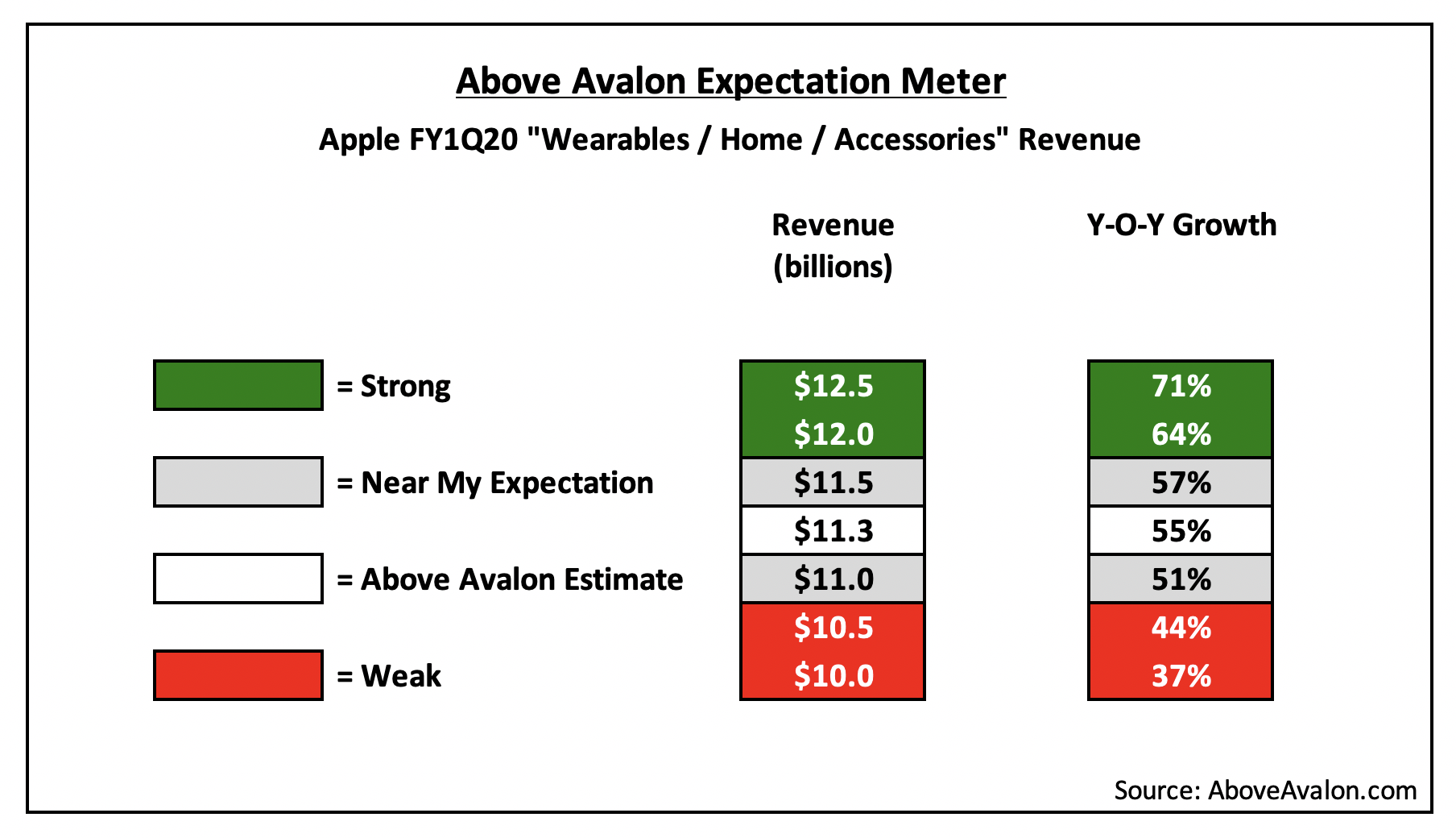
In each expectation meter, the number found in the white shaded box reflects my official single-point estimate. A result that falls in the gray shaded area would be considered near my estimate. This signifies that the product or variable being measured is pretty much performing as expected. A result that falls in the green shaded area denotes strong performance and the possibility of me needing to raise my expectations for that particular item going forward. Vice versa, a result falling in the red shaded area denotes the possibility of needing to reduce my expectations going forward.
As shown below, my expectation is for Apple to report $51.9 billion of iPhone revenue for 1Q20. A result within $51.5 billion to $52.5 billion of revenue would be considered near my expectation. An iPhone revenue result that exceeds $52.0 billion would signal the iPhone business has officially returned to growth after four quarters of revenue declines.
Wearables / Home / Accessories Revenue
Apple’s “Wearables / Home / Accessories” catch basin stands to be the most intriguing product category when it comes to 1Q20 results. The category includes revenue from AirPods, Apple Watch, Beats, Apple TV, HomePod, iPod touch, and various Apple-branded and third-party accessories.
There are three primary revenue growth drivers in this segment (in the following order): AirPods, Apple Watch, and accessories. Each driver looks to have had a good 1Q20.
In what ends up saying a lot about today’s Apple, the “Wearables / Home / Accessories” category is well-positioned to be the top driver of the company’s year-over-year revenue growth (+$4 billion), exceeding Services year-over-year revenue growth (+$2 billion) by a wide margin.
As shown below, my expectation is for Apple to report $11.3 billion of revenue in “Wearables / Home / Accessories” with AirPods and Apple Watch responsible for the vast majority of that revenue.
2Q20 Revenue Guidance
Sell-side consensus expects Apple to report $62.5 billion of revenue in 2Q20. My estimate is for Apple to announce 2Q20 revenue guidance in the range of $57.5 billion to $60.5 billion. This range is a bit low as it includes a $2 billion negative impact from coronavirus in China. One near-term risk facing Apple in China is coronavirus resulting in less customer demand due to the various travel restrictions and reduction in retail foot traffic. While there are ways of mitigating those potential headwinds, Apple may not be able to escape without some impact.
Close attention to management commentary will be required when it comes to assessing whether or not guidance reflects coronavirus risk factors. In the event that Apple sees no discernible impact from coronavirus, having the low end of management’s 2Q20 revenue guidance end up closer to $60B would be considered a good result.
My full 3,900-word Apple 1Q20 earnings preview, along with my working Apple earnings model (an Excel file that also works in Numbers), are available here. Above Avalon membership is required to read the earnings preview. Access to my Apple earnings model is available to Above Avalon members at no additional cost.
My earnings review will be sent exclusively to Above Avalon members after Apple reports. To have the review sent directly to your inbox on Wednesday morning (ET), sign up at the membership page.
Above Avalon Podcast Episode 162: The Apple Question
At the start of a new year, there is less value found in coming up with predictions than there is in looking at questions facing the company. In episode 162, Neil goes over his list of questions for Apple in 2020, and the discussion culminates with one overarching question that covers Apple’s largest challenge and opportunity. Additional topics include why predictions contain so little value, the number of Apple users, and Apple in emerging markets.
To listen to episode 162, go here.
The complete Above Avalon podcast episode archive is available here.

The Big Question Now Facing Apple
Predictions are nothing more than attempts at manufacturing clarity for what is inherently a sea of unknown. With New Year predictions, two things need to happen. The person issuing the prediction needs to come up with what may happen, and the predicted event has to occur within an arbitrary time period. The probability of finding value in such an exercise is low.
Instead of coming up with predictions for Apple at the start of a new year, there is value found in embracing the unknown and looking at questions facing the company. This has led to my annual tradition of coming up with a set of questions facing Apple at the start of a new year. The irony found with questions is that asking the right ones is equivalent to coming up with a surf board for successfully catching waves in the sea of unknown.
Previous year’s questions are found below:
Questions for Apple in 2020
The topics that serve as source material for Apple questions in 2020 can be grouped into two buckets: growth initiatives and asset base optimization.
Growth Initiatives
iPhone Business. The narrative facing the iPhone business has been off the mark for years. Skepticism and cynicism has continued to mask what has been a resilient business. There is now too much talk of 5G kicking off some kind of mega upgrade iPhone cycle. Such a focus ignores what is ultimately taking place with the iPhone: The business is maturing. This presents a set of challenges that will require a fine-tuning of strategy. This involves changes to the device lineup, release schedule, pricing, and feature set.
Paid Content Distribution. Following a very busy 2019 for Apple’s content distribution arm, all eyes are on whether or not Apple will bundle its new paid content services. Ultimately, bundling is a tool that Apple has at its disposal to support a weaker service while increasing the stickiness found with its services.
Wearables. Apple’s wearables business is a runaway train with the company selling approximately 65M wearable devices in FY2019. Based on my Apple Watch installed base estimate (available here), just 7% of iPhone users own an Apple Watch. Similar ownership percentages are found with AirPods despite the product having been in the market for less time. The question isn’t if Apple wearables momentum will continue but instead how fast will adoption grow.
Margins. Apple follows a “revenue and gross margin optimization” pricing strategy. This has led to Apple’s products gross margin percentage declining by 10% over the past two years while products gross margin dollars have declined by only 2%. Apple is willing to let products gross margin percentages decline (via lower product prices and higher cost of goods sold relative to revenue) if it results in stronger customer demand for those products. Attention will be placed at determining the level at which Apple product pricing is too low in order to maximize gross profit dollars.
R&D. There have been two general themes found with Project Titan and Apple’s efforts related to developing a pair of AR glasses: 1) Continued progress and 2) Extended timelines.
Asset Base Optimization
Leadership. With Jeff Williams officially serving as the link between Apple’s design team and the rest of Tim Cook’s inner circle, it will be interesting to see if Apple makes any refinements to its leadership structure.
China. The boogeyman known as U.S. / China trade has been put to bed, for now. With rhetoric having been dialed back in a very big way, attention will shift to the various decisions Apple still has to make regarding its long-term approach to China. The company can continue to rely heavily on China for its supply chain and manufacturing apparatus, accelerate a diversification strategy away from the country, or follow more of a status quo approach that recognizes the benefits (and weaknesses) of being so dependent on one country.
Capex. In FY2019, Apple reported just $7.6 billion of capital expenditures (capex). This was a significant drop from the $16.7 billion of capex in 2018. The most likely reason for the decline in capex was a decline in tooling and manufacturing machinery. The company also slowed spending on corporate facilities. By not providing capex guidance for FY2020, the variable is accompanied by a greater level of intrigue as to what it means about Apple’s near-term product pipeline.
Capital Return. Apple shares were up 89% in 2019, exceeding the S&P 500’s 31% gain. For the first time with Tim Cook as CEO, Apple shares now trade at a premium to the overall market when looking at forward price-to-earnings multiples. This has led some financial writers to call for Apple to slow the pace of buyback and instead push a larger increase in the quarterly cash dividend. In the event that Apple’s market value exceeds intrinsic value, it’s not clear how Apple would remove tens of billions of dollars of excess cash still on the balance sheet in addition to nearly $60 billion of free cash flow generated per year. Special dividends aren’t great from a tax perspective while there are limitations found with simply funneling all of the excess cash into quarterly cash dividends.
The Big Question
Taking a closer look at the preceding list of unknowns facing Apple, the product categories that have served as the primary engines for Apple’s new user growth are quickly maturing while new product categories have been more ARPU (average revenue per user) drivers. There are more than 500 million people who own just one Apple product: an iPhone. This group represents a prime target market for Apple when selling additional tools. Apple is ending one growth phase and is about to enter into a new one.
Exhibit 1 shows the growth trajectory for the number of Apple users, also referred to as Apple’s installed base, over the past 10 years. Based on my estimates, the Apple installed base grew from approximately 90 million people at the end of 2009 to a little more than a billion people at the end of 2019. Apple’s new user growth has slowed dramatically. Thanks primarily to the iPhone, Apple saw spectacular new user growth in the range of 25% to 60% in the early to mid-2010s. More recently, new user growth has been trending in the mid single-digit range.
Exhibit 1: Apple Installed Base (Number of Users)
The methodology and math used to reach my estimate for the number of Apple users is available for Above Avalon members here.
Reaching a billion users is quite the accomplishment for Apple considering how the company doesn’t give away its products for free. It’s one thing to reach a billion users with a “free” service. However, to get a billion people to pay directly for a service or tool is an entirely different thing.
When thinking about Apple’s future, the big question facing the company isn’t about how it will sell additional tools to its existing user base. Instead, the major unknown facing Apple is found with management’s ability to continue expanding its installed base. This raises one overarching question that covers Apple’s largest challenge and opportunity:
How will Apple find its next billion users?
It may be tempting to classify Apple’s first billion users as the “easy” growth or low-hanging fruit. In reality, those billion users primarily came from the premium segments of the various industries that Apple competes in. This means that to find the next billion users, Apple will inevitably need some strategy adjustments.
The Strategy for the Next Billion
The major building blocks for Apple’s plan to find its next billion users are already in place. Apple will come up with tools capable of making technology more personal. This pursuit will involve new user interfaces and inputs that allow people to get more out of technology without having technology take over people’s lives.
Taking a look at the geographical makeup of Apple’s current installed base, developed markets still contain plenty of new users for Apple to target. However, the potential found with emerging markets is a completely different story. Indonesia, Brazil, the Philippines, and Vietnam have a total population that is twice that of the U.S. Meanwhile, there are more people in China and India (2.6 billion) than the next 20 most populated countries combined.
It may be easy to think that Apple can just cut product pricing in order to grab its next billion users. However, the situation ends up being more complicated. Socio-economic trends will contribute to tens of millions of people moving into Apple’s addressable market each year. In addition, relying on the gray market for allowing gently-used Apple products to flow to lower price segments is a more effective strategy for Apple. Not only does the gray market reduce the need for Apple to come up with low priced products lacking in features, but Apple can also benefit from continued product focus in terms of its supply chain and manufacturing apparatus.
As for some of the granular initiatives that stand to promote continued growth in Apple’s installed base:
A truly independent Apple Watch. Advancements such as a truly independent Apple Watch that doesn’t require another Apple device to activate and use will expand the device’s addressable market by nearly four times overnight.
Continuing to run forward with wearables. New product categories that allow Apple to break down the barriers between users and technology will allow the company to target a wider audience. New form factors such as glasses will be designed to make technology even more personal than what is possible with Apple Watch and AirPods.
Longer device longevity. By giving Apple devices longer lifespans via more durable hardware and additional years of software updates, devices will be able to have more owners over time. This will have a direct benefit on the gray market for Apple devices as more devices are recirculated and eventually able to reach customers in lower price segments.
Expanding device repair and support networks. Apple’s current retail store footprint is not capable of handing the additional product servicing and support associated with having another billion users in its ecosystem. This is especially true in developing markets. By building out a device repair and support network to include authorized third-parties, Apple will go a long way in ensuring the next billion users have access to many of the same experiences that are valued by Apple’s current users.
The path to two billion users won’t be easy for Apple. The trajectory may very well end up looking quite different than the path to a billion users. However, there is nothing found with Apple’s long-standing mission to create products that can change people’s lives that limits its reach to a billion people.
Listen to the corresponding Above Avalon podcast episode for this article here.
Receive my analysis and perspective on Apple throughout the week via exclusive daily updates (2-3 stories per day, 10-12 stories per week). Available to Above Avalon members. To sign up and for more information on membership, visit the membership page.
Above Avalon Podcast Episode 161: Apple's Spectacular Year on Wall Street
Something has clearly changed when it comes to the way Wall Street is treating AAPL. For the first time with Tim Cook as CEO, Apple shares are trading at a premium to the overall market. In episode 161, Neil discusses how changing behavior as it relates to passive versus active investing may be creating a type of perfect storm for AAPL shares. Additional discussion topics include Apple’s valuation, free cash flow, momentum shifting to passive investing, and Warren Buffett.
To listen to episode 161, go here.
The complete Above Avalon podcast episode archive is available here.
Apple's $500 Billion Year on Wall Street
Since the start of 2019, Apple’s market capitalization has increased by $500 billion or roughly the equivalent of Facebook’s market cap. For the first time with Tim Cook as CEO, Apple shares are trading at a premium to the overall market. Something has clearly changed when it comes to the way Wall Street is treating AAPL. However, the items that analysts, pundits, and the media positioned as catalysts for this dramatic change (Apple Services, iPhone sales rebound, 5G, improving U.S. / China trade sentiment) likely have little to nothing to do with Apple’s share price outperformance in 2019. Instead, changing behavior as it relates to passive versus active investing may be creating a type of perfect storm for AAPL shares.
Outperformance
It’s difficult to put a $500 billion market capitalization increase in context. Here are a few attempts:
Disney ($262B), Netflix ($146B), and three Spotifys ($78B) combined.
AT&T ($282B), Comcast ($196B), and a Spotify ($26B) combined.
Nearly two ExxonMobils ($588B).
Three Boeings ($558B).
Six Goldman Sachs ($498B).
Sixteen percent of the entire energy sector.
The market caps of the bottom 12% of the companies in the S&P 500 (60 companies in total).
When looking back over the past ten years of stock price performance, 2019 is on track to be the best one for Apple this decade (barring a stock market implosion in the next two weeks). Apple shares are up a whooping 77% in 2019. Comparing the S&P 500’s performance with that of AAPL, we reach Apple’s outperformance / underperformance relative to the broader market:
2010: 40%
2011: 26%
2012: 19%
2013: -22%
2014: 29%
2015: -2%
2016: 3%
2017: 29%
2018: 1%
2019: 50%
Apple shares have outperformed the market by 50% in 2019. For a company of Apple’s size, such outperformance is noteworthy.
Valuation
On a forward P/E multiple basis, Apple shares now trade at a 20% premium to the S&P 500. My preferred valuation metric for Apple is free cash flow yield, or the amount of free cash flow relative to enterprise value. Free cash flow is the amount of cash left over after management has paid all of the bills and maintained / funded capital investments. Enterprise value is market capitalization minus net cash (debt - cash).
In FY2019, Apple reported $58 billion of free cash flow. Apple is a free cash flow machine given its capex light business model. (More information on Apple’s free cash flow advantage is found in the Above Avalon daily update from March 13th available here.) While Apple’s free cash flow will fluctuate given the various moving parts, the combination of a stabilizing iPhone business and no major change in capex spending supports the idea of similar levels of free cash flow over the next 12 to 24 months. Accordingly, we can use $60 billion of free cash flow and Apple’s current enterprise value of $1.1 trillion. Apple is currently trading at a 5.2% free cash flow yield. The higher the yield, the lower the stock valuation.
One way of interpreting a 5.2% free cash flow yield is to compare it to other instruments such as government bonds and high-yield corporates. With those yields closer to 2.5%, a 5.2% yield suggests that Apple is still fairly attractive from a free cash flow yield basis. However, the days of Apple trading like a steel mill with just a few years left of operations are in the rear-view mirror. As recently as 2016, Apple was trading at a 17% free cash flow yield. For discussion purposes, AAPL would need to trade at $100 per share for free cash flow yield to once again be at a 17% yield.
What’s Driving AAPL?
Longtime Above Avalon readers and listeners will be familiar with my consistent stance on how to determine what is behind a stock price’s move. Unless every market participant is interviewed, we are unable to know the exact reason why a stock price behaves the way it does. Given the sheer difficulty found with such an exercise, the task of determining specific reasons behind a stock price move is ultimately a fool’s errand. The activity is nothing more than an attempt to add manufactured clarity to what is ultimately a lot of unknown. It is humans’ discomfort with the unknown that plays a role in the financial press’ never-ending quest to come up with exact reasons behind stock price moves.
When it comes to Apple, the list of “reasons” that analysts and reporters claim are behind the stock’s 77% move in 2019 continues to grow:
A stabilizing iPhone business.
Stronger services growth.
Apple management successfully navigating a tumultuous geopolitical landscape in both the U.S. and China.
Wearables momentum.
Continued ecosystem momentum with ongoing growth in terms of new users and the number of devices.
There is a rather glaring problem found with the preceding list of factors: None are significant enough on their own to justify a $500 billion increase in market capitalization.
Using a conservative measure as to what the iPhone business was previously valued at, Apple’s market cap increase would represent the iPhone business seeing its valuation double in just 11 months. That is unrealistic for a mature business like the iPhone. Expectations would have had to move from Wall Street thinking the iPhone was dead with just a few years of sales remaining (which was never the case) to the business demonstrating some kind of free cash flow bonanza (also not the case).
As for the idea that Services is somehow behind Apple’s spectacular rise, I’m skeptical. The problem with that theory is that there continues to be a lack of consensus as to what that narrative may even be. Apple isn’t becoming a services company, and there remains quite a bit of hesitation around that idea in terms of buy-side investors.
My suspicion is that Apple’s stock price run isn’t driven by any single business-related item. The move is simply too large. Instead, a $500 billion market capitalization increase points to a wide variety of investors wanting greater Apple exposure. This increased interest results in higher stock prices since a stock price is nothing more than the spot where demand for shares equals the supply of those shares.
Why do these investors want more Apple exposure? Instead of looking at Apple’s business for potential answers, we have to look at the multifaceted dynamic found with passive versus active investing.
Passive investing (index funds) are on the rise as investors are becoming increasingly disenchanted with mutual funds and active funds charging for underperforming the market. As more funds are poured into passive investment vehicles, all of the Wall Street giants (Apple, Microsoft, Amazon, Alphabet) benefit. By accounting for 4% of the S&P 500, 4% of every dollar put in an S&P 500 index fund is allocated to Apple. While this mechanism doesn’t necessarily lead to Apple’s share of the overall market increasing over time, it can lead to sustained demand for shares regardless of business fundamentals. This is key as active investors, and their constantly swinging perspectives on stocks, lose power to sway stock prices. While passive investing on its own doesn’t explain a $500 billion increase in Apple market cap in 2019, it likely is a contributing factor to what may be happening.
In a scenario where active investors (hedge funds, mutual funds, pension funds, etc.) were running with historically low exposure to Apple for whatever reason, a scenario in which Apple began to materially outperform the market would place pressure on these active investors given how they are often graded against a market benchmark. Given how Apple represents 4.3% of the overall S&P 500, a 77% move in the stock will likely make or break an active investor’s year depending on whether or not they own the stock.
The most likely explanation for Apple’s run up - however simplistic it may sound - is that active investors have been desperately trying to increase their exposure. The stronger demand for shares leads to higher stock prices in order for demand to match supply.
A crucial piece of evidence for my theory is found with Microsoft. The company is up 52% in 2019 with market cap gains of approximately $400 billion. We know Microsoft shares aren’t up that much because of iPhone sales. Instead, Microsoft is likely experiencing the same situation as Apple. Having shares of the two largest companies go up by 77% and 52% respectively means that active investors need to be overly exposed to these companies or risk underperforming benchmarks. For those active investors late to the party, the need for exposure only intensifies. Some may call this situation FOMO (fear of missing out). Others may call this forced buying - the opposite of forced selling.
Warren Buffett
Warren Buffett ends up being a symbol of this development. Back in 2016, Buffett began building his Apple stake after one of his portfolio managers introduced him to the idea. Buffett has been uncharacteristically quiet about his Apple investment. However, the past few Berkshire annual reports provide enough clues to suggest he is ultimately attracted by Apple’s robust free cash flow and balance sheet strategy in which free cash flow is poured into share buyback and dividends. Buffett took advantage of active investors shunning Apple to increase his own exposure. Buffett’s Apple stake is now worth $70 billion, marking an unrealized profit of approximately $34 billion (not including dividends).
During the period when Buffett was acquiring his Apple stake, the two largest Apple buyers in the market were Apple (via stock buyback) and Buffett. In some quarters, the buying from Apple and Buffett alone totaled as much as 10% of shares traded. That is astounding. As Apple and Buffett were buying shares, many other market observers remained on the sidelines for likely a variety of reasons (unease surrounding Apple’s business model, Apple’s exposure to China, and the list goes on).
What Next?
As for how this situation will end, no one knows. If someone proclaims to know, caution is needed. We can have much more confidence in saying that valuations will matter, eventually. It is also safe to assume that passive investment momentum will continue, which will likely only exacerbate current trends (both to the upside and downside).
Listen to the corresponding Above Avalon podcast episode for this article here.
Receive my analysis and perspective on Apple throughout the week via exclusive daily updates (2-3 stories per day, 10-12 stories per week). Available to Above Avalon members. To sign up and for more information on membership, visit the membership page.
Above Avalon Podcast Episode 160: Let's Talk "Apple Tax"
Apple’s ability to grab monopoly-like share of industry profits isn’t a result of there being an Apple Tax. Rather, it's a byproduct of Apple following a design-led product strategy that ultimately marginalizes industries. In episode 160, Neil discusses the theory behind the “Apple Tax,” Apple’s pricing strategy, and why the days of there being an Apple Tax ended years ago. Additional topics include Apple gross margin trends, two major implications associated with Apple’s pricing strategy, and a few narrative violations found with Apple’s revenue and gross profit optimization playbook.
To listen to episode 160, go here.
The complete Above Avalon podcast episode archive is available here.

The "Apple Tax" Died Years Ago
Two weeks ago, Business Insider caused a stir with a video titled, “Why Apple Products Are So Expensive.” The video was part of Business Insider’s “So Expensive” series, which takes a look at why certain items are priced the way they are.
The video was troubling for the number of inaccuracies, falsehoods, and outright lies it included about Apple and its pricing strategy. According to Business Insider, Apple products are expensive because loyal users are willing to pay an “Apple Tax,” or a higher price attached to products containing an Apple logo. A closer look at Apple’s actual pricing strategy reveals a fundamentally different explanation for why Apple products are priced the way they are. The days of there being an “Apple Tax” ended years ago.
The Video
The following video was pushed out to Business Insider’s 2.3M YouTube subscribers on November 23rd, 2019. The video currently has a little more than 660,000 views.
The video included a long list of claims regarding Apple, its product pricing strategy, and the company’s overall positioning in the marketplace.
Apple was said to be bringing in huge profits by charging higher prices for its products. The progression of pricing from iPhone 6 to iPhone 11 ($649 to $999) and the Mac mini ($499 to $799) were used as examples of Apple charging more for basically the same product. These higher prices are said to be part of Apple’s strategy to squeeze as much profit as possible from loyal customers “unwilling to switch out of the Apple ecosystem.”
Apple products were said to contain components that are standardized and comparable to what is found in competing products. Accordingly, higher-priced Apple products are more expensive than products from competitors despite not including additional functionality. An iPhone’s bill of materials was positioned as a useful tool for tracking how profitable an iPhone is for Apple.
Apple was said to rely on “sneaky” tactics to grab additional profit from these loyal users by charging more for higher-end configurations and requiring users to buy expensive dongles, keyboards, mice, and cables.
When assessing the video’s long list of issues, the primary problem was found with how much long-standing narratives about Apple guided Business Insider’s talking points. Numbers and data were cherrypicked to support false narrative after false narrative while Business Insider ignored or brushed aside evidence that would prove its narratives wrong. For example, Apple’s downright aggressive pricing with Apple Watch and AirPods was ignored. Meanwhile, strategies that have proven to be flat out wrong, such as relying on a product’s bill of materials to figure out profitability, went unchecked.
In an effort to come off as more authoritative, Business Insider relied heavily on commentary from Mohan Sawhney, a marketing professor at Northwestern University. The problem was that Sawhney viewed Apple through a marketing prism - the company was said to be nothing more than a luxury brand selling nice-looking tech gadgets. Sawhney claimed the only reason Apple is able to extract so much profit from the industries it operates in is because people are willing to pay more for the Apple logo. There was no mention of Apple controlling much of the profit within an industry by purposely avoiding the low end of that market while also offering a wide range of devices with different amounts of technology.
Apple Tax
The theory of there being an Apple Tax has been around for more than a decade. The term was coined during the mid-2000s to refer primarily to Apple laptops (iBooks and then MacBooks). A MacBook was said to cost more money than a Windows laptop with similar specifications because of there being a premium built into the MacBook’s price. Said another way, the MacBook was more expensive than other products since it included an Apple logo.
The “Apple Tax’ phrase became a way to poke fun at MacBook users for their apparent cluelessness in paying more for a product despite cheaper alternatives being available. In recent years, the Apple Tax definition has morphed to merely refer to higher-priced Apple products like the iMac Pro and new Mac Pro.
There has always been a glaring hole in the Apple Tax narrative: Since Apple does not license its Mac operating system to OEMs, a MacBook running Apple software ends up being very different than a Windows laptop said to have similar specs. In addition, while Apple made a number of content creation applications available for free on the Mac, Windows laptops positioned as direct competitors lacked such free applications. It may be more correct to say that the Apple Tax reflected the price of Mac software instead of some kind of premium created out of thin air.
Apple’s Pricing Strategy
Apple’s pricing strategy is not based on the idea of forcing users to pay an “Apple Tax.” Instead, Apple follows a revenue and gross profit optimization strategy. Here is Apple’s CFO Luca Maestri talking about the strategy on various Apple earnings conference calls:
4Q17: “We tend to think about maximizing gross margin dollars because we think that's the most important thing for investors at the end of the day. When we look at our track record over years, I think we've found a good balance between unit sales growth and gross margins and revenue, and we will continue to do that as we go forward.”
2Q18: “Our primary consideration is always around maximizing gross margin dollars, and that is the approach that we take around pricing decisions.”
4Q18: “[W]e make our decisions from a financial standpoint to try and optimize our revenue and our gross margin dollars.”
1Q19: “It is important for us to grow gross margin dollars. And if at times we grow services that are at a level of gross margins, which is below average, as long as this is good for the customer and as long as we generate gross margin dollars we're going to be very pleased.”
2Q19: “[W]hat really matters to us and what we look at -- when we look at the elasticity of these [iPhone upgrade] programs is to see the impact on our gross margin dollars.”
While “revenue and gross margin optimization” may sound like loaded terminology, the idea underlying the strategy is straightforward. Instead of Apple including a certain amount of “tax” or premium in a product’s price to maintain a specific gross margin percentage, Apple prices its products in a way that maximizes gross margin and revenue on an absolute basis. Gross margin is cost of goods subtracted from revenue.
The strategy requires Apple to come up with forecasts for how a product’s price will impact customer demand for that product. Price a product too high, and the lower unit sales (as a result of weaker demand) may more than offset the higher amount of revenue and gross margin found with each device. Price a product too low, and the higher unit sales (as a result of stronger demand) may not offset the lower amount of revenue and gross margin found with each device.
Gross Margin Data
A closer look at Apple’s gross margins demonstrates this “revenue and gross margin optimization” strategy in action. Exhibit 1 highlights Apple’s gross margin percentage going back to 2000.
Exhibit 1: Apple Gross Margin (Percent of Revenue)
As shown in Exhibit 1, Apple’s gross margin as a percent of revenue has been steady since 2013. On the surface, such stability would seem to validate Business Insider’s claim of there being some kind of price premium automatically added to Apple products - as if management determines a product’s price by adding a certain premium on top of the cost of goods sold.
However, Apple’s overall gross margin doesn’t tell the full story. There are notable shifts underway when looking at the two components that make up overall gross margin. A decline in Apple’s products (hardware) gross margin percentage is being offset by an increase in services gross margin percentage. This dynamic is seen in Exhibit 2.
Exhibit 2: Apple Gross Margin (Percent of Revenue) - Products vs. Services
In just the past two years, Apple products gross margin percentage has declined by 10% (350 basis points). That is noteworthy. This means that Apple hardware has become less profitable when looking at gross margin as a percent of revenue. The decline is due to two factors:
Apple is lowering product pricing which is eating into the delta between revenue and cost of goods sold. Most of these price cuts are designed to roll back the impact from foreign exchange. However, another factor is that Apple is willing to run with lower gross margin profiles for certain products with the goal of selling more products.
Apple is including more technology in its products while not increasing prices enough to maintain gross margin percentages. As with the first factor, Apple is becoming more aggressive on price in an effort to sell more products and generate more revenue and gross margin dollars.
The decline in products gross margin percentage doesn’t become apparent when looking at overall gross margin because Apple Services is offsetting the decline. Services gross margin is up a very strong 16% (870 basis points) over the past two years as services with naturally higher margins (licensing, AppleCare, paid iCloud storage) gain momentum.
While Apple’s products gross margin percentage has declined by 10% over the past two years, products gross margin dollars declined by only 2%. This tells us that Apple is willing to let products gross margin percentage decline (less profit found with each device) if it means stronger customer demand results in more units being sold. This is the epitome of Apple’s revenue and gross margin optimization strategy.
Implications
There are two major implications associated with Apple’s revenue and gross profit optimization strategy:
Apple’s product portfolio has become increasingly competitive from a pricing perspective. In the case of Apple Watch and AirPods, pricing is downright aggressive compared to the competition. A $159 pair of AirPods sent shockwaves around the industry as competing products were priced in the $200 to $300 range. Even today, it’s difficult for genuine competitors to come close to AirPods pricing. A similar dynamic is found with wrist wearables as Apple Watch pricing remains highly competitive.
Apple has embraced a bifurcation strategy in which product lines have been expanded to include a broader range of models and corresponding prices. This dynamic applies to most of Apple’s products including the iPhone, iPad, Mac, Apple Watch, and AirPods. The primary benefit of Apple becoming aggressive both at the low end and high end of the pricing spectrum is more choice for consumers. Products like the 10.2-inch iPad represent the gateway into the iOS ecosystem for millions of people each year. The MacBook Air remains the most popular Mac. The end result is that products with various margin profiles may end up offsetting each other.
Accessories
When it comes to how Apple prices various accessories like dongles, Watch bands, and iPad keyboards, the company isn’t relying on an Apple Tax. Instead, accessories by their very nature have high gross margins given that the items are sold to customers looking to personalize their experience. A similar philosophy applies to Mac memory and storage upgrades. While those upgrades are indeed profitable for Apple, the fact that Apple charges the prices they do is not a sign of Apple users being held hostage and forced to pay an Apple Tax. Instead, positioning certain items as accessories or upgrades plays a role in Apple keeping entry-level product pricing low for the mass market.
Narrative Violations
A new school of thought positions Apple as a monopoly not because it has significant market share, but because it has loyal and engaged users. The idea is that since these users would apparently face such a dreadful experience by moving outside the Apple platform, it’s as if they have no alternatives. Apple is said to be taking unfair advantage of this situation and its position as the only provider of a premium experience. A byproduct of this stance is that certain Apple actions, such as the way the App Store is managed, are viewed as uncompetitive.
There is no question that Apple has loyal, satisfied users. However, the premise that these users are in some way held captive or hostage by Apple, and therefore forced to pay high Apple prices, just doesn’t hold up to scrutiny.
Contrary to popular opinion, a new Apple product doesn’t sell simply because it has an Apple logo. Apple users are discerning when it comes to determining what products are worth buying. We see this when it comes to upgrade rates for existing products as well as adoption trends for new products.
Apple’s declining products gross margin percentage is driven in part by lower iPhone profit margin percentages. This has occurred despite iPhone ASPs rising, which goes against nearly every narrative that has been put forth about higher iPhone prices.
The App Store is run at just a 10% gross margin (my estimate). This goes against the idea that Apple is being unfair to developers when charging 15% or 30% revenue share. While some developers want Apple to charge them more like 5% to 10% of revenue, or nothing at all, such revenue share arrangements would likely lead to the App Store being operated at a loss considering that a majority of apps do not share any revenue with Apple.
It’s easy to look at Apple pricing and take a cynical view that management is trying to squeeze as much profit as possible from its users. However, Apple’s incentive isn’t to milk users for all they can but rather to expand the Apple user base and provide users great experiences. Apple’s ability to grab monopoly-like share of industry profits isn’t a result of there being an Apple Tax but rather a byproduct of Apple following a design-led product strategy that ultimately marginalizes industries.
Listen to the corresponding Above Avalon podcast episode for this article here.
Receive my analysis and perspective on Apple throughout the week via exclusive daily updates (2-3 stories per day, 10-12 stories per week). Available to Above Avalon members. To sign up and for more information on membership, visit the membership page.
Above Avalon Podcast Episode 159: AirPods as a Platform
Apple is turning AirPods into a platform for what comes after the App Store. AirPods will augment our environment by pushing intelligent sound. In the first episode of Season 6, Neil goes over how AirPods have evolved from an iPhone accessory into the early stages of a platform well positioned to reshape the current app paradigm for the wearables era. Additional topics include the AirPods Pro launch, AirPods Pro initial impressions, AirPods sales, examples of AirPods as a platform, and the three sources from which AirPods will derive its platform power.
To listen to episode 159, go here.
The complete Above Avalon podcast episode archive is available here.

AirPods Are Becoming a Platform
If AirPods were magical, AirPods Pro are supernatural. Apple’s newest pair of AirPods continues to make waves with “augmented hearing” entering people’s vocabulary. However, the broader implications found with Apple’s AirPods strategy are just as impressive. Apple is quickly removing all available oxygen from the wireless headphone market, and competitors find themselves at a severe disadvantage. In just three years, AirPods have evolved from an iPhone accessory into the early stages of a platform well positioned to reshape the current app paradigm for the wearables era.
Another “Quiet” Launch
One of the more fascinating aspects found with AirPods Pro was how the product was unveiled. Instead of receiving stage time at Apple’s big product event at Steve Jobs Theater one month earlier, AirPods Pro received the press release treatment. When contemplating potential sales, AirPods Pro may end up being the best-selling Apple product that has ever been unveiled with just a press release.
The subdued unveiling given to AirPods Pro is consistent with Apple’s prior approach to AirPods. Instead of receiving the red carpet treatment as the Apple Watch did two years earlier, AirPods were unveiled to the world over the course of just five minutes at Apple’s iPhone and Apple Watch event at Bill Graham Civic Auditorium in San Francisco. In a sign of just how nonchalant Apple was with the unveiling, AirPods were positioned merely as an iPhone 7 and 7 Plus feature. The product was said to be an additional option that consumers had for handling the transition away from dedicated headphone jacks. (Remember those?)
Earlier this year, AirPods with wireless charging case was unveiled via press release as well.
AirPods Pro
It’s easy to gloss over many of the selling points found with AirPods Pro given the familiarity with AirPods. Items such as seamless pairing and the carrying case that doubles as a charging station play crucial roles in giving AirPods Pro such a high-quality and enjoyable user experience.
However, the features that have gained the most attention, and rightly so, are Active Noise Cancellation (ANC) and Transparency mode. For many people, AirPods Pro will be their first pair of ANC headphones. Those users are in for a treat as Transparency mode addresses the largest negative found with ANC headphones - the user is seemingly removed from his or her surroundings. A press and hold on one AirPod stem switches between ANC and Transparency mode. The functionality is a great example of how Apple’s engineering and design teams, through collaboration, can produce a great user experience.
Sales
In FY2019, Apple sold 35 million pairs of AirPods at an average selling price (ASP) of $162 (both are my estimates). On a revenue basis, the AirPods business is on a $6 billion per year run rate that is doubling year-over-year.
One way to put those sales numbers into context is to compare AirPods to other Apple products at the same point in time after launch. As shown in Exhibit 1, AirPods are trending similarly to iPhone sales when looking at unit sales out of the gate. After three years of sales, Apple has sold 61 million pairs of AirPods on a cumulative basis. During the first three years of sales, Apple sold 60 million iPhones.
Exhibit 1: Unit Sales out of the Gate
Apple likely crossed an important AirPods sales milestone last quarter. For the first time, Apple sold more than 10 million pairs of AirPods during a three-month stretch. While the preceding observation came from my earnings model (access to my Apple earnings model is a benefit associated with Above Avalon membership at no additional cost), the math checks out with Apple management’s commentary and clues provided on the 4Q19 earnings conference call. It’s likely that AirPods sales will exceed 10 million per quarter for the foreseeable future.
When contemplating AirPods unit sales trends going forward, too many people are stuck in a mobile mindset. Instead of seeing someone buy and use just one pair of AirPods, we may see a new kind of usage pattern develop in which a growing percentage of AirPods owners will use more than one pair of AirPods. This will help boost AirPods unit sales.
On Apple’s 4Q19 earnings conference call, Tim Cook was asked about the potential upgrade trajectory for AirPods. Cook commented that he thought current AirPods owners would be in the market for AirPods Pro to “have a pair for the times that they need noise cancellation.” The clear implication found in Cook’s comment was that Apple expects some AirPods owners to use multiple pairs of AirPods with differing levels of functionality.
After just three years of sales, we are already starting to see the early stages of this trend develop with people upgrading their AirPods but keeping their old pair as a backup.
In an unscientific poll conducted via Twitter poll through my account, 30% of respondents said they use more than one pair of AirPods. Interestingly, 41% of people who said they purchased a pair of AirPods with wireless charging case claim to still be using their older pair of AirPods as well. It helps that AirPods last years before poor battery life takes its toll. My initial pair of AirPods from 2016 are still used daily. It's early, but it looks like people using more than one pair of AirPods is a thing.
Platform Building
The current app paradigm primarily consists of downloading an app to our smartphone, tablet, smartwatch, smart TV, or laptop / desktop. We then interact with the app to “pull” information and context at a time of our choosing. App notifications are not very smart and instead represent mostly useless distractions more than anything else.
The Apple Watch was the first device to genuinely begin questioning the current app paradigm. The Siri watch face on Apple Watch is all about providing the wearer glanceable amounts of information, data, and context in the form of cards chosen by a digital assistant. These cards are personalized to the wearer based on the time of day and schedule. In essence, we are moving away from pulling data from various apps to receiving a curated feed of data that is dynamic - always changing and tailored to our needs.
Apple is turning AirPods into the second platform built for what comes after the App Store. Instead of being about pushed snippets of information and data via a digital voice assistant, something that will likely remain ideal for mobile screens, AirPods will be all about augmenting our environment by pushing intelligent sound.
AirPods Pro wearers are able to experience the early days of this dynamic with Transparency mode. Switching between Transparency mode and ANC is equivalent to augmenting our environment. We are receiving two different experiences despite being in the same location.
This dynamic could be extended so that a simple tap of an AirPod or a quick voice command can take us to a different location via sound. Utilizing HomePods as sound receivers, an AirPods wearer would be able to “move” from the kitchen to family room. A quick tap of one AirPods, or Siri voice command could bring the wearer from the family room to kitchen to answer a family member’s question or simply to be “in” the room.
App developers would be able to take part in this revolution by building experiences that further augment people’s hearing. “Apps” would amount to tools capable of adding context to our hearing. Fitness can be rethought by adjusting the AirPods wearer’s hearing during workouts and exercise based on his or her activity. As an example, AirPods music playbook can be adjusted based on the users’ heart rate obtained by an Apple Watch. Such adjustment would amount to the AirPods wearer being “removed” from his or her environment when close to reaching a maximum heart rate during a run or track workout. Of course, such health tracking and monitoring may one day be brought directly to AirPods in subsequent editions.
Another example involves utilizing AirPods to deliver different sound experiences to different people despite being in the same location and looking at the same thing. As an example, a single presentation shown in a school or office setting can end up delivering a dozen different experiences to those in attendance.
Platform Power
AirPods will derive its platform power from three sources:
Technology advantage
Design focus
Massive adoption
Apple is pulling away from the competition when it comes to building mini computers worn on the body. AirPods are computers for the ears. Years of learning how to manufacture 2.1 billion iPhones and iPads is now helping Apple to build nearly 70 million wearable devices per year.
This technology prowess and manufacturing acumen goes to waste if people don’t actually want to be seen wearing the devices. Apple’s success at redefining luxury, combined with the company’s design-led culture, gives the company a large advantage in the area of understanding what people will want to wear on the body.
The final source of platform power will come from massive adoption. There are currently 45 million people wearing AirPods. At the current rate, more than 100 million people will be wearing AirPods at some point in 2021. As to how Apple is able to see such strong AirPods adoption, Apple is busy removing all available oxygen from the wireless headphone market.
The company is utilizing a masterful combination of price and features to establish multiple beachheads in the market.
AirPods Pro do not replace AirPods in the product line. Apple is instead embracing a strategy of expanding the product line according to functionality. AirPods Pro represent the expansion of the AirPods line into a higher-end segment that places value with ANC. The end result is that Apple now has three different AirPods model, each targeting a different price segment of the wireless headphone market. It is certainly reasonable to expect Apple to continue pushing this strategy in the coming years so that we see a pair of AirPods go for as low as $99 and as high as $500.
We see similar product strategies with the iPad and Mac lines. With these, Apple sells a range of flagship products with varying degrees of functionality, and of course, price.
There are some unique attributes seen in Apple’s campaign to remove oxygen from the wireless headphone market. Unlike what they did with the iPhone or iPad playbook, Apple didn’t launch AirPods at one price and then begin to lower pricing once all of the profit had been sucked from that initial market segment. Instead, Apple has been doing the opposite. Apple unveiled AirPods at a very aggressive $159 price, which sent shockwaves across the industry as the competition was priced closer to $300. Three years later, competitors are still struggling to match AirPods' $159 entry-level price.
Something Big
This AirPods evolution into a platform does not come as a surprise. Here was the opening paragraph from my initial Above Avalon article on AirPods shortly after being unveiled in September 2016:
“AirPods will turn out to be one of the more strategically important hardware products Apple has released this decade. However, you would never know it judging from the way Apple unveiled the device last week. I suspect that was intentional. While the press remains focused on the short-term debate surrounding the iPhone's lack of a 3.5mm headphone jack, few have realized that Apple just unveiled its second wearables platform.”
Three years later and that paragraph still rings true. AirPods have turned into a cultural phenomenon while dedicated headphone jacks on smartphones have become relics. Meanwhile, Apple’s wearables train continues to gain momentum as the company grabs real estate on our wrists and in our ears by bringing a new level of personal computing to the masses.
Listen to the corresponding Above Avalon podcast episode for this article here.
Receive my analysis and perspective on Apple throughout the week via exclusive daily updates (2-3 stories per day, 10-12 stories per week). Available to Above Avalon members. To sign up and for more information on membership, visit the membership page.
Above Avalon Podcast Episode 158: Forced to Sell
How did Fitbit go from being considered the wearables leader to viewing a $2.1B acquisition as its best hope for shareholders to recoup any value? What led Fitbit to run out of options as an independent company? In episode 158, Neil discusses how Apple Watch forced Fitbit to sell itself. Additional topics include Google’s acquisition offer for Fitbit, how Apple Watch redefined the wrist wearables industry, and the most damning evidence of Fitbit’s demise.
To listen to episode 158, go here.
The complete Above Avalon podcast episode archive is available here.

Apple Watch Forced Fitbit to Sell Itself
Saying that a company with an agreement to be acquired for $2.1 billion was killed may sound like an exaggeration. Many start-ups aim to one day be “killed” in such fashion. However, Google’s decision to acquire Fitbit amounts to a mercy kill, putting an official end to Fitbit’s implosion at the hands of Apple Watch. In just three years, the Apple Watch turned Fitbit from a household name as the wearables industry leader into a company that will eventually be viewed as an asterisk when the wearables story is retold to future generations.
The Offer
When news first broke that Google LLC had offered to acquire Fitbit for $2.1 billion, or $7.35 per share, many observers noted how low the offer price was compared to Fitbit’s earlier valuations. This was a company that had its initial public offering at a $4.1 billion valuation and had seen its stock price peak at a $13 billion valuation ($51.90 per share).
My initial reaction was that Google was being extremely generous with its offer. On an enterprise value basis, which excludes $565 million of cash and cash equivalents on Fitbit’s balance sheet, Google is valuing Fitbit at $1.5 billion. For a hardware company with $1.5 billion of annual revenue and declining ASP and margins, questionable intellectual property, a dying ecosystem, and a non-existent product strategy, Google looks to be overpaying for Fitbit.
Industry observers speculate that Google’s offer price reflects the company seeing something in Fitbit that the marketplace missed. Instead, Google’s generous offer price has the makings of being a goodwill gesture aimed at Fitbit employees who have wealth tied to Fitbit stock. The $7.35 offer price represents close to a three-year high in Fitbit’s stock price. Holding Fitbit’s feet to the fire in terms of valuation wouldn't have helped Google retain Fitbit employees for beefing up its fledging hardware team.
On the flip side, Fitbit co-founder and CEO James Park and the board deserve a round of applause for securing such a generous offer from Google. The acquisition can be viewed as Google offering Fitbit a dignified and gracious death and Fitbit’s board as correct to take the opportunity.
Fitbit’s Story
There are two chapters to Fitbit’s life as an independent company. From 2013 to 2016, Fitbit leveraged low-cost, relatively rudimentary fitness tracker bracelets worn on the wrist to consolidate what had been a fragmented market for quantifying one’s physical movement. Fitbit even managed to move into the realm of coolness. Wearing a Fitbit in public contained positive connotations as the user was viewed as being on the forefront of technology. The smartphone revolution also played a role in Fitbit’s rise as people became comfortable giving a new crop of mobile devices an increasing number of roles to handle.
During the early years, Park successfully navigated Fitbit through a tumultuous period that included the company recalling the Fitbit Force for causing skin rashes and burns on nearly 10,000 people. Park also competed effectively against other early wearables pioneers. An ugly battle with the well-funded Jawbone regarding intellectual property theft ended in a settlement. Fitbit became a household name for health and fitness tracking.
Everything changed in 2016. Fitbit’s unit sales, as shown in Exhibit 1, peaked. On the surface, the subsequent decline in unit sales may not have looked too bad considering that demand stabilized around 15M units per year. However, for a hardware company dependent on rising unit sales, the development was alarming. Once again, Fitbit management did the right thing and quickly cut expenses at the first sign of demand weakness. The belief was that Fitbit could manage its way out of the sales slump.
Exhibit 1: Fitbit Unit Sales (Annual)
What management did not realize at the time was that Fitbit was beginning to feel the consequences of one giant mistake that Park had made years earlier. Park did not foresee the fundamental change that would take place on the wrist in the form of dedicated fitness trackers turning into full-fledged computers. Smartwatches aren’t just gloried fitness trackers. Instead, smartwatches are alternatives to smartphones and tablets.
After dragging his feet for far too long, Park knew that the only way forward for Fitbit would be to come out with a smartwatch. With the $300 Ionic, Fitbit launched its first smartwatch in 2017. The device flopped. Fitbit quickly pivoted to a lower-cost smartwatch with the $200 Versa. Once Fitbit had established channel inventory and satisfied pent-up demand for the Versa in its existing installed base, demand evaporated. Despite an even lower price, the Versa has failed to catch in the marketplace.
Why Sell?
In early 2019, Fitbit management began waving the white flag when it decided to pivot yet again, this time into services. In an effort to grab more users who could be monetized via paid services, Fitbit management began to cut into hardware pricing and margins. With the all-important 2019 holiday shopping season quickly approaching, Fitbit’s situation looked dire. Enter Google last week to officially put Fitbit out of its misery.
The only alternative for Fitbit, which was far from unproven, would be for the company to become a much smaller company, essentially a shell of its former self, in order to sell a certain number of dedicated fitness trackers each year to a declining installed base. Even if successful, Fitbit would have looked and acted like nothing that the world had come to know Fitbit as - a leader in the wearables category. Fitbit would instead become something of a zombie company.
How did Fitbit go from being considered the wearables leader to viewing a $2.1B acquisition as its best hope for shareholders to recoup any value? What led Fitbit to run out of options as an independent company?
Two words: Apple Watch.
Redefining the Industry
Apple didn’t just steal customers away from Fitbit. In such a scenario, Fitbit may actually have had a chance to survive as the company could have had a means to respond competitively. Apple ended up doing something that ultimately proved far worse for Fitbit. The Apple Watch altered the fundamentals underpinning the wrist wearables industry. This left Fitbit unable to remain relevant in a rapidly-changing marketplace.
Apple placed a bet that wrist real estate was being undervalued. The Swiss had dropped the ball and were primarily selling the wrist as a place for intangibles with high-end mechanical watches. Instead of following Fitbit and selling a $99 dedicated fitness tracker, Apple looked at the wrist as being a great place for additional utility beyond just telling time or tracking one’s fitness and health. Apple turned health and fitness tracking from a business into a feature. The Apple Watch redefined utility on the wrist.
This change led to consumers wanting more from wrist wearables. Apple Watch established a stronghold at the premium end of the market. Taking a page from its product strategy playbook, Apple then methodically began to lower entry-level Apple Watch pricing, which had the impact of removing oxygen from increasingly lower price segments. Fitbit was squeezed as the company had no viable way to compete directly with Apple Watch. Fitbit’s existing business wasn’t profitable enough for management to ramp up R&D in an effort to go up against Apple. Fitbit had generated just $200M of free cash flow over the past five years. Apple spends that much on R&D in a few days. Meanwhile, competition remained intense at the low-end of the market, which only added pressure to Fitbit’s existing business of selling low-cost dedicated fitness trackers.
Exhibit 2 highlights the number of active Fitbit users compared to the Apple Watch installed base (the number of people wearing an Apple Watch). The Apple Watch figures are my estimates. The exhibit ends up being the most damning evidence of Fitbit’s demise. Fitbit’s installed base lost all momentum just as Apple Watch began to take off. Unit sales trends continue to hide this deterioration in Fitbit’s installed base fundamentals. While Fitbit claims to have 28 million active users, that total isn’t enough to sustain a thriving ecosystem. In addition, there are valid reasons to question the loyalty and engagement found with those users.
A good argument can be made that Fitbit died a while ago, and the company is merely running on fumes from the dedicated fitness tracker glory days. With Fitbit, Google is acquiring a dying wearables platform.
Exhibit 2: Number of Active Users (Fitbit versus Apple Watch)
Fitbit and Google
There is no rationale argument in support of Google buying Fitbit. Both companies lack a workable strategy in wearables. Fitbit doesn’t bring anything to the table for Google. Buying a fitness and health tracker going off of fumes is not a legitimate way to find success in wearables. Not only did Fitbit lack a sustainable product strategy going forward, but it’s fair to assume that Fitbit products will become even less attractive following a Google acquisition.
When a services company with data-capturing tools buys a dying hardware ecosystem built on tools that weren’t just data-capturing tools in disguise, an exodus of users is likely. Judging by how Fitbit decided to include the following paragraph in the press release announcing the acquisition, both companies are acknowledging the exodus risk:
“Consumer trust is paramount to Fitbit. Strong privacy and security guidelines have been part of Fitbit’s DNA since day one, and this will not change. Fitbit will continue to put users in control of their data and will remain transparent about the data it collects and why. The company never sells personal information, and Fitbit health and wellness data will not be used for Google ads.”
That paragraph won’t provide any comfort to Fitbit users concerned about their privacy in a post-Google acquisition. However, that didn’t matter to Fitbit’s board when accepting Google’s offer as their concern was found with Fitbit shareholders, not Fitbit users.
Success in Wearables
Many industry analysts, possibly in an effort to appease Google’s ego, have been going around talking up Fitbit as having a treasure trove of data for Google. The narrative concludes with Google somehow turning this data into an ingredient for success in wearables. This line of thinking makes no sense and is nothing more than wishful thinking.
Google’s problem in wearables isn’t due to a lack of data. In addition, Google’s lack of silicon expertise and dependency on Qualcomm aren’t fatal issues either. Ultimately, Google’s problem in wearables is that it isn’t a design company. At Google, designers are not given control over the user experience. Even if Google ramps up investment and hiring so that it is able to one day ship custom silicon that is competitive with Apple, the company would still need to come up with wearables that people want to be seen wearing. These products need to be born from a design culture in which the way people use technology is given more importance than just pushing technology forward.
Instead of acquiring Fitbit to find success in wearables, Google should work on changing its internal culture to empower designers at the expense of engineering. However, that change isn’t likely to materialize as the people who would be tasked with making such a decision would themselves hold less power and importance as a result of the change.
Fitbit will serve as a case study for what happens to a company underestimating Apple’s ability to redefine not just a product category, but an entire industry. Apple’s culture allows it to succeed in wearables. The company has spent decades learning to make technology more personal, and those lessons are being used to establish the most formidable wearables platform in existence. Apple Watch redefined what it meant to put utility on the wrist, and Fitbit simply wasn’t built to succeed in such a world.
Listen to the corresponding Above Avalon podcast episode for this article here.
Receive my analysis and perspective on Apple throughout the week via exclusive daily updates (2-3 stories per day, 10-12 stories per week). Available to Above Avalon members. To sign up and for more information on membership, visit the membership page.