

Above Avalon Podcast Episode 140: Let's Talk Content
Some of Apple’s recent decisions regarding content distribution have sparked a debate. Is Apple embracing a new kind of strategy that elevates services at the expense of hardware? Episode 140 is dedicated to going over Apple’s content distribution strategy and how the company is looking to leverage its user base in an effort to establish one of the more formidable content distribution arms in existence. Additional topics include Apple’s history as a content distributor, how streaming is changing content consumption, misconceptions surrounding Apple’s content distribution strategy, the sudden collapse in stationary speaker buzz, Apple’s goals for its content distribution arm, and the various challenges facing the company.
To listen to episode 140, go here.
The complete Above Avalon podcast episode archive is available here.
Apple's Content Distribution Strategy
This past November, Amazon sent shockwaves across a number of industries by announcing Apple Music would be available on Echo devices. Earlier this month, Samsung announced Apple was bringing iTunes content to Samsung TVs. Apple also expanded AirPlay 2 support to include a wide range of high-end television sets. These announcements don’t represent some type of cultural shift away from hardware for Apple. Instead, the moves are part of Apple’s strategy to leverage its user base in an effort to establish one of the more formidable content distribution arms in existence.
Content Distribution
Apple has long held an interest in being the one to deliver content to its growing base of users and devices rather than leave content distribution to someone else. Apple’s content distribution arm delivers a variety of genres, listed below, to hundreds of millions of users and more than a billion devices.
Music
TV Shows / Movies
Apps
Podcasts
News
Magazines
Books
Apple has seen varying degrees of success when it comes to distributing content. With iTunes, Apple took advantage of the Mac’s low market share by getting the music industry to test a radical idea at the time: selling digital music online. iTunes ended up playing a big role in moving the music industry from albums to singles.
After years of strong growth, App Store revenue was approximately $45B in 2018. Apple has been a leader in the podcast space from the beginning. Written content distribution has proven to be trickier for Apple although the company has recently seen strong momentum when it comes to offering curated news to users in the U.S., Australia, and the U.K.
What Has Changed?
The landscape facing Apple’s content distribution arm is undergoing significant transformation.
Online streaming has taken over the music industry. The iTunes era of paid downloads is over as the idea of owning music is quickly becoming a thing of the past. Renting has become the preferred method of consuming music. The shifting landscape played a major role in Apple’s decision to buy Beats back in 2014.
According to the Recording Industry Association of America (RIAA), streaming now accounts for an astounding 75% of the U.S. music industry’s revenue. Digital downloads account for just 12%, slightly ahead of the 10% attributed to physical sales. In the U.S., approximately 50M people are paying a monthly subscription to consume as much music as they want. Globally, the total number of paid music subscriptions exceeds 200M. Apple Music has approximately 60M paying subscribers.
Turning to video, direct-to-consumer distribution has turned the industry on its head. Instead of the big cable bundle imploding, new, lower-cost video bundles such as Netflix and Hulu have exploded in popularity. These revised content bundles have the content people want to see, in addition to the distribution method that people want to use. More than 200M people pay a monthly subscription to consume video through these newer bundles. This number will continue to increase as notable names, including Disney, are about to enter the direct-to-consumer space.
One of the more interesting implications found with this new digital content landscape is how scale has been redefined. Success is no longer measured in the tens of millions of users like it was in the iTunes era. Instead, scale is measured in the hundreds of millions of users.
Spotify is the largest paid music streaming service while Netflix is the largest video streaming service. Amazon has seen the most success in the area of bundling access to content. Meanwhile, YouTube remains the behemoth in the ad-supported realm. Localized offerings in a number of emerging markets have also been able to capitalize on music and video streaming to develop compelling solutions, although few have seen success beyond their home territory.
The Strategy
Considering how Apple has approximately a billion users in its ecosystem, the company would appear to have enough customers to sustain a thriving content distribution arm. Such a strategy would involve Apple keeping its content distribution services exclusive to Apple hardware. However, upon closer examination, there is one complicating factor in such a strategy.
According to Tim Cook, there are 1.4 billion Apple devices in the wild. Given the number of Apple users, Cook’s disclosure means that at least 60% of Apple’s user base own just one Apple device. For hundreds of millions of people, the iPhone is likely that Apple device. This changes the dynamic facing Apple’s content distribution strategy.
Apple users are not monolithic when it comes to gadget buying. Instead of exclusively using Apple hardware, a majority of Apple users also own devices from other platforms such as Samsung Smart TVs and Amazon Echo speakers. Apple’s design-led culture and product development process ensure that there will always be product categories, such as TV sets and low-end stationary speakers, that Apple chooses not to play in or compete with.
With that in mind, Apple’s content strategy is as follows:
Develop content distribution platforms.
Give content distribution platforms the best chance of success by leveraging the user base and allowing certain content genres to be consumed on non-Apple hardware.
Provide first-party hardware solutions targeting users who are looking for the best all-around Apple experience.
In summary, Apple’s user base provides the company optionality when it comes to distributing content. By not keeping some of its digital content distribution services exclusive to its own hardware, Apple reduces the risk of its users turning elsewhere for content.
Odds are good that a decent portion of Echo speaker owners also use iPhones. Given how the predominant use case found with stationary speakers is listening to music, these users may have been tempted to try Spotify or Amazon Music. By bringing Apple Music to Echo devices, Apple is able to leverage its existing customer relationships in order to improve Apple Music adoption. The same principle applies to letting Apple users send content played on an iPhone, iPad, or Mac to non-Apple speakers or television sets via AirPlay 2.
Another assumption underpinning Apple’s content strategy is that a portion of the Apple user base will gravitate towards premium content consumption experiences. Apple has the opportunity to sell these first-party solutions, such as Apple TV and HomePod, to users willing to pay for the best all-around Apple experience.
Misconceptions
There has been much confusion in the press as to Apple’s content distribution strategy.
Apple is said to be deemphasizing hardware in order to grow services revenue.
Apple’s decision to bring Apple Music to Echo has been compared to bringing iTunes to Zune music players.
Apple is said to be no longer fully behind products like Apple TV and HomePod.
The preceding theories are off the mark.
A strategy characterized by Apple prioritizing services over hardware would revolve around Apple selling a $29 Apple TV dongle or a $29 HomePod mini speaker. Apple hardware’s function and value proposition would be altered to promote non-hardware Apple products. Neither device is likely to materialize as Apple isn’t prioritizing services over hardware. Instead, Apple is selling an Apple TV box priced at a 20% premium to a 32-inch TCL TV with Roku built-in. One HomePod goes for the same price as 12 Amazon Echo Dots or Google Home Minis.
When it comes to comparing Apple’s current strategy with that of iPod / iTunes, Apple didn’t have an ecosystem containing a billion users and 1.4 billion devices in the early-to-mid 2000s. Making iTunes available on other MP3 players, like Microsoft’s Zune, would have done little to improve iTunes or Apple’s broader ecosystem. The opposite is true today. Making certain content distribution platforms available on non-Apple hardware can help improve the service in question, which ends up adding value back to Apple hardware. In addition, Apple now has the ecosystem to not only target premium accessories to a segment of the user base, but also appeal to other users by bringing certain content distribution platforms to non-Apple hardware. A similar situation did not exist in the 2000s.
Speaking of premium accessories, Apple TV and HomePod are misunderstood products. The products are high-end accessories tasked with offering Apple users the best all-around experiences for consuming video content and listening to music, respectively. Making Apple Music or video available on other platforms does not change that dynamic. HomePod doesn’t have a weaker value proposition because Apple Music is available on a $29 Echo Dot. Apple TV is not kneecapped because AirPlay 2 support is available on a Sony TV set.
Motivation
Apple sees a massive opportunity in content distribution. There is a glaring weak point found in music and video streaming: brutal economics. Both Spotify and Netflix have business models in search of sustainability.
Spotify’s most likely path to sustainability boils down to amassing so many listeners that the balance of power begins to tilt towards Spotify and away from content providers. Either Spotify has to pay less for music, or the company will make a big move into original content.
Meanwhile, Netflix’s business model is based on a feedback loop that is consuming increasing amounts of cash. The move into original content is not proving to be a financial panacea either. Netflix clearly needs significant subscription price hikes over time, and the only way to guarantee those price hikes will stick is to continue ramping up content spending in order to sustain engagement.
Given Apple’s business model, the company doesn’t have to worry about such sustainability issues. Instead of releasing low-margin hardware that boils down to being nothing more than service conduits, Apple can use third-party hardware as Trojan horses for its own content distribution arm. This can be accomplished either by partnering with a company like Amazon to have Apple Music available on Echo devices or by expanding AirPlay 2 support to include a wide range of speakers and TV sets. AirPlay is a brilliant way of ensuring that an Apple product remains at the center of people’s lives.
Dedicated music and video streaming players will have to eventually prioritize profit and revenue. However, Apple has the luxury of not having profit be the motivating factor behind its content distribution arm. Instead, Apple is going for power. A few calculations prove this point. With Apple Music, 100M users paying an average of $7 per month would bring in $8B of revenue per year. Assuming 75% of that revenue goes back to music rights holders, Apple’s gross profit would be approximately $2B per year, or just 2% of Apple’s overall gross profit. Video streaming economics may end up being even less attractive from a cash flow perspective. Instead, Apple would be looking more at improving each service by grabbing scale and gaining influence and power in Hollywood.
Goals
Here are some of Apple’s specific goals for its content distribution arm:
Apple Music
Grab enough users to position Apple Music as a legitimate alternative to Spotify and Amazon Music. From Apple’s perspective, scale in music distribution has gone from being a liability during the iTunes era to being the key to success with Apple Music. The decision to bring Apple Music to Echo speakers is a clear attempt to limit Amazon Music and Spotify adoption, especially among Apple users.
Work more closely with the labels. By positioning Apple Music as an alternative to Spotify for the music labels, Apple is in a position to gain back the incredible amount of power it once had with the iTunes empire.
Capitalize on the changing way music is consumed by investing in better A&R capabilities. Playlists are gaining power in the realm of talent discovery. Capitalizing on improved ways to find new talent stands to improve Apple Music playlists and Apple’s relationships with music rights holders.
Apple Video
Convince third-party content creators to embrace the TV app. The key metric to watch in video streaming will be engagement. Accordingly, to have people spend an increasing amount of time in the TV app, Apple will look to establish a platform from which users can access various video bundles. This strategy resembles more of Amazon’s video playbook instead of Netflix’s. The idea underpinning this strategy is that video streaming won’t be a winner-take-all market, or even a winner-takes-most market.
Use original content to elevate the TV app. Since one form of differentiation in video streaming is great storytelling, Apple has been focused on developing its own slate of original programming. One thing Apple can do to stand out from Amazon is make its initial slate of original programming free for TV app users. The idea behind such a move is to get people using the TV app, which will then increase the odds of people singing up and paying for third-party video bundles through the TV app.
Bundling. There is an opportunity for Apple to bundle various content genres into one monthly payment. Music and video make the most sense for a bundle although news and magazines are doable as well.
Experiences. Apple is one of the few companies to have a diverse content distribution arm in addition to more than a billion customers and devices. This gives the company a unique advantage when it comes to fostering customer relationships. In addition, Apple can offer premium experiences to those in the Apple ecosystem by having its content distribution arm work seamlessly with entirely new hardware form factors.
Challenges
Apple faces various challenges in its pursuit of establishing one of the more formidable content distribution arms in existence. The most difficult task is found with video streaming. There is about to be a brutal war in video streaming as a handful of companies with deep pockets begin to compete with Netflix. We haven’t yet seen genuine competition in the paid video streaming space. In a scenario where there are only one or two all-powerful streaming services, Apple will find itself at a bigger disadvantage. On the flip side, greater competition could prove to be a benefit to Apple if it means other streaming services will want to work with the company and its TV app.
With music, Apple appears to be going back to basics and fighting for every user whether it’s through bundling deals with mobile carriers or keeping existing users as users. It appears to be working. Apple is proving to be a formidable challenger to Spotify despite many having already declared Spotify to be untouchable years ago. In addition, by maintaining good relationships with a handful of labels, Apple has access to tens of millions of songs. The entire dynamic is easier for Apple to manage.
In terms of written content, Apple is in a good position when it comes to relying on human curation to surface content. However, there are questions regarding scalability and just how effective Apple can be in convincing publishers to get behind such efforts.
Big Picture
It is not too late for Apple to compete effectively in music and video streaming. Meanwhile, the turmoil found in distributing and consuming written content through traditional social media vehicles is still in the early innings. This will give Apple its best chance of finally cracking written content distribution.
Despite slowing unit sales, the iPhone continues to fuel growth in the user base. Meanwhile, wearables are boosting the number of Apple devices in the installed base. Not only are these positive developments when it comes to strengthening the Apple ecosystem, but they also increase the number of people in a position to rely on Apple for content.
With a pair of smart glasses not quite ready to be unveiled, now is the time for Apple to dedicate precious time and resources to strengthening its content distribution arm.
Receive my analysis and perspective on Apple throughout the week via exclusive daily updates (2-3 stories per day, 10-12 stories per week). Available to Above Avalon members. To sign up and for more information on membership, visit the membership page.
Above Avalon Podcast Episode 139: Thinking About Apple in 2019
January is a great time to embrace the unknown rather than come up with predictions for the next 12 months. Episode 139 is dedicated to going over my fifth installment of Apple questions as the new year kicks off. We discuss 56 questions facing Apple in 2019. Topics include everything from big picture themes to detailed questions about Apple’s product strategy. Additional topics include Apple’s financial picture, management changes, emerging markets headwinds, R&D, and capital expenditures.
To listen to episode 139, go here.
The complete Above Avalon podcast episode archive is available here.
Apple Questions in 2019
Last year was a busy one for Apple, and all indications point to 2019 being another busy year. Earlier this month, Apple announced a rare negative revision to its quarterly revenue guidance due to an unforeseen sales drop in China. The news was quickly followed by announcements from the leading TV set manufacturers that Apple was extending AirPlay 2 support to smart TVs. In addition, Samsung announced Apple was bringing an iTunes app to Samsung Smart TVs. The moves are part of Apple’s long-standing ambition to strengthen its content distribution arm.
January is a great time to embrace the unknown rather than come up with Apple predictions for the next 12 months. Accordingly, this is my fifth installment of Apple questions as a new year kicks off.
Previous year’s questions are found here:
Here are my questions for Apple in 2019:
Big Picture
Major Themes. What will be the major themes for Apple in 2019? Apple unveiled an aggressive hardware strategy in 2018 with updates to every major product category. Apple Watch and iPad Pro saw especially strong hardware updates. A case can be made that Apple used 2018 to release powerful, new hardware that is now in a position to take advantage of new software and services that will be launched in 2019.
New Products. Will Apple unveil a completely new product? While Apple will likely release a number of updates to existing product categories, the best candidate for an entirely new product in 2019 is found with wearables (a pair of Apple-branded, over-the-ear headphones). New content distribution services are also likely in the pipeline.
Health Initiatives. What does Apple have in plan for health in 2019? With COO Jeff Williams leading Apple’s health initiative, management continues to position health as one of Apple’s more important long-term plays. According to Tim Cook, Apple’s “greatest contribution to mankind” will be about health. While the claim may come off as hyperbole, there aren’t many tools more important than those helping to improve one’s health. The major themes in Apple’s health strategy include adding health sensors to wearables, positioning the iPhone as a health data depository, investigating primary care, and hiring medical professionals to work on entirely new ideas and concepts.
iPhone
New Models. How many new iPhones will Apple unveil in 2019? Last year marked the first time that Apple unveiled three new flagship iPhones at the same time. This added much complexity to the iPhone business. Reports point to Apple will once again unveiling three new iPhones later this year.
New Features. What will be the top features for this year’s new iPhones? The AR era is coming to smartphones, albeit at a slower pace than many expected. A safe bet is to look for upgrades to the device’s brain (processor) and eyes (cameras). Face ID improvements are also likely in the pipeline given how Face ID works in both horizontal and vertical positions with iPad Pro.
Differentiation. Will Apple add greater differentiation between iPhone models? Apple positioned screen size as the only differentiator between the $999 5.8-inch iPhone XS and $1,099 6.5-inch XS Max. A few, relatively minor items differentiate the iPhone XS from the $749 6.1-inch iPhone XR. Greater differentiation could play a role in pushing iPhone demand in a particular direction, say to the largest, most powerful model.
Screen Size. Is Apple working on a new, smaller iPhone? While the smartphone market has likely moved beyond the 4-inch iPhone SE, there may still be enough demand for an all-screen device, with Face ID, that comes in a smaller foot print than the iPhone XS.
Naming. Will Apple stick with the iPhone X nomenclature for its newest iPhones? While the “Max” branding works for Apple’s largest iPhone to date, the effectiveness found with “XS” and “XR” are more up for debate. A good argument can be made for Apple to stay away from a Roman numeral naming scheme. However, as long as Apple maintains an annual iPhone update cadence, it makes sense for Apple to rely on naming to differentiate new iPhones from older models.
Gauging Demand. How will Apple approach iPhone demand forecasting in 2019? One item that outsiders did not fully contemplate was the level of difficulty found in estimating demand for three different flagship iPhones. Not only did Apple management have to estimate overall demand for iPhone, which is incredibly difficult to do on its own, but the sales mix also had to be estimated. While much has been written about waning iPhone demand in 2019, demand fundamentals outside of China look healthier than consensus assumes.
Pricing. Will Apple maintain its current iPhone pricing strategy? While it may be easy to think lower pricing will lead to stronger iPhone demand, there are additional factors to consider. The growing gray market for iPhone is satisfying demand at the low end. This gives Apple more freedom to be aggressive at the high end. At the same time, Apple has likely been increasing pricing to compensate for including additional technology in flagship iPhones.
iOS 13. What will be the tentpole features in iOS 13? With iOS 12 being focused on performance and stability, iOS 13 will likely contain cosmetic and UI changes. Changes to the iOS home screen would not come as a shock, especially given the way iPhone usage has been changing with increased importance given to digital assistances.
Apple Watch
New Models. How many new Apple Watches will Apple unveil in 2019? Last year, Apple discontinued the Watch Edition, a possible sign of Watch demand gravitating towards the lower-priced aluminum version.
Watch Bands. Will Apple continue to position Watch bands as the primary price differentiator between Watch models? Instead of using Watch case materials as a huge differentiator, Watch bands make more sense to appeal to the wide range of Watch wearers. Apple currently sells Watch bands ranging from a $49 Sport Band and Sport Loop to a $539 Hermès.
New Features. What will be the tentpole features in this year’s new Apple Watches and watchOS 6? After a rethinking of most of the Watch’s hardware last year, this year’s features will likely be focused more on internal changes, possibly related to expanded health monitoring.
Watch Faces. Should we expect Apple to rethink Watch faces? The app paradigm found on iPhone doesn’t extend to the wrist. Instead, Watch faces, including how complications are arranged on the face, play a big role in how we get information on our wrist.
Pricing. Will Apple continue to run with higher Watch pricing? Management raised Watch pricing by $70 to $100 moving from Series 3 to Series 4. At the same time, Apple increased entry-level Watch pricing by $30.
AirPods
Update. Will Apple unveil an updated pair of AirPods in 2019? Based on unit sales, AirPods is the second best-selling Apple product of all time, behind only iPad. The product has seen incredible sales momentum despite not being updated in two years. An update to the AirPods charging case to support wireless charging has long been rumored. In addition, rumors of an AirPods update involving additional capabilities have been floating around. Given how the product has gained iconic status almost overnight, major cosmetic changes aren’t likely.
iPad
iPad mini. Is Apple going to update the iPad mini? Peak iPad mini occurred years ago as larger smartphones permanently reduced the market for a small iPad. However, if management believes an updated iPad mini can generate a few million unit sales per year, such a product may receive the green light.
9.7-inch iPad. What will happen to the low-end 9.7-inch iPad? Apple has been aggressive in cutting entry-level 9.7-inch iPad pricing. In addition, the 9.7-inch iPad has been the model used to target educational settings. Judging by iPhone ASP, the 9.7-inch iPad has been a success.
iOS 13. Will the iPad Pro be a beneficiary of iOS 13? Given strong iPad Pro hardware updates in 2018, positioning future iOS versions to take advantage of that more powerful hardware seems inevitable. The debate is found with how best Apple can add greater capability to iPad.
Mac
Mac Pro. What will be the new Mac Pro’s design language? Based on previous management commentary, a modular machine is in the works. However, there are still questions regarding what such a design actually entails.
Standalone Apple Display. How will Apple position its upcoming standalone display? With a new Mac mini announced last year, Apple is likely going to target a display to a relatively small niche of the Mac installed base.
macOS. How will Apple’s efforts to make it easier for iOS developers to bring their apps to macOS impact the Mac’s overall narrative?
ARM-based MacBook. Will there be additional clues of a Mac powered by Apple chips being in the pipeline? Much of the intrigue found with taking frameworks from UIKit and bringing them to MacOS involves implications the move will have on an entry-level Mac powered by Apple chips.
Home Accessories
Apple TV. Will Apple expand Apple TV partnerships to include additional cable providers? The Charter partnership (50M homes) is one of the more interesting news items for Apple TV from 2018.
HomePod. Is Apple planning a HomePod update in 2019? As Apple continues to roll out its stationary speaker to additional countries, a good argument can be made that Apple will skip a HomePod update this year.
Marketing. Will Apple market Apple TV and HomePod any differently given its focus on strengthening the content distribution arm? With AirPlay 2 extended to smart TVs and speakers, there are still important roles for Apple TV and HomePod to play in the Apple ecosystem. Each device ultimately provides the best Apple experiences available to those interested in smart TVs and stationary smart speakers.
Content Distribution
Apple Music. What is the next chapter for Apple Music? Judging by M&A activity, such as the Platoon acquisition, Apple has been busy developing some of Apple Music’s behind-the-scenes pieces. One such focus is working more closely with labels by having a more powerful A&R platform. Apple has also been increasingly focused on growing the number of paid users by betting on partnerships and making the service available on as many devices as possible.
Apple Video. When will Apple launch its original video content initiative? There has been a constant stream of reports pointing to Apple developing a portfolio of original TV shows, movies, documentaries, and children’s programming. A few months ago, reports pegged Apple as making its original batch of content free to Apple’s TV app. However, a paid video streaming service, accessible to users on non-Apple devices, seems likely.
Apple News Availability. Will Apple make Apple News available beyond Australia, the U.K., and the U.S.? The primary reason for the painstakingly-slow rollout is likely found with difficulty in scaling Apple News’ human curation.
Paid News. Will Apple launch a paid tier to Apple News? Apple’s Texture acquisition certainly raised the odds of Apple expanding the paid magazine subscription model to include news.
Apple’s Distribution Arm. How will Apple continue to expand its content distribution arm? As mentioned up above, Apple’s decision to extend AirPlay 2 support to smart TVs can play a beneficial role when it comes to Apple’s streaming video initiative. At the same time, bringing Apple Music to Echo devices and expanding AirPlay 2 to various stationary speakers bodes well for Apple Music. A stronger content distribution arm ends up improving Apple’s digital content offerings, which ultimately adds value to Apple hardware.
Services
Apple Maps. How fast will Apple roll out Apple Maps 2.0? Apple had a somewhat quiet launch of its enhanced mapping service in mid-2018 with a rollout limited to northern California.
iCloud. Will Apple adjust or modify its free and paid iCloud tiers? Apple currently offers 5GB of iCloud storage for free. There are three paid tiers: 50GB, 200GB, and 2TB for $0.99, $2.99, and $9.99 per month, respectively.
Apple Pay. What are Apple’s plans for improving Apple Pay adoption among U.S. retailers?
Siri
Watch Face. How will Apple push Siri forward as a visual digital assistant? The Siri Watch face continues to be one of Apple’s most intriguing features.
Shortcuts. How will Apple push Siri Shortcuts forward? The technology and design philosophy behind Shortcuts say a lot about how Apple thinks about a digital voice assistant. Shortcuts are likely only being used by a small fraction of the installed base.
Capital Management
Share Buyback. Will there be any change to Apple’s share buyback pace in 2019? Following the passage of U.S. tax reform, Apple began to utilize its foreign cash to fund share buyback. In FY2018, Apple spent $73B on share repurchases, although the buyback pace was closer to $80B per year by the end of the year.
Cash Dividends. How much will Apple increase its quarterly cash dividend? Apple has telegraphed that it will increase the cash dividend each year. Apple follows a stable dividend policy in which management targets a consistent dividend growth rate that does not follow the cynical nature of business. For more information on Apple’s dividend strategy, the Above Avalon Report, “Apple and Dividends: A Deep Dive into Apple’s Cash Dividend Strategy” is a 4,000-word deep dive into Apple’s dividend strategy (available here exclusively for Above Avalon members).
Financial
Quarterly Guidance. Will Apple alter its financial guidance strategy after issuing a rare negative revision to 1Q19 revenue guidance? In an environment with increased volatility based on economic conditions in emerging markets, Apple has the option of adjusting the way it provides guidance.
Financial Disclosure. Will management refine its financial disclosure strategy in 2019?
Management
Turnover. Will there be any turnover within Apple’s executive team? There was no turnover in 2018. Given Apple’s upcoming product pipeline, there is no obvious candidate within the SVP ranks when it comes to retirement or departures.
New Hires. Will Tim Cook and his inner circle expand the executive team? There are currently 12 members officially on Apple’s executive team. Last year, Apple expanded the team by one with John Giannandrea being promoted to SVP of Machine Learning and AI Strategy. For more information on Apple’s leadership structure, the Above Avalon Report, “Apple’s Leadership Structure Under Tim Cook and Jony Ive” is a 5,000-word deep dive into Apple’s leadership structure (available here exclusively for Above Avalon members).
Industrial Design Group
Turnover. Will there be any turnover in Apple’s Industrial Design group? After one departure in both 2016 and 2017, things were quiet in 2018 with no reported or rumored departures.
New Hires. Will Jony Ive expand the Industrial Design group? Apple recently hired Andrew Kim, a former senior designer at Tesla focused most recently on the Model 3 interior. It remains unclear if he is part of Jony’s Industrial Design group.
Emerging Markets
China. How will Apple respond to slowing economic growth in China? During the financial crisis of 2008 and 2009, Apple was a fraction of its current size, with the iPhone having just launched and the iPad still being developed.
U.S. / China Trade Tensions. Will Apple approach U.S. / China trade tensions differently in 2019? In what may not be a surprising development, Cook has remained characteristically upbeat about U.S. / China reaching some kind of deal or compromise.
Pricing. Will Apple continue to raise product pricing outside the U.S. to compensate for FX? The stronger dollar has been impacting demand for Apple products outside the U.S. as management has been raising prices.
India. What initiatives does Apple have in store to improve its positioning in India? Apple is being priced out of the market and there is no obvious near-term solution. In 2018, India was responsible for just $2B of Apple’s revenue, which officially positions India, when it comes to revenue, as a rounding error for Apple.
R&D / Future Products
Apple Glasses. Will there be any signs of Apple getting closer to a Glasses unveiling? Based on M&A trends, odds of Apple holding a Glasses unveiling go up in 2020 and 2021.
Project Titan. What will be the major developments related to Titan in 2019? Last year, there were a number of notable news items regarding Titan, a catch basin for Apple’s transpiration R&D initiatives. Apple is reportedly working with Volkswagen on self-driving vans for Apple employees. There were also reports of a few notable hires, including Doug Field, hinting of Apple’s ongoing interest in auto hardware and proceeding with its plans to have a much larger test fleet of autonomous cars.
AirPower. Will Apple launch AirPower in 2019? In an uncharacteristic move, Apple did not provide a comment pertaining to missing AirPower’s launch deadline, which was assumed to be sometime in the first half of 2018. The lack of announcement points more to ongoing development efforts versus a complete project cancellation.
Capital Expenditures / M&A
Manufacturing / Supply Chain. Will Apple unveil any significant changes to its manufacturing and supply chain apparatus? After a few years of little publicity, rising U.S. / China trade tensions have put Apple’s contract manufacturers and supply chain in the spotlight. Questions regarding Apple’s need to diversify out of China have been on the rise.
U.S. Expansion. Is Apple planning additional U.S. expansion in terms of additional facilities and real estate? Apple’s recent announcement about building a new campus near its current Austin, Texas campus led some to think Apple may still announce another campus in the U.S. In addition, Apple continues to own and lease manufacturing space in Silicon Valley.
M&A. Which companies will Apple buy in 2019? The question is difficult to answer as Apple tends to buy small, relatively unknown companies for technology and talent. Over the past few years, Apple has bought approximately ten companies annually.
Retail. Will Apple announce any major new retail initiatives? Apple has been focused on expanding Today at Apple sessions around the world, in addition to remodeling older stores. The number of new store openings has slowed with the focus centering high-profile locations in the world’s largest cities.
Receive my analysis and perspective on Apple throughout the week via exclusive daily updates (2-3 stories per day, 10-12 stories per week). Available to Above Avalon members. To sign up and for more information on membership, visit the membership page.
Above Avalon Podcast Episode 138: iPhone Pessimism Gone Too Far
There will come a time when the iPhone business is in big trouble. However, that day has not arrived quite yet. Episode 138 is focused on how the sheer level of pessimism facing iPhone hit an inflection point in 2018. Things have simply become too negative. The discussion begins with the iPhone’s impact on Apple financials. We then dissect iPhone hysteria to see how pessimism has changed and centered on a new type of narrative. Additional topics include demand for $999+ iPhones, the gray market, genuine risks and concerns facing iPhone, how the iPhone business is changing, and why wearables have to be part of the iPhone discussion.
To listen to episode 138, go here.
The complete Above Avalon podcast episode archive is available here.
iPhone Hysteria
With 2018 quickly coming to a close, a look back at the past 12 months leads to an interesting observation regarding Apple. On one hand, the company had a remarkably strong year when it came to pushing the Apple ecosystem forward. Every major product category was updated, with especially strong updates to Apple Watch and iPad Pro. iOS 12 experienced a successful launch, followed by strong adoption.
However, Apple had an awful year when it came to perception and media coverage. The first half of the year was all about iPhone X demand coming in weaker-than-expected. The past two months have been focused almost entirely on weak demand for iPhone XR, XS, and XS Max.
We are in the midst of an iPhone hysteria phase that has reached an inflection point. Attention is being given to data points that are not good indicators of the underlying strength of the iPhone business. Meanwhile, little to no attention is being given to the items that are genuine risks and concerns facing iPhone. We are now starting to see this hysteria and pessimism spill into how the rest of Apple’s business is perceived.
The iPhone Matters
If there is one widely-held opinion about the iPhone, it would be that the product still matters to Apple. The iPhone is directly responsible for 60% of Apple’s revenue and 65% of Apple’s gross profit. However, those percentages ignore the role the iPhone plays in driving Services and wearables revenue.
According to my estimates, approximately 80% of Apple’s Services business is in some way tied to the iPhone. Revenue drivers such as the App Store, iCloud, licensing, and AppleCare are closely tied to either iPhone sales or the broader iPhone installed base. With wearables, Apple Watch still requires an iPhone to set up. Taking into account the preceding items, the iPhone is responsible for more like 75% of Apple revenue and 85% of gross profit.
Dissecting iPhone Pessimism
The difference in opinion when it comes to iPhone is found with how best to analyze the business. In addition, there is disagreement as to Apple’s iPhone pricing strategy and where the iPhone fits within Apple’s broader product strategy.
There was quite a bit of iPhone pessimism in 2018. Pundits, analysts, and reporters concentrated on a specific narrative. Instead of focusing on the usual risk factors given for iPhone, such as competition from Android manufacturers or lower profit margins, attention was given to the lack of unit sales growth and higher pricing. Apple’s decision to no longer disclose iPhone, iPad, and Mac unit sales only added fuel to the fire.
The following quotes were pulled from articles published since Apple reported 4Q18 earnings last month.
WSJ:
“[Apple’s 4Q18 earnings] offered affirmation for two main pillars of Apple’s current strategy: promoting its software-and-services business and raising prices on its flagship iPhones to compensate for slower growth in unit sales.”
Bloomberg:
“The iPhone maker is transitioning from a business driven by the number of devices it ships into one that leans on pricier products and more sales of software and services to drive revenue.”
Business Insider:
“As Apple also alluded to this year when it decided to no longer announce unit sales in its earnings reports, growth across its most popular product lines, like the iPhone, is beginning to slow down. Price hikes help compensate for less business.”
On the surface, the preceding quotes may sound rational. Raising iPhone prices to offset slowing unit sales may pass the smell test for casual observers. Arguing that Apple is promoting services to offset slowing hardware sales probably won’t raise many eyebrows.
However, each quote shows a fundamental misunderstanding of Apple’s business model and the rationale behind management’s decision to push higher iPhone prices.
The common thread found in each quote is that slowing iPhone sales have led Apple management to desperately seek out revenue growth elsewhere. As a result, Apple is said to be making questionable product and strategy decisions. Higher iPhone prices are positioned as nothing more than an attempt to squeeze more money from existing iPhone users. Some people are going so far as to draw a parallel between Apple’s current iPhone pricing strategy and the company’s disastrous Mac strategy from the 1990s, which played a role in nearly bankrupting the company.
Meanwhile, Apple services are positioned as nothing more than a lever Apple is pulling to squeeze extra money from iPhone users. How Apple uses services to add value to its hardware and become a stronger content distributor is given little to no attention.
Things are Overdone
The sheer level of pessimism facing iPhone has hit an inflection point. Things have simply become too negative. The infatuation with quarterly iPhone unit sales is leading many observers to reach incorrect assumptions about business fundamentals.
Quarterly unit sales data have been telling us less about the iPhone business for years. Here were annual iPhone sales over the past four years:
2015: 231M units
2016: 212M
2017: 217M
2018: 218M
Given how iPhone unit sales have gone nowhere for years, things may not look too great on the surface. However, dive deeper, and iPhone business fundamentals look completely different.
Despite a lack of iPhone unit sales growth since 2015, Apple has added nearly 300M people to the iPhone installed base during the same time period, including 80M in 2018 alone. Strong growth in the iPhone installed base has been completely hidden by flat unit sales trends. Given high loyalty and satisfaction within the installed base, these users will very likely upgrade to a new iPhone at some point in the future. In addition, these users are more likely to subscribe to and pay for various Apple services and even purchase additional Apple products including Apple Watch and AirPods.
Despite declining iPhone unit sales over the past four years, Apple has generated approximately $250B of gross profit from iPhone sales during the same time period. A portion of this profit is funding Apple’s R&D initiatives, including the products designed to eventually take value away from iPhone. Apple is also plowing some of this profit into M&A and capital expenditures such as new stores and data centers. The remaining cash is going to fund Apple’s capital return program.
iPhone pricing was one of the more controversial topics over the past year. While consensus continues to view Apple’s march to higher pricing as a mistake directly responsible for unit sales weakness, few are taking into account the impact of the iPhone gray market. The gray market is handling a growing amount of iPhone demand at the low end. This development is giving Apple the freedom to become more aggressive at the high end. In addition, iPhone trade-in values remain robust, reducing the actual cost of iPhone ownership. A very good argument can be made that the iPhone, even at $1,000, is underpriced when considering the role it plays in nearly a billion lives.
When it comes to gauging demand for higher-priced iPhones, Apple has sold approximately 75M iPhones priced at $999 or higher over the past year. The idea of Apple selling 75M computers starting at $1,000 each in just 12 months would have been unimaginable as recently as a year ago.
Genuine Risks and Concerns
The problem with iPhone hysteria is that due to infatuation with unit sales and higher pricing, genuine concerns and risks facing the iPhone are ignored. Attention is being placed on the wrong items.
There are three genuine concerns found with the iPhone business.
Users switching from iPhone to Android.
Users leaving the Apple ecosystem.
Simpler, non-Apple devices handling use cases formerly given to iPhone.
None of those concerns can be monitored by simply looking at iPhone unit sales or ASP trends. Despite reporting flat to negative iPhone unit sales, Apple is still bringing new users into the installed base. This gives us confidence that the first concern is being kept in check. Strong loyalty and high satisfaction end up playing much larger roles in determining the health of the iPhone business than the quarterly fluctuation in iPhone unit sales.
Meanwhile, strong sales momentum found with Apple wearables and services, along with steady iPad and Mac sales, tell us that the Apple ecosystem continues to gain strength. This will have an impact when it comes to users deciding which smartphone to buy when it’s time to upgrade. Declining iPhone unit sales trends simply aren’t useful for determining if users are moving away from Apple.
However, the biggest risk facing iPhone is the inevitable competition from simpler, more personal devices. These devices will eventually be positioned as smartphone alternatives, handling some tasks formerly given to the iPhone.
While there are early signs of iPhone users being content with their current iPhone, as seen with the slowing upgrade rate, Apple appears to have expected such a development given the company’s focus on wearables. Apple Watch is rapidly becoming an iPhone alternative, handling a growing number of use cases formerly given to iPhone in addition to possessing entirely new use cases. This development means products like Apple Watch need to be part of the iPhone discussion. In reality, few people are even talking about Apple’s wearables platform.
The Road Ahead
It is certainly possible, maybe even likely at this point, that Apple will report a decline in iPhone unit sales in 2019. (Above Avalon members have access to my Apple earnings model, including my iPhone estimates.) Demand for flagship iPhones may indeed be coming in weaker than Apple management expected. (Forecasting iPhone demand is incredibly difficult.) However, such developments do not mean that the iPhone business is imploding or even in dire straits.
There are changes taking place in the iPhone business. The business is maturing. However, the largest change is something unable to be seen by just looking at unit sales or ASP. In recent years, the iPhone’s role within the Apple universe has been evolving.
In the beginning, the iPhone was the vessel for introducing Apple to nearly a billion users. While the iPod was Apple’s first genius mass-market item, the iPhone redefined the definition of mass-market for Apple. Years of mobile carrier expansion, which served as a natural tailwind for iPhone unit sales, ended back in 2015. The iPhone business is not going back to that high growth era.
While the iPhone remains the most effective tool for bringing new users into the Apple ecosystem, something that will continue even if unit sales decline in any given year, the iPhone is now becoming a stepping stone in getting Apple’s wearables platform off the ground. The Apple Watch still requires an iPhone to set up. It won’t be surprising if Apple’s upcoming smart glasses require an iPhone to set up. It’s not that the iPhone is the hub and wearable devices are the spokes of an Apple "wheel.” Instead, the iPhone is being used to promote more personal devices that will one day surpass the iPhone in terms of utility and value.
There will come a time when the iPhone business is in big trouble. One day, the value we place on wearable devices, such as AR glasses and smartwatches, will surpass the value we give to smartphones. However, that day has not arrived quite yet.
Receive my analysis and perspective on Apple throughout the week via exclusive daily updates (2-3 stories per day, 10-12 stories per week). Available to Above Avalon members. To sign up and for more information on membership, visit the membership page.
Above Avalon Podcast Episode 137: A Cheaper Buyback
Given the magnitude of its buyback program, excess cash position, and free cash flow generation, no other public company is in as good of a position as Apple to benefit from stock market turmoil. Episode 137 is focused on how Apple can leverage its buyback program to take advantage of stock market dislocations. The discussion begins with my thoughts on the recent weakness in AAPL shares. We then look back at previous AAPL stock downturns to find a few similarities and takeaways. The discussion turns to Apple’s share buyback and the impact a change in stock price has on Apple’s buyback activity. Additional topics include Apple buyback scenarios, valuation, and the irrationality found in comparing a company’s stock price to its underlying health.
To listen to episode 137, go here.
The complete Above Avalon podcast episode archive is available here.
Leveraging Apple's Share Buyback
AAPL has had a rough two months. The shares are down nearly 20% from all-time highs, shedding $275 billion of market cap in eight weeks. Unprecedented does a good job of describing the fall’s magnitude and speed.
Apple’s dramatic stock price drop is now leading to a surge in pessimism towards the company. An increasing number of Apple management’s actions are being questioned while criticism is being thrown at various Apple products. In reality, most of this criticism is nothing more than a byproduct of a declining stock price. This has happened before, and a closer examination of previous stock price drops suggest Apple management will use the lower AAPL share price to its advantage by leveraging its share buyback program.
Why Is AAPL Down?
Surfing through Twitter over the long Thanksgiving weekend led to some Apple-related observations. There was no shortage of reasons being passed around for why the company’s stock price was in free fall:
Apparently, no one is buying the newest iPhones because they are too expensive.
Management must want to hide something really bad by no longer disclosing unit sales data.
Apple’s fortunes in China continue to sour.
In essence, there was a surge in fear, doubt, uncertainty, and overreaction.
People love to come up with reasons for why a particular stock or market index is up or down on any given day. Much of this is due to the human desire to add clarity to what is an inherently unknown process. Unfortunately, the only way to figure out why Apple’s stock price dropped more than 20% would be to poll every market participant as to why he or she sold or bought shares. Obviously, this isn’t feasible.
We know a few developments took place in recent weeks:
Apple provided slightly weaker-than-expected 1Q19 revenue guidance and cautious commentary. Management cited uncertainty around supply for some of the new products, slowing demand in emerging markets (India, Turkey, Brazil, and Russia), and foreign currency headwinds.
Apple announced it would no longer provide unit sales data, which came as a shock to Wall Street, who as a collective body relied on unit sales as a financial crutch. While consensus has been negative on the move, management’s decision makes sense given how unit sales have been telling us less about business fundamentals over time.
Apple EPS estimates are being revised lower. While every analyst is guided by different motivations, many have cited Apple’s 1Q19 guidance and weaker demand for flagship iPhones as driving their lower estimates. Over the past month, FY2019 EPS estimates have been cut by 2% although many analysts have yet to update numbers. My FY2019 EPS estimate was cut by 7% due to a higher tax rate going forward and lower revenue attributed to a number of product categories. Above Avalon members have access to my current earnings model here.
The broader stock market has been in disarray. The four largest companies saw nearly $800 billion of market cap wiped away in less than two months. On a combined basis, Apple and Amazon saw more than $500 billion in market cap evaporate.
While some market participants may have been swayed by one or more of the preceding developments, others may have been guided by unrelated matters. Accordingly, the most accurate explanation for why Apple shares lost $275 billion in market cap is because Apple shares were down. Selling pressure begets more selling pressure.
We’ve Heard This Song Before
Apple’s stock price has never been immune from rough patches. Prior to 2018, the most recent downturn occurred in 2015 and 2016. Over the course of a year, the stock traded down 30% from an adjusted $124 to $87. There was even a two-month span from November 2015 to January 2016 in which shares fell nearly 20%, reminiscent of AAPL’s recent downturn.
The 2015 and 2016 stock price decline was set within an environment of slowing iPhone sales. In November 2015, Apple provided weak 1Q16 revenue guidance. The implication was that iPhone unit sales growth would soon evaporate despite Apple having just reported 37% unit sales growth in FY2015. Wall Street quickly turned its attention to 2Q16 guidance to determine if iPhone sales weakness would be temporary or a longer-term trend.
Three months later, Apple’s 2Q16 guidance not only implied even weaker iPhone sales, but also an overall year-over-year decline in revenue. Many market observers became concerned about the long-term health of the iPhone business. Analysts fumbled over each other in a rush to cut estimates. AAPL shares ended up bottoming three months later and then went on to see two years of gains totaling 150%. Apple added $600 billion of market cap during this time period as its forward P/E multiple increased from less than 10x to 15x.
Apple went through an even steeper stock price decline in 2012 and 2013 when shares fell 37% from an adjusted $69 to $44. However, the circumstances around that decline were quite a bit different. Apple’s gross margins were evaporating due to the iPad mini launch. Apple’s revenue growth then began to slow as iPad sales imploded. There were also genuine fears in the marketplace that the iPhone would lose at the hands of Android smartphone manufacturers. In summary, the worry was that Apple’s long-term gross margin picture would deteriorate, resulting in less profits and cash flow.
Looking back at previous AAPL downturns, a few takeaways become apparent:
Expectations reset. AAPL shares faced an earnings expectations reset. Either gross margin projections were dialed back or the company’s revenue growth projections were cut. Both changes had a negative impact on earnings expectations.
Negative sentiment. The broader narrative around Apple had turned remarkably negative. In 2012 and 2013 it was about competition driving lower margins while in 2015 and 2016, it was based more on a slowing iPhone upgrade cycle.
Bottoming process. AAPL shares put in a trough once market commenters and analysts stopped trying to call a bottom and instead assumed the stock would keep falling. In essence, once people stopping paying attention to AAPL and expectations had been reset, the shares were in a better position to begin outperforming.
It shouldn’t come as a surprise that the most recent AAPL stock price move is taking place during an earnings expectation reset. Analysts are cutting estimates due Apple’s 1Q19 revenue guidance and fears of slowing iPhone sales although it is debatable if overall iPhone demand is actually that much different from that of previous quarters. In my view, fears of an iPhone demand implosion are off-the-mark.
Similar to previous stock price downturns, AAPL stock weakness is also leading to a rise in criticism facing the company. Some people are convinced that Apple is getting greedy by charging higher prices for iPhones, iPads, and Apple Watches. Gross margin data, which Apple will break out between Services and hardware for the first time, will shine much light on the issue. My expectation is that margin data would show higher product prices are primarily to reflect the additional technology included in the latest flagships. Add in worries about slowing emerging markets growth and the U.S. / China trade tension boogeyman, and the result is a toxic brew of Apple revenue growth concerns.
The Buyback Wild Factor
Instead of going on the PR offense to calm fears about business and product demand, Apple management is in a prime position to stay quiet and take advantage of AAPL share weakness. Given the lower stock price, Apple can leverage its share buyback program to repurchase additional shares for the same amount of cash.
Apple began buying back shares at the end of 2012. Over the span of six years, Apple has spent $239 billion buying back 2.1 billion shares at an average price of $115 per share. As seen in Exhibit 1, Apple’s total number of shares outstanding has been on a steady decline and is now 25% below peak levels. This is another way of saying Apple has repurchased 25% of itself over the past six years.
Exhibit 1: Apple Shares Outstanding
Breaking out Apple’s buyback by quarter, it’s easy to see management’s decision to ramp its buyback pace following U.S. tax reform. Apple no longer has an excess cash dilemma with cash “stuck” in foreign subsidiaries.
Exhibit 2: Apple Share Buyback ($)
As Apple’s stock price increased, it took much more cash to repurchase the same number of shares. In essence, the share buyback became more expensive. For example, Apple repurchased 92 million shares via open market transactions last quarter to the tune of $19 billion. This total ended up being a little more than double the number of shares repurchased in 2Q16 (41M) via open market transactions, for which Apple spent just $4 billion on open market repurchases. Apple paid an average of $210 per share with its repurchase activity last quarter versus $98 in 2Q16.
Apple is currently spending $20B on buyback per quarter. As shown in Exhibit 3, assuming AAPL shares remain near $180, Apple will be able to buy back 330M additional shares over the next two years versus if Apple shares were trading at $230+. An additional 330M shares amounts to buying back seven percent of the company in just two years. This exercise assumes Apple spends the same $20B per quarter.
Exhibit 3: A Cheaper Apple Stock Buyback
If Apple shares trade down to $160, management would be in a position to buy back nine percent of the company in two years. This amounts to 30% more than what can be repurchased at $180, assuming the same $20B is spent on buyback every quarter.
For every $10 price drop in AAPL shares, management can repurchase an additional one percent of the company over two years, assuming Apple spends the same $20B per quarter on buyback. This produces an interesting dynamic as it is in Apple management’s best interest, from the perspective of the share buyback, for AAPL shares to decline in price.
Valuing Apple
Share buyback is not created equal. For some companies, buying back shares is a mistake and nothing more than a ploy to distract shareholders from mismanagement. For other companies, share buyback is a very attractive way to return excess cash to shareholders.
From Apple management’s perspective, as long as AAPL shares trade at an appropriate valuation, the buyback is an attractive way to return excess cash to shareholders. Apple is generating more than $50 billion of free cash flow per year, all of which can be returned to shareholders. Free cash flow is the cash left over after investing in the business and organic growth opportunities. Given Apple’s balance sheet, the company has about $125 billion of excess cash that can be returned to shareholders. Combining the excess cash with free cash flow generation, Apple is in a position to continue the current $20B of buyback per quarter for the foreseeable future.
The key ingredient required for Apple to properly leverage its share buyback is maintaining the buyback pace even in the face of market volatility and dislocation. This is where Apple management has a significant advantage over the market.
Tim Cook and Jony Ive are overseeing a design company tasked with coming up with tools for people. Given how Apple is a toolmaker, the market has had a very difficult time valuing the company’s future cash flows. Revenue and profits are the result of a successful product strategy built on intense collaboration and focus. Once a product ships, the Apple machine keeps churning, pushing out iteration after iteration in a process that is hard for competitors to match.
A consequence of this product strategy is that at any given moment, by just looking at the products Apple is currently selling, one is seeing only a snapshot of the Apple machine. Most of Apple’s long-term value is found with the process used to come up with future products. The market is not in a good position to value this process.
During periods of severe market dislocation, Apple’s market value can swing by hundreds of billions of dollars. For example, Apple’s enterprise value is currently $750 billion, down from $975 billion at the beginning of October. Apple management has an advantage when it comes to determining whether Apple shares are under or overvalued given the unannounced product pipeline. In addition, management is in a good position to judge how effective the Apple machine is in coming up with new ideas for future growth.
By capitalizing on the market’s worry, anxiety, and unease, Apple management can leverage the share buyback program to buy additional shares when Apple shares come under pressure. Given the magnitude of the buyback program and Apple’s free cash flow generation, no other public company is in as good of a position as Apple to benefit from stock market turmoil.
Receive my analysis and perspective on Apple throughout the week via exclusive daily updates (2-3 stories per day, 10-12 stories per week). Available to Above Avalon members. To sign up and for more information on membership, visit the membership page.
Above Avalon Podcast Episode 136: The Unit Sales Crutch
The most surprising part of Apple’s 4Q18 results wasn’t found with the numbers or even guidance. Instead, by announcing unit sales data would no longer be provided starting in 1Q19, management dropped a bomb on Wall Street. Episode 136 is focused on discussing Apple’s decision to move beyond unit sales. We go over how unit sales became a crutch for financial analysts. The discussion then turns to management’s new blueprint for how it wants Wall Street to judge Apple. Additional topics include Apple revenue and gross margin trends, Wall Street narratives, and Apple as a toolmaker.
To listen to episode 136, go here.
The complete Above Avalon podcast episode archive is available here.
Apple Outgrew Unit Sales
In 2014, Apple management surprised many by announcing they were not going to disclose Apple Watch unit sales once the product went on sale the following year. The decision was interpreted by many outsiders as Apple not thinking too highly of Watch’s prospects. As it turned out, nothing could have been further from the truth. Apple’s Watch disclosure decision ended up foreshadowing management’s recent announcement that it will no longer disclose iPhone, iPad, or Mac unit sales. While a number of factors are behind Apple’s decision, the simplest explanation for the disclosure change is that Apple outgrew unit sales.
Disclosure Changes
Apple announced four financial disclosure changes for the new fiscal year (2019):
Unit sales data for iPhone, iPad, and Mac will no longer be provided.
Gross margin data will begin to be broken out by services and products (i.e. hardware).
Revenue corresponding to the amortization of the deferred value of bundle services (Maps, Siri, and free iCloud) will shift from products to services. The same reclassification will apply to costs associated with delivering the bundled services. The impact from these changes will amount to less than 1% of Apple’s overall revenue.
The “Other Products” category will be renamed “Wearables, home, and accessories” to reflect the category’s primary revenue drivers (Apple Watch, AirPods, Apple TV, and HomePod).
Not surprisingly, most of the attention flowed to the first item. The thought of Apple no longer disclosing unit sales surprised most people and some went so far as to say Apple wants to hide something really bad in the coming quarters. Others acknowledged Apple made the right decision to move beyond unit sales, although it wasn’t a great development in terms of public company disclosure.
The Unit Sales Problem
Apple management’s decision to no longer disclose unit sales makes plenty of sense. In recent years, it was becoming increasingly clear that unit sales weren’t as useful of a metric for analyzing Apple’s business now as it had been in the past. The primary problem found with unit sales was how the data provided a limited look inside the Apple machine.
Consider the following items:
Despite iPhone unit sales being mostly flat for the past three years, Apple expanded the iPhone installed base by nearly 300M users.
Despite annual iPad unit sales contracting by 40% from the sales peak in 2013, Apple was able to expand the iPad installed base by more than 120M users over the same time period.
Despite Mac unit sales trending flat, Apple has been able to add approximately 10M new people to the Mac installed base each year.
Unit sales became a crutch for financial analysts. The quarterly numbers were telling us less about Apple’s business and were instead providing a false sense of security to outsiders. As it turned out, unit sales were painting a less attractive picture of Apple’s business fundamentals.
The primary reason unit sales data lost much of its value is Apple’s significant growth over the years. With an iPhone installed base of more than 750M people, quarterly iPhone unit sales were providing less information about the iPhone business. Unit sales went from a measure of the market’s reception to iPhone to a financial data point more likely to be misinterpreted than anything else. The same can be said about the iPad and its installed base of 240M people. Years of unit sales declines gave many the impression that iPad was a dead-end. In reality, iPad fundamentals have been improving for years. Unit sales data was masking the improvement.
The one item that for which unit sales continued to prove valuable was deriving average selling prices. However, given the growing impact the gray market is having on Apple’s various product categories, and wider product price ranges, even ASP data has started to lose value in analyzing business fundamentals.
Revenue and Gross Margin
Analysts are making a big mistake in claiming Apple’s decision to move away from unit sales means management wants to be more like a services company. Claiming Apple is a services company in 2018 is no different than claiming Apple was a hardware company ten years ago. Both are incorrect.
Apple is a design company focused on developing tools for people. These tools allow people to get more out of technology without having technology take over their lives. This mission leads to a simple, but important, realization: Apple has to continuously develop new tools that people want. A question raised by such a mission is how best to measure Apple success and failure.
Management is painting a new long-term blueprint for how it wants Wall Street to judge Apple: revenue and margins. By having attention flow not just to revenue but also to gross margins, Apple ends up adding an interesting twist to the financial disclosure debate.
Revenue has been one of the most consistent metrics for determining how Apple is doing in the marketplace. Exhibit 1 depicts Apple revenue over the past eight years. Despite years of unit sales volatility, Apple’s revenue trends have been much smoother. The only hiccup in Apple revenue followed a surge in iPhone revenue in 2014 associated with the iPhone launching at China Mobile.
Exhibit 1: Apple Revenue (TTM)
Management will continue to disclose iPhone, iPad, and Mac revenue going forward. It’s difficult to see Apple not eventually disclosing Apple Watch revenue, or at least wearables revenue, as sales continue to grow.
However, revenue data by itself is unable to tell the full story. Management could juice near-term revenue by running with lower prices and margins in an attempt to grab market share. Such a move may boost near-term revenue at the expense of problems down the road. Vice-versa, Apple could be generating additional revenue by milking existing customers with excessively high prices and margins. The strategy contains various long-term risks when thinking about the health of the Apple ecosystem.
This is where gross margins enter the picture.
Gross margin data allows outsiders to dive deeper into Apple revenue. Strong revenue growth combined with steady margins tell us that Apple isn’t chasing market share with unsustainable pricing. Steady gross margins, despite higher-priced products, tell us that Apple isn’t milking existing users of profit, but is instead running with higher prices to reflect additional technology. Gross margins add much-needed context to Apple revenue.
Historically, Apple has disclosed one overall gross margin figure for the entire business. Given the lack of disclosure detail, we were only able to reach a few general takeaways about Apple’s gross margins.
Given how Apple’s overall gross margins trend between 37% and 39% and iPhone represents such a large portion of the revenue, it’s fair to assume iPhone margins are somewhere around 40%.
Based on management commentary, Apple’s Services business has gross margins that exceed the company’s overall margins. This tells us that Services gross margin exceeds 40%. My estimate pegs Services gross margin in the mid-50s.
Based on management commentary, Apple Watch gross margins were lower than the company’s overall margins. This tells us Watch margins are somewhere around 25% to 35%. It is a fair assumption that iPad and Mac have a similar margin profile.
As shown in Exhibit 2, for the past four years, gross margins have trended within a narrow 200 basis point range. This hasn’t exactly told us a whole lot about the different variables driving gross margins. Based on Apple’s new margin disclosure, management will break out gross margins by hardware and services. Accordingly, we will be able to see whether or not Apple has been running with higher product margins to boost profits or merely to reflect higher component costs. (My suspicion is it’s the latter.) We will also get our first look at Apple’s Services margins which will help decode the various Services revenue growth drivers. In summary, providing more granular gross margin data is a big step forward from a financial disclosure perspective. While it may seem like an exaggeration, trading unit sales data for more granular gross margin data could prove to be more beneficial for analyzing Apple’s business fundamentals.
Exhibit 2: Apple Gross Margin (TTM)
What About User Growth?
One school of thought regarding Apple’s unit sales disclosure change is that management is gradually moving towards providing completely new metrics such as the number of users in the Apple ecosystem. Apple’s success would then be measured by tracking the total number of users and management’s ability to monetize those users. One way of doing this would be to take Apple revenue and divide the total by the number of users.
Presumably, rising revenue per user would be viewed as a good thing, while a declining revenue per user metric would be viewed negatively. However, there are a few issues to consider.
It’s not sustainable. Unless Apple changes its pricing philosophy, the company will eventually begin to hit a ceiling when it comes to new user growth. Accordingly, why would Apple management elevate an unsustainable metric, especially since the company is moving away from unit sales given its unsustainable nature.
Questions around usefulness. It’s not entirely clear how useful revenue per user actually would prove to be for analyzing Apple. Unless Apple breaks down revenue per user by hardware and services, the overall average won’t tell us much about the various moving parts.
Bias towards services over hardware. By focusing on revenue per user, there is an inherent bias to elevate Services revenue given its more predictable and steady nature.
It’s All About Narratives
The decision to elevate revenue and margins while moving past unit sales is Apple management’s latest attempt to cement a new long-term narrative for the company on Wall Street.
People love great stories, and Wall Street is all about narratives. A strong narrative allows a management team to navigate rough waters while a weak narrative may result in depressed valuation multiples. Accordingly, Apple’s inability to find a sustainable narrative has been a thorn in management’s side for years.
Apple’s narrative problem was relatively straightforward: The key variables management focused on in earnings releases and conference calls weren’t sustainable. By placing an emphasis on unit sales, the inevitable slowdown in unit sales growth for its largest product categories posed a problem for Apple.
Forcing Wall Street to move beyond unit sales and focus on revenue and gross margins isn’t about driving home a Services narrative for AAPL shares. Instead, it’s a big step in elevating a capital allocation narrative. Compelling tools will lead to strong revenue trends and margins, which support attractive free cash flow and consequently more cash for buyback and cash dividends. The opposite is true as well with weaker product sales leading to a reduction in cash flow and less cash for share repurchases and cash dividends.
At the heart of this narrative is management's unique philosophy regarding how shareholder capital is used to generate future cash flows. Apple doesn't develop products to drive revenue. Instead, many ideas are passed over to focus on a few really great ideas. A narrative involving Apple's capital strategy rather than any one story based on a particular product like iPhone or Apple Watch will end up doing a better job of describing the company's design story. More importantly, a capital allocation narrative will be able to grow with Apple as the company evolves over time.
Receive my analysis and perspective on Apple throughout the week via exclusive daily updates (2-3 stories per day, 10-12 stories per week). Available to Above Avalon members. To sign up and for more information on membership, visit the membership page.
Apple 4Q18 Earnings Expectation Meters
Apple will report another good earnings report on Thursday. Revenue guidance for 1Q19 will be one for the record books as Apple will guide to its best quarter ever. However, when diving down deeper into Apple’s 4Q18 results, things may look a bit messier. The fourth quarter was one of transition for Apple as the company launched new iPhones and Apple Watches. It would not be surprising if demand for a number of product categories waned heading into September. However, stronger iPhone and Apple Watch ASP trends will more than offset unit sales weakness.
Estimates
The following table contains my Apple 4Q18 estimates.
The methodology and data behind my estimates are found in my full 3,600-word Apple 4Q18 earnings preview available here exclusively for Above Avalon members. (To become a member and access my full earnings preview, visit the membership page.)
Each quarter, I publish expectation meters ahead of Apple's earnings release. Expectation meters turn single-point financial estimates into more useful ranges that aid in judging Apple's quarterly performance. In each expectation meter, the white shaded area reflects my single-point estimate. The gray shaded area represents my broader expectation range. A result that falls within this gray range signifies that the product or variable being measured is pretty much performing as expected. A result that falls in the green shaded area denotes strong performance and the possibility of me needing to increase my estimates going forward. Vice versa, a result falling in the red shaded area has the opposite effect, potentially leading me to reduce my assumptions going forward.
As with last quarter, I am publishing three expectations meters for Apple's 4Q18:
iPhone unit sales
"Other Products" revenue
1Q19 revenue guidance
iPhone
My expectation is for Apple to report iPhone unit sales between 44M and 48M units. A result north of 48M units would be considered strong while a sub-44M result would be considered weak.
Other Products
Apple's "Other Products" category is a catch basin for the following products: Apple Watch, AirPods, HomePod, Apple TV, Beats headphones, iPod touch, and Apple-branded and third-party accessories. The closer 4Q18 "Other Products" revenue is to $5B, the more likely it is that Apple Watch and AirPods results were strong. A result closer to $4 billion of revenue would reflect some Watch demand being pushed into 1Q19 due to customers waiting for Apple Watch Series 4.
Guidance
Apple’s 1Q19 revenue guidance has a good shot at exceeding Wall Street’s expectations. My $98B to $100B revenue guidance estimate is $5B to $7B higher than consensus. The discrepancy is likely explained by different estimates regarding iPhone unit sales mix and its impact on iPhone ASP.
My full 4Q18 earnings preview contains three parts:
To read my full preview and receive my Apple earnings review later this week, sign up at the membership page.
Above Avalon Podcast Episode 135: The Gray Market Factor
In episode 135, we look at how the gray market for refurbished and previously-owned iPhones is impacting Apple’s iPhone pricing strategy. The discussion begins with a closer look at iPhone ASP (average selling price) trends and my thoughts on how the gray market is impacting iPhone ASP. We then go over the three key ingredients needed to sustain a functioning gray market for iPhone. Additional topics include: iPhone durability, the iPhone Upgrade Program, iPhone residual values and depreciation, and future iPhone ASP trends.
To listen to episode 135, go here.
The complete Above Avalon podcast episode archive is available here.
The Gray Market's Impact on iPhone Pricing
The expanding gray market for refurbished and previously-owned iPhones continues to gain legitimacy and influence. According to my estimate, approximately 150M iPhones in use passed through the gray market. This means that nearly 20% of iPhones in the wild, including hand-me-down iPhones, were previously owned by someone else. Along with helping Apple expand its user base, the gray market is also impacting Apple’s iPhone pricing strategy in an unexpected way: by driving iPhone average selling price (ASP) higher.
iPhone ASP
A few years ago, consensus was convinced that Apple would need to lower iPhone pricing due to competitive pressures. The iPhone 5c and iPhone SE, while very different from each other, were positioned by many as attempts by Apple to address lower-priced market segments.
However, things changed in a big way in 2017. Apple became more aggressive at the high-end of the iPhone line. The iPhone X’s $999 starting price was one of the most talked about Apple topics last year. Apple also increased pricing for iPhone 8 and 8 Plus. Management expanded on its high-end iPhone pricing strategy last month with iPhone XS Max, the highest-priced iPhone to date. In what ends up being a sign of how far Apple’s iPhone pricing has changed, Apple’s “low-cost” flagship, the iPhone XR, is priced $50 higher than the iPhone 8.
Given higher-priced flagship iPhones, it shouldn’t come as a surprise that iPhone ASP has been on the rise. As seen in Exhibit 1, which tracks iPhone ASP on a trailing twelve months basis, a notable upward trajectory in ASP began in 1Q18 with the iPhone X launch.
Exhibit 1: iPhone Average Selling Price (ASP)
The rise in iPhone ASP has led some to conclude that Apple must have shelved its strategy for growing iPhone sales and the user base by lowering prices. Instead, Apple is said to be milking existing iPhone users with higher-priced models. This school of thought ends up ignoring how the expanding market for refurbished iPhones is contributing to new user growth and a higher iPhone ASP.
Gray Market Impact
A tenet of Apple’s iPhone pricing strategy has been selling older flagship iPhones at lower prices. For example, along with selling iPhone XS Max, XS, and XR, Apple continues to sell iPhone 8, 8 Plus, 7, and 7 Plus. Apple is even selling older models such as the iPhone SE and 6s Plus in select markets. The company is able to run with lower prices for these older flagship models due to economics of scale and improved production and assembly costs.
Traditionally, older iPhone models accounted for as much as 30% of overall iPhone sales. Having such a significant portion of unit sales going to lower-priced iPhone models kept a lid on iPhone ASP. However, things are changing. In 3Q18, non-flagship iPhone models likely represented just 20% of overall iPhone unit sales. As the number of customers buying refurbished and pre-owned iPhones through the gray market increases, Apple is seeing less demand for the lowest-priced iPhones in its lineup. Customers in lower price brackets have additional iPhone purchasing options at their disposal thanks to the gray market.
Despite weaker demand for lower-priced iPhones, Apple continues to see modest growth in iPhone sell-through demand. This tell us that demand for new flagship iPhones has not subsided. Instead, demand for higher-priced iPhones is growing. The shift in iPhone sales momentum from lower-priced, older flagships to higher-priced iPhones is contributing to higher iPhone ASP.
Gray Market Ingredients
Three key ingredients are needed to sustain a functioning gray market for iPhone.
Good device durability and usability. Simply put, iPhones need to hold up over time. A phone that can barely last after two or three years of usage is not conducive to a vibrant used market.
Strong demand for refurbished iPhones. Many of Apple’s competitors lack a vibrant gray market given the lack of customer demand for refurbished products from that brand. In addition, other brands directly address lower-priced segments. However, given Apple’s iPhone pricing strategy and the company’s aspirational brand, there is a considerable amount of interest and demand for refurbished iPhones at lower prices.
Steady supply of gently-used iPhones. Services like early upgrade plans offered by mobile carriers and Apple’s iPhone Upgrade Program are resulting in a stream of gently-used, year-old iPhones being turned in by customers. This supply of used iPhones is needed to satisfy the demand for lower-priced iPhones.
Durability and Usability
At last month’s iPhone and Apple Watch event, Lisa Jackson, Apple VP environment,
policy and social initiatives, unveiled Apple’s latest environmental goal to eliminate the need to mine new materials from the earth. In order to stop mining new materials, Apple will focus on three things:
Find new ways to make products with recycled or renewable materials.
Make products last as long as possible.
Recycle products properly.
Increased durability doesn’t just allow existing customers to use Apple products for longer. The products can also enter the gray market and eventually be used by more people over time.
When it comes to durability, Jony Ive and Apple’s Industrial Design group have been focused for decades on the topic as it relates to product design. Good product durability is one reason there is already a strong gray market for iPhone. It is true that Apple designers sometimes find themselves between a rock and a hard place in terms of durability. Mobile batteries are a prime example. The fact that iPhone users can’t easily replace batteries is a durability trade-off in order to achieve other usability goals. However, Apple’s embrace of an iPhone battery replacement program speaks to management’s desire to elevate device durability within its iPhone strategy.
Meanwhile, Apple’s focus on having iOS 12 support older iPhone models highlights management’s motivation to improve usability. By supporting iPhone models going back to the 5s, Apple is able to keep tens of millions of devices, many of which have likely passed through the gray market, running the latest software. This proves beneficial when it comes to keeping these iPhones in circulation.
Strong Demand
Apple has the most popular smartphones in the market. This popularity translates to strong demand for iPhones, even at higher prices. The reason iPhone sales are a fraction of overall smartphone sales is that Apple is only playing in certain market segments. Such a decision ends up providing a huge boost to the iPhone gray market as there is unfilled demand for lower-priced iPhones.
The gray market allows Apple to reach customers who may not otherwise be in the company’s traditional target market. While iPhones sold in the gray market aren’t included in Apple’s revenue, the company does benefit if sales are to new users. Apple is able to sell services and additional hardware to these new users over time. This cycle becomes that much more impactful assuming an iPhone ends up being passed on to three or four owners over its lifetime, with each ownership change occurring at a lower price.
Steady Supply
Services like early upgrade plans offered by mobile carriers and Apple’s iPhone Upgrade Program are made possible by a functioning gray market. Robust residual values make it financially feasible for users to turn in gently-used iPhones after making 12 monthly payments and walk away with the newest iPhone. Many of these gently-used iPhones that are turned in are then recirculated in the market to find a new home. This creates the supply the iPhone gray market needs to sustain itself.
Exhibit 2 highlights iPhone residual value as a percentage of original launch price. After the first year, iPhone residual value is approximately 40%. This means that an original iPhone 8 / 8 Plus owner trading in the device after a year can expect to receive 40% of the device’s original cost. The percentages come from iPhone trade-in values offered through Gazelle. It is important to note that iPhone users may find better trade-in values elsewhere, such as store credit through Apple.
Exhibit 2: iPhone Residual Value Percentage
Note: Trade-in values are for unlocked iPhones in “good condition” and for the lowest storage configuration.
iPhone depreciation appears to be high in the first year (62% on average). The rate of depreciation slows to 13% in the second year and 11% in the third year. All of these iPhone depreciation rates appear to be lower (iPhone has stronger residual values) than the rates of Samsung smartphones.
My theory regarding these residual value/depreciation rates is that iPhone trade-in programs offered by some mobile carriers are beginning to result in a supply of gently-used iPhone 8 and 8 Plus iPhones entering the market. This may be leading to some weakness in trade-in offers for these models from sites like Gazelle. Interestingly, the higher-priced iPhone X has a better residual value percentage than does the lower-priced iPhone 8 and 8 Plus. This could be due to the iPhone X launch taking place in November 2017. Meanwhile, there appears to be a better supply/demand environment for customers trading in two and three year old iPhone models, as seen by lower depreciation rates.
As the gray market for refurbished iPhones grows, it would not be surprising to see iPhone residual values improve slightly over time as demand for pre-owned iPhones increases.
Stronger Flagship iPhone Sales
Earlier this year, the WSJ published an article positioning the gray market as “a culprit to blame for slumping [smartphone] sales.” The scenario painted by the WSJ was that current iPhone users were turning to the gray market when buying iPhones. This was said to result in less demand for higher-priced flagship iPhones.
The problem for the WSJ is that their thesis was built on the theory that iPhone X sales were weak. In reality, Apple sold 60M iPhone X units since launch, which is an impressive feat. The WSJ’s factually incorrect stance ended up being widely held in the press, despite Apple management declaring quarter after quarter that the iPhone X was the best-selling iPhone.
While it may seem counterintuitive, a healthy iPhone gray market can boost sales for higher-priced flagship iPhones. A functional gray market makes it possible for services like mobile carrier upgrade plans and Apple’s iPhone Upgrade Program to exist. As the number of iPhone users take advantage of these upgrade services, Apple sees a growing stream of annual iPhone upgrades. In a market in which the overall iPhone upgrade cycle is getting longer, annual iPhone upgrades, even if representing a small percentage of sales, can play a role in stabilizing iPhone demand and boosting iPhone ASP.
Looking Ahead
Apple will continue to sell lower-priced, older iPhones in in select markets, like India. However, as the gray market for refurbished iPhones continues to expand, Apple will face less pressure to come out with lower-priced iPhones with fewer features in developed markets. This dynamic bodes well for the idea of higher iPhone ASPs over time.
In 3Q18, Apple reported a $724 iPhone ASP, a record-setting $118 higher than the $606 iPhone ASP reported in 3Q17. It will be difficult for Apple to report a similar jump in iPhone ASP in FY2019. Instead, the more likely scenario is that the long-term average for iPhone ASP gradually increases. Over the past 10 years, the mean iPhone ASP was $640. It is possible that this mean ASP will move towards $700 over time.
The iPhone gray market is turning into a long-term tailwind for iPhone ASP. A major implication from such a development is that iPhone ASP is more resilient and sustainable than it may appear at initial glance.
Receive my analysis and perspective on Apple throughout the week via exclusive daily updates (2-3 stories per day, 10-12 stories per week). Available to Above Avalon members. To sign up and for more information on membership, visit the membership page.
Above Avalon Podcast Episode 134: Let's Talk Netflix
The Netflix machine seems unstoppable. Strong paid subscriber growth and rising content budgets have given Netflix a commanding lead in the paid video streaming market. However, change is in the air. Episode 134 is dedicated to discussing Netflix’s business model and why calls suggesting Netflix has won the paid video streaming war are grossly premature. Additional topics include Netflix’s keys to success, upcoming paid video streaming competitors, lessons from the music streaming industry, and things to watch out for in paid video streaming over the coming years.
To listen to episode 134, go here.
The complete Above Avalon podcast episode archive is available here.
Netflix Isn't Invincible
Netflix has been on a roll. The company is adding approximately two million paying subscribers per month while its original content portfolio grows by leaps and bounds. However, calls suggesting Netflix has won the paid video streaming war are grossly premature. In fact, the battle hasn’t even begun. We are still in the early stages of what will likely become a brutal stretch for many players as competition for paying subscribers and our time intensifies. New players, including Disney and Apple, are about to enter the scene as different direct-to-consumer business models are put to the test. Many prevailing assumptions about the paid video streaming industry will end up being proven wrong.
Netflix Growth
It’s easy to see why Netflix has been a Wall Street darling. The company has seen years of sustained paid subscriber growth in an intriguing new market. While a few disappointing earnings reports, including 2Q18 results, have led to sporadic bouts of investor jitters, Wall Street has rewarded Netflix’s paid subscriber growth with a market cap roughly equal to that of Disney. Instead of judging Netflix on profitability or sales, Wall Street has only cared about one metric: the number of paid subscribers.
Exhibit 1 highlights both Netflix’s steady increase in the total number of paid subscribers and robust growth in the international segment offsetting slowing U.S. subscriber growth.
Exhibit 1: Netflix Paid Subscribers
As depicted in Exhibit 2, year-over-year growth in the number of paid Netflix subscribers on an absolute basis stands at an all-time high. In 2Q18, Netflix saw a 25M year-over-year increase in paid subscribers. This is roughly equal to the number of Hulu subscribers. Netflix now has close to 125 million paying subscribers, and the company’s momentum seems unbeatable.
Exhibit 2: Netflix Paid Subscriber Growth
Netflix Keys to Success
A few factors explain Netflix’s strong momentum over the years:
Original video content. Netflix’s decision to bet on original content has been a game changer, helping to maintain paid subscriber momentum from the early 2010s. Shows like House of Cards and Stranger Things have single-handily helped boost Netflix’s paid subscriber tally.
Low pricing. Compared to the price of a large cable bundle, Netflix’s low monthly subscription pricing is viewed as attractive by consumers. Netflix is also running with low pricing options in international markets.
Superior user experience. Consumers want to decide when to watch their favorite shows instead of being told when to tune in.
Netflix’s business model is ultimately dependent on the number of hours subscribers spend watching Netflix content. As long as subscribers are watching an increasing amount of content, the Netflix model works marvelously. Strong paid subscriber and engagement trends give management the green light to spend an increasing amount on original content, which then contributes to additional user and engagement momentum. This produces a positive feedback loop, as shown in Exhibit 3.
Exhibit 3: Netflix Feedback Loop
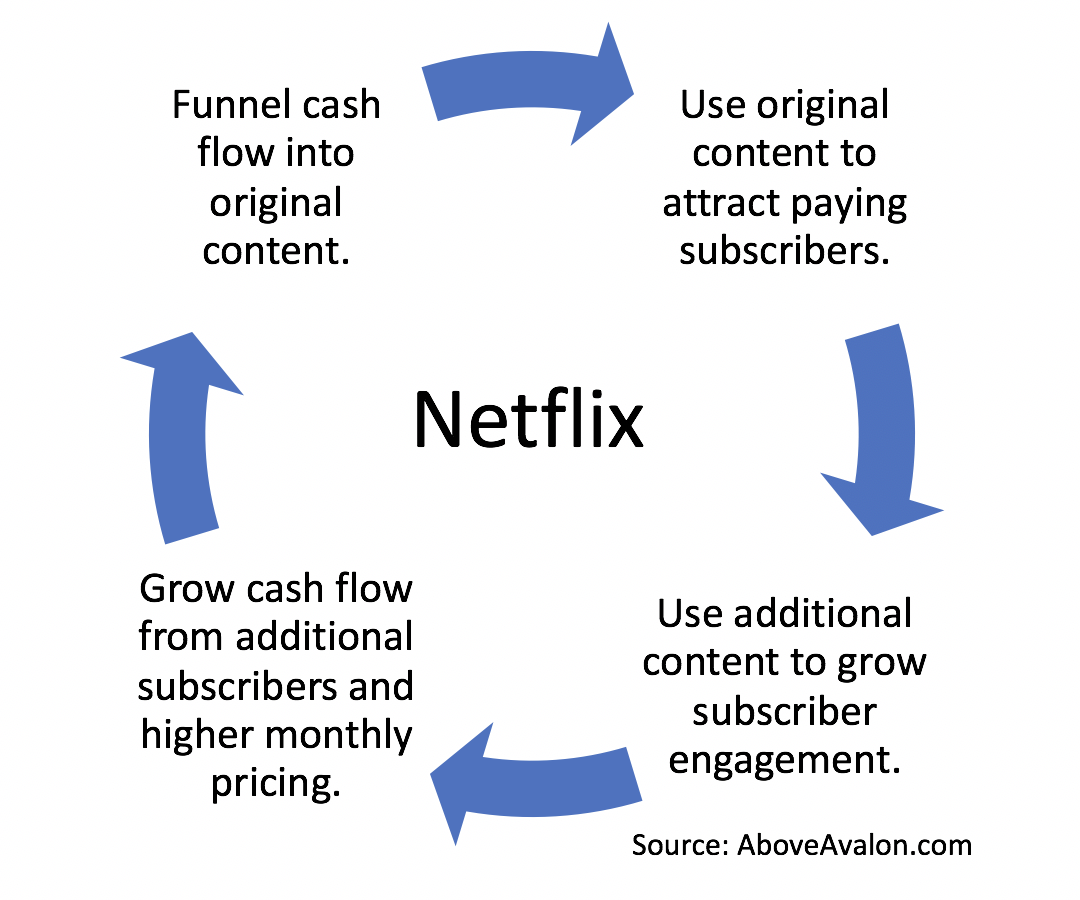
Netflix Competition
Competition has been a recurring theme on Netflix’s quarterly earnings calls. Management’s response has included a carefully-crafted, cautious tone, although the takeaway has been consistent: Instead of spending time worrying about the competition, Netflix remains focused on coming up with a better user experience. The aim isn’t to deny that Netflix faces competition, but rather to claim that Netflix doesn't look at the competition to figure out what to do next.
Up to now, Netflix has faced two primary competitors: legacy cable and our time. Netflix is a media company selling a video bundle to consumers. The company has seen much success in going up against the traditional cable bundle given innovation surrounding distribution. The way we consume video is undergoing a sea change, and Netflix has been able to ride the wave while legacy video struggles to stay afloat.
As shown in Exhibit 4, ESPN’s subscriber count, which serves as a proxy for the health of the large cable bundle, has declined by about 11% from the peak. Given how a growing number of slimmed-down cable bundles include ESPN, the large cable bundle has likely experienced even steeper subscriber declines.
Exhibit 4: ESPN Subscribers
Netflix’s fight against our time has been the more intriguing competitive battle. Netflix’s success is directly related to the amount of time users spend on the platform. Accordingly, the more Netflix video is consumed, the brighter Netflix’s prospects look. Given the finite amount of time available each day, Netflix ends up competing against everyday tasks for our time and attention. This battle has placed Netflix up against work, chores, errands, and even sleep. The battle for our time, not Amazon or even YouTube, has proven to be Netflix’s most formidable competitor to date.
New Battles
While it may seem like Netflix already has quite the nuanced battle on its hands going up against the clock, competition will only intensify. Up to now, Netflix has been running away with the ball with little to no competitive response from other paid video streaming players. When it comes to paid services other than Netflix, the list isn’t long with Amazon, HBO, and Hulu possessing the most mindshare. Things are about to change in a big way. In fact, we haven’t even seen a genuine battle yet in the paid video streaming space.
Three notable competitors are about to enter the paid video streaming scene:
Disney. The company’s existing intellectual property portfolio, combined with assets acquired from 21st Century Fox, position Disney as a formidable force in the direct-to-consumer paid video streaming space. The company plans to have three video bundles: a Disney-branded bundle with family-friendly content, a Hulu bundle with content that isn’t as family friendly, and ESPN+. It is not a question of if Disney will succeed over the long run, but rather how aggressive Disney will be out of the gate in terms of grabbing paying subscribers.
Apple. The new kid on the block. We are seeing what it looks like for Apple to go all-in on developing its own video streaming service. There are still questions surrounding Apple’s video strategy. However, the stream of reports regarding new shows and movies points to Apple building a decent-sized (at least a dozen shows) portfolio out of the gate.
AT&T / Time Warner (HBO). After buying Time Warner for $85 billion, AT&T has a strong incentive to leverage its crown jewel, HBO, to gain a stronger footing in the direct-to-consumer paid video streaming landscape. AT&T seems interested in tinkering with HBO’s strategy of valuing quality over quantity. Such a content strategy is being questioned when compared to Netflix chasing both quality and quantity at the same time.
The three preceding companies will likely unleash a brutal paid video streaming war over the next five years. There will be intense bidding wars for the best ideas and shows. Talent will become even more scarce. Consumers will have more in the way of choice when it comes to watching high-quality shows. This battle will be so intense, free video streaming players, like YouTube, will likely be pulled into the mix. The significant momentum found with the paid video space is a direct threat to ad-based video models. Google may feel pressure to wade even further into the paid video streaming space.
Netflix’s Problems
Netflix’s grip on the paid video streaming market is not as strong as it may appear. The company’s competitive advantages in the marketplace are being oversold.
Netflix’s video catalog is underwhelming. Aside from its one to two dozen original hit shows, Netflix’s broader content portfolio isn’t compelling. Much of the legacy content is stale while a surprising number of original movies feel off - as if they are low-budget despite having household stars. While Netflix’s growing efforts with original shows may be enough to keep viewers as monthly subscribers, more is needed on the content front if Netflix wants to grow viewer engagement.
Switching between video subscription services is easy. The idea that consumers will stick with one video streaming platform has not been fully thought out. While companies like Netflix are incentivized to keep viewers on their own platforms, attention is easily transferrable to other video streaming services. Apple’s TV app breaks down the barriers between video streaming services to the point of there not being any barriers at all. It is not surprising that companies like Netflix have little desire to fully participate in such a service.
Netflix’s technology advantage is misrepresented. As Ted Sarandos, Netflix’s chief content officer, discussed in a recent interview, gut represents around 70 percent of the equation when it comes to Netflix determining what makes great content. The narrative that Netflix is actually a technology company masquerading as a media company ends up being a stretch. Instead, Netflix is a media company that must continue to come up with popular hit shows.
Subsidized subscription pricing helps the competition. Netflix continues to subsidize paid memberships in order to grab as many users as possible. An unintended consequence of this practice is that Netflix ends up leveling the playing field for competitors by devaluing paid video content. By keeping pricing artificially low, Netflix makes it that much easier for new competitors to enter the market with pricing that isn’t too far off from that of Netflix. Disney has telegraphed that it will likely price its family-oriented video bundle at around $5 per month, which isn’t too much lower than Netflix’s pricing, despite Disney having a content portfolio that will be a fraction of the size of Netflix’s.
Business Models
Paid video streaming does not have the characteristics of a winner-take-all industry. No one company will have a monopoly on good, compelling video content. Netflix is not going to become “the new cable bundle.” Instead, it’s very likely that consumers will subscribe to multiple paid video streaming services. We may very well see a handful of video streaming services have more than 100M paying subscribers around the world. This reality is made that much more likely given the significant financial resources found with industry players including Disney, Apple, Amazon, AT&T, and Google.
There have been two primary business models in the paid video streaming space:
Direct subscription fees (Netflix, Hulu)
Larger entertainment bundle fees (Amazon)
The two business models haven’t been put to the test. Direct subscription fees continue to be subsidized in order for companies to grab users. It is very obvious that Netflix will have to raise its subscription pricing in a big way, especially if engagement hours plateau.
Meanwhile, companies that position video as merely one of a handful of services for subscribers don’t need to turn a profit with video streaming. By bundling video into Prime, Amazon doesn’t have to worry about video streaming pricing. Ultimately, this dynamic will pressure companies dependent on direct subscription fees. We haven’t seen what the video streaming industry looks like with another major player bundling video as part of a larger entertainment package. Apple is expected to offer a comprehensive entertainment package containing music, video, news, and even cloud storage.
Mindshare
Paid music streaming provides a sneak peak of what may unfold in the paid video streaming industry. In some ways, the music streaming industry is a few years ahead of the video streaming when it comes to having genuine competition.
There are key differences between the music and video streaming industries. With music, the same content is available on multiple paid streaming platforms. This has resulted in streaming companies positioning music discovery and the listening experience as the primary forms of differentiation. In what is a new development, hardware is also now being positioned as a differentiator with stand-alone stationary speakers, in addition to wearables, increasingly paying a role in how consumers pick between music streaming services.
Meanwhile, differentiation for video streaming comes in the form of original content. For example, Stranger Things is available only on Netflix and will likely remain so for the foreseeable future. Based on Netflix subscriber trends, original programming plays a major role in driving subscriber growth. This has led to a type of arms race when it comes to content budgets. Netflix is reportedly spending close to $10 billion per year on original content. Amazon is spending near $5 billion per year.
There are similarities between the two industries as well. Both music and video streaming began with a clear first-mover. Spotify was the undisputed leader in paid music streaming, similar to how Netflix now holds the same title in the paid video streaming space. This title gave each company significant mindshare, which corresponded to strong early momentum in terms of grabbing new users.
However, with a genuine competitor in the music streaming market, Spotify’s mindshare has suffered. Exhibit 5 compares the growth in paid subscribers for Apple Music and Spotify. While each company continues to benefit from the music streaming pie getting larger, Spotify now has to share the stage with Apple for mindshare.
Based on company disclosures, Apple Music’s new user growth is indeed accelerating as time goes on. In what is likely a worrying development for Spotify, Apple Music is now said to have more paid users than Spotify in the U.S. Similar trends are unfolding in other developed markets.
Exhibit 5: Apple Music vs. Spotify
Meanwhile, Spotify’s stronghold appears to be in Brazil and emerging markets, locations in which Apple’s market penetration is low. This dynamic doesn’t give one confidence in Spotify’s long-term opportunity. Instead, Apple will continue to chip away at Spotify’s mindshare.
While Netflix is able to use original content as a way to set itself apart from the competition, the company hasn’t needed to share the paid video streaming stage with such household names as Disney and Apple.
The Key Variable
The number of paid subscribers is not the key variable to monitor with Netflix. Since the paid video streaming market faces a number of tailwinds, it is certainly possible that Netflix will continue to grow its subscriber count over time. The overall streaming pie will continue to grow. Instead, the Netflix item to watch is subscriber engagement.
Netflix’s business model is ultimately dependent on the number of hours subscribers spend watching Netflix content. As discussed up above with Netflix’s feedback loop, as long as subscribers consume an increasing amount of content, the Netflix model works marvelously.
Based on Netflix’s 2Q18 earnings commentary, viewing/engagement hours are still up year-over-year. What will happen to Netflix engagement once Disney and Apple launch their own video bundles? Questions surrounding future competition are legitimate for Netflix. While consumers may very well end up subscribing to multiple video bundles, there is only so much time that can be split among each bundle. Time spent watching Disney or Apple content will be time not spent watching Netflix content.
As shown in Exhibit 6, the hole in Netflix’s armor will likely be found with the item circled in red: engagement. Any sign of plateauing engagement could lead to a domino effect as Netflix loses pricing power and the ability to run with higher content budgets. Any slowdown in new original content could then begin to impact new user trends, especially in international markets. Less content could then lead to even lower engagement.
Exhibit 6: Netflix Feedback Loop (Potential Problem Circled in Red)
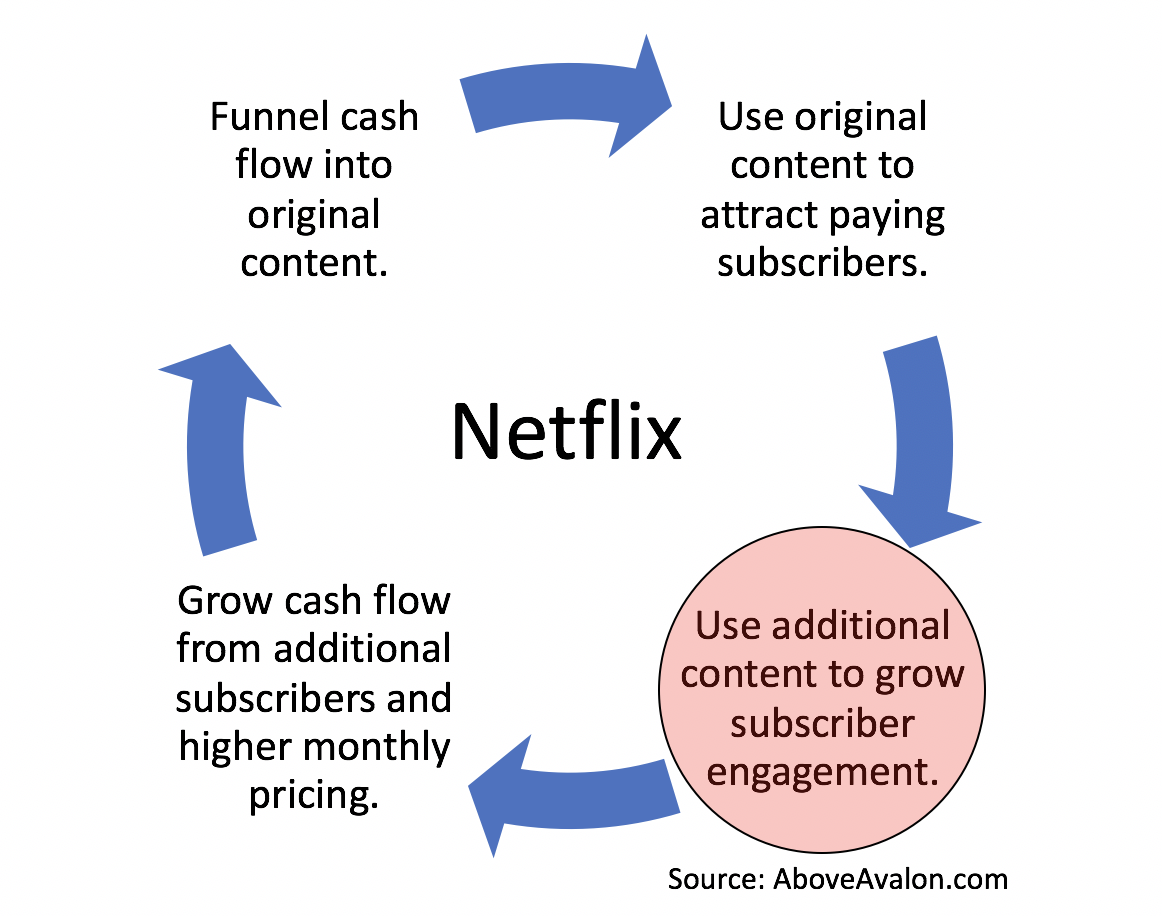
The Big Picture
Given how Netflix is viewed by many as unstoppable, it probably shouldn’t come as a surprise that consensus expectations remain muted for Disney and Apple in the paid video streaming space. This will likely end up being a mistake. Various publications have been solely focused on casting doubt on Apple’s video efforts instead of highlighting how the paid video streaming market remains attractive for a company like Apple. The cynicism surrounding Apple Video brings back memories of the doubt facing Apple Music in the early years.
Tim Cook and Eddy Cue are reportedly taking a very hands-on approach with Apple’s video initiative, highlighting the service’s importance to Apple. Video will end up being a key ingredient of an Apple entertainment bundle containing various services. The company ends up building not just a video streaming service, but a Hollywood arm. Meanwhile, Disney has the strongest intellectual property out of any video player. The company’s problem up to now has been found with distribution. Those problems are now being addressed.
As for Netflix’s future, management appears to be well-aware of the risks found with being just a paid video streaming company. Netflix management will likely focus on two items in particular:
Acquire or build a strong portfolio of intellectual property. It would not be surprising to see Netflix embrace M&A (the company has only acquired one company - Millarworld) in an effort to beef up its intellectual property.
Expand beyond video content. Netflix reportedly considered buying a chain of movie theaters. Recent reports have Netflix moving into radio as well. These efforts are designed to move Netflix beyond being just a paid video streaming company.
Disney and Apple don’t have to go toe-to-toe with Netflix to do well in the video streaming space. Instead, each company is ultimately focused on grabbing viewer attention with compelling content. The ingredients are in place for both Disney and Apple to do very well.
Receive Neil’s analysis and perspective on Apple throughout the week via exclusive daily updates. The updates, which have become widely read and influential in the world of Apple, provide timely analysis of news impacting Apple and its competitors. Neil also publishes exclusive reports on Apple business, product, and financial strategy. The daily updates and reports are available to Above Avalon members. To sign up and for more information on membership, visit the membership page.
Above Avalon Podcast Episode 133: The Big Picture from Steve Jobs Theater
Earlier this month, Apple Watch was the star of Apple’s second major product event at Steve Jobs Theater. Episode 133 is focused on looking at the big picture following Apple’s event. The discussion begins by going over Tim Cook’s comments regarding Apple’s mission statement and then quickly puts the iPhone and Apple Watch updates into context. We then turn to my Grand Unified Theory of Apple Products. Additional topics include my user base estimates for Apple’s various product categories, my rationale for why Apple Watch and Apple Glasses will one day have a larger user base than iPhone will, and the power associated with new form factors that are capable of handling new tasks.
To listen to episode 133, go here.
The complete Above Avalon podcast episode archive is available here.
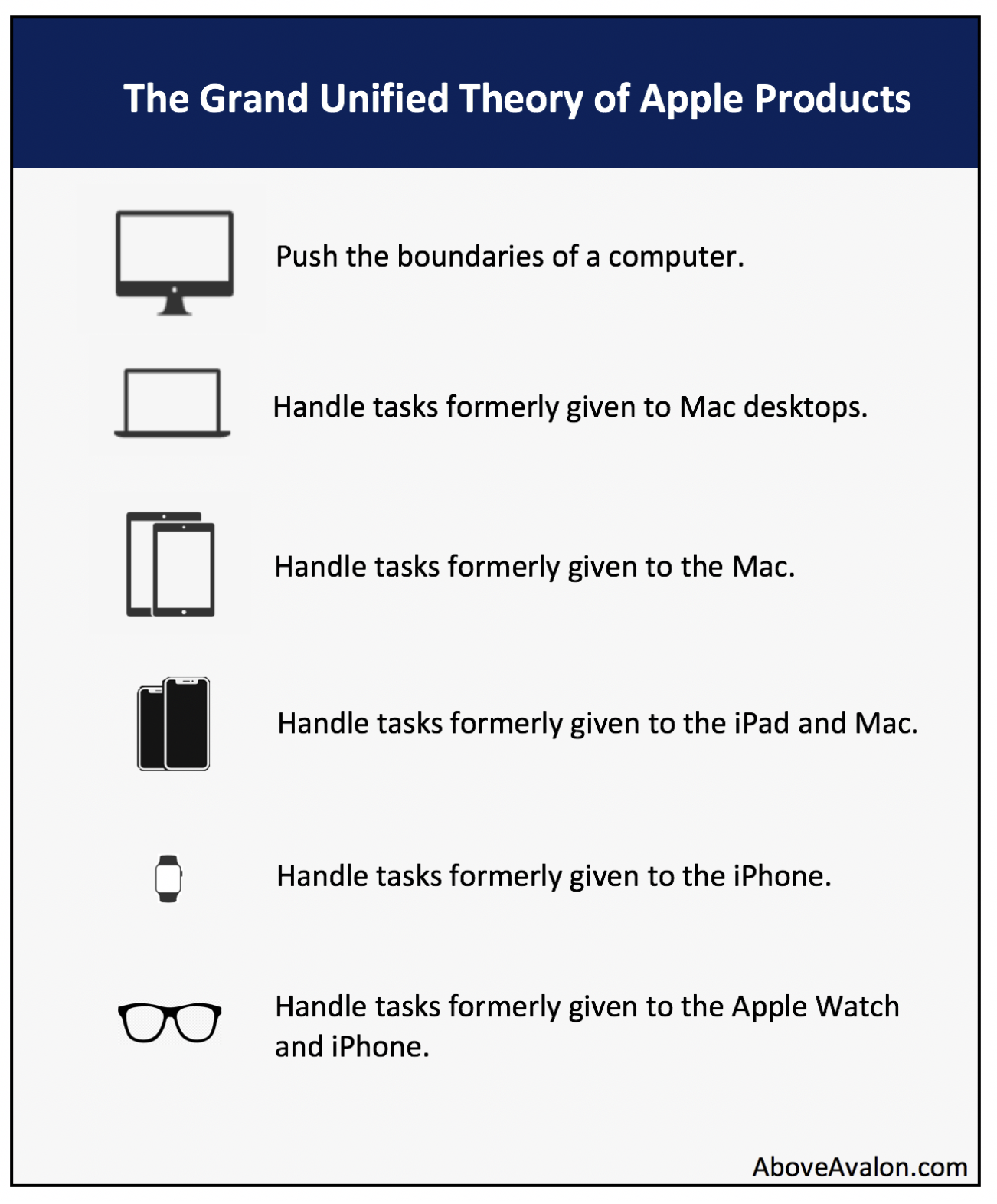
Connecting the Apple Dots
Apple is following a clear and defined product strategy. Last week, Apple provided the latest look at this strategy by unveiling new iPhones and a redesigned Apple Watch. These products represent clues that help paint a picture of where Apple is headed.
Mission Statement
Tim Cook kicked off Apple’s most recent product event at Steve Jobs Theater with an overview of the company’s mission statement. Here’s Cook:
“Apple was founded to make the computer more personal. Of course first with the Apple II, and then later with the Mac. Over the years, we’ve taken this mission further than anyone could have imagined. We’ve created several categories of technology that have had a profound impact on people’s lives - from the iPod to the iPhone to the iPad to the Apple Watch…
Of course we aim to put the customer at the center of everything that we do. That’s why iOS is not just the world’s most advanced mobile operating system. It’s the most personal. We’re about to hit a major milestone. We are about to ship our two billionth iOS device. This is astonishing. iOS has changed the way we live - from the way we learn, to the way we work. To how we’re entertained, to how we shop, order our food, get our transportation, and stay in touch with one another. And of course, how we capture the moments of our lives and share them with those we love. It’s amazing how our mission started with personalizing technology for the desktop to now seeing the many ways that we’ve made it more personal in so many aspects of our lives.
So it’s only fitting that today, we’re going to tell you about two of our most personal products - the ones that are with you everywhere that you go - and how we are going to take them even further.”
Along with announcing three iPhone X successors, Apple unveiled the most significant year-over-year change to Apple Watch since its unveiling in 2014.
My full review of Apple’s event is available for members here (major themes and takeaways) and here (full notes).
iPhone XS / XR
In order to push the iPhone X experience forward, Apple focused on three items:
Larger screens (A 6.5-inch screen with the iPhone XS Max and s 6.1-inch screen with the XR.)
Smarter brains (The A12 Bionic gives Apple an even larger lead over the competition.)
Better eyes (The dual-camera system is giving iPhone the ability to see the surrounding world with a more intelligent perspective.)
The following image does the best job at describing the current state of the iPhone business:

There is a reason Apple spent nearly 10% of the presentation talking about the A12 Bionic chip. Apple has spent the past decade working to control the core technologies powering its devices. The end result is an Apple chip that is providing the company a significant competitive advantage in the marketplace. With each new iPhone release, Apple’s custom silicon is responsible for an increasing portion of the iPhone experience. Apple didn’t just announce three new iPhones last week. Instead, thanks to the A12 Bionic and increasingly capable cameras, Apple announced three AR navigators serving as laptop and desktop alternatives.
Apple Watch Series 4
While the new iPhones were impressive, Apple Watch Series 4 stole the show. Two slides from the Apple Watch portion of the presentation stood out. The first of these covers improved optical heart sensor on the back of Apple Watch. The second shows Jeff Williams demonstrating some findings from Apple's multi-year research into falls.
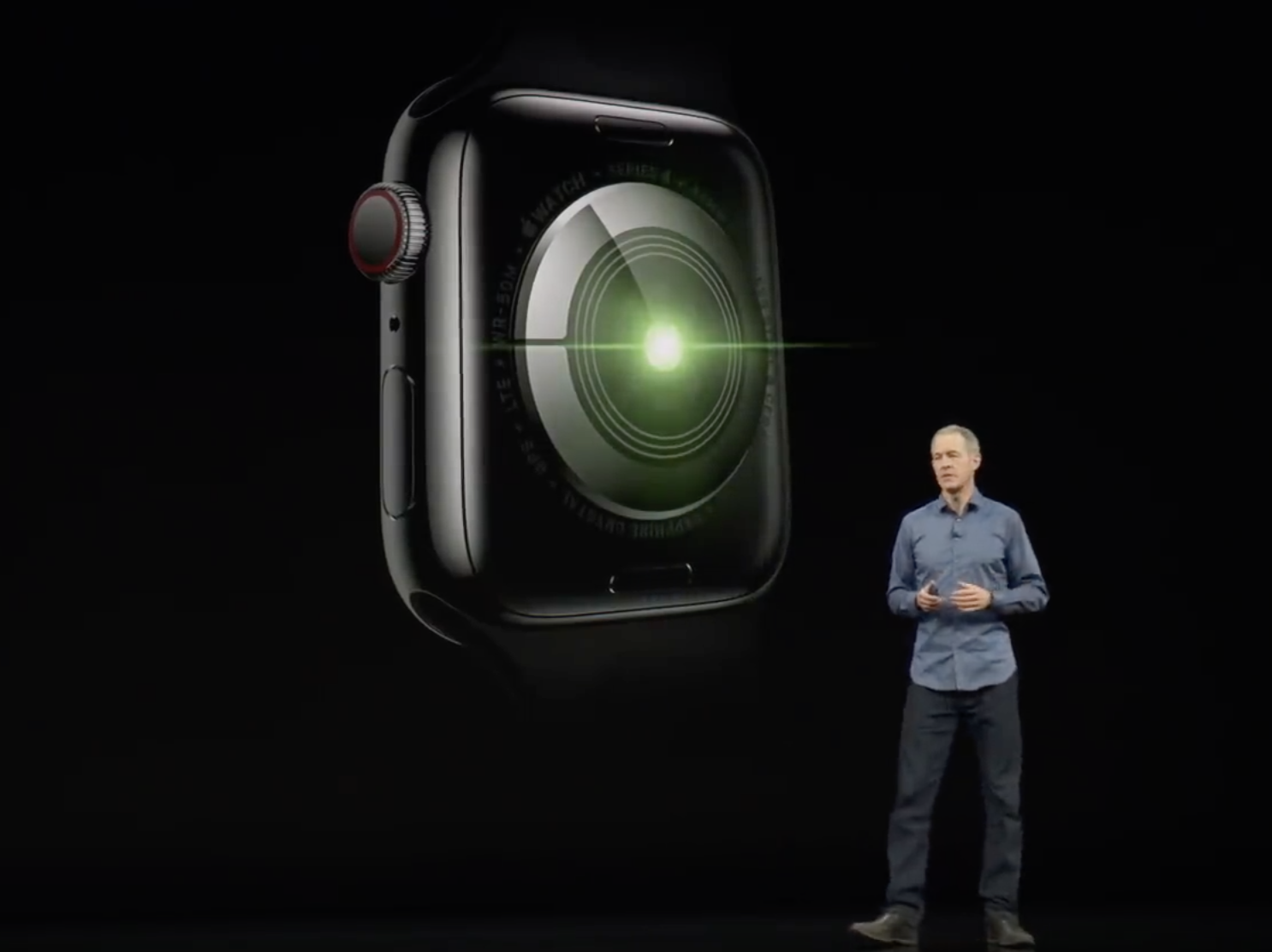
Both slides depict Apple Watch as a proactive digital assistant. The device is capable of monitoring everything from our heart rhythm to whether we have fallen and need help. By being worn on the body, Apple Watch is able to handle tasks that will never be given to iPhone. When combined with the independence found with cellular, Apple Watch contains an incredibly powerful value proposition.
Apple Product Theory
The iPhone and Apple Watch represent the two most personal devices in Apple’s product line. While it may seem like these products lack any obvious connection with their larger siblings, there is a single philosophy connecting each of Apple’s major product categories. Introduced in 2015, my Grand Unified Theory of Apple Products is worth revisiting given the significant changes that have taken place within Apple’s product line.
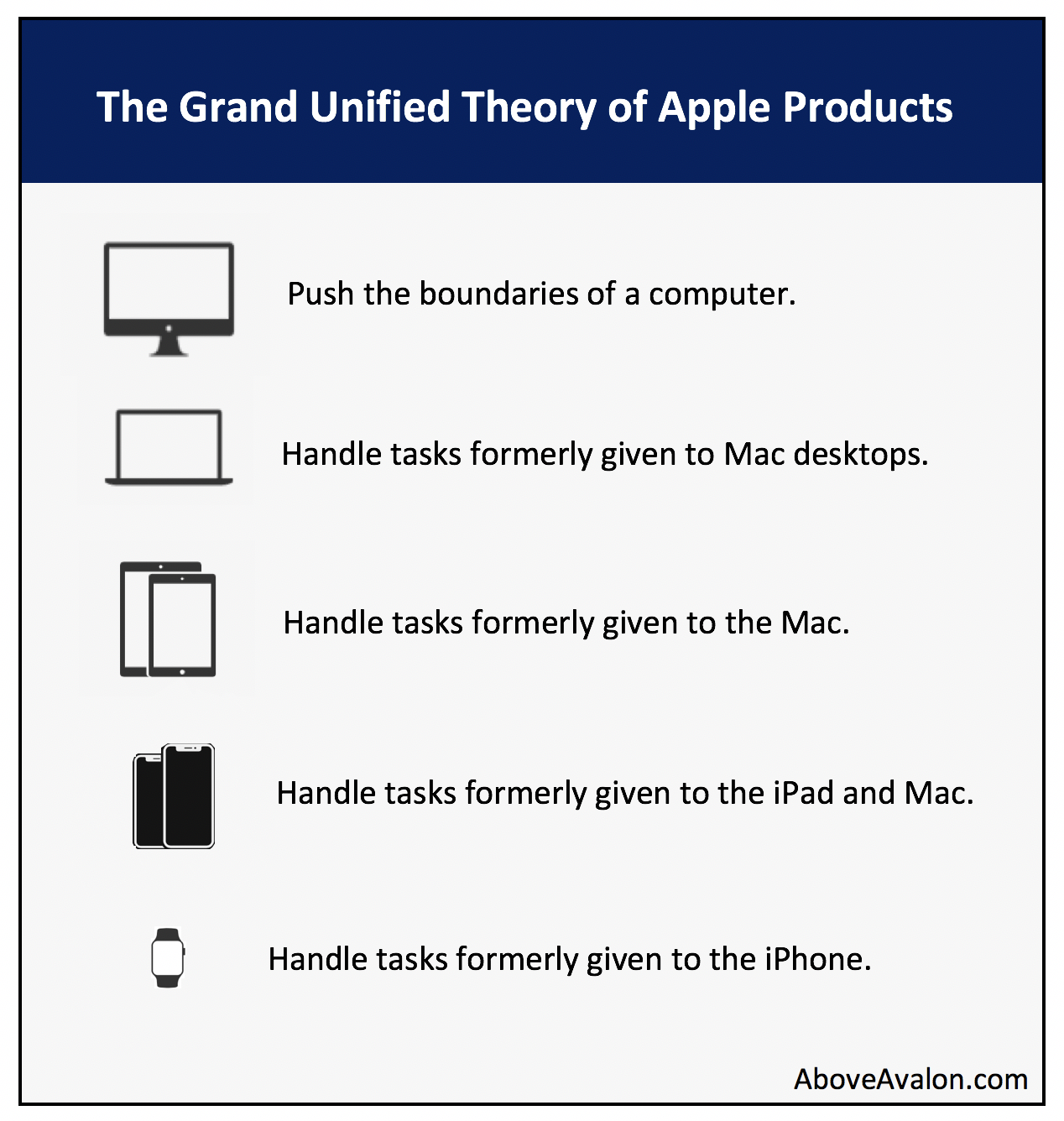
Apple’s major product categories are interconnected by the roles they play in making technology more personal. Each product is given a goal that ends up describing its design attributes.
Mac desktops. Designed to be powerful and capable enough to push the boundaries of a computer.
Mac portables. Designed to handle tasks that may have traditionally went to a desktop.
iPad. Designed to serve as an alternative to laptops and desktops.
iPhone. Designed to be powerful enough to reduce the need for iPad and Mac.
Apple Watch. Designed to handle an increasing number of tasks so that less time has to be given to iPhone and iPad.
Apple’s product strategy is based not on coming up with replacements for existing products, but on using personal technology to come up with alternatives to more powerful computers. By relying on new form factors in addition to new user inputs and outputs, Apple has seen much success in coming up with products that contain less in the way of barriers between the user and technology. Intuitiveness is used to harness technology’s potential. Apple’s goal with iPhone has been to give the product enough functionality to serve as a Mac and iPad alternative. Meanwhile, Apple’s goal with Apple Watch is to give the product enough functionality to reduce the need for an iPhone.
The Grand Theory also does a good job of explaining why Apple uses a hands-off approach when it comes to telling consumers which product(s) fit best in their lives. While some think this has been a strategic error on Apple’s part, ultimately management wants customers to determine the degree of personal technology that makes sense for their needs. For some customers, a Mac may be required. For others, an iPhone is the only computer needed. Based on the most recent Mac and iPad Pro ad campaigns, Apple management has become comfortable in allowing each product category to stand on its own and not necessarily lift up one category at the expense of the other.
Connecting the Dots
Based on the most recent iPhone and Apple Watch updates, Apple’s longer-term ambition has become crystal clear. This is a company that believes Apple Watch will serve as a viable alternative to iPhone. As a result, the environment will become more hospitable for new form factors capable of making technology even more personal than is possible with Watch. As shown below, the Grand Unified Theory will likely expand to include a new product category beneath Apple Watch: Apple Glasses.
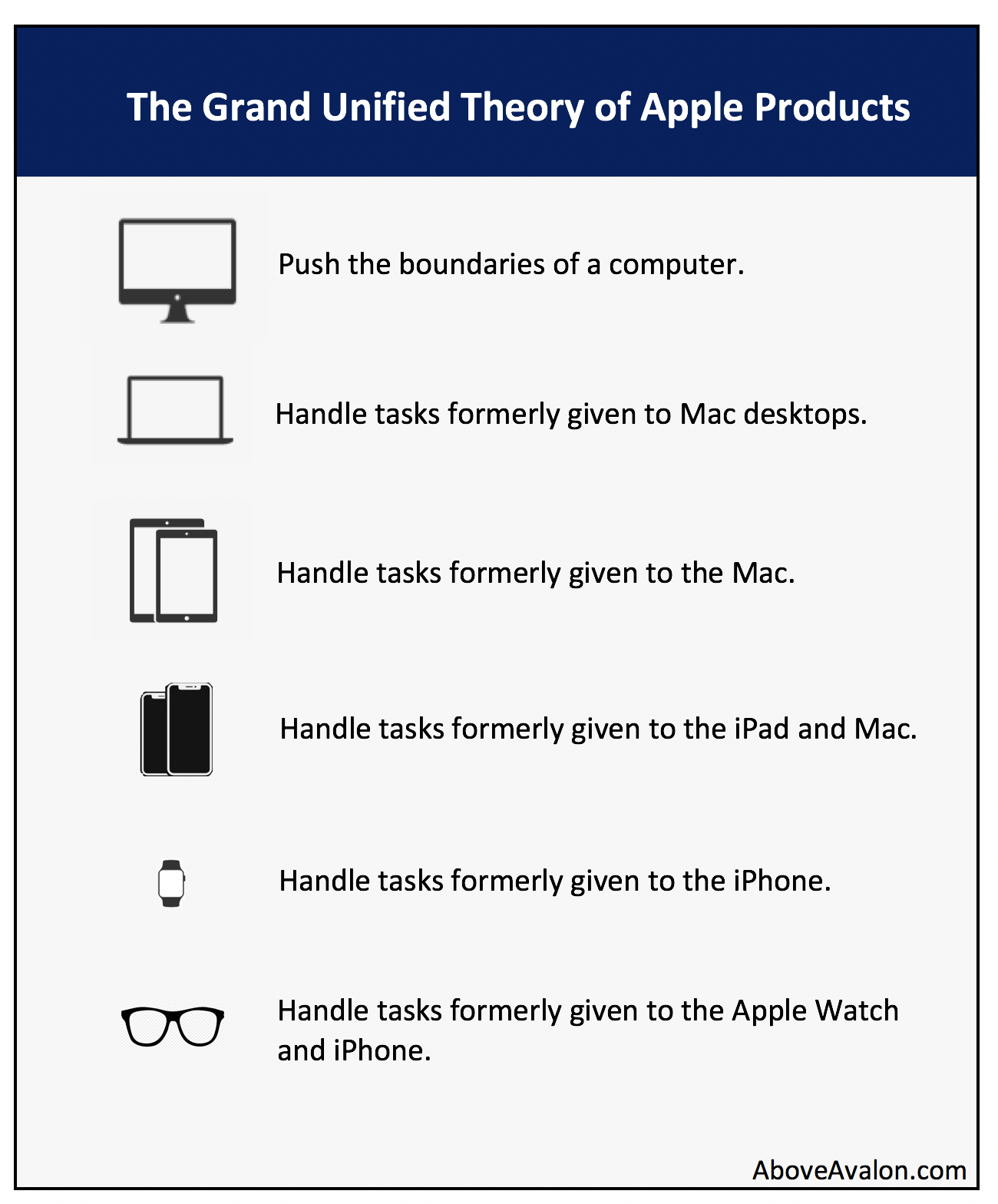
Apple Glasses fit perfectly within the theory as a product category given the job of handling tasks currently given to Apple Watch and iPhone. This would be accomplished by new user inputs (such as glances and voice) and outputs. The work Apple is doing with its custom silicon, along with miniaturization techniques it is using on Apple Watch will come together to make a pair of lightweight smart glasses possible. With the iPhone continuing to gain new capabilities as an AR navigator and the Watch becoming a new kind of proactive digital assistant, there will be room for a simpler device. This device will be designed to break down technology even further to provide an enhanced view of the world around us. There won’t be too many things as intuitive as a pair of smart glasses.
Consequences
One of the major consequences of the Grand Theory is shown below. Apple’s various product categories have dramatically different user base sizes based on the amount of personal technology found with each product. While the Mac has a combined user base of around 100M users, the iPad has almost three times as large of a user base. Meanwhile, the iPhone will soon exceed a user base that is nine times as large as that of Mac.
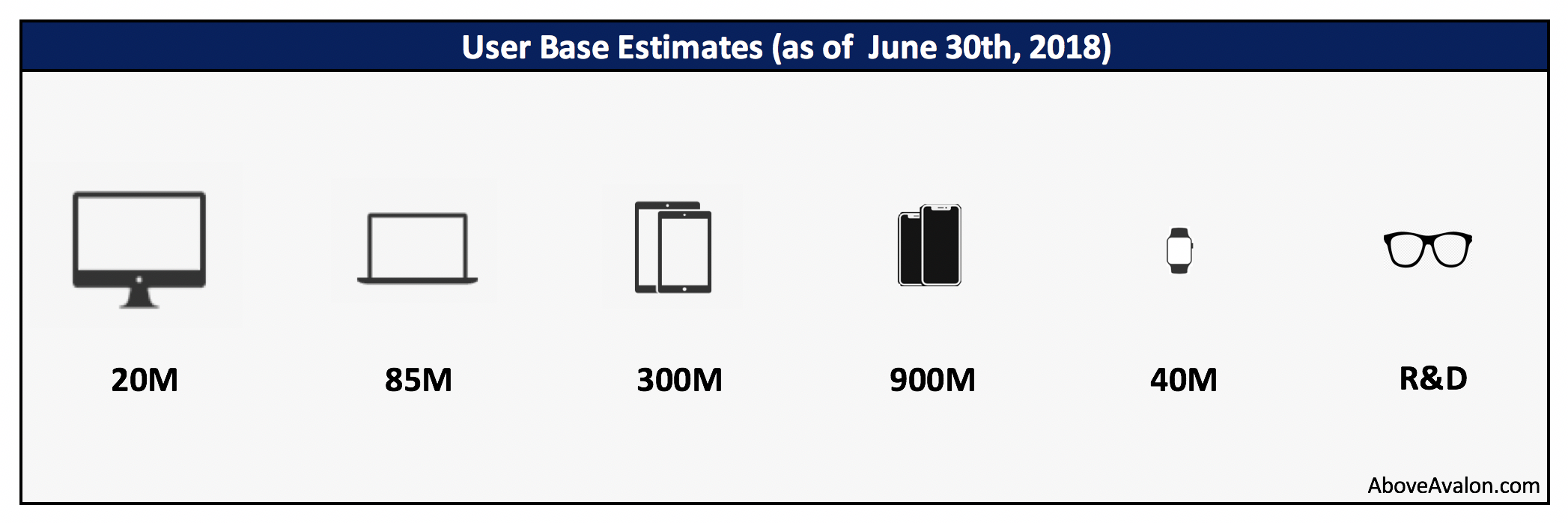
For more information on the methodology and calculations used to derive these estimates, visit here (iPhone), here (iPad), and here (Apple Watch).
Apple Watch’s user base has grown to 40M in just three years. For context, the iPhone user base stood at 55M after three years. Considering that an Apple Watch still requires an iPhone, the 40M user base figure is that much more remarkable.
As shown below, my expectation is that Apple Watch and Apple Glasses will one day be used by more people than will the iPhone. Such a radical idea may seem like fantasy, especially given how pivotal of a role the iPhone is playing in our lives. However, the appeal found with intuitive devices capable of making technology more personal will prove too powerful.
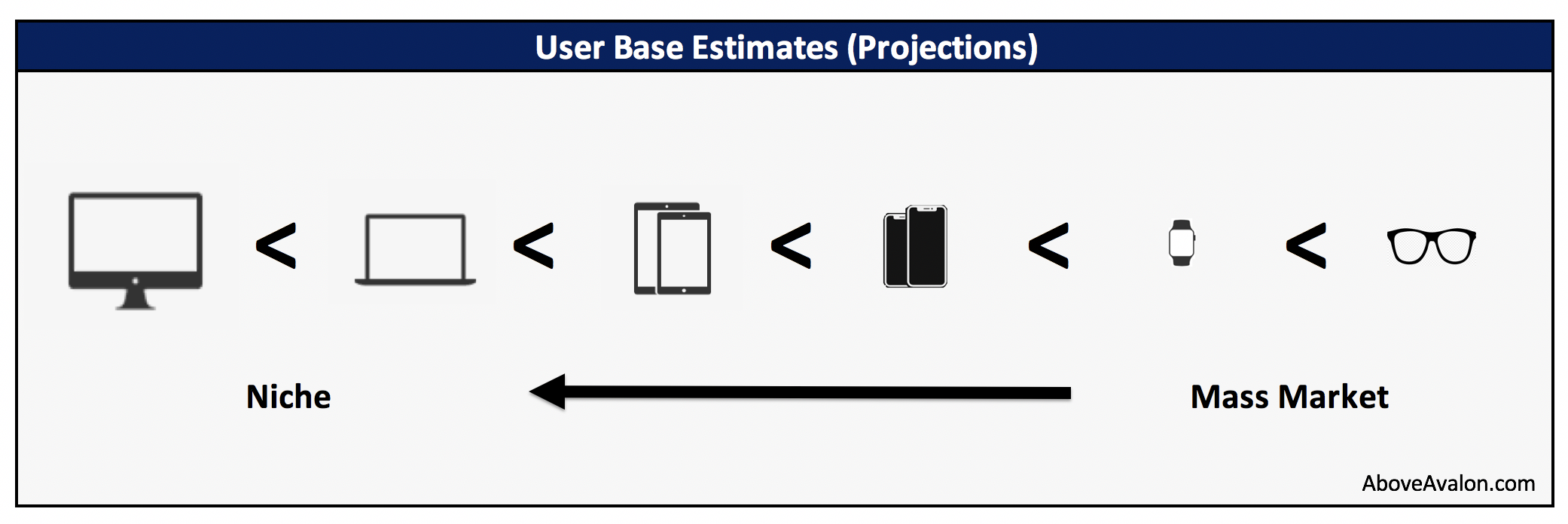
As new form factors allow Apple to harness technology’s potential, the scope to which those products are able to connect with humans intensifies. Multi-touch was a leading factor in iPhone having a user base that is nine times larger than that of Mac. A proactive digital assistant on the wrist will give Apple Watch a user base that eventually exceeds that of iPhone. The key to my projection is the eventual decoupling of Apple Watch from iPhone. This is an inevitable development. The only question is found with timing.
When it comes to glasses, a product that will be tasked with making technology more personal than iPhone or Watch, providing enhanced vision will be one of the more attractive value propositions in existence. While a user base of 900M people may seem impossible for Apple Watch or Apple Glasses to surpass, there are 7.5B people on Earth. Everyone can benefit from a device that delivers an enhanced view of the world around us.
The Current Era
With smarter brains and better eyes, the iPhone XS and XR will continue the trend of iPhones gaining functionality. It is not a surprise that we see iPhone pricing begin to move higher as a result. However, despite these advancements, the Apple Watch Series 4 was the star of the show at Apple’s recent product event. While this may have come as a surprise to some observers, there have been signs that this day would come. The Watch’s ability to proactively monitor our life is game changing.
When we look back at the late 2010s for Apple, we will likely refer to this as the early stages of the Apple Watch and Apple Glasses era. Apple’s multi-decade quest to make technology more personal is based on using intuitiveness to knock down the barriers that exist between humans and technology. One way of accomplishing this is push the boundaries found with today’s most personal products. The faster Apple runs with iPhone and Apple Watch, the closer the company will get to announcing its most personal product yet: glasses.
Receive my analysis and perspective on Apple throughout the week via exclusive daily updates (2-3 stories per day, 10-12 stories per week). Available to Above Avalon members. To sign up and for more information on memberships, visit the membership page.
Above Avalon Podcast Episode 132: Titan vs. Tesla
In episode 132, we take a closer look at Apple's Project Titan. The discussion begins by going over the signs pointing to Apple expanding Titan initiatives in recent months. We then turn to Apple's goal with Titan and the automobile's changing value proposition. Tesla enters the discussion as we look at why the company isn't a realistic acquisition target for Apple. Additional topics include Tesla's struggles, poaching, Doug Field's move from Tesla to Titan, and the most interesting things to watch for in the auto space.
To listen to episode 132, go here.
The complete Above Avalon podcast episode archive is available here.
Poaching Tesla
Apple and Tesla share some similarities. Both companies possess remarkably strong brands, loyal customer bases, and products capable of maintaining that loyalty. Each also has a visionary product leader. Apple has Jony Ive while Tesla has Elon Musk. Accordingly, some have concluded that Apple should acquire Tesla as a way of quickly jumping into the transportation industry.
A Tesla acquisition doesn't make sense for Apple. However, Tesla does have something that Apple has a use for: talent.
Project Titan
Apple's ambition with Project Titan, a catch basin for the company's transportation R&D endeavors, continues to be underestimated. The number of signs pointing to Apple expanding Project Titan initiatives in recent months is on the rise.
Apple currently has the third-largest test fleet of autonomous vehicles on the road in California. In just a few months, the number of test vehicles has expanded from 27 to 66.
Apple reportedly is expanding its vehicle testing presence in Arizona, another hotbed of autonomous driving research.
Apple is reportedly working with Volkswagen on developing autonomous shuttles for Apple employees. The partnership includes Apple developing both hardware and software for the autonomous shuttles.
Apple recently hired two high-level auto industry executives (Jamie Waydo and Doug Field). Waydo played a key role in the safety program Waymo uses to test and develop its self-driving technology while Field was one of Tesla's most important engineers overseeing vehicle engineering and Model 3 production.
One word to describe Apple's Project Titan strategy is "methodical." Apple appears to be gradually doing everything one would expect of a company establishing a large test fleet of autonomous vehicles on public roads. All the while, Apple's hardware ambitions remain intact. The company appears to still own a web of buildings across the Sunnyvale / Santa Clara / San Jose area that are dedicated to heavy manufacturing and have open space for future growth. (A map of the various locations is available for Above Avalon members here.) This is a company that wants to come up with new transportation solutions consisting of hardware, software, and services.
When news of Project Titan's existence broke in early 2015, many people were skeptical because Apple had no expertise in the auto industry. Apple would be starting from scratch.
In what was a departure from the iPhone development playbook, Apple looked outwardly for Titan talent. Specifically, Apple turned to the auto industry for hardware expertise. As shown below, a list of select Titan members (as of mid-2015) served as a wakeup call to skeptics. Apple was indeed working on a vehicle.
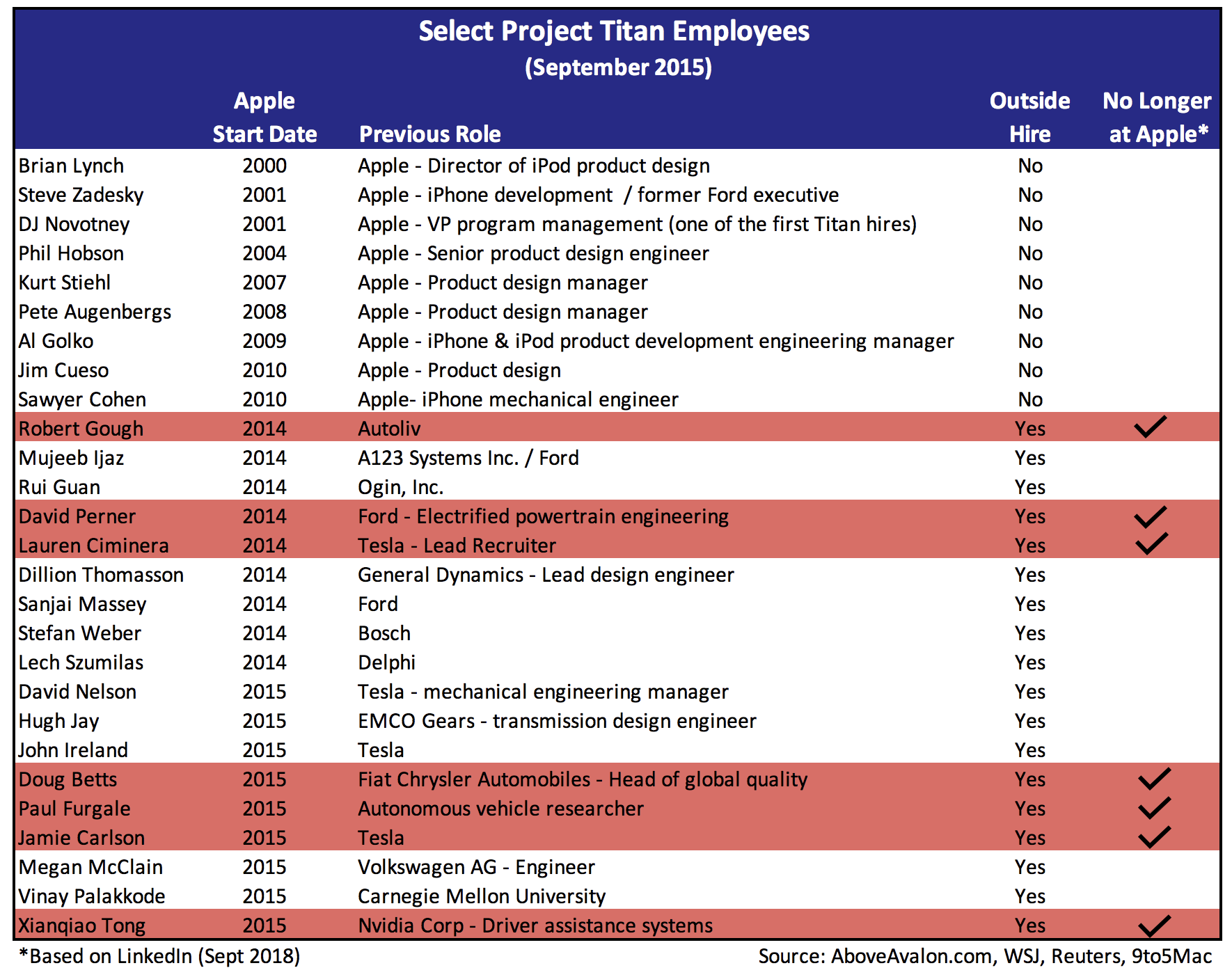
In late 2015, Project Titan began to hit speed bumps as friction between designers and engineers intensified. In order to come up with a truly new user experience, Apple designers wanted to skip human-driven vehicles and instead go straight to an autonomous vehicle. Others argued the better strategy was to begin with an electric car and then position autonomy as a future feature. Not surprisingly, the designers won.
Bob Mansfield, a hardware engineering guru who is arguably one of Apple's most successful liaisons between the design and engineering teams, was brought in to right the Titan ship. The initiative was refocused on developing the core technologies that would power a variety of transportation hardware options. The refocus on autonomous driving led to a culling of hardware talent.
At least 40% of the outside hires listed in the table above are no longer at Apple (based on LinkedIn updates). Most of the departures took place between August 2016 and early 2017, which fits with the reported timeline of Mansfield overseeing Titan changes. In addition to turning to outside auto hires, Apple ended up poaching itself by taking veteran Apple product design managers off of other teams. There doesn't appear to be much turnover with those Titan additions. Recent reports peg the number of people working on some aspect of Project Titan to be between 2,000 and 2,500.
Apple's Goal
The best way to understand Apple's goal with Project Titan is to think about the company's design-led culture. Apple's strength lies in taking existing product categories and using design to rethink our assumptions about that category. By rethinking how we use products, Apple is able to come up with products that can change the world.
Apple wants to rethink the automobile. While electric powertrains, autonomy, and ridesharing will help in Apple's efforts, something more is needed. Our fundamental assumption of what a car is (and isn't) is still in need of being reimagined. Without fresh thinking when it comes to design, we are still left with most of our prevailing assumptions about cars.
This lack of fresh perspective in automobile design is one factor likely fueling the growing interest in bikes and scooters in high density areas. However, the problem with automobile design goes beyond city centers. People are increasingly tired, frustrated, and bored with cars. The dramatic shift to SUVs in the U.S. is driven by consumers caring less about traditional car value metrics such as performance. Instead, consumers are craving personalization in any form possible. Unfortunately, personalization options, especially when it comes to driver and passenger compartments, remain limited in the auto industry.
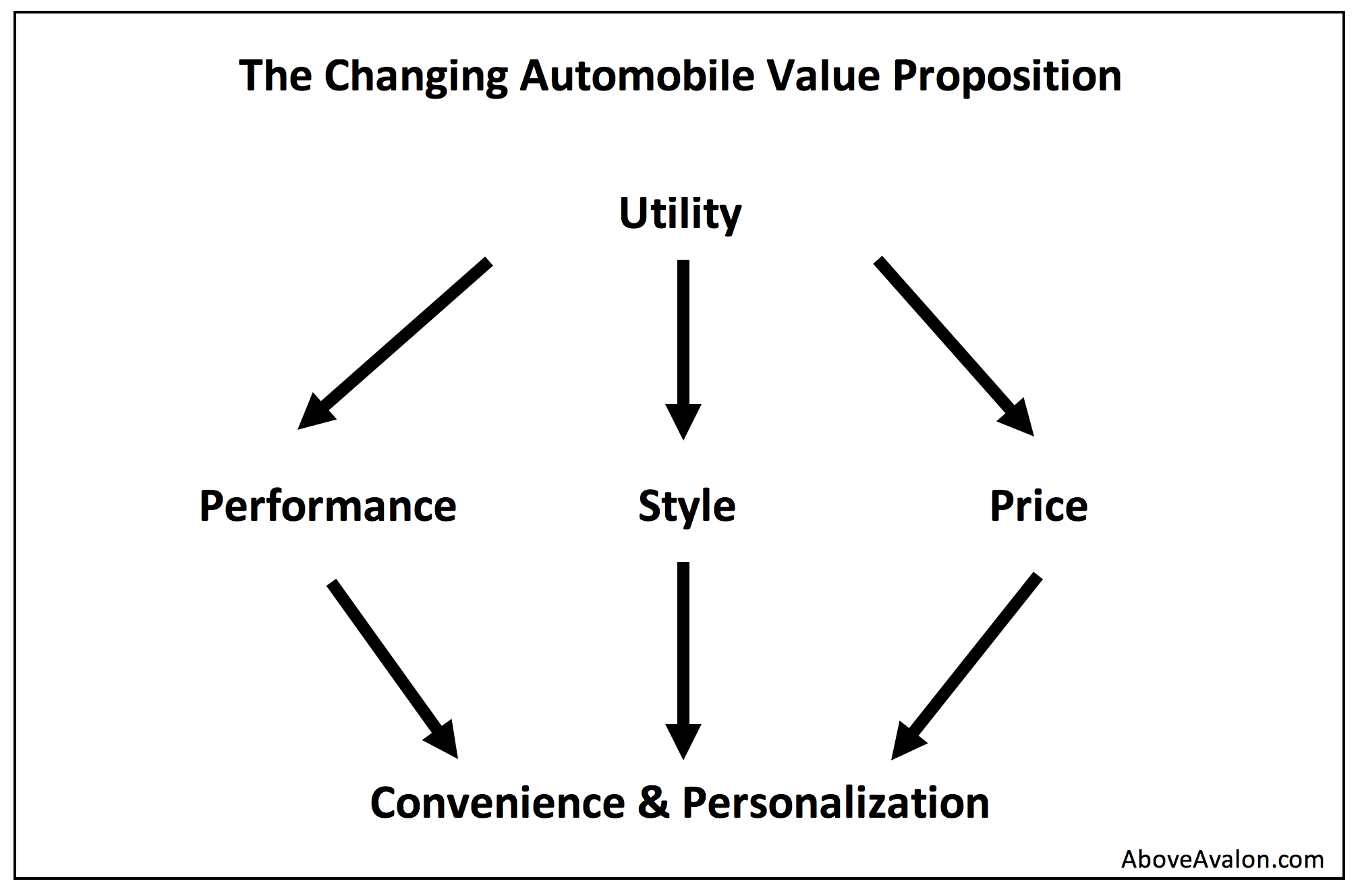
Tesla did something extremely well: It developed electric cars that people actually wanted to drive. Talk of other luxury car makers competing with Tesla is likely more fantasy than reality. However, it's not clear if Tesla is actually on the right path given the car's changing value proposition.
One way Tesla has been able to do so well in the luxury segment is by competing on old-school value metrics like performance and style. The problem for Tesla is that these values won't matter in the future. Instead, the focus will shift to convenience and personalization. While iPhone relies on software to become a personalized computer for 900 million people, we will demand a similar personalized experience from automobiles. As it stands now, personalization when it comes to the automobile amounts to CarPlay, moving the driver seat back and forth a few inches, and folding down a row of back seats.
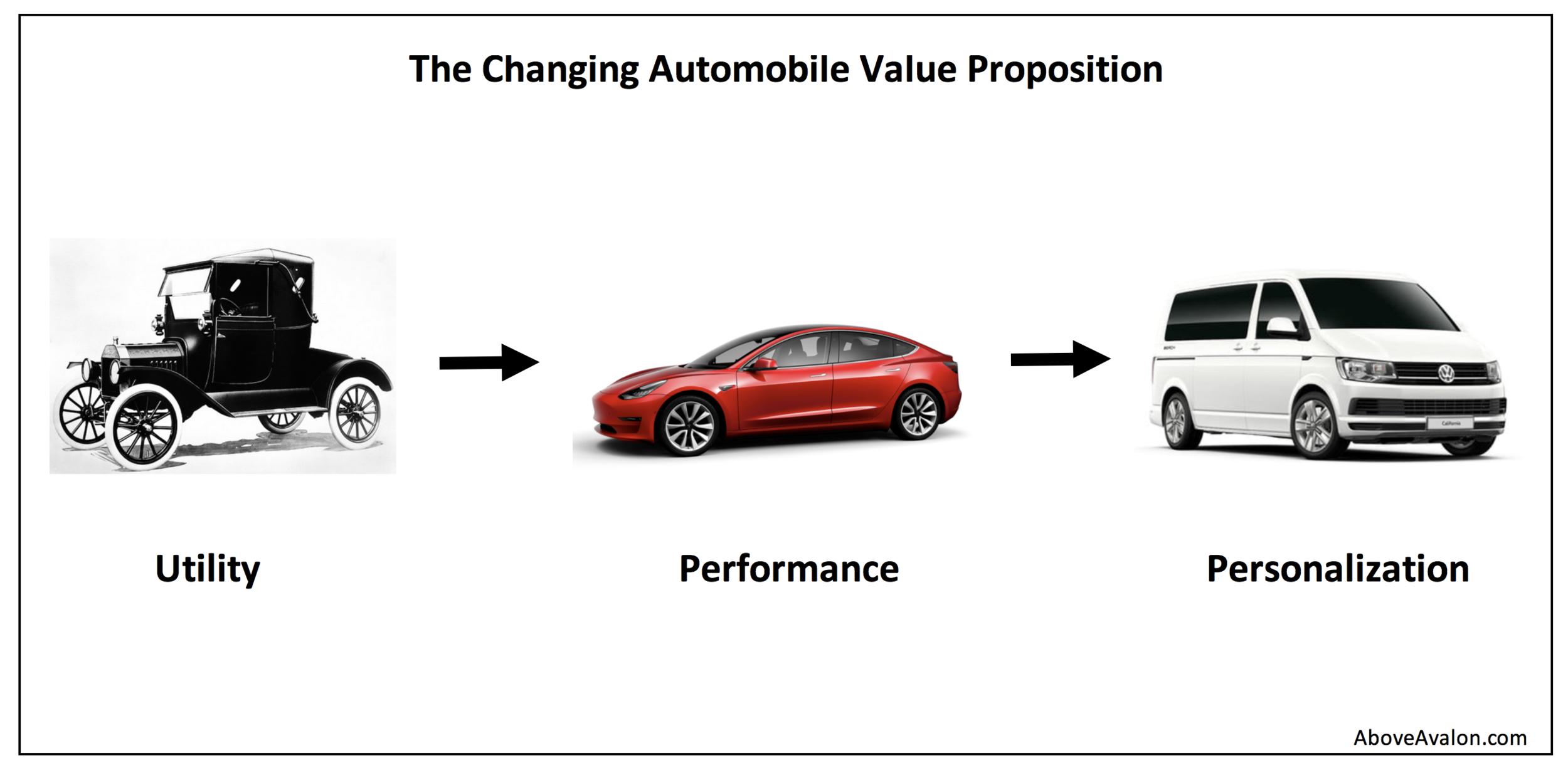
Why Not Acquire Tesla?
Given Apple's interest in transportation and Tesla having the most popular, highest-rated car on the road, many have positioned Tesla as an Apple acquisition target. Apple's strong balance sheet adds fuel to the fire. With $129B of net cash, Apple could pay $70B+ to acquire Tesla and instantly become a player in the auto space.
However, Tesla isn't a realistic acquisition target for Apple. More importantly, Apple doesn't need to acquire Tesla in order to meet its goals. The best way to understand why is to look at the key components of Apple's M&A philosophy:
A strong brand and product aren't enough for an Apple acquisition. There has to be more to an Apple acquisition target besides strong branding and a popular product in the marketplace.
Apple doesn't use M&A to acquire revenue. Apple doesn't use M&A as a tool to grow revenue.
Apple doesn't use M&A to acquire users. Apple doesn't acquire companies simply to grow its user base. This tenet has become that much stronger in recent years as Apple's user base has grown. Apple currently has one billion users. When considering how the vast majority of those users comprise the premium segments of the smartphone and tablet markets, Apple has no need to acquire what ends up being its own users.
In essence, Apple isn't interested in buying its way into new product categories. Instead, Apple positions M&A as a tool to either enhance its existing product line or plug holes in the product development process. M&A is used to a tool to supplement, not replace, Apple's design-led product development process. Accordingly, there are two things Apple looks for when acquiring companies:
Apple uses M&A to acquire technology. Apple looks at M&A as a tool for plugging holes in its asset base. Given how Apple is constantly working on new products, one hole is often the need for new technology.
Apple uses M&A to acquire talent. One area in which Apple is resource constrained is talent. As Apple moves from one industry to another, the company is always on the lookout for teams of talent that help boost knowledge and expertise.
A look at Apple's acquisition history demonstrates these core M&A tenets. Acquisitions such as P.A. Semi, AuthenTec, LinX, and Metaio were about technology and talent. Even acquisitions that included consumer-facing products like Beats, Beddit, and Shazam (pending approval) were ultimately about the technology behind the products.
Netflix
Netflix represents a great example of how Apple doesn't use M&A. In a Netflix acquisition, the two primary things Apple would have bought are a strong brand and lots of users, neither of which is enough to justify an acquisition. In addition, Apple users already had full access to Netflix. It's unclear how Apple owning Netflix would lead to an improvement in Apple products. Positioning Netflix's technology as justification for an acquisition is quite the stretch. Netflix is a media company, and the company's content library is grossly overrated when moving beyond the 15 to 20 marquee series.
Instead of spending $100 billion to acquire Netflix, Apple opted to poach talent from the entertainment industry and build something on its own. The result is a new "Apple Studios" division overseen by former Sony Pictures Television executives. Apple is reportedly planning to launch its new Apple Video streaming subscription service sometime next year.
Arguing that Apple should acquire Tesla because it has a great brand and popular product in the marketplace is faulty thinking. Instead, Tesla would need to provide resources that can either strengthen Apple's existing product line or plug holes in Apple's design-led product development process. Some will say that Tesla's fleet of human-driven cars ends up being the company's secret weapon when thinking about the race to autonomy. I'm not so sure about that claim. Others think Tesla's charging network or factories represent the company's crown jewels. Both claims are questionable. Instead, those items could end up being viewed as liabilities, which is one reason Apple embraced contract manufacturing nearly two decades ago.
Poaching
A Tesla asset that Apple may have an interest in is talent. Given Apple's ambition, Project Titan can benefit from having employees with experience developing cars that people love. However, instead of acquiring Tesla to bring on tens of thousands of employees, which would raise many red flags, a better strategy would include Apple selectively seeking out talent that would be the best fit for Titan.
When selling prospective hires on the Titan message, Apple is ultimately selling two things: vision and process.
Vision. Explaining Apple's mission to come up with products that can change the world. Even though new hires aren't likely given the full lay of the land when joining Titan, the Apple mission can still be telegraphed.
Process. Explaining the process in place for turning vision into reality.
It's not that Apple has necessarily struggled appealing to new hires for Titan. Instead, Tesla likely had the stronger message up to now. In the early 2010s, Tesla was successful at picking off members of the Mac, iPod, iPhone, and iPad teams looking for the next big challenge. At the time, Apple's focus was on Apple Watch, a product that ultimately had a relatively small development team. Project Titan was still a few years away. Doug Field was one of these employees who always had an interest in the transportation space and jumped at the Tesla opportunity.
Around the time Apple began ramping up Project Titan hiring in 2014 and 2015, the Apple versus Tesla talent wars began in earnest. Tesla was much farther along than Titan, with cars already on the road.
However, the environment has changed. The past few months have been a tough stretch for Tesla. The company's long-term goal is to usher in the era of sustainable transport. To reach such a goal, Tesla needed to take a luxury detour and sell cars to those most willing to pay top dollar for a high-performance electric sports car (which happens to have more than two seats). The problem is that Tesla finds itself having trouble getting back on track. A truly mass-market Model 3 remains missing in action. Tesla has become a case study of a company led by a product visionary struggling to turn vision into reality.
Elon Musk has consolidated power, and it's not clear that this is for the better. It's one thing for a product visionary to focus on details. It's a completely different story when a product visionary is being stretched too thin. Recent comments Musk gave to The New York Times regarding him being the only person that can solve Tesla's manufacturing problems is worrying.
These challenges may give Apple a potential opening for poaching Tesla for talent. Meanwhile, after leadership changes and some shaky times, Project Titan is now in a much more orderly state. Apple would make the case that it has a better process in place than Tesla. It's relatively easy to design a great car. The challenge is to build tens of millions of that car and to then be able to develop new versions over time.
Tesla's problem is ultimately its desire to do everything on its own. While such a decision was made given the lack of alternatives, Tesla faces less flexibility and financial capacity as a result. This has opened the door for Apple in terms of appealing to Tesla employees. Other factors may include being attracted by Apple ideals such as protecting data privacy and security, which will become a crucial topic in the auto space.
Doug Field
Tesla critics have been quick to point out the growing list of executive departures as a sign of major issues within Tesla. While the turnover does raise an eyebrow, Doug Field's departure stands out.
Field was Tesla's second-highest ranked engineer, behind CTO JB Straubel. Field was responsible for vehicle engineering and Model 3 production. Back in 2013, his hire from Apple was positioned as a huge win for Tesla. With experience that included Segway's CTO and Mac product design, Field had experience in both personal transport and shipping consumer products at scale.
Field's job at Tesla was to turn Musk's vision into reality. As recently as this past April, Musk viewed Field as one of the most talented engineering executives in the industry. Accordingly, it's telling that Field ended up quitting Tesla to join Titan. It will be interesting to see if any of Field's deputies at Tesla make the same move. Such a defection would end up being a major coup for Titan.
Elon vs. Jony
There will be a role for cars in the new transportation paradigm. Two visionaries to keep an eye on are Elon Musk and Jony Ive. Each is taking lessons learned from other industries with the goal of rethinking transportation. It is no surprise that Musk has thrown a few snide comments and jokes Jony's way in recent years.
Two of the more interesting things to watch in the auto space remain design and manufacturing. Instead of asking questions about legacy auto's software expertise, the more valuable question to ask is, Who is that company's Jony Ive? While auto manufacturers have teams of talented designers, such talent ends up being wasted as upper management and boards mitigate design risk out of fear of losing sales.
Over at Tesla, a company more geared towards engineering than design, Musk and company are learning the harsh realities of auto manufacturing. Many of Tesla's decisions won't be repeated by others.
Meanwhile, Apple's Project Titan is becoming a testbed of new technology that can be used to power new vehicle concepts from Apple's industrial design group.
Receive my analysis and perspective on Apple throughout the week via exclusive daily updates (3 stories per day, 12 stories per week). Available to Above Avalon members. To sign up and for more information on membership, visit the membership page.
Above Avalon Podcast Episode 131: Growth Drivers
Apple's latest growth story is driven by three drivers: iPhone, Services, and Wearables. In episode 131, we discuss these three growth drivers to see how they are not created equal. After going over the factors fueling Apple's growth drivers, we spend time discussing how Apple's growth story may change in the near term. The episode concludes with a big picture overview of why Apple's long-term growth story won't just be about Services.
To listen to episode 131, go here.
The complete Above Avalon podcast episode archive is available here.