

Above Avalon Podcast Episode 129: Giants on Wall Street
A select group of corporate giants have been gaining influence and investor dollars on Wall Street. Episode 129 is dedicated to discussing today's corporate giants (Apple, Amazon, Alphabet, Microsoft, and Facebook) including the key differences and similarities between the five. The second half of the episode goes over why I think odds are good that today's giants won't be tomorrow's giants. The episode concludes with a closer look at Apple's quest to do the seemingly impossible - remain relevant.
To listen to episode 129, go here.
The complete Above Avalon podcast episode archive is available here.
The Race to a Trillion
An arbitrary race that many have been following on Wall Street is, which company will be the first to reach a trillion dollar market capitalization? Currently, there are four legitimate contenders: Apple, Amazon, Alphabet, and Microsoft. However, the race to a trillion dollars ends up hiding a much more interesting development that has been unfolding on Wall Street.
A select group of corporate giants continue to gain influence and investor dollars. Their rise is drawing into question whether or not this time is different. Have these companies found a way to remain at the top indefinitely? Are we seeing the rise of a new breed of corporate giant?
Today's Giants
There are currently five giants on Wall Street:
- Apple: $924B
- Amazon: $848B
- Alphabet: $814B
- Microsoft: $782B
- Facebook: $587B
Combined, the five preceding companies total $4.0 trillion of market cap, representing 16.5% of the entire S&P 500. This development has raised concerns that we may be in some kind of tech bubble or, worse, that today's giants are gaining too much power over the broader market.
History offers a different viewpoint. Wall Street has been no stranger to corporate giants. In fact, power was much more centralized at the top in the 1960s and 1970s when the top five companies made up more than 20% of the S&P 500.
Exhibit 1: Market Capitalization of Top Five Companies in S&P 500 (% of Total S&P 500)
During the 1960s and 1970s, the largest company represented 7% to 9% of the overall S&P 500. Today, Apple represents approximately 4% of the S&P 500. As seen in Exhibit 2, no company has been immune from the eventual fall from the top. It seems like the surest way to not be the largest company in the future is to be the largest company today.
Exhibit 2: Market Capitalization of Largest Company in S&P 500 (% of Total S&P 500)
Diversification
Historically, there has been diversification among the largest public companies. For decades, the top five companies have included representatives from different segments of the economy such as the tech, industrial, energy, and financial sectors. Many have looked at today's giants and concluded such diversification has disappeared. However, upon closer examination, a different picture comes into focus. There is still diversity at the top:
- Apple is a design company selling tools that empower people.
- Amazon is a retailer intently focused on offering the best retail experience imaginable.
- Microsoft is an enterprise-focused services company focused on helping people get work done.
- Google is a services company aimed at delivering data-capturing tools to as many people as possible.
- Facebook is a services company providing curated versions of the web (Facebook and Instagram).
The preceding five companies rely on different business models to form unique customer relationships. More impressively, each company has gotten to where it is today without interrupting the others' business models. We see some skirmishes at the edges. (Facebook and Google are both offering prime real estate for advertisers while Amazon has entered Google's search territory.) However, things have remained shockingly benign when it comes to all-out wars among giants.
Narratives
The five giants aren't treated and viewed equally on Wall Street. Along with having different business models, each also possesses unique narratives with some stronger than others. Amazon currently has one of the strongest narratives. Out of the five giants, Amazon is viewed as having the most defensible business model with the company positioning itself as a type of utility that will eventually own the most cost efficient and effective way goods are transferred from merchants to people's homes. One way to verify this strong narrative is to look at the market's reaction to Amazon announcing M&A activity. News of Amazon entering a new industry (grocery and now pharmacy) is accompanied by significant market cap losses among that industry's existing players.
Meanwhile, Facebook and Google are viewed as being more susceptible to competition grabbing users' attention with different kinds of data-capturing services. Nevertheless, the market is still rewarding the two companies for their seemingly more predictable services revenue streams based on delivering ads.
Apple is viewed as the most susceptible of the group. There continues to be a significant amount of doubt regarding Apple's ability to keep coming up with new products that people love. This skepticism has surrounded Apple for decades and is used by the company as a factor motivating employees to surprise the world.
Valuation multiples afforded to each company reflect these different narratives. Amazon shares trade at the highest multiples among the group with Apple bringing up the rear, trading at a 10% discount to the overall market (according to forward P/E multiples).
The following valuation metric is operating cash flow yields (operating cash flow / market cap). The lower the yield, the higher the valuation metric. For example, the market is currently willing to pay 3x more for a dollar of Amazon operating cash flow (and Amazon's future cash flow stream) versus a dollar of Apple operating cash flow.
- Apple: 7%
- Microsoft: 5%
- Alphabet: 5%
- Facebook: 4%
- Amazon: 2%
Software
The five largest public U.S. companies do have one thing in common: software prowess. Three of the five were able to harness the power found with software in the mobile era to achieve a type of scale that was once unimaginable. All five relied on software advancements to come up with new customer experiences. Facebook and Alphabet cater to more than two billion customers each. Microsoft and Apple have more than a billion customers each.
Some market observers are wondering if the combination of software prowess and sheer scale has resulted in a different kind of corporate giant. Have today's largest companies gained so much power thanks to their capabilities and loyal customer bases that they will be able to avoid the inevitable fall from grace? Similar questions have been pointed towards non-U.S. companies as well, including Tencent and Alibaba.
Defining Power
Today's corporate giants hold considerable power in two ways:
- Cash
- Data
Four of the five largest public U.S. companies have remarkably strong balance sheets. The following totals reflect net cash (excludes debt) positions as of the end of March 2018:
- Apple: $145B
- Alphabet: $100B
- Microsoft: $55B
- Facebook: $44B
- Amazon: $6B
More impressively, each company is kicking off significant amounts of cash flow. The following totals reflect operating cash flow for FY2017:
- Apple: $64B
- Microsoft: $40B
- Alphabet: $37B
- Facebook: $24B
- Amazon: $18B
Strong balance sheets and superior cash flows provide management teams flexibility to fund and pursue ambitious ideas. Each company has seen a dramatic rise in R&D expense in recent years. Apple, historically known for its R&D expense frugality, will spend more on R&D in 2018 than it did from 1998 to 2011. The following totals are R&D expense in FY2017.
- Alphabet: $17B
- Microsoft: $13B
- Apple: $12B
- Amazon: $12B*
- Facebook: $8B
*Estimated as Amazon includes R&D within its "technology and content" line item.
Add topics like AI and machine learning into the discussion, and some think these giants derive value not from just having many users, but also from users' data. There is a growing number of market observers and pundits that see a new breed of monopoly being born, a "data monopoly." This group views data, or the lack thereof, as a formidable barrier to entry, preventing others from competing with today's giants. In such a scenario, government regulation would be the only thing capable of slowing down the giants.
Nothing Lasts Forever
This may be a controversial statement, but odds are good that today's giants won't be tomorrow's giants. Despite some companies being viewed as more defensible than others, each is fragile. New companies, some of which haven't been founded yet, will rise up and compete with today's leaders for market supremacy. Critics will argue this thinking is too old-school and that today's companies simply hold too much power (via cash and user data) to one day be disrupted. I disagree.
It is easy to think that today's giants are where they are today because of a particular product, feature, or core competency. However, this isn't the case. Instead, each company has developed a culture and process to create value for customers. It is this process, and the sheer level of difficulty found with changing such a process, that will serve as a roadblock for today's giants.
Over time, new forces will rise that will challenge existing processes and require giants to come up with new ways of thinking. The degree to which management teams can respond and adjust to these new forces will determine the amount of success in staying at the top. There is nothing inherently found with today's giants that prevents new companies from leveraging technologies to deliver customer value in new ways. Instead of there being some kind of innovation black hole where advancements can only come from the five giants, tomorrow's giants will likely use today's leaders as stepping stones to reach new heights. An example of this development would be the way companies have used smartphones to rethink transportation via ride sharing.
Start-ups will be able to innovate in the areas of A.I. and machine learning despite not having access to the quantity of data that the giants possess. In essence, too many people are positioning data and scale as moats that will protect today's giants. Neither will prove true.
The five giants are keenly aware of their fragility. No one wants to miss the next big thing and be left behind. Consider the following actions when it comes to avoiding irrelevancy:
- Apple is sprinting into wearables while continuing to embrace additional vertical integration by owning the core technologies powering its devices. Apple is mapping a post-iPhone path forward.
- Google's Alphabet reorganization was designed to better manage the various bets the company had placed. While the reorg doesn't appear to be going terribly well from a management / leadership perspective, Alphabet has become more financially-disciplined when it comes to its long-term bets.
- Facebook's annual developers conference has seen Mark Zuckerberg position different initiatives as the company's future. In 2016, VR was said to be Facebook's future. The implication is that the world will increasingly move beyond just text and photos. In 2017, AR was Facebook's future. Today, Facebook finds itself dialing things back to put more resources in cameras and video.
- Microsoft's shift away from consumer markets symbolized management's acceptance of missing the mobile revolution and instead staking out a differentiated path forward.
- Amazon's vertical integration into product and delivery is upending nearly every part of the legacy retail complex.
While the giants have become more ambitious and willing to take on challenges, there has been very little change to their cultures or processes.
Case Study: Apple
Apple management is well aware that they are trying to do the seemingly impossible - remain relevant. Aside from a few luxury brands, very few companies have been able to avoid what appears to be the inevitable fall from grace.
Apple's future won't be determined by the iPhone, Apple Watch, or Services. Instead, Apple's future will be based on the company's ability to come up with valuable tools for people. This reality is dependent on a few ingredients:
- Deep collaboration among teams within Apple.
- An intense focus on design (i.e. how Apple products are used).
- Correct market positioning and timing (Arguably, these attributes end up being a design offshoot as they relate to how people will use Apple tools.).
Tim Cook is misunderstood as Apple CEO. Many have been grading Cook as if he is Apple's product visionary. Instead, Cook is tasked with managing something more important than any one product. Cook is looking over the process used to develop products. He has overseen major changes to the way Apple is managed on a day-to-day basis while doubling down on positioning Apple's Industrial Design group as purveyors for the experience found with using Apple products.
As we move into the AI / ML era, it isn't a coincidence that Apple has been making internal changes to foster deeper collaboration between industrial designers (who oversee Apple's product vision) and other teams on the frontline of new technologies. The recent hiring of John Giannandrea as Chief of Machine Learning and AI Strategy emphasizes this last point. Apple's new headquarters house a design studio fostering a greater level of idea dissemination versus what was possible at Apple's old headquarters.
We also see Apple moving deeper into owning core technologies - a bet that will likely give the company a competitive advantage measured in decades. Not only is Apple working on developing the required technologies for new product categories, but management is also waiting for the correct market timing. The transportation industry isn't quite ripe for a company like Apple to enter. However, given the significant amount of change unfolding in the space, an Apple move into transportation is inevitable. Such a move may be associated with Apple relying on different processes to monetize premium experiences. It is this embrace of change that gives Apple the best chance of continuing to build tools for people. Waiting for the right time to move is a freedom that Apple never had twenty years ago.
A Trillion Dollar Reminder
Barring some kind of global slowdown in economic activity, there will likely be at least one trillion dollar company among today's giants. Over the next few years, it is certainly possible that there will be multiple trillion dollar companies.
Instead of this milestone representing the start of a new chapter for these giants, it should serve as a reminder of these companies' fragility and the never-ending supply of new companies coming up with new processes for delivering experiences and value to the world.
While many think there will be growing competition or wars between today's giants, such a scenario is unlikely. Instead, the competition will come from other directions, including new entrants possessing dramatically different business models and processes.
The strongest opponents in the giants' battle to remain relevant end up being themselves. The natural aversion to change will simply be too strong for most giants. Strong balance sheets, billions of users, and access to seemingly unlimited user data will all prove futile in their bids to remain relevant.
Receive my analysis and perspective on Apple throughout the week via exclusive daily updates (2-3 stories per day, 10-12 stories per week). Available to Above Avalon members. To sign up and for more information on memberships, visit the membership page.
Above Avalon Podcast Episode 128: Figuring Out What's Next
One of the major takeaways from this year's WWDC keynote was found with something not announced on stage. Apple finds itself announcing new technologies that make more sense on form factors that don't yet exist. Episode 128 includes a discussion of this year's WWDC, which demonstrated how Apple is figuring out what comes next. After quickly recapping the major WWDC 2018 announcements, Neil discusses how Apple is setting the stage for smart glasses. The second half of the episode goes over Apple's motivation for looking beyond current success to figure out what's next.
To listen to Episode 128, go here.
Apple Is Figuring Out What's Next
"If you do something and it turns out pretty good, then you should go do something else wonderful, not dwell on it for too long. Just figure out what's next." - Steve Jobs
Apple used this year's WWDC to demonstrate a number of areas in which it is playing offense. This isn't a company content with letting others control the user experience found with its devices. However, one of the major takeaways from the WWDC keynote was found with something not announced on stage. Apple finds itself announcing new technologies that make more sense on form factors that don't yet exist. Management is increasingly focused on what comes next, and the answer is smart glasses.
WWDC 2018
The features and software unveiled at WWDC 2018 could be split into two categories. The first group included items targeting the way we use and consume content on Apple devices. This included everything from empowering users with information regarding how devices are used to improving the way we consume content via:
- An updated Apple News app.
- Apple Podcasts on Apple Watch.
- A completely redesigned Stocks app.
- A revamped (and rebranded) Apple Books.
Apple knows it holds a lot of power when it comes to content distribution given a user base of a billion people and 1.4 billion devices.
The other group of announcements was related to new technologies designed to make the cameras and screens in our life smarter.
- ARKit 2 introduces new ways of transforming smartphone and tablet cameras into smart eyes.
- Siri Shortcuts continue Apple's efforts to customize Siri to better suit a user's lifestyle.
- New machine learning (ML) capabilities are powering Memoji and various other applications made possible by smarter cameras.
There is a drawback found with most of the cameras and screens that stand to benefit from these new technologies: We still have to hold them. While AR makes for a cool on-stage demo, having to hold an iPhone or iPad up as an AR viewfinder for long periods of time isn't ideal. Items like Siri Shortcuts and Siri Suggestions are interesting on iPhone and iPad although they are incredibly more appealing on mobile displays worn on our bodies. ML applications on iPhone and iPad are useful, but the predictive and proactive nature of the technology can work wonders when combined with mobile cameras and screens that we don't have to hold. Apple is announcing new technologies that make more sense on form factors that currently don't exist.
My full WWDC 2018 review is available for subscribers here (major themes) and here (full notes).
What's Next?
While Apple management will never admit it, the company has been thinking and looking beyond iPhone for years. The Apple Watch's ongoing march to iPhone independency is clear evidence of this post-iPhone thinking. This isn't to say that the iPhone will lose its spot as the most valuable computer in hundreds of millions of lives anytime soon. In addition, the iPhone will likely remain Apple's top revenue-generating product for some time. However, those realities don't determine Apple's post-iPhone product strategy. Management isn't driven by the goal to come up with something that is more profitable than iPhone. Instead, the focus is on coming up with something that makes technology more personal and handling new workflows that were never able to be handled by iPhone.
Last month, Mary Meeker presented the latest edition of her Internet Trends presentation. Narrowing 294 slides into one major takeaway isn't easy, but such a task was possible this year - the smartphone industry is mature, and it's time to figure out what's next. Smartphone sales are flat as the average consumer is OK with holding on to his or her smartphone for longer before upgrading.
As seen in the chart below, Apple hasn't been immune to this trend as iPhone sales have plateaued. Apple is currently selling approximately 215 million iPhones per year, and sales are likely to remain in that ballpark in the near term.
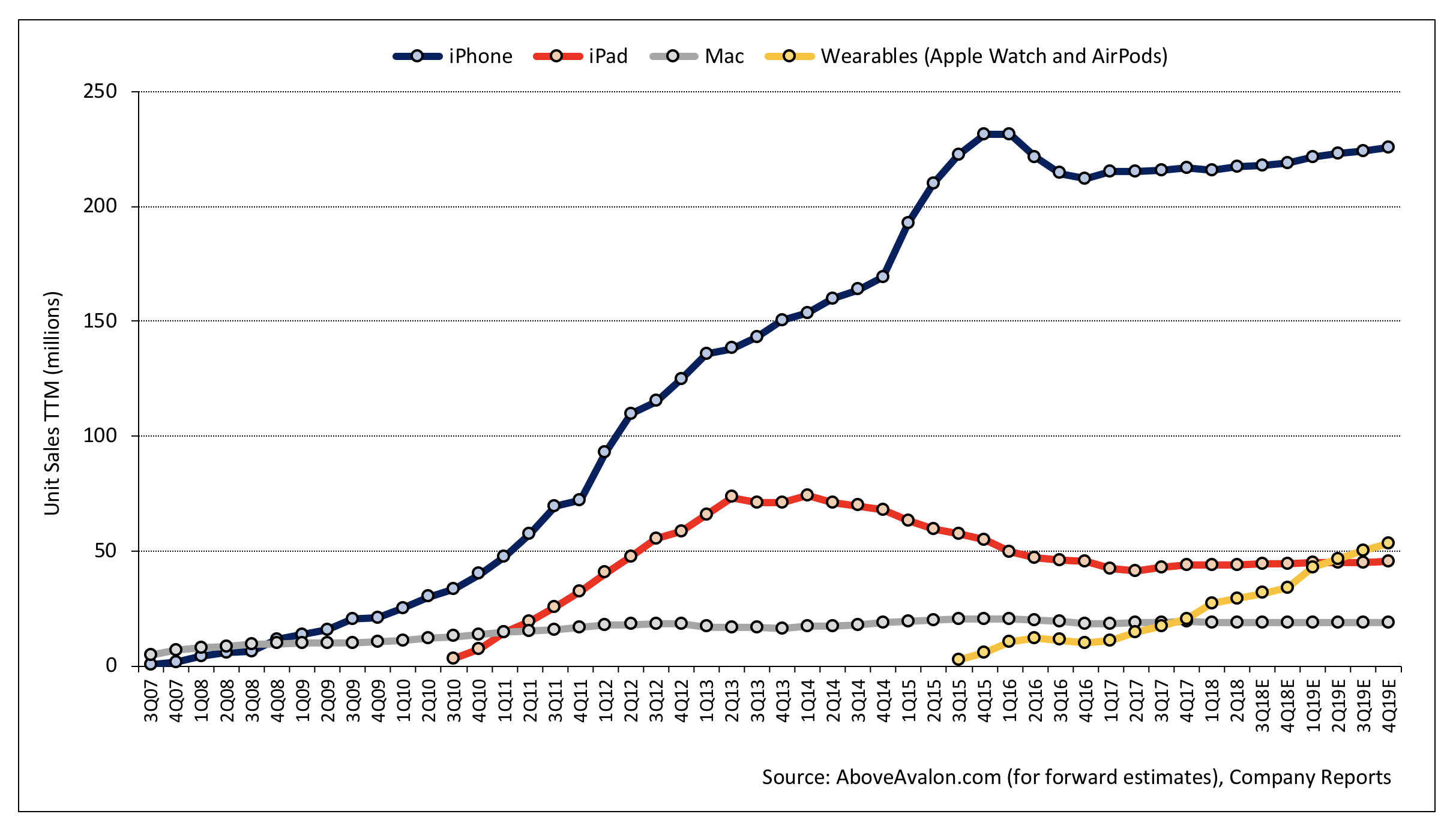
When thinking about what comes next, it's difficult to miss the rising yellow line in the preceding chart. Apple is seeing significant sales momentum in its battle for our wrists with Apple Watch and our ears with AirPods. These new form factors are successful in making technology more personal for tens of millions of people. When combining Apple Watch and AirPods sales, Apple's wearables segment will soon outsell iPad in terms of unit sales.
The next wearables battle will be for our eyes. This battle will revolve around a product that benefits from technologies currently found with ARKit, Siri, and Apple's ML efforts. Apple is setting the stage for smart glasses. A pair of smart glasses will essentially boil down to an ML playground cool looking and light enough to wear throughout the day. There's one problem for Apple: The world isn't quite ready for such a product. As Jony Ive put it a few months ago, "there are certain ideas that we have, and we're waiting for the technology to catch up."
Biding Time?
It's easy to think that Apple may simply be biding its time until the world is ready for AR glasses. However, WWDC gave us a glimpse of how Apple is busy behind the scenes, preparing for what comes next. With ARKit, Apple is using hundreds of millions of iPhone and iPads to inspire 20 million developers with the potentials found with AR. A similar dynamic is at play in getting customers comfortable with items like Animoji and Memoji - items that will likely one day be available via a pair of smart glasses.
In many ways, Apple is doing more than any other company to prepare the world for AR. Startups like Magic Leap have positioned themselves as being ambitious for wanting to control everything needed to develop a pair of mass-market AR glasses. However, Magic Leap is missing a few crucial ingredients needed for success. Unlike Apple, Magic Leap doesn't have a few hundred million devices for seeding early technologies that will eventually power a pair of smart glasses. Instead, Magic Leap is forced to conduct a portion of its R&D in public, releasing early prototype versions of AR goggles in an attempt to capture AR mind share that is increasingly flowing to Apple.
Another item that Magic Leap doesn't have, but which will prove to be incredibly useful for AR glasses, is Apple Watch. Apple has learned a significant amount about how personal technology can be worn on the body by having nearly 40 million people wear an Apple Watch on any given day. In addition, Apple Watch serves as a test bed for learning about proactive digital assistants. However, the most important aspect of Apple Watch is how the device will likely end up playing a key role in serving as a place to put tech on the body that will help power smart glasses. In fact, an argument can be made that Apple Watch will become more instrumental to Apple Glasses' success than any other Apple product.
Apple's Game to Lose
We see Apple pulling away from the competition when it comes to grabbing real estate on our wrists and ears. The company has a good shot at doing the same in the battle for our eyes. Consider the various ways Apple is well-positioned for AR glasses:
- Hardware and software integration. Apple has a few decades worth of experience while competitors have only recently realized that hardware/software integration is essential when it comes wearables.
- Controlling core technology. Apple's silicon efforts and broader ambition to control the core technologies powering its devices are giving the company a head start that will likely be measured in decades.
- Wearables manufacturing. Apple is learning a great deal about miniaturization with Apple Watch and AirPods. No other company is close to Apple in this area.
- AR technology. In just over a year, Apple has announced two major versions of its AR platform with hundreds of millions of supported devices. Years of extensive M&A activity in the AR arena is beginning to pay dividends.
- Developers. Apple has 20 million iOS developers focused on coming up with new experiences for a billion people. Companies like Magic Leap and Microsoft lack this critical piece of the equation.
- Fashion and luxury. Apple has learned a great deal about selling fashion with Apple Watch.
- Health/Medical. What may have started as an interest for Apple is turning into a strategic mission. A pair of smart glasses stand to improve the well-being of hundreds of millions of people as one of the key use cases for such a device is enhanced vision.
- Retail demoes. Apple has 502 retail stores around the world with plenty of space for glasses demoes.
There's an elephant in the AR room. This is Apple's game to lose.
Creating Tools
Five years ago, Apple management was facing growing pressure to announce something new. Wall Street and Silicon Valley were eager to see Apple unveil a new product category in the post-Steve Jobs era. To this group, the lack of a new product category from Apple meant that management was either struggling with innovation, or worse, suffering from a lack of imagination. The intense pressure to come up with something new likely played a role in Apple giving Apple Watch a huge product unveiling in September 2014.
Fast forward a few years, and Apple faces a dramatically different environment. There aren't as many calls for Apple to come up with something new following Apple Watch. Instead, Apple's ability to monetize the iPhone experience beyond hardware sales has made people think Apple is a different kind of company - one that is more focused on monetizing existing users instead of dreaming about what's next. In a way, many market observers are the ones now suffering from a lack of imagination when it comes to Apple.
Apple is a design company focused on creating tools for people. While some of those new tools may be positioned as accessories to existing products, other tools will be capable of ushering in paradigm shifts. The only way for Apple to remain relevant in the future is to disrupt itself by coming up with new tools consisting of a combination of hardware, software, and services. Such groundbreaking tools won't likely be released every two or three years. In fact, Apple may go more like five, six, or even seven years between announcing major new product categories. The point is that such paradigm shifts are needed.

Steve Jobs' quote calling for figuring out what's next and not dwelling on current success for too long was from a 2006 interview in which Jobs was asked where he sees himself within history's famous thinkers and inventors. Jobs was describing where the motivation for coming up with so many new products originated. For Apple, Jobs' quote serves as inspiration for not resting on its laurels and instead coming up with the next "pretty good" thing.
Receive my analysis and perspective on Apple throughout the week via exclusive daily updates. To sign up, visit the subscription page.
Above Avalon Subscriptions Turn Three
Last week, I celebrated the third anniversary of launching Above Avalon subscriptions. Those who signed up on May 13th, 2015 began their fourth year as Above Avalon subscribers. In an environment where online publishing is being questioned and doubted like never before, Above Avalon subscriptions are working. Above Avalon is an independent source of Apple analysis, 100% supported by subscriptions. The lack of dependency on ads, sponsors, or other revenue streams has played a large role in what Above Avalon has become over the past few years. In addition, Above Avalon has given me a front-row seat for watching the changing Apple news industry.
Strategy
Above Avalon embraces a subscription model in which subscribers pay for access to my full analysis and perspective on Apple. Two subscription options are available: $20 per month or $200 per year. Along with publishing weekly articles and podcast episodes, which are available to everyone, I publish a daily email available exclusively to subscribers. These emails go over everything that I think matters in the world of Apple. On any given week, I will cover 10 to 12 topics, one of which is discussed in the weekly article and podcast. The remaining topics are covered in email.
Subscribers receive other benefits that include receiving the weekly Above Avalon article via email, accessing the subscriber forum in Slack (more on this down below), and utilizing an archive consisting of approximately 600 emails previously sent to subscribers.
Above Avalon is unique as a paid subscription site that focuses on analyzing one company. I am unable to name another paid subscription site that has the same objective. Most subscription sites focus on broader topics such as certain genres or entire industries. In an interesting development, the other paid subscription niche popping up has been in the sports world as writers and analysts launch sites focused on specific sports teams.
The paid subscription model for analysis is not new. Its pioneers can be traced back to the financial world in which publications sent monthly and quarterly correspondence to paid subscribers via postal mail. However, the major change that has taken place more recently is a diversification in the way we consume news and analysis. A number of independent sites, often run by one person or a small team of people, have been able to grab an increasing amount of mind share from larger, more traditional news publications and multinational research firms. This market dislocation was one reason that led me to leave Wall Street and launch Above Avalon in 2014. The harsh economics of online publishing, combined with social media and tools for accepting online payments, sending emails, etc., have made it possible for one-person operations to find their audience (i.e. sustainability) in a sea of giants.
Paid subscriptions afford me the ability to focus on quality, not quantity, when it comes to readership. There is no financial incentive for me to publish sensational articles as the primary byproduct is a temporary jump in page views. Instead, my incentive is aligned with my desire to write articles that inform, enlighten, and provide an alternate view of Apple and the world. This ends up producing trust and credibility with readers, which are important drivers for attracting new subscribers.
Over the years, I've received different versions of the same question: Why don't I expand my coverage to include companies other than Apple? There is a simple answer: As Above Avalon subscribers can attest, my coverage area is already large. Since Apple doesn't operate in a vacuum, there is a need to monitor and analyze Apple's various competitors and the industries in which the company plays. However, the difference between Above Avalon and other sites is that all of my analysis is positioned from the perspective of Apple. In my view, having it any other way tends to breed Apple cynicism given the company's unique attributes. This cynicism often leads to the conclusion that Apple's different way of approaching the world will lead to failure. In fact, unwarranted cynicism is one of the main characteristics that lead to faulty Apple analysis.
Highlights and Challenges
Highlights from the first three years of Above Avalon subscriptions include:
- Reaching sustainability. While there was a specific subscriber threshold that marked Above Avalon sustainability (reached in 2015), subsequent events over the years have served as milestones. For example, seeing the first wave of annual Above Avalon subscriptions renew back in May 2016 further validated the business model.
- Online community. One thing that I didn't necessarily expect to happen was an online community to develop around Above Avalon. The Above Avalon subscriber forum in Slack continues to see an increasing amount of interaction and discussion. Subscribers currently reside in 55 countries and hold a diverse range of backgrounds and occupations. They include Silicon Valley executives and investors, the largest Apple shareholders, and the leading Apple journalists and writers in the business.
- Member meet-ups. There have been three member-meets (two in San Francisco and one in San Jose). The fourth is scheduled for next month during WWDC. Each has been memorable as I've been able to meet subscribers and put faces to what were previously just names in email, on Twitter, or in the forum.
- Subscriber support. Since launching Above Avalon subscriptions, I've experienced quite a few life changes. My wife and I welcomed two boys into this world. Each time, the outpouring of well-wishes from subscribers has been great. However, there have also been difficult times, such as my mother's recent passing. Subscribers were there with condolences. I even received condolences via postal mail from subscribers. It may seem like a small thing, but it's something I will never forget.
The biggest challenges have been:
- New things. I'm self-taught when it comes to the world of online publishing, podcasting and videography. In my prior career, I was a Wall Street analyst. While it hasn't been easy, YouTube and Twitter have been great tools for finding answers to questions.
- Hesitancy to publish. As Above Avalon has grown in terms of readers, listeners, and subscribers, I've become more hesitant to publish on topics when my views on them are still in their fragile state. This hesitation has resulted in certain articles and podcast episodes taking a shockingly long amount of time to write and produce.
Requirements
Above Avalon is an example of a paid subscription site working. However, when it comes to the model being replicated, I don't think there is a particular recipe or path for success with paid subscriptions. While some will find success literally overnight, others may find success only after a number of years.
There are three requirements needed for paid subscription sites to work:
- A strong voice. The recurring theme found in every successful independent site, email, or podcast is that it contains a strong voice. Wishy-washy stances on positions won't go far. The strongest voices have an ability to support their opinions with facts.
- Perspective. Above Avalon subscribers aren't interested in simply reading about news events and topics that matter to Apple. Instead, subscribers want to know my perspective on those news events and topics. By having perspective, one possesses a certain kind of philosophy that transcends any particular topic or news event.
- Be the best. While "best" is subjective, in my view, being the best entails having a deep understanding of the subject matter at hand. In nearly every example of a successful subscription-based site, the founders / writers are experts in their coverage areas.
The Apple News World
Above Avalon has given me a front-row seat to the changing Apple rumors and news world, also known as the Apple blogosphere. There are three buckets:
- News / Rumor Aggregators. MacRumors, iMore, 9to5Mac, and AppleInsider are the most well-known. Others such as Cult of Mac, MacDailyNews, and MacSurfer have also been around for some time. The largest sites are characterized by having a team of writers and a business model consisting of various revenue streams (ads, sponsors, affiliate links, different forms of memberships). Many have moved into video, podcasts, and email newsletters. A vibrant online community in the form of active message boards and forums play a big role in these sites' sustainability.
- News Publications. These include Financial Times, The Wall Street Journal, The New York Times, Fast Company, CNBC, Recode, Bloomberg, Wired, The Independent, BuzzFeed, The Verge, and *insert your favorite news publication that covers Apple news here*. Most of these sites have one or two correspondents who write about Apple. However, it is becoming rare for news publications to have Apple-exclusive writers. Business models vary in this group but have increasingly been moving towards paid subscriptions. Only a select number of these sites have vibrant online communities.
- Curators / Analysis / Research. Above Avalon, Daring Fireball, Asymco, Stratechery, MacStories, Tech.pinions, Six Colors, The Loop, Apple 3.0, TidBITS, Wall Street sell-side firms, podcast-only ventures, YouTubers, industry research firms, VC firms, and popular Twitter personalities are included in this category. There is much diversity in this group. Some write exclusively about Apple while others write and talk about Apple from time to time. Meanwhile, others use Apple as a way to analyze broader business and disruption theories. Business models run the gamut and include everything from ads and sponsors to paid subscriptions, donations, and affiliate links. Other sites and accounts are run strictly for marketing purposes. Communities tend to play a major role in these sites.
While some sites have tried to play in more than one bucket, few have found success. News and rumor sites have made few inroads in terms of analysis and research while analysis sites have generally stayed away from the tough business of breaking news and scoops.
Over the years, there have been a number of major changes in the Apple blogosphere:
News / rumor aggregators have grown up and gained legitimacy. After years of rocky relations, Apple basically treats the leading Apple news and rumor aggregators like any other news organization. Aggregators have achieved sustainability by broadening coverage to include pretty much everything that is in some way connected to Apple or the large iOS ecosystem. In addition, each runs with super lean operating budgets. The stories themselves likely don't pay the bills. Instead, it's the repeat visitors that are interested in the comment sections and forums. Each publication relies on podcasts and video as ways to maintain mindshare in each respective news medium.
Apple rumor / scoop industry has dried up and consolidated. Ten years ago, there were a number of news publications that were in a legitimate position to break the next Apple scoop (some of which were likely controlled leaks from Apple). Today, there are only two or three sites that even publish Apple scoops. The consolidation in Apple scoops has been driven by Apple ramping up the amount of secrecy regarding unannounced projects. In addition, Apple "scoops" have increasingly come from research firms paying for confidential information coming out of Apple's supply chain. One byproduct of this rumor consolidation has been a relatively high degree of turnover among Apple reporters.
Ad-supported business models are struggling. It is becoming more difficult to find ad-supported business models on the web. While there are likely a few reasons for this change, one includes ad dollars being funneled away from blogs and into podcasts and videos. This explains what appears to be an exodus of resources away from written blogs and into podcasts and video-focused efforts. Unfortunately, my suspicion is this won't end well for many as increased competition in the podcast and video space will tend to push sponsors to those with the largest followings. Such an environment would make it increasingly difficult for independent ventures to find sustainability by chasing scale.
Paid news sites boost independents. Most news publications have embraced paid subscriptions as another way of boosting revenues. While a paid subscription to a multinational news organization may make sense for many readers, the value / price tradeoff becomes murky for readers interested in specific topics and niches. For example, the average news publications will only write about Apple once a week (if that much). This environment provides an even greater amount of oxygen to independent sites that can give the time and attention to niche subjects.
Donation / support route isn't promising. The transition from ad-supported business models to subscription-based models hasn't been easy for many independent sites. Going from a scenario in which all content was public to one in which only a fraction of content is public can be jarring. Most sites have handled this transition by keeping content free and instead giving paid subscribers a very marginal amount of exclusive content. In essence, sites are treating subscriptions and memberships like donations. This is not sustainable for or attractive to subscription-based models.
Exciting Times
It's never been easier to start a paid subscription site. This reality has made it harder than ever to get a paid subscription site off the ground. While barriers to entry have been lowered in many content-focused genres, including blogs, YouTube, and podcasting, discovering your audience is becoming more challenging. At the same time, competition is intensifying. It's not realistic to assume the average consumer will subscribe to dozens of paid sites. However, there is no such thing as an "average" consumer. Instead, every consumer will subscribe to a different portfolio of paid sites. As an independent, the job is to earn a spot in some of those portfolios.
As I enter the fourth year of paid subscriptions, a big thank you goes out to Above Avalon subscribers. The past three years have been great and I'm looking forward to many more. I don't think there has been a better time to examine Apple.
To become an Above Avalon subscriber, visit the subscription page.
The Apple Services Machine
Apple's services business is remarkably strong yet surprisingly mysterious. A closer look at Apple Services reveals an apparatus, which can easily qualify as a Fortune 100 company, that isn't what it seems from the outside. Apple isn't becoming a services company focused on coming up with a myriad of ways to milk existing users. Instead, Apple's services strategy primarily reflects the company's long-held ambition of becoming a leading content distribution platform.
Momentum
Services represent Apple's second-largest revenue source behind iPhone. In 2017, Apple reported $31 billion of Services revenue, which represented 13% of overall revenue. As seen in Exhibit 1, Apple Services revenue has experienced steady growth for years.
Exhibit 1: Apple Services Revenue (TTM)

In recent quarters, Apple's services business has seen renewed momentum. As shown in Exhibit 2, Services revenue growth began accelerating in late 2015 and is now at multi-year highs. The growth likely coincided with very strong new user trends for the iPhone business. An acceleration in growth despite Apple's already large Services revenue base is that much more impressive.
Exhibit 2: Apple Services Revenue (TTM) Growth

The Services Machine
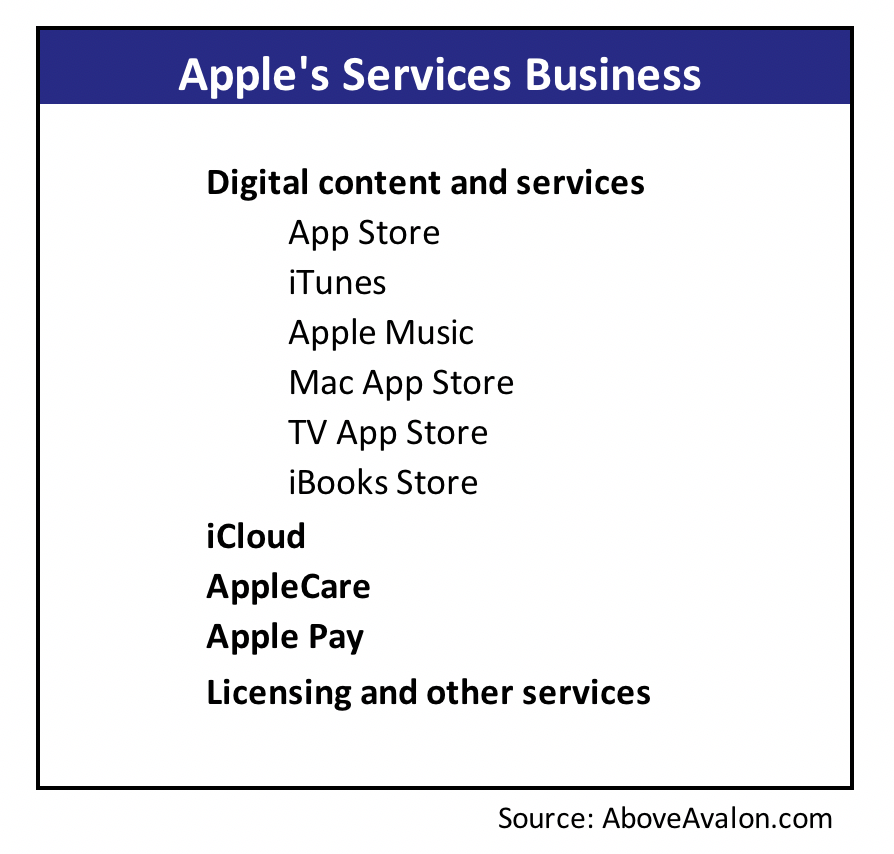
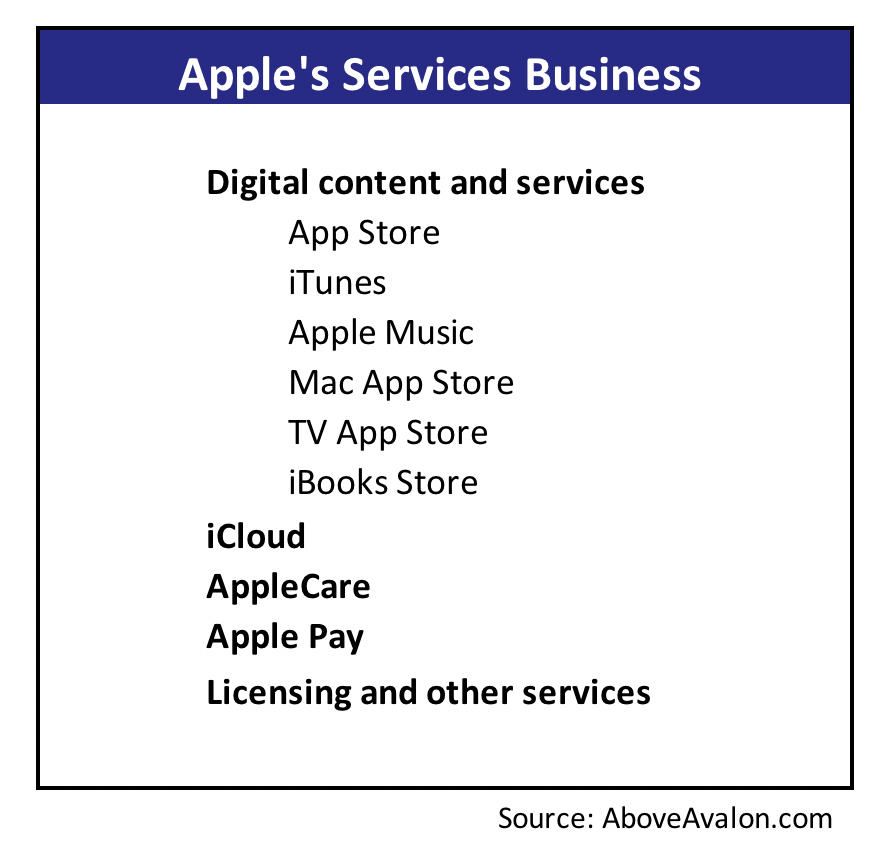
Services is a financial catch basin for Apple's non-hardware revenue. As disclosed in Apple's financial filings, Services consists of five categories: digital content, iCloud, AppleCare, Apple Pay, and licensing.
Exhibit 3: The Apple Services Machine
Digital content. This includes revenue from Apple's various content stores, including the App Store and iTunes. Apple Music is also included in this category. While Apple doesn't disclose the total amount of revenue associated with selling digital content, the company has provided the amount paid to app developers on an annual basis. This data point makes it possible to derive the total amount of App Store revenue. In addition, Apple regularly discloses the number of paid Apple Music subscribers, which can be used to derive Apple Music revenue.
iCloud. Apple offers three tiers of additional iCloud storage (50GB, 200GB, and 2TB). Prices vary depending on the geography. The 200GB and 2TB storage tiers are eligible for family sharing. While Apple has not disclosed the number of users on a paid iCloud storage plan, management recently disclosed that iCloud revenue was up over 50% year-over-year to a record high, which implies good new user growth.
AppleCare. Apple sells a number of service and support options for its products.
Apple Pay. Apple earns a small percentage of every amount transacted through Apple Pay. Initial reports pegged this percentage at 0.15% for U.S. transactions. For every $100 of Apple Pay purchases in the U.S., Apple earns 15 cents. However, in the UK, Apple reportedly receives a smaller fee. Given Apple Pay's prominence outside the U.S., a safe assumption is that Apple earns on average less than 0.15% of every Apple Pay transaction.
Licensing and other services. Apple earns revenue from third parties for offering their services as default options on Apple devices. One of the more well-known examples is Apple's contract to have Google be the default search provider for Safari on Mac and iOS. Apple recently expanded its Google relationship to include Google for web searches via Siri and YouTube for video searches. Microsoft Bing remains the option for Siri image searches.
Estimating Services Revenue
Apple doesn't disclose the amount of revenue generated by each Services category. However, after sifting through years of earnings call transcripts as well as recent news releases involving the App Store and Apple Music, it is possible to put together a few pieces of the Apple Services puzzle.
According to my estimates, Apple earns a majority of its Services revenue from delivering content to nearly a billion people using more than 1.3 billion Apple devices. In 2017, Apple earned an estimated $21 billion from selling digital content ranging from apps (especially games) to music and movies.
Back in January, Apple disclosed that it paid $26.5 billion to app developers in 2017. Apple keeps either 15% or 30% of app revenue, depending on the app and whether it is a subscription. This suggests that overall App Store revenue was approximately $37 billion. Since Apple reports App Store revenue on a net basis, recognizing only the commission it retains, the full $37 billion of App Store revenue is not reflected under Services. Instead, Apple reports just its $11 billion share of the revenue.
The remaining portion of Apple's digital content revenue came from iTunes and Apple Music. Apple reports Apple Music revenue and some digital content sold through iTunes on a gross basis. This results in iTunes and Apple Music representing a large portion of Services revenue despite bringing in significantly less revenue than the App Store. In fact, iTunes and Apple Music likely contribute close to the same amount of Services revenue as the App Store.
Exhibit 4: Apple Services Revenue Mix (2017)

To put the preceding revenue totals in context, Apple Watch generated $6.5B of revenue in 2017.
The primary reason Apple has experienced accelerating Services revenue growth since late 2015 is that the company has seen a dramatic increase in the number of people accessing its various content stores. The iPhone installed base grew by more than 100 million people each year from 2013 through 2017. These new users are spending an increasing amount of money buying various forms of content through Apple's stores.
One of the more interesting revelations from my estimated Apple Services revenue mix is the degree to which licensing is a key revenue driver. My estimate has Apple earning $4 billion per year from licensing. While Apple doesn't discuss its licensing business, recent reports of Google paying much higher TAC (traffic acquisition costs) suggests Apple has seen strong growth in its licensing revenue. The growth is a result of iOS gaining power at the premium end of the smartphone market. Companies like Google increasingly need access to iPhone users in order to feed their free data capturing services. According to my estimates, the $4 billion of revenue associated with licensing is roughly the same amount of revenue generated by AppleCare.
While Apple has built new services revenue streams in the form of iCloud and Apple Pay, neither come close to matching the revenue associated with content distribution. Given the economics surrounding Apple Pay, it's not likely the service will be a significant revenue driver for Apple in the near term. For every $1 trillion transacted through Apple Pay, Apple would generate just $1.5 billion. As for iCloud, while management boasts about record revenue, the total likely pales in comparison to content distribution.
Estimating Services Gross Margin
In addition to not breaking out Services revenue by category, Apple management has kept Services margins under wraps. We know from management commentary that Services end up boosting Apple's overall gross margins. This is a major clue suggesting Services gross margin exceeds 40%. One way of reaching a more specific Services margin estimate is to look at each revenue driver.
Exhibit 5: Apple Services Gross Margin Mix (2017)

As shown in Exhibit 5, each Services category has a different gross margin. Licensing is likely the most profitable for Apple, followed by Apple Pay and iCloud. Extended warranties, such as AppleCare, are also highly profitable. The fact that Apple reports some iTunes revenue and Apple Music revenue on a gross basis weighs on digital content gross margins. Overall, my estimate is that Apple's services business has a 55% gross margin.
The Services Strategy
Apple's services strategy is misunderstood. Many have looked at Apple's services momentum and concluded that Apple is turning into a services company. In addition, a growing number of people are positioning services as Apple's future. Neither viewpoint is true.
Apple has been pursuing two goals with services:
Deliver Content. Apple has a long-standing ambition of leveraging its platforms in order to become a leading content distributor for apps, music, books, podcasts, and video. To claim that Apple has only recently begun to focus on earning revenue from delivering content is incorrect.
Increase Hardware Value and Functionality. Management looks at services as a key differentiator that increases the value found in using Apple hardware and software. Services like AppleCare, iCloud storage, and Apple Pay are designed to improve the experience found in using Apple hardware and software.
A recurring theme found with Apple Services is hardware dependency. Apple's ambition to be a content distributor is intertwined with its hardware capabilities. Without more than 1.3 billion devices in the wild, Apple's digital content revenue would be a fraction of its current size.
In addition, AppleCare, Apple Pay, iCloud, and licensing are also heavily dependent on the number of Apple devices in the wild. It is this hardware dependency that makes it impossible to look at Apple Services as a stand-alone business. The relationship between services and hardware is one reason why an Apple Services narrative on Wall Street hasn't been able to stick. The Services narrative isn't compelling if it excludes Apple hardware from the equation.
Apple's future isn't about selling services. Rather, it's about developing tools for people. These tools will consist of a combination of hardware, software, and services.
Looking Ahead
Apple management recently reiterated its goal of reaching approximately $50 billion of Services revenue by 2020. The most likely way Apple will reach this goal is by growing the amount of revenue associated with digital content distribution. App Store revenue has been growing by approximately 30% per year. Assuming Apple Music revenue growth more than offsets a decline in paid music downloads, Apple stands to grow its digital content revenue by at least $15 billion over the next two years. This will push Apple very close to its $50 billion Services revenue goal by 2020. These calculations don't take into consideration any new content subscription offerings from Apple.
Apple currently has more than 270 million paid subscriptions across its services, up over 100 million year-over-year. My suspicion is that a good portion of those subscriptions are content subscriptions. Apple is currently developing two new paid services for delivering content: Apple Video and a paid tier to Apple News. Each service will likely be given a long-term target of having at least 100 million paying users. In addition, Apple is in a good position to benefit from growing momentum for video streaming services including Netflix, HBO, and Hulu. It is not a stretch to claim that Apple will one day have 500 million paid subscriptions across its services.
Apple isn't becoming a services company. Instead, Apple is building a leading paid content distribution platform.
Receive my analysis and perspective on Apple throughout the week via exclusive daily updates (2-3 stories per day, 10-12 stories per week). Available to Above Avalon members. To sign up and for more information on membership, visit the membership page.
Apple 2Q18 Earnings Expectations
Wall Street has major jitters when it comes to Apple's upcoming earnings release. Sentiment has decidedly swung toward the negative as questions swirl around iPhone X demand. Despite the dramatic downturn in expectations, Apple's stock price has held up remarkably well. While many eyes will be on iPhone sales tomorrow, my suspicion is that the data point won't have as much influence as consensus assumes. Instead, Apple's capital return update has the potential to be the major takeaway from 2Q18 earnings.
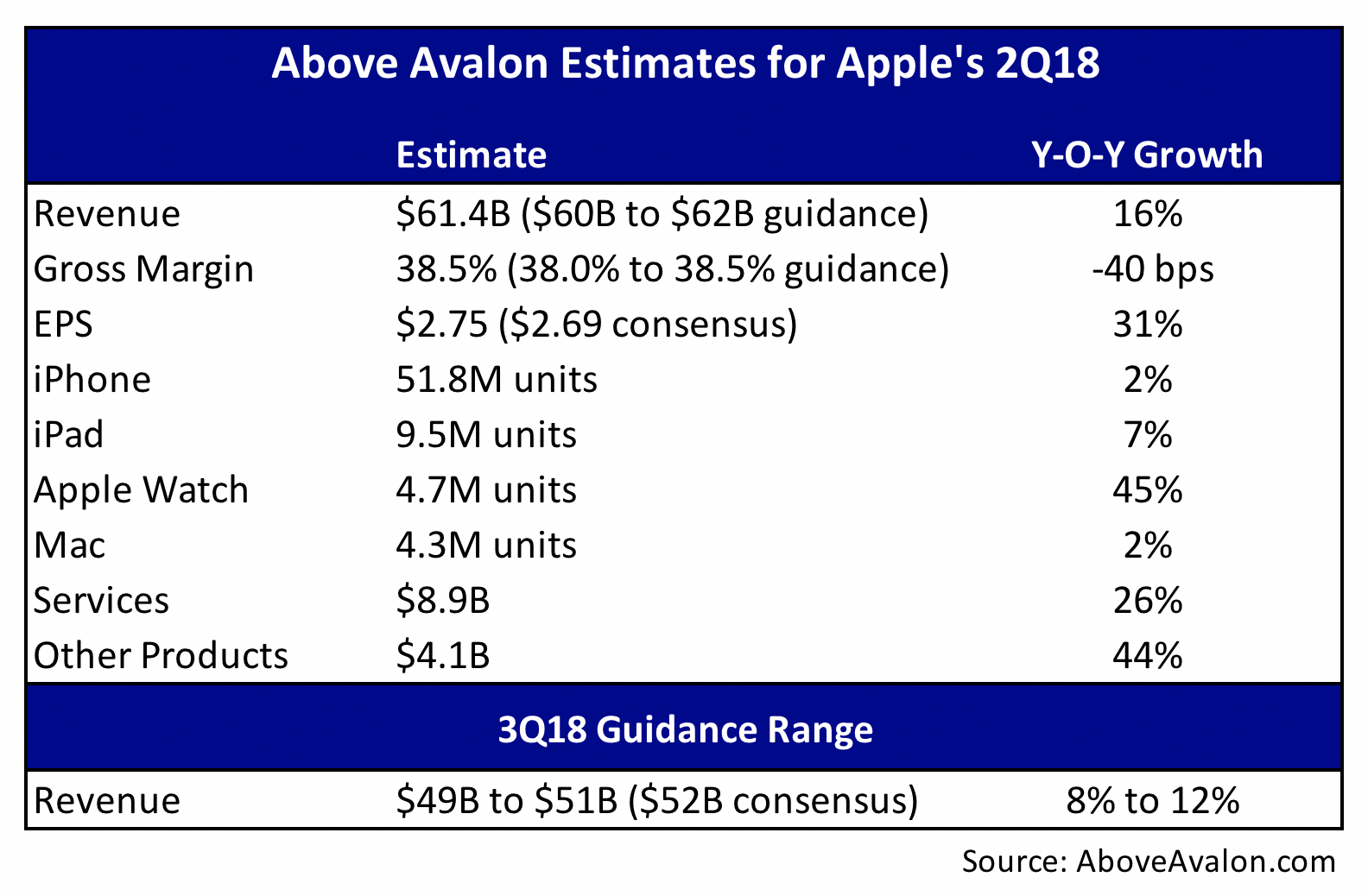
The following table contains my Apple 2Q18 estimates. The ingredients are in place for Apple to report a slight EPS beat to consensus although 3Q18 revenue guidance will likely come in below consensus.
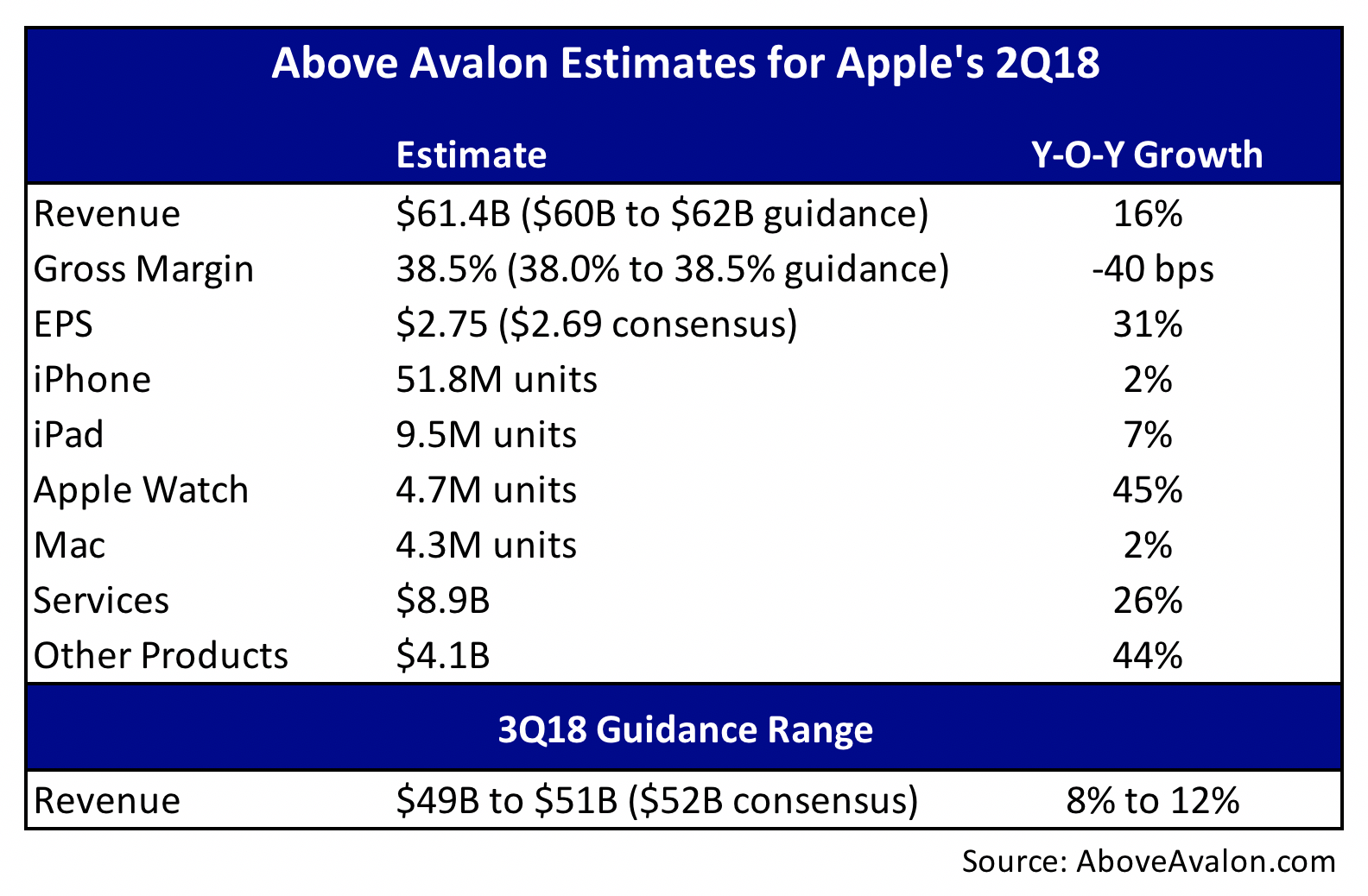
My full perspective and commentary behind these estimates are available to Above Avalon subscribers. (Become a subscriber to access my full 5,000-word Apple 2Q18 earnings preview available here. To sign up, visit the subscription page.)
Items Worth Watching
Here are the five variables worth watching when Apple releases earnings on Tuesday:
iPhone Channel Inventory. Given prior management commentary, iPhone unit sell-through growth and iPhone average selling price don't represent the major wildcards for 2Q18 earnings. Instead, the big unknown is found with iPhone channel inventory. A significant channel inventory drawdown will result in Apple reporting iPhone unit sales closer to 50M units. Vice versa, a relatively minor decline in iPhone channel inventory may lead to Apple reporting iPhone sales slightly ahead of my 52M unit expectation.
iPad ASP. The days of dramatic iPad unit sales declines are over. Accordingly, instead of unit sales, average selling price (ASP) stands to provide much more information regarding the latest iPad trends. A weaker-than-expected iPad ASP may support the view that the 9.7-inch iPad at the low end of the line is likely gaining momentum at the expense of the higher-end iPad Pro options.
Other Products. Apple's "Other Products" category has the sales momentum. The line item includes various products such as Apple Watch, AirPods, HomePod, Beats headphones, iPod touch, and Apple-branded and third-party accessories.
3Q18 Guidance. Apple's 3Q18 revenue guidance will likely provide a few clues as to how iPhone demand has been trending. One complicating factor when it comes to revenue guidance is that Apple's non-iPhone part of the business is seeing major momentum. iPhone weakness will be partially offset by strength in Other Products and Services.
Capital Return. Apple will announce changes to its capital return program. My expectations are for a $100 billion increase to share buyback authorization and a 20% increase to the quarterly cash dividend. Management commentary regarding timing associated with share repurchases will be closely monitored.
2Q18 Expectation Meters
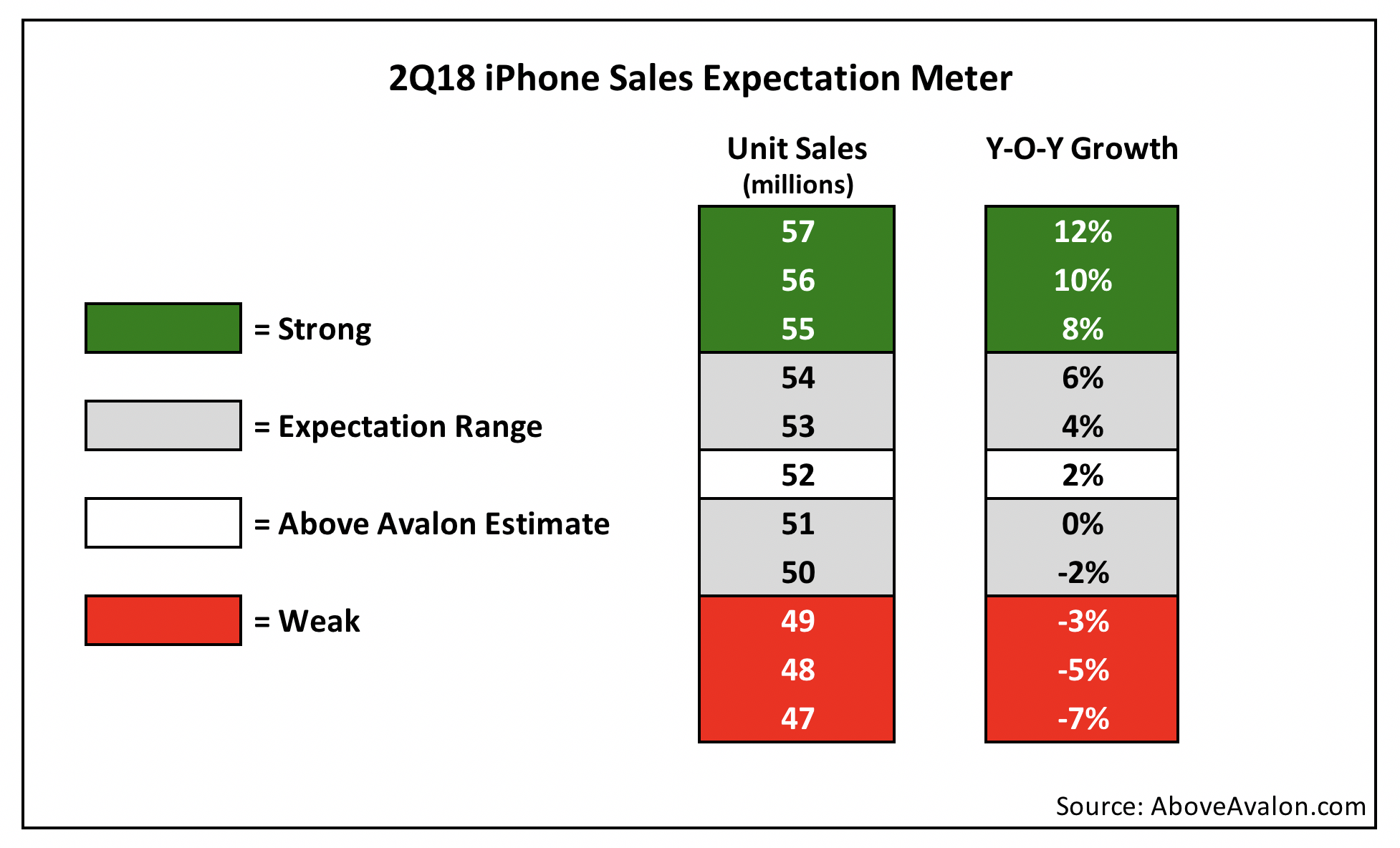
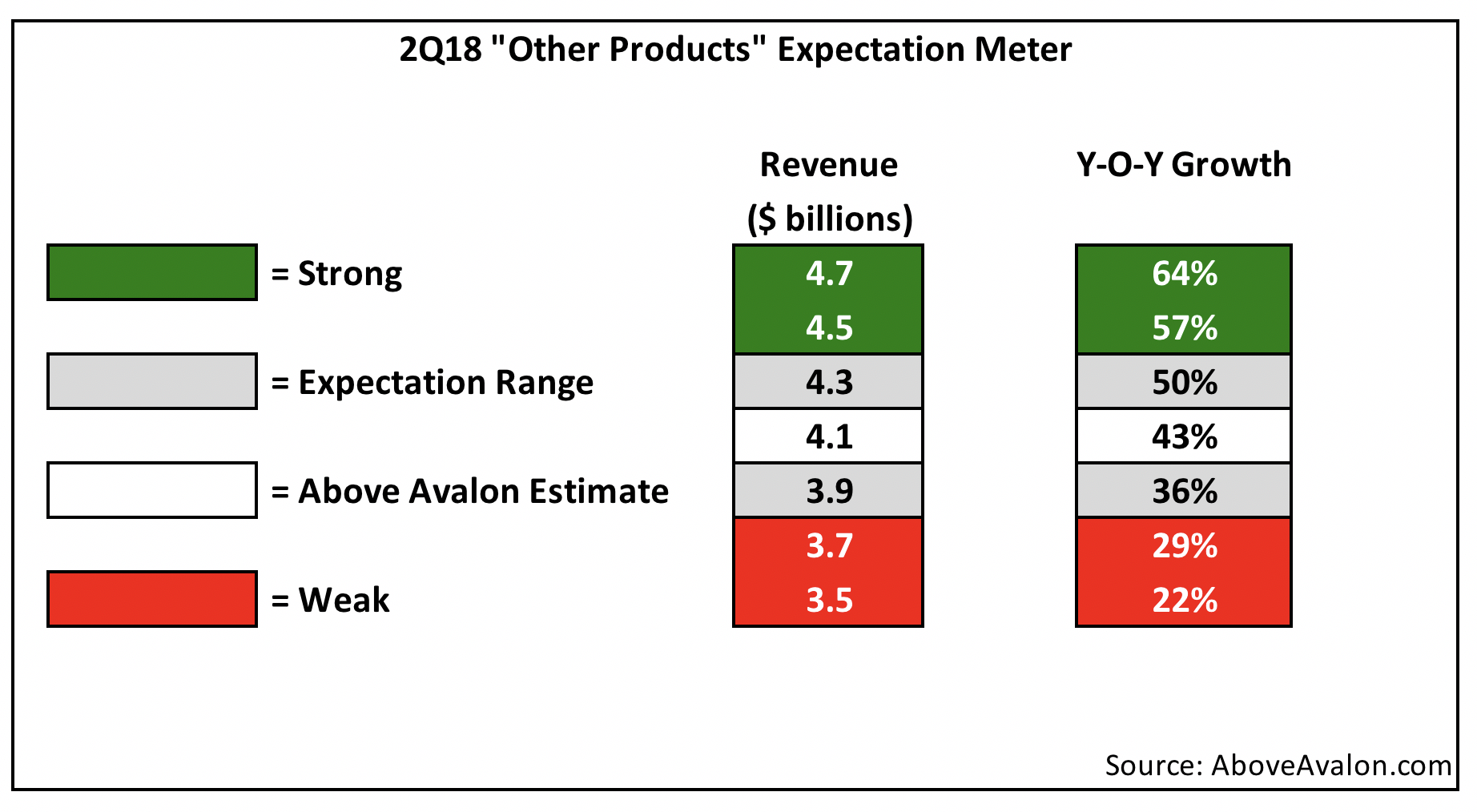
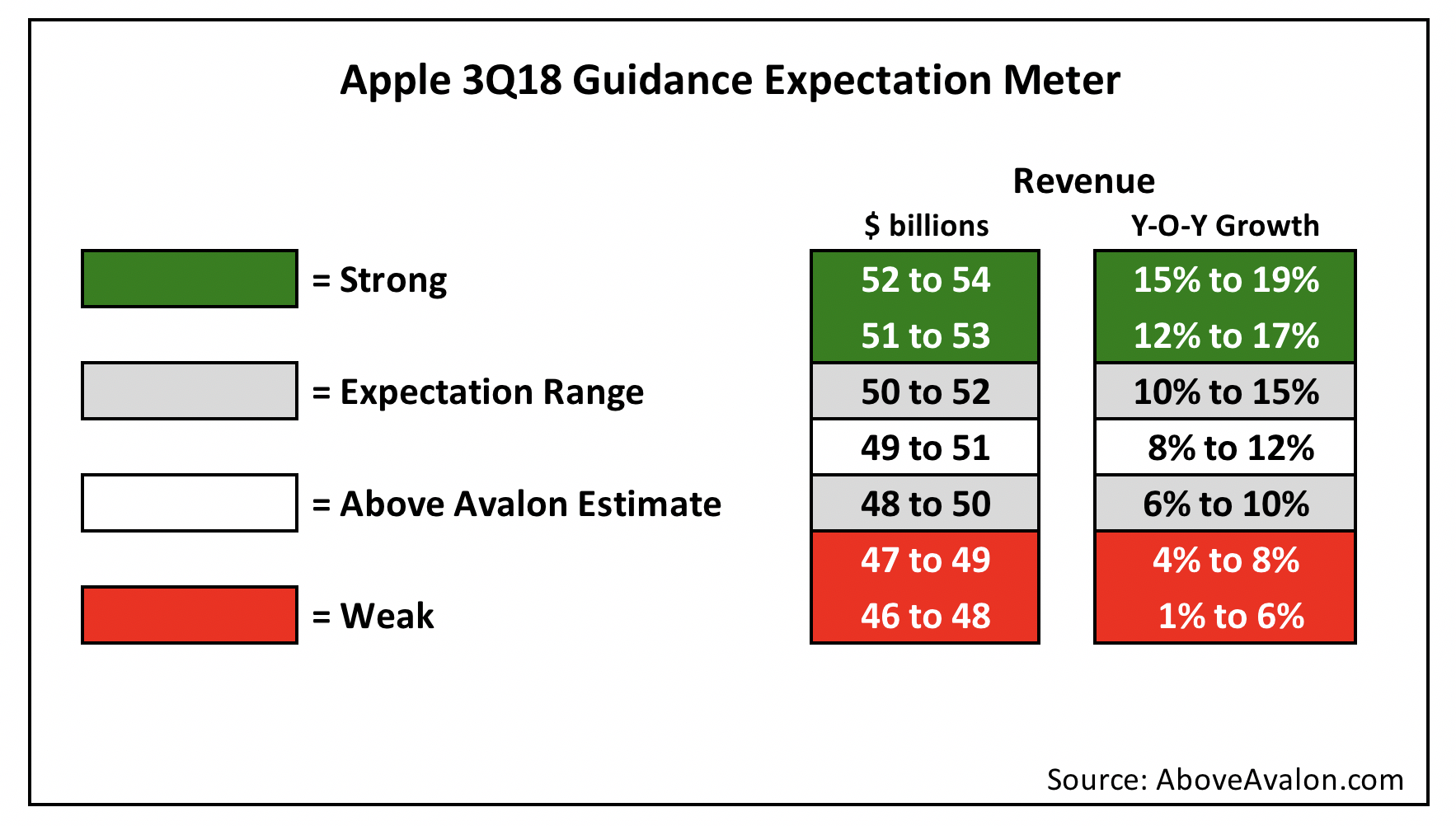
Each quarter, I publish expectation meters ahead of Apple's earnings release. Expectation meters turn single-point financial estimates into more useful ranges that aid in judging Apple's quarterly performance.
In each expectation meter, the grey shaded area is my expectation range. A result that falls within this range signifies that the product or variable being measured is performing as expected. A result in the green shaded area denotes strong performance and likely leads me to raise my assumptions and estimates going forward. Vice-versa, a result in the red shaded area has the opposite effect and leads me to reduce my assumptions.
I am publishing three expectations meters this quarter: iPhone unit sales, Other Products, and 3Q18 guidance.
My iPhone unit sales expectation range stretches from 50M to 54M iPhones. iPhone unit sales within this range would be labeled as expected. If Apple reports iPhone sales greater than 54M units, results would best be described as strong. A sub-50M iPhone result would lead me to reassess my sales expectations going forward.
For "Other Products," revenue that exceeds $4 billion would support the view that Apple Watch and AirPods were strong sellers during the quarter. HomePod sales will also likely contribute to the year-over-year growth in revenue.
Revenue guidance that exceeds $50 billion would likely be viewed positively while revenue closer to $45B would be viewed negatively. It is likely that Apple's 3Q18 revenue guidance will reflect a year-over-year revenue increase. The increase is due to momentum in Services and Other Products.
Above Avalon subscribers have access to my full 5,000-word Apple 2Q18 earnings preview (four parts):
- Setting the Stage
- iPhone Estimates
- iPad, Apple Watch, Mac, Services Estimates
- Revenue, EPS, Capital Return, 3Q18 Guidance
Subscribers will also receive my exclusive earnings reaction emails containing all of my thoughts and observations on Apple's 2Q18 earnings report and conference call. To read my Apple earnings preview and receive my earnings reaction notes, sign up at the subscription page.
Making the Case for Doubling Apple's Share Buyback Pace
Next week, Apple will provide an update to its capital return program. In what has become an annual tradition, the announcement will include a sizable increase to Apple's share repurchase authorization and a hike in the quarterly cash dividend. Given recent management commentary, Apple's overall thought process regarding capital allocation is already known. The only way Apple will be able to accomplish its capital return goals is by doubling the pace of share buyback from current levels.
Capital Return Update
For the past five years, Apple has used FY2Q earnings to announce updates to its capital return program. Here are the changes Apple announced to its share buyback authorization over the years:
2012: $10 billion buyback authorization
2013: $60 billion (increase of $50 billion)
2014: $90 billion (increase of $30 billion)
2015: $140 billion (increase of $50 billion)
2016: $175 billion (increase of $35 billion)
2017: $210 billion (increase of $35 billion)
In terms of the quarterly cash dividend, Apple has announced five increases over the years:
2012: $0.38 per share
2013: $0.44 (15% increase)
2014: $0.47 (8% increase)
2015: $0.52 (11% increase)
2016: $0.57 (10% increase)
2017: $0.63 (11% increase)
Excess Cash
In order to assess the most likely changes Apple will announce next week to its share buyback authorization and quarterly cash dividend strategy, we turn to recent comments from Apple CFO Luca Maestri:
"Tax reform will allow us to pursue a more optimal capital structure for our company. Our current net cash position is $163 billion. And given the increased financial and operational flexibility from the access to our foreign cash, we are targeting to become approximately net cash neutral over time."
Maestri's comments tell us three things:
Apple considers its current excess cash position to be $163 billion. After taking into account repatriation taxes, Apple's excess cash totals approximately $125 billion.
Apple wants to remove the vast majority of this excess cash from the balance sheet in order to reach "a more optimal capital structure." This isn't a management team that will sit on the excess cash indefinitely.
Apple's "net cash neutral" target implies management is okay with holding debt on the balance sheet. It's not likely that Apple will use excess cash to reduce its debt obligations significantly.
In addition to holding $125 billion of excess cash (after taxes), Apple is also kicking off significant amounts of cash. A successful capital return strategy needs to account for this ongoing cash flow generation. The company is currently generating approximately $50 billion of free cash flow per year. This total reflects approximately $60 billion of operating cash flow per year and between $10 billion and $15 billion spent on property, plant, & equipment. Over the next five years, it is conceivable that Apple will generate more than $200 billion of free cash flow. Management has been funneling nearly all of its free cash flow into capital return initiatives.
Combining Apple's $125 billion of excess cash currently on the balance sheet with its $200 billion of free cash flow generation, Apple is on track to have $325 billion of excess cash over the next five years. Without record-breaking increases to share buyback authorization and quarterly cash dividends, Apple will have trouble spending this excess cash prudently in a timely manner. Since 2012, Apple has spent just shy of $250 billion on capital return initiatives. Assuming Apple maintains its current share buyback pace and cash dividend payouts, it would take Apple close to ten years to spend $325 billion of excess cash. Big changes are needed in order for Apple to reach an optimal capital strategy in a reasonable amount of time.
Changes
Apple has a number of options at its disposal when it comes to spending $325 billion of excess cash over the next five years. The company can utilize mechanisms like a Dutch auction tender offer to repurchase a significant number of shares in a very short amount of time. There are also various cash dividend strategies that management can follow involving special dividends. However, the odds of Apple utilizing such strategies are not high. Instead, Apple will likely follow its existing capital return strategy but at much higher levels. Such a strategy is realistic, achievable, and financially prudent for shareholders.
One possible path Apple can follow includes announcing the following changes next week:
Increase share buyback authorization by $100 billion (would represent a record increase).
Increase the quarterly cash dividend by 20% to $0.75 per share (would represent a record increase).
Buyback Changes
Apple is currently buying back approximately $30 billion of shares per year. While this is a significant amount for any company to spend on share repurchases, Apple will have to materially increase this buyback pace to spend its excess cash in a timely manner. At the same time, there are limits as to the number of shares Apple can realistically buy back before distorting the market. (My Apple stock buyback program primer is available for Above Avalon subscribers here.)
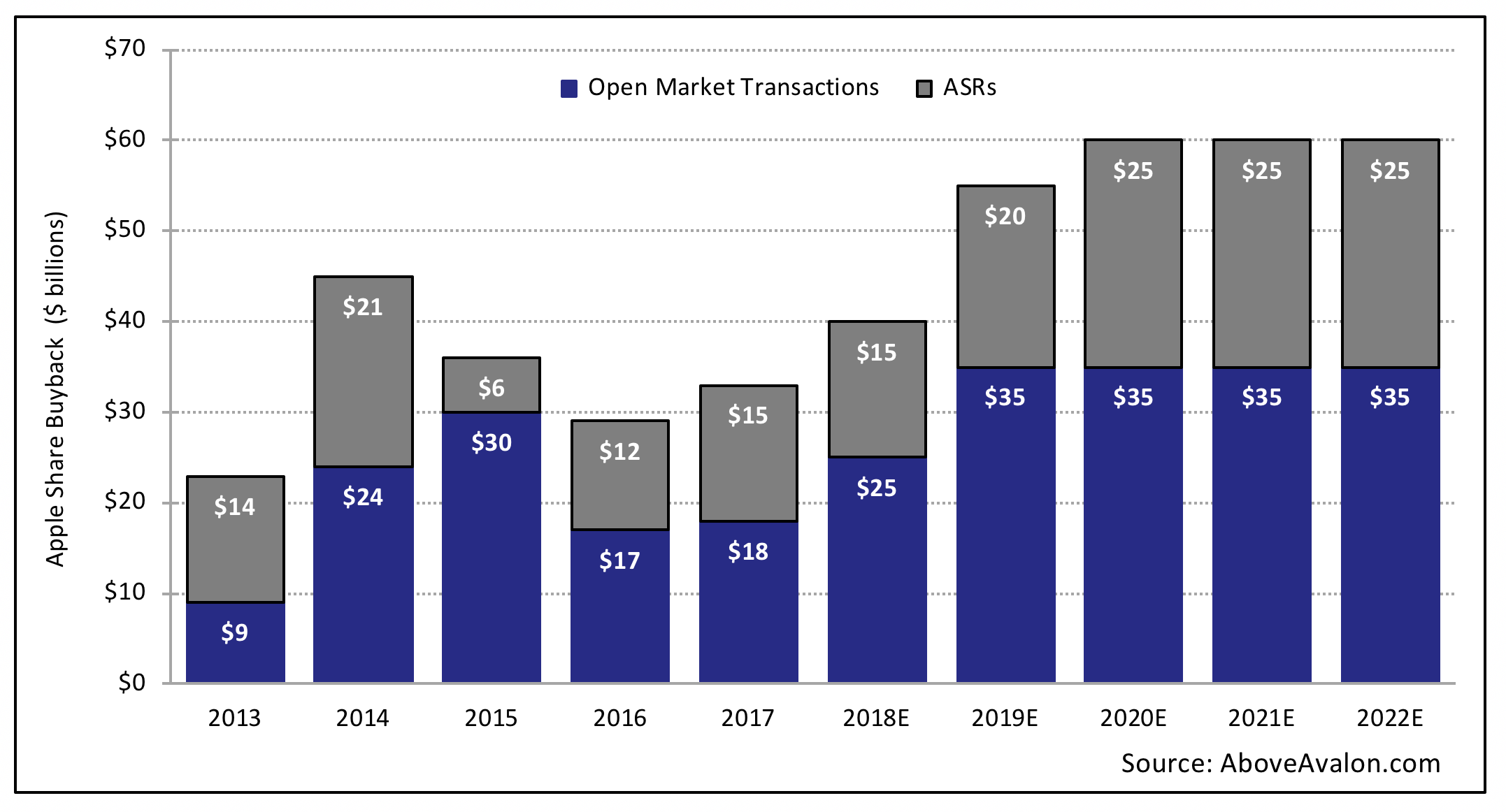
Increasing share buyback authorization by $100 billion would give Apple the best of both worlds: the ability to buy back substantially more shares over the next two years while avoiding much market dislocation. In fact, a $100 billion authorization would allow Apple to double its buyback pace to $60 billion per year. Given Apple's daily trading volume, a $60 billion annual share buyback pace amounts to about 10 days of AAPL buying pressure. In subsequent years, Apple could announce smaller increases to buyback authorization in the range of $50 billion to $75 billion. This would be done to maintain the $60 billion per year buyback pace.
As shown in Exhibit 1, Apple can continue to utilize both open market transactions and accelerated share repurchase arrangements (ASRs) to buy back shares. The ramp in buyback from 2017 to 2020 reflects the amount of time Apple will utilize to bring back foreign cash to U.S. subsidiaries.
Exhibit 1: Apple Share Buyback
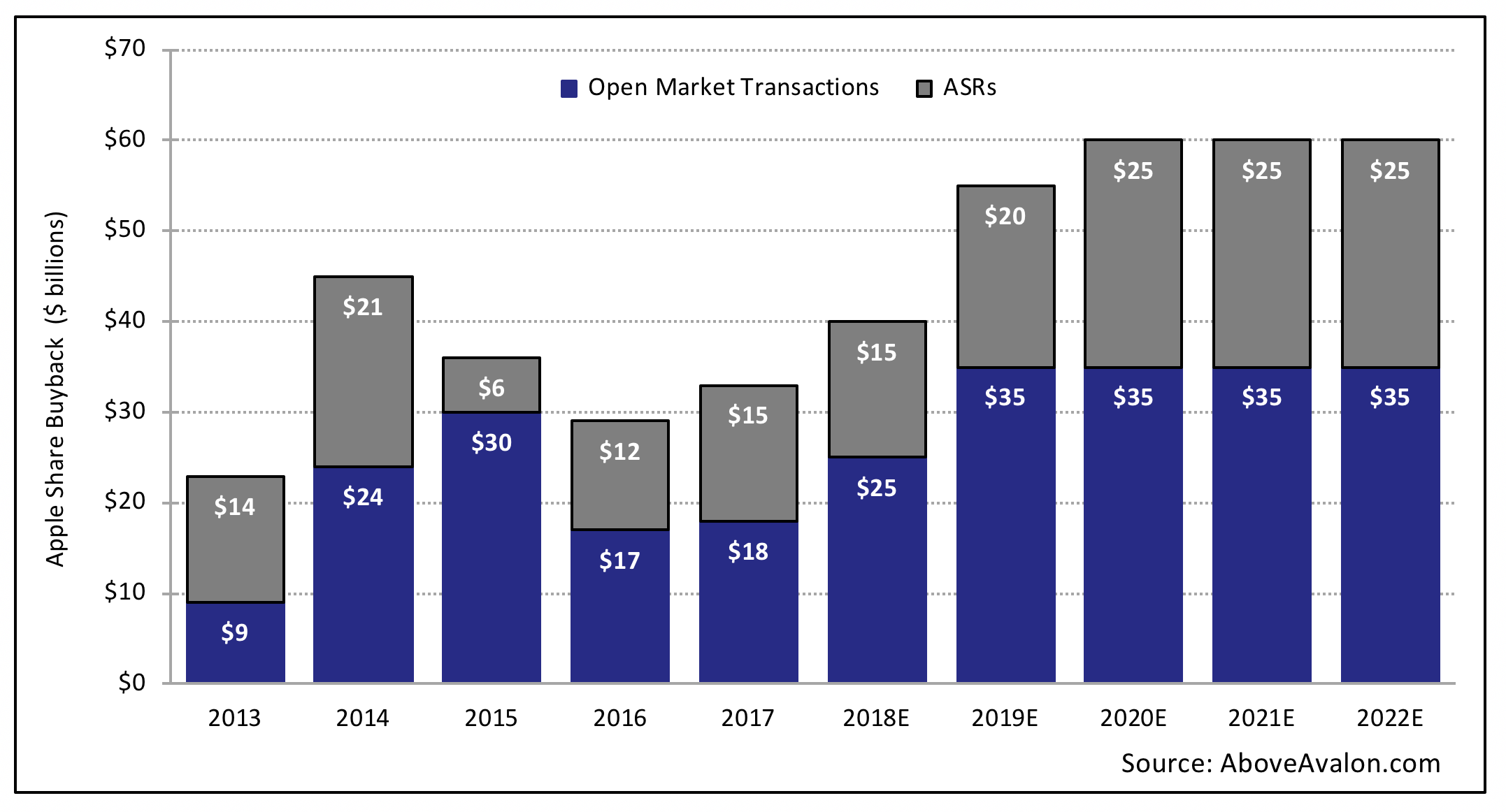
In the above scenario, Apple will have spent $275 billion on share buyback over the next five years. While Apple could certainly announce a larger increase to share buyback authorization next week such as $125 billion or even $150 billion, it's not likely that such authorization would result in a significantly higher buyback pace as Apple must still back its foreign cash to U.S. subsidiaries. In addition, a significant higher pace of share buyback would begin to raise questions about market dislocation.
Dividend Changes
A scenario that includes doubling its share buyback pace will have a major impact on Apple's dividend strategy. The company has been following a dividend strategy of conservative year-over-year increases in dividend expense. Due to the share buyback program, Apple has been able to grow dividends per share by larger margins each year given the reduction in the number of shares outstanding. Whereas Apple's dividend expense has increased by 21% since 2013, Apple's quarterly cash dividend has increased 66% during the same time period.
By ramping share buyback to $60 billion per year and increasing dividend expense gradually to $16 billion per year in 2021 (from the current $13 billion a year), as shown in Exhibit 2, it is possible for Apple to increase its quarterly cash dividend per share by as much as 80% over the next five years. In this scenario, Apple's dividend expense would increase by only 25% during the same time period.
Exhibit 2: Apple Dividend Expense
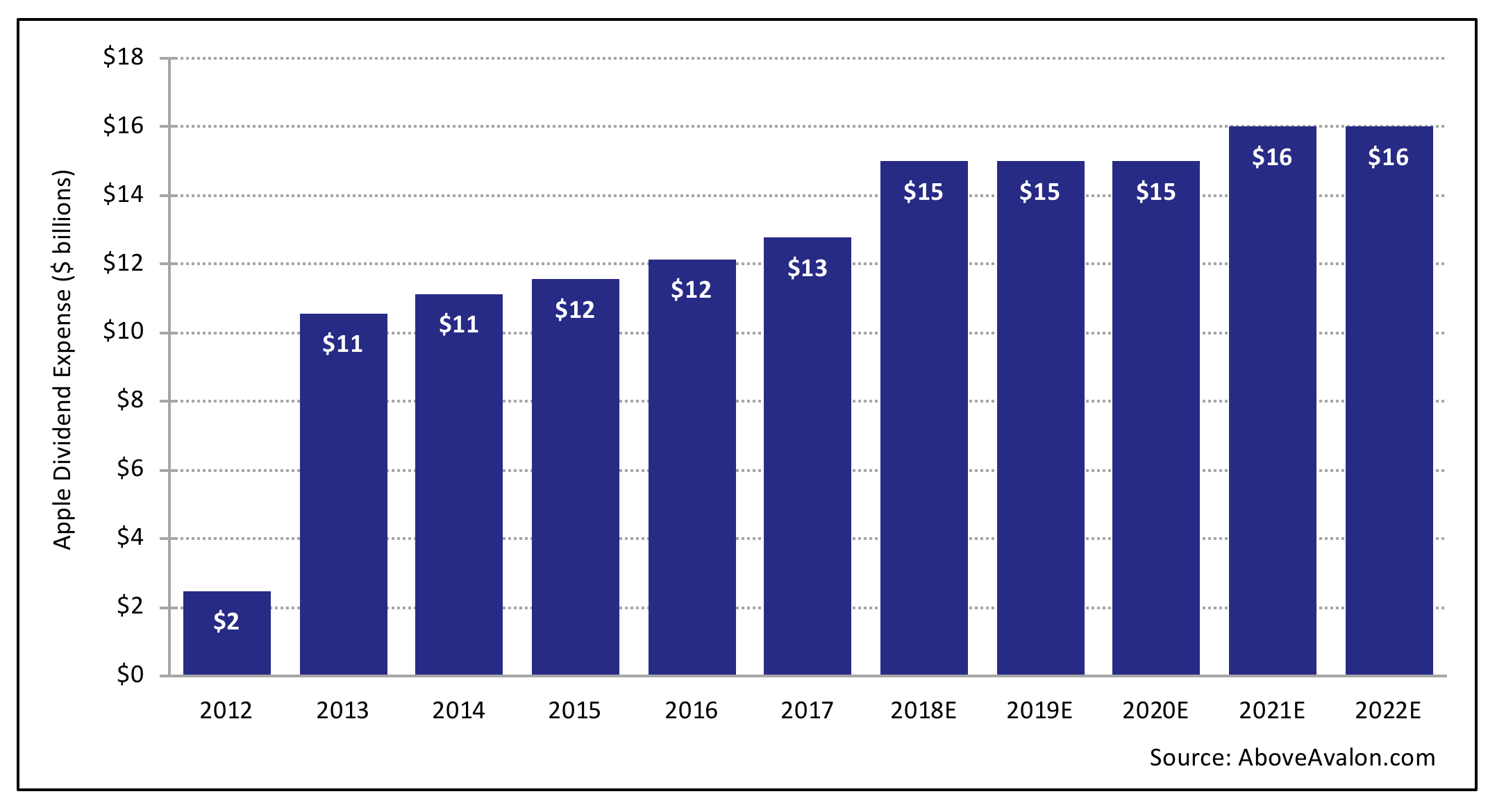
In the above scenario, Apple will have spent close to $75 billion on dividend expense over the next five years. The exact magnitude of Apple's dividend increase will be dependent on the price at which the company buys back its shares in the coming years. However, there is no question that Apple's quarterly cash dividend stands to benefit from a large increase in share buyback pace. An 80% increase over five years would bring Apple's quarterly cash dividend to $1.10 per share by the end of 2022.
Summary
Apple's balance sheet objective is to reach an optimal capital structure by giving excess cash back to shareholders. This goal will be achieved via the continued use of share repurchases and quarterly cash dividends. Following U.S. corporate tax reform, and assuming continued robust free cash flow generation, Apple will possess as much as $325 billion of excess cash over the next five years.
As shown in Exhibit 3, a realistic and prudent way for Apple to remove this excess cash from the balance sheet is to double the pace of share buyback (from $30 billion to $60 billion) while gradually increasing the amount spent on dividend expense over time.
Exhibit 3: Apple's Capital Return Program
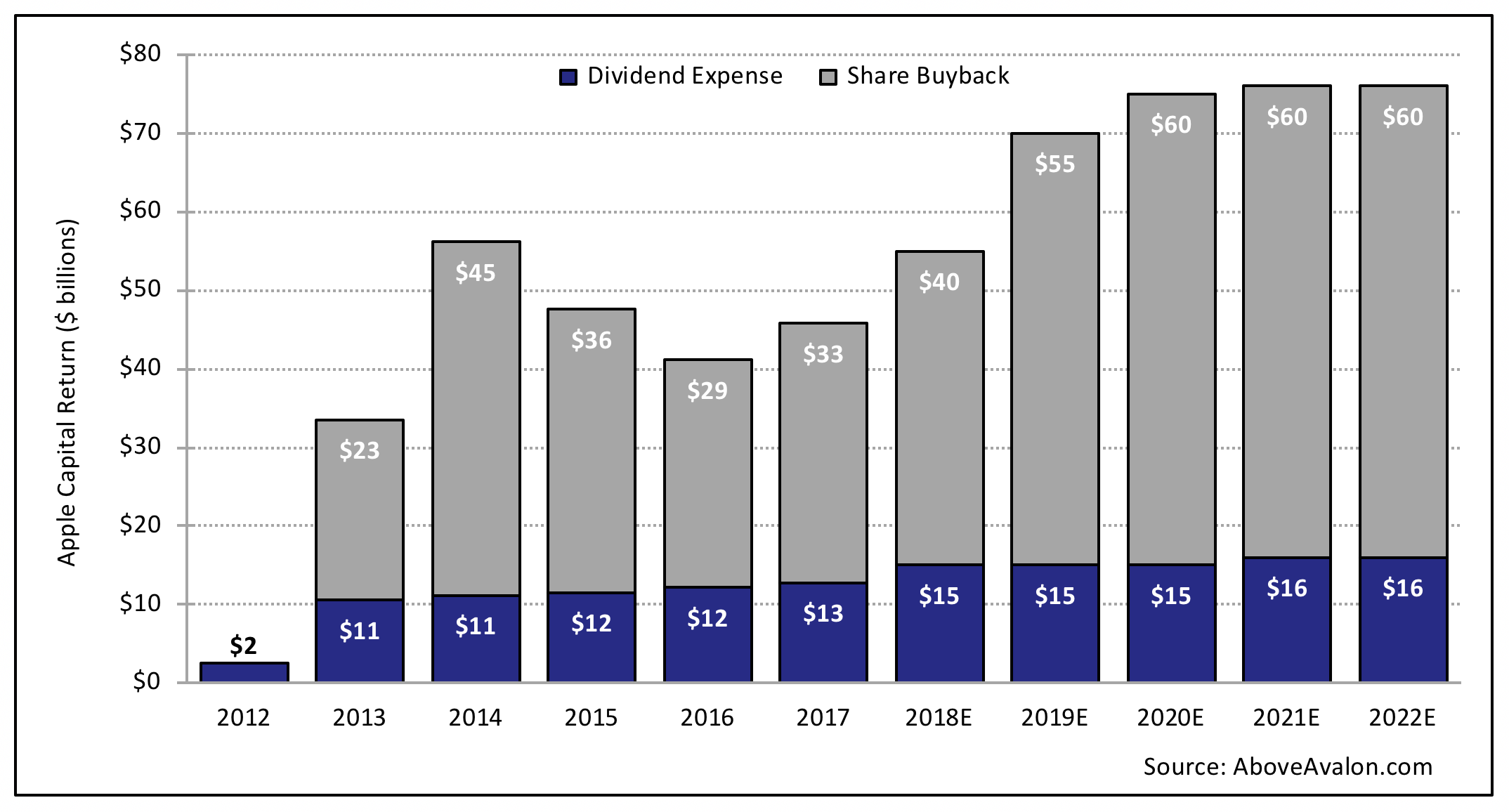
By spending $75 billion per year on capital return initiatives, up from the current $45 billion per year pace, Apple will be on track to spend more than $325 billion of excess cash in order to reach an optimal capital structure.
Receive my analysis and perspective on Apple throughout the week via exclusive daily updates (2-3 stories per day, 10-12 stories per week). Available to Above Avalon members. To sign up and for more information on membership, visit the membership page.
Apple Found a Wall Street Narrative
After months of iPhone sales estimates being slashed by analysts, expectations have been reset. The iPhone mega upgrade cycle of 2018 that so many were calling for is not going to happen. One assumes such a reset would have been accompanied by a significant decline in Apple's stock price. Instead, Apple shares have outperformed the market and continue to trade near all-time highs. The resiliency in Apple's stock price reflects the company finally finding a narrative on Wall Street, and it's not centered on the iPhone. Apple has become a capital allocation story.
Narratives
Narratives matter on Wall Street. A compelling and easy to understand narrative allows companies to navigate rough waters such as a disappointing earnings report. Amazon and Netflix currently possess some of the strongest narratives on Wall Street. Amazon is all about coming up with the best retail experience for customers. Wall Street is OK with Amazon funneling a good portion of its operating cash flow back into the business with the intention of becoming a better retailer. Netflix is focused on delivering a superb entertainment experience in which subscriber dollars are used to fund additional video content. Profits are not as important as subscriber growth.
Apple has long struggled with Wall Street narratives. A good argument can be made that Apple has never had a true Wall Street narrative. Instead, the company was judged merely by unit sales growth of whatever its best-selling product was at the time. This posed a challenge as unit sales growth will inevitably slow. In addition, a narrative revolving around unit sales growth ignores attributes that make Apple's business model unique. Apple is viewed merely as a hardware company.
In early 2016, Apple management began disclosing new data points in an attempt to find a Wall Street narrative and in the process, get investors to think about the company differently.
Installed base related purchases. Instead of relying on the Services line item to denote the amount of revenue driven by Apple's installed base, management disclosed the amount of installed base related purchases. The much-higher total included revenue retained by third-party app developers and digital content owners.
Number of paid subscriptions. In an effort to demonstrate Apple's ability to monetize the iOS base beyond hardware sales, management began disclosing the number of paid subscriptions across Apple's various services. The data point also reinforced the idea of Apple possessing a stream of consistent revenue.
Number of devices in use. Apple disclosed the total number of devices in use to highlight the strength of its ecosystem.
While a narrative revolving around services or ecosystem strength seems attractive for Apple, the stories contain major holes. A significant portion of Apple's Services revenue is tied to growth in the iPhone installed base. According to my estimates, Apple has grown the iPhone installed base by more than 100 million users per year since 2013. Once this new user growth slows, which has already begun to occur, Apple's Services revenue growth will likely face a headwind.
A narrative involving the Apple ecosystem and the number of devices in use addresses some of the downsides found with a services narrative. Even in an environment of slowing product sales, the number of active devices in use could still increase. However, an ecosystem narrative lends itself to Apple being judged by growth rates in terms of the number of devices in the wild. Both narratives lack sustainability. In addition, neither is able to capture the attributes that make Apple unique.
Stock Price Outperformance
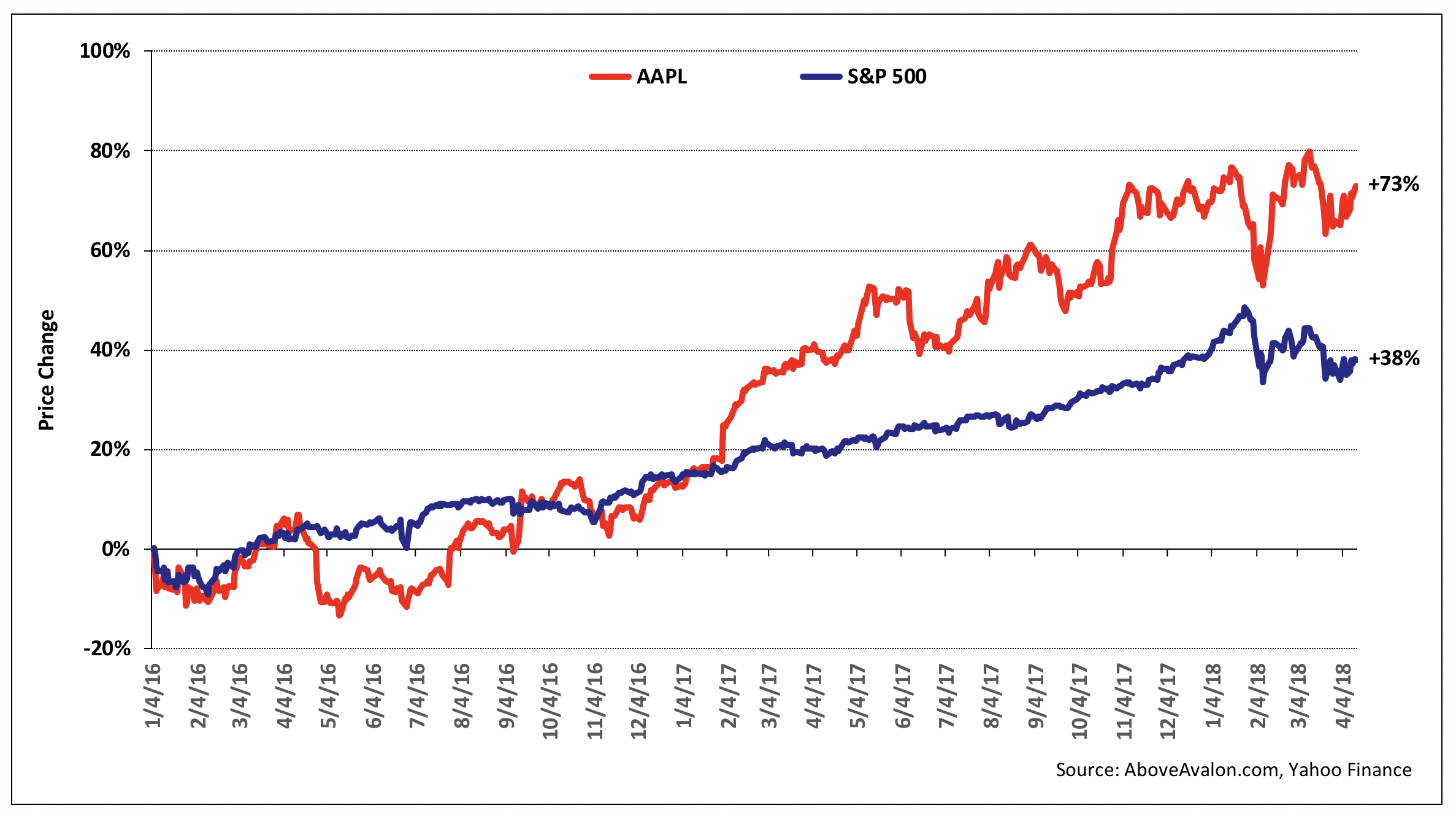
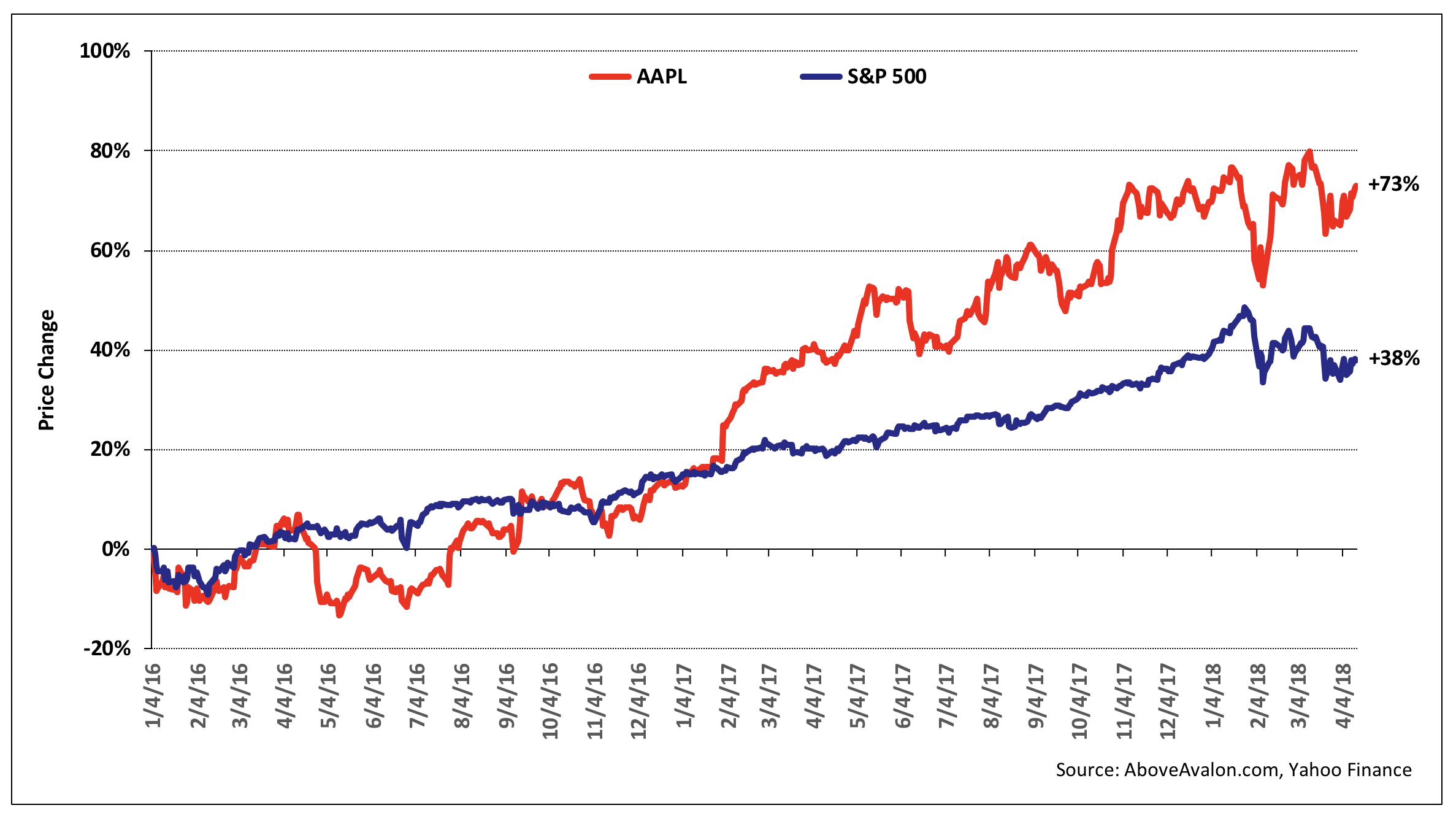
Evidence is building that Wall Street has begun looking at Apple differently. As shown in Exhibit 1, Apple's stock price began to outperform the market in 2017. Apple shares were up 48% in 2017, more than double that of the S&P 500. Apple has continued to outperform the broader market in 2018 despite a sharp increase in market volatility.
Exhibit 1: AAPL vs. S&P 500
Many look at Apple's recent stock price outperformance as a sign that Apple management's efforts to weave a new narrative are working. Wall Street must be paying more attention to Apple Services or the broader Apple ecosystem. In addition, lofty iPhone sales expectations leading up to the iPhone X launch were repeatedly cited in the press as driving Apple's stock price increase in 2017. None of these explanations for Apple's stock outperformance sit well with me. Instead, there's likely something else at play.
A New Narrative
In July 2017, two months before the iPhone 8, 8 Plus, and X were announced, I published "Wall Street Has Begun to Think About Apple In a New Way" with the following thesis:
"The iPhone no longer has the same kind of influence over Apple shares as it once did. Instead, Apple has turned into a balance sheet optimization story on Wall Street. Apple's growing net cash balance (now standing at an all-time high of $158 billion) has taken the place of iPhone unit sales growth as the most influential variable impacting Apple shares."
With no new evidence disproving my theory, it is time to expand on my thinking. Apple has found a narrative revolving around capital allocation. Instead of iPhone sales or Apple Services revenue gaining importance, Apple's balance sheet strategy is driving the company's new Wall Street narrative.
There are three core tenets to Apple's capital allocation narrative:
Superb cash flow generation. Apple's business model predisposes the company to superior cash flow generation. Apple is able to monetize premium experiences more effectively and efficiently than anyone else. Instead of chasing scale, Apple sells tools that management think people will want and are willing to pay for. Scale ends up being merely a byproduct of a successful strategy. Apple is generating more than $60 billion of operating cash flow per year.
Capital efficiency. Apple's business model is remarkably efficient in terms of the amount of capital required to generate these cash flows. Instead of owning a complex web of factories, Apple has built a network of third-party suppliers and assemblers that are second to none. In addition, the company remains focused when it comes to funding capital expenditures for organic growth. As a result of these actions, Apple reports more free cash flow than Alphabet, Facebook, and Amazon combined.
Returning excess capital to shareholders. Given such strong free cash flow generation, Apple is kicking off more cash than management needs to fund growth opportunities. Instead of sitting on the excess cash or spending the cash on unattractive projects, management has shown the willingness to return excess cash to shareholders via share repurchases and quarterly cash dividends.
Apple is a capital utilization machine spitting out more than $50 billion of free cash flow every year, nearly all of which will be used to fund the company's capital return program. This capital allocation narrative is not driven by any one product. Weaker iPhone sales won't derail the narrative. In addition, new revenue streams such as Apple Watch, AirPods, or growth in Apple Services don't represent holes in the narrative. Apple's new narrative is all about management's unique philosophy regarding how shareholder capital is used to generate future cash flows. Stronger product sales will lead to additional cash flows and consequently more cash for buyback and cash dividends. The opposite will be true as well with weaker product sales leading to a reduction in cash flow and less cash for share repurchases and cash dividends.
At its core, Apple's capital allocation narrative describes the company as a design-led organization tasked with developing tools for people. Apple doesn't develop products to drive revenue. Instead, many ideas are passed over to focus on a few really great ideas. Maintaining a focused product line and working closely with contract manufacturers on new processes to build products are key attributes of Apple's design culture. A narrative involving Apple's capital strategy rather than any story based on one particular product like iPhone or iPad ends up doing a better job of describing the company's design story.
Implications
There are a number of implications found with Apple possessing a capital allocation narrative on Wall Street.
Quarterly iPhone sales won't matter as much. While there will continue to be value in monitoring iPhone sales trends, Wall Street will increasingly not care about the quarterly gyrations in iPhone unit sales growth. This is my theory for why negative iPhone reports have simply been tossed aside by the market.
The level of free cash flow will gain influence. The emphasis won't be on any one particular product but rather on the collective result of new products such as Apple Watch, AirPods, HomePod, and new services contributing to Apple's overall cash flow picture. It is certainly possible that wearables and Services revenue growth will offset any weakness in the iPhone business.
Apple's capital return program will continue to matter. New disclosures related to Apple's share buyback and cash dividends have the potential to move the share price higher or lower depending on how new revelations compare to expectations.
New initiatives may be judged more strictly. Traditionally, Wall Street hasn't cared much about new Apple products and initiatives since they were financial rounding errors next to iPhone. However, with a capital allocation narrative, increased attention may be given to new strategies that have the potential to change Apple's thought process regarding capital and the balance sheet.
Apple's capital allocation narrative has also led to changes in the way the market is valuing Apple shares. As shown in Exhibit 2, Apple's stock price is up more than the percentage increase in market cap. This is likely due to two factors: The market is valuing Apple's future cash flows at a higher multiple, and Apple's cash on the balance sheet is being priced differently since the share buyback program was launched. Both developments are likely a result of Apple's capital allocation strategy taking hold.
Exhibit 2: AAPL vs. Apple Market Cap vs. Apple Enterprise Value
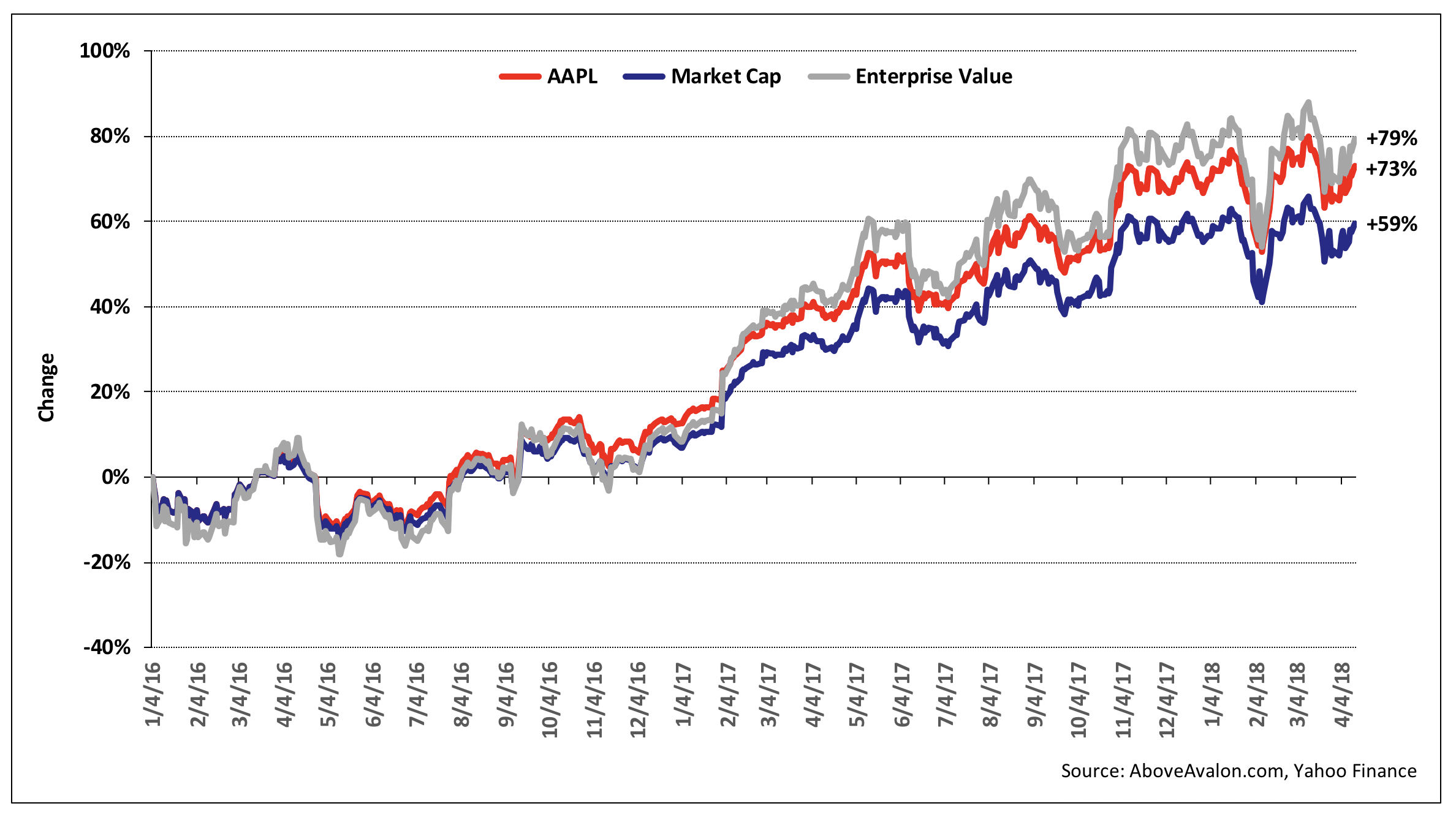
Nearly all of the increase in Apple's enterprise value over the past five years has come from the market attaching a higher valuation to Apple's future cash flows (i.e. a higher market capitalization). Apple shares are currently trading at a 13.5x forward price to earnings multiple. Two years ago, this multiple was closer to 10.5x. Apple has experienced a nearly 30% increase in valuation multiple.
As shown in Exhibit 3, Apple's market capitalization and enterprise value are up by approximately $330 billion since the beginning of 2016. These are significant moves that are indicative of a major shakeup in Apple's shareholder base and the market's view of the company. Investors are focused on Apple's ability to generate significant free cash flows and then return excess cash to shareholders via share repurchases and cash dividends.
Exhibit 3: Apple Market Cap vs. Apple Enterprise Value
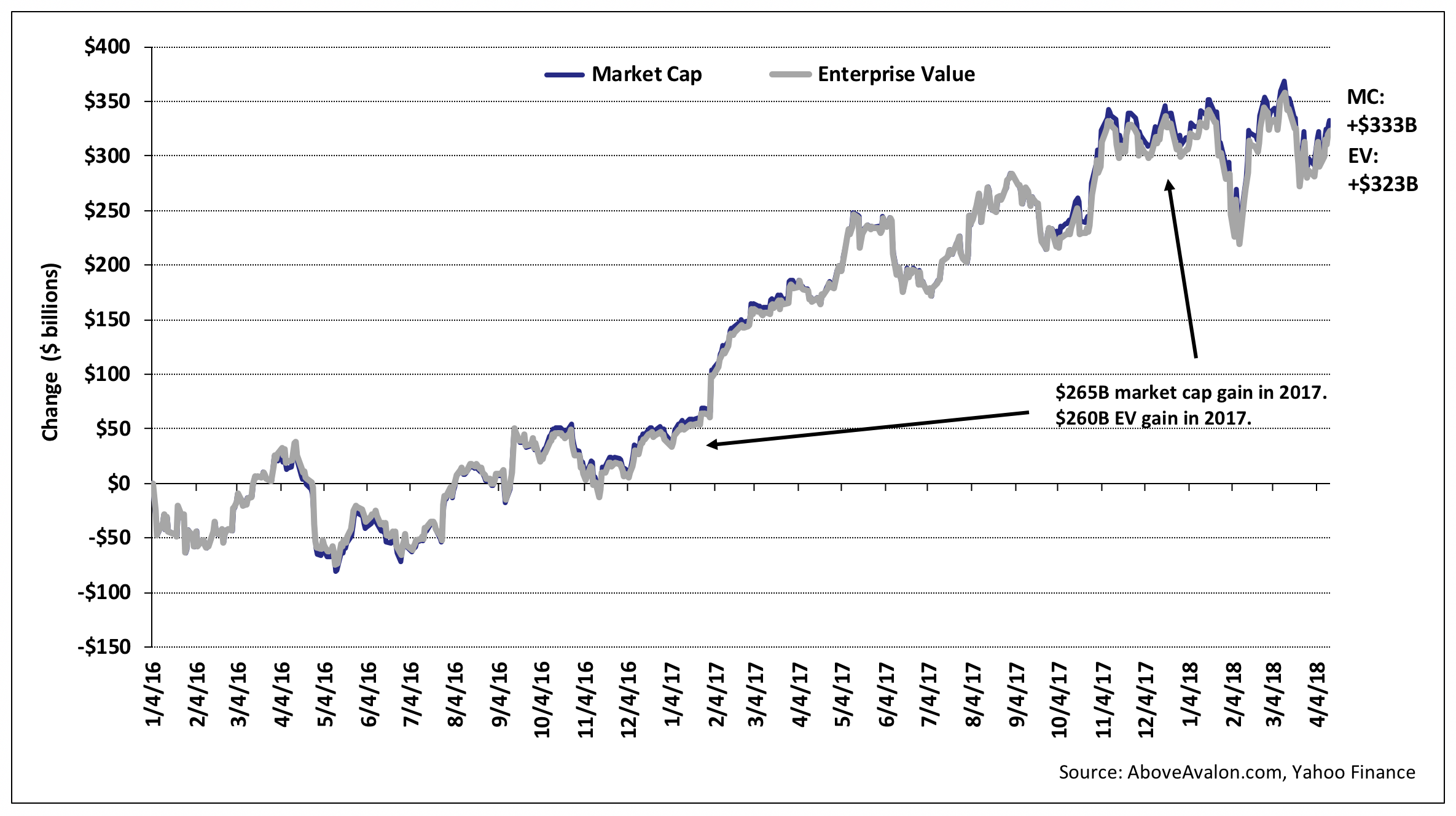
Offsetting Pessimism
Despite the sharp increase in share price and valuation, Apple shares are still trading at a 20% discount to the S&P 500 when comparing forward price-to-earnings multiples. Some of this valuation discount may be due to Apple's capital allocation narrative not being as simple as other stories on Wall Street. However, the more likely reason is that the narrative is polarizing. Not every investor or market participant is behind Apple's story. Some investors may not have confidence in Apple's ability to continue generating robust levels of free cash flow. Various theories involving greater competition or Apple's inability to innovate can lead to more pessimistic cash flow projections. This is where the impact from Apple's share repurchase program enters the discussion.
Apple has likely seen massive turnover in its investor base since launching its share buyback program. Over the past four years, Apple has used share repurchases to reduce the number of shares outstanding by 23%. Stories are everything on Wall Street, and Apple is using its share repurchase program to buy back shares from existing shareholders not buying into Apple's capital allocation story. Apple has been the largest buyer of Apple stock in recent years thanks to the share buyback. There is no question that this dynamic has likely played some role in Apple's stock price outperformance.
Receive my analysis and perspective on Apple throughout the week via exclusive daily updates (2-3 stories per day, 10-12 stories per week). Available to Above Avalon members. To sign up and for more information on membership, visit the membership page.
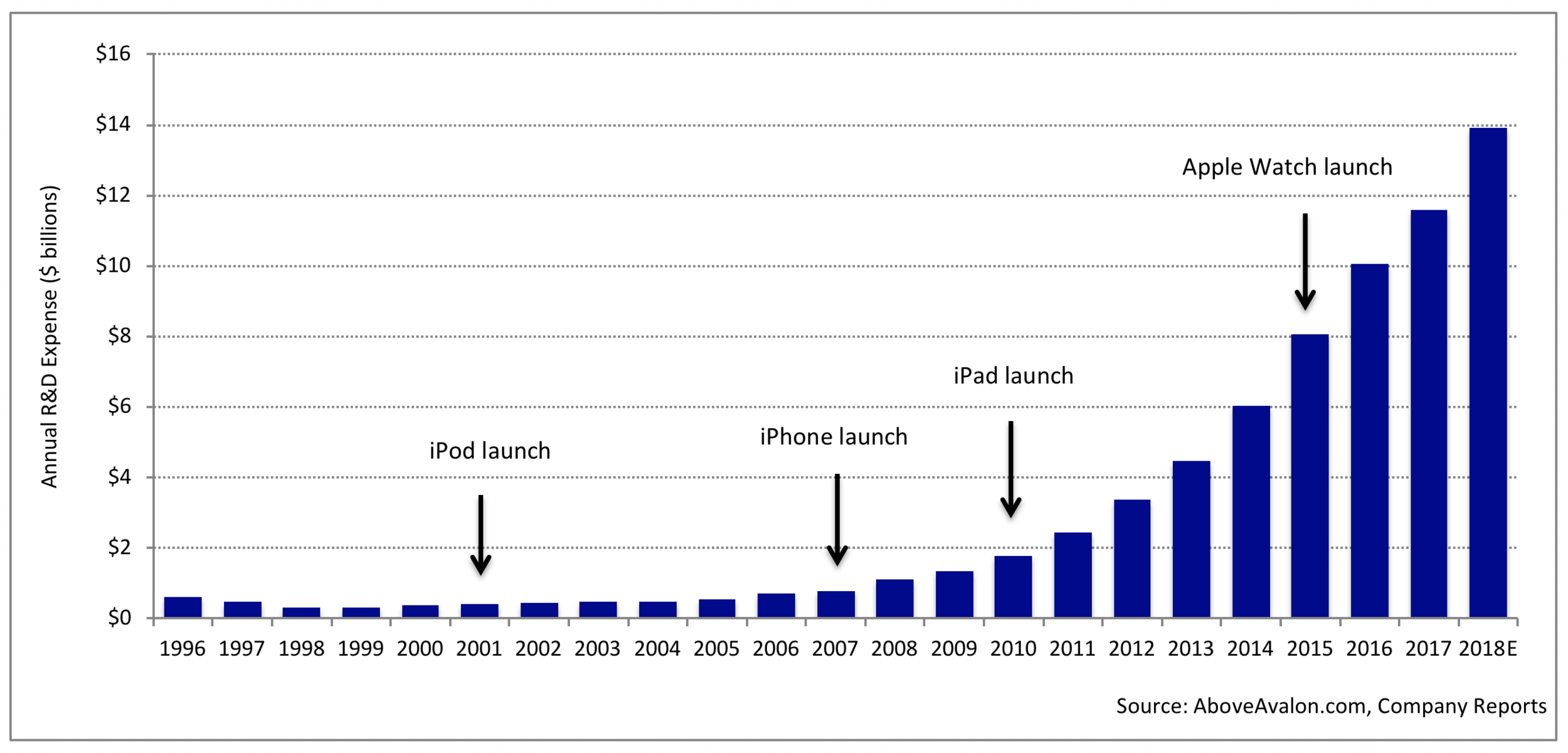
An Apple R&D Bonanza
After a brief lull, Apple's R&D expenditures are once again exploding higher. Apple's 2Q18 financial guidance implies the company will soon report the largest year-over-year increase in quarterly R&D expense in its history. Management is on track to spend $14 billion on R&D in FY2018, nearly double the amount spent on R&D just four years ago. The dramatic rise in Apple R&D expenditures raises questions regarding the company's product pipeline and whether management's overall approach to R&D is changing.
The Numbers
Apple's pace of R&D expenditures is nothing like the company has ever seen. The $14 billion of R&D expense that Apple will spend in FY2018 will be more than the amount Apple spent on R&D from 1998 to 2011. The CAGR for Apple's R&D expenditures has been a remarkable 32% since 1998. As seen in Exhibit 1, the ramp in Apple R&D expense spanning more than two decades has been breathtaking.
Exhibit 1: Apple R&D Expense (Annual)
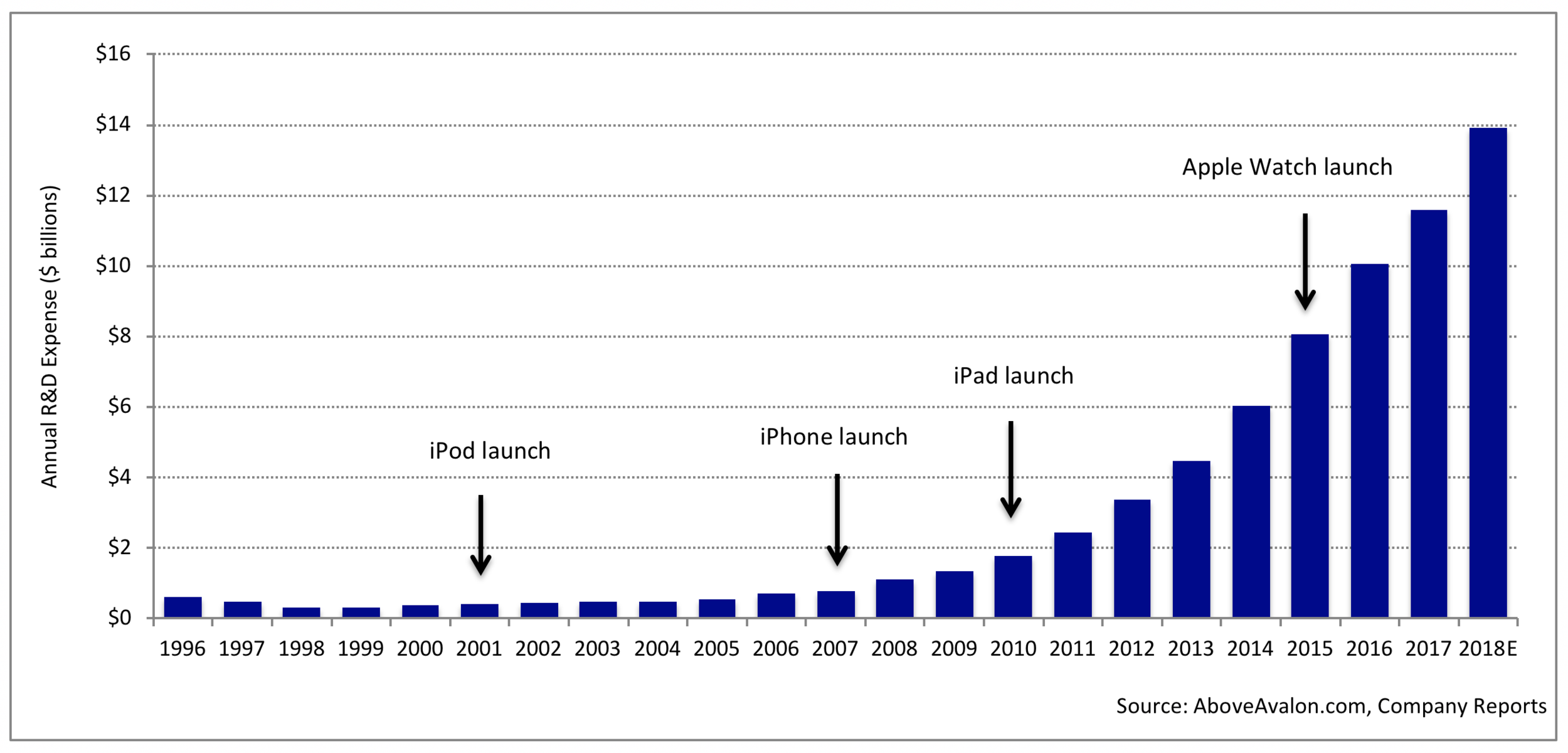
Another way to demonstrate the dramatic rise in Apple R&D is to look at the year-over-year increase in expenditures on a quarterly basis. As seen in Exhibit 2, beginning in FY2Q17, Apple R&D expense growth has been on an uptrend. The expected $725 million increase year-over-year in Apple R&D expenditures in FY2Q18 will be nearly 25% higher than the previous R&D expense growth record. This $725 million figure is obtained by using Apple's guidance for operating expenses and backing into estimates for SG&A and R&D expenses. The recent ramp in R&D expenditures suggests Apple is definitely up to something.
Exhibit 2: Year-Over-Year Increase in Apple R&D Expense (Quarterly)
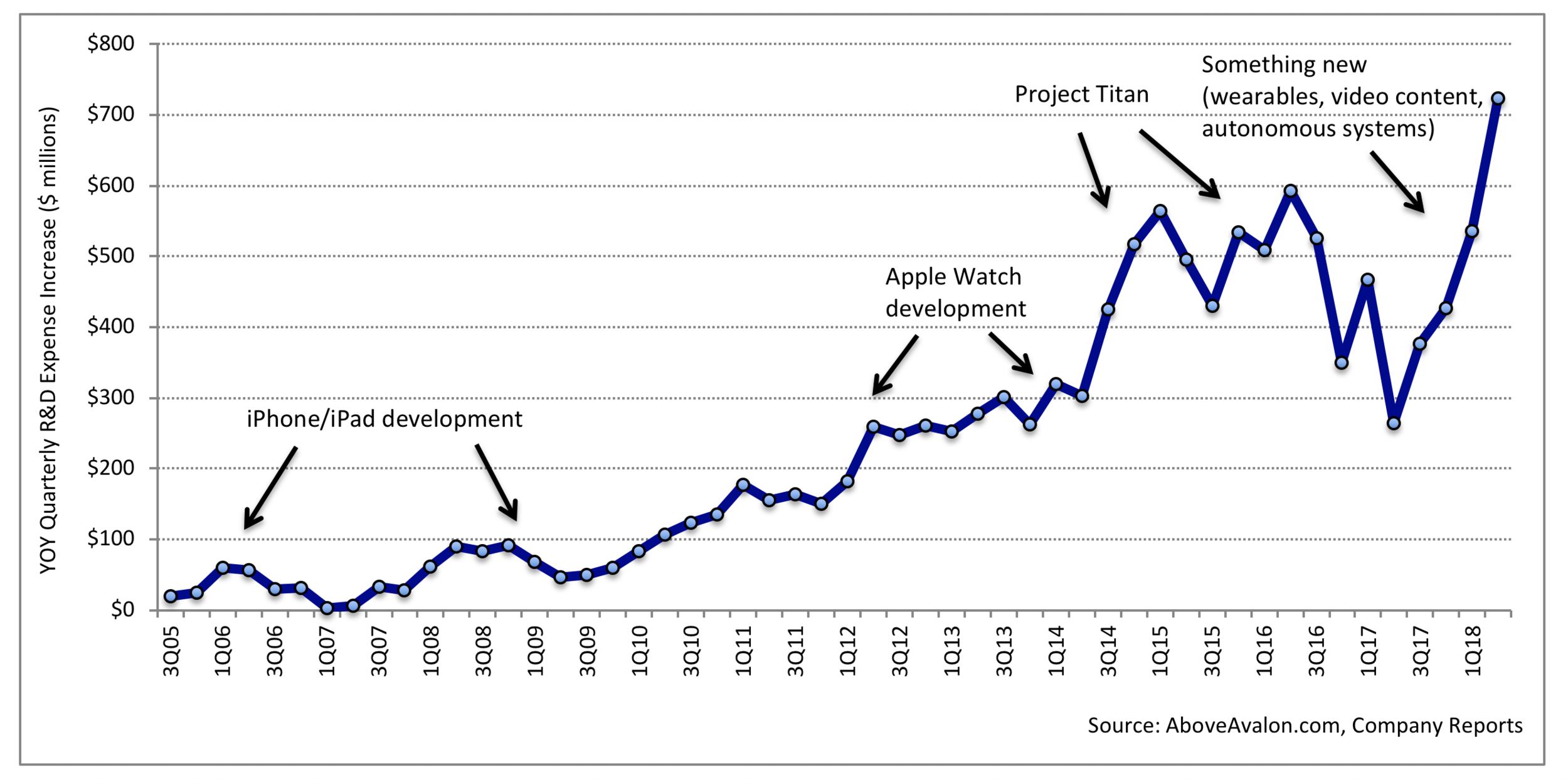
R&D Growth Drivers
It's easy to assume that the increase in Apple R&D expenditures over the years simply reflects Apple's expanding product line. However, there is more behind Apple's R&D expenditures. Three items are responsible for the growth in Apple R&D expenditures:
Existing products. Apple is doing more these days given a broader product portfolio.
In-house tech development. Apple has positioned controlling the core technologies powering its devices as a main goal.
New products. Apple is developing products for which it has no guarantee of future commercial viability.
Once a project's commercial viability has been established, it becomes that much more difficult for Apple to classify subsequent manufacturing or evolutionary product updates as R&D. This means that cash spent on developing new versions of existing products may not necessarily qualify as R&D. Instead, such expenses may have to be marked as a capital expenditure and amortized or depreciated over the life of the asset.
Another item that isn't contributing to Apple R&D expense is Apple Park construction. Real estate construction costs related to general corporate usage, or even design labs where some R&D may take place, cannot be categorized as R&D expense. Instead, for real estate to be classified as R&D, there has to be uncertainty regarding future commercial viability. As an example, the numerous buildings Apple bought, or began leasing, in the mid-2010s specifically for Project Titan likely boosted R&D at the time. (A map of Project Titan buildings is available to Above Avalon subscribers.)
New Products
Whereas Project Titan was a leading R&D driver a few years ago, there are likely two new items now driving the recent surge in R&D expenditures:
Smart glasses. We know Apple is working on smart glasses given the company's M&A track record (Vrvana, SensoMotoric Instruments, patents, and subtle clues found in Apple management commentary. The team dedicated to the effort is likely massive.
Content distribution efforts. Apple appears to have settled on a broader strategy for content, and it involves doubling down as a content distributor. Apple is investing big when it comes to delivering music, video, apps, news, and written content to more than 850 million users (of which 500 million visit the App Store on a weekly basis). Apple's effort to launch a video streaming service from scratch is likely being classified as R&D. For example, Apple has no guarantee that money spent on script development will lead to a commercially viable video streaming product. We also know Apple is reportedly spending $1 billion on original video content.
Apple is also continuing to work on doubling down on hardware to control the brains powering its products. As long as the byproduct of such efforts leads to products that are significantly different from existing products, Apple is likely able to qualify such efforts as R&D. Ongoing costs associated with Project Titan are also likely substantial, especially relative to smaller product-specific projects found throughout Apple.
Changes
Although Apple remains an incredibly focused company when it comes to products, the amount of money spent on R&D would seem to suggest that management may be relaxing its focus mantra a bit when it comes to researching new ideas. As seen in Exhibit 3, Apple R&D expenditures as a percent of revenue now stand at a 14-year high. This tells us that Apple is spending more on R&D for every dollar of sales earned despite the dramatic rise in sales over the years. For some companies this may not mean much, but for Apple it can't be ignored.
Exhibit 3: Apple R&D Expense as a Percent of Revenue
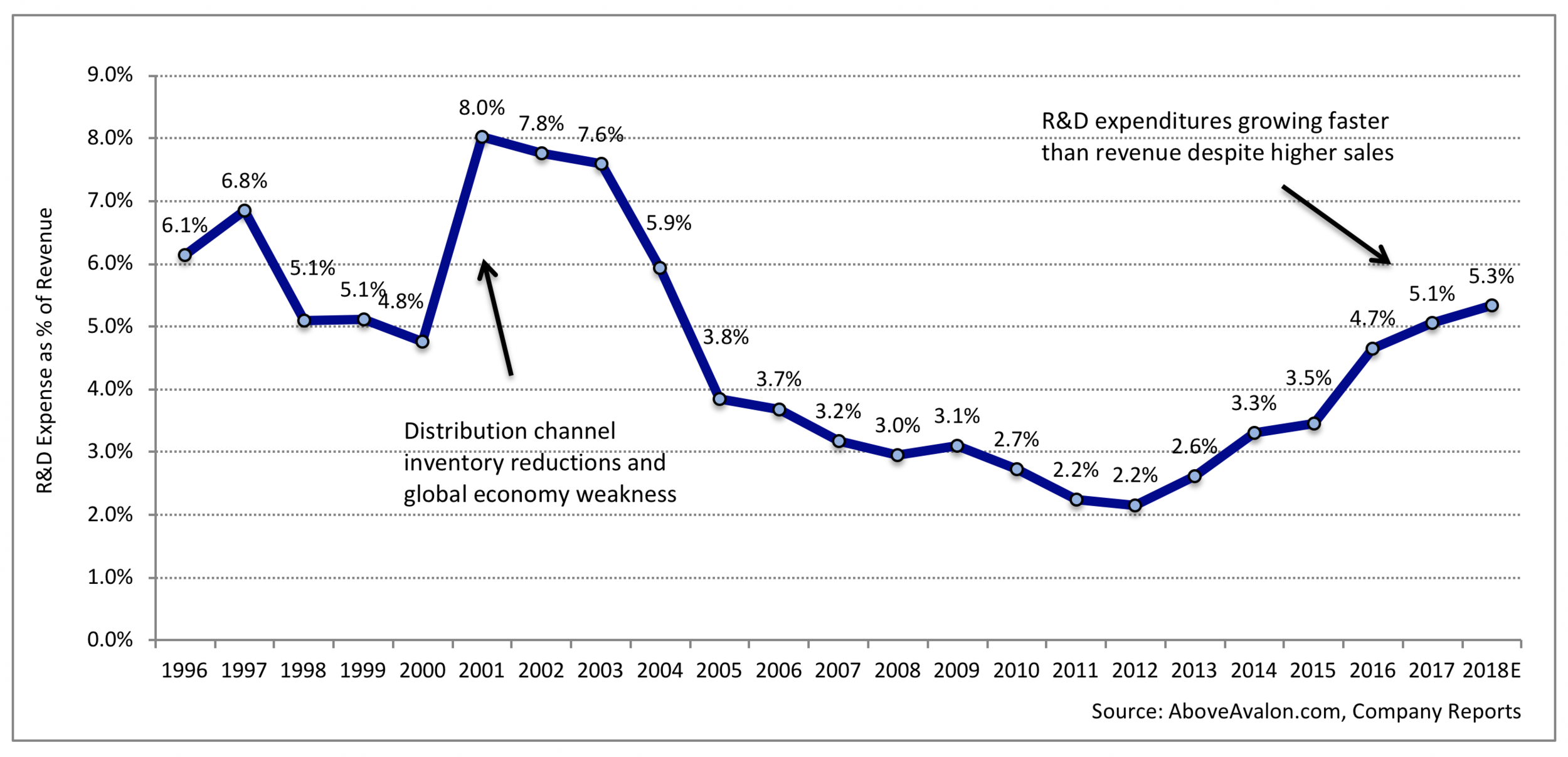
There are a few possible explanations for the growth in Apple R&D expenditures in recent years:
Greater ambition. Apple finds itself in a position of being able to do a whole lot more. It is estimated that Apple spent $150 million to build the first iPhone in the mid-2000s. At the time, it was a significant amount of cash for Apple. Nearly ten years later, Apple finds itself spending that much money developing one show for its upcoming video streaming service. To a certain degree, Apple management may feel it has an obligation of having to do more given its size. As Tim Cook recently put it, "We can do more things than we used to do because we’re a bit bigger."
Competition. One factor driving Apple's ambition to do more is competition. It is no longer enough just to control hardware and software. Apple now finds itself needing to control the technologies powering its devices. Bringing development of fundamental technologies in-house doesn't come cheap. Apple has opened a series of R&D centers around the world (China, Japan, India, Indonesia, New Zealand, Canada, France, Italy, Israel, Sweden, and the U.K.), many of which are tasked with developing hardware. Some of these R&D outposts are a result of Apple acquiring teams of talent.
More experimentation. Apple is likely experimenting much more when it comes to new ideas and processes. While there is no evidence of Apple allowing more of these ideas to actually proceed to market, it sure looks like Apple management wants to be in a position where it can afford to say "no" to more ideas than in the past.
The third point involving additional experimentation ends up being the most interesting. For a company that positions its ability to focus on a few things at any one time as a core competency, increased experimentation seems to be at odds with this value.
Apple R&D Theory
My theory on the dramatic rise in Apple R&D expenditures is that management is becoming more ambitious. Apple's future is found in new industries. Just as Apple moved from desktops/laptops to personal music players, smartphones, and watches, the company will need to enter new industries to remain relevant. This is not a company that is holding onto the iPhone as tight as possible for fear of change. Apple management is investigating new ideas and processes in order to support future moves into new industries.
This explains Apple's ongoing interest in transportation and Project Titan, an area that Apple has pretty much no expertise in. We have Apple building an entertainment arm from scratch despite having no experience developing scripted content. In each case, Apple has had to rely on outside hires and significant cash outlays to build core competencies.
It's not that Apple has thrown its focus mantra out the window. Apple remains very selective in terms of both its M&A activity and deciding which products make it to market. Instead of funding significant R&D endeavors with no intention of them one day leading to a product, Apple's R&D remains focused on ideas that at least have the potential to see the light of day. The years of development behind making Face ID a reality would be a recent example.
Much of this focus mantra is driven by the fact that Jony Ive and his Industrial Design group oversee Apple's product vision and the user experience found with Apple products. With only 20 or so members, Jony and team can only do so much at any given moment. In a way, Apple's organizational and leadership structure serve as safeguards preventing Apple from spreading itself too thin and doing too much. Instead of trying to expand the design team in order to work on more products, Apple's strategy appears to be to do the opposite and place bigger bets on a few products.
These bigger bets come in the form of owning the core technologies powering Apple devices. Apple wants to reduce dependency on others. We are quickly moving to the point at which every Apple product will be powered by core technologies developed in-house. Such a reality would have been a pipe dream just a few years ago. Apple believes this strategy will give them an advantage in the marketplace. It's a new twist to the Alan Kay line about "people who are really serious about software should make their own hardware." We are moving to the point at which companies serious about software should design their own silicon. Having $285 billion of cash on the balance sheet gives Apple the freedom to pursue this ambitious goal. It is this motivation to control more of the user experience while pursuing new industries to enter that is driving the remarkable increase in Apple R&D expenditures.
Receive my analysis and perspective on Apple throughout the week via exclusive daily updates (2-3 stories per day, 10-12 stories per week). Available to Above Avalon members. To sign up and for more information on membership, visit the membership page.
Apple's Strategy for Controlling Sound
September 2016 marked the start of Apple's latest battle in what has been a multi-decade war. This newest battle was going to look and sound different. Apple had unveiled new iPhones lacking dedicated headphone jacks. The controversial move was criticized by many as a sign of Apple going too far in flexing its power and killing off legacy technologies for the sake of change. However, Apple's move wasn't about headphone jacks or even iPhones. Apple had made a big bet regarding the future of "sound on the go," and headphone wires were the enemy. We now see Apple unveiling its revised strategy for controlling sound in the home. The best way to analyze products like AirPods and HomePod is to look at them as the latest weapons in Apple's battle for controlling sound in our lives.
The Strategy
Apple's motivation in controlling sound is based on delivering impactful and memorable user experiences. Accordingly, music has played a fundamental role in Apple's sound strategy for the past two decades. Listening to a particular song can mentally remove someone from his or her surroundings. Music is one of the few things capable of fostering such strong emotional connections and experiences. It's a safe bet to assume music will be around for a very long time while music consumption will remain a key task handled by our computing devices.
There are two parts to Apple's strategy for controlling sound:
- Sound on the Go
- Sound in the Home
Sound on the Go
Apple is no stranger to selling devices designed to deliver sound. However, the iPod marked the beginning of Apple's quest to control sound on the go. Positioned as a "breakthrough digital device," the iPod changed the way we consumed music on the go, offering a much better experience than existing mobile listening options at the time. In what is now difficult to comprehend, the iPod effectively put an end to not being able to have your entire music library in your pocket.
The first iPod commercial highlighted the device's mobility as the user danced around his house while listening to music via iPod and white earbuds. The kicker was found at the end as he stepped outside the four confined walls of his home and into the outside world without missing a beat. The iPod was about consuming sound not just around the home, but more importantly, outside the home.

Over the subsequent years, Apple went on to unveil a number of different iPods, some of which turned out to be more popular than others. However, Apple was just getting started when it came to controlling sound on the go. Sensing that the iPod's long-term threat was found with people listening to music on smartphones, Apple began work on a much more ambitious product: iPhone.
As seen in Exhibit 1, the iPhone changed the course of Apple's sound on the go strategy. While the iPod was thought to be Apple's first mass-market product, the iPhone went on to redefine what it meant to be truly mass market. When Apple unveiled iPhone, the company was selling 50M iPods per year. Apple is currently selling 215M iPhones per year. Even though iPhone was much more than a dedicated music player, Apple never let go of its deep interest in music.
Exhibit 1: Apple "Sound on the Go" Devices Unit Sales (iPod and iPhone)
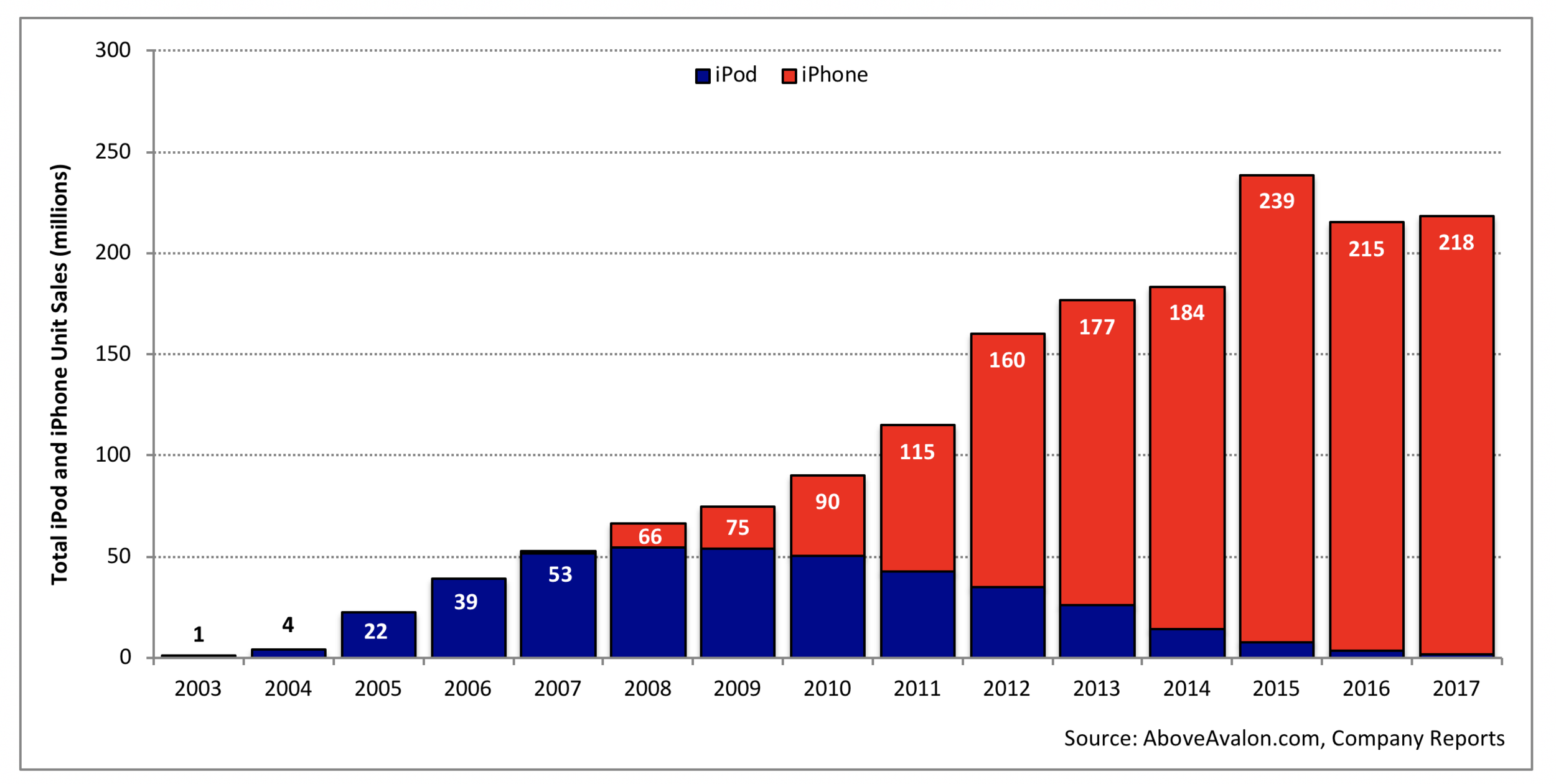
AirPods mark the latest step in Apple's sound on the go strategy. The device is born out of the belief that there isn't a place for wires in a wearables world. AirPods were initially criticized for their unusual looks, but those concerns have quickly disappeared. Whereas wireless AirPods may have looked odd to some, having wires hanging out of people's ears will eventually look out of place.
Based on sales, AirPods have been a resounding success. According to my estimate, Apple sold approximately 11M pairs of AirPods in 2017. This positions the device as the third best-selling Apple product out of the gate, behind iPad and Apple Watch.
Exhibit 2: AirPods Unit Sales

AirPods sales momentum is poised to continue over the next few years. As Apple Watch achieves greater independency from iPhone, AirPods will play a crucial role in delivering sound to tens of millions of Apple Watch users. Apple will reportedly unveil updated AirPods later this year. The runway for AirPods is long with a list of potential features that could include everything from health tracking to noise cancelling and augmented hearing. The big question found with future AirPods is, which features will get the green light? Apple is also rumored to unveil new noise-cancelling, over-ear headphones in a move suggestive of Apple expanding its line of wireless headphones.
Sound in the Home
It's easy to look at HomePod as Apple's foray into controlling sound in the home. In reality, the company's sound in the home strategy started with a whimper in 2006 with the iPod Hi-Fi speaker. The speaker was tasked with reinventing the home stereo for the iPod age by being positioned as a companion product to iPod. Apple ended up pulling the plug on the device after just 19 months of sales.
Twelve years later, Apple is giving sound in the home another try with HomePod. There are key differences in strategy this time around. Whereas iPod Hi-Fi was meant to enhance the iPod and iTunes ecosystem, HomePod and its A8 chip are being given a more ambitious goal of reinventing sound in the home by bringing computational audio to the masses. HomePod scans the room it's located in and then tailors sound output to that room. However, Apple isn't using computational audio to underpin its initial HomePod marketing campaign. Instead, Apple is relying on emotion, a page taken directly from the iPod, iPhone, and even AirPods playbooks. The latest HomePod "ad," a 4-minute film directed by Spike Jonze, is striking in theatrics. However, the thing that instantly jumped out to me about the video is how similar it is to the original iPod ad.
In both, we see people enjoying music using Apple devices. While one is listening to an iPod to get him pumped up to leave the house and experience the outside world, the other is listening to HomePod after coming home following a tough day. In both examples, the people lose themselves in the music experience produced by an Apple device.
Apple Music and Beats
Instead of being a revenue or profit driver, Apple Music serves as the glue in Apple's quest to control sound. While Apple's Beats acquisition was driven by music streaming and buying into Jimmy Iovine's overall music vision, Apple probably didn't mind getting a popular headphones brand in Beats. It's not as if Apple was unfamiliar with the power found with headphones (not to mention the branding opportunity).
The fact that Apple kept the Beats brand for headphones speaks to how Beats headphones are likely serving a different target market. In fact, Apple has positioned Beats headphones as a compliment to AirPods. This has likely gone a long way in removing the oxygen from the wireless headphone category market and preventing competitors from establishing any kind of beachhead.
Elephant in the Room
Apple's strategy for controlling sound in the home seems to have met its match in the form of Amazon Echo Dot and Google Home Mini. Whereas iPod, iPhone, AirPods, and Beats are personal devices delivering sound to individual users, cheap stationary smart speakers powered by digital voice assistants are shaping up to be more about communal experiences. In addition, the value found with an Echo or Google Home isn't derived from sound quality but rather from the intelligence of the digital voice assistant that lives in the cloud. This has led the tech community to think Apple misfired by positioning HomePod as a high-quality music speaker.
I see things differently.
The rise of digital voice assistants like Alexa and Google Assistant have seemingly redefined a stationary speaker's purpose so it's now about delivering intelligence rather than sound. The implication here is that the stationary speaker part of the equation is temporary in nature. If the same intelligence can be delivered to the user via another way, say via smart glasses, a smartwatch, or a pair of wireless headphones, low-end stationary speakers lose value. This idea serves as the basis for why I think the current stationary speaker narrative is off the mark. Apple looks at a stationary speaker as a tool capable of delivering intelligent sound. This use case likely won't change any time soon.
With HomePod, Apple isn't selling a high-quality music speaker. Instead, Apple is selling a new kind of music experience - one that isn't able to be produced with mobile devices, low-end speakers used for digital voice assistants, or even high-end speaker systems that may exceed $1,000. This music experience consists of a music streaming service, a digital voice assistant, and a combination of hardware and software that allows HomePod to map its surroundings and adjust sound output accordingly.
iPod did not become popular because it offered vastly superior sound quality on the go. Instead, it became a hit because it offered a better all-around music listening experience versus the competition. In addition, fashion began to matter with iPod and the accompanying white earbuds. We see a similar dynamic take place with AirPods. Millions of people aren't buying AirPods because of their superior sound quality. Instead, AirPods just work and offer a great user experience. Similar to iPod, AirPods are also seeing building momentum in fashion. AirPods are becoming the new cool, fashionable item that people want to be seen wearing on the street.
Juxtaposition
Apple is running away with its controlling sound on the go strategy. The company has no legitimate competition in the wireless headphone market. While this may change, it's not clear where that competition will come from. Meanwhile, Apple's positioning with controlling sound in the home appears to be much more precarious. Many think such a dramatic juxtaposition is due to Alexa and Google Assistant having already established a beachhead in the home. I'm not so sure about that. My suspicion is that HomePod is facing three different issues that make a challenging environment:
- Communal experiences. Voice-controlled smart speakers positioned in a common area aren't personal gadgets like iPhones and AirPods. It's not realistic to assume a family of four will have four different smart speakers catering to each member of the family. Apple's approach to this situation with HomePod appears to be to initially assume the device is for one user and then give that user the option to turn the device into more of a family music speaker that anyone can use to consume music. However, there are questions as to whether that can truly provide a superior music listening experience.
- Not just about music. While music has underpinned Apple's sound on the go strategy, iPhone and AirPods are used for more than music consumption. It's a stretch to say the same thing applies to the first iteration of HomePod with which music consumption is the primary use case. This may change down the road as Apple brings additional features to HomePod, but it's not clear if anything would replace music consumption as the speaker's primary use case.
- Competing against nonconsumption. With HomePod, Apple's most intense competitor ends up being nonconsumption, or the lack of high-quality speakers in the home. Up to now, most people haven't seen the need for or appeal of high-quality sound in the home. The high-end speaker market is niche. Apple is trying to change that and thinks a broader focus on the music listening experience is the answer.
While there are differences between Apple's sound on the go and sound in the home strategies for controlling sound, both share a common trait. Ultimately, each is about delivering experiences. In terms of sound on the go, Apple will likely look to deeply integrate Apple Music into its growing wearables lineup. In addition to delivering music, these wearables products will also serve as a conduit for delivering a digital voice assistant to the user. For sound in the home, Apple believes a use case for a stationary speaker that will likely still be around 5, 10, and even 15 years from now is music consumption. There is a long runway found with HomePod and the ability to reimagine sound to deliver a better music experience.
Receive my analysis and perspective on Apple throughout the week via exclusive daily updates. To sign up, visit the subscription page.
The iPhone's Turning Point
Later this year, Apple will unveil a 6.5-inch screen that runs iOS. Five years ago, such a product would have been introduced as the newest member of the iPad family. However, Apple finds itself on the verge of releasing its largest iPhone to date. In fact, the device will likely be one of the largest smartphones in the market. Upon closer examination, such a dramatic change in product strategy was ultimately driven by Apple's realization that iPad mini was the wrong bet. It marked a turning point for iPhone.
An iPad World
The iPad was a rocket ship like nothing Apple had ever seen. It's difficult envisioning a future Apple product that will outsell iPad out of the gate. Three million iPads were sold in the first 80 days. During the first year on the market, 22 million iPads were sold.
As seen in Exhibit 1, iPad sales outpaced iPhone sales by nearly 3x after three years of sales. The iPad made the iPhone look mediocre. Some people even thought the iPad would become a bigger deal than iPhone. One has to wonder if at least a few Apple executives viewed iPad, not iPhone, as the product most capable of changing the world. We were truly living in an iPad world in the early 2010s.
Exhibit 1: iPad and iPhone Sales Out of the Gate
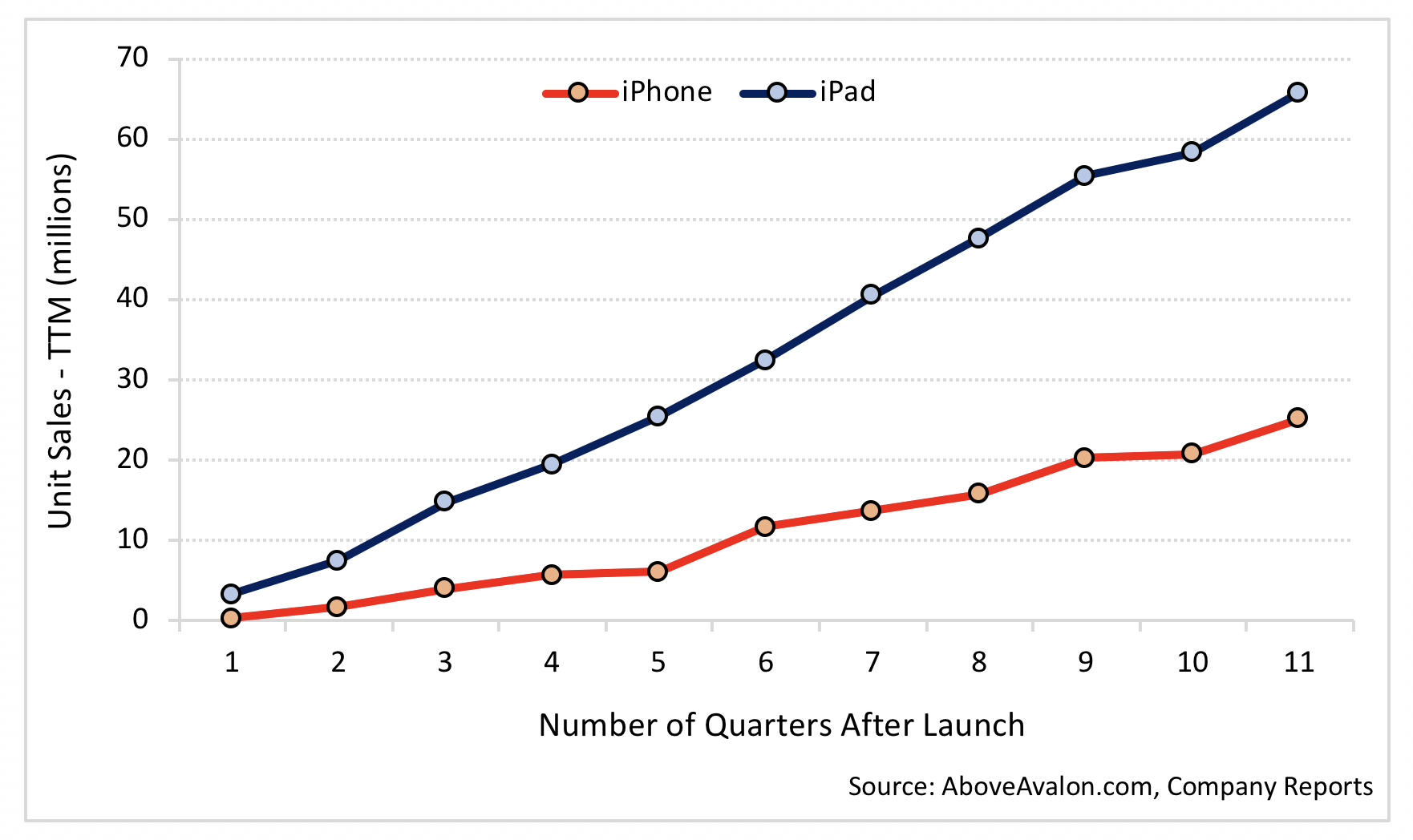
There were a number of factors behind the iPad's astronomical rise overnight. One of the more obvious was Apple's success in making the case that a device like iPad was needed. Apple positioned iPad as a device that sat between an iPhone and Mac. The juxtaposition elevated iPad at the expense of iPhone and Mac. The iPhone was positioned as a small, mobile device that wasn't great for things like web browsing, email, and consuming photos and video. Meanwhile, the Mac was positioned as a heavy beast blown out of the water by iPad for certain tasks.
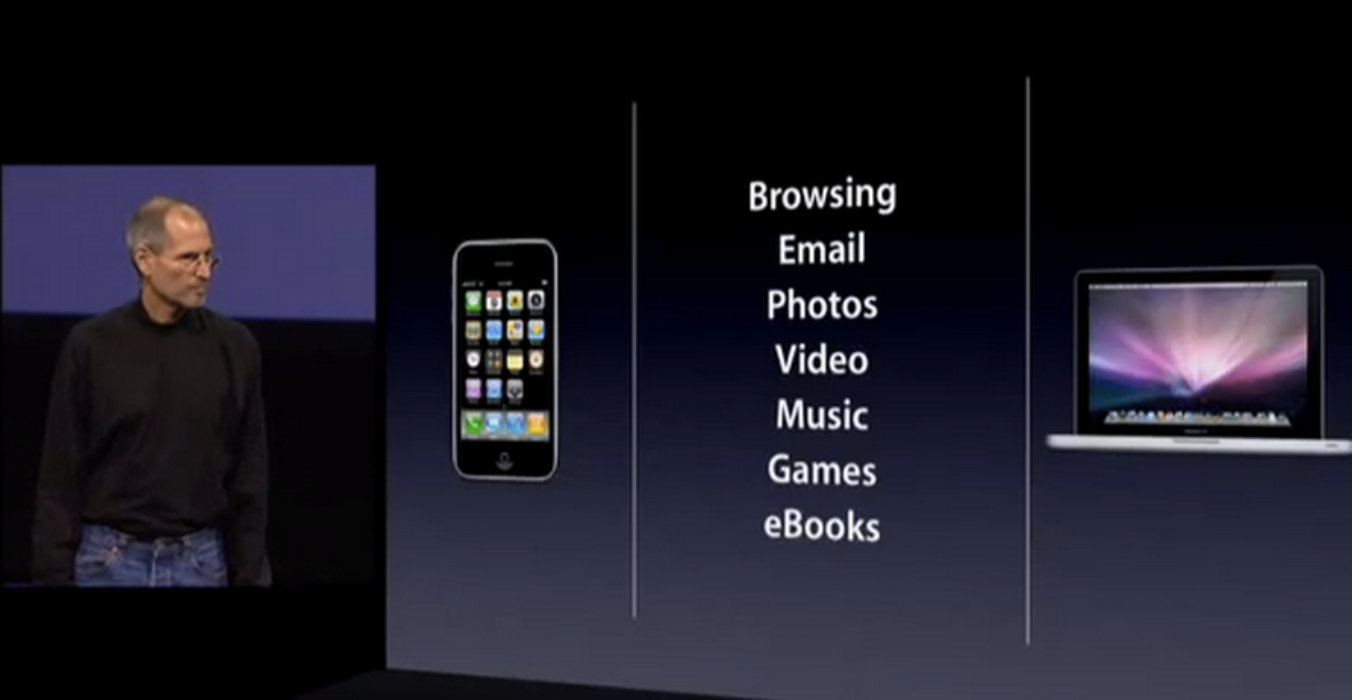
iPad Mini Rationale
Despite strong iPad sales out of the gate, the early iPad years were also a period of immense anxiety and worry for Apple. Much of this fear was born from Apple's paranoia around competition. A $499 9.7-inch iPad left a price umbrella, so manufacturers can potentially undercut Apple with cheaper and smaller tablets running Android.
In late 2010, Apple was so worried about these 7-inch Android tablets that Steve Jobs made a rare appearance on Apple's earnings conference call to downplay the threat. This is when he gave the now infamous comment about having to sandpaper your fingers to one quarter of their present size in order to use a 7-inch touchscreen. Much of this was posturing as other Apple executives were making the case to Steve that Apple should do a smaller iPad.
Ultimately, it was this fear of cheap Android tablets that pushed Apple to launch iPad mini two years later in 2012. While the product was a rare defensive move from Apple, management also saw something intriguing about the 6-inch to 7-inch screen form factor. Instead of pursuing that interest with a larger iPhone, Apple saw the iPad as the better-suited product. It was increasingly looking like an iPad world after all, and smartphones were all about mobility. This turned out to be a mistake.
Flat-Footed
Just as Apple launched iPad mini, something was brewing over in smartphone land. Samsung was grabbing buzz by shipping smartphones with larger screens. It caught Apple's attention.
In March 2013, on the eve of Samsung's Galaxy S4 unveiling in NYC, Apple SVP Worldwide Marketing Phil Schiller sat down for an exclusive interview with The Wall Street Journal to throw punches at Samsung and downplay the momentum found with larger smartphones. Here's Schiller:
"Given the iPhone 5 is so thin and light, the reason that people are making their devices bigger is to get up to the battery life the iPhone 5 offers."
According to Schiller, large smartphones were being sold simply because manufacturers were able to use the additional size to fit a bigger battery. The devices were not being launched because they provided a better experience, according to Schiller. In reality, Apple was worried. They had just placed a big bet on iPad mini as a way to prevent Android from gaining share in the tablet space. However, the competition wasn't found with smaller Android tablets. Instead, it was found with 5-inch and 6-inch smartphones running Android. Having just launched the 4-inch iPhone 5, Schiller knew that Apple wouldn't have an adequate answer to these larger smartphones for at least another year and a half. Apple was caught flat-footed due to betting on iPad mini.
Turning Point
At some point in 2013, Apple likely made the decision that iPhones had to become larger in a big way. Giving the next major iPhone a small step up in screen size wasn't going to cut it. While Apple was likely pushed in that direction by market forces, the realization that such a move was needed was still a crucial one for management to make. In particular, Apple had to accept the fact that the iPad mini may not have too bright of a future despite just being launched and seeing remarkable strong sales out of the gate. There wasn't going to be a compelling use case for a 7.9-inch iPad in a world with larger smartphones.
What Happened?
My theory as to how all of this came together is that Apple executives were initially mesmerized by iPad's rocket sales out of the gate. It seemed like consumers would own and use both a smartphone and an iPad. Even if iPhone's market share remained on the low side, Apple would be able to sell iPads to feature phone, Blackberry, Windows, and Android users. This outcome would materialize as long as two factors were true:
iOS was the tablet platform of choice for developers. This is why Apple was so concerned about 7-inch Android tablets.
Smartphone screens were small. Larger smartphones would throw a wrench in Apple's strategy as the iPad would lose quite a bit of its value proposition.
Apple had an incentive to keep a sizable screen size differentiation between iPhone and iPad. As a result, Apple downplayed the phablet threat while dragging its feet in terms of shipping larger iPhone screens.
Based on Jony Ive's recollection of events, Apple tested larger iPhone prototypes with screens ranging from 4 inches to 6 inches as early as 2011. Apple designers thought a 5.7-inch screen felt good for iPhone, but the size was later deemed too large. It would end up taking another three years for Apple to launch iPhone 6 and 6 Plus with 4.7-inch and 5.5-inch screens, respectively.
Annual iPad sales peaked at 74M units at the end of 2013. According to my estimates, strong iPad mini sales played a big role in establishing that sales peak. In fact, iPad mini sales likely exceeded 35M units on an annual basis at their high point. However, the realization that the most formidable competition was found with larger smartphones rather than smaller tablets pushed Apple. The company was no longer hesitant to run with larger iPhones even if it meant weaker iPad fundamentals weren't too far behind.
As seen in Exhibit 2, which breaks out 7.9-inch iPad sales, iPad mini sales were decimated following Apple's move into larger iPhones.
Exhibit 2: iPad Unit Sales (TTM)
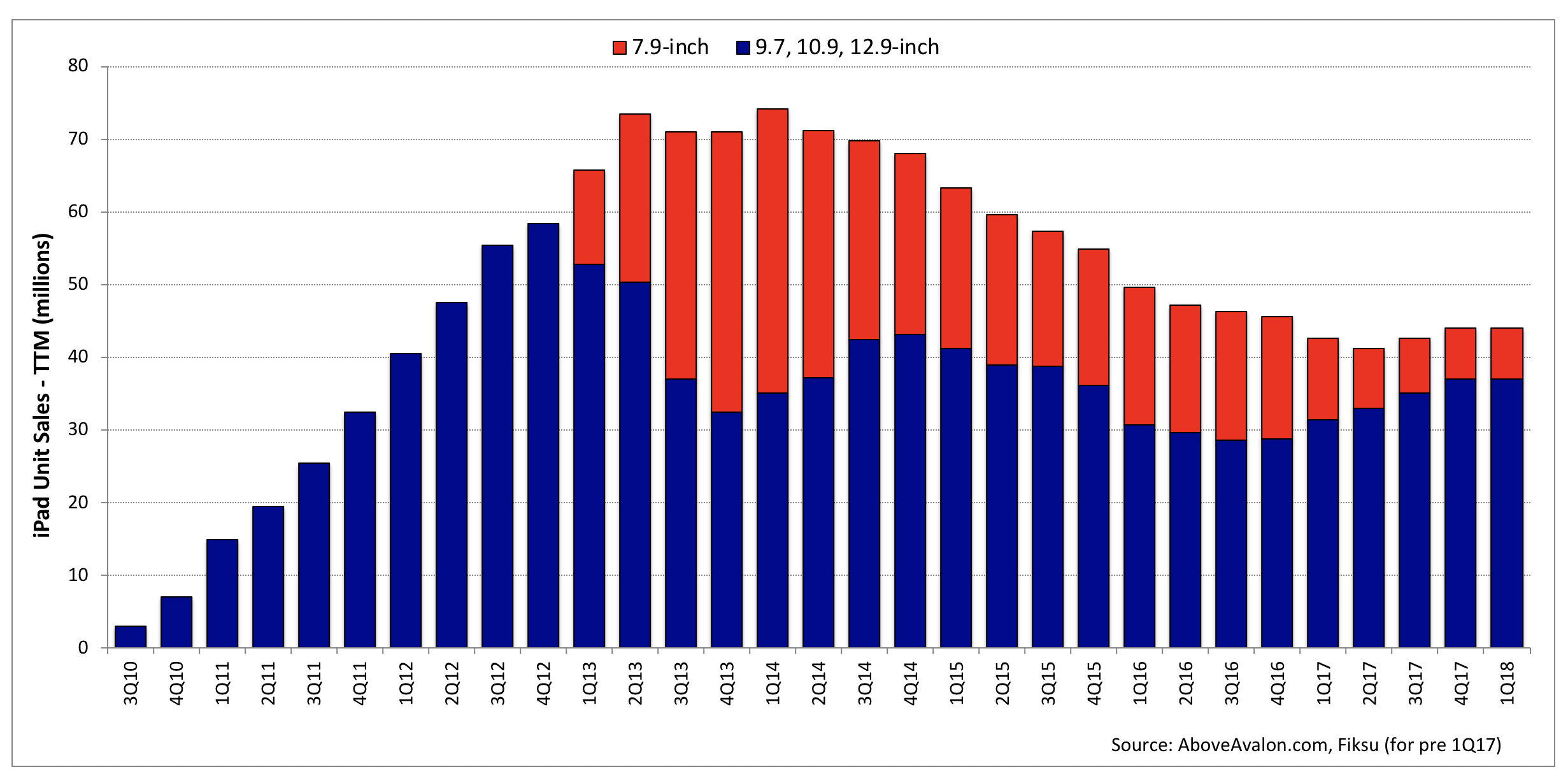
We now see Apple becoming extremely aggressive with larger iPhones. A 6.5-inch screen iPhone will launch less than a year after a 5.8-inch screen. A 6.5-inch iPhone would have been unfathomable during the early iPad years. Such a device would have decimated Apple's iPad strategy. Today, Apple is comfortable ceding a much larger portion of the market to iPhone at the expense of iPad. This has led to a much stronger iPhone franchise.
Earlier this week, Samsung unveiled its latest flagship smartphones, the Galaxy S9 and S9+. Unlike five years ago, when Schiller nervously tried to upstage Samsung's keynote, it is doubtful Apple even blinked an eye this time around. Apple removed Samsung's key advantage when it began to ship larger iPhones in 2014. The iPhone versus Samsung dynamic has never been the same since.
Lessons
There are a few lessons to be taken from this situation.
Cannibalization is OK. Cannibalizing a product is OK as long as you are the one doing the cannibalizing. For Apple, the thought of severely damaging iPad mini, which looks to be the best-selling iPad size out of the gate, wasn't easy. It would be the equivalent of Apple deciding to give AirPods health and fitness monitoring even if it meant Apple Watch would be permanently impacted as a result. However, Apple found itself with a much stronger iPhone business as a result of cannibalizing a portion of the iPad line. A 6.5-inch iPhone will likely sell for $1,199 while the original 7.9-inch iPad mini retailed for just $329.
Admit Mistakes and Embrace Change. There is this attitude that Apple doesn't make mistakes and instead the company needs to possess the right strategy out of the gate to be a winner. Reality is quite different. Apple is willing to admit to mistakes and then make needed changes to get back on course. Apple's decision to set aside iPad cannibalization fears and launch larger smartphones fundamentally changed both the iPhone and iPad businesses.
Get Rid of Dogma. Throwing away the dogma that smartphones derived value from small screens was crucial in uncapping iPhone's potential. In what may be hard to believe, we are likely still underestimating the trend found with larger smartphones. Apple has seen growing momentum with its 5.5-inch iPhone Plus models over the years. In fact, the iPhone 8 Plus is the best-selling 5.5-inch iPhone relative to its 4.7-inch sibling. Meanwhile, Apple will sell tens of millions of the 5.8-inch iPhone X in 2018. A 6.5-inch iPhone may outsell an iPad mini despite selling for 4x more.
Ultimately, the iPad mini's demise at the hand of larger iPhones led Apple to view the iPhone and iPad as siblings on the same computing spectrum. In such a vision, smartphones are allowed to possess increasingly large screens (6+ inches) while iPad screens trend larger (10.5-inch and 12.9-inch) in an attempt to stand out from increasingly larger smartphones.
Receive Neil’s analysis and perspective on Apple throughout the week via exclusive daily updates. The updates, which have become widely read and influential in the world of Apple, provide timely analysis of news impacting Apple and its competitors. Neil also publishes exclusive reports on Apple business, product, and financial strategy. The daily updates and reports are available to Above Avalon members. To sign up and for more information on membership, visit the membership page.
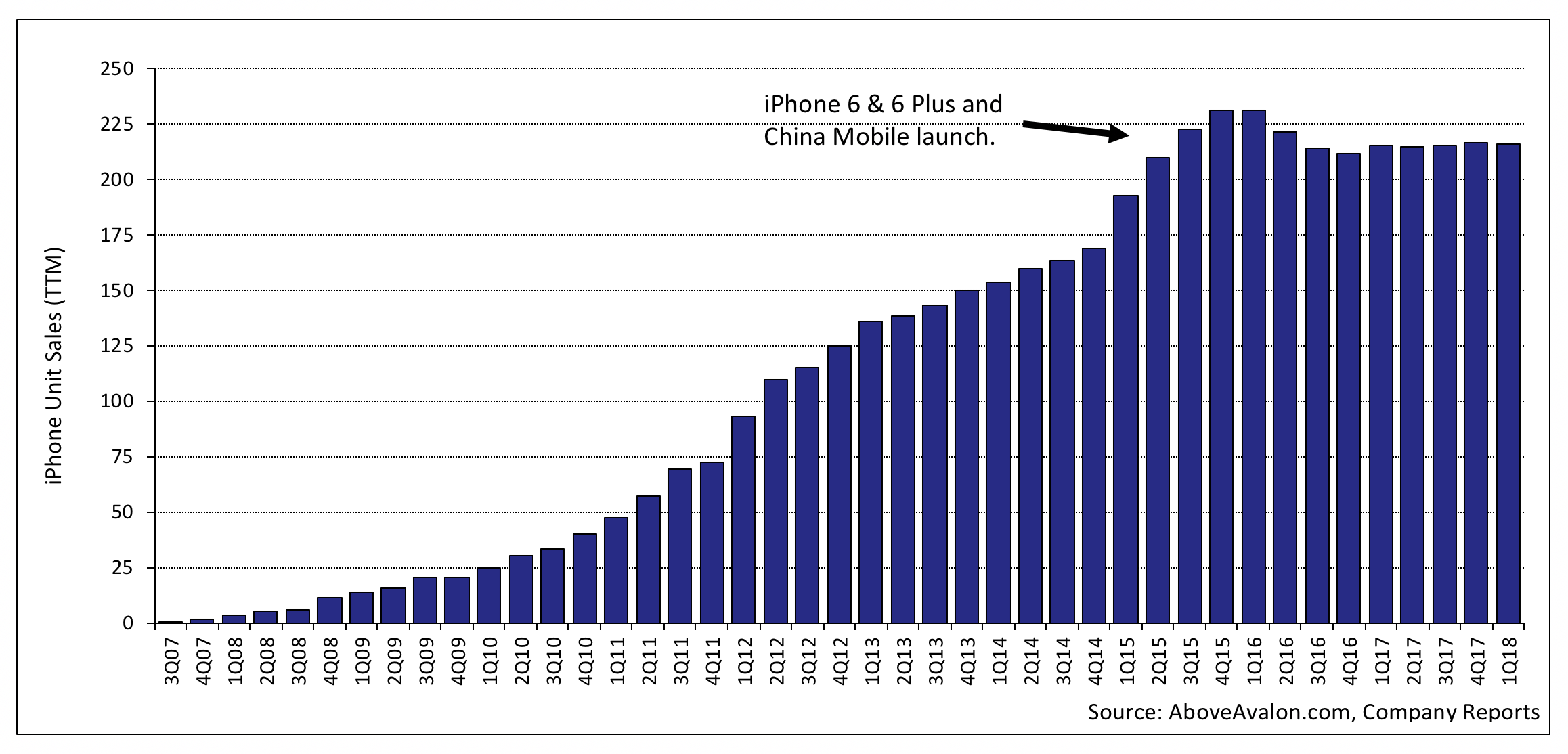
The Goldilocks Era for iPhone Has Begun
Not too hot. Not too cold. The iPhone is entering a new era that can best be characterized as status quo. The days of huge growth are over, and fundamentals aren't likely to improve significantly from current levels. However, underlying dynamics found with the iPhone business will likely prevent sales and revenue from dropping precipitously in the near term. We are in the iPhone's Goldilocks era.
iPhone Growth Era Over
iPhone sales have plateaued at a 215M units per year pace. As seen in Exhibit 1, Apple reached this sales plateau in mid-2016. The unit sales growth era that had defined iPhone for years is over.
Exhibit 1: iPhone Unit Sales (Trailing Twelve Months)
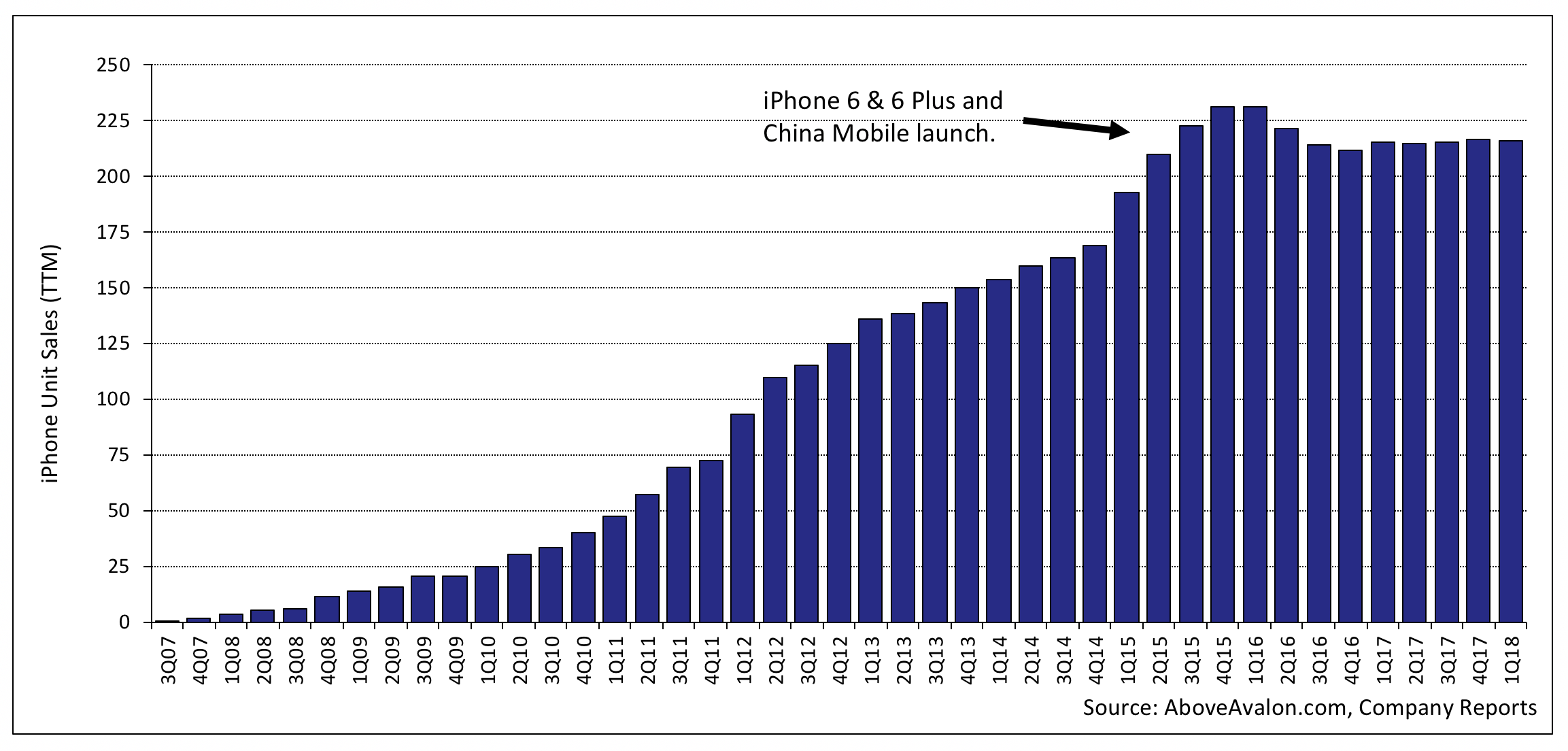
One issue found with Exhibit 1 is that reported iPhone sales include channel inventory adjustments. This opens the door to Apple management having a greater level of discretion over reported sales, especially in an environment of slowing demand. In an effort to get the most accurate view of iPhone demand, channel inventory adjustments have to be excluded to reveal sales on a sell-through basis (i.e. customer demand).
As seen in Exhibit 2, strong iPhone 6 and 6 Plus sales in late 2014 and early 2015 marked a high point for iPhone unit sales growth on a sell-through basis. After a difficult 2016, growth in sell-through demand has been anemic for the past five quarters. Management's 2Q18 guidance points to only a slight improvement in iPhone sell-through demand. Analysts calling for the "OLED iPhone" to kick off an iPhone megaupgrade cycle in 2018 - something I've been skeptical about from the beginning given the number of growth headwinds found in the iPhone business - have given up on the thesis.
Exhibit 2: iPhone Unit Sales Growth (Sell-Through Basis)
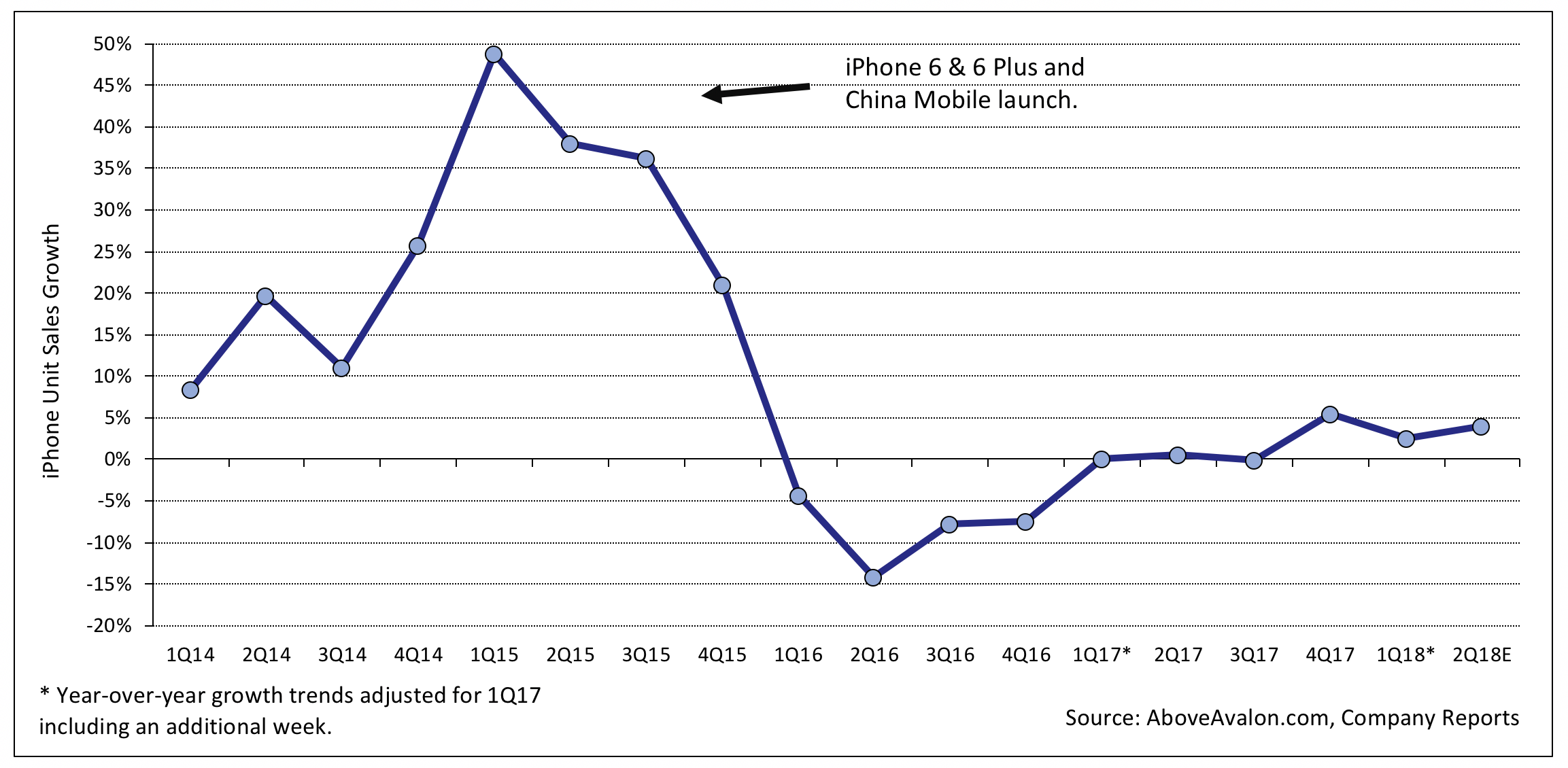
Red Flags
The lack of iPhone unit sales growth is not surprising. In May 2016, I published "iPhone Warning Signs" and the conclusion that "the iPhone growth story is breaking apart and management does not seem to be in control of the situation." Over the past two years, this is exactly what has happened as the four iPhone growth warnings signs highlighted in my article have fully materialized.
- Mobile carrier expansion is complete. Apple no longer has a sales tailwind from bringing iPhone to new carriers around the world.
- India isn't the next China. Any expectation of India becoming an iPhone sales growth engine in the near term is misplaced.
- Smartphone saturation. The era of iPhone sales growth coming from people buying their first smartphone has come to an end.
- Running out of Android switchers. There are only so many premium Android users in a position to switch to iPhone.
Two additional red flags have now appeared:
- Slowing iPhone upgrade rate. iPhone users are holding on to their devices for longer before upgrading. This trend has been unfolding for years, but the impact on iPhone sales is only now being felt.
- Overserving users. One reason iPhone users are holding on to their devices for longer is that their needs are being met with older models and less capable features. While new iPhones are still intriguing and enticing to a majority of iPhone users, a growing percentage of the iPhone installed base is content with their current device.
Instead of there being one particular reason or cause for the lack of iPhone unit sales growth, the six preceding factors have come together to create a much less friendly growth environment.
The Sky Isn't Falling
Given the presence of so many iPhone sales growth headwinds, it is logical to assume that iPhone sales will decline, potentially substantially, from current levels. In such a hypothetical situation, iPhone sales could even track similar to iPad sales which are now trending at 40% below peak levels. However, such a scenario isn't likely in the near term given the unique fundamentals underlying the iPhone business. A closer look at the dynamic between the two main iPhone sales drivers show a more resilient iPhone business.
There are two iPhone sales drivers:
- New iPhone users (a.k.a. switchers). This group includes consumers buying their first iPhone from Apple or a third-party retailer. Once someone buys an iPhone from Apple or a third-party retailer, that person becomes part of the iPhone installed base.
- Existing iPhone users (a.k.a. upgraders). This group includes current iPhone owners who purchase another iPhone from Apple or a third-party retailer.
Over the past six years, Apple has seen very strong iPhone sales to new users. This has helped Apple grow the iPhone installed base from 100M people in 2011 to more than 700M in 2018. These new users have come from various sources over the years. In the beginning, feature phone users drove iPhone installed base growth. Eventually, Blackberry users became a growth driver. Today, former Android users and people using preowned or hand-me-down iPhones are driving Apple's iPhone installed base growth.
As seen in Exhibit 3, I estimate Apple grew the iPhone installed base by more than 100 million people in 2017. While adding 100 million customers to the iPhone installed base is no small feat, my estimate reflects Apple's first year-over-year decline in the number of new users entering the installed base. The iPhone sales growth headwinds mentioned above are starting to take their toll. It is logical to assume iPhone sales to new users will continue to decline as time goes on.
Exhibit 3: iPhone Unit Sales to New Users
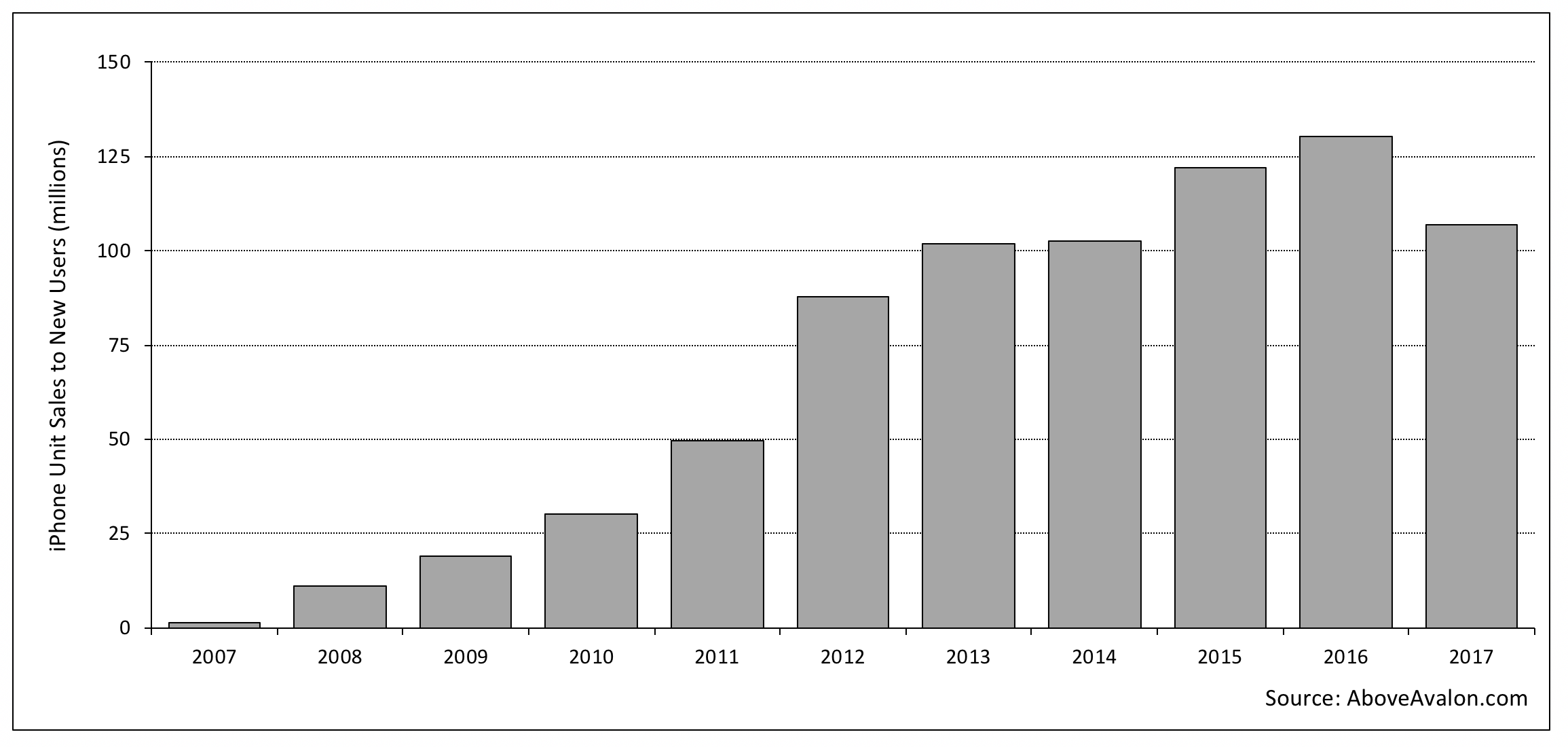
One of the largest benefits found with years of strong growth in the iPhone installed base is that Apple now has hundreds of million of users in a position to upgrade to a new iPhone. Exhibit 4 highlights annual iPhone sales to upgraders. According to my estimate, Apple sold a record number of iPhones to existing users in 2017. This may seem counterintuitive given the slowing iPhone upgrade rate. However, following years of dramatic growth in the iPhone installed base, there are simply more iPhone users in a position to upgrade. The increase in the installed base has more than offset the sales headwind caused by a slowing iPhone upgrade rate. It is logical to assume iPhone sales to upgraders will remain robust as time goes on.
Exhibit 4: iPhone Unit Sales to Upgraders
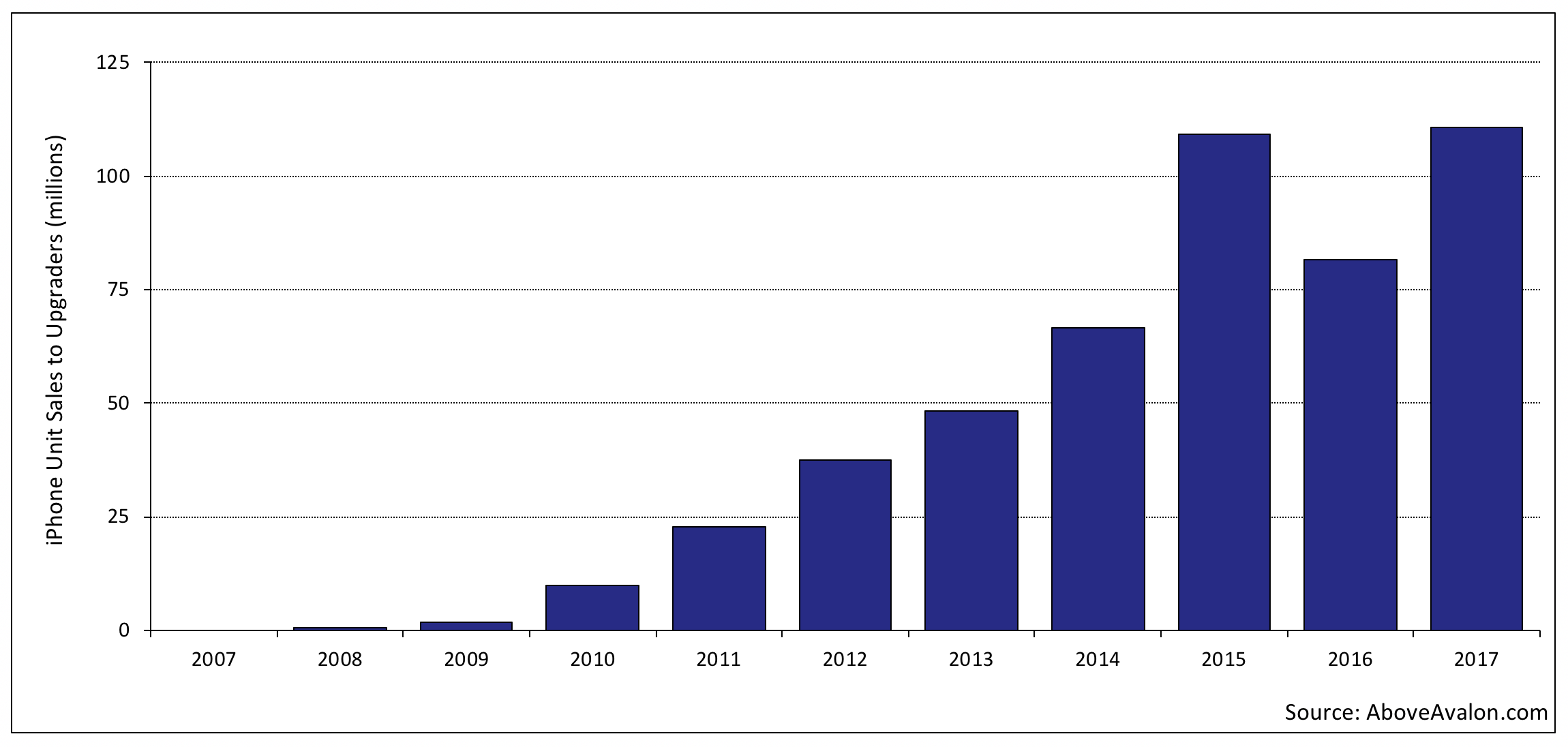
Combining iPhone sales to new users with sales to upgraders provides a clearer view of the dynamic underlying the iPhone business. The number of iPhones sold to existing users is increasing at approximately the same rate as the number of iPhones sold to new users is declining. This dynamic resulted in Apple reporting roughly flat iPhone sales for the past two years. In essence, the iPhone business is operating at sales equilibrium. It took iPad years to find its sales equilibrium after putting in a sales peak in 2013. Products like iPod and Blackberry never found a sales equilibrium as outside forces reduced their long-term value in the marketplace.
Exhibit 5 highlights the iPhone sales equilibrium dynamic. The blue portion of the bars (iPhone sales to existing users upgrading) made up a larger portion of overall iPhone sales in 2017 while the grey portion (iPhone sales to new users) shrunk.
Exhibit 5: iPhone Unit Sales Mix (New Users vs. Upgraders)
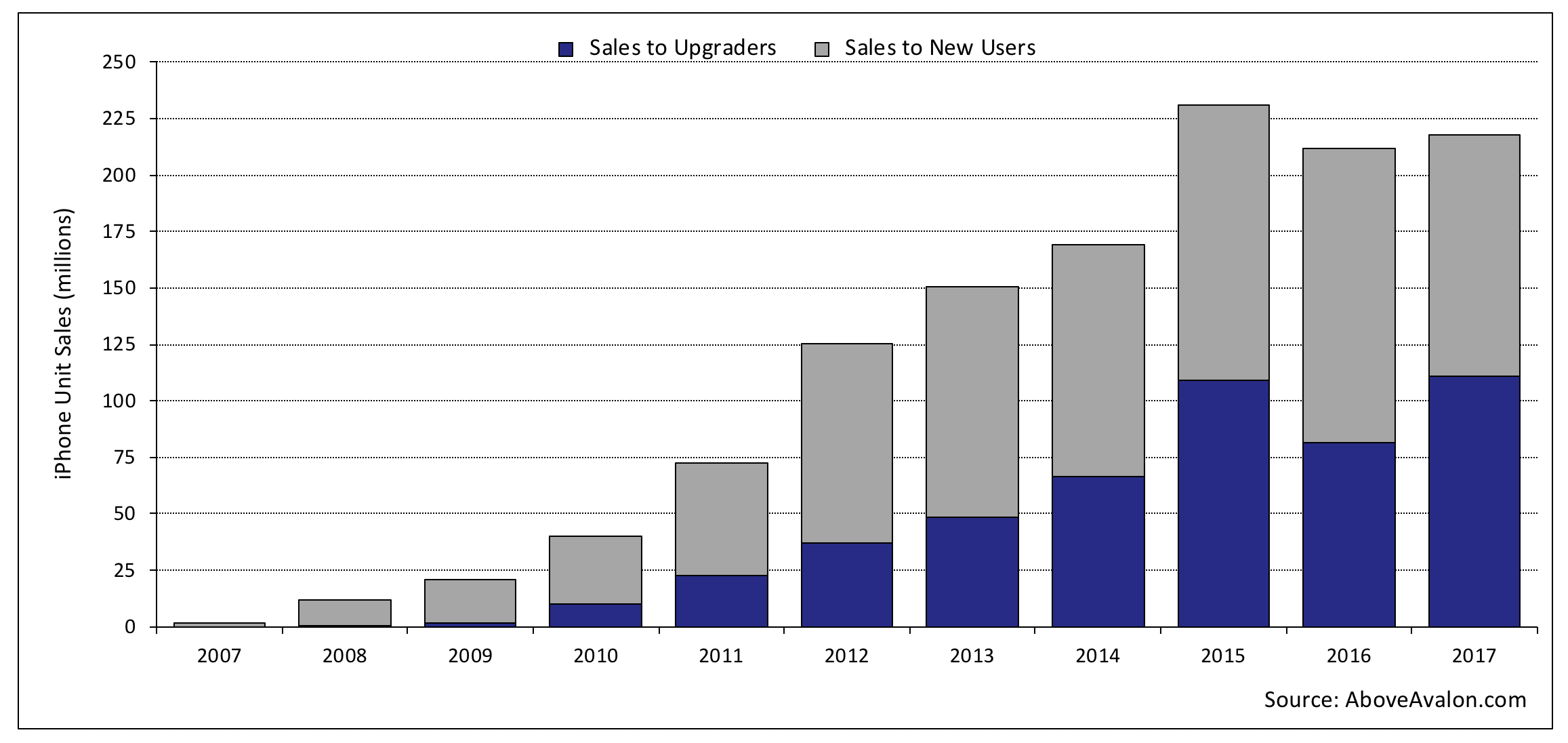
Defining the Goldilocks Era
The iPhone business has entered a new era in which status quo is the new normal. Along with unit sales growth, this dynamic will encompass other iPhone fundamentals such as average selling price (ASP), revenue, and margin trends.
Unit Sales. There is no clear path for Apple to grow iPhone sales substantially from current levels. While Apple may still report quarterly iPhone unit sales growth from time to time, especially if year-over-year compares are favorable, the growth would not represent some kind of step increase in sales.
As long as Apple is bringing in new users, a scenario that is likely to continue for at least the next few years, the iPhone installed base will continue to expand. This expansion will help offset some of the pressure from a slowing upgrade rate. A good rule of thumb is that annual iPhone sales will remain around 215M units, give or take 10 percent, for the next two to three years.
Once new user trends slow to the point of Apple barely bringing in any new users, all bets are off in terms of annual iPhone sales. From a unit sales perspective, the lack of new users will likely mark the top for iPhone sales given an upgrade cycle that continues to elongate. Apple likely has a few years before reaching this point.
ASP. Similar to iPhone sales growth, iPhone ASP will likely follow this Goldilocks path of not being too hot or cold, but rather following a status quo. As seen in Exhibit 6, after years of remarkable consistency, iPhone ASP hit $796 in 1Q18. Not only was this a record high for iPhone ASP, but the $178 sequential jump in ASP was also a record. The strong results were driven by a perfect storm of the higher-priced iPhone 8 and 8 Plus as well having the iPhone X launch take place in 1Q18.
Management commentary points to iPhone ASP falling in 2Q18. ASP will then decline further as we move away from the iPhone 8, 8 Plus, and X launches.
Apple can only push so far with iPhone pricing in the near term before demand trails off due to accessibility concerns. While many thought that threshold was $999 for an iPhone, in reality it's probably closer to $1,500. In addition, Apple will likely continue to get aggressive at the low end of the iPhone pricing spectrum. Accordingly, a reversion to the ASP mean of $650 is likely. The addition of a higher-priced iPhone X with a larger screen should keep iPhone ASP from falling too far below $650 in the near term.
Exhibit 6: iPhone Average Selling Price
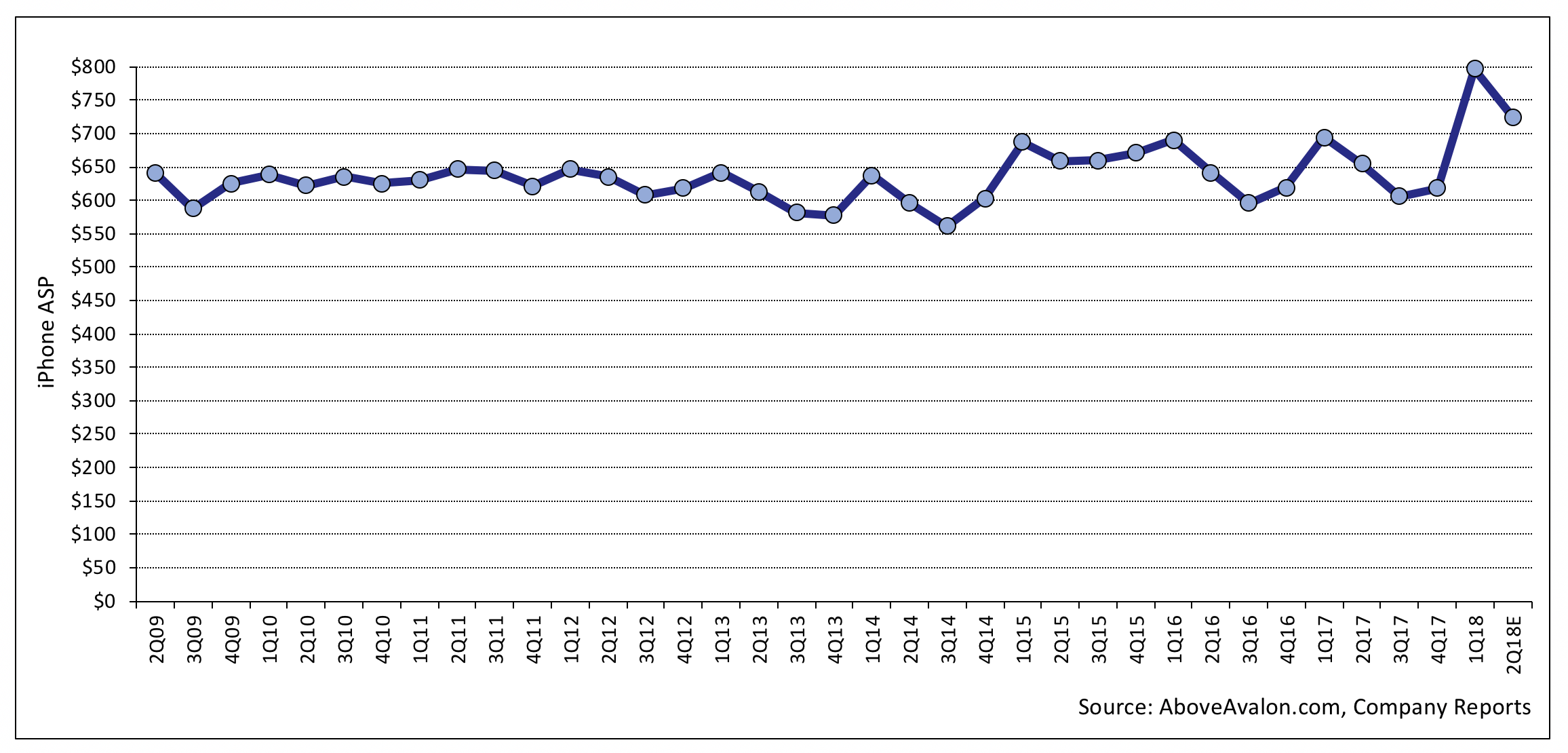
Revenue. Apple saw robust iPhone revenue growth in 1Q18 due to the dramatic jump in iPhone ASP. Going forward, an ASP reverting back to the mean, combined with modest iPhone unit sales growth, will make it difficult for Apple to maintain robust iPhone revenue growth.
Margins. Apple doesn't disclose iPhone margins. However, given the company's stable overall gross margin, there is no reason to believe iPhone margins have deteriorated significantly in recent years. While Services revenue growth has certainly contributed to Apple's stable overall gross margin, much of that positive impact has likely been offset by weaker wearable and iPad margins.
One reason iPhone margins won't likely change much in the near term is Apple's broader iPhone strategy of using higher-priced, high-margin SKUs to offset margin pressure from lower-priced SKUs.
Implications
There are two major implications from the iPhone business entering a Goldilocks era:
- Time. A relatively stable iPhone business buys Apple management much needed time to come up with the next big thing(s). It's been a little more than three years since Apple unveiled Apple Watch, the company's most recent major new product category. New products like Apple Pencil, AirPods, and HomePod are accessories meant to work with Apple's major product categories. It's not realistic to expect Apple to launch new major product categories every three or four years. Instead, pressure for Apple to unveil a new product category will likely begin to grow in 2019 or 2020, five to six years after the Apple Watch was unveiled.
- Money. The iPhone is kicking off approximately $60 billion of gross profit per year. Assuming iPhone fundamentals remain relatively unchanged from current levels, Apple stands to earn close to $200 billion of gross profit from iPhone over the next three years. This is enough cash to support Apple's organic growth, R&D, M&A, and still leave funds to handle the capital return program.
Risks and Wildcards
In the mid-2000s, there was a school of thought that viewed the U.S as having a Goldilocks economy. Instead of strong growth, which would lead to inflation, or weak growth, which would lead to a recession, the economy was following a path somewhere in the middle. As it turned out, an asset bubble was forming in housing during this period. The bubble burst in 2007. A massive recession ensued, made much worse by toxic financial instruments based on an inflated asset.
Is there a variable that may do the same to the iPhone business? What may be developing or building in the background that has the potential to appear suddenly and quickly unravel the iPhone business overnight?
A few of the more popular items positioned as iPhone risks include:
- Voice. The expansion of rudimentary digital voice assistants into new platforms where data is increasingly transferred via voice and value moves away from apps and touch screens.
- Post Device Era. All-powerful cloud services eventually reduce the value found with hardware.
- China. The iPhone business can experience a sizable contraction overnight due to new policies enacted in China targeting Apple.
- Lack of Innovation. Mediocre features that are on par with competitors can lead to longer upgrade cycles, lower margins, and fewer sales.
- New Product(s). A new kind of product reduces the value found with iPhone.
Out of those five items, China regulatory issues represent the only item capable of impacting a decent portion of iPhone sales overnight. China is responsible for approximately 30% of iPhone sales. The other risks don't pose as much of a near-term concern for the iPhone business.
The largest wildcard that will jeopardize the iPhone business over the long run is a new kind of screen that is able to grab our time and attention away from iPhone. (I don't think voice by itself will be the answer.) This screen won't replace the iPhone, just as the iPhone didn't replace a laptop or desktop. Instead, this screen will initially appeal to those who felt overserved by iPhone. Eventually, this screen will begin to handle an increasing number of new tasks and workflows, some of which were never given to iPhone. Apple Watch and a pair of augmented reality (AR) glasses are best positioned to be those screens.
The initial versions of AR glasses for the mass market will probably be more like head-up displays positioned as smartphone accessories. This leads me to think that it will be difficult for new products to unravel the iPhone business overnight. The iPhone is simply too multi-functional and multi-purpose. The artificial sense of safety found with such a statement does not escape me. The moment when it seems like there is nothing that can impact a business or product is usually the time when safety needs to be thrown out the window.
Big Picture
The iPhone's Goldilocks era is all about stable fundamentals for the next two to three years. During this period, Apple will continue to experiment with higher-priced and more capable SKUs at the high end while making iPhone more accessible with lower pricing at the low-end.
As for what comes after the Goldilocks era, a good argument can be made that iPhone's future is one of a powerful AR navigator. In this environment, Apple Watch and Apple Glasses handle much of the low-hanging fruit in terms of mobile tasks and workflows while iPhone is a more powerful computer targeting increasingly niche applications. This would lead to less robust iPhone unit sales but improved ASP and margin trends.
Receive my analysis and perspective on Apple throughout the week via exclusive daily updates. To sign up, visit the subscription page.
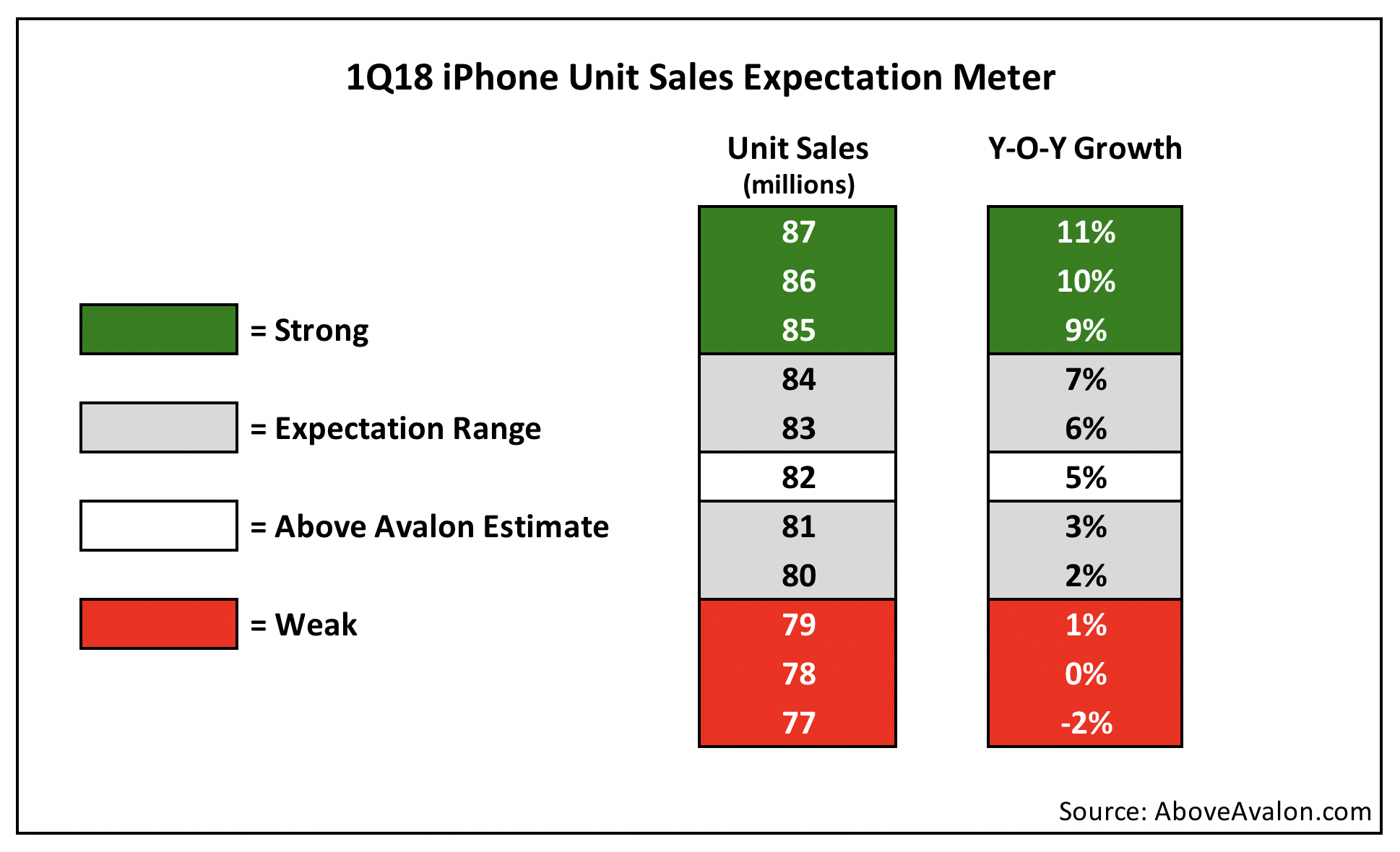
Apple 1Q18 Earnings Expectations
If Apple's 4Q17 amounted to a throwaway quarter, 1Q18 earnings will prove to be much more important for Apple. For the first time in six years, Apple's FY1Q results will reflect a full flagship iPhone launch. Typically, iPhone launches have been split between Apple's FY4Q and FY1Q. On top of it all, this wasn't just any iPhone launch as it was Apple's first flagship iPhone to begin at $1,000. The iPhone X will have a major impact on Apple's 1Q18 results.
The following table contains my Apple 1Q18 estimates. The ingredients are in place for Apple to beat consensus and its own revenue guidance.
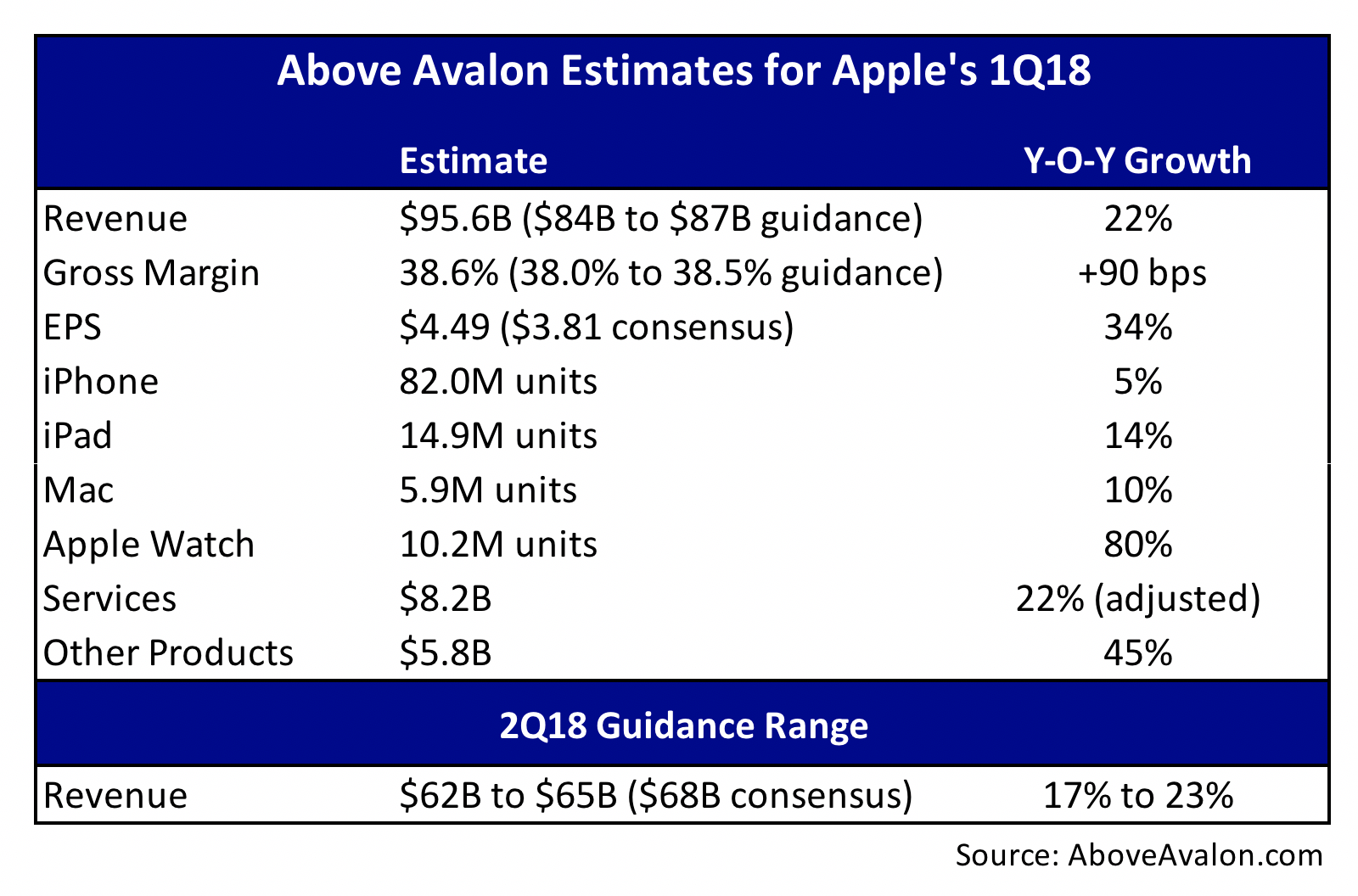
My full perspective and commentary behind these estimates are available to Above Avalon subscribers. (Become a subscriber to access my 6,000-word Apple 1Q18 earnings preview available here. To sign up, visit the subscription page.)
Items Worth Watching
There are five variables worth watching when Apple releases earnings on Thursday.
- iPhone ASP. iPhone unit sales won't tell the full story as to how the iPhone business performed during 1Q18. Instead, iPhone average selling price (ASP) will provide useful clues for determining how iPhone X sold. I expect Apple to report the largest quarterly sequential jump in iPhone ASP on record because of strong iPhone X sales. The dramatic jump in iPhone ASP is the primary reason why my revenue estimate is 10% above the top of Apple's 1Q18 guidance range.
- iPad ASP. While Apple is expected to report continued iPad unit sales growth, iPad ASP will provide clues as to whether the low-end 9.7-inch iPad, the iPad Pro, or a combination of the two sold well.
- Other Products. The "Other Products" line item will include Apple Watch and AirPods revenue. Both products likely saw very strong sales momentum during the holiday season as Apple wearables are quickly connecting with the mass market.
- China. The underlying fundamentals found with Apple's China business have been trending stronger than consensus assumes. There is a possibility that China was the primary driver for iPhone X sales, which will have a major impact on Apple's overall results. In addition, there have been signs of broad Apple ecosystem strength in China as seen with non-iPhone sales.
- 2Q18 Guidance. There's never an Apple quarter in which management's revenue guidance isn't an item worth watching. Apple's 2Q18 revenue guidance will give us a look at how the company is thinking about the broader iPhone upgrade cycle as we move away last year's iPhone launches.
1Q18 Expectation Meters
Each quarter, I publish expectation meters ahead of Apple's earnings release. Given the significant amount of modeling work that goes into each of my Apple financial estimates, these expectation meters turn single-point estimates into ranges in order to more accurately judge Apple's quarterly performance.
In each expectation meter, the grey shaded area is my expectation range. In most cases, a result that falls within this range signifies that the product or variable being measured is performing as expected. A result that lands in the green shaded area denotes strong performance and likely leads me to raise my assumptions and estimates going forward. Vice-versa, a result that lands in the red shaded area has the opposite effect and leads me to reduce my assumptions.
I am publishing four expectations meters for Apple's 1Q18: iPhone unit sales, iPhone ASP, iPad unit sales, and 2Q18 guidance.
My iPhone unit sales expectation range stretches from 80M to 84M iPhones. An iPhone unit sales result within this range would be labeled as "expected." A result that exceeds 84M iPhones would be viewed as strong, while a sub-80M iPhone result would lead me to reassess my sales expectations going forward.
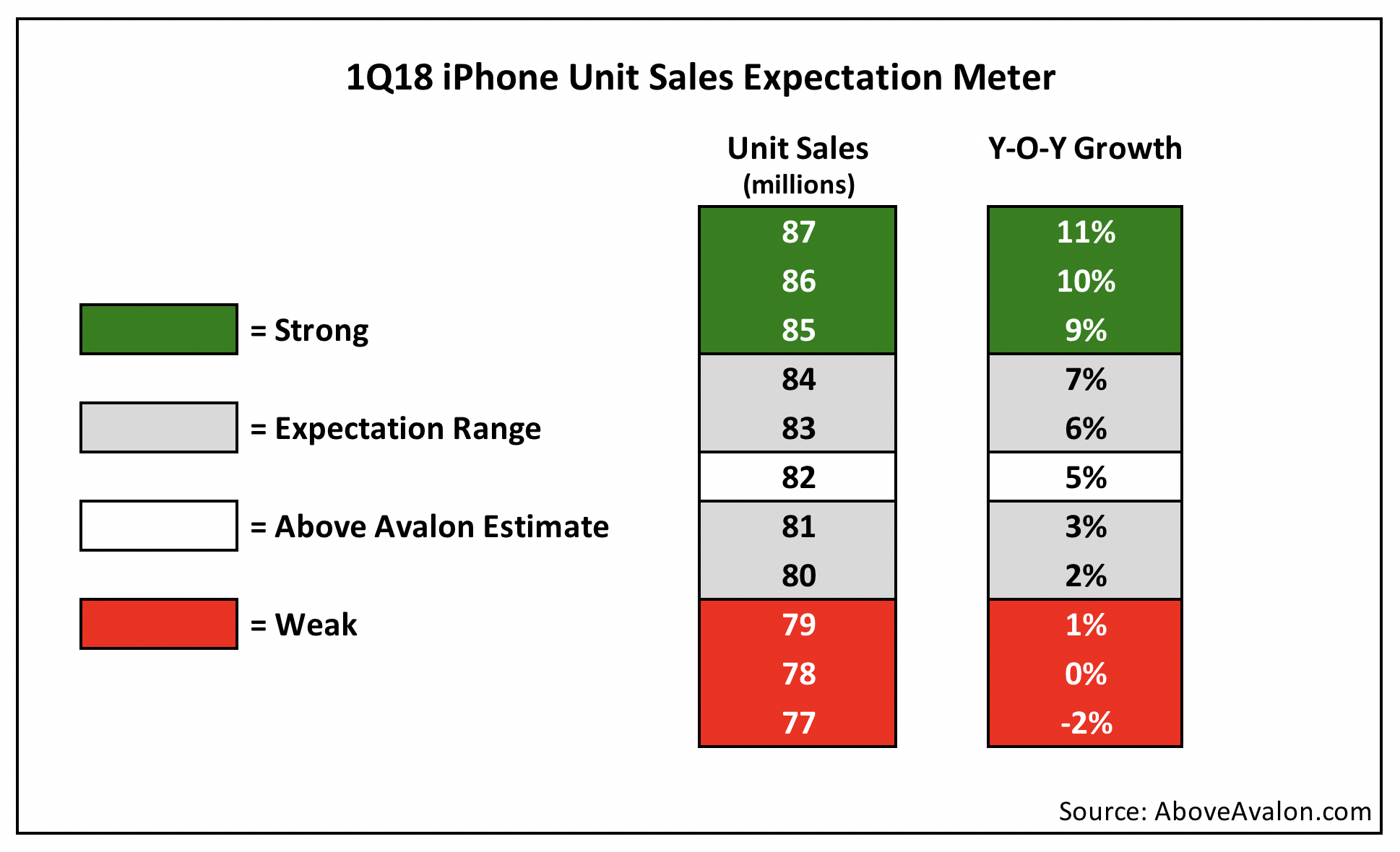
For the first time, an iPhone ASP expectation meter is being shared. This reflects the importance found with the variable for Apple's 1Q18 earnings. An iPhone ASP below $750 would come in well below my expectations and point to sales momentum being found with lower-cost iPhone options.
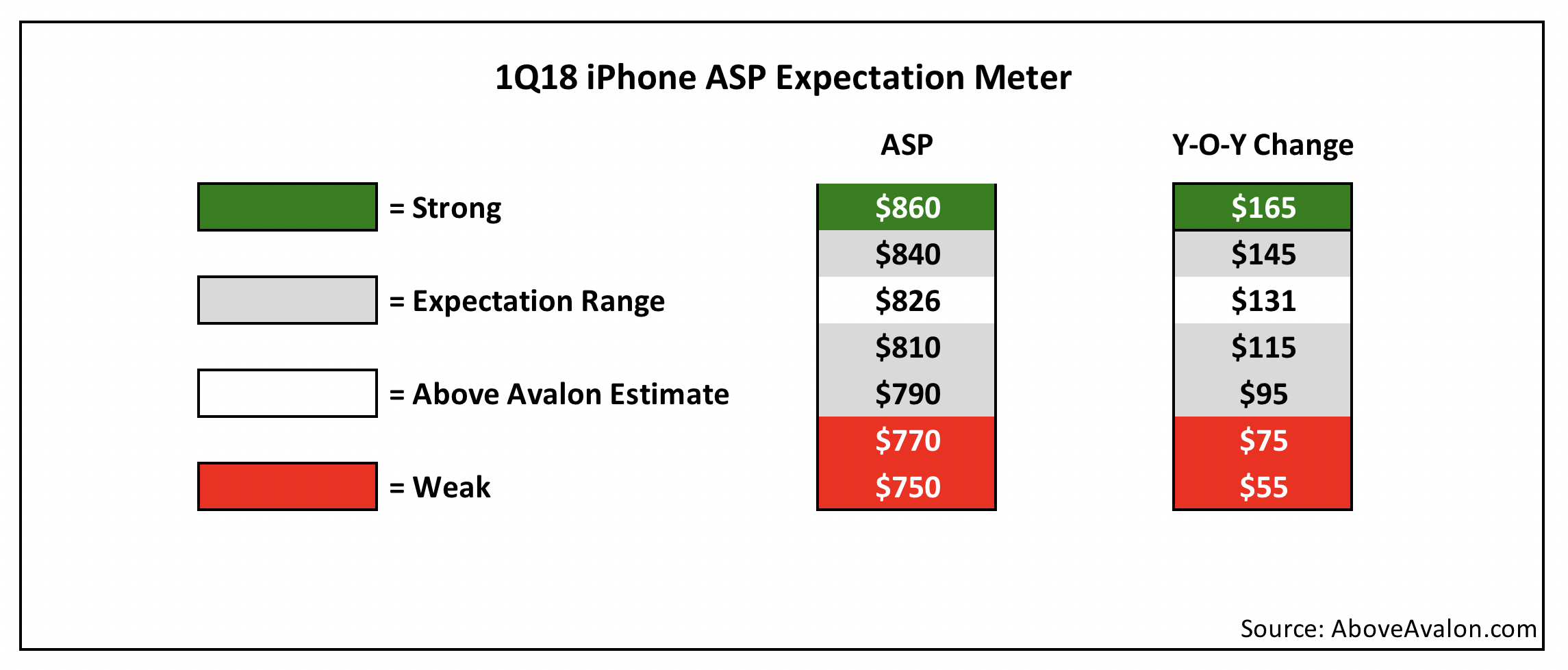
The iPad is the second-best selling Apple product category. Accordingly, the product remains a good reflection of how the broader Apple ecosystem is trending, especially in terms of emerging markets, enterprise, and education.
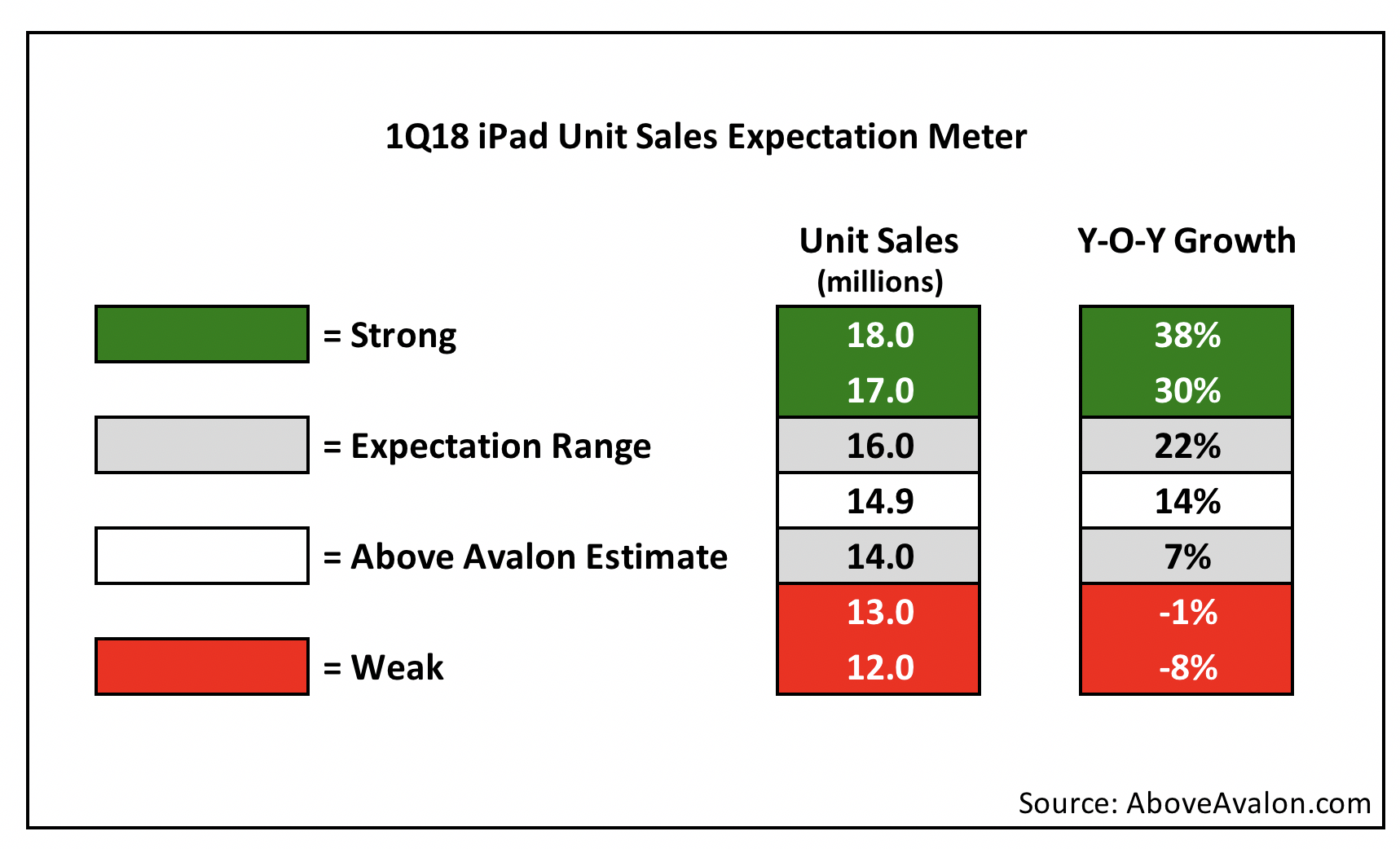
Based on consensus, sell-side analysts expect Apple to earn $68B of revenue in 2Q18. Expectations have been declining in recent weeks as a growing number of analysts think strong 1Q18 iPhone results may have been a result of demand being pulled ahead from 2Q18.
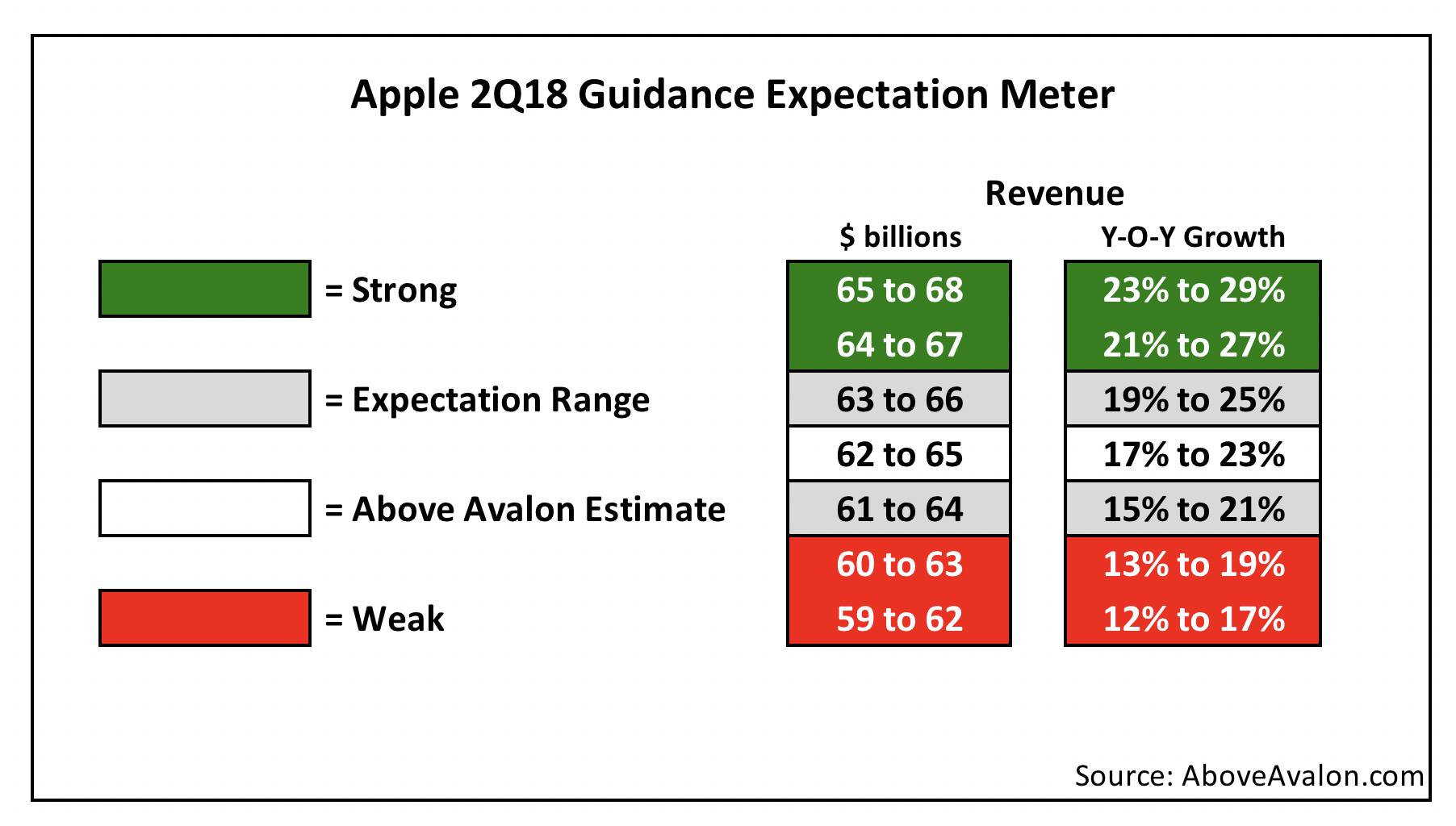
Revenue guidance in the $65B to $70B vicinity would likely be viewed positively while revenue closer to $60B would be viewed more negatively. It is worth pointing out that Apple reported $54B of revenue in 2Q17.
Above Avalon subscribers have access to my full 1Q18 earnings preview (four parts):
- Setting the Stage
- iPhone Sales Estimate
- iPad, Apple Watch, Mac, Services Estimates
- Revenue, EPS, 2Q18 Guidance, Big Picture
Subscribers will also receive my exclusive earnings reaction emails containing all of my thoughts and observations on Apple's 1Q18 earnings report and conference call. To read my Apple earnings preview and receive my earnings reaction notes, sign up at the subscription page.
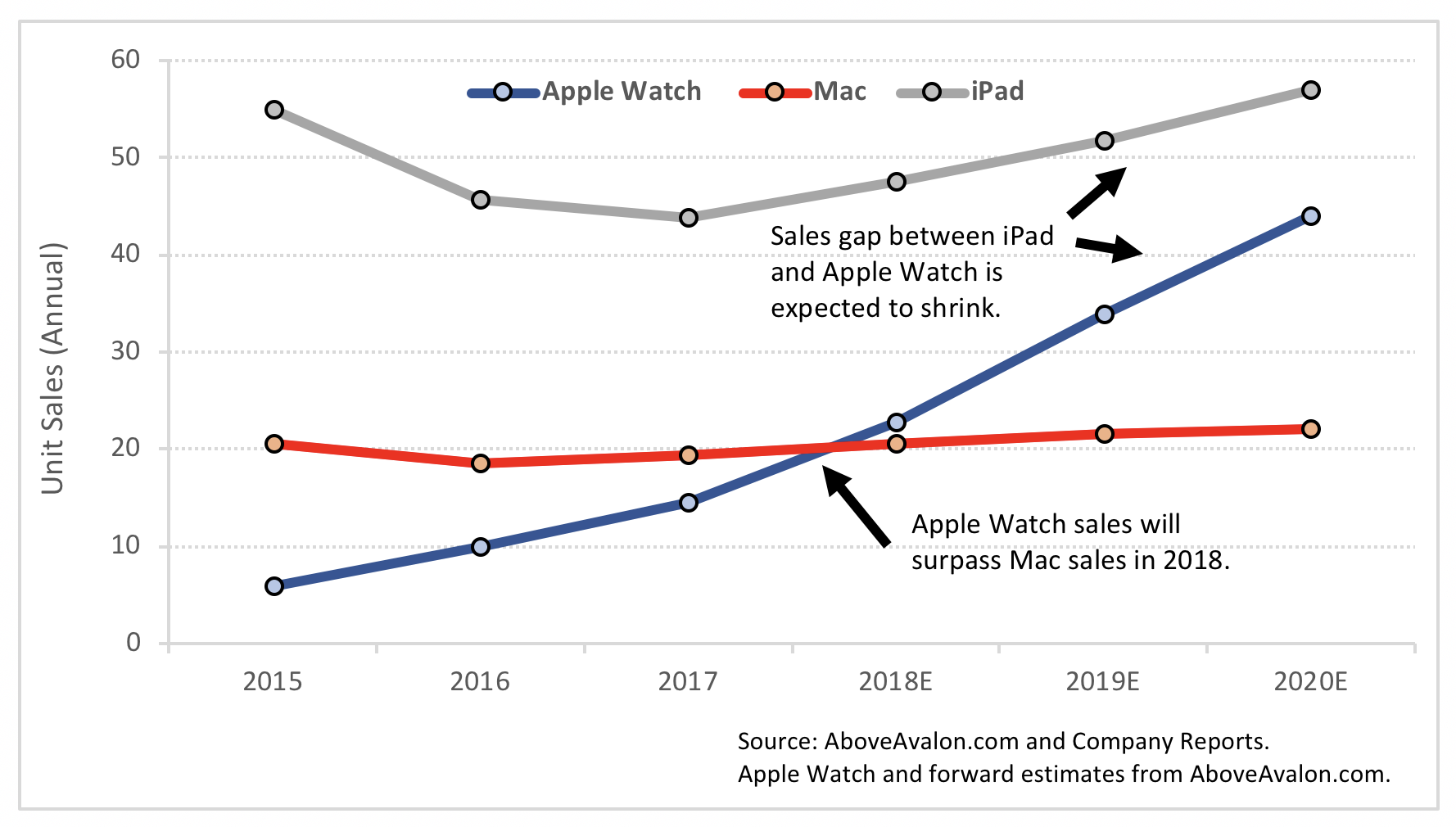
Apple Watch Is a Bridge to the Future
Something has changed inside Apple Retail stores. On a recent trip to my local Apple Store on a Sunday afternoon, it was actually difficult to get up close to the Apple Watch tables. People were looking at and buying various Apple Watch models and bands. It brought back memories of the early hoopla found when trying out iPad for the first time. Just two years ago, the lack of crowds around the Apple Watch tables led people to wonder if the Apple Watch was a misfire. Something is changing when it comes to the way people are thinking about Apple Watch.
Sales Momentum
My recent Apple Store observation is not an isolated incident. More people are buying Apple Watches these days. During the three quarters leading up Apple's FY1Q18, Apple Watch unit sales have been up at least 50 percent year-over-year. From a unit sales perspective, this works out to Apple Watch sales trending at a little less than 20M units on an annual basis. In what will come as a surprise to most people, Apple Watch likely outsold Amazon Echo during the holidays despite Apple Watch selling for nearly 10x more money.
Based on unit sales, the Apple Watch business is currently about the size of the Mac business. When considering that the Apple Watch is less than three years old, for the product to be nearly outselling Mac on an annual basis is quite the achievement. As seen in the chart below, assuming Apple is able to maintain Apple Watch sales momentum, the sales gap between Apple Watch and iPad will continue to narrow.
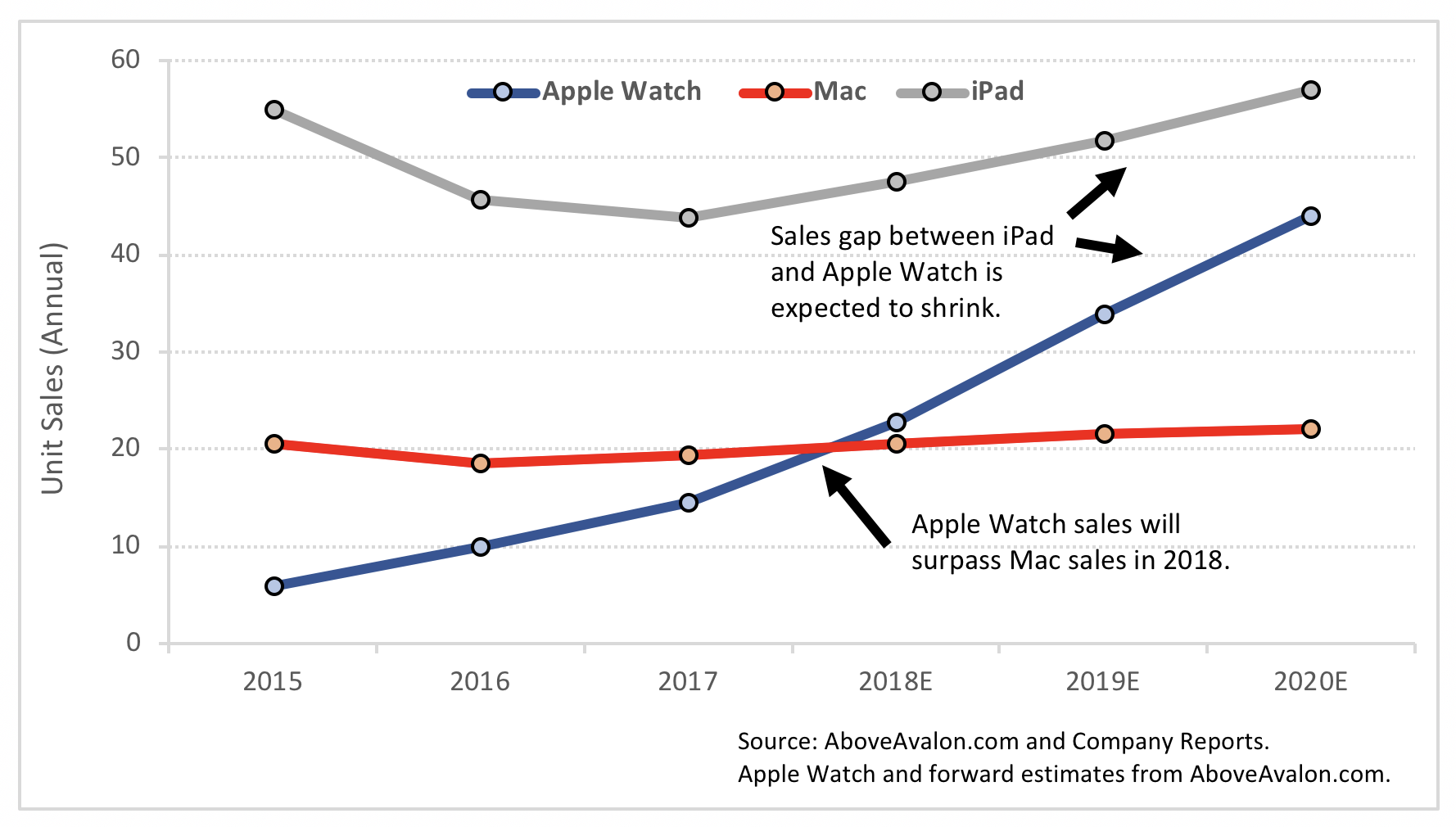
There is currently no legitimate wrist wearables market. Instead, there is only an Apple Watch market. Android Wear continues to be a nonfactor. Samsung and Fossil haven't been able to put all of the pieces together. Garmin has been able to carve a nice niche for itself in the endurance sports space, but there is no obvious path for the company to take to broaden its appeal. Meanwhile, the former leader of wrist wearables, Fitbit, is quickly fading away.
A Bridge
Why is Apple Watch sales momentum growing? My theory is that consumers are starting to see a place for Apple Watch in their lives. While Apple's revised Apple Watch marketing campaign around health and fitness has led to a clearer sales pitch, I think the health and fitness messaging ends up being Apple's way to get its wrist in the door. People aren't buying and using Apple Watch just for its health and fitness monitoring features. There is something more at play here.
Close to 20 million people bought an Apple Watch in 2017 because the device has become a bridge between the present and future. By including a screen, Apple Watch retains the familiarity found with smartphones, tablets, and laptops/desktops. At the same time, Apple Watch is giving wearers a glimpse of the future by introducing new ideas around how artificial intelligence, voice, digital assistants, and smart sensors can come together to produce a new kind of experience.
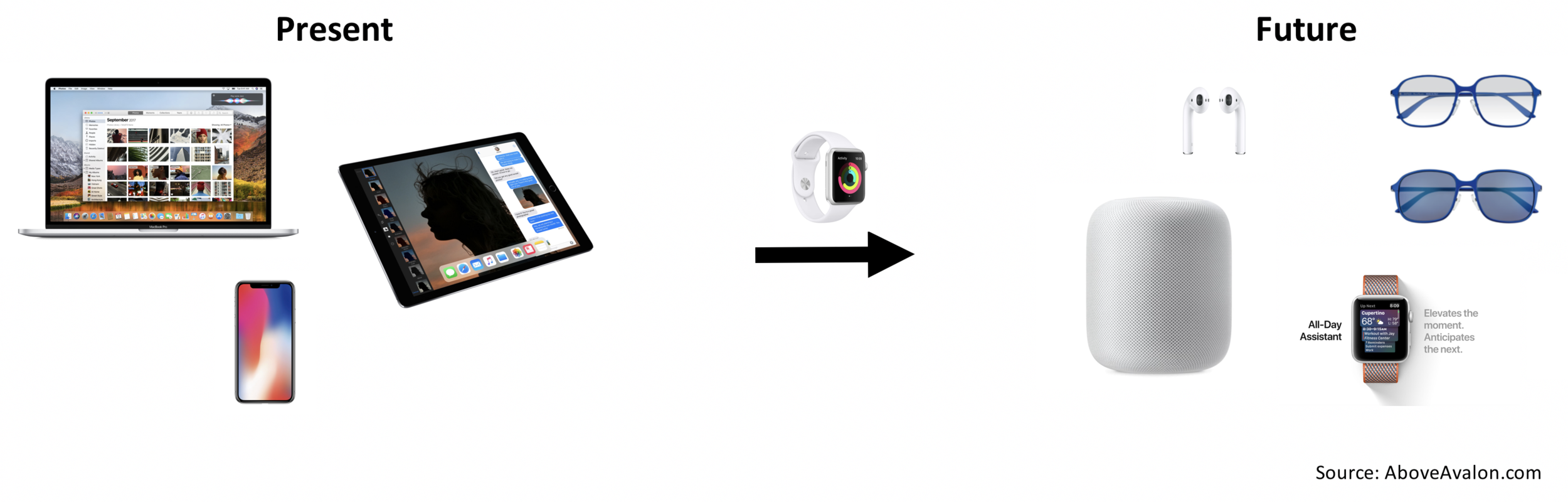
A Revolution
We are witnessing nothing short of a revolution with Apple Watch. The device holds the potential to become more disruptive to the current computing paradigm than even Apple may want to acknowledge. This potential is becoming easier to see as time goes on.
Apple Watch is designed to initially pick the low hanging fruit from the iPhone and iPad trees in terms of handling relatively simple use cases like receiving notifications, checking the time and weather, and tracking our daily activity. The device handles these tasks by approaching touch screens in a unique way. Apple Watch is designed for glances instead of prolonged viewing or watching.
For companies with business models based on grabbing as much of our attention as possible, Apple Watch does not represent a preferred revolution. This is likely one reason why Android Wear has failed to amount to much for Google. There just isn't much incentive for Google to put Android on the wrist. Apple Watch will also likely end up being quite disruptive to Apple's existing ecosystem. Apple management doesn't mind this future. Instead, they are embracing the unknown.
The same can't be said for a segment of the iOS developer community that ranges from indies to multinational companies. This group is becoming nervous about Apple Watch because it's not clear how the device will support the existing app ecosystem. In fact, this explains why a small portion of the Apple community has been so dismissive of Apple Watch from the start. News of major companies backing away from Apple Watch support has led this community to think that Apple Watch is in trouble. In reality, this is backwards. The current app ecosystem, not Apple Watch, is in trouble.
While Apple sees what the Apple Watch can become, management likely isn't sure of the exact path that will be taken to get there. For example, the honeycomb pattern of apps on Apple Watch is likely based too much on the present state of technology. Meanwhile, Apple's ongoing quest to figure out what to do with the Apple Watch side button is another sign of the company trying to capture the genie in the bottle in terms of how we will use apps on the wrist.
The reality is that Apple Watch likely won't support the same kind of ecosystem that we are accustomed to with iPhone and iPad. Apple Watch ends up being designed more for what may come after the App Store. Instead of relying on a collection of apps on my wrist, most of my interactions with services and features on Apple Watch end up being through the Siri watch face and various cards featuring glanceable amounts of information and data chosen for me by a digital assistant. These cards are personalized for me based on the time of day and my schedule. The implications of this computing experience are immense. We move away from pulling data from various apps and getting pushed mostly useless notifications to being pushed a curated feed of data that is always changing and tailored to the day at hand. Every app developer will be impacted by this dynamic.
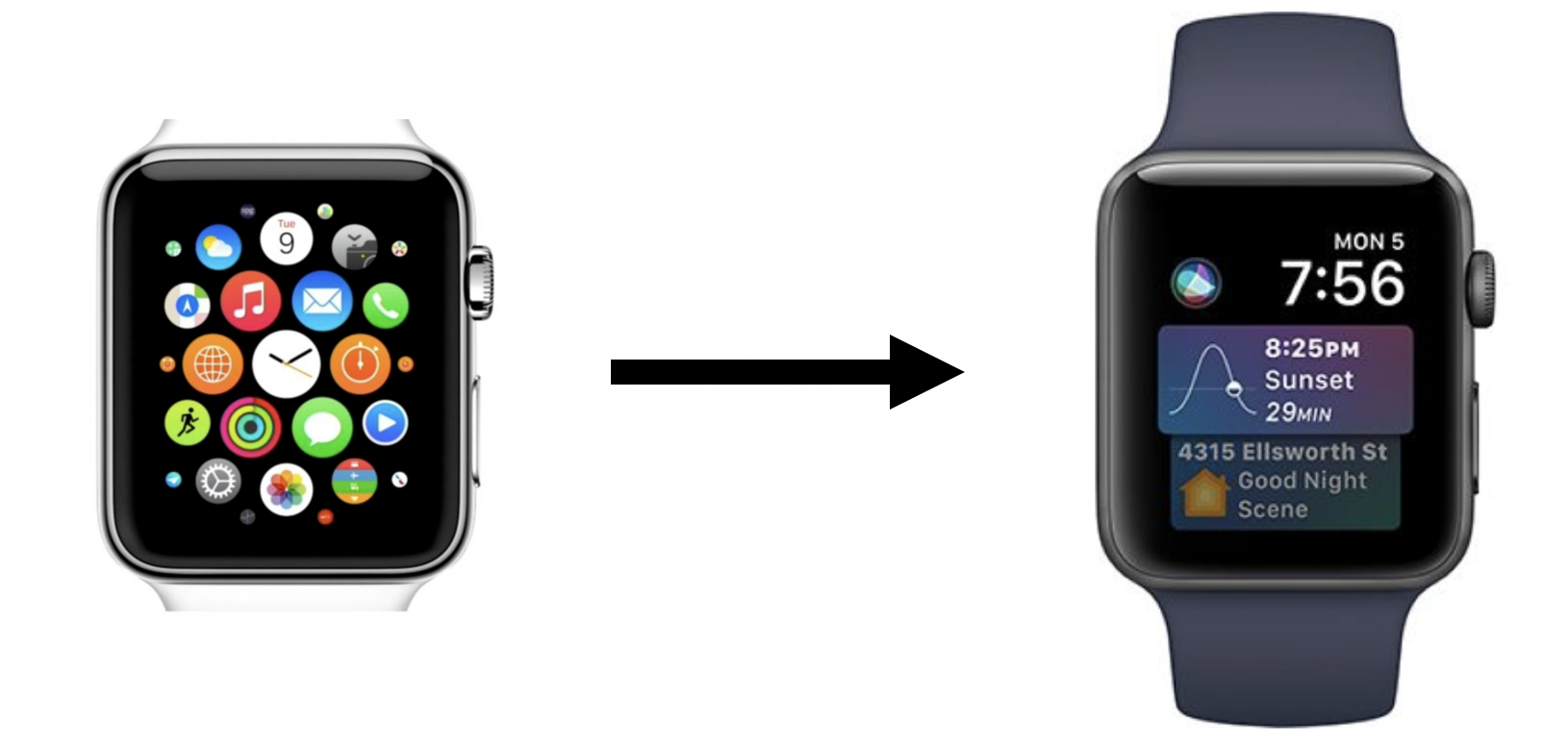
Betting Big
Given how Apple Watch is playing such a crucial role in Apple's product vision, one assumes the product is gaining importance and priority within Apple. A closer look at Apple's product strategy confirms Apple Watch's growing influence within the company.
The Apple Watch-centric feel to Apple's recent product strategy is becoming hard to miss. While AirPods are a pair of wireless headphones that work with a plethora of devices, including iPhone, Apple is positioning them as an Apple Watch accessory more than anything else. The subtle references to AirPods in the following ad make it difficult to know if it's an Apple Watch or AirPods ad. (It's actually an Apple Watch & Apple Music ad, and it's pretty great.) The ad is meant to highlight the ability to listen to music on the go with Apple Watch and AirPods.
New accessories for Apple Watch won't stop with AirPods. Apple's upcoming stationary speaker, HomePod, will likely turn into a useful Apple Watch accessory as Watch wearers get additional music controls on their wrist. In one of the animated videos on Apple's HomePod website, the only Apple product shown in the room other than HomePod is Apple Watch. There is no iPhone, iPad, or Mac in sight. For some companies, this can be brushed off as a simple oversight, but not for Apple. It's intentional.

Vision
When it comes to thinking of a product or feature that may one day serve as a legitimate iPhone alternative, there is a small but passionate group who thinks a paradigm around voice is the answer. In this voice world, screens and keyboards still exist, but their value will have been greatly diminished. Everything from hardware to the app ecosystem is expected to be disrupted in this voice-centric world. Meanwhile, there is another group who doesn't think it's a good bet to assume screens will lose value in our lives. While voice may be a useful input mechanism, screens and user manipulation on screens will remain a valuable way to consume data for the foreseeable future.
Apple has a vision for how we will use the combination of voice and screens in the future. Unlike Amazon and Google, who are desperately trying to position voice as a way to leapfrog over the current smartphone/tablet and app paradigm, Apple is approaching things from a different angle. Instead of betting on a voice interface that may push some information to a stationary screen, Apple is betting on mobile screens that are home to a digital assistant. Apple is placing a bet that consumers will want the familiarity of a touch screen to transition to a future of greater AI and digital assistants. In addition, Apple thinks user manipulation via screen (fingers, hands, and eyes) will remain a crucial part of the computing experience for the foreseeable future.
Priorities
Here are Apple's priorities for Apple Watch in order for the device to become a more desirable bridge between the present and future:
Independency from iPhone. Apple Watch's largest new features since launch have been related to achieving greater independency (GPS in 2016 and cellular connectivity in 2017). The writing has been on the wall since 2014. Apple Watch will eventually become completely independent of iPhone. We will likely be surprised at how quickly this independency will be achieved.
Powerful screen. The most useful and powerful screen in our lives will be the one that is on us. For most people, that screen is currently our smartphone. In the future, Apple Watch and a pair of AR glasses will have a good chance of holding that distinction.
Powerful camera. The most useful and powerful camera in our lives will be the one that is on us. For most people, that camera is currently found in our smartphone. In a world where we may begin to leave iPhone behind, there is logic found in giving Apple Watch a selfie camera with Face ID.
Superb health monitoring. It's difficult to think of another device that will be on our body as much as a wristwatch. According to Apple, the Activity app is the most used Apple Watch app. This doesn't come as a surprise given the wide range of notifications and reminders delivered to Apple Watch wearers throughout the day.
Home to our digital assistant. Creating a device that can both listen to our voice and provide visual context is a powerful way to quietly place a digital assistant in our lives. The Siri watch face on Apple Watch is the embodiment of this intelligent assistant. Apple believes an intelligent assistant that is always on you, and comes with a screen, is more powerful than one that is just confined to four walls. Amazon's urgency to bring its voice assistant, Alexa, to wearables adds validity to Apple's stance.
The Big Question
One question facing Apple is how the company plans on taking the app ecosystem that turned iPhone and iPad into juggernauts and use it to push Apple Watch and future wearables (i.e. Apple Glasses). Apple's product strategy has been receiving criticism given Amazon's push to get Alexa into as many third-party products as possible. Even if Amazon's advantage is in perception only, which I think there is truth to, such perceived notions can prove to be a danger to Apple.
It appears that Apple's strategy of building a new wearables ecosystem consists of two overarching themes. The first is establishing a platform of first-party hardware, software, and services. For example, AirPods and Apple Music will end up being great marketing tools for Apple Watch (and vice versa). The same will likely be said about HomePod.
Apple also has invested significantly in getting the health, fitness, and medical industries to embrace Apple Watch. Items like GymKit allow Apple Watch wearers to pair their device with fitness equipment. Third-party products like AliveCor's KardiaBand, which takes a clinical grade EKG, are literally being built for Apple Watch. Meanwhile, the list of medical and heath devices that work with Apple Watch is growing while ResearchKit and CareKit gain influence in the health and medical industries. This is where Apple's sheer dominance in wrist wearables helps the company appeal to third parties looking to offer health and medical services.
Later this year, there will be more than 40 million people wearing an Apple Watch on a daily basis. As competition for our attention moves away from smartphones and tablets, it will soon become evident that Apple holds immense power in being the largest wearables software provider in the world. This power will manifest itself in Apple's digital assistant occupying a growing role in hundreds of millions of users' lives. Apple Watch is becoming Apple's bridge to this new world.
Receive my analysis and perspective on Apple throughout the week via exclusive daily updates (2-3 stories per day, 10-12 stories per week). Available to Above Avalon members. To sign up and for more information on membership, visit the membership page.
Apple Questions for 2018
The beginning of January is a great time to embrace the unknown found with the new year. Instead of trying to manufacture clarity with a long list of predictions for the new year, there is much more value in embracing the unknown and asking questions. This is my fourth installment of Apple questions. Previous years' questions can be found below:
Here are my Apple questions for 2018:
iPhone
New iPhones. How many new iPhones will Apple launch in 2018? In 2017, Apple unveiled three new iPhone models simultaneously for the first time with iPhone 8, 8 Plus, and X. This dynamic makes 2018 the most interesting year yet when it comes to contemplating the company's plans for new iPhone models.
Larger iPhones. Will Apple introduce a larger iPhone? One of the more pronounced multi-year trends with iPhone has been a move to larger form factors. A strong case can be made for Apple to introduce a larger version of the iPhone X. By removing the home button and front-facing bezel, an iPhone with a 6.5-inch screen and Face ID would end up being close in size to the iPhone Plus.
Face ID 2.0. Will Apple unveil a second version of Face ID with additional features and capabilities? Examples include working at closer proximity to one's face or when flat on a table.
iPhone SE. Will Apple update the iPhone SE? A 4-inch smartphone screen is looking increasingly out of place in today's smartphone landscape, not to mention Apple's product line. However, the iPhone SE represents Apple's entry-level option into the iPhone ecosystem. In addition, iPhone SE is Apple's ticket for building a supply chain and assembly network in India.
Pricing. How will Apple expand the iPhone's pricing spectrum in 2018? Apple has been aggressive at cutting entry-level iPhone pricing while introducing higher-priced SKUs at the other end of the spectrum.
Naming. What is Apple's plan for iPhone nomenclature going forward? While iPhone X certainly stands out in the naming department, the name adds a new twist when it comes to marketing new iPhones.
Upgrade Cycle. Will the iPhone upgrade cycle continue to extend? The average iPhone user is holding on to their iPhone for a longer amount of time before upgrading. A continuation of this trend will have a significant impact on the iPhone business.
Overserving Users. Will we see additional evidence of Apple overserving customers with iPhone? If a portion of the iPhone user base feels like their needs are being met with older iPhones and less advanced features, Apple will face a new challenge with iPhone.
India. How will Apple alter its iPhone strategy in India in order to improve accessibility?
New User Growth. How will Apple respond to slowing new iPhone user growth? The company appears to be running out of pockets of premium smartphone users around the world. In order to expand the iPhone installed base, Apple will either have to appeal to increasingly loyal premium Android users or begin to move down the pricing pyramid to appeal to Android users in lower price tiers.
iPad
New iPads. Will Apple unveil news iPads? Apple does not necessarily follow an annual schedule for iPad updates as it does with iPhone.
Face ID. Will iPad receive Face ID in 2018? Face ID is the future, and it's inevitable that the technology will make its way over to iPad. However, there are many questions surrounding the timing of such a move and the actual implementation.
iPad mini. What is Apple's plan for the 7.9-inch iPad mini? The form factor is becoming increasingly awkward in a product line containing larger iPads and iPhones. By removing iPad mini 2 from the lineup last year, the iPad mini form factor lost its place as the lowest-priced, entry-level option for the iPad ecosystem.
Pricing. How aggressive will Apple become with entry-level 9.7-inch iPad pricing? The company slashed 9.7-inch iPad pricing to $329 ($299 for education institutions) last year. There is likely room for Apple to become even more aggressive with 9.7-inch iPad pricing.
Education. Will Apple unveil new iPad features specifically targeting education? Management is well aware of iPad's weakened position in the classroom due to school districts and administrators tailoring curricula to cheap Chromebooks.
Apple Watch
New Apple Watches. Will there be a new Apple Watch unveiled in 2018? While Apple seems to be following an annual cadence for Apple Watch updates, running too fast with assumptions can be dangerous when contemplating such a young product category.
New Form Factor. Will Apple alter the Apple Watch form factor? With only minor cosmetic changes year-to-year, Apple has maintained the original Apple Watch form factor unveiled in 2014.
Upgrade Cycle. Will Apple begin to reveal assumptions regarding an Apple Watch upgrade cycle? A revised Apple Watch form factor would speak volumes as to how Apple is thinking about a potential Apple Watch upgrade cycle.
New Features. Which features will anchor a new Apple Watch? Similar to iPhone, Apple likely wants to have two or three marquee features to anchor a marketing campaign around a new device. The easy answer has been "better and improved health sensors." However, the past two years have shown that Apple has been focused on the device gaining independency with key Watch features. In 2016, the key feature was GPS. Last year, it was cellular connectivity.
New Watch Bands. How many new Apple Watch band collections will Apple unveil in 2018?
watchOS 5. Which new features will anchor watchOS 5? Apple's strategy to choose quality over quantity with watchOS 4 worked out well for the company and Watch owners.
New Partnerships. Will Apple introduce new Apple Watch partnerships? Instead of expanding the number of partnerships, Apple has been focused on strengthening its existing ones with Hermès and Nike. However, 2018 may be different, especially if Apple sees the need to remove oxygen from the fashion or endurance smartwatch niche in which Fossil and Garmin are playing, respectively.
Pricing. How aggressive will Apple become with entry-level Apple Watch pricing?
Sales Disclosure. Will Apple begin to disclose Apple Watch unit sales? A strong case can be made for Apple to take advantage of strong Apple Watch sales momentum and disclose unit sales. Apple Watch revenue can continue to be lumped in with the Other Products line item.
Mac
New MacBook Pro. Will Apple unveil a new MacBook Pro in 2018? As with iPad, Apple doesn't necessarily follow an annual cadence when it comes to Mac updates. However, Apple management has indicated it is aware of some user complaints with MacBook Pro. Historically, Apple has been quick at addressing issues and problems, assuming Apple views MacBook Pro complaints as legitimate problems.
MacBook Air. Will Apple continue to sell MacBook Air? The model increasingly appears to be merely a placeholder in order for Apple to sell a Mac portable for less than $1,000.
Mac Pro. Will Apple unveil the new Mac Pro and standalone display in 2018? We know a new Mac Pro is coming, but the big question is when.
Mac mini. What are Apple's plans for Mac mini? Despite Tim Cook strongly signaling a new Mac mini is in the works, there continues to be a debate as to whether the Mac mini even has a future at Apple.
AirPods
New AirPods. Will Apple unveil new AirPods in 2018? We know a new AirPods case designed to work with Apple's new AirPower wireless charging pad is in the pipeline. There are plenty of new features, including various health-related items, that can be added to AirPods. The question is if any of those features will get the green light to market, especially when Apple is looking to position Apple Watch as the health monitoring device.
Additional Colors. Will Apple sell AirPods in a color other than white? While there is likely consumer interest in various AirPod colors, it's not a given that AirPods will follow Apple Watch bands and come in a range of color options.
Additional Sizes. What is Apple's stance on offering various AirPod sizes?
HomePod
Launch. When will Apple launch HomePod? Given the company's statement on HomePod launching in "early 2018," a CY1Q18 launch would make sense.
Features. Will Apple unveil new HomePod features that weren't announced on stage during WWDC? There is still a decent amount of unknown found with HomePod, especially when it comes to how the device is designed to be used with Siri and other Apple products/services.
Pricing. Will Apple launch HomePod at $349? It would be unprecedented for Apple to change the price of an unreleased product between unveil and launch.
Apple TV
Pricing. Will Apple update Apple TV pricing? Apple increased Apple TV pricing with Apple TV 4K. The move highlighted a company with a very different view of the video streaming box market.
iOS
iOS 12. What will be the major themes for iOS 12? A release focused more on quality over quantity in terms of new features wouldn't necessarily be met with much disagreement in some parts of the Apple community.
Features. Which features will get Apple's attention? Candidates high on the list include the camera, photos, ARKit, and HomeKit.
Siri
I am giving Siri its own category to reflect its growing importance.
Vision. How is Apple going to push Siri forward in 2018? The question is left broad on purpose. There is evidence of the digital voice assistant receiving far too much criticism given what amounts to genuine improvement and advancement in recent years. In addition, there is a growing debate as to how Apple looks at Siri's role in our lives.
Content
Apple Music. What are Apple's plans for Apple Music in 2018? With approximately 35M paying Apple Music subscribers, Apple is about one-third of the way to reaching its unofficial goal of having 100M paying Apple Music subscribers. When taking into account family accounts, there are now between 40M and 45M people using Apple Music.
Apple Video. When will Apple launch its video streaming service? The company continues to build out its Apple Studios division as a billion dollar content budget is put to work to assemble a bundle of original content programming.
Content Bundle. Will Apple combine Apple Music with Apple Video to form an Apple Entertainment bundle? Such a product would certainly give both Apple Music and Apple Video differentiation in what is becoming a crowded market.
Podcasts. Will Apple look to leverage its long-standing power as a podcast distributor into something else?
Services
Apple Maps. What are Apple's plans for improving Apple Maps in non-U.S. geographies?
Apple Pay. Does Apple have a strategy for increasing Apple Pay adoption among U.S. retailers?
M&A
Acquisition Targets. Which companies will Apple buy in 2018? This question is left open-ended on purpose. One would expect AR companies to remain high on the M&A target list.
Investments. Will Apple take a deeper step into venture capital and tech fund investing? The company has said such investments will aid in the discovery of new technology in an increasingly competitive landscape.
Project Titan
Objectives. What are Apple's plans and objectives for Project Titan in 2018?
Washington and Wall Street
U.S. Manufacturing. How will Apple respond to increased pressure from Washington to bring manufacturing jobs back to the U.S.? The company's primary response has been to ratchet up the PR around job creation. Will Apple expand its manufacturing fund for U.S. manufacturers? The company has been gifting sizable amounts of capital to U.S. suppliers in exchange for improved supply of critical components needed for Apple products.
Cash Strategy. When will Apple bring back its foreign cash? Once the cash is in U.S. subsidiaries, how will Apple remove excess cash from the balance sheet?
Buyback. How much will Apple spend on share buyback in 2018?
Dividends. What will be Apple's new quarterly cash dividend? The announcement will be made in the spring.
Management
Turnover. Will there be any high-level turnover at Apple in 2018? There is no obvious candidate in the SVP ranks that is either at risk of being removed or close to retirement. The most recent departure was that of former general counsel Bruce Sewell, who retired at the end of last year.
New Faces. Will Tim Cook expand Apple's executive team? The last addition to the SVP ranks was Johny Srouji, who was promoted at the end of 2015 to SVP Hardware Technologies.
Tim Cook's Inner Circle. How will responsibility be split among Tim Cook's inner circle? Jeff Williams, Eddy Cue, and Phil Schiller are each overlooking key aspects of Apple's business. Williams oversees Apple Watch and health. Cue is becoming Apple's content czar, and Schiller was given leadership over the App Store across all platforms.
Power. Which executive will gain power and influence within Apple in 2018?
Apple Industrial Design
Jony Ive. Will we get any surprises from Jony? With Apple Park mostly completed and the new design language for Apple Retail finished, Jony appears to be dedicating time and attention to new product initiatives.
Turnover. Will there be additional turnover in the Apple Industrial Design group? Apple lost an industrial designer in both 2016 and 2017.
New Hires. Will Apple add to its Industrial Design group? While Jony may want to make the team even smaller, there is space for one or two new industrial designers. An additional benefit of a few new hires would be adding fresh ideas into the team dynamic underpinning Apple Industrial Design.
New Workspace. How will Apple's industrial designers adapt to Apple Park? For the first time, Apple will have one large design studio housing hundreds of designers instead of a web of disconnected spaces. This process will inevitably lead to changes in team dynamics.
Wildcards
Product Events. How many product events will Apple hold in 2018? Apple held only two events in 2017 (WWDC in June and the iPhone X / Apple Watch event in September at Steve Jobs Theater). One theory as to why Apple experienced a number of hardware and software delays in 2017 was that the company had to prematurely announce products since there were only two events to unveil them (June and September).
Health and Medical. Does Apple plan to announce new health and medical initiatives?
Public Image. Will Apple alter its public image in 2018? Changes can include a renewed focus on a particular area of the business.
New Product Categories. Will Apple unveil a completely new product category this year? In recent years, Apple has unveiled a number of new accessories. In 2015, Apple unveiled Apple Pencil. In 2016, Apple unveiled AirPods. Last year, Apple unveiled HomePod.
Receive my analysis and perspective on Apple throughout the week via exclusive daily updates (2-3 stories per day, 10-12 stories per week). Available to Above Avalon members. To sign up and for more information on membership, visit the membership page.
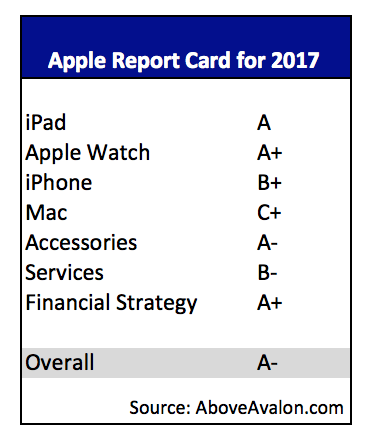
Grading Apple's 2017
Apple had an eventful 2017. Over the span of just a few months, the company updated nearly its entire product line. In addition, we saw Apple unveil a number of noteworthy strategy changes and even a pivot across its major product categories. The year concluded with a handful of high-profile problems including a serious macOS security flaw, delayed software and hardware releases, and the company getting caught in a crisis of its own making involving throttling older iPhones.
Grading Methodology
It's easy to point out the inevitable long list of problems and mishaps Apple experiences in any given year and then conclude that the company went off the rails. By such measure, 2017 was a pretty bad year for Apple. On the other hand, there is little value found in just focusing on items that are traditionally viewed as positives, but are in reality bare minimums for Apple to maintain status quo, such as updating existing products or generating significant amounts of cash.
There are two ways to judge Apple's performance in 2017:
- Financial perspective. Base the company's degree of success or failure on financial metrics including margins, ASPs, unit sales, and revenue.
- Product perspective. Analyze the positives and negatives found with Apple's product strategy.
A hybrid approach is used for my grading process. A successful product strategy will eventually manifest itself in positive financial trends. However, financials are sometimes unable to tell the full story. By using both financial and product perspectives to grade Apple in 2017, the two schools of thought end up complimenting each other, leading to an in-depth review that fully captures Apple's performance.
Report Card
My report card for Apple's 2017 is broken into eight categories.
iPad. After a multi-year stretch of steep unit sales declines, questionable marketing, and an increasingly complicated product line, Apple turned things around with iPad in 2017. Management unveiled a number of significant strategy changes to iPad. These came together nicely to give the product category its best year since 2013, despite unit sales remaining approximately 40% below peak levels.
Signs of light at the end of the iPad tunnel began to appear in 2016 as sales of larger iPads continued to outperform sales of the smaller 7.9-inch form factor. It became clear that the iPad mini was not only contributing to iPad's ongoing unit sales decline, but was also holding the iPad back.
In February 2017, Apple unveiled its first multi-ad campaign for iPad Pro. The ads were noteworthy for what they told us about how Apple management viewed iPad. Traditionally, Apple's argument had been that the iPad is actually a computer due to having features X, Y, and Z. Apple was now saying the iPad Pro isn't a computer. Instead, iPad is better than a computer due to having features X, Y, and Z.
In March 2017, Apple announced a number of iPad strategy changes. Apple took the iPad Air 2 and gave it a new processor, screen, name, and $70 price cut. The changes, which added much-needed simplicity to the iPad line, amounted to Apple doubling down on larger iPad form factors. In addition, Apple was convinced that a lower-cost 9.7-inch iPad would entice existing iPad owners still on their first iPad to upgrade.
Apple continued to run with iPad at WWDC, dedicating 21% of the keynote to iPad. Management announced an all-new 10.5-inch iPad Pro, which replaces the 9.7-inch model. The 10.5-inch screen iPad, with a 20% larger screen than the 9.7-inch model, supports full-size on-screen and smart keyboards. Apple announced significant software features for iPad via iOS 11, including a dock, drag and drop, a redesigned keyboard, and a files app.
The result of Apple's numerous iPad changes throughout 2017 were iPad sales surprising to the upside. As seen in Exhibit 1, on a trailing twelve months basis, iPad unit sales have grown for the past three quarters. The holiday quarter (1Q18) will likely represent the fourth consecutive quarter of iPad unit sales growth.
Exhibit 1: iPad Unit Sales - Trailing Twelve Months
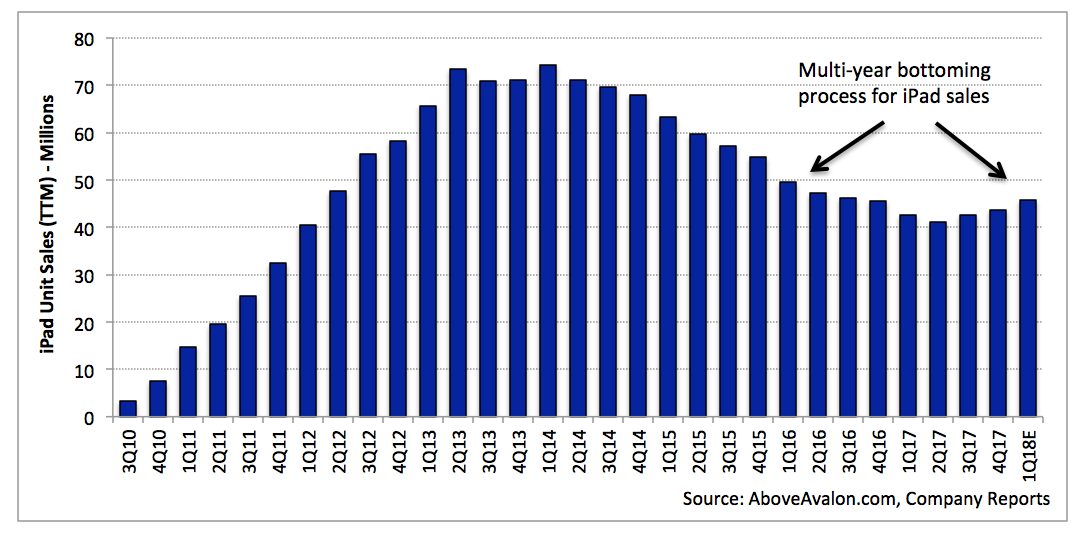
iPad milestones in 2017:
- Unveil a revised iPad marketing strategy.
- Become ultra-aggressive with 9.7-inch iPad pricing.
- Introduce an all-new 10.5-inch screen form factor.
- Push significant iPad software improvements in iOS 11.
iPad issues in 2017:
- There are still genuine questions as to just how fast Apple is pushing iPad in order for the device to serve as a viable Mac alternative for content creators.
- iPad still faces an uphill battle in education settings.
Grade: A
Apple demonstrated the willingness to take some big risks with iPad in 2017. Pricing and marketing changes may end up being a much larger deal for iPad sales in 2018 than software enhancements found in iOS 11.
Apple Watch. Apple Watch had a banner year in 2017. Apple sold approximately 18M Apple Watches during the year, up a whopping 70% from 2016. As shown in Exhibit 2, Apple Watch sales have become so strong that there is now more upside found with management disclosing unit sales rather than keeping them hidden and just providing sales clues.
Exhibit 2: Apple Watch Unit Sales - Trailing Twelve Months

In March 2017, Apple unveiled its spring 2017 Apple Watch band collection. This was the first time that Apple unveiled a significant update to Apple Watch bands outside of a keynote.
At WWDC, Apple's watchOS 4 portion of the keynote was among the company's strongest segments. Along with some user interface tweaks, new watch faces, such as the Siri face, turned the Apple Watch into a completely new kind of device. Apple is relying on machine learning to provide Apple Watch wearers personalized information based on their daily routine.
However, the Apple Watch highlight in 2017 occurred in September at Apple's inaugural event at Steve Jobs Theater. In fact, Apple Watch was the strongest segment of Apple's presentation. Apple has found a use case specifically designed for the Watch - health tracking - and has been successful in wrapping both product and ad marketing around this new use case. Health-tracking capabilities such as the new heart-tracking capabilities are intriguing. Such moves help shine light on Apple's goal with Apple Watch: make the device an indispensable product for the mass market by positioning it as a lifesaver, literally.
Apple Watch Series 3 ended up being a pleasant surprise given how Apple was able to add LTE connectivity without making Apple Watch that much thicker. Items such as building the antenna directly into the screen reveal how Apple is head and shoulders above the competition in the wrist wearables space.
Apple Watch milestones in 2017:
- Launch a cellular Apple Watch with very few hiccups.
- Position quality over quantity in terms of new features found with watchOS 4.
- Introduce compelling new Apple Watch band options throughout the year.
Apple Watch issues in 2017:
- Apple has plenty of work ahead of itself to improve Apple Watch adoption, which still stands at less than 5% of the iPhone user base.
- There are questions as to just how widespread third-party developers outside of the health/fitness segment can take advantage of Apple Watch in a sustainable way.
Grade: A+
While there are obvious items to improve with Apple Watch, there is no legitimate reason to deny Apple Watch the A+ that it deserved in 2017. It was an all-around great year for Apple Watch.
iPhone. There are two ways to look at the iPhone business in 2017. The first is through a product lens. The second is using a business lens. From a product perspective, the iPhone business is thriving. Based on my time with iPhone 8 and iPhone X, the devices are successes as each represents an improvement from its predecessor. The iPhone 8 provides a better user experience than the iPhone 7, and the iPhone X provides a better experience than iPhone 8. In addition, Apple continues to hit the nail in the head in terms of iPhone marketing and focusing on camera enhancements.
With iPhone X, Apple launched one of its more significant technological accomplishments in years. Removing the home button and the very popular Touch ID could have derailed the entire iPhone business if done poorly or incorrectly. Instead, Apple nailed it. iPhone X is a big win for various teams at Apple including designers, engineers, and product marketers.
From a business perspective, the iPhone story is more complicated. A growing number of concerns have appeared. In early 2016, it was clear that the iPhone's growth story was winding down. As seen in Exhibit 3, over the subsequent six quarters since 3Q16, much of my iPhone growth concerns have materialized. While it is still possible for Apple to report stretches of iPhone unit sales growth, the days of 40% to 50% growth are over. Given a number of factors, Apple is now much more dependent on iPhone upgraders to maintain unit sales. This adds more risk to the overall iPhone story, especially given how the iPhone upgrade cycle is extending.
Exhibit 3: iPhone Unit Sales - Trailing Twelve Months
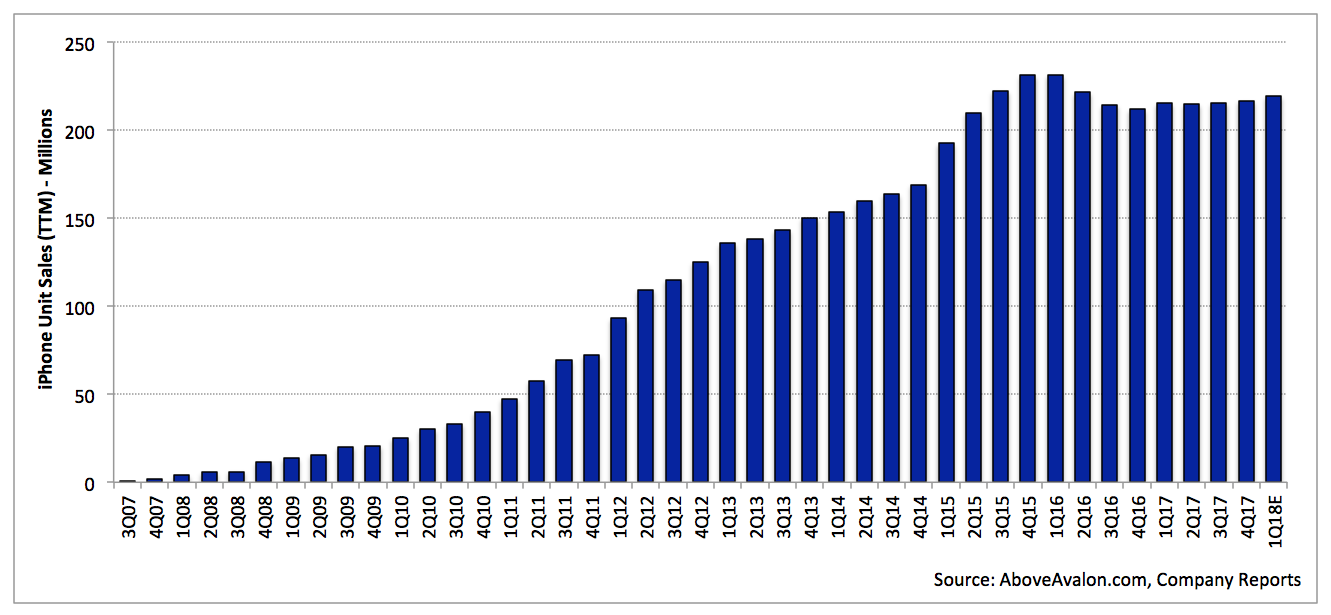
At the same time, there is early evidence of a portion of the iPhone user base becoming satisfied from a feature perspective with older iPhones, similar to what took place with the iPad business years ago. On the flip side, features like the iPhone Upgrade Program and the fact that Apple is still pushing noteworthy updates on an annual basis will likely help to offset some of the headwind found with a portion of the base being content with less. In addition, Apple continues to do very well when it comes to maintaining iPhone margins and ASPs, a byproduct of Apple expanding the iPhone pricing spectrum.
It was hard to ignore what seemed like an outsized number of iOS bugs in 2017. Some were more of a nuisance variety. Others were more embarrassing and even worrying for Apple. In addition, after a very promising start, tepid ARKit developer adoption took some of the wind out of the AR sails, although we are still in the very early stages.
Apple then suffered an iPhone crisis this past December when it was revealed that the company was slowing down CPU performance for older iPhones in order to avoid iPhones from shutting down due to degrading batteries. The crisis was of Apple's own doing given the company's complete lack of transparency surrounding its actions. iPhone throttling is a big problem for Apple, indicative of longer-term issues involving iPhone users holding on to their iPhones for longer.
iPhone milestones in 2017:
- Launch iPhone 8, 8 Plus, and X.
- Successfully position Face ID as an alternative to Touch ID on iPhone X.
iPhone issues in 2017:
- Structural growth issues.
- iPhone upgrade cycle is getting longer.
- No clear strategy for boosting iPhone sales in India. (Apple has no intention of dropping iPhone pricing to levels needed for significant sales.)
- iPhone throttling crisis.
Grade: B+
The iPhone throttling crisis and various iOS 11 bugs do not wipe out the legitimate successes Apple saw with iPhone X in 2017.
Mac. The Mac business entered 2017 on crutches. Apple had just released the highly controversial MacBook Pro a few months earlier. Questions were building regarding Apple's commitment to the pro Mac user.
In early 2017, Apple shocked many by convening five outside journalists for an on-the-record 90-minute briefing to talk about the Mac. Apple had changed course and was now working on a new modular Mac Pro and standalone display. The decision to reveal its hand well before a finished product was ready certainly seemed to be born out of desperation as Apple tried to limit possible defections within the highly influential content creation niche. Fortunately for Apple, much of the migration chatter is likely just that, talk. Regardless, Apple now seems fully committed to catering to the niche, which should alleviate some of the concerns held by users in that community.
While Apple continued to demonstrate a vision for the Mac's future, the product category is increasingly representing Apple's weak point. In fact, it became clear in 2017 that the Mac is Apple's Achilles' heel. At its core, there are genuine questions to ask regarding whether Apple should be dedicating more resources to come up with improved alternatives to the Mac or betting on increasingly niche Mac models targeting less than 0.1% of the Apple user base.
Mac milestones in 2017:
- Launch iMac Pro.
Mac issues in 2017:
- Questions surround Apple's Mac portable strategy and the broader direction for Mac in a mobile world.
Grade: C+
It's easy for some to look at the new MacBook Pro and instantly give the Mac an "F" in 2017. Such an action would ignore the tangible positives found with Mac in terms of iMac Pro and the decision to dedicate resources to pro Mac users.
Accessories. The primary product categories within Apple's accessories bucket include AirPods, Beats headphones, and Apple TV. Despite ongoing AirPods supply issues during the first half of 2017, the product had a stellar year from a sales perspective with Apple shipping as many as 12M units. With Apple TV, Apple continues to make progress on a number of fronts. Management has decided to take a very different approach to the video streaming box market than the competition has as seen with higher Apple TV pricing at a time when the trend is a race to the bottom.
Accessories milestones in 2017:
- Ramp AirPods supply throughout the year.
- Launch Apple TV 4K with the revised Siri remote.
Accessories issues in 2017:
- HomePod launch was delayed to early 2018.
- Questions surround Apple's willingness to cede market share in the TV streaming box space to competition.
Grade: A-
AirPods' A+ offsets lower grades for Apple TV and the delayed HomePod.
Services. Apple's Services category is officially comprised of iCloud, AppleCare, Apple Pay, Apple Music, and Apple's various app and content stores. For this exercise, Apple Maps and Siri are also included here. Apple isn't a services company. Accordingly, it's difficult to point to any particular Apple service as being head and shoulders over the competition in 2017. Instead, Apple's focus continues to be found with making sure that its various services offer an all-around good customer experience. This goal often involves deep services and hardware integration. Apple Pay on Apple Watch is a prime example. Controlling Apple Music playback via Apple Watch is another example.
As seen with ongoing issues with Apple Maps and Siri, Apple has plenty of services work ahead of itself. However, there are signs of progress. Apple Maps in the U.S. is legitimately good. Meanwhile, Siri on Apple Watch has never been better.
Services milestones in 2017:
- Continued momentum found with the App Store and Apple positioning itself as an attractive platform for third-party paid subscriptions.
Services issues in 2017:
- Apple Services quality is highly dependent on geography with notable issues in key Apple markets including China and India.
Grade: B-
It's easy to look at something like Apple Maps in India and instantly slap an "F" on Apple Services. However, this ignores the tangible progress made in 2017 with various Apple Services.
Financial Strategy. There weren't too many negatives found with Apple's financial strategy in 2017. Apple continues to generate more cash than it needs to fund the business. Management spent an amount equal to 90% of its free cash flow generation, which is cash left over after funding the business, on share buyback and quarterly cash dividends during FY2017. Even after taking into consideration capital management activity, Apple's net cash remained around $150B. Apple spent approximately $700 million on announced M&A during the year, more than half of which is attributed to the recently announced Shazam acquisition.
Apple's pricing strategy continued to intrigue in 2017. Many of Apple's newest products, such as Apple Watch and AirPods, are underpriced in comparison to the competition. Even iPhone X at $999 ended up being not as outlandishly priced when compared to competing premium flagship offerings from other smartphone manufacturers. As shown in Exhibit 4, average selling price (ASP) trends remained intact despite Apple cutting entry-level pricing for iPhone and iPad. Overall margin trends were benign as higher-priced SKUs containing a higher margin offset lower-margin SKUs at the opposite end of the pricing spectrum. In addition, higher-margin Apple Services revenue is likely offsetting margin pressure in Apple's other product categories.
Grade: A+
Exhibit 4: iPhone and iPad Average Selling Price
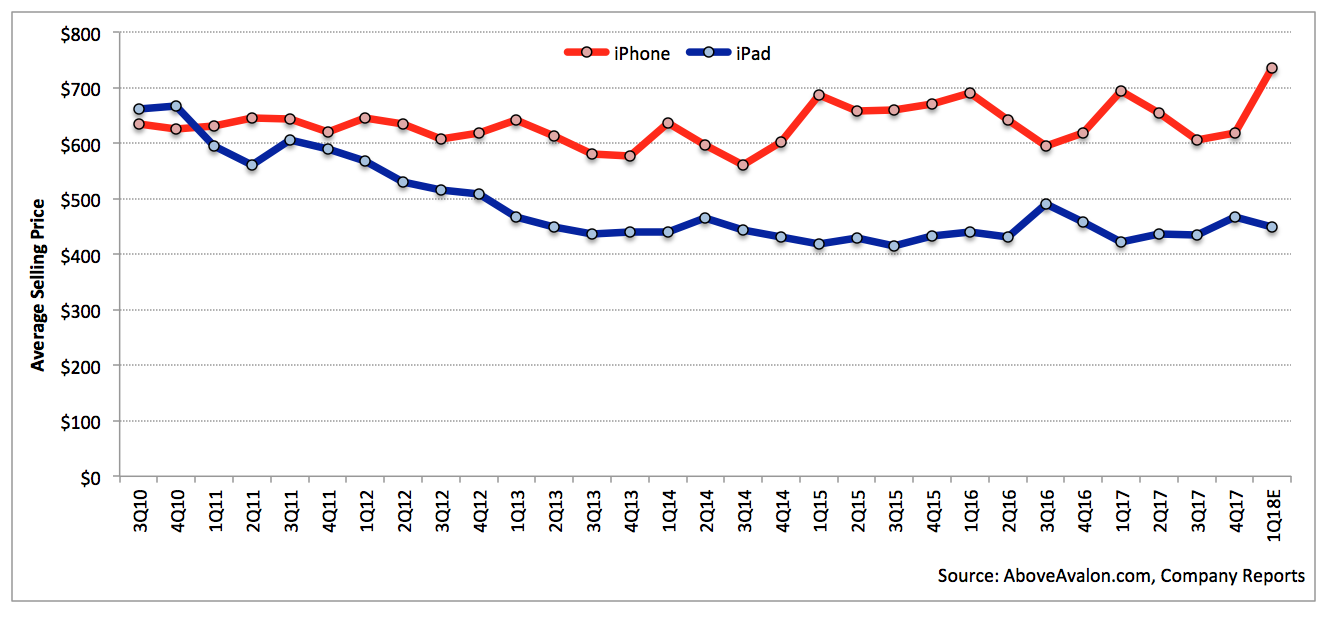
Other. There were a number of other highlights during the year that don't neatly fit into one of the preceding categories.
- Apple held a successful WWDC at San Jose.
- Steve Jobs Theater / Apple Park had its grand opening.
- Wall Street embraced a new approach to Apple with the focus increasingly being aimed at the company's balance sheet and excess cash.
- Apple began ramping its original video programming effort.
- Apple continues to place a big bet on hardware (owning the core technologies powering its devices) in order to become a better software provider.
Final Grade
Apple had a good 2017. Taking an equally-weighted average of the grades from the preceding seven categories, Apple earned an A- for its 2017 performance. When giving iPhone, iPad, Apple Watch, and Services additional weight in comparison to the other categories, Apple still earned an A-.
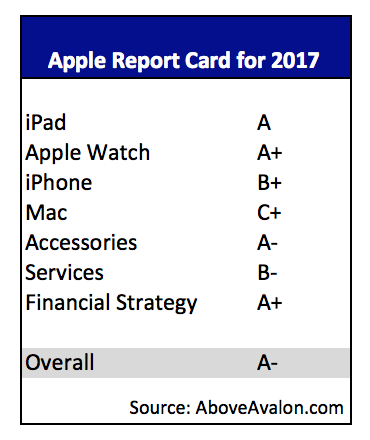
Much attention was given to Apple's various software bugs, delays, and mishaps in 2017. In addition, there was an increasing amount of skepticism facing Apple and its approach to voice-first interfaces, the smart home, and the broader "post device" narrative in 2017. However, upon closer examination, Apple made genuine strides in most of its product categories. With the company's broader bet on hardware, Apple provided a sneak peak at its dramatically different view on hardware's role in our lives going forward. In addition, Apple's growing momentum with wearables bodes well for the company's near-term prospects in many industries and fields that the company is said to be suffering in.
A missing piece to Apple's report card ends up representing a crucial ingredient for future report cards: Apple R&D. A sizable portion of Apple's attention during any given year is given to unannounced products. It is difficult to assess the progress Apple is making with R&D given the company's strict stance on secrecy and keeping ideas hidden until they are ready for prime time. One way to judge Apple's R&D progress is to look at M&A. Along those lines, it looks like Apple Glasses continue to be a high priority based on Apple acquiring SensoMotoric Instruments and Vrvana. In addition, Apple's transportation ambitions remain intact as judged by various clues pointing to the company expanding its autonomous car R&D efforts.
An interesting exercise to conclude Apple's annual review involves thinking of how 2017 will be viewed in a few years. I continue to think that Apple finds itself in the early stages of the wearables era. With Apple Glasses positioned as the most likely new product category (HomePod will be positioned as a music accessory), 2017 will likely be looked back at as just another year in the run-up to Apple having a full-fledged line of wearables products. Meanwhile, transportation initiatives continue to represent a long-term focus for Apple.
Receive my analysis and perspective on Apple throughout the week via exclusive daily emails (2-3 stories a day, 10-12 stories a week). To sign up, visit the membership page.
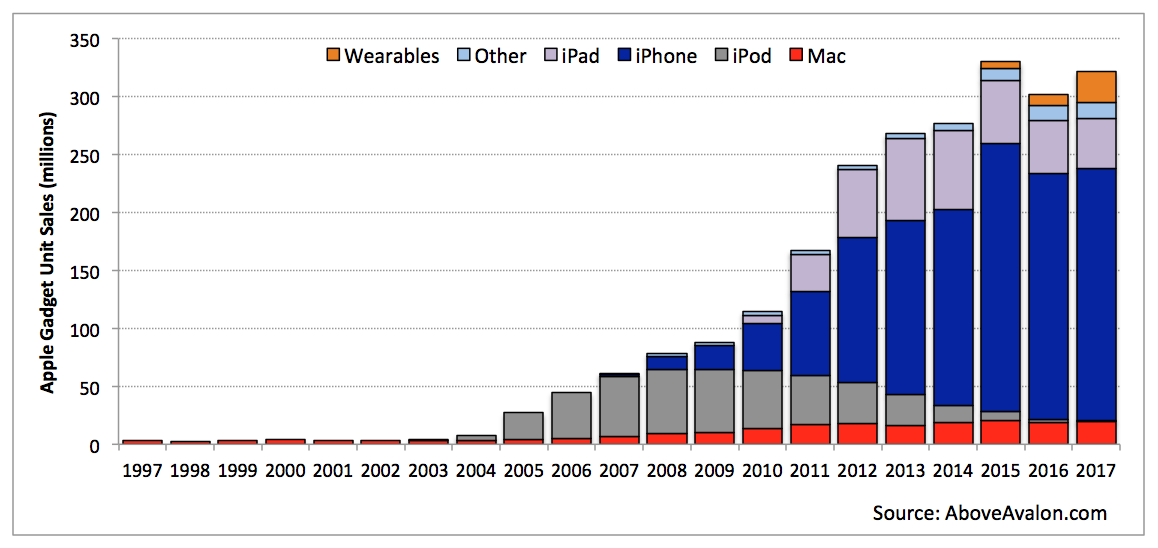
Apple's Growing Bet on Hardware
Apple isn't a hardware company. Nevertheless, hardware's importance to Apple continues to grow. Apple is now overseeing a supply chain and manufacturing apparatus responsible for producing more than 300M gadgets per year. As Silicon Valley increasingly bets on services and intelligent assistants, many are making a critical mistake in downplaying hardware. As Alan Kay, a tech industry pioneer, once said, “People who are really serious about software should make their own hardware." Apple is betting that Kay's advice will remain relevant in the future. Apple is doubling down on hardware in order to become the most powerful software provider in the wearables era.
Hardware Strategy
The vast majority of Apple's products are assembled by contract manufacturers in Asia. This wasn't always the case. In the 1990s, Apple owned its own factories. However, the company was imploding financially from a bloated product line and a costly manufacturing apparatus. Apple's supply chain and network of factories just weren't efficient. In March 1998, Steve Jobs hired Tim Cook as SVP of Operations to save Apple, literally. Cook's initial tasks included quickly drawing down excess Mac inventory in addition to laying the groundwork for Apple's outsourcing strategy.
Cook began to rethink Apple's supply chain, going so far as to get suppliers to move closer to Apple's new assemblers. Apple soon discovered that manufacturers and assemblers in China were capable of meeting the company's high standards like no other. It was around this time that Apple began its long-standing partnership with Foxconn, the company's largest product assembler. Cook also instituted a just-in-time inventory production system which addressed excess inventory issues that nearly crippled Apple.
While much attention has been placed on Apple's contract manufacturers, little is reported on the degree to which Apple works with its suppliers and assemblers. It is not uncommon for Apple designers to spend weeks, or even months, at factories in China. Apple does not design a product in California and just send final manufacturing instructions to its assemblers. The amount of collaboration that occurs between Apple and its various suppliers and manufacturers would surprise most outsiders.
Even though Apple doesn't own factories, the company does own a significant amount of equipment and machines housed in third-party factories. As of the end of September, Apple held $54B of machinery, equipment and internal-use software on its balance sheet. A significant portion of this total is machinery used in the production of Apple's products.
Expanding the Bet on Hardware
Apple's bet on hardware continues to grow. In the past, controlling hardware still amounted to Apple being dependent on others to provide the core technology and components. Apple began to see the value in controlling its own destiny by owning the core technology powering its devices.
In 2010, Apple unveiled the iPad. The device was powered by an A4 processor, the first Apple-designed chip. The A4 was made possible by Apple's P.A. Semi acquisition two years earlier. Jumping ahead seven years, Apple now has a range of processors:
- A Series: iPhone and iPad
- S Series: Apple Watch
- W Series: AirPods, Beats, and Apple Watch
- T Series: Mac
Back in September, Apple introduced the A11 Bionic chip in iPhone 8, 8 Plus, and X. The chip includes the first Apple-designed GPU solution. There is now an increasing amount of evidence that Apple is moving into modem design and power management chips. Apple's end goal is to create a system-on-a-chip (SoC) that includes Apple Ax processors, GPUs, and LTE modem chips.
Apple's current hardware strategy is all about controlling the experience found with its products. In the past, differentiation came from simply doing both hardware and software. Differentiation is now found when there is tighter control over the core components powering products.
Scale
It's easy to think of Apple as just an iPhone maker. More than 210M iPhones are sold per year, and no other Apple product comes close to surpassing iPhone in terms of unit sales. However, iPhone is only one piece of Apple's hardware story.
According to my estimates, Apple sold 322M gadgets in FY2017. This total includes unit sales from every major product category and accessory powered by Apple software (iPhones, iPads, Macs, Apple Watches, AirPods, iPods, Apple Pencils, Beats headphones, and Apple TVs). After a down year in 2016, when Apple shipped 8% fewer devices than in 2015, the company returned to unit sales growth in 2017. In fact, Apple shipped 7% more devices in 2017 than in 2016.
Exhibit 1: Apple Gadget Unit Sales
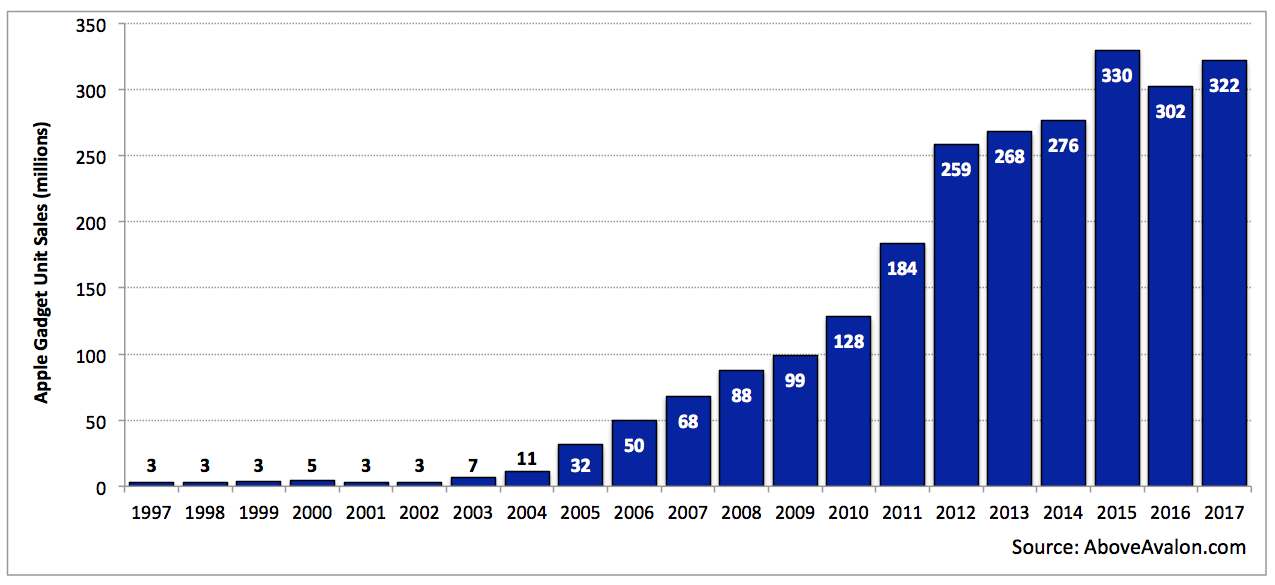
Apple gadget sales include: iPhones, iPads, Macs, Apple Watches, AirPods, iPods, Beats headphones, Apple Pencils, and Apple TVs.
Additional accessories such as Apple Watch bands, iPhone and iPad cases and covers, and various charging cords and cables push the total number of Apple products sold in FY2017 well past 400M.
Along with demonstrating Apple's success at selling mass-market items, these sales numbers illustrate the ability of Apple's supply chain and manufacturing apparatus to produce hardware at scale. In fact, there aren't too many companies operating at Apple's hardware scale. While Samsung doesn't disclose smartphone sales, industry estimates peg the company at selling approximately 300M smartphones per year, which includes a wide range of models. Every other smartphone manufacturer is selling fewer smartphones than Apple is selling. Meanwhile, the world's largest PC makers and other consumer electronics companies don't have the sales required to come close to matching Apple in terms of hardware sales.
Wearables
Apple's hardware scale is about to undergo significant changes. The upcoming wearables era will prove to be a game changer for hardware sales. As there are a little under a billion users, it is not inconceivable for Apple to eventually ship a billion gadgets per year. While this may seem hard to believe considering Apple sold 322 million gadgets in FY2017, the wearables era will likely be defined in terms of ecosystems consisting of different wearable devices. An Apple product line including Apple Watch, AirPods, Beats, and Apple Glasses, combined with a user base of more than one billion people, will lead to massive demand for hardware.
We are already starting to see the beginning stages of wearables impact Apple's manufacturing apparatus. According to my estimates, Apple sold nearly 30M wearable devices in FY2017, up from 10M devices in FY2016. Nearly one out of ten gadgets Apple sells is a wearable. Looking ahead, it is possible we will see Apple sell 50M wearable devices in FY2018 as Apple Watch and AirPods are seeing remarkable momentum in the marketplace. Both Apple Watch and AirPods are products that contain the potential of one day selling in the hundreds of millions of units per year. Meanwhile, it is inevitable that Apple will one day sell a pair of augmented reality glasses.
Exhibit 2: Apple Gadget Unit Sales by Product
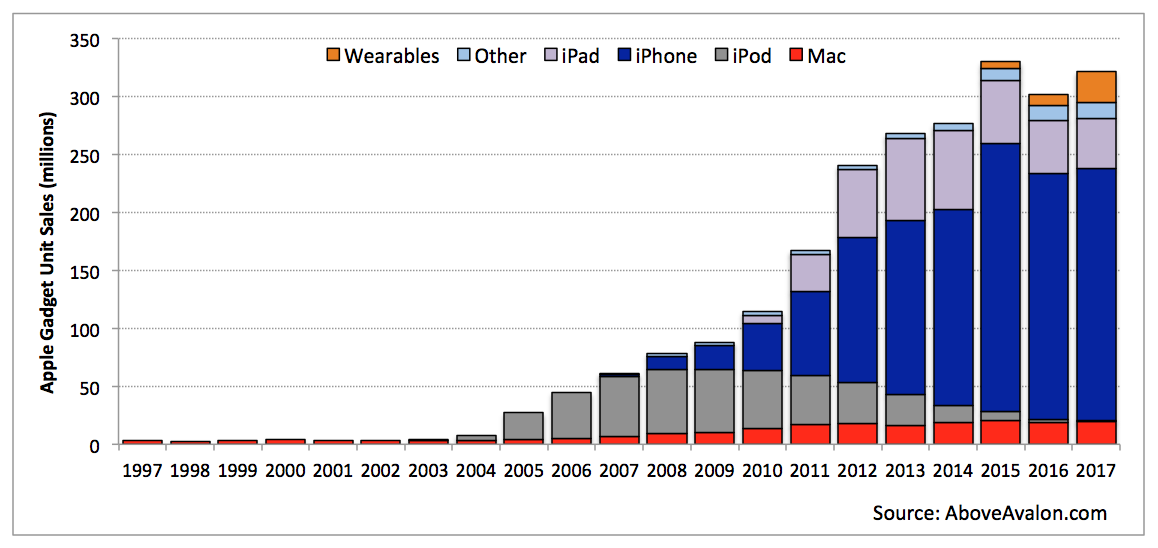
Note: "Other" includes Apple Pencils, Apple TVs, and Beats headphones. Wearables include Apple Watches, AirPods, and select Beats headphones.
Hardware Prowess
In many ways, Apple's product event this past September at Steve Jobs Theater demonstrates the scope of Apple's hardware prowess. Apple unveiled a cellular Apple Watch and iPhone X, two products made possible only after years of intensive collaboration throughout Apple. The amount of collaboration required puts the company's extensive efforts with Apple Park, a campus designed to improve collaboration within Apple, into perspective.
Everything from the iPhone X's OLED display to the neural engine found inside the A11 Bionic chip come together to produce an experience that would be impossible to create by a company focused just on software or hardware. Similarly, the W2 and S2 chips found in Apple Watch Series 3, along with the ability to include cellular without jeopardizing device thickness or even battery life, is remarkable. After placing big bets on hardware for decades, Apple is now in a position where its hardware capabilities are opening doors for Apple software and services.
While Apple's hardware bets are already providing the company a competitive advantage over peers with smartphones, tablets, and wearables, the long-term implications of Apple's hardware strategy are still being underestimated. Apple is well-positioned to build the most formidable supply chain and manufacturing apparatus for wearables. Apple now finds itself making bets in terms of controlling core components in products. The company is also investigating new manufacturing techniques and processes that will give the company an advantage over peers in the wearables space. This may be better measured in decades than in years. Apple has never seen a scenario like this play itself out before. This is unchartered territory.
Google, Microsoft, Amazon, and Facebook have been busy talking about a "post device" era in which the very idea of a device fades away. Instead powerful voice assistants and cloud services powered by artificial intelligence ultimately gain power at the expense of hardware. Apple is betting on a very different future. Apple sees a world in which hardware gains power in our lives. Apple is moving to the point at which it will have near complete control over every major component powering its device. Whether it is seen in new kinds of displays, smarter cameras, or custom silicon, hardware has a role to play in pushing more intelligent software and services. Instead of tomorrow's winners being those companies controlling powerful software and services, the winners will be companies shipping hardware that can melt away allowing the user to interact with software with as few barriers as possible.
Receive my analysis and perspective on Apple throughout the week via exclusive daily emails (2-3 stories a day, 10-12 stories a week). To sign up, visit the membership page.
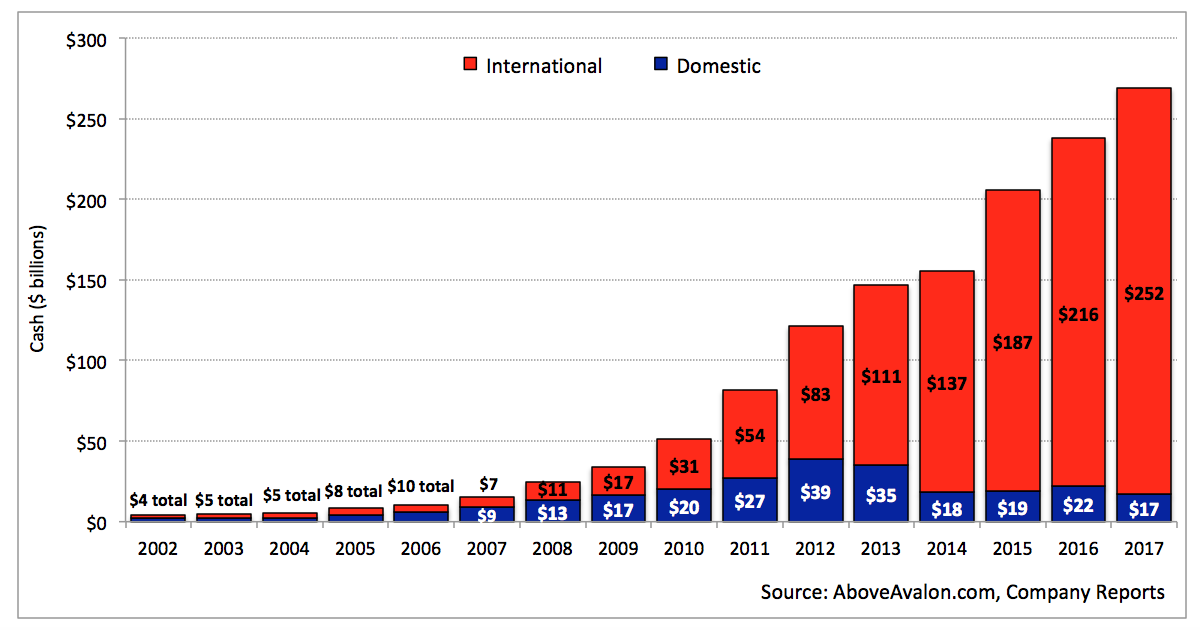
The End to Apple’s Cash Dilemma
With the U.S. Senate passing its tax bill earlier this month, the probability of a U.S. corporate tax overhaul has never been higher. While differences between the House and Senate tax bills still have to be reconciled in conference, the end to Apple's cash dilemma is in sight. Both bills move the U.S. to a territorial-based tax system. In addition, both bills include deemed repatriation at a 14% rate. (The Senate bill calls for a 14.49% tax rate.) The repatriation tax change alone benefits Apple to the tune of tens of billions of dollars. More importantly, the tax changes will allow Apple to develop a sustainable long-term strategy for managing its cash and balance sheet.
Current Cash Strategy
Apple is a cash-generating machine. In FY2017, Apple reported $64B of operating cash flow, nearly as much as that of Alphabet, Facebook, and Amazon combined. On a free cash flow basis, which is a measure of how much cash is generated after taking into account capital expenditures and other costs associated with running the business, Apple's $50B of free cash flow was $2B more than free cash produced by Alphabet, Facebook, and Amazon combined. Apple has the best business model for generating cash.
Under the current U.S. tax system, Apple owes 35% tax to the federal government on all revenue earned, both in the U.S. and abroad. However, Apple pays tax on foreign profits only when the cash is repatriated, or brought back, to the U.S. This has led Apple, along with other Silicon Valley firms, to keep foreign cash offshore as it is the financially prudent thing to do for shareholders. Deferring repatriation to a later date reduces the present value of tax payments. In the meantime, Apple pays local taxes on foreign profits (a credit is provided for taxes paid to foreign governments) and accrues tax on the portion of cash deemed to be brought back to the U.S. at some point in the future.
With Apple unable to use cash held in foreign subsidiaries to fund share buyback and quarterly cash dividends, management has been facing quite the cash dilemma. Apple is generating cash internationally at a much faster rate than it is able to spend. This has produced a situation where excess cash that is not needed to run Apple's business has been building on the balance sheet. As of September 30th, 2017, Apple had $252B of cash, cash equivalents, and marketable securities in foreign subsidiaries. As seen in Exhibit 1, international cash now represents 95% of Apple's total cash, cash equivalents, and marketable securities. Meanwhile, Apple is unable to deplete its U.S. cash totals too much more without jeopardizing company flexibility.
Exhibit 1: Apple's Cash, Cash Equivalents, and Marketable Securities

One way management has handled Apple's cash dilemma in the near-term has been to turn to debt markets. By issuing debt at a pace roughly equal to international cash generation, Apple has essentially been using debt as a way to utilize its international cash. The company funnels cash raised via debt offerings into share buyback and quarterly cash dividends. This process becomes apparent when looking at Apple's net cash, which is the amount of cash, cash equivalents, and marketable securities on the balance sheet minus debt. Apple's net cash has plateaued at $150B as international cash generation has been offset by capital management and expenses needed to run the business. However, Apple hasn't been able to spend cash fast enough to actually lead to a declining net cash balance. Instead, Apple finds itself in a situation where it is unable to get rid of excess cash on the balance sheet in a prudent way.
Exhibit 2: Apple's Net Cash
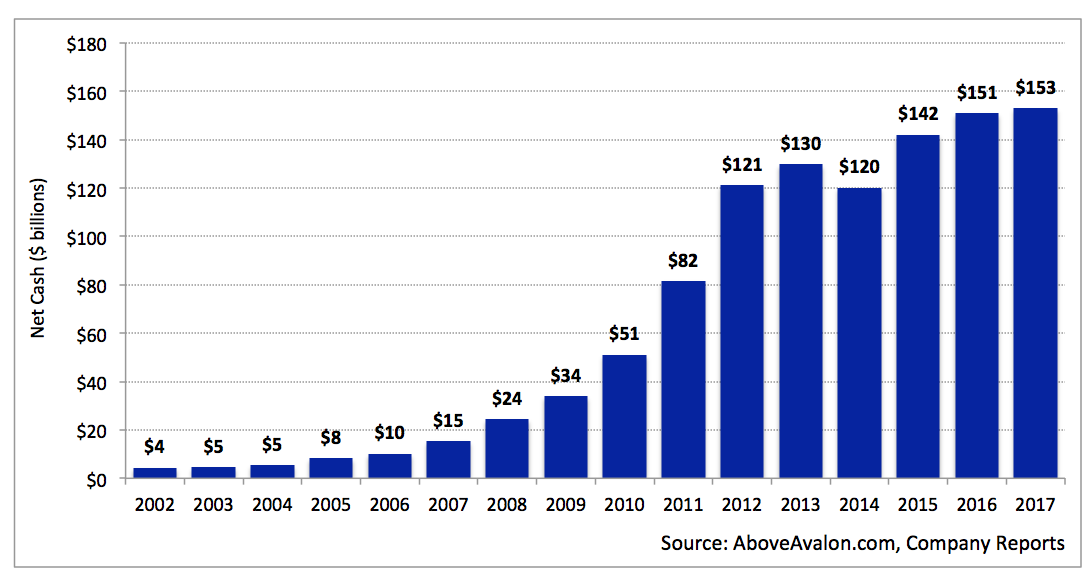
Given Apple’s current balance sheet strategy and assuming no change to the U.S. corporate tax code, the company is on track to soon have $300 billion of cash, almost all of which is located abroad, and $150 billion of debt. Apple will need to carefully manage this growing level of debt as upcoming debt payments come due. This will only strain its U.S. cash needs even further. Simply put, the strategy of issuing debt in lieu of using international cash to fund capital management activity just isn’t sustainable, especially if interest rates rise or iPhone sales slow. Instead, management needs a solution to Apple's excess cash dilemma and an overhaul to the U.S. corporate tax code represents one of the optimal solutions.
Changes Are Coming
Assuming the U.S. corporate tax code is overhauled to include a territorial-based tax system and deemed repatriation at a 14% rate, Apple's cash and balance sheet strategy will undergo two significant changes:
- International cash is brought back to the U.S.. Management will bring Apple's $252B of international cash back to the U.S. After taking into account taxes, Apple will have at least $225B of cash, cash equivalents, and marketable securities in U.S. subsidiaries. Assuming foreign cash is taxed at 14.5%, Apple's decision to delay repatriation will have paid off to the tune of tens of billions of dollars as Apple would have needed to pay a higher rate to return the cash.
- Debt issuance pace slows. Apple is currently issuing approximately $30B of debt per year. The only reason Apple has been issuing so much debt has been to offset the ballooning amount of international cash. With at least $225B of cash in U.S. subsidiaries, Apple will no longer need to issue as much debt. A good argument can be made for Apple to continue issuing some low-cost debt in order to optimize the balance sheet and lower the company's overall cost of capital. One potential strategy is for Apple to issue debt at a pace equal to the amount of existing debt payments coming due ($6.5B of principal debt payments come due in 2018 and another $8.9B in 2019).
Spending Excess Cash
Following repatriation, Apple will have at least $225B of cash in U.S. subsidiaries. After taking into account Apple's $116B of debt and various cash needs including funding organic growth opportunities, SG&A, capital expenditures, R&D, and M&A, management will have at least $75B of excess cash in U.S. subsidiaries following a U.S. corporate tax overhaul. The company has never had more than $39B of cash in the U.S. at any one time. This raises an obvious question: What should Apple do with $75B of truly excess cash? Management has a number of options:
- Share Buyback. Apple has been spending approximately $30B per year on share buyback. Given the daily trading volume found with Apple shares, management could increase the pace of buyback without negatively impacting Apple's share price with excessive buying pressure. Apple could also rely on accelerated share repurchase (ASR) programs to handle additional buyback activity. Management has other buyback options at its disposal, including a modified Dutch auction tender offer, which allows Apple to repurchase a sizable portion of itself in a financially efficient and timely manner.
- Dividends. Apple is currently spending $13B per year on quarterly cash dividends. Management has telegraphed its intention to increase the quarterly cash dividend on an annual basis. Apple can use excess cash to fund a larger increase to the quarterly cash dividend. In addition, Apple can issue a special, one-time cash dividend. Such a dividend would end up being one of the more straightforward ways to quickly get rid of excess cash.
- M&A. Management can use excess cash to alter its M&A strategy and begin buying additional companies, targets with larger price tags, or a combination of the two trends.
- R&D. Similar to M&A, Apple can use excess cash to expand its R&D spending in terms of both breadth (i.e. new industries) and depth (i.e. greater number of bets in existing industries).
- Do Nothing. Apple can choose to do nothing and simply sit on the excess cash.
Out of the five preceding options, additional share buyback is the best use of Apple's excess cash, assuming shares are trading at an appropriate valuation. Management should funnel a significant portion of the cash bought back to the U.S. into share buyback. The other options either contain too many downsides and risks or just don't make sense for Apple.
For the past few years, Apple management has been using share repurchases (and quarterly cash dividends) to funnel excess cash from the balance sheet to shareholders. These actions have reduced the number of Apple shares outstanding, thereby giving each remaining share a larger ownership claim to Apple's future cash flows and earnings. It's not that share buyback is creating shareholder value as cash moves from the balance sheet to those selling their shares. Instead, share buyback has led to a more optimal balance sheet, which helps lower Apple's total cost of capital. Other benefits found with share buyback include strong signaling effects in the market and the increased probability of investors placing a higher value on future cash flows and earnings. (My stock buyback program primer is available for Above Avalon members here.)
Dividends. A huge increase to the quarterly cash dividend will limit Apple's financial flexibility in the future. Unlike share buyback, which can easily be dialed back at any time, there is more downside found with needing to cut a quarterly cash dividend when business prospects turn negative. It isn't wise from a financial perspective to use excess cash on the balance sheet to initiate a higher quarterly cash dividend, which amounts to a recurring expense stream. Instead, dividend payouts should be tied to earnings and cash flow generation. As for a special cash dividend, many Apple shareholders have no interest in paying the taxes associated with a special dividend.
M&A. Apple has been following a very particular M&A strategy. Over the past five years, Apple has spent $5 billion on M&A buying smaller companies. More than half of that M&A expense total relates to Apple's Beats acquisition in 2014. Instead of using M&A to buy revenue or users, which is a disastrous strategy in Silicon Valley, Apple looks to fill asset holes in terms of technology and talent. While Apple's existing M&A strategy doesn't exclude the possibility of big ticket acquisitions, it does reduce the likelihood of Apple buying sprawling companies with lots of baggage. There is little sense found with Apple altering its M&A strategy to pursue larger M&A deals because it has excess cash to spend.
R&D. There is a growing amount of evidence that Apple has been adapting its R&D strategy to the changing tech and design landscape. While the company remains remarkably focused in terms of R&D spending (Apple spent $12B on R&D in FY2017), management appears to be expanding its interests to include additional industries, manufacturing techniques and processes. Apple has also been moving in the direction of venture capital investing as seen with $1B investments in Didi and SoftBank's tech fund. The moves are part of Apple's effort to improve access to new ideas and upcoming technology. The major takeaway from Apple's evolving R&D strategy is that management is able to fund R&D with organic cash generation. There is no need for Apple to ramp R&D expenditures to get rid of cash.
Do Nothing. While management has the option to do nothing with the excess cash, such a decision isn't financially prudent. Investors are not valuing Apple shares based on management's skill at running the largest hedge fund in the world. Instead, shares are valued on the degree to which management utilizes Apple's assets to produce future cash flows. Sitting on excess cash ends up being a major liability for Apple. One of the largest risks found with holding too much cash on the balance sheet is Wall Street discounting the cash. In fact, Apple likely saw this scenario play out in the early 2010s, before the company's capital return program was launched. One fear that investors have with companies holding excess cash is that future management teams will waste the cash on frivolous M&A and other questionable investments. This results in the value of the cash being discounted, leading to a lower stock valuation.
Modified Dutch Auction Tender Offer
Apple management will need to dramatically increase its share buyback pace if the goal is to use $75B of excess cash to repurchase additional shares in a timely manner. On paper, this wouldn't seem to pose a problem. However, there are limitations as to how many shares Apple can repurchase without distorting the share price. The company is already repurchasing $30B of shares per year. It just isn't realistic to assume Apple can use open market transactions, or even ASRs, to repurchase an additional $75B of its shares over the next year or two.
Instead, Apple can turn to an alternative mechanism for share buyback. A modified Dutch auction tender offer jumps out as the most appropriate vehicle. In a modified Dutch auction tender offer, a company goes straight to shareholders with plans to repurchase a significant amount of stock. Shareholders are then given the means to indicate interest in selling their shares to the company, at a particular price range chosen by the company.
With a modified Dutch auction tender offer, Apple would be able to buy back $75B of its stock in just a few weeks at a relatively cost efficient manner. The repurchased shares would be retired and taken out of circulation. More importantly, Apple would be able to buy back a significant portion of itself without causing too much distortion in the marketplace. Modified Dutch auction tender offer announcements have a tendency to initially drive stock prices higher due to the strong signaling effect (i.e. management must be very optimistic about future prospects). On average, companies buy back 15% of outstanding shares with modified Dutch auction tender offers. A $75B tender offer would amount to Apple buying back about 8% of itself.
Light at the End of the Tunnel
An overhaul to the U.S. corporate tax means much more to Apple than just a different tax rate going forward. A territorial-based tax system will allow Apple to manage future cash generation much more efficiently. The days of Apple being stuck with too much cash in international subsidiaries are numbered. In addition, concerns surrounding Apple issuing too much debt will subside as the company will no longer need to rely on debt issuance to fund share buyback and quarterly cash dividend. These changes amount to a sustainable strategy for Apple to use when managing its massive balance sheet. There is finally light at the end of Apple's cash dilemma tunnel.
Receive my analysis and perspective on Apple throughout the week via exclusive daily emails (2-3 stories a day, 10-12 stories a week). To sign up, visit the membership page.
A Stationary Smart Speaker Mirage
We are in the midst of a massive mindshare bubble involving stationary smart speakers in the home. While the press talk up the category with near breathless enthusiasm and positivity, there is a growing amount of evidence that stationary smart speakers powered by digital voice assistants do not represent a paradigm shift in computing. Instead, the stationary smart speaker's future is one of an accessory, and it will be surpassed in prominence by wearables. It's time to call out the stationary smart speaker market for what it is: a mirage.
Amazon Echo
Despite a number of companies competing in the stationary smart speaker space, Amazon is the undisputed leader. In November 2014, Amazon introduced the Amazon Echo to little fanfare. TechCrunch’s relative simplistic take on the first Echo ended up being very telling:
"Amazon has a new product that doesn’t really have any current equivalent from any other tech company – a connected speaker called Echo that’s always-on, listening for commands that its virtual assistant can then respond to with information or by triggering a task."
Instead of positioning hardware, software, or design as the most critical ingredient, Amazon positioned a digital voice assistant as the Echo's differentiator. Silicon Valley was intrigued, and it is fair to view that initial Echo as having single-handily kicked off today’s smart speaker market.
As shown by Google Trends, it took another two years for the Echo to go mainstream. Given how Amazon has supplanted a portion of Google search, one can safely assume Google Trends underestimates Echo interest, especially when considering Amazon Prime users.
Google Trends results for "Amazon Echo" in the U.S.
The 2016 holiday season stood out for Amazon Echo. The company went on to say it sold nine times more Echo devices during that holiday shopping period than during the previous year's. While Amazon didn't elaborate on the reasoning behind the dramatic jump in sales, the most logical explanations were that Echo sales were coming off a very low base in 2015 and consumers were enticed by the low-priced Echo Dot, unveiled in March 2016.
Sales
Since the leading smart speaker manufacturers avoid disclosing sales, there is a dearth of concrete sales data regarding the overall size of stationary smart speakers. Therefore, we are left to depend on questionable customer surveys and research firms using mysterious methodologies.
When it comes to the current market leader, it is not in Amazon’s best interest to disclose Echo sales. Given how Amazon already receives near universal praise in the press, there would only be downside found in Echo sales disclosure. Taking the few clues provided by Amazon management in the form of holiday press releases, my estimate pegged Echo sales at around 15M speakers per year during the first half of 2017. To put that sales number in context, Apple is selling approximately 20M Apple Watches per year. Earlier this week, Amazon said that “millions” of Echo devices were sold between Thanksgiving and Cyber Monday. It is reasonable to assume that the company has seen an increase in the Echo sales pace in recent months.
As seen by the massive resource shift occurring across the industry, other companies have taken note of Amazon’s Echo sales. Seemingly every consumer-oriented tech company is now coming up with its own offering for the stationary smart speaker market. Facebook is even rumored to be working on a stationary screen with a speaker.
A Mirage
On the surface, Amazon Echo sales point to a burgeoning product category. A 15M+ annual sales pace for a product category that is only three years old is quite the accomplishment. This has led to prognostications of stationary smart speakers representing a new paradigm in technology. However, relying too much on Echo sales will lead to incomplete or faulty conclusions. The image portrayed by Echo sales isn't what it seems. In fact, it is only a matter of time before it becomes clear the stationary home speaker is shaping up to be one of the largest head fakes in tech. We are already starting to see early signs of disappointment begin to appear.
A closer look at Amazon's Echo line reveals why people are apparently buying millions of Echo devices: they're cheap. Amazon has ushered in a race to the bottom within the stationary speaker space like we have never seen in consumer electronics. In just three years, the stationary home speaker market is now filled with mediocre speakers costing as low as $20. Google has followed suit with Google Home Mini, a cheaper version of its Google Home smart speaker. It is just as expensive to buy a specialty pizza as an Echo Dot or Google Home Mini. Similar races to the bottom were projected in smartphones, tablets, and wearables but never materialized.

Aside from cheap Echo speakers, there is no clear evidence of other speaker manufacturers seeing significant traction. Google Home sales are estimated to be a fraction of Amazon's speaker sales. Meanwhile, there is a similar lack of evidence supporting the idea that higher-end speaker alternatives like Sonos have been able to move beyond niche.
It’s not just that smart speaker prices have collapsed. If the primary value of an Echo speaker is access to Amazon's digital voice assistant, Alexa, there is little additional value found in higher-priced Echo alternatives. While Amazon is not in a rush to provide a sales breakdown by Echo model, my suspicion is that the vast majority of sales are found with the Dot, the cheapest Echo.
Silicon Valley calls this race to the bottom the commoditization of hardware. Services companies like Amazon and Google use low-cost hardware to seed rich, data-capturing services in our lives. The end goal for these companies is accessing valuable customer data while the vehicle of choice to capture this data is a digital voice assistant.
Mobile Trouble
It is not a coincidence that the companies placing the largest bets on stationary speakers in the home have either failed or run into trouble with previous mobile strategies. Amazon's entry into smartphone hardware with the Amazon Fire phone was one of the colossal failures in smartphone history. Similar attempts by Facebook to come up with its own smartphone went nowhere. Meanwhile, Google now finds itself running into trouble as Android continues to lose power in the premium end of the smartphone market.
The commonality among the three preceding examples is that each has seen its dependence on Apple grow over time. The lack of a viable, standalone smartphone offering means Amazon, Facebook, and Google have had to rely increasingly on iPhone and iOS to reach their customers. This scenario has irked Jeff Bezos for years and plays a big role in Amazon's hardware strategy. Facebook's Oculus acquisition was born out of a similar mindset with Mark Zuckerberg looking to control Facebook's destiny by owning hardware. Meanwhile, Google has resorted to using the Pixel smartphone to reach premium users becoming disenchanted with Samsung. In addition, Google has begun ramping up its traffic acquisition costs (TAC) to ensure it remains the default search option on iOS.
These companies are not moving into stationary devices for the home because they represent the next frontier in tech or an upcoming paradigm shift. Instead, these companies are incentivized to figure out a way to reduce smartphone usage by unbundling the device. The result is smart speakers piping digital voice assistants that are also available through our smartphones, tablets, and smartwatches.
The fact that companies that did not succeed with smartphone hardware are increasingly betting on stationary devices has been described as a moment of opportunity. Some in the tech community have looked at low-cost hardware powered by digital voice assistants as some kind of hardware disruption – commoditized hardware powered by closed-based services to handle tasks we used to give smartphones and tablets. I disagree. Stationary home speakers aren't a disruption. Instead, they are proving to be a distraction.
Crossroads
The past 10 years of technology can be boiled down to one overarching theme: mobile devices with a multi-touch interface (smartphones and tablets) becoming alternatives to traditional laptops and desktops. While there have been a few side shows here and there, nothing has come close to matching this one paradigm shift.
While smartphones and tablets continue to get smarter and more advanced, there is no denying that sales growth reflects mature product categories. With already high adoption rates, upgrade trends and platform switching are increasingly becoming the only remaining sources of sales growth. This has led to acceleration in resources being shifted to other product categories in search of the next big thing.
We now find ourselves at a crossroads. The competitive tech landscape is changing. The battle for our attention is broadening into a massive land grab for the most valuable real estate in our lives. Tech battle lines are now being redrawn around three pivotal aspects of daily life: body (health), home, and transportation.
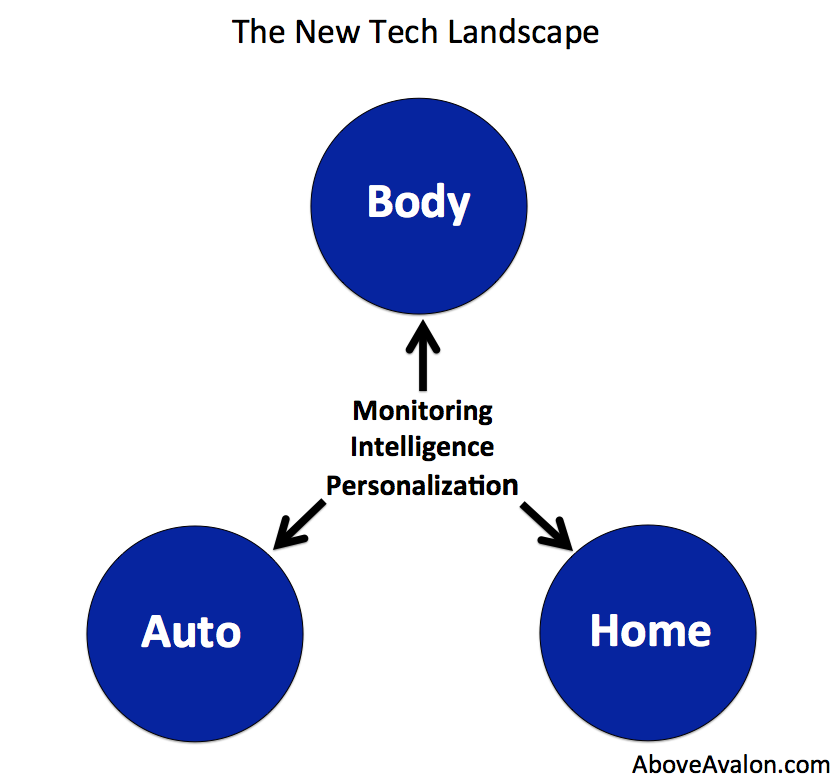
It would be a mistake to assume that these three categories have jobs and use cases that will require three completely different sets of products. At the same time, it would be equally incorrect to assume the smartphone will remain at the center of our lives. Instead, there will likely be new products and some overlap as to how those products are used. One of the major sources of this kind of overlap is found with the body and home.
Future
In some ways, the stationary smart speaker market resembles the early wrist wearables market. There was a significant amount of unknown found with where the wrist wearables market was headed: low-end fitness trackers, high-end smartwatches, or some combination in between. It took a few years and Apple’s entry into the market for the landscape to change.
There are three distinct possibilities as to the stationary smart speaker's future.
Low-cost hardware to push digital voice assistants. Consumers purchase cheap smart speakers solely based on the accompanying digital voice assistant. Smartphones, tablets, and smartwatches ultimately lose value in this scenario. The winners are services companies betting on intelligent digital voice assistants to capture as much customer data as possible.
High-end accessory. Given how digital voice assistants are already found in smartphones, tablets, and smartwatches, consumers look for standalone speakers to offer something more. That additional capability would likely be superior sound quality.
Disjointed space waiting for unknown catalyst. A number of players are able to coexist despite relying on dramatically different strategies and core competencies. While market share will likely be used to denote winners and losers, in reality, success will be determined by usage patterns and access to premium users.
Consensus currently thinks the first option is the most likely outcome for the stationary smart speaker market. This explains the sheer amount of skepticism pointed toward higher-priced speakers like Apple’s HomePod speaker. Meanwhile, Apple is placing its bet on the second or third options coming true. When introduced at WWDC 2017, HomePod was marketed as an iOS accessory that will serve as the best speaker people have ever owned. The $349 price certainly reflects this accessory mindset. While Apple briefly went over how HomePod will be able to serve as a type of smart home hub, it was almost more of an afterthought. At its core, Apple does not think the only function for stationary smart speakers is to pipe digital voice assistants.
Wearables
I don’t think stationary smart speakers represent the future of computing. Instead, companies are using smart speakers to take advantage of an awkward phase of technology in which there doesn’t seem to be any clear direction as to where things are headed. Consumers are buying cheap smart speakers powered by digital voice assistants without having any strong convictions regarding how such voice assistants should or can be used. The major takeaway from customer surveys regarding smart speakers usage is that there isn’t any clear trend. If anything, smart speakers are being used for rudimentary tasks that can just as easily be done with digital voice assistants found on smartwatches or smartphones. This environment paints a very different picture of the current health of the smart speaker market. The narrative in the press is simply too rosy and optimistic.
Ultimately, smart speakers end up competing with a seemingly unlikely product category: wearables. In fact, stationary smart speakers and wrist wearables share a surprising amount of similarities. Each is ultimately based on handling tasks formerly given to smartphones and tablets. Two examples are delivering both digital voice assistants and sound. If the goal is to rely on a digital voice assistant, an Apple Watch wearer has access to Siri at pretty much every waking moment. When simply wearing an Apple Watch, Siri is instantly available everywhere in the home. The same kind of access to Alexa would require five, ten, or maybe even 15 Echo speakers spaced strategically throughout the home (another reason why Echo sales are becoming increasingly misleading - some consumers may be buying a handful of $20 speakers at one time). With a cellular Apple Watch, Siri is now available outside the home even when users are away from their iPhones. Meanwhile, Alexa is stuck within four walls - at least until Amazon unveils its Alexa smartwatch.
Wearables contain a much more attractive long-term value proposition than stationary smart speakers that have to be connected to a wall outlet. In addition, the presence of a screen provides even more value as it has become very clear that voice-first or voice-only interfaces just aren't that efficient.
The writing is on the wall. The stationary speaker market is a stopgap measure taking advantage of relatively low wearables adoption. My estimate is that Apple Watch adoption stands at 3% of the iPhone user base (10% to 15% of iPhone users in the U.S.). As that percentage increases, my suspicion is we will start to see the stationary smart speaker market begin to experience usage and retention troubles. Just as every company seems to be moving into the smart speaker space today, pain and lackluster results will begin to spread, ultimately leading to most companies exiting the space.
There may still be a future for stationary smart speakers, but not as some kind of future computing paradigm. Instead, stationary smart speakers will become accessories to the very same wearables that they are competing against today. For example, when an Apple Watch wearer wants to listen to music, HomePod will be positioned as a way to provide a much better sound experience. In addition, the very same HomePod can be positioned in the home as a type of smart home hub for controlling devices while away. If voice interfaces evolve to the point of becoming more useful, wearables will be able to easily support an increased reliance on digital voice assistants. The current fascination with standalone smart speakers may end up being labeled as a stepping stone to mass-market wearables adoption.
Receive my analysis and perspective on Apple throughout the week via exclusive daily updates (2-3 stories per day, 10-12 stories per week). Available to Above Avalon members in both written and audio forms. To sign up and for more information on membership, visit the membership page.