

It's Time for Apple to Disclose Apple Watch Sales
Apple Watch is a resounding success, and it's time for Apple to make it official by providing quarterly sales data. The question of whether Apple should disclose Apple Watch sales has never had a simple "yes" or "no" answer. Instead, the positives and negatives found with disclosure have to be weighed against each other. There is now more upside found in Apple disclosing quarterly Apple Watch sales than in keeping them private and just providing sales clues.
The Initial Decision
In late 2014, six months before Apple Watch went on sale, Apple announced that it would not be disclosing quarterly Apple Watch revenue and unit sales. The company would include Apple Watch in a new financial line item. The category, called "Other Products," would serve as a catch basin for a variety of products including iPod, Beats, Apple TV, other Apple accessories, and a range of third-party accessories sold through Apple Retail.
Apple's decision to withhold Apple Watch sales was a controversial one. Apple Watch represented Apple's first genuine new product category in the Tim Cook / Jony Ive era. Expectations were high as observers positioned Apple Watch as a litmus test for Apple's ability to innovate following iPhone and iPad. The lack of disclosure meant analysts would have to back into Apple Watch sales estimates using their own earnings models. This process guaranteed there would be a discrepancy when it came to Apple Watch estimates.
A number of theories were put forth regarding why Apple made the initial decision to lump Apple Watch in with Other Products. The official reasoning according to Apple management was that given how Apple Watch was a new product with no revenue, it made sense to lump the product with other products. In addition, the lack of disclosure was said to make it difficult for competitors to assess Apple Watch demand and market trends. The much simpler explanation was that Apple just didn't stand to benefit from disclosing Apple Watch sales out of the gate. Apple faced a number of benefits associated with keeping Apple Watch sales hidden, such as:
- Keeping competitors in the dark.
- Avoiding negative press coverage focused on the wide discrepancy between Apple Watch and iPhone sales.
- Avoiding investor and analyst disappointment if Apple Watch sales missed very high expectations.
- Moving the Apple narrative on Wall Street beyond unit sales growth.
Meanwhile, the downsides associated with keeping Apple Watch sales hidden included:
- Portraying a lack of confidence in Apple Watch.
- Being unable to control the Apple Watch narrative in the press.
In early 2015, there was very little upside for Apple found with disclosing Apple Watch sales. While management was confident that Apple Watch would become a hit product, there was no reliable way of converting that optimism into multi-year sales projections. The product had an unknown adoption curve, and Apple did not have a recent product to use as a proxy to estimate adoption. The iPad was released five years earlier, but the product had proven to be a sales outlier by riding the iPhone's coattails. In addition, management knew initial Apple Watch sales would pale in comparison to iPhone sales, potentially leading to negative stories in the press. Apple made the correct decision to keep initial Apple Watch sales hidden.
Sales Clues
On the surface, Apple's decision to withhold quarterly Apple Watch sales data would make it difficult to assess performance. As seen in Exhibit 1, Other Products revenue, which includes Apple Watch sales, doesn't provide many clues regarding Apple Watch demand. If anything, the most likely takeaway is that Apple Watch sales haven't been impressive. However, this assessment is grossly inaccurate.
Exhibit 1: Apple "Other Products" Revenue
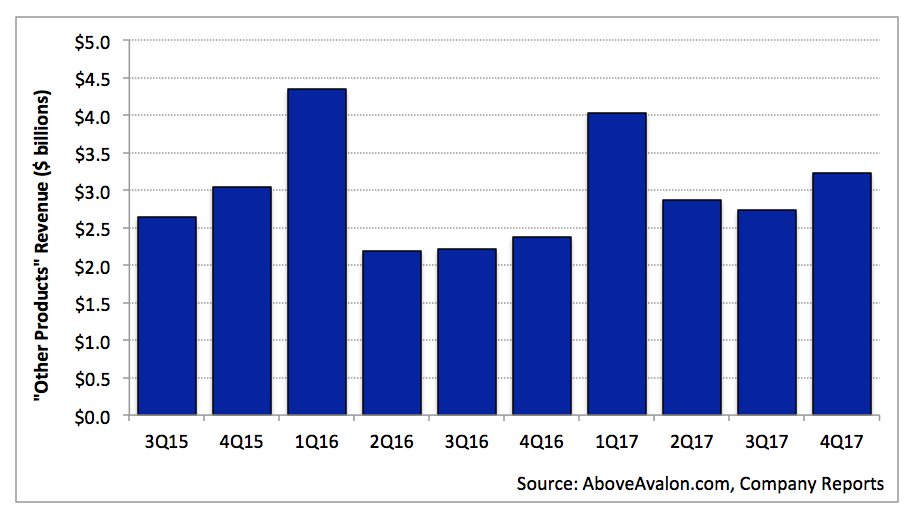
In what came as a surprise, soon after Apple Watch launched, Apple management began to provide clues regarding Apple Watch sales. The sales clues have now become so helpful at reaching Apple Watch sales estimates, management appears to be systematically undermining its initial decision to withhold sales data. Some of the more noteworthy sales clues over the past two-and-a-half years include:
- Apple Watch revenue accounted for "well over 100% of the growth" in Other Products in 3Q15 (two months of sales). In addition, Apple Watch sell-through was higher in 3Q15 than in the comparable launch periods for iPhone and iPad.
- Apple Watch unit sales were up sequentially in 4Q15 and once again in 1Q16.
- Apple Watch unit sales exceeded sales of iPhone during its first year. Apple Watch was the second best-selling watch brand in CY2015 (revenue).
- Apple Watch experienced a unit sales and revenue record in FY1Q17. Apple Watch sales "nearly doubled year over year" in 2Q17 and have been up "over 50%" in 3Q17 and 4Q17.
- Apple Watch was the best-selling watch brand over the twelve months ending in June 2017 (revenue).
Taking the preceding clues into consideration and adding them to my Apple financial model leads to the Apple Watch unit sales estimates found in Exhibit 2. Apple has sold 30M Apple Watches to date. More detail on the size of the Apple Watch installed base and user base is available for Above Avalon members here.
Exhibit 2: Apple Watch Unit Sales (Above Avalon Estimates)
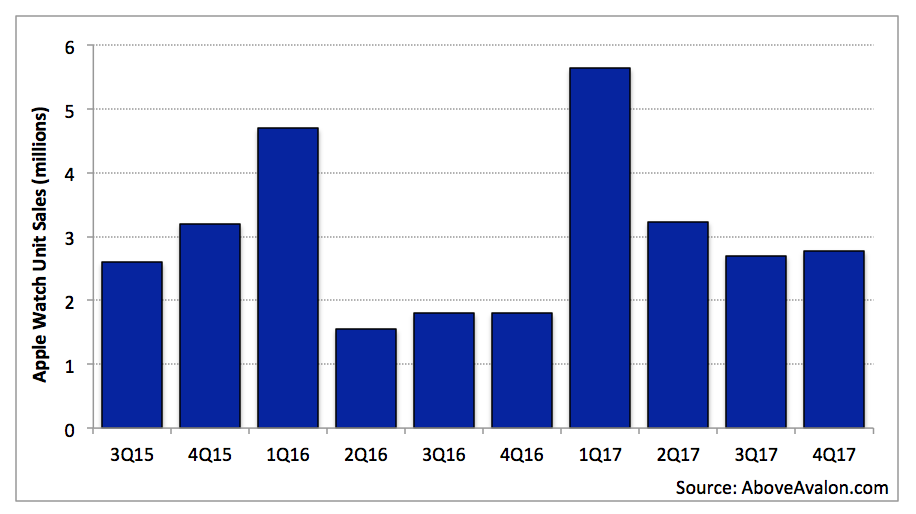
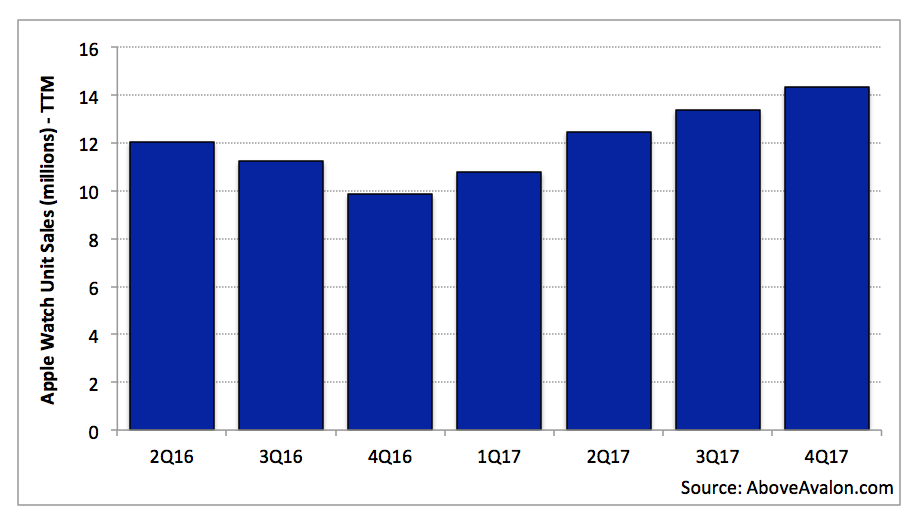
In order to remove the seasonality found with Apple Watch (sales are concentrated in the holiday quarters - 1Q16 and 1Q17), Exhibit 3 shows Apple Watch sales on a trailing twelve month basis. Apple Watch momentum becomes much easier to observe. Apple Watch unit sales have been steadily increasing over the past year with unit sales up nearly 50% year-over-year on a trailing twelve month basis.
Exhibit 3: Apple Watch Unit Sales - TTM (Above Avalon Estimates)
Time for Change
Four major changes have swung the disclosure debate in favor of Apple providing Apple Watch data on a quarterly basis.
- There is no smartwatch market. After more than two-and-a-half years of competition, it is clear that Apple Watch doesn't have much genuine competition. Instead of there being a smartwatch market, there is just an Apple Watch market. In the beginning, some thought low-cost, dedicated health and fitness trackers would pose a major long-term sales risk to higher-priced, multipurpose wearable devices like Apple Watch. This has proven to be incorrect. Apple Watch is seeing growing sales momentum while dedicated fitness trackers are quickly fading in the marketplace. Samsung, Garmin, Fossil are the only companies selling at least 100,000 smartwatches per quarter on a regular basis. The rationale for withholding Apple Watch sales data "due to competitive reasons" is getting weaker as time goes on. In addition, competitors already have a very good idea of how Apple Watch is performing in the marketplace thanks to the sales clues provided by Apple. (In addition, I have been providing Apple Watch sales estimates to Above Avalon members for years.)
- Additional Apple Watch sales data. Apple has a much better handle on Apple Watch demand trends given 10 quarters of Apple Watch sales data. Management is well aware of the seasonality found with Apple Watch sales. In addition, much of the unknown found with the quarterly swings in Apple Watch sales has been removed. Year-over-year growth projections for Apple Watch now serve as a more reliable way of forecasting sales.
- Low Apple Watch expectations. Wall Street no longer has high expectations for Apple Watch sales. Accordingly, Apple is no longer facing the same level of risk of missing Apple Watch sales expectations.
- New Wall Street focus. There is evidence of Wall Street focusing much less on Apple's unit sales growth. Instead, Wall Street is increasingly focused on Apple's balance sheet. The result is an environment in which Apple doesn't have to worry as much about slowing Apple Watch unit sales posing a threat on Wall Street.
Apple has been trying to play both sides of the Apple Watch disclosure debate. On one hand, the company still doesn't want to face the pressure and scrutiny found with disclosing Apple Watch revenue on a quarterly basis. However, management is providing increasingly detailed sales clues in an effort to tell the world that Apple Watch is selling well and gaining momentum.
Apple now stands to benefit more from disclosing Apple Watch sales than keeping them hidden. What were once incentives for not disclosing Watch sales have reversed and now represent reasons to provide sales data.
- Apple is missing positive press coverage associated with strong Apple Watch sales figures.
- Apple can improve its Wall Street narrative by talking up Apple Watch as a primary computing platform. Sales data will help Apple in such efforts.
The recurring theme found with Apple's disclosure philosophy is providing numbers when doing so benefits the company. A few recent examples include Apple beginning to disclose the number of paid subscriptions across the various App Stores and more detailed numbers related to Apple Retail traffic. The paid subscriptions disclosure goes a long way in painting Apple as having the best ecosystem for paid third-party services. Meanwhile, the Apple Retail and online store traffic disclosure paints a picture of an expanding Apple ecosystem in China and emerging markets.
Best of Both Worlds
Since Apple won't be required to disclose Apple Watch sales in the near-term given their small percentage of overall revenue, there is a way for management to have the best of both worlds when it comes to Apple Watch disclosure. Management can begin disclosing quarterly Apple Watch unit sales while keeping revenue lumped in with "Other Products." By disclosing unit sales, Apple is able to receive all of the upside found with Apple Watch disclosure. However, by not disclosing revenue, management would be able to keep Apple Watch average selling price (ASP) data hidden for competitive reasons. While the world would know how many Apple Watches are sold every quarter, estimating would still be required to assess which Apple Watch models are selling well. Apple has done something similar in the past with Apple TV when the company periodically disclosed unit sales without breaking out revenue.
By providing just Apple Watch unit sales on a quarterly basis, Apple can beginning taking back the Apple Watch narrative. As of today, there is still a remarkable amount of skepticism pointed toward Apple Watch. Since there is no rational reason for such skepticism to exist given management's Apple Watch sales clues, the lack of official Apple Watch unit sales data is likely a contributing factor. Official Apple Watch unit sales would go a long way in positioning Apple Watch as a compelling computing platform. Some consumers may become interested in Apple Watch once knowing how many other people are buying and wearing the product. Compared to the lack of sales disclosure from companies like Amazon, Google, and Samsung, providing quarterly Apple Watch unit sales would garner much more positive press for Apple Watch.
Meanwhile, there is a declining number of downsides and risks found in disclosing Apple Watch unit sales. Apple Watch has significant momentum in the marketplace, and Apple's engineering and design teams are running as fast as they can with the product category. Apple is leading the market with a cellular Apple Watch and being able to apply fashion/luxury attributes to design and technology. These items will very likely continue to fuel sales momentum for Apple Watch. No other company is close to Apple when it comes to selling multipurpose computers on the wrist at volume.
Financial Disclosure
Apple will eventually have no choice but to disclose Apple Watch revenue. Once "Other Products" begins to account for 10% to 15% of Apple's overall revenue, pressure will build for management to break up the line item to make it easier for analysts to model. Other Products currently accounts for 6% of Apple's overall revenue. The iPad represented close to 15% of Apple's overall revenue immediately after going on sale. Apple likely had no choice but to break out iPad sales. Meanwhile, Apple stopped reporting iPod sales once it declined to 1% of overall sales.
The Other Products line item has been effective up to now since it represents a small fraction of overall Apple revenue. This was the primary motivation behind Apple creating the category in the first place - to serve as a catch basin for products bringing in a small percentage of overall revenue. If Apple Watch continues to see significant revenue growth, pressure will build for Apple to rearrange its financial disclosure in order to break out Apple Watch revenue. While this scenario won't happen in the near term, a few more years of strong Apple Watch sales growth will make it a very real possibility.
Holiday Quarter
Apple's next earnings report marks a great opportunity for Apple to begin disclosing Apple Watch unit sales. Apple will likely sell more than 9M Apple Watches during the holiday quarter, which would represent a sales record and exceed Mac sales by a wide margin. Looking ahead, Apple Watch is on track to reach a 25M unit sales per year pace in 2018. It's time for Apple to begin disclosing Apple Watch unit sales data and become much more vocal in telling the Apple Watch story.
Receive my analysis and perspective on Apple throughout the week via exclusive daily emails (2-3 stories a day, 10-12 stories a week). To sign up, visit the membership page.
iPhone X
After 10 years, the iPhone business is displaying signs of maturity. The days of significant sales growth are in the rearview mirror. The upgrade cycle is getting longer as it becomes that much harder to get people to upgrade their iPhones.
Apple was faced with a choice: Stick with the familiar and milk the iPhone business for all it’s worth, or throw familiarity out the window to pave a new iPhone journey for the next 10 years. Apple chose the latter, and iPhone X is the byproduct.
I’ve been using an iPhone X since Monday. Accordingly, this is not a comprehensive review. Instead, the focus is on my initial impressions and thoughts from using the device. My expectation is for additional iPhone X observations to materialize over the coming days and weeks.
iPhone X is without question an inflection point for the iPhone business. This new iPhone era won’t necessarily materialize in the form of stronger iPhone sales growth. Instead, the iPhone user experience is now on a different trajectory. In some ways, iPhone X places iPhone firmly in the direction of the original vision Jony Ive and Apple’s industrial designers had for iPhone when it was still an R&D project 12 years ago. Apple wants iPhone hardware to melt away, leaving just the user interacting with software.
Not Your Typical Update
The first thing that becomes apparent after using iPhone X is that this isn’t just any iPhone update. (Most people will probably call it iPhone “ex” instead of “ten” – I doubt Apple cares too much since people are going to buy this device in droves).
Historically, Apple has strived to have two or three marque features for each iPhone release. These features have to be substantial enough to frame a marketing campaign around. Some of these features, such as larger screens and fingerprint readers, have been hardware-related while other features, such as Portrait Mode and the dual camera system, have been a combination of software and hardware. In addition, new case colors have become a reliable way of enticing some iPhone users to upgrade. A few of the more noteworthy updates over the years include:
- iPhone 5: Larger 4-inch screen
- iPhone 5s: Touch ID / Gold finish
- iPhone 6 / 6 Plus: Larger 4.7-inch and 5.5-inch screens / Apple Pay
- iPhone 6s / 6s Plus: 3D Touch / Live Photos / Rose Gold finish
- iPhone 7 / 7 Plus: Dual camera system (Portrait Mode) / Jet Black finish
- iPhone 8 / 8 Plus: Glass back / Gold finish
When looking at the preceding list, no one feature jumps out as single-handily changing the way we use iPhone. Instead, each feature played a supporting role in a much bigger production. Apple’s broader goal has been to improve the iPhone experience ever so slightly with each new iPhone. Management has seen more success in reaching that goal in some years than in other years.
With iPhone X, two design changes stand out: the removal of the front-facing home button and Face ID replacing Touch ID. The changes amount to nothing short of an entirely new iPhone experience. The best way to describe the feeling found when using iPhone X is that it’s the closest thing to using an iPhone from an alternative universe. There is this fresh, or reinvigorating, feeling to it – as if the home button was holding the iPhone experience back, representing a barrier to interacting with software. No other iPhone update has been able to elicit such a strong feeling. It is also easy to see where Apple wants to take iPhone over the next ten years (more on this shortly).
Learning Curve
Much to my surprise, there really isn’t much of a learning curve with iPhone X. While it will take a few minutes to get used to not having a home button, the memory reflex adjusts incredibly quickly. I was expecting to keep pressing the bottom of the screen as if there was still a dedicated home button, but it just never occurred.
The remarkable thing about this is that considering how engrained the home button has been in our lives, to just move on after a few minutes says something about the intuitive user interface found with iPhone X. The home button wasn’t just a way to unlock our iPhone the dozens of times throughout the day or to get back to the home screen. Instead, the home button represented familiarity and safety. In case of trouble, a quick tap would drop us back into the comfort found with the home screen. In case of an extra sticky situation, a quick double tap would bring up the multitasking window as a form of escape.
With iPhone X, the swiping gesture has replaced home button pressing, and it feels more natural than a home button ever felt. A swipe up from the bottom of the screen in both a horizontal and vertical position brings you back to the home screen. Control panel is a swipe from the upper right corner.
Why No Home Button?
There is a rather straightforward question to ask about iPhone X: Why did Apple remove the iPhone home button in the first place? It’s all about coming up with a different way to interact with technology – removing extra bezel to just leave you and the screen. A byproduct of this is that Apple is able to fit more screen in the same form factor. iPhone X has a little bit less screen real estate (in terms of area) than iPhone Plus. The 5.8-inch screen has a more vertical element than its iPhone Plus sibling.
While the iPhone Plus has been gaining sales momentum in recent years, culminating with iPhone 8 Plus outselling its smaller iPhone 8 sibling, the form factor is a bit large for a certain portion of the iPhone user base. Apple went with the iPhone X’s particular form factor because it felt the best in hand. Of course, Apple will likely sell different iPhone X sizes over time, but the company had specific reasons for going with the current iPhone X form factor.
Face ID
Touch ID is a thing of the past. If it wasn’t for needing to use Touch ID on my iPad Pro, I doubt I will give the fingerprint recognition technology much thought going forward.
The Apple rumor cottage industry had a wild 2017 when it came to Touch ID and iPhone X. Many Apple rumor finders and reporters were extremely confident that Apple actually wanted to put Touch ID under the screen and due to technological roadblocks had to settle for Face ID. While it would not be surprising for Apple to investigate trying to put fingerprint recognition under a screen (why wouldn’t they kick the tires?), Apple is no way settling with Face ID. In addition, the claim that Face ID is in some way a stop gap is just wrong. Instead, Face ID represents the next reiteration of Apple’s quest to push biometric authentication forward.
Face ID set-up is ridiculously smooth, easy, and quick. We can probably throw the word magical into the mix as well – it would qualify. While Touch ID signup has improved over the years, Face ID blows it out of the window in terms of simplicity and intuitiveness.
There are a few notable drawbacks to Face ID – which do seem like low-hanging fruit for Apple to address down the road. (These drawbacks were discussed in my accompanying iPhone X initial impressions video.)
- You need to look at the iPhone X TrueDepth camera system basically directly on for Face ID to work. The days of laying your iPhone on the desk and just reaching over and pressing the home button are over (for now). Instead, you will either need to shift so that your face is directly over the TrueDepth camera system, or you have to lift up the iPhone from the flat surface. You can just tap the screen to see notifications.
- Face ID requires access to your eyes, nose, and mouth. For some people, this will limit Face ID availability. It is important to point out that Touch ID has its fair share of issues as well including wet fingers.
- In my initial tests, Face ID on iPhone X was slower than Touch ID on an iPhone 8 Plus when used to get to the home screen.
All in all, Face ID is impressive. It’s not a perfect replacement for Touch ID but it’s more than adequate. iPhone X will place Face ID as the first genuine technology that will make facial recognition go mainstream in a smartphone.
The Screen
A few hours with the screen is all you need to begin understanding why Apple chose to remove as much bezel as possible. The way Apple wraps the iPhone X screen around the TrueDepth camera system (a.k.a the notch) has been a polarizing topic in the run up to this week’s launch. Some people think the notch is bad design. This camp argues Apple shouldn’t have included a visual gap in the screen. Renderings showing various iPhone X apps in portrait mode, which clearly look odd at first, have given this camp a decent number of supporters.
However, in what likely isn’t a coincidence, the “notch is bad design” camp has been quiet when it comes to offering or suggesting better alternatives. Including extra bezel to the left and right of the TrueDepth camera system, like every other smartphone manufacturer currently does with their front-facing camera, isn’t a better solution. One wouldn’t be able to use that space to display information such the date, time, battery indicator, carrier signal, etc. In addition, the whole point of iPhone X is to get rid of as much bezel as possible.
Much like the home button, the “notch” will be quickly forgotten. It just melts away after a few hours of use. Let’s not beat around the bush – an iPhone X without any notch would obviously be the closest representation to Apple’s vision of hardware melting away to just leave the user interacting with software. However, the technology for such a feat just isn’t available today (although Apple R&D suggests the company is working at it). But Apple sure comes close to that perfection, even when taking into account the notch.
I don’t think it’s fair to say that the way Apple wraps the screen around the TrueDepth camera system was some kind of major compromise. Instead of Apple redesigning iPhone to remove the notch next year or the following year, there is a much higher likelihood of Samsung and other smartphone manufacturers embracing some version of the notch as the extra bezel found on Galaxy S8 or Pixel 2 XL really does stand out in a negative way when positioned next to iPhone X.
The debate over the notch is not about whether Apple should have included a notch or not with iPhone X. Instead, the debate comes down to screen real estate. Along those lines, the notch comes out ahead. Regardless of the pros and cons found with the notch, Apple is fully embracing it. In fact, the notch replaces the home button as a defining characteristic of the device – a way for the phone to stand out from competitors. The notch ends up being iPhone X branding.
Thoughts on Sales
Beginning Friday, Apple will be selling three new iPhones simultaneously for the first time (iPhone X, iPhone 8, and iPhone 8 Plus). After using both an iPhone 8 Plus and iPhone X, I don’t think it’s completely right to label each as Apple’s flagship iPhone. Instead, iPhone X has the exclusive rights to that title.
While iPhone X shares some similarities with iPhone 8 and 8 Plus, the differences are just too much to place the three phones on the same plane. However, it would be a mistake to cast iPhone 8 and 8 Plus as the forgotten iPhones.
Conventional wisdom positions iPhone X as targeting iPhone users focused on the latest and greatest technology. Meanwhile, everyone else is thought to be interested in the lower-cost iPhone 6s, 7, or 8. After using iPhone X and taking into consideration how most consumers buy iPhones, I’m not sure such a generalization is correct.
The question of how an iPhone user will choose between an iPhone X and a different kind of iPhone (most existing iPhone users will stick with iPhone for their next smartphone) won’t come down to one’s desire for the latest and greatest technology. Instead, it will likely come down to one’s comfort level with change and the desire for familiarity.
For a portion of the 800M iPhone users in the wild, iPhone X will represent change that isn’t essential at this time. This isn’t to say anything about iPhone X not appealing to the mass market or the device not being intuitive enough. Instead, the iPhone user base is increasingly heterogeneous when it comes to views and thoughts regarding technology and iPhone. For many people, iPhone 8 and 8 Plus are worthy upgrades to their existing iPhones. A very strong case can be made that iPhone 8 and 8 Plus will sell just fine next to iPhone X. In subsequent years, these users will eventually be in a better position to embrace the design changes found with iPhone X as Apple extends that design language to different screen sizes.
Approximately 80% of iPhone sales in the U.S. occur through mobile carriers. This means that for many iPhone users, the purchase decision between iPhone 8 and iPhone X may come down to how each iPhone looks next to each other in a Verizon or AT&T store. The iPhone X would probably win if it were a beauty contest – the screen just can’t be beat. However, the home button may give iPhone 8 and 8 Plus some points with a portion of consumers. At the end of the day, sales may end up a draw, which would be a big win for iPhone X considering its higher price.
Speaking of iPhone X pricing - which will likely go down as the most talked about Apple topic of the year – concerns of iPhone X pricing being too high are misplaced. This phone is going to sell well in U.S. and China. In fact, iPhone X will sell well in all of Apple’s established markets. Emerging markets will likely be a different story, which explains Apple’s consumer segmentation strategy for iPhone pricing. The iPhone SE, 6, and 6s are clearly targeting emerging markets where pricing is a much bigger sticking point.
Apple’s Goal
In many ways, iPhone X is the kind of product you would expect from Apple. Instead of settling with the existing iPhone paradigm and watching iPhone sales and profit gradually decline over time, Apple is determined to move on to the next thing. iPhone X is that the next thing. We are seeing the foundation for the next ten years of iPhone. All iPhones will eventually look and feel like iPhone X.
There are a few rough items around the edges. Face ID has some drawbacks when compared to Touch ID, although these are pretty much offset by its positives. In addition, some iPhone Plus users may be left a bit unsatisfied with iPhone X screen real estate (I would be interested in trying an iPhone X in the size of an iPhone Plus).
Apple is laying the foundation for a new user interface paradigm in which we rely much less on multi-touch to control our iPhones. Instead, we will rely on glances and looks. With wearables increasingly positioned as Apple’s product priority, an iPhone that serves as an augmented reality navigator controlled by glances is the future. The technology underpinning such a product can then one day be applied to other wearables controlled by glances and looks: Apple glasses.
Receive my analysis and perspective on Apple throughout the week via exclusive daily emails (2-3 stories a day, 10-12 stories a week). To sign up, visit the membership page.
Apple Is Facing a Double Standard
Apple is a Silicon Valley and Wall Street leader. The company has the most profitable and best-selling smartphone, tablet, smartwatch, and wireless pair of headphones in the market. Apple has grown its user base by 10x over the past 10 years and is bringing in nearly more revenue than Amazon, Alphabet, and Facebook combined. This level of success places a bull's-eye on Apple’s back and rightly so. Leaders should be held to a higher standard.
However, a trend has developed where a number of tech companies are said to be outperforming Apple. Despite being cast as leaders, these companies aren't judged by the same high standards as Apple. Microsoft, Samsung, and Google are said to be one-upping Apple in core competencies like hardware and design. Yet, these companies don't face anywhere near the amount of criticism thrown at Apple.
Even when looking at companies that deserve to be put on a pedestal, such as Amazon, Tesla, and Tencent (WeChat), a double standard becomes apparent. While these companies are doing great things in terms of building promising customer relationships, none are exposed to the level of cynicism facing Apple. A company that is heralded in the press as surpassing Apple as a leader should face the same high standards used to judge Apple. Unfortunately, this never happens. The bull's-eye is never removed from Apple's back and given to another company.
Grading on a Curve
A massive curve is being used to grade companies not named Apple. The list of recent examples is extensive.
Samsung. Samsung released its Galaxy S8 flagship smartphone to near unanimous praise this past April. Tech media positioned the phone as a sign of Samsung taking the smartphone design baton from Apple. The phone was said to be an engineering marvel, standing apart from iPhone, and every other smartphone for that matter. YouTube vloggers, some with financial ties to Samsung, couldn’t say enough positive things about the phone. Samsung had beaten Apple to market with a smartphone lacking a dedicated home button and having reduced front bezels.
Only a few days after launch, Galaxy S8 problems began to appear. In what has become a perennial occurrence with Samsung, smartphone features that were positioned as key attributes of the device were shown to be gimmicks. Samsung’s facial recognition software was easily spoofed with pictures. The company was forced to backtrack in terms of positioning facial scanning as a secure biometrical identification method. These problems should have led many to reassess claims that Samsung was the smartphone design leader.
Due to the home button being removed, Samsung decided to move the Galaxy S8 fingerprint reader to the back of the phone. It quickly became apparent that the decision was a questionable one. Instead of being labeled as a major design compromise, many reviewers brushed off the awkwardly positioned fingerprint reader as just a Samsung quirk. If the same scenario happened to Apple, leadership would be questioned and the company's strategy would be put into doubt. For Samsung, it was business as usual.
Microsoft. Microsoft has enjoyed two years of unanimous media praise for its Surface products. The company is said to push the boundaries of personal computing forward with Surface. Unlike Apple, Microsoft is viewed as giving consumers something they want before they even know they want it. Microsoft’s Surface business is being graded on a curve. The product category is losing in the marketplace as consumers show little to no interest in tablet/laptop hybrids. Despite poor sales, there has been no discernible change to the Surface narrative in the press. The same kind of sales decline for iPad led many to question Apple's entire strategy and vision. The goal posts continue to move for Microsoft. Surface success is now said to be found with enterprise adoption despite Microsoft spending the better part of the past five years positioning Surface for consumers.
Amazon. No company is currently receiving more praise than Amazon. While some of this is justified, a strong case can be made that Amazon's product strategy is being graded on a curve. Stationary speakers powered by Alexa are positioned by many as the future of personal computing. The lack of retort or debate regarding this claim is astounding. The tech community has elevated Amazon Echo on one of the tallest product pedestals around. Boilerplate language referencing Echo's success and popularity are found in every smart home article despite Amazon providing very few clues as to how the devices are selling or being used. Newer Echo devices such as the Echo Show and Echo Look led some tech reviewers to bend over backwards in an attempt to avoid the appearance of not "getting it." This behavior stands out when compared to the sheer level of skepticism thrown at Apple's HomePod, a device that isn't even available for sale.
Google. The company is said to be getting better at hardware, and a few people are starting to declare Google the new design leader. Google Pixel is positioned by some as a sign of Google even beating Apple at hardware. In reality, there are a growing number of signs indicating Google continues to fumble forward when it comes to hardware. While Pixel's growing number of issues are well-covered in the press, the degree to which Google received the benefit of the doubt in the first place is something not afforded to Apple.
Tesla. While Tesla receives its fair share of criticism from Wall Street, the tech community rarely pushes back against the company. Tesla's growing manufacturing struggles and missed deadlines are written off as typical Elon Musk antics. Meanwhile, Apple's manufacturing struggles are viewed as a sign of bad decision-making.
Snap. One word: Spectacles. The sunglasses with camera was looked at as a sign of Snap innovating faster than Apple. Long lines in front of a Spectacles vending machine were said to demonstrate how Snap was grabbing just as much buzz and interest as Apple during one of its global product launches. Not surprisingly, Spectacles flopped in the marketplace.
Apple Watch
The stark difference in how Amazon Echo and Apple Watch have been portrayed in the press highlight the double standard facing Apple. Neither Amazon nor Apple officially disclose product sales for each respective product, although Apple provides many more helpful Apple Watch sales clues. This makes it interesting how Amazon Echo has been declared a resounding success while Apple Watch receives doubt and criticism.
Amazon Echo and Apple Watch were likely selling at roughly the same pace during the first half of 2017. When considering Apple Watch sells at average selling price that is more than 5x that of Echo's, it's clear Apple Watch has been the revenue winner. In addition, given how some people have purchased four or five Echo devices, Apple Watch likely has wider user adoption.
Why is Apple Watch momentum and sales success not reported while Amazon Echo is positioned as the next big computing platform? Amazon doesn't have the same kind of bull's-eye placed on its back compared to Apple. Amazon Echo doesn't receive any where near as much criticism or cynicism as Apple Watch does.
China
Nowhere is the double standard Apple faces on display more than when China is discussed. Apple is the best-selling western brand in China. The company will bring in $45B of revenue this year in Greater China, selling upwards of 50M iPhones. According to Apple management commentary, Apple is seeing solid sales growth through its App Store in China. In addition, the iPad and Mac continue to sell well. Apple Retail store traffic and sales are also up year-over-year. However, judging by the press, Apple is one step away from implosion in China. Whether it is competition from the low-end, which is not new or unique to China, or services companies like Tencent (WeChat) stealing Apple users, a narrative with lots of holes, Apple’s strategy in China is being severely questioned.
While Apple has clearly experienced trouble in China, which likely played a role in Apple appointing Isabel Ge Mahe as VP of Greater China, the lack of criticism facing other companies regarding China is noteworthy. Amazon, Facebook, and Netflix, three companies considered to be among the most innovative entities today, have little to no presence in China. In some cases, it’s not a stretch to say these companies will never have a presence in the country. Yet, this reality is not viewed as a problem or hindrance for these companies. Instead, China is positioned as a wildcard opportunity containing just upside and little to no downside. For Apple, China is viewed in the exact opposite way, representing a lot risk with little to no upside opportunity.
Theories
Why is a double standard applied to Apple? Why are competitors being graded on a curve? I have a few theories:
1) People like underdogs. It's not that people necessary want to see Apple fall, but rather people want to get behind the underdog. It makes for a good story. A recent example of this is found with Andy Rubin's Essential getting into the smartphone market. Despite Essential's smartphone being positioned right next to iPhone, there was a notable lack of skepticism and proper analysis facing both the company and smartphone. Essential should never have been positioned as a genuine iPhone threat. Microsoft Surface's battle against Mac and iPad represents another underdog story that some people just don't seem to get enough of. In reality, there isn't much of a battle when looking at sales. Similar underdog stories are found with Amazon's Alexa outpacing Siri, Samsung beating iPhone in terms of design, Google matching up with Apple hardware, and Tesla grabbing more buzz than Apple.
2) Founder bias. There is a tendency for people to give companies run by founders the benefit of the doubt, while companies like Apple have a much higher bar to jump over. Few have made much out of Mark Zuckerberg's growing list of bad product bets and lack of vision. Zuckerberg's fascination with VR is at worst merely laughed off. Larry Page's and Sergey Brin's lack of focus are widely known and mentioned, but rarely questioned in terms of Alphabet's grand vision. Jeff Bezos can do no wrong, despite plenty of examples of Amazon making mistakes. Tesla has become all about Elon Musk's vision with few discussing the company's strategic blunders and holes. Meanwhile, each step Tim Cook and Jony Ive take is questioned more than the previous step. The only difference between these companies: Facebook, Alphabet, Amazon, and Tesla are led by founders, while Apple isn't.
3) Apple is misunderstood. Apple lacks a strong narrative in Silicon Valley and Wall Street. While much of this is due to Apple's own doing, the situation leads to unknown regarding how to judge Apple's performance. Many still view and grade Apple as if it is a technology company. In reality, Apple is a design company. This likely contributes to an elevated amount of skepticism and cynicism being applied to Apple's actions.
Solutions
The high standards applied to Apple should not be lowered in an effort to remove the double standard applied to the company. Leaders should receive an outsized amount of attention and criticism. Instead, the bar needs to be raised for companies not named Apple. If a company is said to be outpacing Apple, that company deserves to have a bull's-eye placed on its back. When it comes to the underdogs, stories should not romanticize David slaying Goliath, but detail the challenges and risks found in going up against Apple. Once problems and issue emerge, which they undoubtedly will, they should be covered as closely as the initial stories filled with optimism.
Apple is a polarizing company. This guarantees that the company will continue to face an outsized amount of skepticism and cynicism going forward. It's time that the same level of criticism be given to companies said to be giving Apple a run for its money as a Silicon Valley and Wall Street leader.
Receive my analysis and perspective on Apple throughout the week via exclusive daily updates (2-3 stories per day, 10-12 stories per week). Available to Above Avalon members. To sign up and for more information on membership, visit the membership page.
Apple's Grand Vision
Apple's product strategy has been receiving more attention lately as voice-first and AI-first become buzzwords in Silicon Valley. Questions regarding whether Apple even has a coherent product vision are on the rise. While Apple is no stranger to receiving skepticism and cynicism, the degree to which people are discounting Apple's product strategy is noteworthy. There is mounting evidence that Apple's industrial designers are following a product vision based on using design to make technology more personal. It is becoming clear that such a vision extends well beyond just selling personal gadgets.
Product Strategy
Apple's financials paint a picture of a company following an iPhone as Hub product strategy in which iPhone is the sun and every other product revolves around iPhone. Apple generated $140B of revenue and approximately $60B of gross profit from iPhone over the past year. These totals amounted to 60% and 70% of Apple's overall revenue and gross profit, respectively. As seen in Exhibit 1, over the past year, Apple sold 2.5x more iPhones than iPads, Macs, Apple Watches, Apple TVs, and AirPods combined.
Exhibit 1: Apple Product Unit Sales
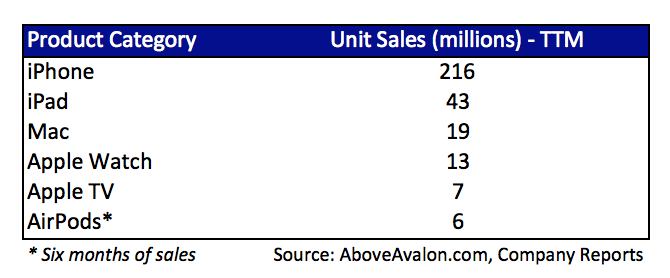
Upon closer examination, Apple is not following an iPhone as Hub strategy. In fact, the company has never followed such a product strategy. Apple is instead following a strategy based on selling a range of tools containing varying levels of personal technology. Management is placing big bets on four product categories: Mac, iPad, iPhone, and Apple Watch.
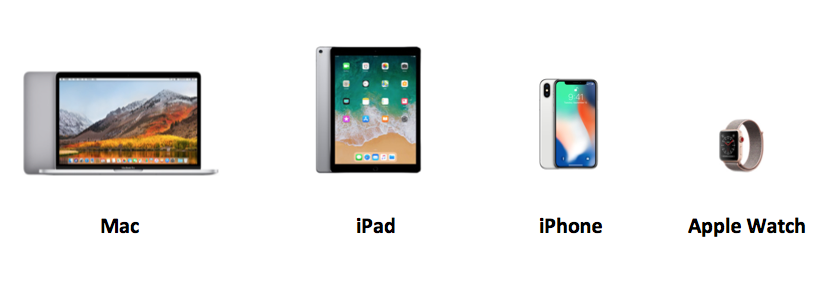
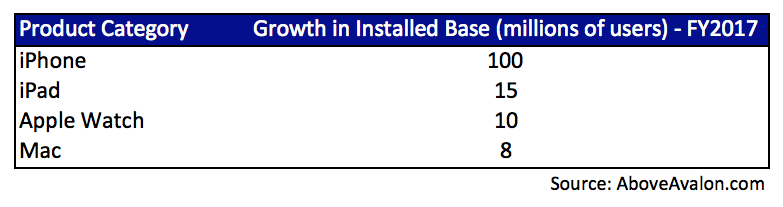
Apple leaves it up to the consumer to determine the amount of personal technology that fits best in his or her life. For hundreds of millions of people, iPhone is the device that has just the right mix of power and functionality in a convenient form factor. This plays a major role in explaining the iPhone's oversized impact on Apple's financials. When looking at the number of new users entering each product category, it becomes clear that iPhone is Apple's best tool for gaining new customers. (The math behind Exhibit 2 is available for Above Avalon members here, here, and here.)
Exhibit 2: Growth in Installed Base
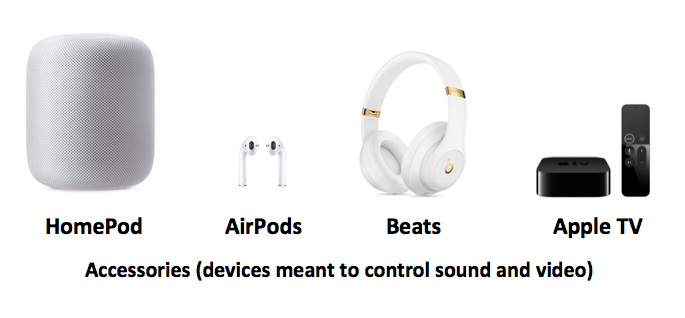
In addition to the four primary product categories, Apple also sells a line of accessories. HomePod, AirPods, Beats, and Apple TV are positioned to add value to Apple's primary computing platforms. The bulk of these accessories are designed to control sound. AirPods and Beats handle sound on the go while HomePod is tasked with controlling sound in the home. Apple TV is unique because it is given the job of controlling both sound and video on the largest piece of glass in the home. This uniqueness is also evident with Apple launching the tvOS platform for third-party developers.
The Grand Unified Theory of Apple Products
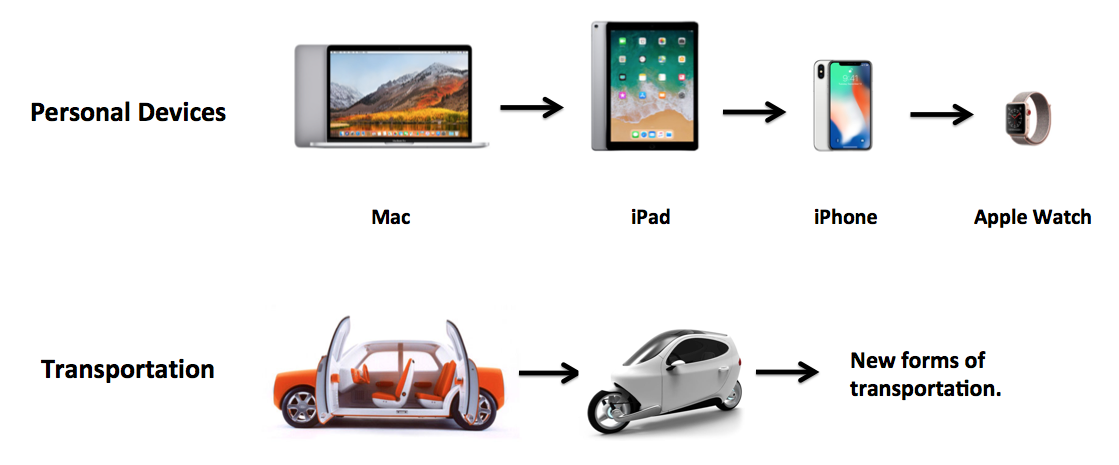
While Apple's four primary product categories share a few obvious attributes such as possessing screens, there is a more important connection. Each is designed to be an alternative to the next most powerful device as detailed in The Grand Unified Theory of Apple Products (shown below).
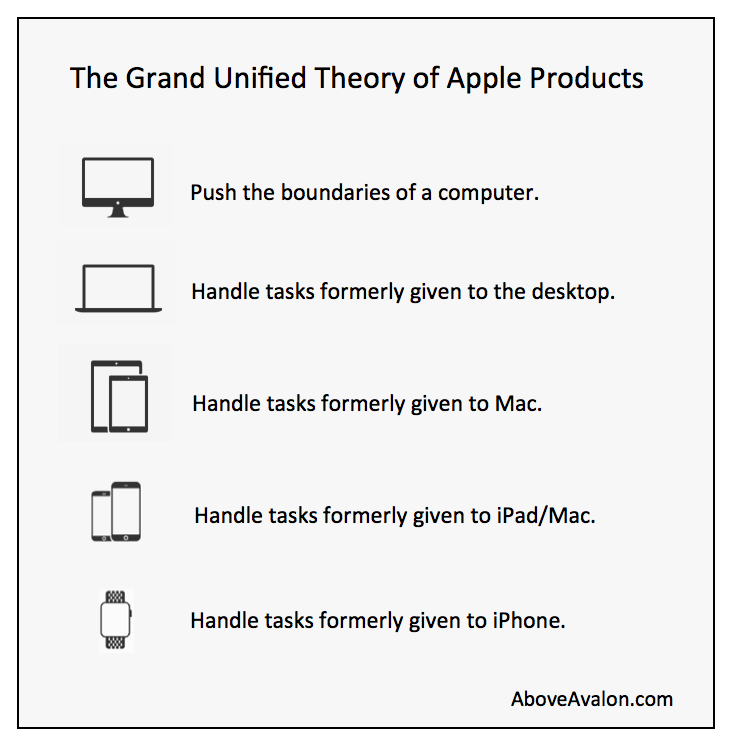
Apple's quest to make technology more personal involves using design to remove barriers preventing people from getting the most out of technology. Instead of positioning new products as replacements for older ones, Apple is focused on coming up with alternatives. One way to accomplish this goal is to take complicated tasks and break them down into more granular tasks, which can then be handled by smaller and simpler devices.
- iPad is given the job of being powerful and capable enough to serve as a Mac alternative.
- iPhone is given the job of handling tasks that may have otherwise gone to iPad.
- Apple Watch is tasked with doing enough things on the wrist that it can serve as an iPhone alternative.
Multitouch computing represented a giant leap in Apple's quest to make technology more personal. Based on unit sales, it's fair to say hundreds of millions of people think iPhone and iPad are adequate Mac alternatives. In a similar vein, Apple Watch isn't designed to replace iPhone. Instead, Apple Watch is given the job at handling some of the tasks given to iPhone. The ability to put digital voice assistants on the wrist represents Apple's latest personal technology breakthrough.
Evolving Product Priorities
While Apple designers and engineers have shown the willingness to push Apple's four primary product categories forward, change is in the air. Apple Watch and the broader wearables category represent Apple's best chance to make technology more personal. One of the highlights from Apple's inaugural event last month at Steve Jobs Theater was a cellular Apple Watch. In fact, the Apple Watch portion of the event was the strongest part of Apple's presentation. After spending the past two years refining its Apple Watch messaging, Apple now has a more appealing and convincing Watch sales pitch for consumers.
It's becoming clear that Apple's product priorities are shifting.
- Release an Apple Watch that is fully independent of iPhone.
- Position Apple Watch to handle more tasks currently given to iPhone.
- Release accessories that complement Apple's expanding wearables strategy.
- Position iPhone as an AR navigation device.
- Position iPad as a genuine Mac alternative.
- Position Mac as a VR/AR content creation machine.
Combining the six preceding priorities into one cohesive product strategy leads to the following diagram.
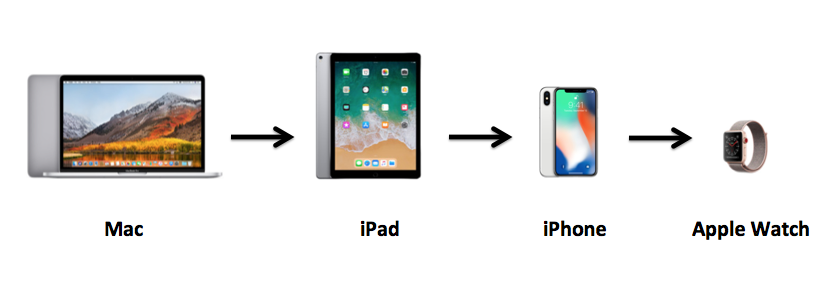
Resources and attention are flowing to the devices at the right end of the spectrum, the products most capable of making technology more personal. A cellular Apple Watch Series 3 is the latest step in Apple's journey to an Apple Watch that is completely independent from iPhone. Such a product will represent a watershed moment for Apple Watch as it would more than triple the product's addressable market. When it comes to Apple Watch serving as a genuine iPhone alternative, the addition of a selfie camera one day and an increased role played by Siri intelligence will go a long way in allowing Apple Watch to handle additional tasks formerly given to iPhone.
Grand Vision
There is a grand vision behind Apple's product strategy of selling a range of personal devices. Apple believes design is the ingredient that allows people to get the most out of technology. Even though Apple's industrial designers oversee this vision, the entire company ranging from engineers and product designers, to Apple retail specalists believe in focusing on the user experience. Apple views core technologies not as products in of themselves, but as ingredients for something else. Instead of copying other companies and chasing after technology's raw capability, Apple is more interested in technology's functionality as it relates to the user experience.
It is easy to look at Apple's current product line of personal devices and wonder where the company will turn next. Additional wearable devices like AR glasses are inevitable and fit within a product line of personal gadgets. On the other hand, Apple's growing interest in transportation has been a head scratcher for many observers as a car doesn't seem to fit within Apple's product strategy. This has led some to wonder if Apple is getting away from its mission or vision in an attempt to chase revenue or users.
Instead of assuming a self-driving car would be tacked onto the end of Apple's product line next to Apple Watch, the much more likely scenario is that transportation would represent a brand new product paradigm for Apple. The same idea applies to Apple's growing interest in architecture and construction.
As shown below, Apple would have multiple product paradigms, each comprised of a range of products. This is the primary reason why Project Titan shouldn't be thought of as just a self-driving car initiative, but rather Apple building a foundation for its transportation ambition.
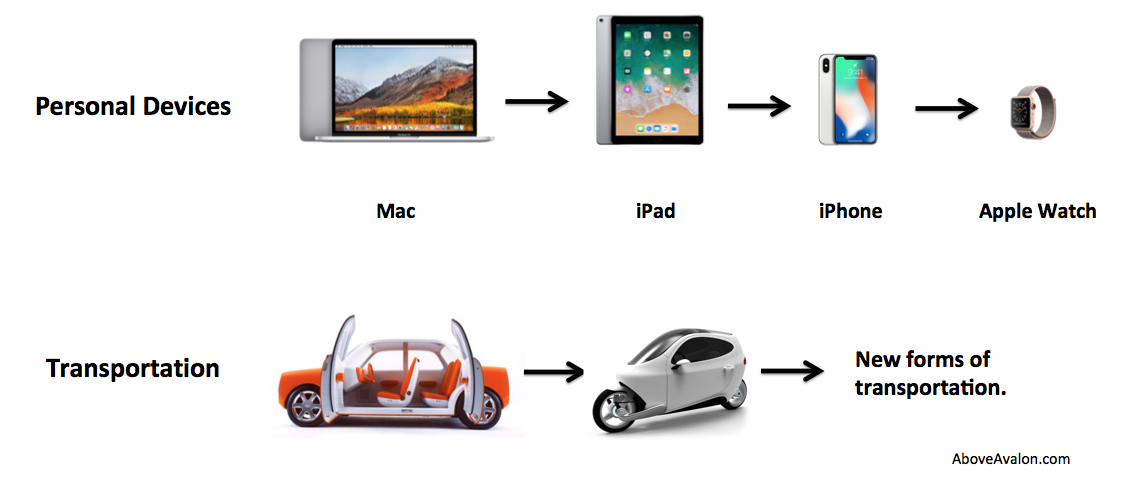
In essence, Apple's transportation strategy would begin with a self-driving car but then eventually lead to the company developing more personal modes of transportation based on new user interfaces, fewer wheels, and different seating arrangements. This process would be equivalent to Apple starting with Mac and then using new user interfaces, technology, design, and manufacturing techniques to create products capable of making technology more personal. Apple would take a self-driving car and strip away capabilities in order to improve functionality. The same goal can occur with architecture and the broader concept of smart homes. It's difficult to see homes becoming truly smart until Silicon Valley begins building housing. The major takeaway is that Apple's quest to make technology more personal doesn't just apply to personal devices. Instead, there is a role for design to play in entirely new industries such as transportation and construction.
Issues
Apple has run into its fair share of issues and roadblocks following its grand vision. As resources and attention flow to devices most capable of making technology more personal, Apple has made some questionable design decisions. The Mac Pro and Apple's overall approach to pro Mac users has not fared well in recent years. This serves as the basis for my "The Mac is Turning into Apple's Achilles' Heel" article earlier this year. Management was forced to back track in order to stem growing backlash within the pro Mac community. Even today, the amount of criticism pointed at the Mac, some of which is genuine, is trending at multi-year highs.
The Mac debacle also ends up revealing some of the downsides associated with Apple's functional organizational structure. The company practices a focus mantra when it comes to product development, which may result in certain products getting left behind or not getting as much attention as they may need. This may make the jump into new product paradigms like transportation that much harder for Apple.
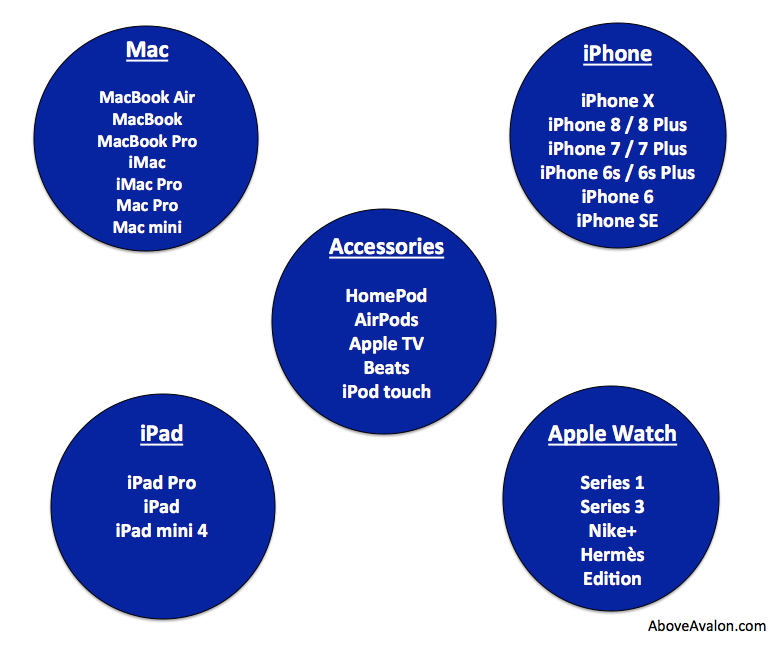
While Apple's product line is still incredibly focused for a $825B company, there is no denying that additional models and SKUs have led to an expanding product line over the years. Apple's entire product line is shown below. Apple relies on a consumer segmentation strategy to target as broad of a market as possible for each of its four primary product categories. Apple has learned a lesson or two from the dark days in the 1990s. A byproduct of this strategy has been complexity being added to the product mix in recent years.
Inevitable Path
Apple puts much effort, care, and deliberation into marketing. This makes one of the animated videos found on Apple's website so intriguing. As shown in the screenshots below, the animated video is meant to highlight HomePod's spatial awareness capability. The only two Apple products shown in the room are HomePod on a table and the two individuals wearing Apple Watches. There is no iPhone, iPad, or Mac in sight. For some companies, this can be brushed off as a simple oversight, but not for Apple. It's intentional.
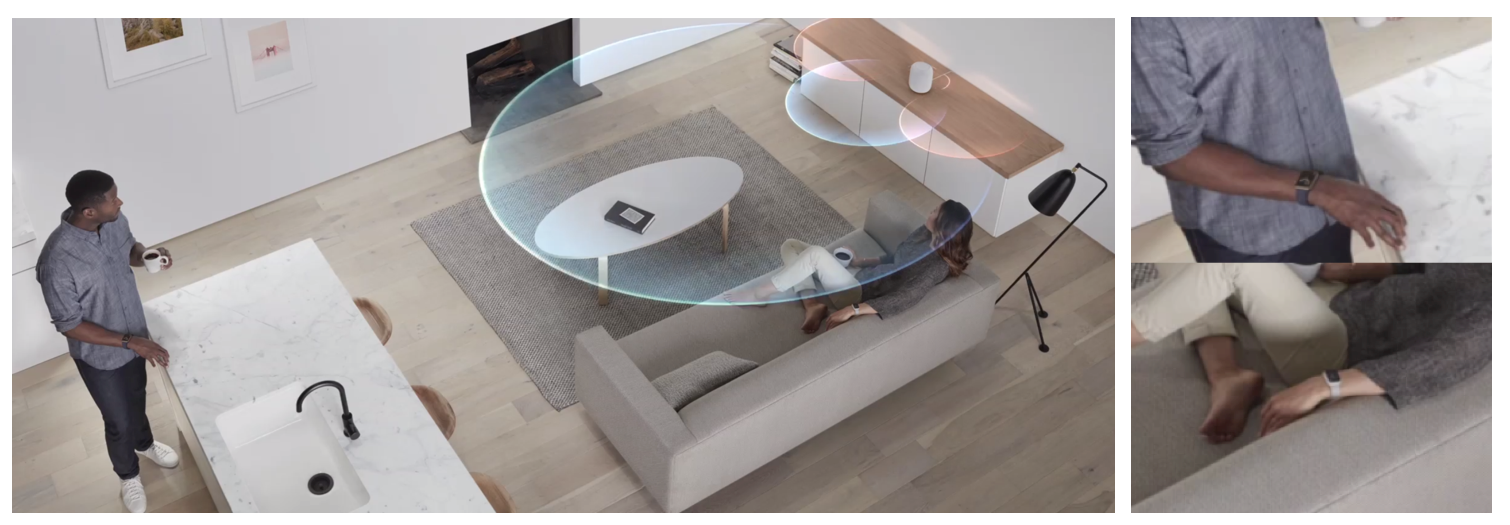
Apple looks at Apple Watch as the natural evolution of personal computing. Having Siri intelligence on the wrist throughout the day, in addition to receiving and consuming information via a screen, is powerful. Meanwhile, HomePod is positioned as an Apple Watch accessory capable of delivering sound in a way that just isn't feasible for a device worn on the wrist. While some companies are advocating new product strategies such as voice-first or AI-first, Apple is taking a different path with a product strategy evolving into one based on wearables. Voice and AI are then positioned as core technologies powering these wearable devices. To a certain degree, this is the inevitable path Apple has been on for the past 40 years. Going forward, the largest opportunity for Apple will be found in using its product vision to create personal technology paths in new industries.
Receive my analysis and perspective on Apple throughout the week via exclusive daily emails (2-3 stories a day, 10-12 stories a week). To sign up, visit the membership page.
iPhone Courage
iPhone pricing has garnered more attention in recent months than any other Apple topic. However, pricing is not the most important variable impacting the iPhone business. With iPhone X, Apple is taking what previously worked with iPhone and throwing it away in an effort to create a better user experience. For Apple to take this much risk with the product responsible for the vast majority of its cash generation and new user growth is noteworthy.
iPhone X
During its inaugural event at Steve Jobs Theater last month, Apple unveiled three flagship iPhones. Management dedicated 20 minutes of stage time to iPhone 8 and 8 Plus, models clearly positioned within the existing iPhone paradigm. Attention then turned to iPhone X, which garnered nearly twice as much stage time. While the "X" stands for ten, it could have very well stood for extreme. iPhone X will be the most radical iPhone Apple has sold to date. The home button has been removed to fit a larger screen in a smaller form factor. This change, which was years in the making, ushers in a completely new iPhone experience. Users will have to retrain their finger reflex to not press the bottom of the screen and instead, get used to swipes. In addition, the removal of fingerprint recognition in favor of facial recognition represents a very big change in how we will use iPhone. A strong argument can be made that removing the home button is the single-biggest change Apple has made to iPhone. The sheer amount of risk found in the move is being grossly underestimated.
iPhone Strategy
Apple is launching iPhone X at a critical juncture for the iPhone business. A slowing upgrade rate among existing iPhone users has led to overall unit sales plateauing, as highlighted in Exhibit 1.
Exhibit 1: iPhone Unit Sales (Trailing Twelve Months)
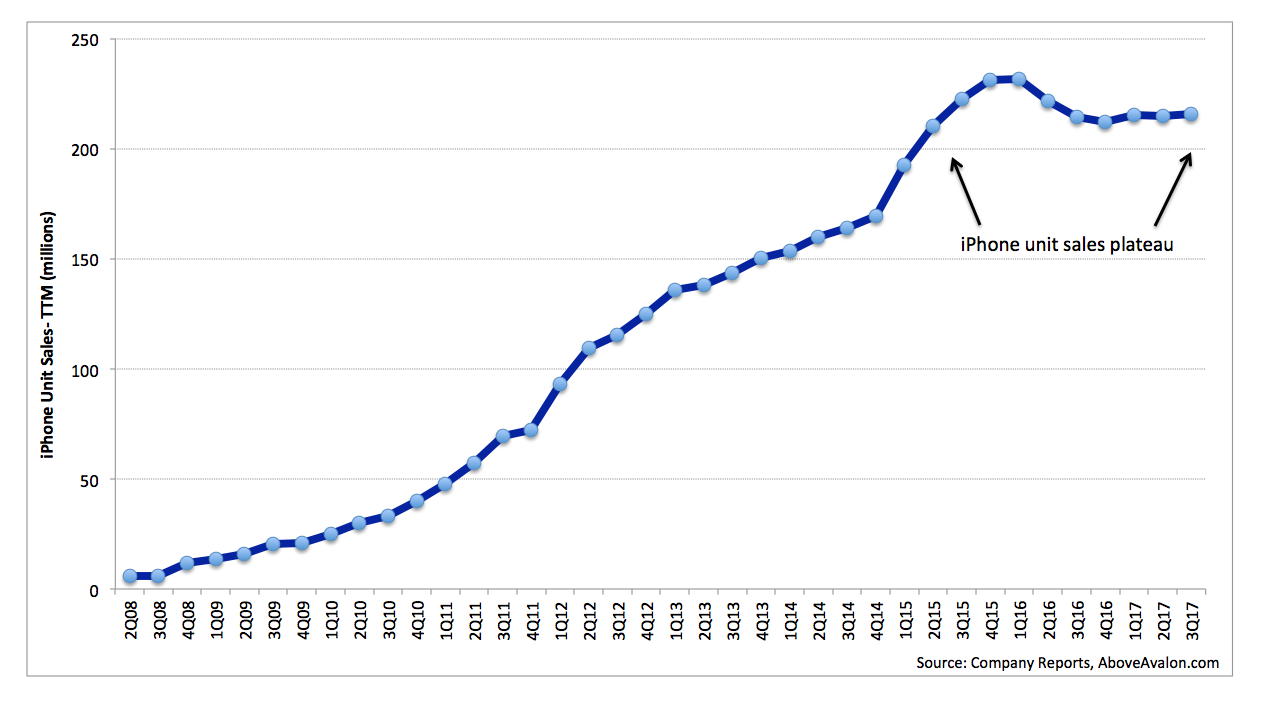
Despite weakening sales growth trends, Apple is still selling more than 200M iPhones per year, bringing in $140B of revenue and $60B of gross profit. In addition, the iPhone installed base grew by approximately 110 million users in 2017. iPhone remains Apple's most effective tool for grabbing new users.
Apple's iPhone strategy can be broken into three parts:
- Pricing
- Product marketing
- Design
While much of the attention has been focused on Apple's move at the high-end of the iPhone pricing spectrum, the company is making just as interesting of a change at the low-end. Apple is following a consumer segmentation strategy. Management is cutting iPhone pricing at the low-end to improve accessibility. The $399 iPhone price floor that had been in existence for years was shattered last month. A $350 iPhone SE is the lowest-priced "new" iPhone Apple has sold to date. Management's decision to continue selling iPhone 6s and 6s Plus, and even iPhone 6 in select markets, positions additional SKUs for customers focused on value and price. Meanwhile, at the other end of the pricing spectrum, Apple is running with higher-priced models targeting consumers who value the latest and greatest technology.
Underlying this pricing dynamic is a product marketing strategy focused on positioning the iPhone as the best camera people have ever owned. The dual-camera system found in iPhone 7 Plus is one of the more noteworthy iPhone features in years. With iPhone 8 Plus and iPhone X, Apple introduced Portrait Lighting, which adds a new element to Portrait mode. Apple then went further to include Portrait mode and Portrait Lighting on the iPhone X front-facing camera.
Apple saw how cameras are becoming much more than memory capture tools. Cameras are turning into smart eyes powering the dawn of the augmented reality era. Apple spent years dedicating resources to the effort and is now at the point where iPhone cameras are being powered by Apple silicon. This provides Apple's cameras additional differentiation and the ability to stand out from peers.
Apple has seen quite a bit of success with its iPhone pricing and product marketing strategy over the years. However, these two variables are not the most important items impacting iPhone's evolution. Design, or the way consumers use the product, has a much larger impact on iPhone's future, and Apple is making big changes to how we will use iPhone going forward.
The Headphone Jack
iPhone X demonstrates how Apple is willing to move beyond legacy design constraints and thinking. The home button has come to represent safety for hundreds of millions of people. In just a few years, Touch ID and fingerprint recognition became universally accepted because of their connection with the convenient iPhone home button. Apple is taking this familiar design and throwing it out the window in an attempt to push the iPhone experience forward. Although Apple is confident consumers will embrace the changes, the confidence sure isn't a result of consumers demanding or wishing for these changes. Instead, Apple designers and engineers are throwing away legacy thinking in order come up with something new. Upon closer examination, Apple has previously demonstrated this willingness to let go of legacy design.
In September 2016, Apple unveiled iPhone 7 and 7 Plus. The two flagship models contained the typical assortment of new features and upgrades. However, one change stood out from the others. Apple removed the dedicated headphone jack despite no one having asked for such a move. Instead of including the traditional pair of EarPods in the box, Apple unveiled a new pair of EarPods that used the Lightning connector. In addition, Apple included a small adapter so that older headphones would connect with Lightning.
When explaining Apple's decision, Phil Schiller, Apple SVP worldwide marketing, said "it really comes down to one word: courage. The courage to move on, do something new that betters all of us."
To say that removing the headphone jack was a controversial decision would be an understatement. The mere thought of removing the dedicated headphone jack from smartphones drove the tech community up a wall with some declaring the move as "user hostile" and "stupid." Schiller's explanation for the removal did not sit well with many. Some referred to it as tone-deaf, and others used arrogance and greed to describe the situation. There were then some who thought Schiller should have said "courage of convictions" in order to better encapsulate his meaning.
In reality, Schiller was right in calling Apple's decision to remove the dedicated headphone jack courage. As it turns out, Apple displayed additional courage last month by removing the home button from iPhone X.
Courageous
The reason these iPhone design choices can be called courageous is that Apple is not afraid to risk sales in order to make technology more personal. It is not easy to take a product that is bringing in more than $140B of revenue per year and change the way people fundamentally use the device. While this situation may seem too self-centered to deserve being called courageous, iPhone is used by 800 million people. (The math behind my iPhone user base estimate is available for Above Avalon members here.) A design decision capable of improving or advancing the iPhone experience will have a tangible impact on many lives. It's not an exaggeration to say that society as a whole can benefit from these iPhone design choices. We are empowered by having a mobile computer in our pockets, and additional power will flow to users as smartphones evolve into augmented reality devices.
The headphone jack is one of a handful of examples of Apple displaying courage by taking what seemed to be working fine and throwing it away to improve the iPhone user experience.
- 30-pin dock connector removal
- Headphone jack removal
- Home button removal
These design choices share a few common traits:
- Deliberate. Apple doesn't make changes for the sake of making changes. Instead, the company is deliberate with its choices. A headphone jack is not removed in order to merely have iPhone 7 stand out from iPhone 6s. Instead, the move is an early step in Apple's long-term mission to remove wires from our lives. Schiller's inability to discuss the long-term goal found in removing the dedicated headphone jack is one reason his courageous comments came off as tone-deaf. A number of years and iPhone versions often have to pass before the motivation behind some of Apple's design decisions becomes clear.
- Decisive. Apple doesn't sit on the fence when it comes to design. One should not bet on a dedicated headphone jack returning to iPhone. In what is still a raw and polarizing topic for some, dedicated home buttons with fingerprint readers are on their way out over the coming years. Dedicated home buttons don't have a future at Apple.
- Design. All of these significant iPhone changes are made with design in mind. By removing the dedicated headphone jack and home button, Apple is changing the way we interact with iPhone. While some of these changes occur through a new user interface, other changes involve how we use iPhone in relation to other products. While the user experience change is less clear with some changes, such as Apple swapping the 30-pin dock connector with Lightning, other examples, like the home button removal, are much more apparent.
It's All About Design
Avoiding change out of fear of angering users or customers can cripple an otherwise successful product and company. Fear of throwing away design artifacts and legacy tendencies represents one of the biggest risks facing iPhone today. This is why design, and not pricing or product marketing, is the most important variable when thinking about iPhone's future.
Fear of embracing change would make it impossible for Apple to accomplish its long-term goal of making technology more personal. When it comes to iPhone, this goal manifests itself in a design that blends hardware and software. Apple's willingness to take big design bets allows iPhone to evolve over time. As buttons and ports are removed to make room for the latest camera, battery, and screen technology, iPhone morphs from a multi-touch computer into an augmented reality navigator controlled by glances and looks.
This behavior of killing off features, components, ports, and technology in an effort to push the user experience forward is a carryover of Apple's approach with the Mac. The difference this time around is that Apple is making these changes to a product that is used by 8x more users.
Samsung vs. Apple
Apple is not alone in pushing smartphone changes like removing a front-facing home button or dedicated headphone jack. In fact, making changes for the sake of change is relatively easy in the smartphone industry. The difficult part is leveraging these changes to push the user experience forward.
Samsung was able to beat Apple to market with an OLED smartphone lacking a front-facing home button. However, the difference in how Samsung and Apple leveraged these design changes is noteworthy. By removing the home button, both companies had to come up with an alternative to having a fingerprint reader positioned in a convenient location. Samsung chose to place the reader in a much more awkward location on the back of the device. Meanwhile, the company's facial recognition alternative ended up being a bust as it quickly became apparent it just wasn't as good as fingerprint recognition. It is tough to argue that the Samsung Galaxy user experience was improved with such changes. Instead, Samsung serves as an example of making changes for the sake of change.
Meanwhile, Apple is positioning Face ID as the alternative to having Touch ID and the home button. If done correctly, Apple will be the company to bring facial recognition as a form of biometric authentication to the masses. Based on the company's success with Touch ID, Apple deserves the benefit of the doubt that Face ID can follow suit and see massive customer acceptance. In fact, Apple's removal of the home button and embrace of Face ID will likely kick off a new era at the company involving facial recognition. It is only a matter of time before every Apple product with a camera has the TrueDepth camera system. Such a development may seem trivial, but it will lead to a new era of health monitoring to which we haven't even contemplated the implications yet.
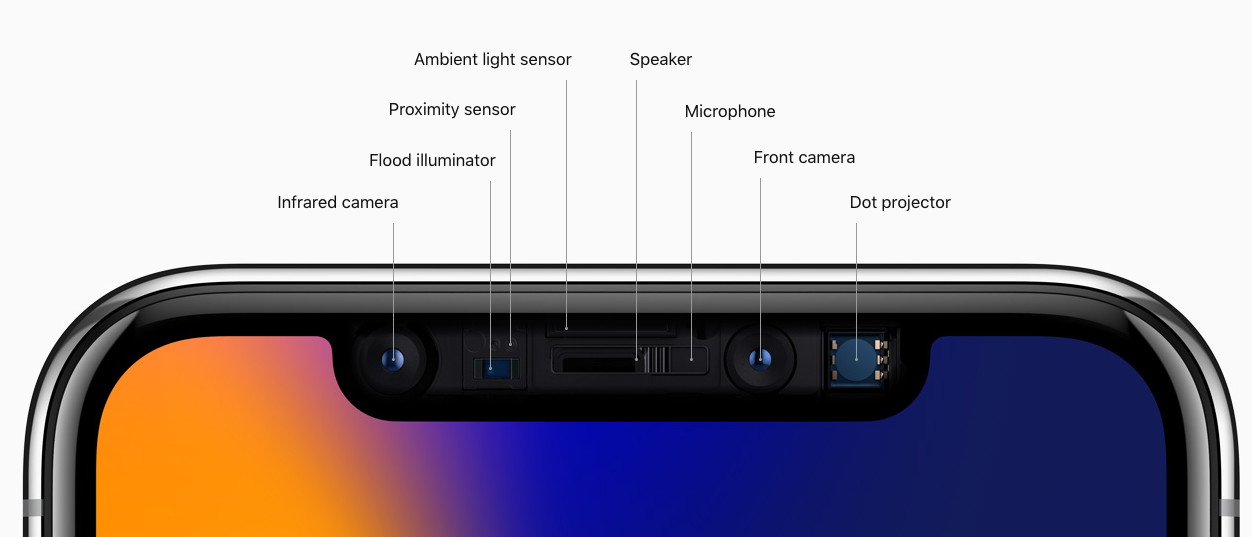
TrueDepth camera system in iPhone X.
The other implication found with Apple taking design risks is that unlike every other smartphone manufacturer, Apple sells very few smartphone models. The company does not have the benefit of taking risks with a much less popular model and only then bringing new features to the mass market once market adoption has been proven. Instead, Apple spends years and multiple iPhone versions systemically preparing for a major design change included in a flagship model.
Putting Fear Aside
The amount of risk Apple is taking with iPhone X should not be underestimated. There is a reason why management is positioning iPhone X as a glimpse of the next 10 years of iPhone. The model is dramatically different to iPhone 8 and 8 Plus. While Apple is confident that consumers will embrace these changes, it sure isn't due to consumers demanding or wishing for these changes. Instead, Apple designers, engineers, and marketers are showing a willingness to break down legacy thinking in order to come up with something new. By not letting fear of change and customer rejection dictate iPhone design decisions, Apple is displaying courage. While Apple stands to benefit financially from these design changes, iPhone users also stand to benefit. iPhone is empowering hundreds of millions of people in ways that were never before imagined. Courage is putting fear aside and taking bold risks in order to empower others.
Receive my analysis and perspective on Apple throughout the week via exclusive daily emails (2-3 stories a day, 10-12 stories a week). To sign up, visit the membership page.
The Significance Behind Steve Jobs Theater
On paper, Steve Jobs Theater doesn’t make complete sense. The price tag would lead many to question the rationale in building a massive underground theater for unveiling products. It’s difficult to envision any other company wanting to undertake such a project. However, after I attended Apple’s inaugural event at Steve Jobs Theater, Apple’s motivation behind the building became crystal clear. Steve Jobs Theater is an Apple product, and a closer look at the building uncovers a side to Apple that few have seen before.
Initial Visit
Steve Jobs Theater is located in Cupertino and positioned in the southeast corner of Apple's new $5 billion Apple Park headquarters. The 167,000-square-foot building consists of a 921-seat underground theater and accompanying product demo room. Apple plans on utilizing Steve Jobs Theater for product unveilings and the periodic corporate event. Apple hired Norman Foster and his firm Foster + Partners as the project's architect although Apple Chief Design Officer Jony Ive and other Apple designers played a pivotal role.

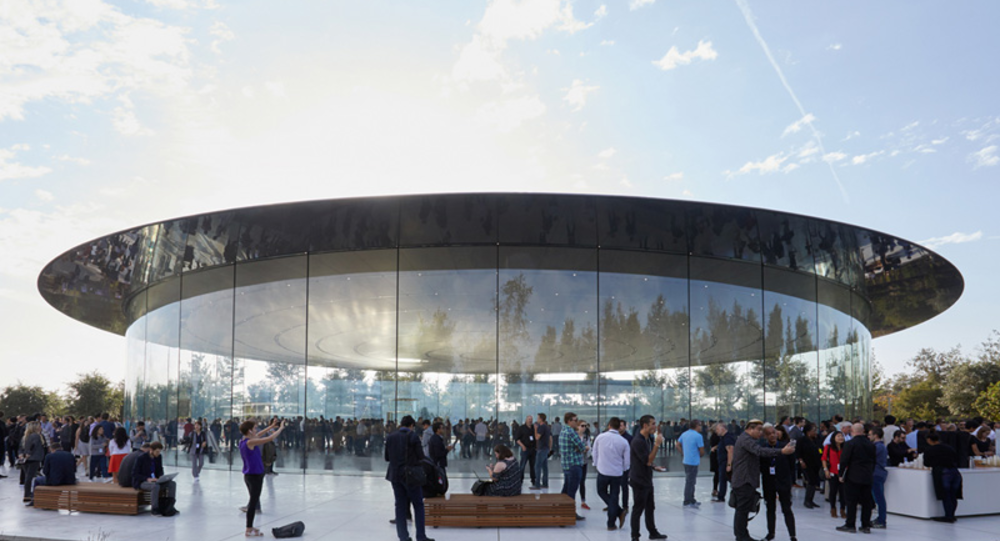
Steve Jobs Theater. Photo credit: Apple
Most visitors arriving at Steve Jobs Theater for the first time will be impressed by its seclusion and allure. Unlike the 2.8-million-square-foot ring building, Steve Jobs Theater cannot be seen from nearby streets surrounding Apple Park. Instead, visitors must walk along a path that winds its way through a series of carefully landscaped hills. It soon becomes clear that this short walk is actually part of the broader experience Apple was trying to achieve.
The path empties out into a basin containing Steve Jobs Theater’s lobby. The 22-foot curved panes of glass create a strong first impression. To the right is an unobstructed view of the giant, circular ring building. The entire experience is reminiscent of Disney World as it becomes clear that someone has created this specific experience to be consumed at this particular location. The lobby, the only part of Steve Jobs Theater that is above ground, is massive, intriguing, and even magical. It doesn’t take long to notice the lack of walls or support structure. This leads to the inevitable question of how the 155-foot roof is being held up. (Spoiler: the glass supports the carbon fiber roof.) Additional questions are raised regarding how plumbing for the water sprinklers and electricity for the lights and speakers are piped to the roof. As it turns out, a little magic is indeed at work. As reported by Lance Ulanoff over at Mashable, all of the necessary plumbing and wiring is found in 20 of the narrow gaps between the large panes of glass.

Steve Jobs Theater floor plans.
The other item that stood out about Steve Jobs Theater was the two sets of stairs on either side of the lobby that are used by visitors to walk down to the theater. The intriguing use of Castagna stone and handrails hand-carved into the stone walls reminded me of a mix between an Egyptian structure and something from space. Photos and videos don't do them justice.
(My complete review of Apple's inaugural event at Steve Jobs Theater is available for Above Avalon members here.)
Not Perfect
Steve Jobs Theater is far from perfect. A strong argument can be made that Apple outgrew the theater before it even opened. Apple's prior two iPhone launches took place in a venue that fit 50% more people, which allowed Apple to invite many more Apple employees than they did to the inaugural event at Steve Jobs Theater.
Despite the building's large footprint, the exhibit space felt incredibly cramped. While Apple may like the visual of hundreds of people bumping into each other to get their hands on the latest products, it's not exactly the best experience to go through. My suspicion is that the exhibit space needs a few modifications to reflect the new era of reporters wanting to live stream.
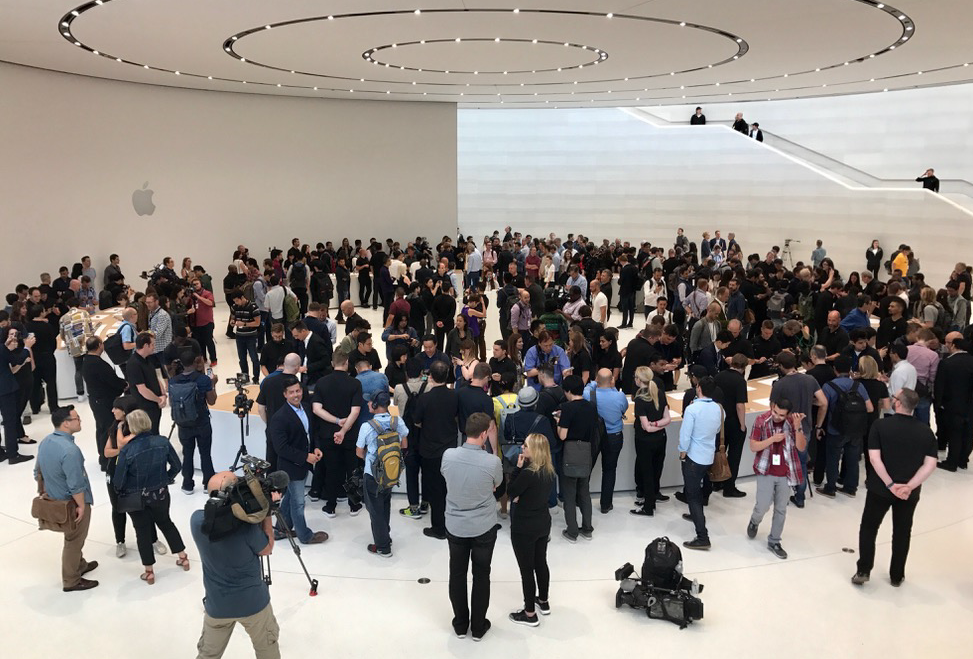
The Steve Jobs Theater exhibit space was still packed after an hour of hands-on time.
In addition, there were a number of odd design decisions found at Steve Jobs Theater. These range from the awkward paper towel dispensers in the restroom to uneven temperature control in the lobby and doors that are unusually difficult to open. There was also a decent probability of getting a little wet from water dripping off the carbon fiber roof in the morning. However, the building's accomplishments end up vastly outweighing these minor oddities.
Observations
Much of the discussion regarding Steve Jobs Theater up to now has been superficial. Most people agree that the building is impressive and fits within Apple's broader design focus. However, upon closer examination, Steve Jobs Theater provides a fascinating look at today's Apple. A number of items stood out to me.
An Apple Product. Apple is no longer a company that just ships consumer hardware powered by differentiated software. The unveiling of Steve Jobs Theater is the latest sign of this reality. The theater is an Apple product, in the same vein as Apple's redesigned Retail stores. Apple approached Steve Jobs Theater and the broader Apple Park headquarters in the same way that it would any other product. Significant time and resources were spent on modeling and prototyping before construction. An identical process occurs for Apple products that eventually end up on our desks, in our pockets, and on our wrists.
One of the most significant takeaways from Steve Jobs Theater is that Apple is no longer a company content in just focusing on making well-designed electronics. Apple is moving into bigger and bolder initiatives. Jony Ive has hinted in various interviews about his never-ending drive to make technology more personal and create tools for people. While this goal will inevitably lead Apple further into wearables, including glasses, there is a very high likelihood that Apple will focus on bigger tools like self-driving cars. These bigger tools will require Apple to move much further into construction and architecture. Apple reportedly owns and leases a collection of heavy manufacturing facilities close to Apple Park that includes some of the last remaining open space in the San Jose vicinity. (A listing and map of these Apple buildings are available for Above Avalon members here). The day when Apple designers build their very own state-of-the-art transportation R&D center minutes away from Apple Park is no longer a fantasy. All of this puts the PR photos with Tim Cook and Jony wearing Apple hardhats into a new light.

Tim Cook and Jony Ive at Apple Park. Photo credit: The Telegraph
We have arrived at a weird point in time. Silicon Valley giants are gaining unfathomable amounts of power yet remaining remarkable aloof when it comes to manufacturing and construction. Apple is the notable exception. Apple is the company most eager to step outside its comfort zone and experiment in construction and architecture realms. Apple sees the gap between architecture and design starting to shrink. According to Jony, architecture is "a sort of product design; you can talk about it in terms of scale and function and materials, material types. I think the delineation is a much, much softer set of boundaries that mark our expertise."
Experience. There's a reason why Steve Jobs Theater and the overall Apple Park campus is reminiscent of Disney World. Both locations provide an unmatched experience to the visitor. When walking around the grounds surrounding Steve Jobs Theater, it truly felt as if the building is meant to represent Earth while the large circular ring building off in the distance is the Sun.
Steve Jobs Theater symbolizes how Apple is doubling down on extending the Apple experience beyond just iPhones in our pockets and Apple Watches on our wrists. As Apple's Retail store strategy shows, the idea of using architecture and physical spaces to explain the Apple story isn't new. However, Apple has taken the idea further to include its headquarters and even the theater at which it plans to unveil many of its future products.
Focus. It's easy to look at Steve Jobs Theater and forget the amount of work and resources that went into the building. Jony and Apple's Industrial Design team reportedly worked alongside Foster + Partners on nearly every aspect of the theater and the entire Apple Park campus. Apple management likes to use every opportunity to reiterate its goal of remaining focused and saying no to a lot of great ideas. The company's product line demonstrates such focus. Accordingly, there is logic in considering how much attention went into Apple Park over the past few years and where that attention is now being placed. This brings us to the most crucial takeaway regarding Steve Jobs Theater: Jony Ive.
Jony Ive
In May 2015, Jony was promoted to Chief Design Officer. The transition kicked off a debate regarding the underlying motivation behind the move. Many argued that the promotion marked the beginning of the end for Jony's time at Apple. Some observers argued Apple is setting the stage for Jony's eventual retirement by shifting day-to-day responsibilities to Richard Howarth and Alan Dye. The degree to which Jony then took a less visible presence in subsequent months (which was clearly telegraphed by Apple in announcing his promotion) added oxygen to the fire.
Others said Jony's Chief Design Officer title is mostly ceremonial with little-to-no responsibility and compared it to Steve Jobs giving the Chief Software Technology Officer title to Avie Tevanian in 2003. Tevanian ended up leaving Apple a few years later. In reality, such a comparison is so off base it could classify as intellectual dishonestly.
I've held a completely different view of Jony's promotion. The day after Jony's promotion was announced (via a Stephen Fry article), I wrote:
"With Howarth and Dye serving as Jony's two lieutenants in terms of managing day-to-day aspects of Apple design, what would such a dynamic look like and where would Jony fit into the picture? I consider Jony's new role to be much more about leadership while Howarth and Dye handle the more corporate side of things - the actual management of teams. The amount of additional time and attention that Jony can spend on entirely new projects, while leaning on his two right hands to make sure that schedules are being met and projects are receiving all of the resources they need, goes a long way in describing Apple's strategy over the next few years.
I see an environment in which Jony's potential can be unleashed even more now than the world has already seen. Similar to how Steve Jobs was known to head down to Jony's design lab to hang out, I suspect in some ways, Jony wants to do the same - check out of the day-to-day executive grind and lose himself in research and design elements on whatever topic or subject he choses. By being positioned in more of a leadership role than a managerial role, Jony could maybe be more like Jony."
Two years later, and with Steve Jobs Theater officially open, it is clear Jony holds the role closest to the one held by Steve Jobs. The promotion to Chief Design Officer represented sustainability for Jony. It has been reported that Apple Watch development, in addition to overtaking leadership of human interface, took its toll on Jony. The entire Apple Park project represents much of Jony's focus in recent years. Jony reportedly was the one who carried Apple Park on his shoulders. Its completion now gives Jony the freedom to focus on new initiatives and projects at Apple.
A Design Company
"[O]ne of the ways that I believe people express their appreciation to the rest of humanity is to make something wonderful and put it out there." - Steve Jobs
It's difficult to envision any other company building something like Steve Jobs Theater. Based on the reported $14 million price of the theater seating, my estimate for the overall cost of the building exceeds $100 million. Most management teams will struggle to find how such an initiative would ever come back to boost sales or benefit the company. The fact is that Apple is unlike any other Silicon Valley firm. Steve Jobs Theater symbolizes how Apple isn't a tech company but rather a design company. Apple believes that how we experience and interact with a product is more important than a single focus on the technology powering that product. Apple is now bringing that philosophy to the way we experience architecture. As for the why behind it all, Apple's answer would probably be to make something wonderful.
Receive my analysis and perspective on Apple throughout the week via exclusive daily emails (2-3 stories a day, 10-12 stories a week). To sign up, visit the membership page.
Major Tech Trends Ahead of Apple's Big Event
With Apple about to host its largest product event in years, much of the attention continues to be focused on the details. Plenty of questions remain regarding the various changes Apple will announce across its iPhone, Apple Watch, and Apple TV lines. A closer look at the broader trends taking place in these product segments go a long way in adding much-needed context to Apple’s inaugural event at Steve Jobs Theater.
Smartphones
On the surface, the smartphone battle seems to be largely settled. Predictions calling for iPhone’s demise at the hands of Google and Android have subsided although some are now eager to replace Google with WeChat as Apple’s arch nemesis.
Behind this facade of relative calm, the smartphone market continues to evolve at a rapid pace. Three major trends are unfolding regarding how consumers view smartphones:
- Larger screens continue to gain momentum.
- Form factor size is hitting a ceiling.
- The pricing gap is widening.
With an increasing amount of content consumed on smartphones, consumers and manufacturers alike continue to get behind larger screens. Once deemed excessive and niche, large smartphones with 5-inch to 6-inch screens are seeing growing sales momentum. This large screen smartphone trend has materialized across the industry, indiscriminate of geography and even price.
While there is still evidence that a portion of the market is OK with smaller screens as seen by continued 4-inch iPhone SE sales, this segment is more likely to contract than expand over time.
The newest and most intriguing development in the smartphone space is found with the relationship between screen size and form factor. Historically, smartphone screen size faced a ceiling in terms of its relationship to form factor. Mobility is greatly reduced if a smartphone is so large that it is unable to fit comfortably in pockets, purses, and pouches. The trend of removing front-facing bezel and dedicated home buttons is eliminating this form factor limitation. Smartphone manufacturers are able to ship larger screens without increasing form factors.
The OLED iPhone is rumored to include a 5.8-screen, which is larger than the 5.5-inch iPhone Plus screen, in roughly the same form factor as an iPhone 7. This will have a major impact on how consumers think about smartphone size preference. It is inevitable that all iPhones will eventually contain the same design language - no home buttons and little to no front bezel. Large swathes of the iPhone user base will likely want to upgrade to these new iPhone models over time. It is the type of multi-year upgrade cycle that PC makers hoped would occur in the laptop space but never materialized.
As manufacturers increasingly bet on camera and screen innovation to stand out from the competition, smartphone pricing has been on the rise. While smartphone prices are increasing at the high-end, as seen with the $750 Samsung Galaxy S8 and $950 Galaxy Note 8, there continues to be a significant portion of the smartphone market desiring price accessibility. The key for smartphone manufacturers will be balancing higher-priced smartphone SKUs packed with the latest technology with increasingly lower-priced SKUs still offering a premium experience.
Wearables
The wearables market has had a rocky start. Some of the initial wearables players have retreated out of the space while others have taken a more cautious view. Only a handful of companies are seeing wearables sales success. It is fair to say everyone, including Apple, has seen their fair share of strategy changes over the years.
Three major trends are unfolding in the wearables space:
- Sales momentum is flowing to smartwatches.
- Fashion and luxury continue to gain importance.
- The wearables battle is slowly expanding beyond the wrist.
Dedicated fitness trackers have lost momentum while Apple Watch continues to outperform sales expectations. Fitness and health tracking is moving from being a product to a feature. Nowhere is this seen more than in a comparison of Fitbit and Apple Watch sales over the past year.
Exhibit 1: Fitbit vs. Apple Watch Unit Sales
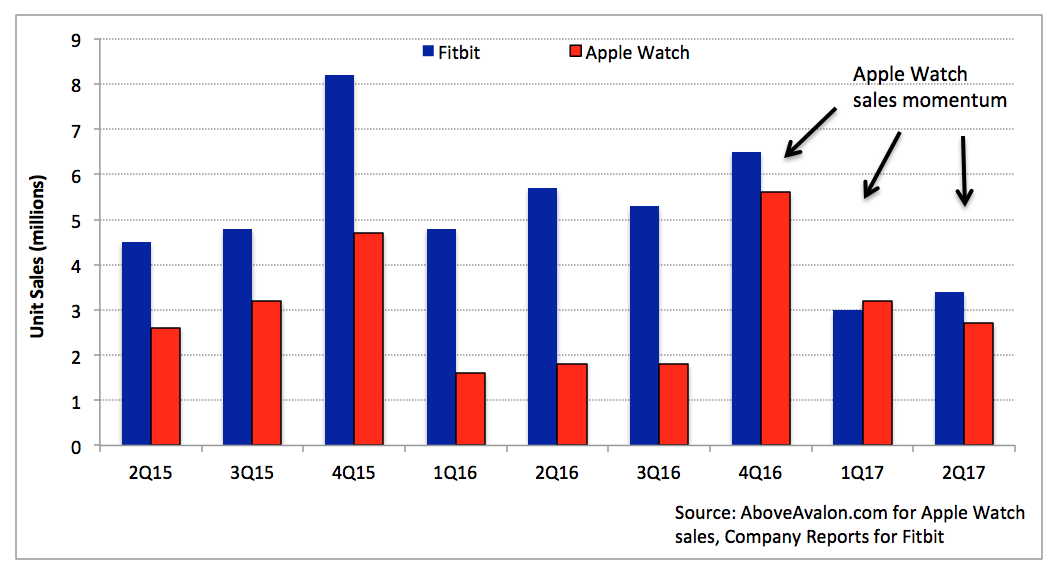
Meanwhile, Fitbit’s new Ionic smartwatch is a "bet the company" type of move in an attempt to capitalize on this new wearables landscape. Garmin has seen similar trends with sales momentum flowing from dedicated fitness and health trackers to its smartwatch offerings. We are only seeing the initial fallout from this development.
One of the items Apple got correct out of the gate with Apple Watch was interchangeable watch bands. This dynamic is now viewed as natural and almost inevitable when discussing smartwatches. Going forward, technology companies will continue to face pressure in the wearables space given how consumers are demanding luxury and fashion options.
As the battle for the wrist evolves, the ear is shaping up to be the second major wearables battleground. Apple, Samsung, Fitbit, and a slew of smaller hardware companies and start-ups will have wireless or cordless headphone offerings in the market for the upcoming holiday season. Apple is the clear leader in the space with its W1 chip-equipped AirPods and Beats. More importantly, given the company's sales success with Apple Watch, Apple has the most formidable wearables platform. We are moving to a point at which the wearables narrative will evolve. No longer will it only be about wrist devices. Rather, it will also include platforms consisting of hardware and software solutions for different parts of the body.
Television
After years of unknown, we are starting to get a glimpse of TV's future. The large cable bundle's days are numbered. Netflix, Amazon, Facebook, Google (YouTube), and Apple are the new power brokers in the TV space. There is a long list of others including Disney (ESPN), HBO, and Hulu that would like to join that coveted list of influencers. Netflix and Amazon are the newest TV networks with massive budgets for funding scripted video content. YouTube and Facebook continue to reign supreme when it comes to offering ad-supported video content. Apple owns the most lucrative platform that involves consumers accessing paid video subscriptions.
Major themes unfolding in the space include:
- Price is playing a major role in the streaming set top box market.
- Momentum is found with smaller screens.
- New content players are holding optionality.
Roku is the current streaming video box leader with approximately 40% market share in the U.S. Amazon, Google, and Apple hold second, third, and fourth place, respectively. The market is unfolding largely based on price. Roku has been able to position itself as the cheapest way for people to access Netflix and YouTube on a large television screen. The company is going so far as to give away its Roku OS to TV manufacturers for free. Meanwhile, with Apple TV priced nearly five times higher than Roku, Apple's streaming TV box is bringing in nearly 6x more gross profit than Roku earns from its players.
While much attention continues to be placed on large screen televisions, such focus ends up being grossly misleading. Apple is actually selling more than 250M "TVs" per year called iPhones and iPads. These smaller screens are responsible for delivering an increasing amount of video content to consumers.
In a battle for our time and attention, content creators with formidable content budgets are winning. There is a brain drain underway in Hollywood as talent in front and behind the camera is moving to the new players in town. There are still genuine questions as to just how sustainable some of these streaming video business models are as independent entities. However, there is no question that a company like Netflix has earned itself optionality from providing a superior entertainment experience to more than 100M people.
Home
The smart home ended up being the surprise tech topic of 2016. Much of this was due to sheer fascination in Amazon's Alexa digital voice assistant and accompanying Echo speakers. The narrative has shifted in 2017 as mindshare is now splintered due to additional companies entering the scene. Apple is expected to discuss HomePod in detail at its upcoming product event. Major themes in the smart home space include:
- Voice is being positioned as an early user interface.
- Companies are basing their home strategy around core competencies.
- It is still early to declare definitive leaders and laggards.
As the number of smart items for the home available for sale increases, questions have swirled as to the best way to control these devices. Voice continues to grab much of the attention although the automation capabilities found in Apple's HomeKit hold much intrigue. At the same time, we are seeing pretty dramatic differences in strategy for the home based on a company's core competency. While Google and Facebook will look to monetize the data obtained via microphones and cameras through advertising, Amazon is looking for Alexa to serve as a better shopping assistant in order to drive Prime memberships. The preceding strategies include giving away hardware at or below cost. Meanwhile, Apple's strategy to sell the best-sounding speaker people have ever owned gives the company a good shot at becoming the most profitable device in the smart home space.
Even though Amazon has garnered much good press in the space, it is simply too early to declare winners and losers in the smart home. The way that Apple and pretty much every large consumer-facing technology company are running forward with stationary speakers and screens for the home brings back flashbacks to the early wearables rush. Many companies will end up being disappointed. At the same time, the attention given to stationary devices has taken the spotlight off the importance of mobile devices in our home. The smartphone remains the most valuable computer in our home and we should not underestimate it when contemplating the smart home's future. Of course, a home won't likely truly be a smart home until Silicon Valley firms begin building their own housing, but that topic is for another day.
Apple's Big Event
Apple's upcoming event at Steve Jobs Theater has the ingredients to be the largest Apple product event since the Apple Watch unveiling at the Flint Center in 2014. Apple will unveil at least three new iPhones in addition to new Apple Watches and a refreshed Apple TV. In some areas, Apple's goal will be to improve upon existing themes unfolding in the smartphone and streaming video arenas. In other areas such as smartwatches, Apple will likely take a true leadership role in pushing the market forward.
I will be attending Apple's inaugural event at Steve Jobs Theater. My full thoughts and observations on the event will be sent exclusively to Above Avalon members. To receive this analysis and perspective, visit the membership page. Members also receive my analysis and perspective on Apple throughout the week via exclusive daily emails (2-3 stories a day, 10-12 stories a week).
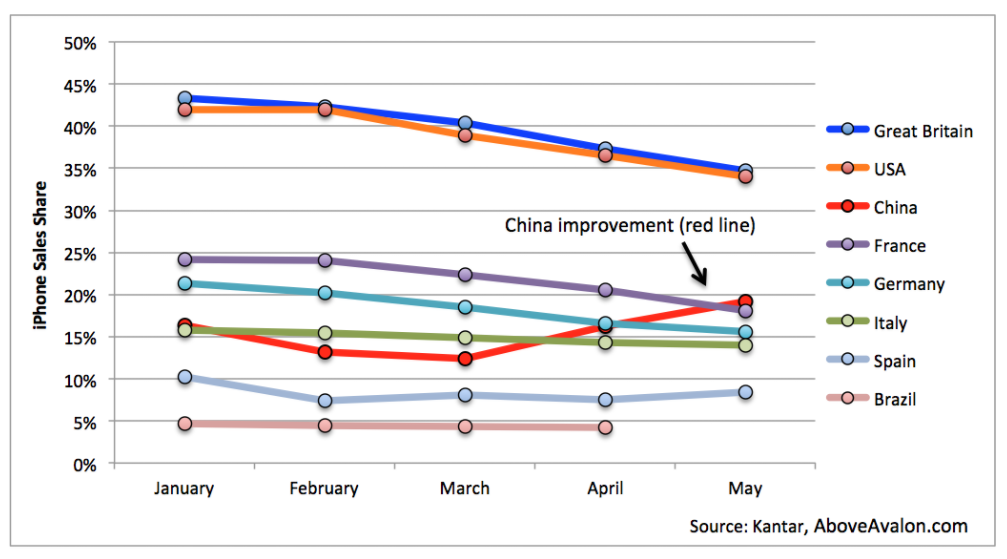
Apple in China
The narrative of Apple's China problem boiling down to a brutal battle with Tencent (WeChat) or local smartphone manufacturers is inaccurate. Apple's business in China is not imploding. Rather, it is experiencing growing pains. After more than a year of sales declines, positive signs are beginning to reappear in Apple's China business. China continues to represent more of an opportunity than a risk for Apple.
The Numbers
Greater China is Apple's third-largest operating segment and consists of Mainland China, Hong Kong, and Taiwan. As shown in Exhibit 1, the segment saw significant revenue growth in 2015 followed by a surprising decline in 2016. With Apple on track to report nearly $45B of Greater China revenue in FY2017, the segment will report its second consecutive annual decline.
Exhibit 1: Apple Revenue from Greater China
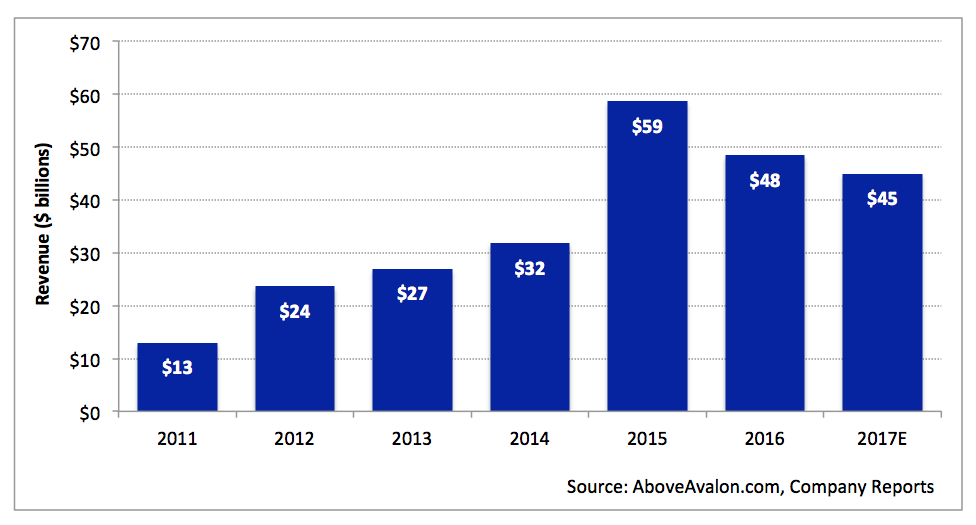
In 2013, Tim Cook looked at China as being well-positioned to eventually become Apple's top market. At the time, Greater China was Apple's third-largest operating segment, representing approximately 15% of overall revenue. Over the subsequent two years, it looked like Cook's prognostication would be proven correct. After a very strong 2015, Greater China bypassed Europe to become Apple's second largest operating segment, responsible for 25% of overall revenue. Observers soon began to forecast when Greater China would overtake the Americas to become Apple's largest operating segment.
As seen in Exhibit 2, the situation changed dramatically in 2016. Weakness in Greater China led to the segment falling back below Europe in terms of revenue. Meanwhile, the Americas firmly remains Apple's largest operating system with revenue nearly double that of Greater China.
Exhibit 2: Apple Revenue by Operating Segment
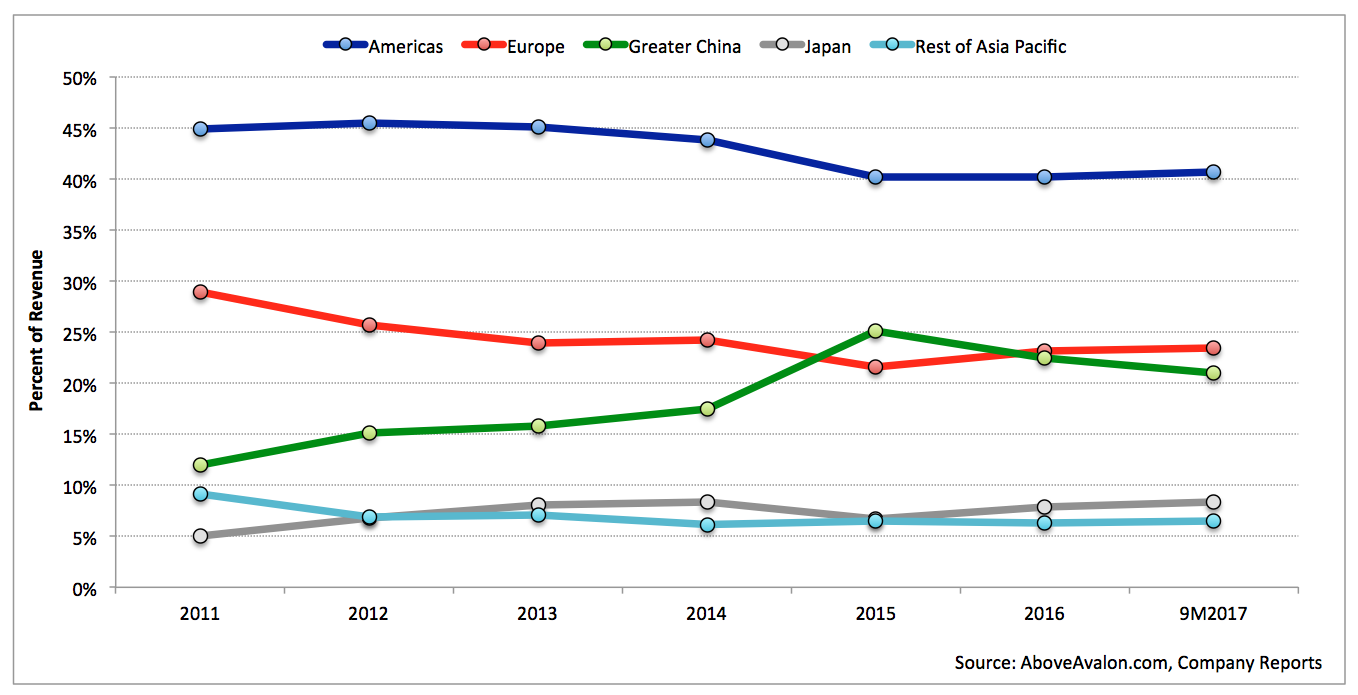
What Happened?
Apple's declining revenue in Greater China over the past six quarters can be attributed to a slowdown in iPhone sales. As seen in Exhibit 3, iPhone sales share in Mainland China saw a notable tick down beginning in early 2016. The data is courtesy of Kantar Worldpanel, an analytics firm relying on longitudinal surveys to track the same individuals and their smartphone habits over time. Kantar data provides a decent snapshot of how the iPhone is selling relative to other manufacturers (sales share). The sales share peaks experienced in early 2015 and early 2016 corresponded to new iPhone launches. The most recent iPhone launch (iPhone 7 and 7 Plus) clearly underperformed the two previous iPhone launches. This weakness undoubtedly led to much discussion at Apple HQ as it came as a surprise to management.
Exhibit 3: iPhone Sales Share (Mainland China)
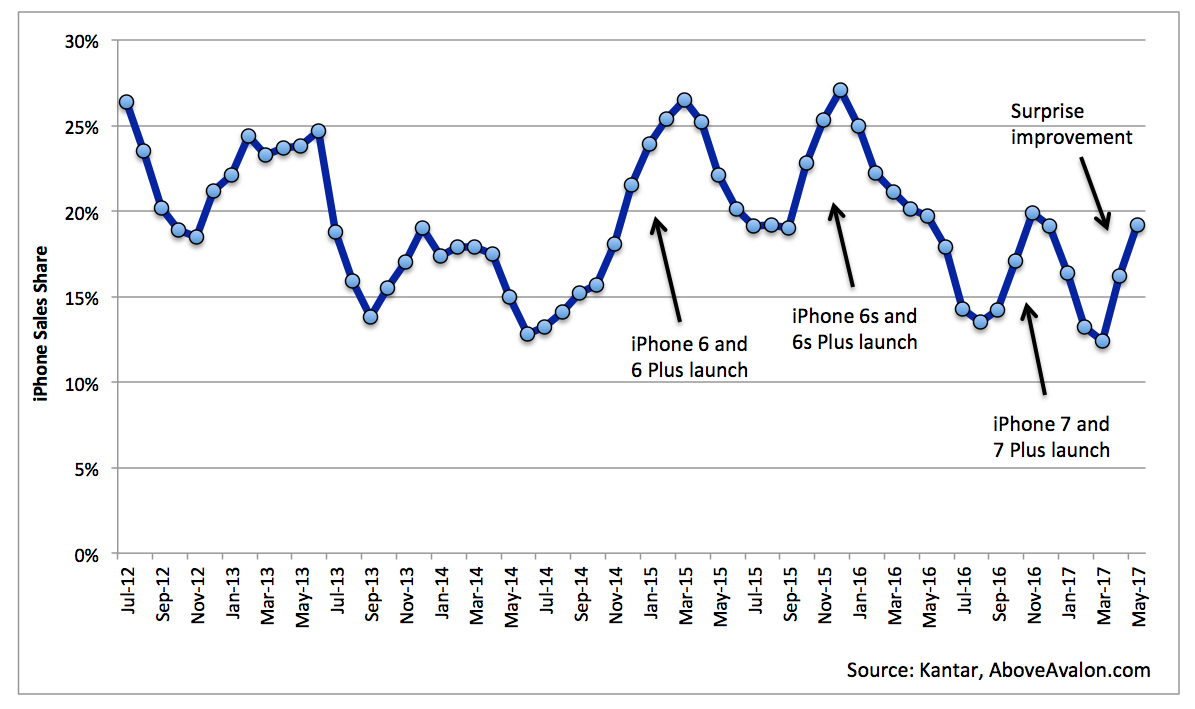
A number of theories have been put forth in an attempt to explain iPhone sales weakness in China. Ben Thompson over at Stratechery made the case that WeChat's prominence in China has reduced the value and lock-in found with iOS, reducing Apple to "simply another smartphone vendor." According to Thompson, this situation has led to declining loyalty and retention rates among iPhone users. WeChat also seems to have become the consensus pick among western media when it comes to pinpointing Apple's problem in China.
Wired's Jeremy Hsu took a slightly different angle, saying Apple was "a victim of its own failure of imagination." The company's failure to adapt services such as Apple Music and Apple Pay to local culture has contributed to fading consumer interest in Apple hardware. Hsu argued Apple Music should have a free tier while Apple Pay's reliance on near-field communication technology isn't appealing in China.
While the preceding arguments contain solid points, they ultimately end up being dubious for explaining iPhone sales weakness. Both arguments position weak Apple services adoption, either due to a strengthening WeChat or Apple's own doing, as a sign of shifting customer perceptions facing Apple in China. Poor Apple services adoption is then said to lead to less brand loyalty and greater odds of switching away from iPhone. Such a claim ends up giving way too much credit to the influence Apple services play. It's as if Apple is a services company that just happens to sell hardware. This isn't the case. There is something more at play in China regarding weaker iPhone sales besides greater WeChat competition or lackluster Apple services.
The Smartphone Market in China
A closer look at the smartphone market in China provides the context needed to assess Apple's performance. There are three major smartphone trends:
1) Anemic smartphone sales growth. There continues to be a misperception that Mainland China is seeing 20% to 30% smartphone unit sales growth year-over-year. This just isn't the case. In reality, smartphone sales growth is much harder to find. According to IDC, the smartphone market in China grew 3% in 2015, 8% in 2016, and has been struggling to grow in 2017. Apple management likely contributed to the false perception of there being massive smartphone sales growth in the country by constantly talking up the opportunity tied to China's expanding middle class. While this shift is occurring, its impact on overall smartphone growth is less clear.
2) Massive consolidation. Given such anemic sales growth, there has been intense competition and consolidation, especially at the low-end of the smartphone market. In 2014, the "Other" category consisting of Samsung, Lenovo, and a number of smaller smartphone manufacturers, represented 238M smartphone shipments. Two years later, "Other" sales declined by 60M units to 178M smartphones. The big smartphone loser in China hasn't been Apple, but rather Samsung and smaller smartphone manufacturers.
Meanwhile, Oppo has experienced the strongest increase in smartphone sales on an absolute basis in China with Vivo and Huawei coming in second and third, respectively. On a combined basis, Oppo, Vivo, and Huawei saw an increase of 130M smartphone unit sales from 2014 to 2016. While it may be easy to look at Oppo, Vivo, and Huawei as winning at the hands of Apple, in reality, their sales gains have likely come from Samsung, Lenovo, and new customers entering the smartphone market at the low-end. Despite a very difficult 2016, Apple was still able to grow annual iPhone shipments by 8M between 2014 and 2016. This goes to show just how strong the iPhone performed in 2015.

3) ASP Divergence. The smartphone pricing gap in China is expanding. While Apple sits at the premium end of the market with an iPhone average selling price (ASP) exceeding $700, every other major smartphone manufacturer is reporting ASP that is a fraction of iPhone's. Pricing data would support the theory that Apple and those smartphone manufacturers with the strongest sales momentum are appealing to completely different customers. While overall smartphone growth remains subdued, whatever growth there is can be found at the low-end of the market.
Issues
Taking into account the unique trends found in the China smartphone market, my theory is that there are actually four distinct issues impacting Apple in China.
1) Lack of New Users. It is becoming that much harder for Apple to find pockets of premium users in China ready to buy their first iPhone. Apple's smartphone sales share in China peaked in 2015 right after China Mobile began selling the iPhone 6 and 6 Plus. While China Mobile had officially begun selling iPhone a year earlier, it was the iPhone 6 and 6 Plus that represented the first big iPhone launch for the carrier.
Apple experienced a big iPhone sales boost from the iPhone 6 and 6 Plus launching into an untapped reservoir of premium China Mobile users. Once these users purchased iPhones, there weren't similarly-sized pockets of new users elsewhere in China. Instead, Apple had to turn to Android switchers for new users. This is one reason why new users as a percent of overall iPhone sales has been on the decline.
2) Longer iPhone Upgrade Cycle. Considering how Apple saw a significant number of new iPhone users in China in 2015, these users were not ready for an upgrade in 2016 or even early 2017 for that matter. Instead, iPhone users in China are likely holding onto their iPhones for a longer period of time before upgrading. This trend is not unique to China but rather has occurred in various geographies.
3) Pricing Pressure. The significant smartphone pricing gap in China has placed a ceiling on Apple's iPhone target market. It looks like the number of Android users switching to iPhone is on the decline. According to Apple, switching outside of China was up year-over-year. The implication is that switching in China was down year-over-year. A similar dynamic does not exist in the U.S. where iPhone is actually priced at or below the Android competition. A better comparison for measuring iPhone sales share performance in China would be countries where the iPhone is similarly priced at a premium. As seen in Exhibit 4, in what may come as a surprise, iPhones sales share in these countries end up even worse than that of China.
Exhibit 4: iPhone Sales Share (2017)
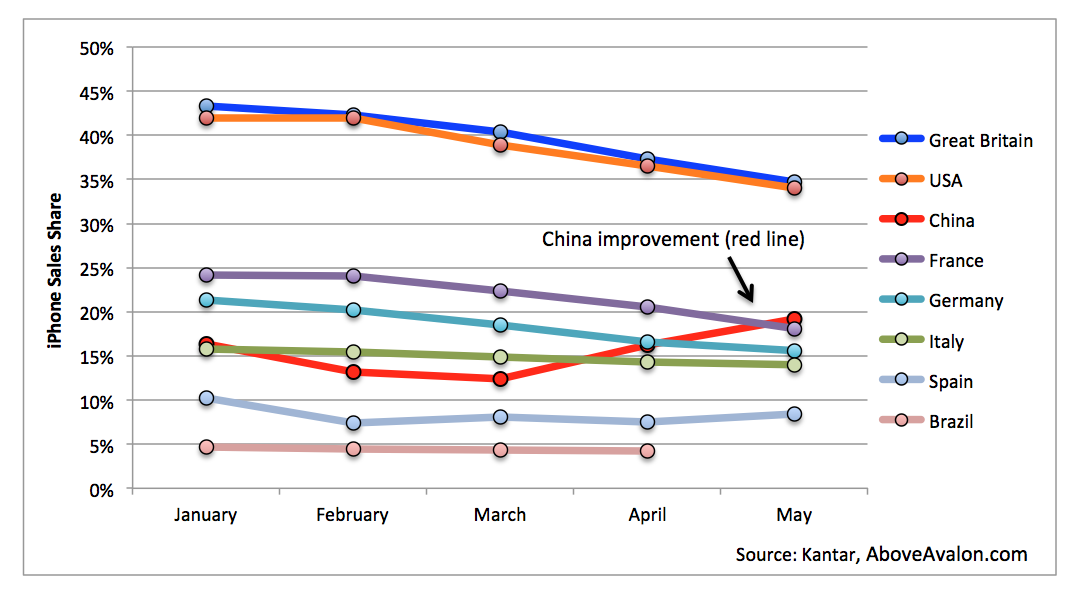
4) Growing Pains. Although Apple has made much progress opening new Retail stores in China, the company still has an inadequate retail footprint in the country. There are only 40 Apple Retail stores in China, a country with 1.4 billion people. To put that number in context, Apple has seven retail stores in Connecticut, home to a little more than three million people.
Brick and mortar retail matters in China. According to Kantar, nearly 90% of Oppo smartphone sales took place through brick and mortar. Apple just doesn't have the retail penetration in Tier 1, 2, and 3 cities in China. For example, Apple has only three stores in Chongqing, one of the largest municipalities in China with a population of 30 million people.
While consumers have the option of buying Apple products through carriers or third-party retailers, there are drawbacks found with Apple relying on others to sell product. Despite selling the iPhone for years, iPhone sales share at Verizon remains lackluster compared to that at AT&T, Apple's initial partner in the country. Many have speculated that this lower sales share is due to the way smartphones are sold at Verizon where sales clerks have sway over consumer purchasing decisions.
Apple Retail stores represent one of the best ways for management to push the Apple experience. This is something not possible with third-party retailers. Considering it took management two years to open 20 stores in China, the lack of Apple Retail stores is an issue that will take Apple years to fix.
Apple's main issues in China are related to the underlying structure of the smartphone market, not greater WeChat competition. Why then is WeChat positioned as Apple's arch nemesis in China? If users spend all of their time and attention within the WeChat ecosystem, is Apple's ecosystem negatively impacted? Is WeChat cultivating a user base that views Apple as simply a premium-priced hardware provider, which will then result in less consistent hardware sales?
Unfortunately, quite a bit of the analysis regarding Apple and WeChat relies exclusively on anecdotal evidence. In an effort to move beyond this, we can use WeChat's most recent disclosures to gain a better perspective. The company disclosed that half of its 900M monthly active users spend 90 minutes a day on a WeChat property. That is a significant amount of time which likely makes Mark Zuckerberg and Evan Spiegel quite envious. WeChat is seeing success on a scale that simply isn't seen elsewhere by any other services company. However, we use our smartphones for more than 90 minutes a day. Current estimates peg average smartphone usage at five hours per day. This means the average WeChat user, while heavily invested in WeChat, is still relying on other services besides WeChat.
Meanwhile, App Annie recently pegged Chinese smartphone users as relying on ten apps on a daily basis. In terms of monthly usage, that number rises to 30 apps. Even if we assume these estimates are being generous, the narrative that WeChat users only use WeChat is exaggerated.
The WeChat topic raises a broader question: What is Apple actually selling in China? iOS? Services? Hardware?
Apple is selling the same thing in China as it does in every other country. Apple is selling an experience. The simple act of buying an iPhone, even if it is used for WeChat, is part of that Apple experience. While Apple management would certainly like to see customers using Apple services, in reality, Apple service usage is not a requirement for Apple to succeed in a market. Instead, services are meant to add even more value to Apple hardware. At the same time, Apple service usage doesn't necessarily lead to increased loyalty and retention. Instead, the dynamic is much more complicated. For example, Apple loyalty is doing just fine in the U.S. even though Apple Pay usage remains surprisingly low.
Light at the End of the Tunnel
Signs of a bottoming process are appearing for Apple in Greater China.
- Revenue trends are stabilizing. During Apple's 3Q17 earnings conference call (my complete review of Apple's 3Q17 earnings is available for members here), management commented that although Hong Kong sales were still down, revenue trends in Mainland China were actually flat year-over-year. Revenue trends have now been improving for the past two quarters. While Apple is clearly not out of danger, the Greater China operating segment appears to have found some stabilization.
- iPhone sales share is improving. As seen in Exhibit 3, iPhone sales share has now seen two months of improvement in Mainland China. For this to occur in the period leading up to Apple's largest iPhone release in years is actually remarkable. There are two possible explanations for this improvement: the Product Red iPhone 7 and 7 Plus and a natural bottoming process in which existing iPhone users are ready for an upgrade.
- Broader Apple ecosystem strength. Judging from Apple management commentary, Apple is seeing solid sales growth through its App Store in China. In addition, the iPad and Mac continue to sell well. Apple Retail store traffic and sales are up year-over-year as well. This sure doesn't look like a company seeing its opportunity in China slip away due to WeChat attacking the iOS ecosystem.
- Apple made a notable leadership change. Apple recently promoted Isabel Ge Mahe to the newly created role of vice president and managing director of Greater China, reporting to Tim Cook and Jeff Williams. While the move was an acknowledgement of issues and trouble in Greater China, it is reasonable to expect greater operating efficiency, including additional effort to localize products.
One question regarding Greater China is whether the operating segment still represents an opportunity for Apple or if it is more appropriate to look at the segment as a risk. Is the $45 billion of annual revenue from the region more likely to decline over time or can Apple be confident in looking at that total as a base for future growth?
China still represents an opportunity for Apple although management will likely need to make additional strategy adjustments:
- Continue fine-tuning products to better fit local culture. There is pretty much no downside to spending additional resources on this effort. New iOS features targeting China (QR Code support, SMS fraud prevention, etc.) are a clear sign that management looks at this fine-tuning as crucial.
- Embark on a massive Retail store expansion in Mainland China. A strong case can be made that Apple should have hundreds of retail stores located throughout China.
- Continue strengthening relationships with key partners, including Foxconn and Tencent. With future China government regulations representing an unknown, Apple's best strategy for handling the geopolitical environment is to strengthen its relationship with local companies, including Foxconn. Contrary to popular belief, Tencent is more of a partner than enemy for Apple.
- Remain steadfast on taking a long-term view on China. Apple should focus not on turning around quarterly iPhone sales by releasing a cheap iPhone, but instead on forming a foundation for the Apple brand in the country.
Apple ends up being graded on a curve in China. Apple is on track to report $45B of revenue in Greater China in 2017. Meanwhile, some of Apple's peers in the U.S. may never see much revenue at all from China. While Apple has its fair share of issues to overcome in China, fundamentals appear to be intact. Apple's ultimate goal in China is similar to its goal in every other country: Sell tools that are capable of improving people's lives. Apple is going to be just fine in China, even if customers use WeChat to enhance their Apple tools.
Receive my analysis and perspective on Apple throughout the week via exclusive daily emails (2-3 stories a day, 10-12 stories a week). To sign up, visit the membership page.
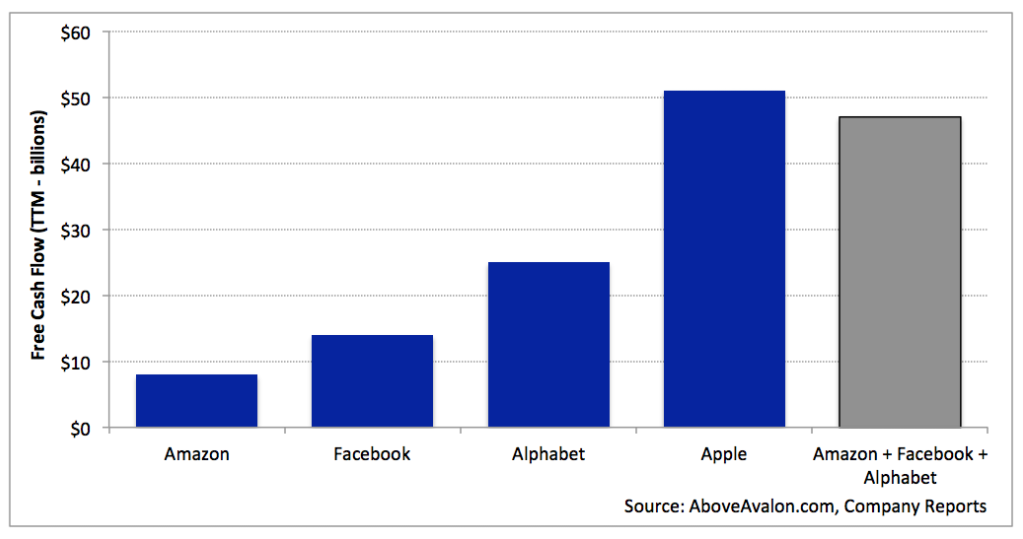
Apple Has the Best Business Model for Generating Cash
Apple is generating obscene amounts of cash. The company recently reported nearly $6 billion of free cash flow during what is typically its weakest quarter of the year. Over the last 12 months, Apple earned $51B of free cash flow. This is more than any other company earned. It is easy to chalk up Apple's financial success to the iPhone and call it a day. However, upon closer examination, Apple's business model predisposes the company to cash generation unlike any other firm in Silicon Valley. In fact, Apple currently possesses the best business model in the world when it comes to generating cash.
The Numbers
Apple is in a financial league of its own. As seen in Exhibit 1, Apple's $224B of trailing twelve month (TTM) revenue was nearly as much as that of Amazon ($143B), Alphabet ($95B), and Facebook ($33B) put together.
Exhibit 1: Revenue (TTM)
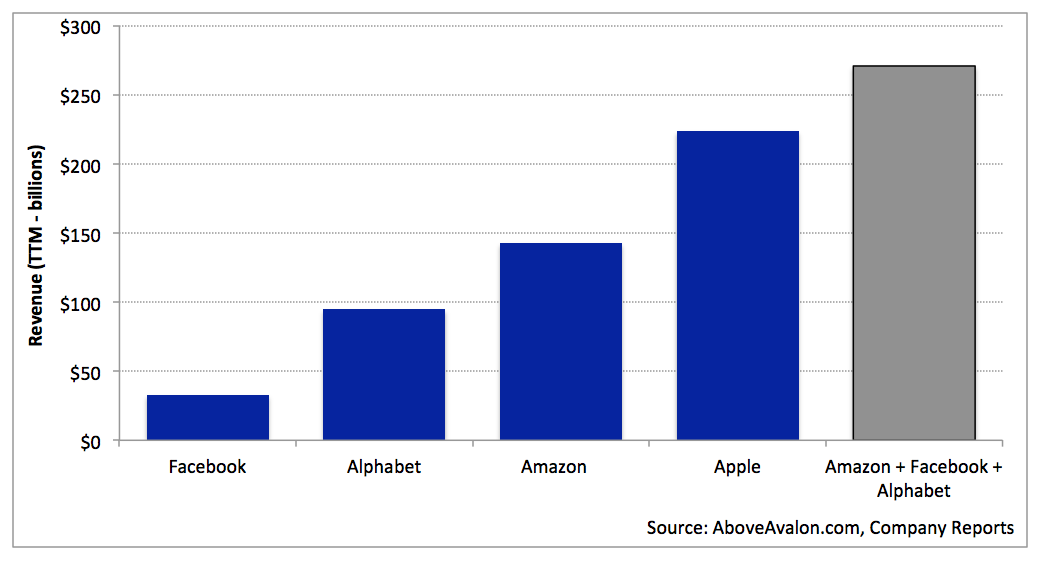
The numbers become more daunting when moving down the income statement. As seen in Exhibit 2, Apple's $60B of TTM operating income was nearly 50% more than the combined operating income of Alphabet ($24B), Facebook ($15), and Amazon ($3B).
Exhibit 2: Operating Income (TTM)
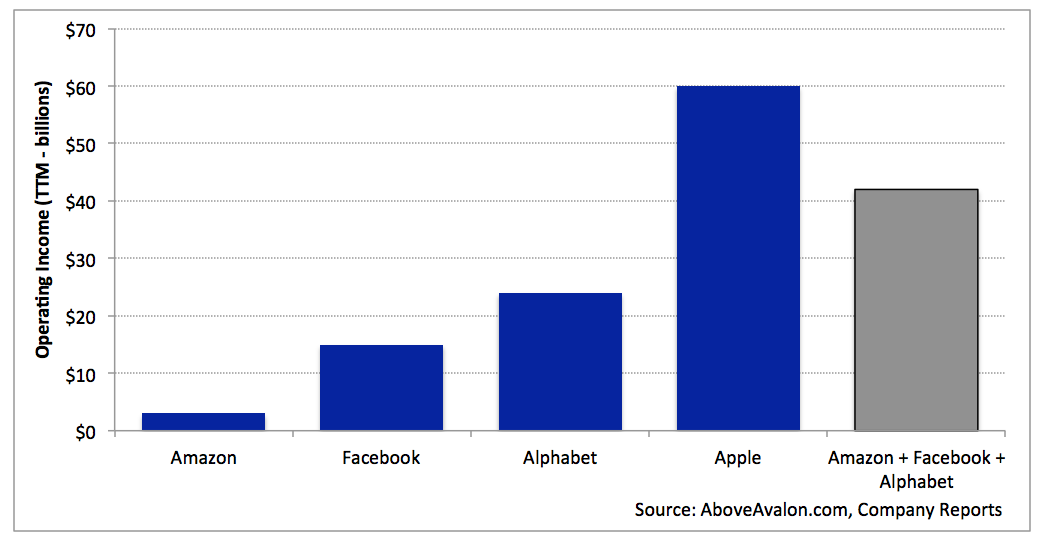
Turning to the cash flow statement, Apple's numbers are just as remarkable. Apple's $64B of operating cash flow was nearly as much as that of Alphabet ($36B), Facebook ($19B), and Amazon ($17B) combined. In essence, Amazon is doing as well financially as Facebook. Google is generating as much cash as Amazon and Facebook put together. Apple is generating nearly as much cash as Amazon, Facebook, and Google combined.
Not only is Apple generating significant operating cash flow, but the company is also kicking off free cash flow at rates not seen elsewhere in Silicon Valley - or the world for that matter. Free cash flow is a measure of how much cash is generated after taking into account capital expenditures and other costs associated with running the business. Apple's $51B of TTM free cash flow is $3B more than the free cash flow produced by Alphabet, Facebook, and Amazon combined. In what may come as a surprise, Apple is bringing in 70% more free cash flow than Microsoft, who is still considered to possess one for the more lucrative business models in existence.
Exhibit 3: Free Cash Flow (TTM)
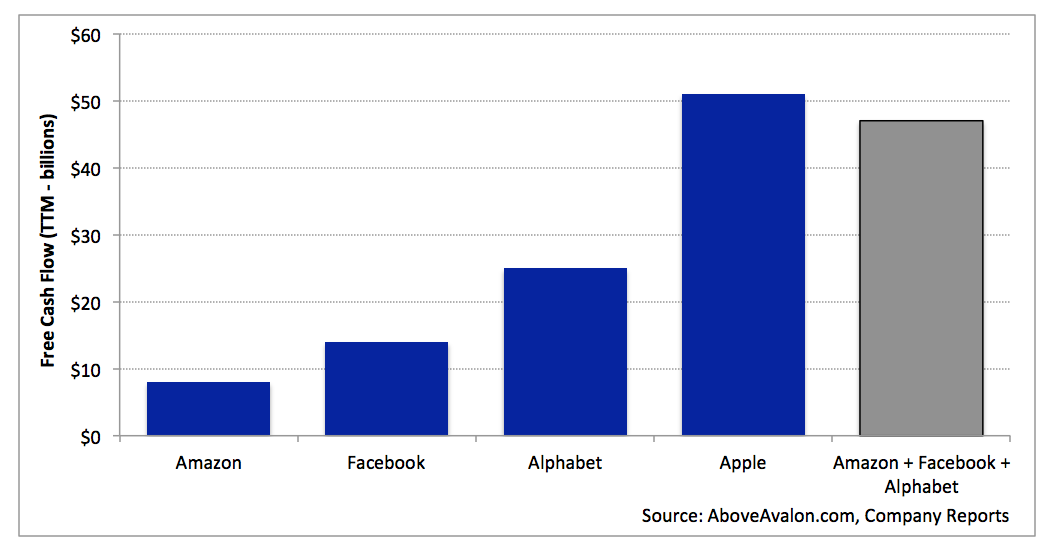
Superior free cash flow generation has played a major role in Apple's ballooning cash hoard, which now stands at $154B of net cash (excludes $108B of debt). Despite spending $216B on share buyback and dividends since 2012, Apple's net cash level has increased by $33B over the same time period. The company is generating so much cash, management can't spend it fast enough.
Exhibit 4: Net Cash

Profit Extraction
Most of the discussions involving Apple's finances position the iPhone as being responsible for the company's good fortune. While the iPhone accounts for approximately 60 percent of Apple's revenue, the device doesn't tell the full story.
Consider Apple's current product line:
The most profitable smartphone
The most profitable tablet
The most profitable laptop
The most profitable desktop
The most profitable smartwatch
The most profitable pair of wireless headphones
The most profitable streaming TV box
Few hardware manufacturers make money selling smartphones and tablets. The money found in the components business doesn't come close to Apple-like profitability. The best-selling laptop and desktop manufacturers can only dream of Mac margins. Apple is the most profitable wearables company. Even minor Apple products from a sales perspective, like Apple TV, are grabbing profit in an otherwise profitless industry.
It may be easy to look at these products and conclude that Apple must be overcharging its customers. How else can Apple sell so many profit leaders? However:
Apple Watch and AirPods are underpriced versus the competition.
MacBook is priced competitively with laptops with similar specs.
iPhone is priced competitively with Samsung's flagship Galaxy smartphones.
Apple's product line shows that there is more than just pricing behind management's ability to extract profit from an industry. Apple's entire business model predisposes the company to superior free cash flow generation.
Core Tenets
The best way to begin dissecting the Apple cash machine is to take a closer look at Apple's business model. There are three tenets, or beliefs, underpinning Apple's business model.
Placing the product above all else. Apple's superior cash generation begins all the way back in the R&D labs. Management is motivated by coming up with great products, not making massive profits. While Apple executives use every opportunity to reiterate this point, most outside observers think it's just talk or PR. However, Apple's financial performance backs up management's claim. Apple doesn't design and sell products to drive revenue. If Apple is able to make great products, management is confident that consumers will like the product and profit will follow. This motivation results in a much more unique product strategy than that of other companies.
Staying focused. Apple values the art of focusing, saying no to great ideas in order to concentrate the entire company on a few really great ideas. This intense level of focus extends all the way down to Apple's R&D efforts. The amount of money Apple spends on R&D as a percent of revenue is well below that of its peers. In addition, Apple's M&A strategy follows a similar protocol as management is very deliberate in its purchases, focusing on technology and people purchases capable of plugging holes in the asset base.
Relying on contract manufacturers. Apple is a product company that relies on others to assemble its products. While Apple brings in significant amounts of cash from hardware sales, the company's free cash flow generation receives a big boost from using contract manufacturers. Instead of owning an extensive web of factories around the world, Apple invests in equipment and machinery located in other companies' factories. This results in Apple spending much less on capital expenditures as a percent of revenue. Apple is on track to spend $15B on capital expenditures this year. Alphabet and Amazon spend nearly as much on expenditures despite having a much smaller revenue base. This means that a significant portion of Apple's operating cash flow ends up as free cash flow and can be considered truly "excess" cash.
These three factors play a big role in Apple selling highly profitable hardware that stands out from the competition.
Apple Is Different
The next item to investigate when dissecting the Apple cash machine is to see how the preceding core tenets come together to make the company's business model stand out from that of its peers.
In some cases, Apple hardware has gone on to hold monopoly-like market share in its respective product category (iPod, iPad, Apple Watch). For other products, Apple hardware remains the small player in town in terms of sales share (iPhone, Mac, Apple TV). However, in nearly every example, Apple ends up being the profit leader because management looks at scale differently than other companies view it. Apple doesn't view scale as a requirement to achieve success. This has major implications on Apple's pricing strategy in addition to how the company thinks about monetization.
Facebook and Google approach scale very differently. For both companies, scale is needed in order to reach as many people (and their data) as possible. The additional data enhances and improves their free services. Amazon's business model is also dependent on scale, albeit a different kind. Much of the company's ongoing investments (transportation, logistics, cloud, and artificial intelligence) are designed to get you to buy more and more goods through Amazon. This significant level of investment will likely be needed for the foreseeable future.
In summary:
Apple is a design company focused on selling tools capable of fostering superior experiences. Scale is considered a byproduct of a properly functioning business model.
Facebook and Google are service companies focused on offering free, data-capturing services to as many people as possible. The business models are dependent on achieving scale in order to access as much data as possible.
Amazon is a retail platform company focused on getting you to buy more stuff over time. Scale in terms of purchase volume is needed in order for the cash flow/reinvestment cycle to continue.
There are exceptions to these underlying themes such as Apple Music needing scale in order to become a better music streaming service. In addition, Apple Pay needs widespread retailer adoption to make sense for consumers. However, these examples only reinforce the uniqueness found with Apple's primary business model. Instead of being key revenue or profit drivers, Apple Music and Apple Pay are services meant to increase the value found with Apple hardware.
Putting It Together
Apple possesses the best business model for generating cash because the company is capable of monetizing premium experiences much more effectively and efficiently than anyone else. Instead of chasing scale with the goal of monetizing data or usage, Apple sells tools that management thinks people will want and are willing to pay for.
While Apple doesn't look at scale as a requirement for success, the company undoubtedly benefits from scale in a few ways. Greater economics of scale help drive down product costs over time, which both improves both product accessibility and Apple profitability. Scale also allows Apple to place larger component orders. There are a number of examples over the past decade involving Apple competitors being unable to ship competitive products due to Apple buying up all of the available component supply. These elements don't define Apple's cash machine but rather represent the lubricant that makes it run more smoothly.
Stationary Speaker Market
Apple's unique approach to the burgeoning stationary speaker market highlights how the company plans on using its business model to set the company up for cash generation. Amazon and Google currently have products in the marketplace. Apple's HomePod is scheduled to go on sale in December. Facebook is rumored to be entering the market next year with some kind of stationary screen/camera/speaker.
Amazon. The company's goal with selling Echo hardware is to get its digital voice assistant, Alexa, in as many homes as possible. Greater Alexa usage leads to more data being collected which then helps Amazon become a better, and smarter, retailer. In order to accomplish this goal, the company is willing to give away Echo hardware at cost, or even a loss. When it comes to monetization, instead of making money from Echo hardware, Amazon positions Prime subscriptions as the cash generator. While this strategy has been wildly successful for the company, it has been difficult to miss Amazon's lack of free cash flow. Unlike Apple, Amazon piles most of its operating cash flow right back into the business. Market observers have made the mistake of looking at this behavior as purely optional on Amazon's part. In reality, Amazon will likely need to maintain this high level of investment indefinitely to ward off competitors and keep people buying products from Amazon. This means that Amazon's business model, while successful in delivering valuable customer experiences, may just end up being contained when it comes to excess cash generation.
Google and Facebook. Both companies are interested in capturing customer data in order to power their free services. This will lead to the companies selling hardware at cost or even at a loss, similar to the way Amazon does. Instead of making money on hardware, Google and Facebook will look to monetize the data obtained via microphones and cameras through advertising. We have seen this model's profitability over time. Facebook and Google serve more customers than Apple, but the companies generate cash on a much smaller scale than Apple. Their business models just don't throw off the same kind of free cash flow as Apple. While the home will present different dynamics than mobile and there is room for each to grow the advertising pie, there is little reason to think the overall profitability picture will be much different in the near term.
Apple. Apple is positioning HomePod, its new stationary speaker, as the best sounding speaker people have ever owned. Apple is betting that controlling both the hardware and software while having the product work closely with Apple services such as Apple Music will lead people to want to own and use HomePod. Apple plans on making money from HomePod through hardware sales. Priced at $349, the device very likely contains a profit margin equivalent to that of other Apple hardware. It is worth pointing out how the device is aggressively priced compared to speakers with equivalent speaker quality. Over time, HomePod usage will help drive Apple services such as Apple Music and Siri. These services will then go on to add greater value to future Apple hardware. Apple's strategy will be to use HomePod to extract most of the profit from the standalone stationary speaker market. Additional profit will come from Apple expanding the speaker pie (i.e. bringing more people into the stationary speaker fold).
Even though it may seem counterintuitive, Apple stands to earn more cash through hardware sales at a smaller scale than companies giving away hardware at cost but looking to monetization in other ways. This is why the initial exhibits up above comparing Apple's financial picture to the leading consumer-oriented tech companies are so surprising.
The Big Question
Apple has built a spectacular cash machine kicking off remarkable amounts of free cash flow. There does not seem to be any other company that is close to copying this machine. Amazon, Google, and Facebook look at hardware as a way of improving data capturing services. Microsoft's hardware success in consumer markets is fading. This leaves companies such as Samsung, Huawei, Oppo, Vivo, and Xiaomi as the only large companies trying to make money from consumer hardware. Each is seeing various levels of mediocre success.
There is no question that the smartphone wave has been a good one for Apple to ride. As iPhone sales have stabilized, Apple's revenue, operating income, and free cash flow growth has also stabilized. Meanwhile, Facebook, Amazon, and Alphabet are seeing stronger growth trends.
The big question going forward isn't if Apple will find another product as profitable as iPhone to drive growth, but rather if Apple will need to find another business model in order to enter new industries. Will there come a time when Apple's business model will need to evolve into something else?
Growing Pessimism
It's been hard to miss the growing amount of pessimism surrounding Apple's cash machine. There is a large chorus in Silicon Valley that views Apple's business model as a liability given how artificial intelligence (AI) will infiltrate literally all aspects of our lives. Do Amazon, Facebook, Google, Microsoft, Tencent (WeChat), and Baidu actually possess early versions of the business models of tomorrow? Is Amazon's Echo strategy the more attractive way to handle hardware? Many people now think companies chasing scale and collecting as much data as possible are much better positioned for the future than Apple.
In some ways, concerns regarding Apple's cash machine are genuine. For example, it's not clear if Apple's current business model would do well in tomorrow's transportation industry without some modifications. Is the future of transportation based on people buying or leasing cars? A good case can be made that the future is found with ridesharing. The answer would likely impact the way Apple monetizes transportation tools.
However, there is also evidence that fears of Apple's cash machine imploding are overblown. Unlike the unknown found with the transportation question, the idea that AI will make Apple's business model irrelevant looks to be based on faulty logic. The entire thesis assumes the world is headed in a different direction that it actually is.
Over the past decade, one of the biggest revelations in technology has been design's increased role in how we consume and value technology. The mass market has bought into Apple's view of personal technology. There is nothing about AI that changes this reality. Instead, we have non-hardware companies pontificate how hardware won't matter in the future. In reality, the opposite will likely occur. Hardware will matter more going forward. The wearables industry represents a good example of this in practice. Meanwhile, the way smartphone and tablet components are mattering more now than ever to AR and AI is another hole in the "hardware won't matter" thesis.
Some Things Won't Change
As it stands today, Apple's business model is producing more excess cash flow than every other business model. Even assuming competitors see stronger growth than Apple over the next few years, it's not clear how any company will match Apple in terms of cash generation. There is also evidence to suggest Apple will continue to rely on its current cash machine in the wearables industry (Apple Glasses, Apple Watch, AirPods) as these products fit within Apple's current business model extremely well. In fact, the way Apple Glasses seems to match perfectly with Apple's current business model may end up elevating that product to likely be the next product category Apple enters.
However, even in a world that requires Apple to modify its cash machine, some things won't change. The core tenets that underpin Apple's business model will remain, and those are the key ingredients that make the cash machine tick.
Receive my analysis and perspective on Apple throughout the week via exclusive daily updates (2-3 stories per day, 10-12 stories per week). Available to Above Avalon members. To sign up and for more information on membership, visit the membership page.
Apple Glasses Are Inevitable
All of the pieces are coming together for Apple to sell glasses. Using fashion and luxury lessons learned from selling Apple Watch, Apple will enter the glasses industry and in the process launch its first product category designed specifically for the augmented reality (AR) era. While ARKit has taken the world by storm, the development platform is already making it clear that new form factors are needed to take full advantage of AR. It is no longer a question of if, but when, Apple will use AR to rethink glasses.
ARKit
ARKit is Apple's new framework for developing AR apps on iOS. Apple defines AR as the illusion of virtual objects placed in a physical world. There are three ARKit layers:
Tracking. Using Visual Inertial Odometry (VIO), camera sensor data is combined with CoreMotion data to get the device's location and orientation.
Scene Understanding. Using the camera view, the device can find horizontal planes in a room in addition to estimating the amount of available light in a scene.
Rendering. A constant stream of camera images, tracking information, and scene understanding can be inputted into any renderer.
ARKit transforms iPhone and iPad cameras into smart eyes. Developers then use those eyes, and the technology already found with iPhones and iPads, to enhance our reality. Of course, that enhanced reality is constrained to what appears on our iPhone and iPad screens. Despite this limitation, the possibilities seem limitless.
While some of the earliest examples are interesting, it is difficult to ignore how many of these examples make more sense for a pair of AR glasses. Any AR app involving holding up an iPhone or iPad while not requiring much user manipulation directly on screen makes more sense for glasses. For example, virtual turn-by-turn directions are destined for AR glasses as it’s just not ideal to have to hold up a smartphone in front of our face as we are walking down the street.
This isn’t meant to discredit iPhones and iPads as powerful AR tools. In fact, the iPhone’s future will be one as an AR navigator. However, wearable form factors will likely outpace iPhone and iPad over the long arc of time in terms of their ability to extract utility from AR.
Inevitability
AR glasses check off all of the boxes for a product in Apple's wheelhouse and are deserving of a rare green light to market.
Hardware and software integration. There is room for Apple to create value by controlling both the hardware and software comprising AR glasses. The sum will be greater than its parts.
Wearables manufacturing. Apple is learning quite a bit about manufacturing techniques and materials from Apple Watch and AirPods. These lessons can be transferred over to glasses, an item that will need to include a plethora of technology yet remain light.
AR technology. Apple's big bet on AR will represent the catalyst for turning glasses and sunglasses into something more. An engaged base of iOS developers experimenting with ARKit will give Apple Glasses a hospitable app environment.
Personal technology evolution. AR glasses represent the evolution of Apple's decades-long quest to make technology more personal - allowing people to get more out of technology without having it take over their lives.
Fashion and luxury themes. Apple Watch has taught Apple much about how to get people to wear personal technology.
Health/Medical. The ability to improve one's vision fits within Apple's expanding interest in health and medical.
Retail demoes. Nearly 500 Apple Retail stores offer prime demo areas for customers to try on various glasses.
In terms of selecting the next big industry and product category to enter, AR glasses are high on Apple's list.
Glasses are Misunderstood
Glasses have gotten a bad rap. The item hasn't been able to shake the connotation of being a medical device used grudgingly by those in need of clearer vision. It is still commonplace for people to say something along the lines of "I wouldn't wear glasses if I didn't need to." Such a description undersells glasses, ignoring the device’s purpose and potential.
People wear glasses because they provide utility. For many, that utility comes in the form of improved vision. This is another way of saying corrective lenses (glasses and contact lenses) provide a clearer sense of reality to the wearer. Recent statistics show that nearly 75% of the population has vision that can be improved with corrective lenses. For certain age demographics, the percentage is even higher.
It cannot be overstated how clearer vision is one of the most value-add items a product can provide to its user. There aren’t too many gadgets or devices that would be selected over a smartphone in terms of its importance in our lives. However, corrective lenses would certainly be at the top of the list for many people. Corrective lenses are even required for certain tasks, such as operating heavy machinery like cars. In these situations, clearer vision isn’t just a luxury, but it's a requirement to ensure one's safety.
Glasses also provide a different kind of utility than clearer vision. A growing number of people are wearing glasses despite having perfect vision. Glasses are increasingly becoming accessories for the face, a fashion item complimenting a particular outfit, haircut, or even social occasion. Sunglasses have become a universal fashion accessory. A quick stop by the local shopping mall will reveal a number of stores focused on selling one accessory: sunglasses. Consumers have thousands of frames to choose from in order to find that one pair of glasses that best matches their personality. The glasses/sunglasses industry, led by Luxottica, has played a major role in pushing this new fashion narrative.
Evolution
Apple’s attitude toward face wearables has evolved. In 2013, Tim Cook was interviewed at the D11 conference, and the topic of wearable computing came up. Cook was very clear in his messaging: The wrist made more sense for computing than the face.
Here’s Cook:
"I wear glasses because I have to. I can't see without them. So I kind of have that problem. I don't know a lot of people that wear them that don't have to. People that do wear them generally want them to be light, they want them to be unobtrusive. They probably want them to reflect their fashion, their style, and so forth. And so from a mainstream point of view, [glasses] are difficult...I think the wrist is interesting."
It's noteworthy how Cook undersold glasses, positioning them as merely something he was forced to wear. In early 2015, Jony Ive, overseer of Apple's product strategy, referred to the wrist as "the obvious and right place" for a wearable device while saying the face "was the wrong place." Cook once again dismissed glasses:
"We always thought that glasses were not a smart move, from a point of view that people would not really want to wear them. They were intrusive, instead of pushing technology to the background, as we’ve always believed."
It is easy to dismiss Cook's and Jony’s comments as simple posturing. In the case of Cook, Apple was well on its way to developing Apple Watch in 2013. It had become clear that the wrist would represent Apple’s entry into wearable computing. Regarding Jony's and Tim's later comments, Apple was just a few months away from the Apple Watch launch, arguably the largest product launch for the company since iPad. For them to talk up anything other than Apple Watch and wrist utility would have been surprising.
However, this current Apple management team is not big into misdirection. Apple rarely shoots down product categories only to enter the same space shortly thereafter. Instead, there is a good probability that management was actually not completely sold on the idea of face wearables (i.e. glasses) when Cook and Jony provided their comments. Cook’s initial comments took place well before Apple began acquiring AR companies, which likely play a crucial role in justifying Apple selling glasses. In addition, prior to Apple Watch, Apple had little experience in selling an item as personal as glasses or sunglasses.
Hesitation
I have held much hesitation over the years regarding the idea of wearing computers on the face. Much of this skepticism originated out of questions regarding design (how the device would be used). Computers on the face can very easily become a barrier to getting the most out of technology. Taking a look at the current lineup of computers designed to be worn on the face, it is not difficult to see why such hesitation has been warranted.
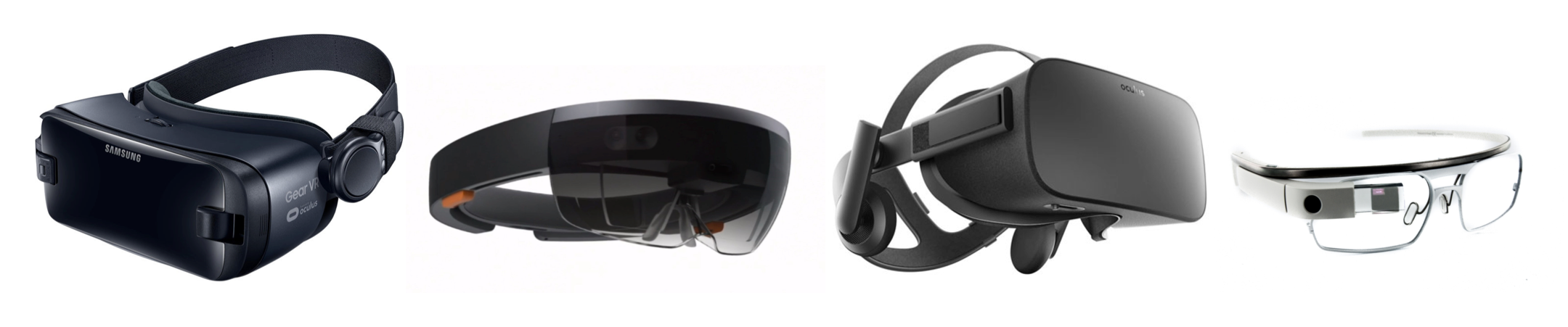
None of the preceding devices represent the future of face wearables for the mass market. The best case scenarios for such devices are found with niche applications such as gaming and certain enterprise settings. For AR glasses to go mainstream, the product will have to shed the “computers for the face” image portrayed by Google Glass, HoloLens, and every VR headset. This will involve innovative software and technology as well as a breakthrough user interface.
Something Changed
Apple's success with Apple Watch has done much to calm some of my fears and hesitation regarding face wearables. With 29 million Apple Watches sold to date, Apple has turned the dynamic of tech meeting fashion on its head. Apple has been able to get people to wear an item that was increasingly losing its place in a smartphone world.
Before Apple unveiled Apple Watch, smartwatches were bulky computers on the wrist with mediocre user experiences and questionable value. The product did not play in the fashion and luxury realms. Instead, smartwatches were judged by the degree to which their functionality could replace a smartphone.
Apple was able to completely change the connotation found with smartwatches and make them a mass-market item. The Apple Watch is now just as much of a fashion item as it is a computer. That is a good, not bad, thing. Watch bands and the ability to easily swap bands allow Apple Watch to be worn all day, every day, for various occasions and activities. Much of this dynamic can be recreated for glasses. Apple has the potential to change the narrative surrounding glasses, including our perception of the device.
M&A
In the clearest sign to date of Apple's growing interest in AR glasses, the company recently acquired SensoMotoric Instruments, an eye-tracking company. While the company's technology can improve various Apple products, my suspicion is the deal was all about Apple developing a pair of AR glasses that can be controlled by our eye movement. The idea of controlling technology using just our eyes is very intriguing.
Apple also acquired a number of AR-related entities in 2015 and 2016 including Metaio, Emotient, Polar Rose, Faceshift, PrimeSense, Flyby Media, and Perceptio. All of these companies in one way or another can play a role in Apple Glasses. In fact, all of the work Apple is doing with iPhone and iPad cameras can ultimately play a role in glasses.
Apple Glasses
When it comes to envisioning what a pair of Apple Glasses would look like, there is value in not overthinking the topic. Marc Newson, the most recent addition to Apple’s Industrial Design group, has experience designing face wear. In 2014, Newson designed various glasses (seen below) for Safilo as part of a special collection marking the company's 80th anniversary.
My suspicion is that Apple Glasses would look similar to Newson’s previous designs. Certain attributes such as being lightweight while having lenses with a large surface area will likely be carried over to Apple Glasses. There is precedent in Apple Industrial Design relying heavily on Newson's prior designs. A number of Apple Watch bands were clearly inspired by Newson.
Strategy
Apple Glasses would be a mass-market item with a target market measured in the hundreds of millions of users – similar to Apple Watch and AirPods. The go-to market strategy for a pair of Apple Glasses is relatively straightforward. Consumers would purchase hardware via Apple (online and in store) and through third-party retailers including retailers focused on selling corrective lenses, such as LensCrafters.
Apple Glasses would be a continuation of Apple's wearables strategy. The product would initially be positioned as an iPhone accessory, similar to other Apple wearables including Apple Watch and AirPods. Apple would also likely launch glassOS in an attempt to create an ecosystem of third-party AR apps destined specifically for glasses.
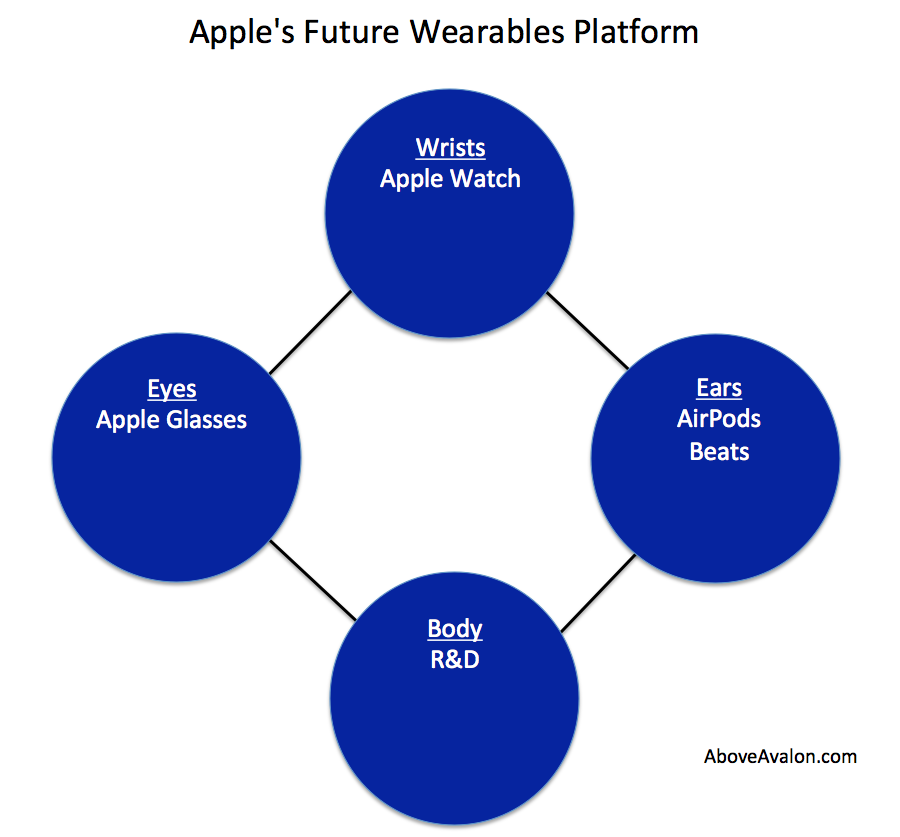
Instead of selling just one version, Apple would likely sell an entire line of Apple Glasses including various lenses (prescription, light-responsive, polarized, and clear). There would also be different sizes for men and women. The prescription lenses carry the important implication of Apple Glasses following Apple Watch in potentially qualifying as an item covered by insurance plans. In addition, prescription glasses can be bought using flexible spending or health spending account dollars.
In terms of pricing, Apple Glasses would likely continue Apple's current strategy of underpricing their wearables relative to the competition.
Marketing
It is crucial to not miss the forest for the trees when it comes to Apple Glasses. The device's purpose will be to enhance, not replace, reality for the wearer. As of today, glasses enhance reality by making things appear clearer. In the future, this utility will be transformed. Glasses will not just make our surroundings appear clearer, but also use AR to provide additional context related to our surroundings. The implications related to such a feature are far and wide.
This raises a few questions:
What would be the "killer app" for Apple Glasses?
Will Apple Glasses replace iPhones?
The idea of a product having a "killer app" has been misconstrued over the years. The iPhone really doesn't have a killer app. Instead, the device itself has turned into the killer app - the most valuable computer in our lives. In addition, the iPhone's role in our lives has evolved over time - a true sign of value. Apple Glasses would provide an improved view of the world to its user. For some, this will come in the form of clearer vision plus additional context. Others will gain value just from receiving additional context.
Apple Glasses won't "replace” an iPhone. However, it's not likely any product will replace the iPhone. Thinking about new products in the sense of their ability to replace existing products is faulty. iPhones and iPads didn't replace PCs and Macs. Instead, they became viable alternatives to PCs and Macs for hundreds of millions of people. Similarly, Apple Glasses will one day serve as a viable alternative to the iPhone, handling a new set of tasks never given to iPhone.
Timing
Historically, Apple has launched a major new product category every few years. While consensus thinks the gap between when Apple enters new product categories is something like three years, it is more likely five to seven years. However, there isn't a large sample size to allow us to place much confidence in any particular pattern. Since the Apple Watch was unveiled in 2015, Apple still has some time before the inevitable pressure arises for the company to launch a new product category. It is certainly plausible that Apple Glasses have become Apple's most likely new major product category, even ahead of any Apple transportation initiative. It is no longer a question of if Apple will sell its own AR glasses, but when.
Receive my analysis and perspective on Apple throughout the week via exclusive daily updates (2-3 stories per day, 10-12 stories per week). Available to Above Avalon members. To sign up and for more information on membership, visit the membership page.
Wall Street Has Begun to Think About Apple In a New Way
For the past few years, Apple shares have been judged by one metric on Wall Street: iPhone unit sales. As iPhone growth has fluctuated, so has the stock price. Analysts have been infatuated with quarterly iPhone sales gyrations and the impact they may have on Apple earnings and the stock. However, things are changing. The iPhone’s influence over Apple’s stock is subsiding on Wall Street.
Wild Ride
Over the past five years, Apple shares have been volatile. As seen in Exhibit 1, Apple's stock has experienced distinct stretches of severe underperformance and outperformance. For a company valued at more than $700B, a 70% move in a year is surprising, if not downright shocking.
Exhibit 1: Apple Stock Price Performance
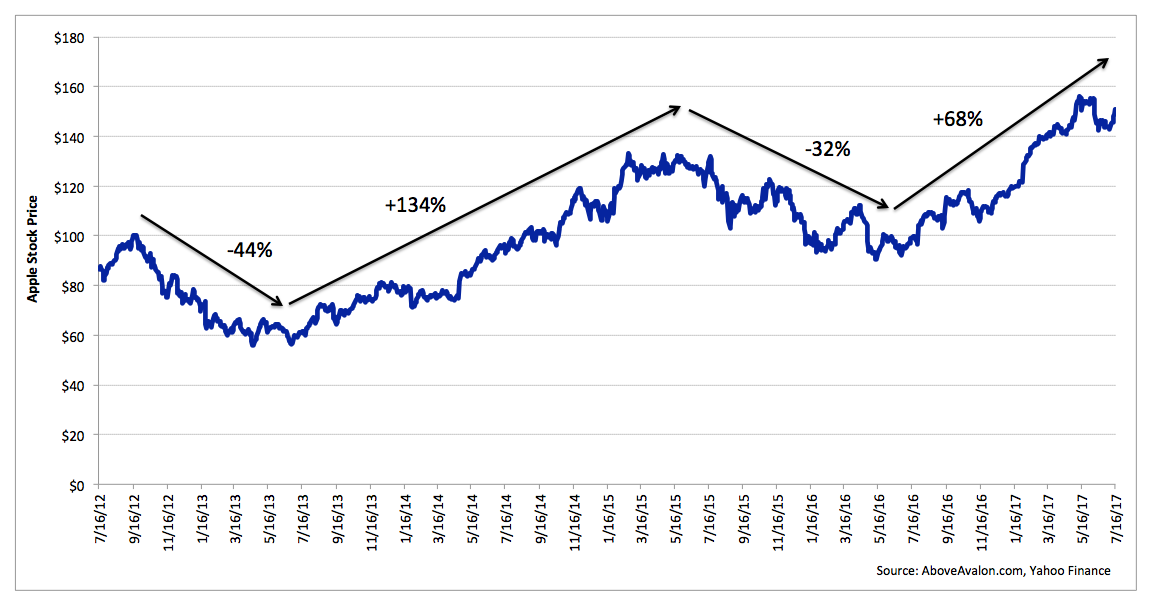
Five years of Apple stock price performance can be broken into four distinct eras:
- Samsung competitive fears. The 2012 to 2013 period was symbolized by Samsung commercials mocking Apple users waiting in line to buy small screen iPhones. The market was beginning to demand larger smartphone screens, and Samsung was running fast to fill the need. There were growing fears of iPhone losing to smartphones running Android, resulting in lower iPhone ASP and margins. Apple shares dropped nearly 45% over this stretch.
- iPhone 6 and 6 Plus excitement. The iPhone launch at China Mobile, along with Apple's entry into large screen phones, drove a two-year stretch that saw Apple shares more than double in price. iPhone sales growth returned with a vengeance, with quarterly shipment growth up as high as 46% in late 2014.
- iPhone's first sales decline. Once the excitement surrounding the iPhone 6 and 6 Plus launch subsided, the new reality set in for the iPhone business. iPhone warning signs were appearing. The era of significant unit sales growth was coming to an end. The iPhone business registered its first quarterly sales decline in early 2016. During this period, Apple shares fell 30% from the previous high.
- Something new. Apple shares are now up nearly 70% from the low experienced in mid-2016.
Recent Outperformance
Over the past year, AAPL shares have outperformed the overall market. There are now questions regarding what has driven a 53% increase in Apple's stock price from the bottom experienced in May 2016.
- Is Apple's services narrative finally catching on Wall Street?
- Are investors becoming increasingly optimistic about iPhone sales prospects?
Apple has become much more vocal in telling its services story. Management went so far as to provide a rare financial projection of doubling the Services business over the next four years. While Apple analysts have certainly been talking more about Apple services, it's not clear if new investors have actually bought into Apple's new messaging. At the same time, greater attention is being placed on the upcoming OLED iPhone, which may be the most significant iPhone update to date. Not only is Apple expected to announce a completely redesigned iPhone, but the device will likely include significant changes to the user experience. Some analysts have been adamant that the device will kick off a "mega upgrade cycle."
It may be easy to assume Apple services or new iPhones may have been responsible for much of Apple's latest stock outperformance. However, I don't think those factors alone were able to drive a 50% increase in Apple's share price.
Services represents less than 15% of Apple's overall revenue. Truly recurring services revenue in the form of subscription revenue occupies an even smaller portion of that total. It is a stretch to argue that such a small piece of the business can drive what amounts to nearly $250 billion of market capitalization gains in a little over a year. There would need to be a widespread change across Wall Street when it comes to investor attitude towards Apple services, and there just isn't any evidence of that occurring.
In terms of a new iPhone driving a mega upgrade cycle, consensus EPS estimates have barely budged for FY2018. This tells us there isn't widespread optimism flooding into the market. In fact, the trend has actually been for Apple EPS estimate cuts as talk of iPhone supply issues and potential delays grow louder.
Exhibit 2 takes Apple's stock price data from Exhibit 1 and superimposes iPhone unit sales growth (set on a three-month forward basis to account for investors' forward-looking tendencies). As clearly seen in Exhibit 2, Apple shares have skyrocketed over the past year despite a lack of iPhone sales growth. This represents a significant change from previous years. Something just doesn't add up.
Exhibit 2: iPhone Unit Sales Growth vs. Apple Stock Price Performance
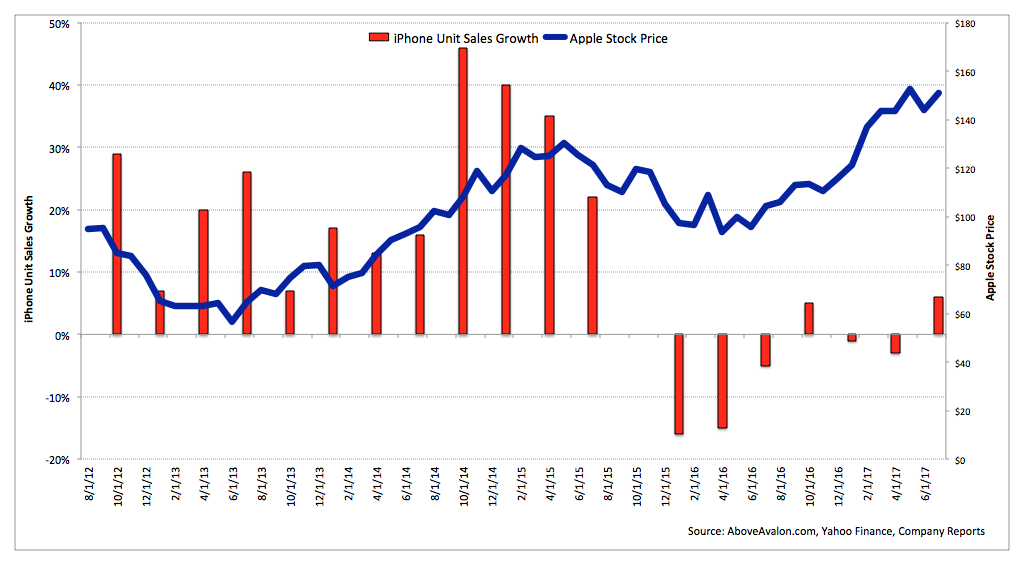
Note: iPhone unit sales growth is on a three-month forward basis (3Q17 and 4Q17 growth metrics are estimates).
One may look at Exhibit 2 and argue that Wall Street is taking a longer view of the iPhone business. Instead of just looking at the next quarter of iPhone sales, the focus is on 2018 and even 2019 sales. That could very well be true. However, it may not be that investors are necessarily expecting the iPhone business to return to some kind of sustainable growth. In what is the most telling sign that something unusual is occurring, rumors of iPhone supply issues and delays that would typically send Apple shares sliding now seemingly have no impact on the stock. Something major has changed regarding how Wall Street is thinking about Apple.
Balance Sheet Optimization
My theory is that the iPhone no longer has the same kind of influence over Apple shares as it once did. Instead, Apple has turned into a balance sheet optimization story on Wall Street. Apple's growing net cash balance (now standing at an all-time high of $158 billion) has taken the place of iPhone unit sales growth as the most influential variable impacting Apple shares.
The best way to lay out this theory is to compare Apple's stock price performance to the change in market capitalization. As seen in Exhibit 3, over the past five years, the two data points have increasingly been on a divergent path. Apple's stock price is up 74% while its market capitalization has increased just 35%. Apple's enterprise value (market cap + debt - cash) is up just 36%. Why is Apple's share price significantly outperforming the company's overall change in valuation on Wall Street? The share buyback program is impacting Apple's share price.
Exhibit 3: Apple Stock Price vs. Market Cap Performance

Apple management is using share repurchases to funnel excess cash from the balance sheet to shareholders selling their Apple shares. This not only reduced the number of Apple shares outstanding, but also gave each remaining share a larger ownership claim to Apple's future cash flows and earnings. It's not that share buyback is creating shareholder value with excess cash simply moving from the balance sheet to those selling their shares. Instead, investors are now willing to pay more for Apple's future cash flows and earnings.
There are a few reasons likely driving this higher valuation of future Apple cash flows.
- Higher ownership stake. As Apple uses excess cash to reduce the number of shares outstanding, each remaining Apple share has a higher ownership stake in a more optimized balance sheet and cash flows. This has led to a significant increase in EPS. Over the past five years, Apple's operating income has increased just 15%. However, Apple's EPS has increased 45%. As long as Apple continues to use excess cash and low-cost debt to buy back shares, this trend will continue indefinitely.
- Apple cash discount. While it may seem counterintuitive, it's actually not wise for a company to hold a significant amount of excess cash on the balance sheet. Apple was likely being penalized for holding so much cash. Another way of saying this is that investors were not fully valuing the $150B of net cash sitting on the balance sheet. This would materialize via below-average price-to-earnings (P/E) multiples. Investors just weren't interested in paying up for the full amount of cash on the balance sheet (technically, the amount of cash left over once Apple brought its foreign cash back to the U.S. at a lower tax rate). There is plenty of financial theory behind investors pricing excess cash at a discount, including fear of management misusing the cash on bad M&A or other improper uses.
- Expectations for additional capital management. Wall Street is forward-looking and with $240B of foreign cash and cash equivalents sitting on Apple's balance sheet, investors are increasingly contemplating various use cases for the cash if it is returned to the U.S. The most likely outcome would be a significant increase in the share buyback pace. At that point, a Dutch auction tender offer would even be a possibility. This would reduce the number of Apple shares outstanding by up to another 25% (which would boost EPS even higher).
- Shareholder base. Share repurchases are systemically shrinking Apple's shareholder base. Apple has reduced the number of outstanding shares by 20% since kicking off its buyback program. Apple investors who have done nothing but hold on to their shares over the past five years would have seen their ownership stake in Apple grow by 20%. As a result, long-term shareholders who have bought into the Apple story are gradually becoming larger Apple owners over time. While some of these holders may not be comfortable with their Apple stakes continuing to grow and represent an outsized portion of their portfolios, in theory, Apple is relying on fewer investors to buy into its narrative.
Declining Influence
One unintended consequence of Apple's cash hoard gaining influence over Apple shares is that the iPhone no longer has the same kind influence it once did. This isn't to say that Wall Street ignores iPhone trends. The vast majority of free cash flow used for share buyback is coming from iPhone sales. The key difference is that Wall Street has grown less concerned about the quarterly gyration in iPhone sales. In the grand scheme of things, there is little difference between Apple selling 200M iPhones per year and 300M iPhones per year. It also doesn't matter if a new iPhone is delayed by a few months. These are relatively minor details that just don't matter in terms of the big picture. I suspect this is why ongoing iPhone delay rumors are having little impact on the stock. In addition, Apple's ongoing iPhone sales pressure and troubles in China and India are no longer viewed as significant hiccups that could derail the stock. Both countries combined represent approximately 20% of overall iPhone sales. U.S. and European sales strength would likely be enough to maintain the iPhone's current sales level.
Warren Buffett Symbolism
Warren Buffett's recent purchases of Apple shares over the span of less than a year (the stake is now worth $20 billion) symbolize how Wall Street is thinking differently about Apple. While Buffett is on record talking about how the iPhone is such a compelling consumer product, his comments regarding share buyback are quite telling.
Here's Buffett back in May on his Apple investment:
"Well the shares when we bought 'em, at least, were much more reasonable in relation to current earnings. Apple didn't have to do a lot better in the future than they were doing at the current time."
It's not that Buffett expects any significant change in Apple's business going forward. Instead, he viewed Apple's valuation as compelling given Apple's current performance. This begs the question, why now? Why didn't Buffett buy Apple years ago when the valuation was lower? Buffett claims he now understands the competitive landscape facing Apple. However, my suspicion is that Apple's balance sheet optimization story had simply become too hard for Buffett to ignore. Here's Buffett back in February responding to questions about Apple's market cap being too large to grow from here in any significant way:
"[Y]ou could have a lot fewer [Apple] shares outstanding at some time and still do very well on a per share basis. [Apple management] bought about 4 percent of the company last year. And they've been pretty, pretty aggressive on that. So my guess is they've got about 5.25 billion shares outstanding now, but my guess is that ten years from now they'll have substantially fewer."
Buffett is buying Apple because he has confidence that the iPhone business is a good cash generating machine that can fund aggressive share buyback. The Apple story on Wall Street now revolves just as much around the company's balance sheet and significant cash balances as it does around the iPhone business.
Future Implications
There are a number of implications related to Wall Street thinking differently about Apple.
1) Apple earnings will take on a different meaning. While quarterly earnings will still matter from the perspective of providing a window into Apple's current business trends, the way Wall Street responds to earnings will change. There will be less focus on weak/strong guidance or a beat/miss to iPhone or iPad sales. Instead, the focus will be on whether the overall Apple story has changed. This new reality will actually make it more important than ever for market observers to possess a longer view of Apple. Fresh and unique perspective will be needed to assess just how Apple's long-term competitive positioning is holding up.
2) Share buyback will continue to gain importance. The single biggest factor impacting Apple shares isn't the upcoming new iPhone or competition with Amazon or WeChat. Instead, it's the probability of Washington passing U.S. corporate tax reform, including a lower tax rate for bringing offshore cash back to the U.S. Apple is poised to spend a significant portion of its $240B of excess cash currently sitting in foreign subsidiaries on buyback, assuming it can be bought back at a lower tax rate.
3) A potential new long-term Apple story. Apple still lacks a compelling business narrative on Wall Street. For analysts and investors focused on modeling Apple's forward cash flows, a company that sells customer experiences comprised of hardware, software, and services isn't exactly the easiest company to forecast. Of course, there is also unknown found with companies like Amazon, Facebook, and Alphabet. However, those companies have easier (and simpler) narratives revolving around non-hardware revenue. There is no evidence to suggest that Apple is now viewed as a design company focused on something much larger than just selling hardware. Apple's R&D pipeline, an item that plays a critical part in the company's mission statement of coming up with future product that can improve people's lives, is still not valued on Wall Street.
This dynamic presents an interesting theory as to Apple's future as a public company. The notion of Apple being considered some kind of annuity with recurring hardware and software revenue may never catch on Wall Street. At the end of the day, Apple's future will always be focused on coming up with new products. This makes it incredibly difficult for investors to model Apple cash flows going forward. What if Apple were instead viewed as a balance sheet stock? The company would go through cycles based on a varying degree of share repurchases. These repurchases would be based on the company's ability to generate strong cash flows. For example, we are currently in the cycle in which iPhone is funding share repurchases. In the future, we may see Apple AR glasses or transportation initiatives fund share repurchases. Simply put, regardless of Apple's product line at any particular moment, investors will likely remain more focused on Apple's balance sheet and cash levels. As a result, Apple's future as a public company would be one of a cash generating machine supporting the largest share repurchase program in the world.
Receive my analysis and perspective on Apple throughout the week via exclusive daily emails (2-3 stories a day, 10-12 stories a week). To sign up, visit the membership page.
iPhone Turns Ten
Today marks the tenth anniversary of Apple launching the iPhone. It would be an understatement to say that the iPhone has changed Apple and the broader mobile industry. The iPhone fundamentally altered the way Apple views the world and measures ambition when contemplating new industries to enter. At the same time, Apple's steadfast approach to controlling both iPhone hardware and software ended up being a bet that is still giving mobile competitors headaches a decade later.
The Numbers
There are three sets of numbers that stand out when thinking about ten years of iPhone.
Unit Sales
On a cumulative basis, Apple has sold 1.2 billion iPhones to date. The magnitude of this number is difficult to grasp and put into context. Prior to launching the iPhone in 2007, Apple had sold approximately 180M devices since being founded in 1976 (70M Macs and 110M iPods). Assuming Apple is able to ship at least 200M iPhones per year for the next few years, Apple is on track to sell its two billionth iPhone at some point in 2020.
Exhibit 1: iPhone Unit Sales (cumulative)
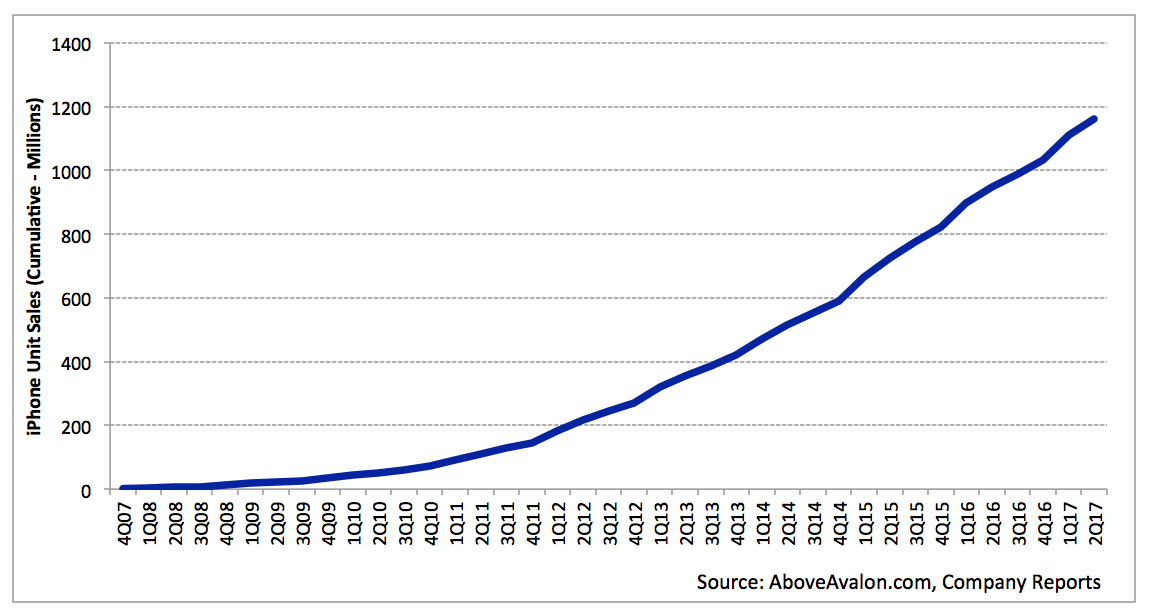
Revenue
With an average selling price (ASP) exceeding $600, more than one billion iPhone sales translates to $743 billion of cumulative revenue. Apple is on track to report one trillion dollars of revenue from iPhone sales by the end of 2018. Even more remarkable, the iPhone's evolving role in our life has led to iPhone ASP increasing as time goes on. The probability of Apple unveiling the first $1,000 iPhone SKU in the U.S. this coming September is quite high.
Exhibit 2: iPhone Revenue (cumulative)
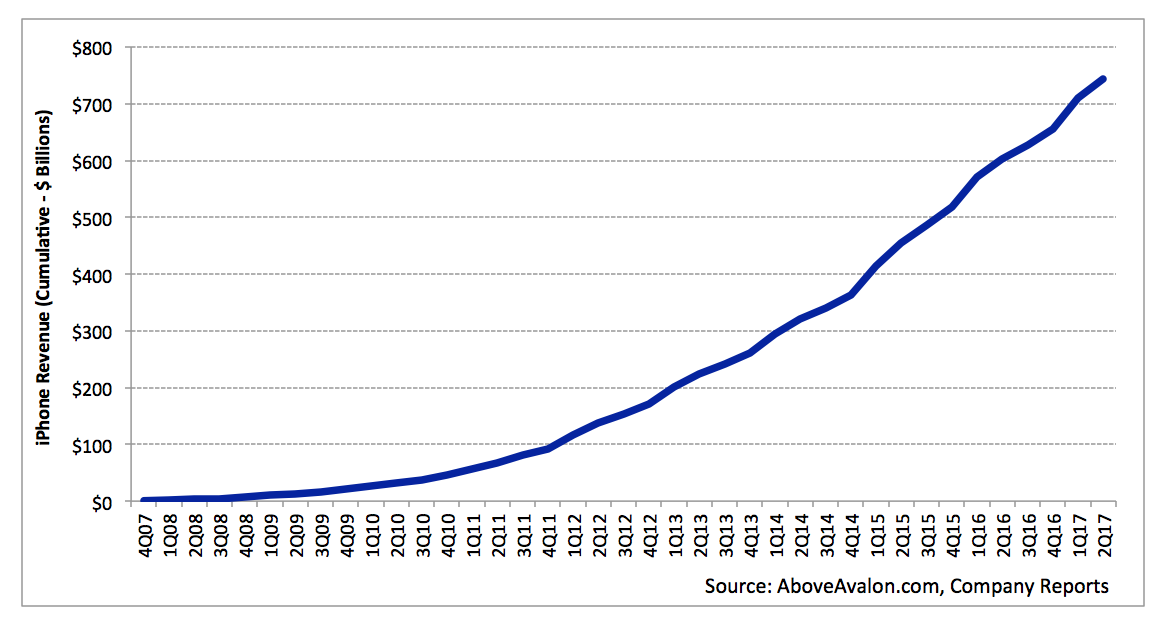
Profit
Apple has a monopoly on smartphone profits. Assuming an average gross margin of approximately 45%, Apple has earned approximately $330 billion of profit from iPhone over the past ten years. On a net income basis, the iPhone has brought in 1.5x more profit than the combined profits of Amazon, Facebook, and Google during the same time period.
Exhibit 3: iPhone Gross Profit (cumulative)
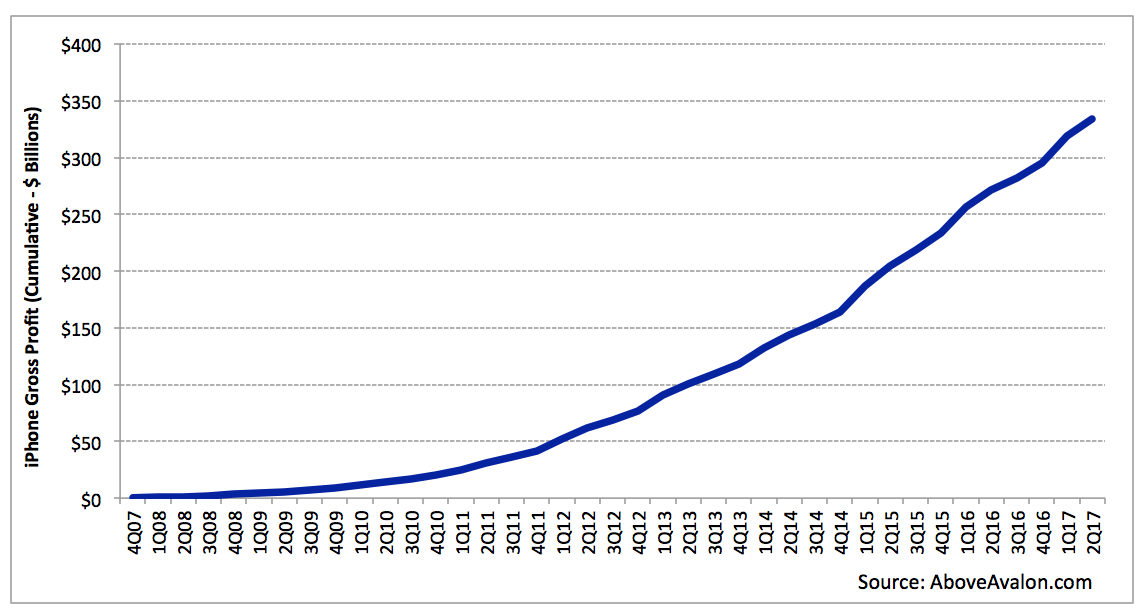
iPhone Lessons
The more intriguing impact from ten years of iPhone cannot be measured or quantified by sales, revenue, or any chart for that matter. Instead, the iPhone contributed quite a bit to preparing Apple for future pivots into new industries. Along those lines, there are three specific items that stand out when it comes to lessons Apple learned from the iPhone over the past 10 years:
- Ambition
- Control
- Platform
Ambition. Prior to the iPhone, Apple was primarily a computer company selling Macs and Mac accessories. The company had only recently begun to see broader consumer appeal with iPod. Apple had no expertise in mobile telephony prior to developing the iPhone. On paper, Apple shouldn't have been able to come up with something like iPhone. The company just didn't have the required core competencies for selling a great phone.
Former Palm CEO Ed Calligan's now infamous words regarding Apple's entrance into the phone industry were based on the belief that Apple would never be able to learn as much as established phone players:
We've learned and struggled for a few years here figuring out how to make a decent phone. PC guys are not going to just figure this out. They're not going to just walk in.
There was one glaring hole found in Calligan's logic. Phones were going to become computers. Instead of Apple worrying about becoming a good phone maker, phone makers should have been worrying about becoming good computer makers.
The innate desire to rethink a gadget that many people had trouble using drove Apple into smartphones. Of course, the fear of smartphones one day impacting iPod sales also pushed Apple management. This led to a more than two year process during which Apple learned quite a bit about phones, mobile carriers, and itself. The learning didn't stop after launching the iPhone in 2007. In subsequent years, Apple learned, at times the hard way, about the ins and outs of mobile telephony. Over time, Apple's long-standing strengths in building computer hardware and software gave the company its advantage over the Blackberries and Nokias of the world.
Today, Apple's ambition continues to be underestimated. Apple is approaching new industries in a way that is similar to how it looked at the mobile phone arena in the mid-2000s. The Apple Watch was tasked with rethinking wrist watches. Apple had to learn quite a bit when it came to fashion and luxury in order to get people to want to wear Apple gadgets. Management now has its sights set on the transportation industry, a sector that hasn't seen much change in 100 years. In addition, Apple is moving into the health and medical arena at an incredible pace.
Just a few years ago, this kind of product pipeline would have been labeled an ambitious pipe dream for Apple. Something changed over the past 10 years. The iPhone showed Apple how a single product with a rethought user experience can change an entire industry to make it much more hospitable for the company. At this point, it is fair to say that Apple is willing to compete in any industry as long as there is room for someone to rethink the user experience. The same couldn't be said prior to iPhone.
Control. The iPhone taught Apple quite a bit about the power found in controlling one's destiny. While the iPhone did not introduce the company to the idea of controlling both software and hardware, the iPhone played a major role in showing Apple benefits associated with owning the core technologies powering a device. Some of the early bets Apple placed in this regard, such as the P.A. Semi acquisition in 2008, are still paying dividends.
Here's Tim Cook talking to Businessweek following the WWDC keynote earlier this month:
Steve’s DNA will always be the base for Apple. It’s the case now. I want it to be the case in 50 years, whoever’s the CEO. I want it to be the case in 100 years, whoever’s CEO. Because that is what this company is about. His ethos should drive that—the attention to detail, the care, the simplicity, the focus on the user and the user experience, the focus on building the best, the focus that good isn’t good enough, that it has to be great, or in his words, “insanely great,” that we should own the proprietary technology that we work with because that’s the only way you can control your future and control your quality and user experience.
It says a lot that Cook looks at owning core technologies as an inherent aspect of Apple's culture. The iPhone contributed quite a bit to that reality. There is now an increasing amount of evidence pointing to Apple working on its own GPU solution in addition to LTE modem chips. We are moving to the point at which it will no longer be enough for Apple to just own the most important components powering a device. Rather Apple will need to come up with its own solutions that combine the most important components to power increasingly smaller, wearable gadgets.
What were once hardware and software bets that gave Apple a five-to ten-year head start on the competition are now turning into technological bets that will give the company advantages measured in decades.
Platform. While Wall Street remains infatuated with iPhone sales, Apple continues to see a strengthening iOS platform thanks to robust new iPhone user growth and an engaged developer community. The iOS platform has afforded Apple a new way to think about the world. There are signs of Apple management being well aware of the power and influence found with iOS.
Here's Eddy Cue in August 2016:
[Apple] can’t be everything. One of the reasons we’ve been highly successful is that we focus. We can’t be great at everything; nobody’s great at everything. I mean, come on. So, if you want to be great at something, you have to focus and do a few things. We’ve been lucky. We’ve had a few, and not just one. That’s the only way we know how to work. So we don’t want to be Amazon and be Facebook and be Instagram and so on. Why? Or Uber. Why? I think it’s awesome that Travis [Kalanick, Uber’s CEO] and his team have done Uber on our platform. It would not exist without our platform, let’s be clear. But great for them for thinking of that problem, and solving it. We would never have ever solved that problem. We weren’t looking that way. We would have never seen it.
It's easy to read Cue's response as Apple taking responsibility for Uber's success in rethinking personal transport. However, Cue is correctly pointing out that the iOS platform served as the breeding ground for innovative ideas and business models. With the iOS platform, Apple has played a major role in creating a number of new industries. In the coming years, management will determine which parts of the iOS platform are worth Apple playing in themselves. Management has already determined a need to play in music and video streaming in addition to messaging and mobile payments. It's not yet clear if ridesharing or another larger industry will one day make sense for Apple. Even more importantly, the iOS platform has given Apple a fighting chance to create the most attractive platforms for third-party developers around a new suite of products including Apple TV (tvOS) and Apple Watch (watchOS).
Defining Legacy
A great deal of iPhone's success can be traced back to the fact that Apple bet on a very big product category at just the right time. The smartphone redefined a computer for billions of people in just a few years.
While some people are convinced that nothing will match the smartphone in terms of its influence on our lives, such prognostications end up selling future innovations short. Odds are very good that a new device, or series of devices, will one day serve as a viable smartphone alternative. It's likely that these new devices will achieve even greater market penetration than smartphones.
Regardless of where technology is headed, we are already starting to get an early glimpse of the iPhone's legacy. The iPhone spawned an industry that redefined a computer, transforming it from a niche tool into a mass-market phenomenon. For Apple, the iPhone went further than any other Apple product before it in terms of making technology more personal. The iPhone was Apple's first genuine mass-market product. All of this occurred in just ten years, which ends up being the most remarkable part of the story.
Receive my analysis and perspective on Apple throughout the week via exclusive daily emails (2-3 stories a day, 10-12 stories a week). To sign up, visit the membership page.
WWDC Clues Hint at Mac's Future
Apple used this year's WWDC keynote to let the world know it has every intention of supporting the Mac for the long haul. When reading between the lines, it becomes evident that the Mac's future is one of a niche product within Apple's portfolio. Meanwhile, Apple's messaging around the iPad during the same keynote couldn't be any different. As the Mac is going in the direction of niche, the iPad is being groomed to be the Mac/PC alternative for the masses.
Turning Point
The past few years have been an odd stretch for the Mac. Hardware updates have been unusually sporadic although the few updates that did ship were noteworthy. The MacBook Pro with Touch Bar, unveiled in October 2016, represented a prime example of Apple's strategy to use aspects of mobile to push the Mac forward. Apple silicon, Touch ID, and multi-touch displays bring a different kind of experience to the Mac. Throughout this awkward stretch for the Mac, the Apple Industrial Design team's influence on the Mac remained quite obvious, which only increased the level of uneasiness felt by many pro Mac users.
Management used this year's WWDC keynote to officially put an end to this odd Mac stretch. The keynote couldn't have been any different from the previous, somewhat awkward Mac event that took place this past October. This time around, Apple unveiled item after item, clearly targeting pro Mac users.
The new $4,999 iMac Pro was announced to much surprise and with certain configurations that were unimaginable for a Mac all-in-one just a few months earlier. Apple's decision to sell an external graphics development kit was also unthinkable just a few months ago.
It is likely that all of these Mac announcements had been in the pipeline for a while. Nevertheless, Apple seemed eager to spin a fresh Mac narrative around pro users. Much of this change in narrative and attitude was a carryover from management's recent Mac intervention with journalists at Apple HQ this past April. At that meeting, SVP Phil Schiller, SVP Craig Federighi, and VP John Ternus clearly telegraphed a revised Mac strategy focused on placing more attention on the tail end of the business. While one would think the new iMac Pro marks Apple's extent into niche Mac territory, the company still plans on releasing a completely redesigned Mac Pro. Given iMac Pro pricing, it is not out of question the for a new Mac Pro configuration to surpass $10,000. Let that sink in for a minute.
The iPad Juxtaposition
If this year's WWDC keynote doubled as a Mac event (Apple dedicated 23% of stage time to the Mac), the event could have also moonlighted as an iPad event (Apple dedicated 21% of stage time to iPad). My full WWDC review is available for members here. However, when the two products were viewed back-to-back, there couldn't have been a more stark difference between them. While the pro in iMac Pro and Mac Pro stood for professional, the pro in iPad Pro stood for productivity.
During the Mac portion of the keynote, management's focus was on addressing the tail end of a 100M Mac user base. A $4,999 iMac Pro is not about adding productivity for the masses. Instead, it is targeting a particular kind of professional. Apple will likely sell fewer iMac Pros than cylinder Mac Pros sold to date. In terms of a redesigned Mac Pro, it is difficult to picture the machine even qualifying as niche. Instead, it will be a niche of a niche.
Meanwhile, the iPad portion of the WWDC keynote was all about Apple bringing additional productivity to the masses. The new $649 10.5-inch iPad Pro continued Apple's multi-year bet on larger iPad screens (a very sound strategy). Apple also unveiled iOS 11 refinements for iPad that some had been hoping to see for years. One key aspect found in every major iPad software refinement was optionality. For those users craving additional capability, the new software features will prove to be quite valuable. However, for many iPad users, items like multitasking or the new Files app may never be used. In those cases, the same, familiar iOS experience will still be available. Apple was able to add productivity options to the iPad without changing what had gotten the product to where it is today - simplicity and ease of use. The not-so-subtle implication made on stage at WWDC was that the iPad is becoming more of a genuine laptop alternative for hundreds of millions of people.
Change in the Air
This year's WWDC keynote provided a glimpse of the Mac's future. A large portion of the Mac user base are going to find their computing needs met with iPad Pro. According to Apple, approximately 70% to 85% of the current Mac user base does not rely on professional Mac software. This amounts to approximately 80M people. These users are not app developers, nor do they have the need for the kind of power found in a MacBook Pro, iMac Pro, or Mac Pro. Instead, these users are likely attracted to the Mac for keyboard computing.
As Apple pushes the iPad Pro forward with hardware and software advancements, including various keyboard improvements, these 80M Mac users are going to discover that the iPad is getting better at handling their computing needs. It's not that the Mac will lose value, but rather that a large multi-touch display running iOS will gain value. The shift won't occur overnight for the simple fact that consumers hold on to Macs for years. In addition, it is important to point out that Apple management won't have any issue with this development as long as these Mac users remain within the Apple ecosystem.
Over time, the exodus of non-pro Mac users to iPad Pro will transform the Mac into a niche product category. There will still be millions of users, but the machines will increasingly be geared toward narrow use cases such as VR and AR content creation. In addition, the Mac will become the preferred tool for those in various academic, science, and engineering fields.
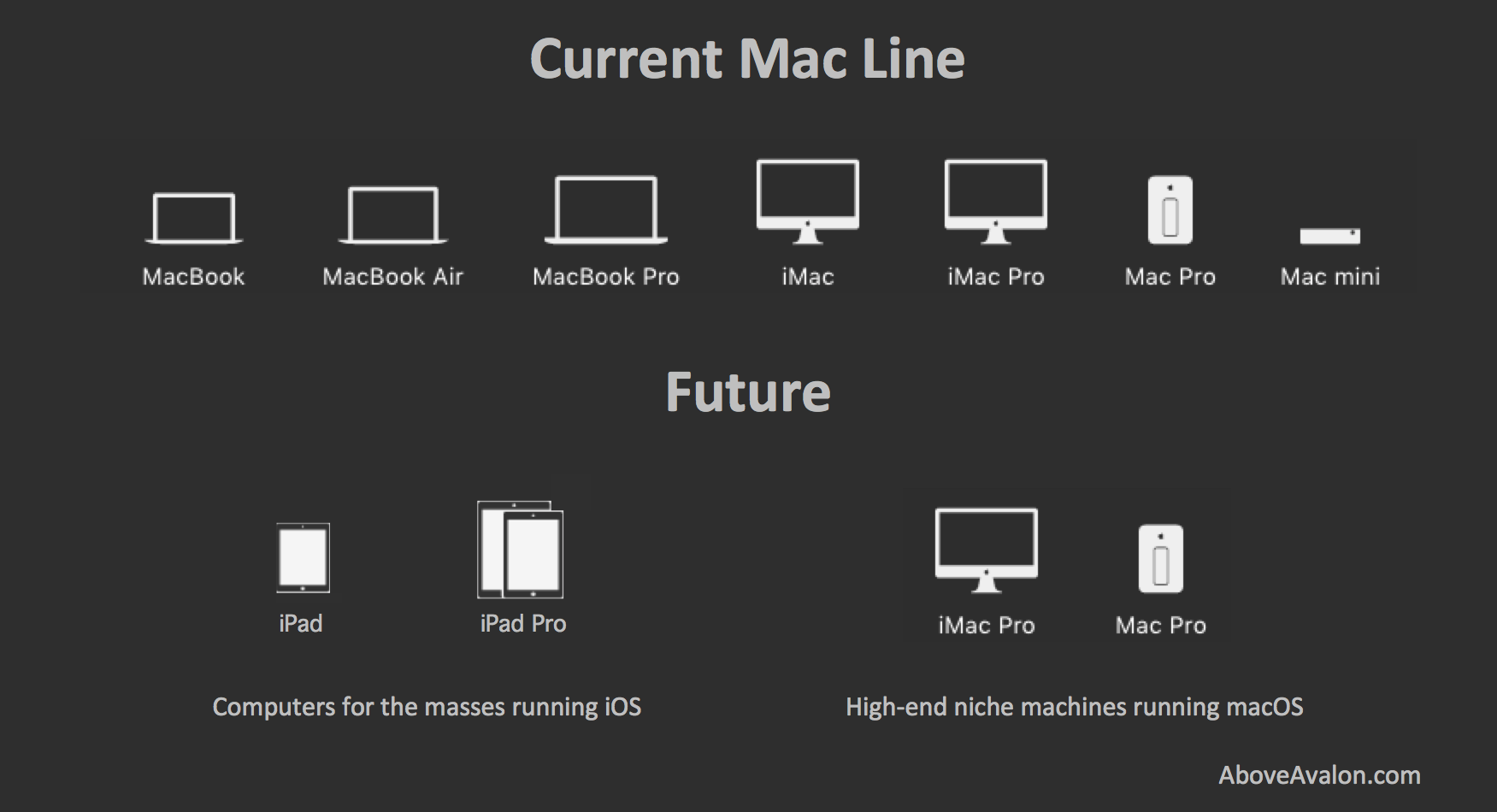
One may ask, what will happen to consumer-grade Macs, including the MacBook Air and 12-inch MacBook? They will be cannibalized by the iPad Pro line, much as the iPad mini has been cannibalized by larger iPhones. In fact, the entire Mac portable form factor is at risk of cannibalization at the hands of iOS screens. While this won't stop Apple management from pushing the MacBook form factor forward, consumer purchasing habits will speak volumes.
The Achilles' Heel
Two months ago, I published "The Mac Is Turning into Apple's Achilles' Heel." My thesis was that Apple's inability to move beyond the Mac represents a vulnerability in an otherwise strong product strategy geared toward the mass market. Reaction to the piece came in swift and spanned the spectrum.
The issue facing the Mac has never been Apple's ability to give the product category attention. We saw evidence of this first-hand at this year's WWDC. Apple is able to update the Mac, along with every other product category. In fact, it is not a stretch to say the Mac's outlook within Apple has never been brighter and stronger than it stands today. If one were to place a bet on which current Apple product category will remain within Apple's product line the longest, the Mac would certainly be high on the list. This ends up supporting my thesis that the Mac is Apple's Achilles' heel.
It is very difficult envisioning Apple being able to move beyond the Mac. The product is on track to become a permanent niche within a continuously changing product line.
Apple is moving to a point where the product line will look something like:
- iPhone: An AR navigator (mass market item)
- iPad: Computer for the masses (mass market item)
- Wearables: Various form factors with broad use cases (mass market items)
- Transportation: Autonomous transport (mass market item)
- Home: Various form factors with broad use cases (mass market items)
- Mac: Graphics intensive content creation and computation (niche)
This may not seem like a problem for Apple. The Mac has been responsible for a lot of beneficial things at the company, including inspiring the current generation of content creators. However, the problem for Apple is that having a long tail end of the business comprised of niche Macs may pose a new kind of challenge. Apple Industrial Designers will need to look after the user experience found within a portfolio of mass market product. At the same time, they will need to handle the dramatically different user needs found with a niche product category, the Mac. It's not clear how they will do this. Will Apple designers cede control over the user experience to their engineering peers when it comes to niche Mac hardware?
Unchartered Territory
While some people look at Apple's big risk as management's inability or unwillingness to move beyond the iPhone, that fear is misplaced. Apple is already moving beyond the iPhone as seen with more personal gadgets worn on our body.
Instead, the genuine risk facing management is that Apple will be unable to move beyond the Mac. This is unchartered territory for Apple. The theory that Apple has to move beyond legacy products in order to completely focus on the future is going to be put to test. It is also possible that the Mac will end up being the first product category that represents genuine growing pains for Apple. In the past, the company would have been able to bring its entire nimble user base from one product category to the next. A niche Mac line will put an end to that era.
Despite gaining niche status, the Mac will still play a major role in creating content consumed on future Apple products including wearables and transportation products. This will give the Mac a level of influence that should not be underestimated. While it is difficult for some to believe, now has never been a better time to be a pro Mac user. This year's WWDC made it clear that the Mac has a future at Apple. However, the amount of change headed towards the Mac should not be underestimated.
Receive my analysis and perspective on Apple throughout the week via exclusive daily emails (2-3 stories a day, 10-12 stories a week). To sign up, visit the membership page.
HomePod
Apple unveiled a brand new product category last week at WWDC: HomePod. On the surface, HomePod seems like an unusual product for Apple. The company's most recent new products (Apple Watch and AirPods) form the foundation of an expanding wearables strategy. How does a stationary smart speaker fit into such a product strategy? Meanwhile, Amazon Echo and Google Home have led many to assume HomePod is merely Apple's me-too response to speakers piping voice assistants throughout the home. This isn't correct. HomePod isn't actually about Siri. Instead, HomePod will serve as the foundation for augmented hearing in the home.
A Computer with Speakers
While HomePod is technically a smart speaker, it is more correct to say HomePod is a computer with a touchscreen, speakers, and microphones. The device is powered by Apple's A8 chip, the same chip found in an iPhone 6 and 6 Plus. This chip is responsible for turning HomePod into a computer that contains the best-sounding speakers most people will have ever owned.
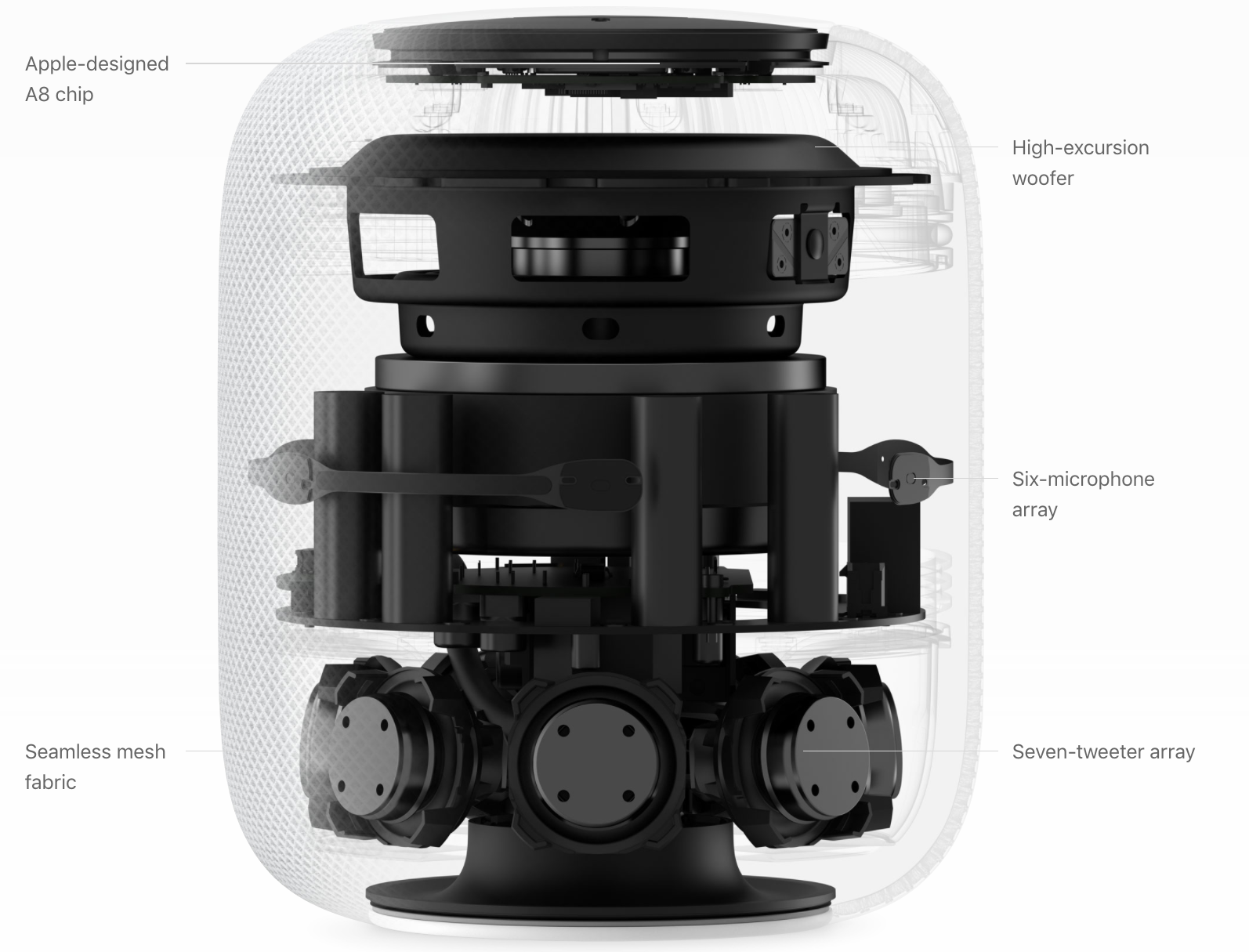
I was able to listen to HomePod play various music genres last week. (My full WWDC review is available for members here.) Apple is not overselling the device's speaker capabilities. In a somewhat controlled environment resembling a typical living room, HomePod's sound output clearly stood out from that of Amazon Echo and Sonos Play 3. In fact, it made the Amazon Echo sound like a cheap toy, and the Sonos Play 3 sounded so inferior, I wondered if something was wrong with the Sonos.
As I walked around the room, there was no change in sound quality coming from HomePod. Standing to the side of the computer, I mean speaker, rather than sitting right in front led to the same listening experience. When two HomePods were used simultaneously (there was about a five-foot gap between the two computers), a different experience was produced. Instead of just amplifying the sound, the two units worked together to produce a richer experience. It is easy to imagine how situating two HomePods in opposite corners of a room could lead to a revolutionary listening experience.
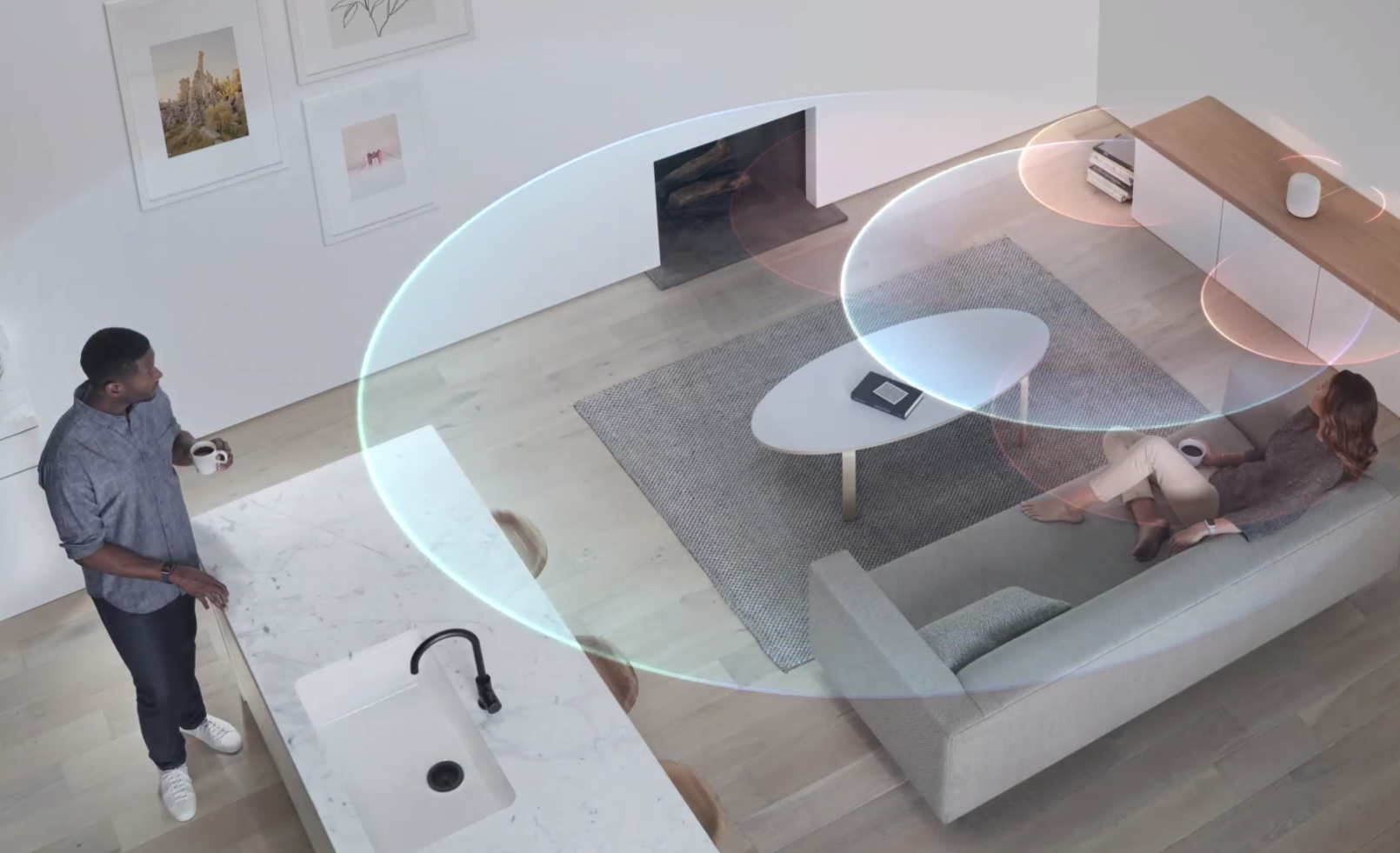
HomePod's Value
During the WWDC keynote, Apple positioned HomePod as a great speaker for playing music that can do a few other things. Those "other things" involve using Siri as a digital voice assistant. In addition to controlling various HomeKit-enabled devices around the house, Apple plans on allowing Siri to handle a set of its most popular requests out of the gate. These capabilities will be similar to those of other smart speakers in the marketplace.
This has led many to conclude that HomePod isn't actually too different than the competition, especially if Siri is deemed not as capable as other voice assistants. However, such logic severely misinterprets the situation. HomePod's value isn't found in asking Siri for sports scores or controlling the kitchen lights. HomePod's value is found in an A8 chip controlling a series of microphones and speakers.
HomePod is a computer capable of mapping a room and then adjusting its sound output accordingly. This is another way of saying that HomePod is able to capture its surroundings and then use that information to tailor a specific experience to the listener. It is easy to see how collecting data and then using that data to improve the experience will position HomePod as an augmented reality (or maybe we should say augmented hearing) device.
Augmented Hearing
Whenever the topic of augmented reality (AR) is discussed, most people automatically think of the visual world. We are able to view additional information that augments reality. Apple began to lay out its big AR push with ARKit for iPhone and iPad. However, AR can also apply to hearing and sound. In both cases, we are given new sensory stimuli capable of changing our perception of the surrounding environment.
Augmented hearing in the home begins to play in the realm of omnipresent computing. It is not out of question that HomePod will eventually be able to grab data from our surroundings and then provide personalized feedback to us wherever we are at home. (Given how multiple HomePods can communicate with each other, this could be both in and around the house.) Signal processing and far-field voice recognition, items which were not demoed last week, will make it possible for the user to respond to or interact with HomePods in a normal environment containing people and plenty of other noise. While HomePods will handle this task indoors, AirPods can serve as the solution for when we are away from the home. One would be correct to think of HomePods and AirPods as siblings.
A few augmented reality examples include the HomePod recording and copying the sound from one location or room and then replicating that sound in another room. This would be game changing as it would be as though we were in a completely different room even though we hadn't changed locations. An adult would be able to speak to a child in another room by simply talking out loud in a regular tone thanks to multiple HomePods. In these examples, we are beginning to redefine how we consume sound in the home. Discussions will one day be able to be wired through HomePods and then delivered directionally so that someone in a crowded room will be able to have a private chat without the need for headphones. In effect, the definition of sound as we currently know it will be altered. In these examples, the use of multiple HomePods working together with each other multiples the value found with using the devices.
The Strategy
The competitive tech landscape is changing as the battle for our attention when using smartphones is broadening into a massive land grab for the most valuable real estate in our lives. The tech battle lines are being redrawn around three areas: cars, homes, and bodies. HomePod is part of Apple's growing battle for our home.
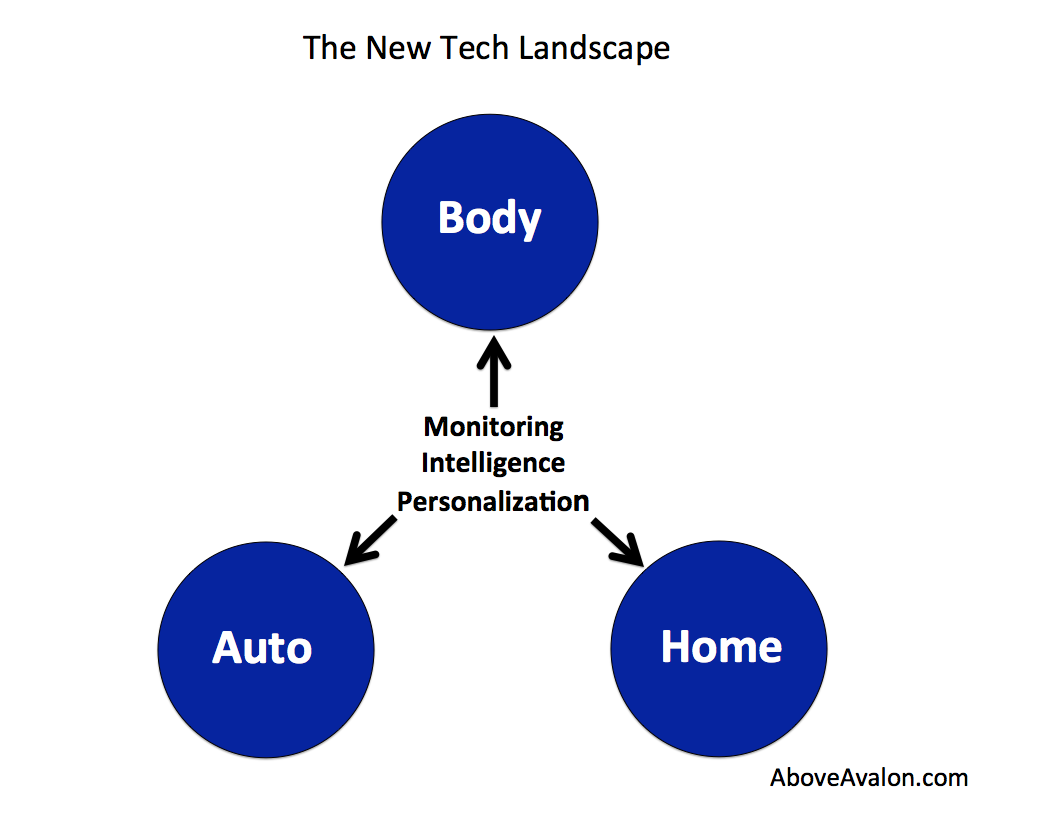
There a few variables guiding this new competitive landscape.
Monitoring. Value will flow to devices and software that can monitor significant portions of our day.
Intelligence. Devices will learn from this data in order to provide feedback to the user.
Personalization. Hardware personalization will gain importance as the line between technology and fashion becomes blurry.
HomePod plays squarely in two of those three factors out of the gate. A HomePod will make for a great monitoring device while it will also be able to provide intelligent feedback via speakers and microphones. While HomePod doesn't play in hardware personalization similar to that of Apple Watch and other wearables, the personalization angle takes the form of tailored, personalized listening experiences suited to our specific hearing needs.
When it comes to the concept of a smart home, we are still looking at pretty rudimentary ideas. A home won't be truly smart until tech companies build housing and we are no longer able to tell between smart and non-smart items. Up to that point, a smart home describes the concept of controlling things around the home that move. Given how the smart home battle is still in the early stages, Apple has the opportunity to do quite a bit with HomePod and the concept of augmented hearing in the home.
HomePod is not Apple's first product designed to compete for our attention in the home. Instead, Apple has been selling Trojan horses in its battle for our home called iPhones, iPads, and Apple Watches. These mobile devices are very likely to remain near us, or in some cases, on us, when we are at home. HomePod is unlike the Amazon Echo because it doesn't pretend that we lack smartphones, tablets, or wearables. This is one reason why Apple decided to take a straightforward path in pitching HomePod as a great music speaker. The device is all about producing sound so great that it cannot be replicated by any of our other devices, even if the HomePod has touch controls located on the top of the device.
Pricing
When it comes to pricing, HomePod should not be compared to voice assistant conduits such as Amazon Echo or Google Home. The HomePod is not just a "smart speaker." Saying that HomePod is competing against Amazon Echo is equivalent to saying the iPod competed against generic MP3 players.
Instead, a more relevant HomePod comparison would be dedicated speaker systems from Sonos and Bose. With HomePod, Apple is aiming to sell the best speaker someone has ever owned. The Sonos Play 5, at $499, may be the closest comparable speaker to HomePod within the Sonos lineup. At $349, HomePod is priced very competitively not only when it is compared to the Play 5, but even when it is compared to the $299 Sonos Play 3, which was inferior to HomePod in terms of sound quality. Meanwhile, surround sound speaker systems from Bose retail from $700 to $1,000, or the same price as three HomePods.
Of course, comparing HomePod to existing speakers in the marketplace ignores the fact that HomePod is powered by an A8 chip. This is like comparing AirPods to a simple pair of bluetooth wireless headphones lacking Apple's W1 chip. While Sonos claims to do some form of room mapping to alter its sound output, the process just doesn't compare to that which is found with HomePod.
Challenges
As with any major new product category from Apple, management is placing a few big bets on HomePod. Apple is ultimately looking to sell a new idea to consumers. This idea involves positioning stationary speakers throughout the home. The concept may seem like a stretch today because it mostly is when looking at the current state of standalone speakers. Judging by sales, the standalone speaker market is niche. We have not seen the need to buy stand-alone speakers to accompany existing speakers found in TVs, iPhones, and iPads. Apple wants to change consumer behavior with HomePod. The other challenge Apple faces is convincing people of the value attached to augmented hearing.
Goals
Apple likes to point out how music is in its DNA. We can look at iTunes, iPod, iPhone, Apple Music, and now AirPods, as well-known Apple products tasked with rethinking how we consume music. One product missing from that list is the iPod Hi-Fi. In what may come as a surprise to many, Apple actually sold a standalone speaker (which also retailed $349). The fact that iPod Hi-Fi was available for just 17 months back in 2006 and 2007 speaks volumes as to its ultimate success.
There are key differences between that speaker and HomePod. iPod Hi-Fi was meant to sell iPods (and iTunes) by making it easy to connect an iPod to a great-sounding home stereo. HomePod is given a much more ambitious goal, which is to reinvent sound in the home. In fact, Apple wants HomePod to redefine sound in the home much as iPod, iPhone, and now AirPods, redefined sound on the go. Apple will begin this quest by initially positioning HomePod as a great speaker that can add value to the Apple ecosystem. Apple's audio engineering team is at a completely different place today than it was 10 years ago. However, the fundamental difference between HomePod and iPod Hi-Fi quickly becomes obvious as Apple silicon allows the HomePod to do revolutionary things with speakers and microphones.
The writing is on the wall: Apple wants to control as many speakers in our lives as possible. Controlling sound is Apple's secret strategy for gaining a stronger foothold in the home.
Receive my analysis and perspective on Apple throughout the week via exclusive daily updates (2-3 stories per day, 10-12 stories per week). Available to Above Avalon members in both written and audio forms. To sign up and for more information on membership, visit the membership page.
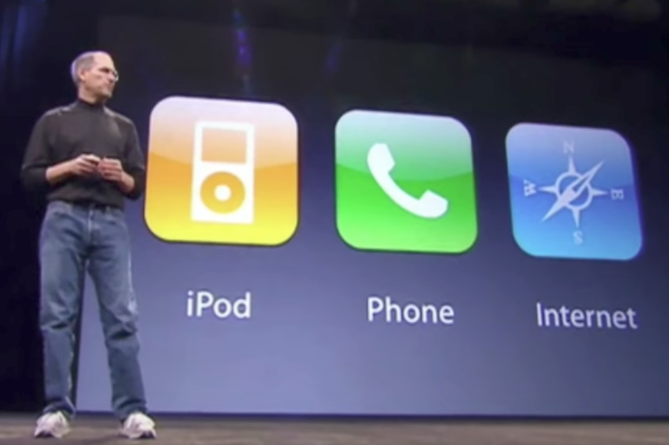
iPhone Evolution
The iPhone's most remarkable quality is the degree to which its role in our lives has changed. In 2007, the iPhone was a computer that fit in our pocket. The product evolved into the most valuable communications tool in our life thanks to advances in camera technology. We are now on the verge of the iPhone becoming a new kind of personal navigator as Apple embraces augmented reality. The iPhone's role in our life doesn't remain static, but rather it evolves. This fact has major implications when it comes to thinking about iPhone sales and pricing, screen size preference, upgrade trends, and even how other gadgets will fit into our lives.
The iPhone 7 Plus
One takeaway from Apple's 2Q17 earnings was that the iPhone 7 Plus is selling surprisingly well. Management assumed the larger iPhone form factor would gain popularity, but iPhone 7 Plus demand has exceeded Apple's internal expectations. Not only has the iPhone 7 Plus sold well in the U.S. and Europe, but the model is seeing double-digit sales growth in China.
Relying on app usage trends provided by Fiksu, iPhone 7 Plus demand looks to be up at least 20% year-over-year compared to the iPhone 6s Plus. Given that overall iPhone sales are trending flat year-over-year, sales of the other iPhone models are not as robust as that of iPhone 7 Plus. In fact, management commented on how subdued interest in older iPhone models drove much of the sales weakness in China last quarter.
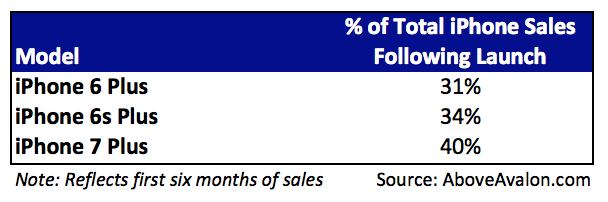
This raises an obvious question: Why has the iPhone 7 Plus seen such strong demand? The model looks very similar to an iPhone 6 Plus and iPhone 6s Plus. In addition, consumers have had the option to buy an iPhone with a 5.5-inch screen for three years.
The most logical explanation is that the iPhone's role in our lives continues to change, and iPhone 7 Plus features have become more appealing than those of smaller iPhones. Bigger screens are gaining popularity because photos and videos are becoming a more crucial part of our daily communication. While large screen smartphones have been popular in Asia for years, momentum is only now building in Western markets. In addition, the dual-camera system in the iPhone 7 Plus has led to Apple's significant marketing campaign around Portrait Mode. The iPhone 7 Plus camera is actually one of the more marketable iPhone features in years, which speaks volumes about iPhone being the key communication device in our lives.
Evolution
Up to now, iPhone evolution has meant the process of Apple gradually improving features and components each year. Rather than calling a new iPhone a revolutionary update, we look at year-to-year hardware and software changes as evolutionary. However, this doesn't do a great job of describing what is really taking place with the iPhone. The iPhone's role in our lives is the item actually evolving. The iPhone is not a static product providing a similar experience year in and year out, much like a laptop or desktop. Instead, the iPhone's definition changes over time thanks to software and hardware advancements.
2007. Next month marks the tenth anniversary of the iPhone's launch. In what is now widely referred to as the greatest product unveiling of all time, the iPhone introduction provides an easy way to see the iPhone's initial definition out of the gate. The iPhone was positioned as a widescreen iPod with touch controls, a revolutionary mobile phone, and a breakthrough internet communicator wrapped into one product. Judging by the audience's reaction and applause, the most anticipated feature was the revolutionary mobile phone, not the internet communicator. Said another way, the iPhone was initially viewed as a different kind of phone.
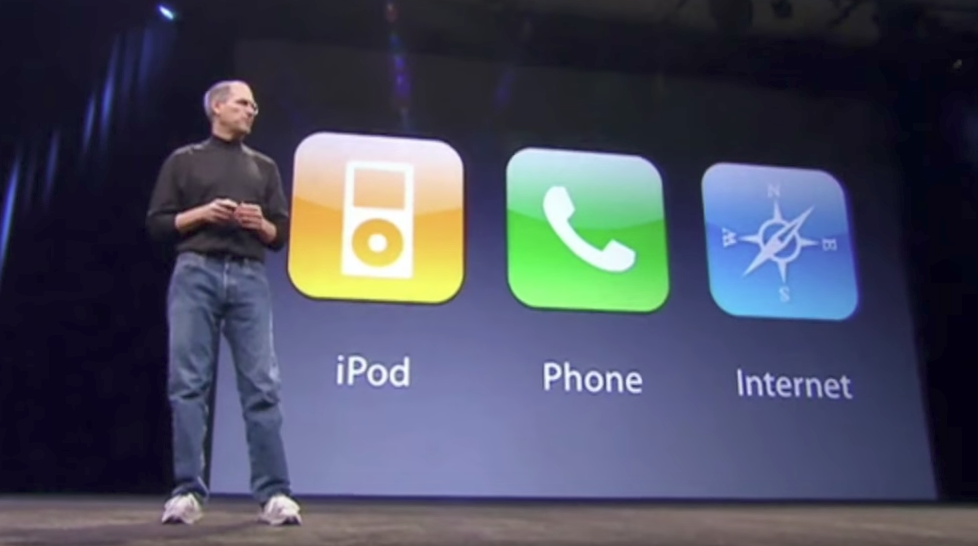
Steve Jobs introduces the iPhone in January 2007.
2008. The App Store introduction in July 2008 set the iPhone on its current trajectory. It became clear that the iPhone wasn't just a phone, but rather a computer that fit in one's pocket. The potential found with iOS was not fully appreciated at launch. A smartphone was initially looked at as a device supplementing our PC usage while away from the desk or home. This is one reason why Blackberry was so popular among business users. For the first time, they had access to their email while away from the office.
2012. Facebook's acquisition of Instagram in 2012 was a turning point not for Facebook, but rather for the smartphone camera. Around this time, the iPhone's role in our lives was also changing. The device was no longer just about having email or webpage browsing in our pocket. The camera began to gain value. We started using cameras for more than just capturing memories. Social networks based entirely on pictures started to take off. Other companies, including Snapchat, soon followed in terms of fostering new forms of communication based on new visual mediums. If the camera renaissance began in 2012, then the video renaissance started a few years later. Everyone is now battling for live streaming prominence. The latest trend with video filters begins to reveal where things are headed: augmented reality.
AR Navigator
There are signs that the iPhone's role in our lives is about to change once again. We are on the verge of the augmented reality (AR) era. Apple has been investing heavily in AR for years with a number of notable acquisitions including Metaio, Emotient, Polar Rose, Faceshift, PrimeSense, Flyby Media, and Perceptio. AR is going to turn the iPhone into a smart pair of eyes. These eyes will transform the iPhone's functionality. Much of what has been written and said about AR positions the technology as merely an interlacing of objects with a real-world layer. Snapchat filters come to mind. However, the much more interesting and valuable attribute found with AR is having a device extract data from our surroundings and then offer additional value and context to the user. The dual-camera system found in the iPhone 7 Plus is able to extract more data than any other iPhone camera.
Near-Term Implications
Higher Pricing. As the iPhone's role in our live continues to evolve, the device has been able to capture an increasing amount of value. When phones were just phones, we were willing to spend a certain amount on the device and corresponding service (voice minutes and text messages). Once the iPhone kicked off the era of smartphones turning into computers, we valued "phones" differently. We were willing to pay much higher prices because the devices provided additional value. Once an iPhone becomes an AR device, we are going to place even more value on the device. This will manifest itself in higher iPhone pricing. There is a reason why there has been an increasing number of reports and rumors about future iPhone pricing exceeding $1,000: It makes plenty of sense.
Higher Costs. Simply put, it is costing Apple more to build iPhones. Apple is passing these higher component costs on to consumers. Apple increased iPhone pricing by $100 in 2014 for the 5.5-inch screen found with the iPhone 6 Plus. Pricing was raised by another $20 last year to account for the dual-camera system found in the iPhone 7 Plus. An iPhone model exceeding $1,000 is inevitable due to the simple fact that screen and camera technology costs are increasing. This may seem to be a recipe for disaster when it comes to iPhone demand. However, iPhone 7 Plus shows there has been a certain level of inelasticity found with iPhone demand. It all comes back to iPhone evolution and the iPhone's role in our lives changing to support higher pricing.
Screen Size Preference. The 4-inch iPhone SE served Apple well over the past year. According to my estimates, Apple sold 30M iPhone SE units to date. However, the iPhone's evolution will likely impact screen size preference going forward. The desire for one-handed iPhone use is being surpassed by the desire to consume photos and videos on larger screens. It is becoming difficult to see 4-inch iPhone screens remaining in Apple's product line. Instead, the product will likely be cannibalized by iPhones with larger screen to bezel ratios. Apple will be able to fit larger screens in a similar form factor, thereby solving the dilemma experienced by those wanting not only one-handed iPhone use, but also larger screens.
Long-Term Implications
iPad Demand. As larger iPhone screens become the norm, small iPad screen demand will continue to decline. As discussed in my "Peak iPad Mini" article published in November 2015, there is no room for the iPad mini in Apple's evolving product line. Going forward, the iPhone will continue to represent the iPad's biggest headache. Larger iPhone screens handle many of the core items that were initially positioned as key iPad selling points. This will force Apple to position the iPad as a high-end device focused on larger screens and tasks such as writing, drawing, and sketching.
Wearables Demand. The iPhone may be great at capturing the world around us, but it comes up short in terms of capturing a crucial part of our lives: biometrics data. Health monitoring will represent a key use case for wearables (not just for Apple Watch). It may seem counterintuitive, but the more crucial of a device the iPhone becomes in our life, the more room there may be for a new breed of device.
Upgrade Trends. While the iPhone upgrade cycle will continue to elongate, a ceiling may begin to appear preventing the iPhone upgrade cycle from approaching that of a PC or Mac. The iPhone's evolving role in our lives makes the product much more dynamic than a laptop or tablet. The amount of change seen over the course of four to five iPhone versions will likely keep the average upgrade cycle from extending beyond five years. The wild card is the degree to which consumers embrace annual upgrade plans that take much of the decision-making out of the process and make iPhones that much more accessible to the mass market.
It's All About the Camera
Critics have been wrong about iPhone over the past 10 years because they failed to predict iPhone evolution. When the iPhone was just a computer in our pocket, the device was said to eventually lose to lower-priced computers. Instead, the iPhone became the most valued communication tool in our lives. Some now think the iPhone will lose to the most powerful communication services currently running on the iOS platform. However, the iPhone won't just remain a communication tool. Instead, the iPhone is quickly becoming a personal navigator capable of capturing much more data around us.
My theory as to why the iPhone has evolved while larger screens like tablets, PCs, and TVs have seen much less change is that the iPhone contains the most valuable camera in our lives. As the iPhone's role in our lives has changed, camera usage has increased. We are giving much more value to the most mobile camera in our lives. The fact that we have our iPhones on us throughout the day breeds this evolutionary process. It also helps having an industry the size of the smartphone industry work on advancing certain core technologies found with the camera (hardware and software). The camera's importance to iPhone evolution raises an intriguing idea. The iPhone's future may be found by forecasting how we will use and value cameras in our lives.
Receive my analysis and perspective on Apple throughout the week via exclusive daily emails (2-3 stories a day, 10-12 stories a week). To sign up, visit the membership page.
Apple Wearables Sales Outpacing iPhone out of the Gate
Apple's wearables platform is gaining momentum. According to Apple's most recent earnings and management commentary, the company sold more than five million wearable devices last quarter. When combined, Apple Watch, AirPods, and W1 chip-enabled Beats headphones are now outselling Mac in terms of unit sales. More impressively, Apple wearables are tracking ahead of iPhone in terms of unit sales out of the gate. As competitors continue to approach wearables with caution, Apple is doubling down.
Apple's Wearables Platform
Apple's wearables platform consists of three product categories:
- Apple Watch. Launched in April 2015, Apple Watch is Apple's first wearables device. After reconfiguring the Apple Watch line this past September, Apple now sells five Watch models ranging from a $269 Apple Watch Series 1 to a $1,499 Apple Watch Hermès. To date, Apple has sold 25M Apple Watches (my estimate).
- AirPods. AirPods are much more than just a pair of wireless headphones. The inclusion of Apple's new W1 chip, along with a series of sensors and voice accelerometers, position AirPods as Apple's second major wearables product. Despite launching with very limited supply in December 2016, Apple has managed to ship at least three million AirPods (my estimate) in a little more than three months on the market. This amounts to $475 million of revenue in just the first 14 weeks on the market.
- Beats headphones. The inclusion of Apple's new W1 chip means three Beats headphone models (BeatsX, Solo3, and Powerbeats3) should be classified as Apple wearables. The expectation is that these headphones will gain additional features in subsequent versions.
Apple launched a wearables platform with Apple Watch two years ago in April 2015. Apple has since expanded the platform to include devices for the ears (AirPods and Beats headphones). As Apple unveils new wearable devices and form factors, those products will expand the company's wearables platform.
Sales Trends
There has been an intense debate involving wearables and how to define sales success. The best way to begin addressing the issue is to go over the sales numbers. As seen in Exhibit 1, Apple Watch and iPhone have been trending similarly when we look at sales out of the gate. When looking at the first two years each product was available in the market, we see that both Apple Watch and iPhone are outpacing early iPod sales by a wide margin.
Exhibit 1: Early Sales Trends (Two Years Following Launch)
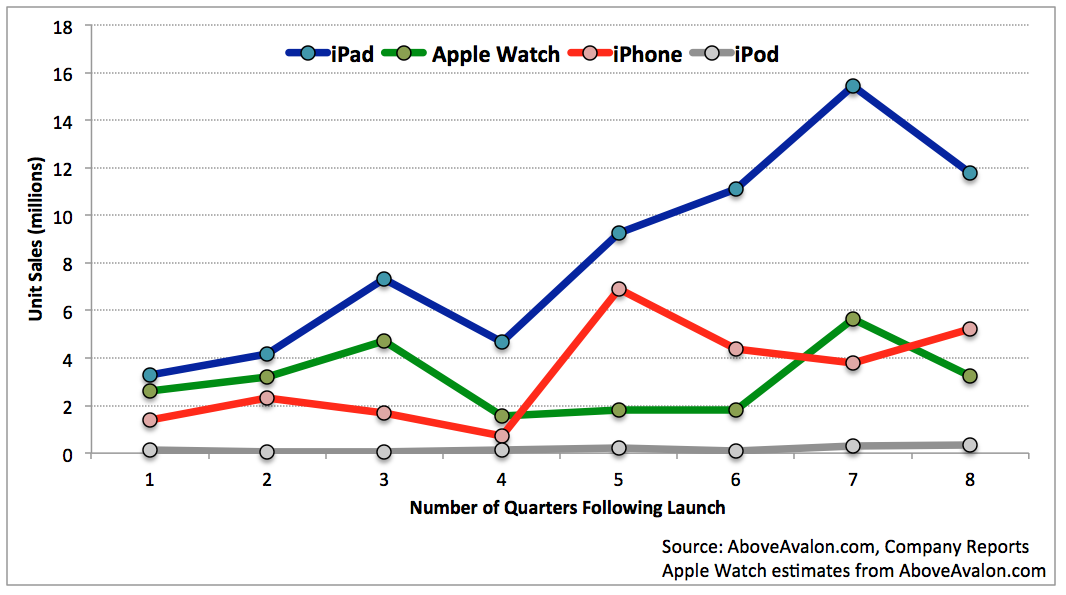
Rearranging the data from Exhibit 1 into cumulative unit sales removes the seasonal impact. It becomes easier to see how Apple Watch and iPhone are running neck-and-neck for second best-selling Apple product category across the first eight quarters following launch. The fact that Apple has sold nearly the same number of Apple Watches as iPhones during the first two years on the market will surprise many people. The narrative surrounding Apple Watch does not match that of a product very close to being the second best-selling product out of the gate in Apple's history.
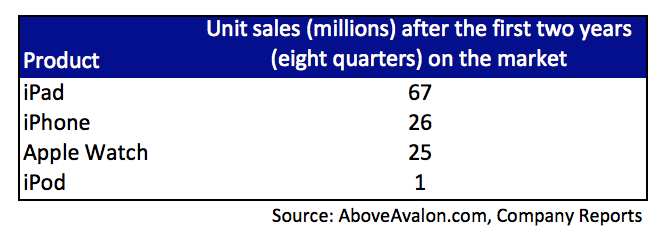
This past quarter marked the eighth quarter that Apple has been selling a wearable device. When AirPods and Beats headphones unit sales are added to Apple Watch sales, the true extent of Apple's wearables platform becomes apparent. Apple's total wearables sales are outpacing iPhone sales out of the gate. As seen in Exhibit 2, AirPods and Beats headphones sales boosted Apple wearables sales in the seventh and eight quarters following Apple's wearables platform launch.
Exhibit 2: Early Sales Trends (Two Years Following Launch)
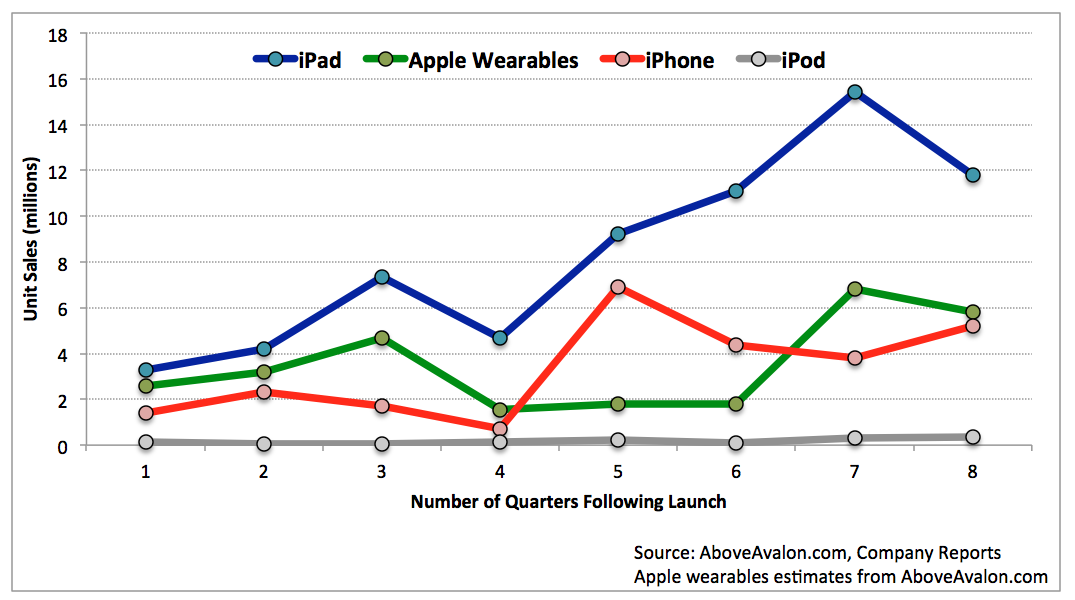
On a cumulative unit sales basis, Apple wearables sales are exceeding iPhone sales by two million units after the first eight quarters on the market. Wearables are Apple's second best-selling product category out of the gate.
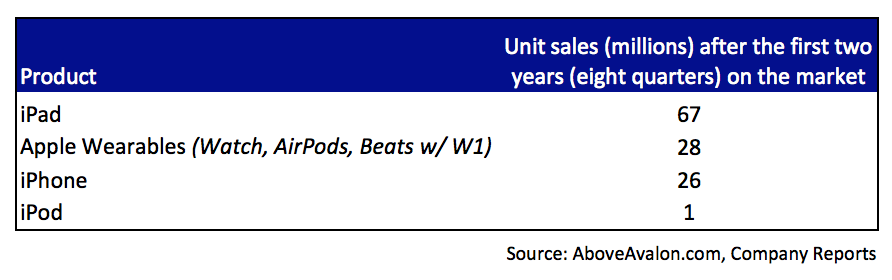
Key Considerations
Whenever sales comparisons are made between Apple wearables and iPhone and iPad, there are a number of key differences between the product categories that need to be discussed.
iPhone. In 2007, Apple launched the iPhone with very limited distribution. For the first four months, iPhone was only available at AT&T in the U.S. By time the iPhone 3GS launched in 2009, the iPhone was available in 80 countries. The iPhone's limited distribution masked the product's underlying adoption trends. During those first two years on the market, consumers began to see value in a hand-held computer. This makes it impossible to know how well the first iPhone would have sold if it was given a much wider launch. It took a few years for the mass market to become interested in iPhone.
iPad. The iPad launch was timed perfectly and enabled the iPad to ride the iPhones' coattails. The iPhone app bonanza certainly contributed to iPad sales in addition to the fascination found with much larger multi-touch screens running iOS. While the iPad saw a limited rollout at launch, distribution was much wider than it was with the iPhone launch a few years earlier.
Apple Watch. Despite Apple Watch seeing a much wider rollout at launch, the product has faced a different kind of constraint. Apple Watch requires an iPhone. This has the effect of more than doubling the entry-level price of Apple Watch for non-iPhone owners. Even though the Apple Watch was available in nine countries, including China, at launch, the product's target market was closer to 500M people.
AirPods. AirPods launched this past December in more than 100 countries. Exhibit 2 adds AirPods sales to Apple Watch and Beats headphones sales beginning in the sixth quarter following Apple's platform launch. This ends up adding quite a bit of conservatism to Apple wearables sales as AirPods will likely be on an annual sales pace measured in the tens of millions per year by time they have been available in market for eight quarters. As long as supply improves, AirPods will likely give the iPad a run for its money in terms of it being the best-selling Apple product out of the gate over the first two years. (The methodology and math behind my AirPods sales estimates are available for members here.)
Context
One takeaway from all of these launch and distribution differences is that each product has faced its own set of unique situations and challenges. However, there is value found in comparing sales of wearables to those of early iPhone and iPad because such comparisons provide context for wearables sales.
Many people have been grading Apple wearables on a curve, looking at the devices through an iPhone lens. Since unit sales pale in comparison to current iPhone unit sales (220M a year), wearables are being cast off as either disappointing or irrelevant. This ignores what is growing momentum for Apple's wearables platform.
To have Apple wearables sales outpace iPhone sales out of the gate when looking at the first two years of availability demonstrates that wearables are a thing. Apple has built and sold more wearables than iPhones after the first two years in the market. That fact goes a long way in helping to define just how significant Apple wearables sales have been. It is irrelevant if Apple could have shipped additional iPhones by launching with wider distribution back in the late 2000s. An argument can be made that Apple would have sold many more wearables this past quarter if it wasn't for severely constrained AirPods supply.
Redefining Wearables
Too much attention is being placed on Apple Watch as holder of the wearables torch. Instead, the focus needs to be placed on both Apple Watch and AirPods, with W1 chip-equipped Beats headphones representing Apple's third wearables product category. Instead of looking at these wearable devices as standalone products with few similarities or overlap, we should view them as coming together to create a platform, as shown below. AirPods usage increases the value found with Apple Watch ownership. The reverse applies as well. Apple Watch usage increases the value found in AirPods ownership. This interdependency is only going to intensify and likely boost overall Apple wearables sales.
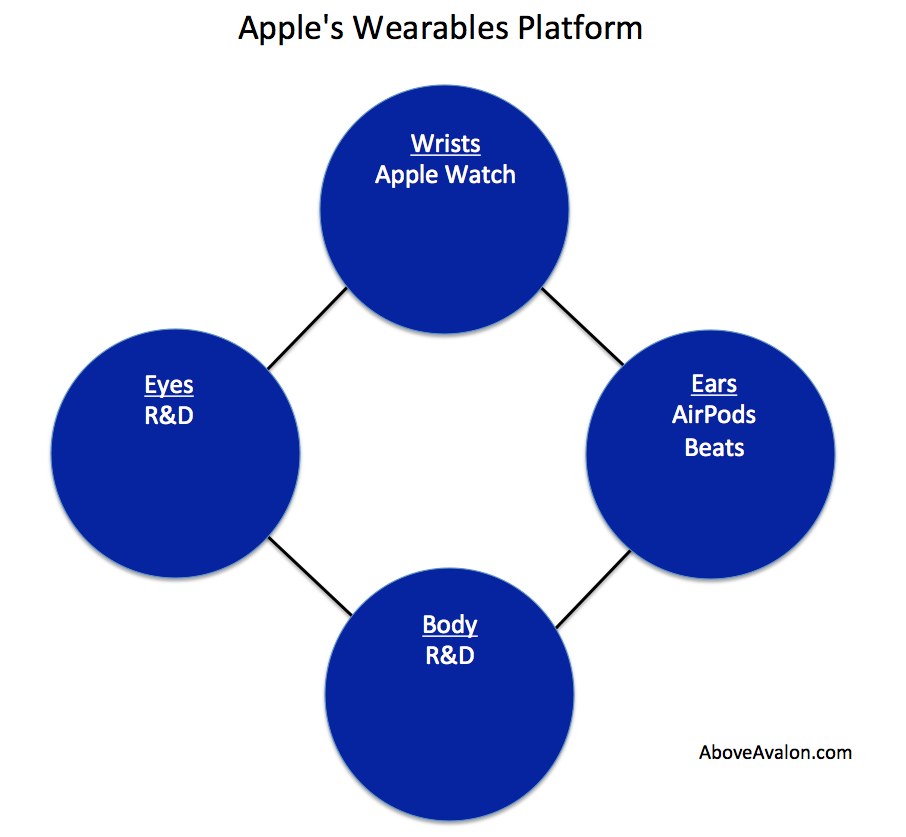
Looking Ahead
According to my estimates, Apple is on track to sell more than 30M wearable devices in 2017. This is an astounding figure considering that it would represent approximately 15% of the number of iPhones Apple is expected to sell in 2017. As seen in Exhibit 3, there is a strong probability that Apple wearables sales will continue to outpace iPhone sales when looking at the first three years of availability following launch.
Exhibit 3: Early Sales Trends (Three Years Following Launch)
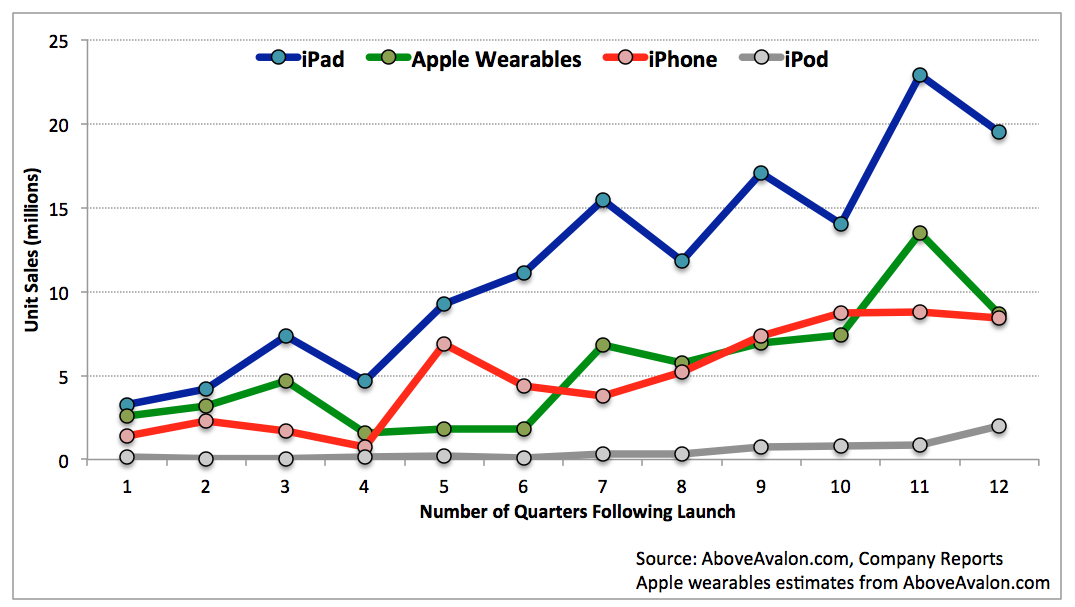
Note: AboveAvalon.com projections used for wearables sales quarters 9 to 12.
Looking out a bit further to the first five years of availability following launch, things become even more interesting. The iPhone began to outsell the iPad three years following launch, and the sales gap has increased ever since. Similarly, Apple's wearables platform is positioned to outsell iPad in roughly the same amount of time following launch. It is not out of question that Apple wearables will continue outpacing iPhone as we move to four years of availability following launch. While this is no small task as Apple would likely need to double the number of wearables it is currently selling, AirPods would play a key role.
Exhibit 4: Early Sales Trends (Five Years Following Launch)
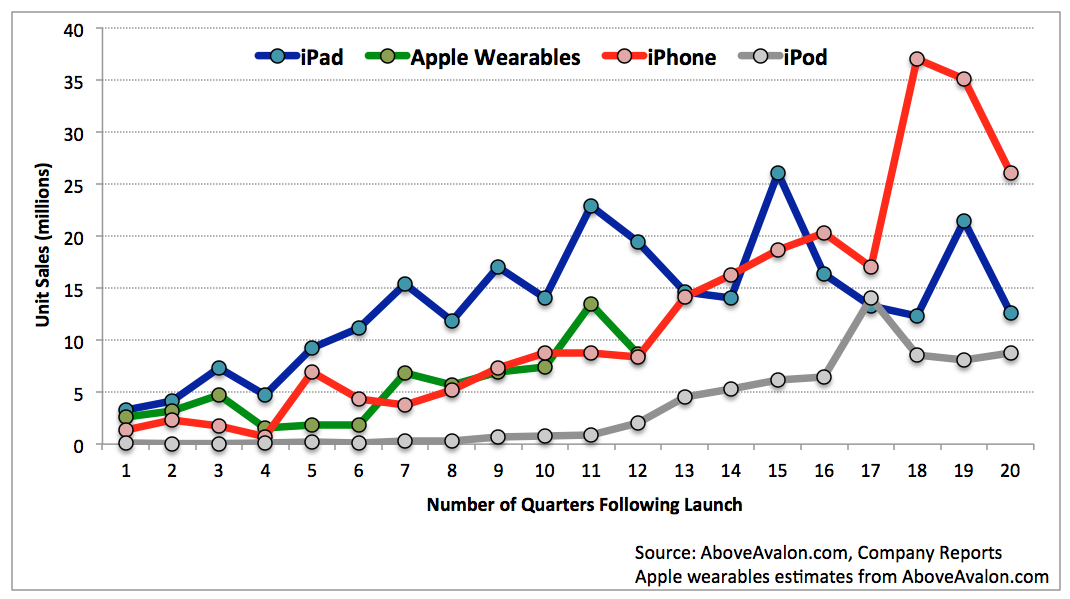
Note: AboveAvalon.com projections used for wearables sales quarters 9 to 12.
Momentum Building
This past holiday season, Apple passed Fitbit to grab the title of largest wearables company. This past quarter, for the first time, more Apple Watches than Fitbit devices were sold. The number of people wearing an Apple wearable device has likely surpassed 20M. Apple is laying the foundation for a wearables platform that will eventually grow to annual unit sales in the hundreds of millions of devices.
Receive my analysis and perspective on Apple throughout the week via exclusive daily emails (2-3 stories a day, 10-12 stories a week). To sign up, visit the membership page.
Apple Isn't a Tech Company
Apple continues to be misunderstood. With the company's cash cows showing signs of maturity, Apple's interest in new industries is growing. Questions are swirling as to where Apple may be headed next. The answer is found by assessing how Apple views itself and the role it has to play in the world. Apple isn't a tech company, but rather it's a design company betting that consumers want something more than just technology in their lives.
Defining Apple
Over the years, Apple has been given a number of labels:
Computer company
Technology company
Product company
Consumer electronics provider
Mac company
iPod company
iPhone company
Luxury retailer
Consumer discretionary company
Consumer staples company
Some of these labels were more valid than others. In some cases, the label was meant to represent Apple's relationship with customers. Other labels went a bit further in an attempt to describe some aspect of Apple's culture or product philosophy.
Even Apple contributed to a few labels. In January 2007, Steve Jobs announced that Apple would drop the "Computer" from its name and become just "Apple Inc." to reflect the changing product line. The name change led some to believe that Apple now viewed itself as a consumer electronics company or even an iPhone company. However, a corporate name change doesn't tell us much about how best to define a company.
A more interesting clue about how Apple views itself came three years later, at the end of the iPad unveiling keynote, when Jobs talked about how Apple was able to make a device like the iPad. Here's Jobs:
"The reason that Apple is able to create products like the iPad is because we've always tried to be at the intersection of technology and liberal arts. To be able to get the best of both. To make extremely advanced products from a technology point of view but also have them be intuitive, easy to use, fun to use, so that they really fit the users and users don't have to come to them, they come to the user. And it's the combination of these two things that I think let us make the kind of creative products like the iPad."

Clues
This location at the intersection of technology and liberal arts explained why competitors had such a difficult time competing against iPad (as they still do today). There was something more to the iPad than just technology. However, this still doesn't tell us how best to define Apple going forward. Instead, a closer examination of Apple's business provides more valuable clues.
Power Structure. In the late 1990s, Steve Jobs shifted the power structure within Apple so that designers had control and influence over engineers. The logic in turning Apple into a design-led company was that design is the item that leads to great products. The iMac was the first product to be born out of this new power structure.
Since becoming CEO in 2011, Tim Cook has made a number of leadership and managerial changes that amount to giving even more power to Apple designers. My theory is that these changes have reinforced a structure that splits Apple leadership into two groups:
Operations and corporate strategy
Product
An inner circle comprised of Tim Cook, Eddy Cue, Phil Schiller, and Jeff Williams oversees Apple's day-to-day operations and broader corporate strategy. This inner circle is supported by a number of SVPs and VPs. In addition, Cook increased the number of direct reports to the CEO while expanding the managerial reach of those making up the inner circle.
Meanwhile, the Apple Industrial Design group is positioned as the overseer of Apple's product direction. Christopher Stringer is a veteran Apple industrial designer who recently was reported to be leaving Apple. A few years ago, during Apple's Samsung trial, he explained that the job of an Apple industrial designer is "to imagine objects that don’t exist and to guide the process that brings them to life."
As seen in the following diagram, which was published in my "Grading Tim Cook" article, Apple leadership is split into two groups: operations/corporate strategy and product. This structure doesn't resemble that of a technology company. The Industrial Designers have continued to consolidate power during the Tim Cook era.
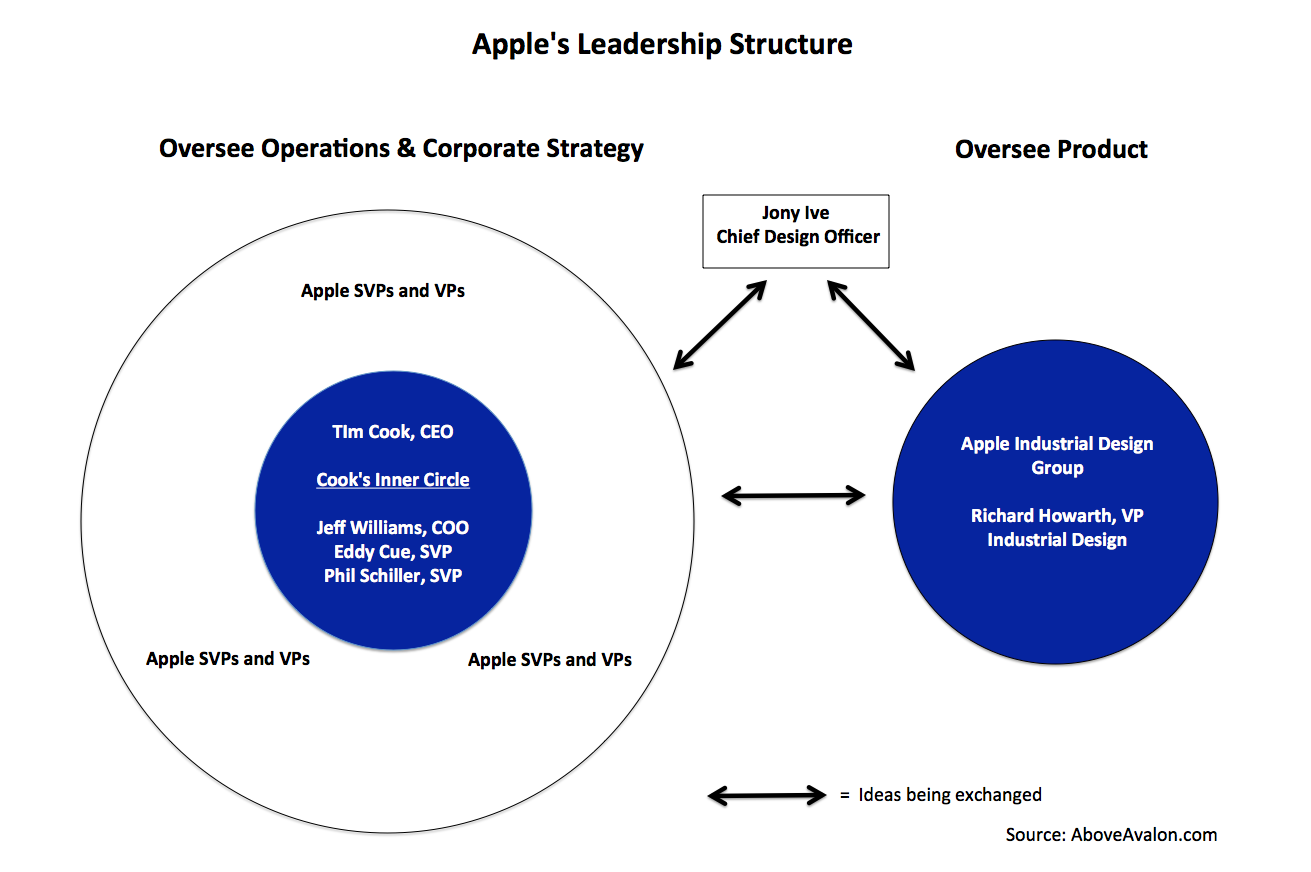
Organizational Structure. It is logical to assume that the significant amount of change in power structure has resulted in cracks forming elsewhere within Apple. While some of this has manifested itself in certain groups losing influence or sway with management, the broader culture at Apple doesn't appear to have been jeopardized. The company's functional organizational structure has played a significant role in keeping corporate politics somewhat at bay. The focus, by design, remains on the product.
In managing the Industrial Design group, Howarth isn't simply overseeing a team of 17 industrial designers. Instead, he is managing Apple's in-house design studio. Even after including the Human Interface team, Apple's core group of designers is remarkably small. This creates a contrast with tech companies employing hundreds of designers or utilizing various outside design consultants. Today, Apple handles all of its design internally.
By rearranging the Apple leadership structure diagram shown above, we obtain a different look at Apple. The company is comprised of a nimble design studio supported by one of the largest technology arms in the world. It would be incorrect to classify Apple as just a design studio. The technology arm allows Apple to develop the technologies powering products created by the Industrial Design group. This dynamic is made possible by close collaboration between the designers and Apple's significant engineering resources.
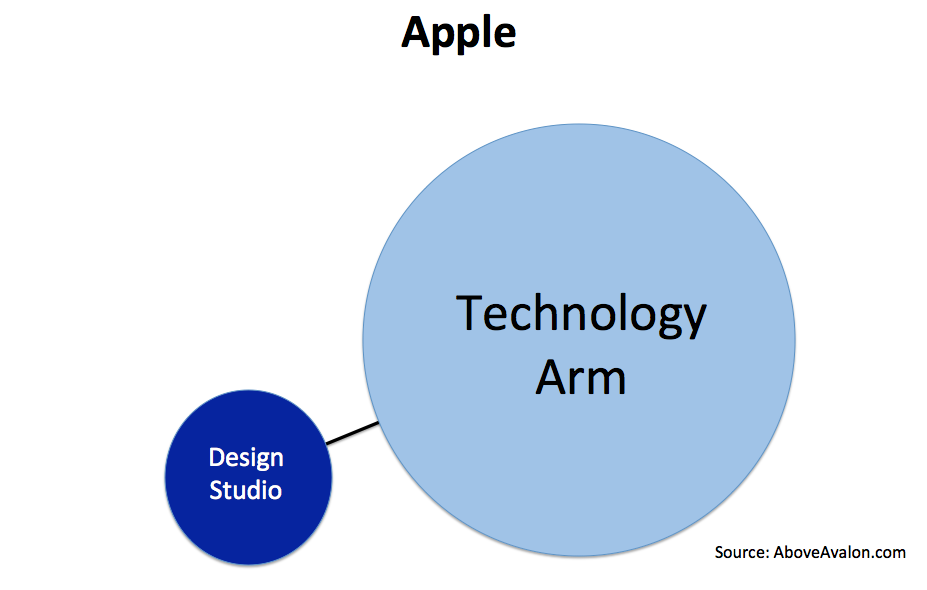
Storytelling. The next big clue as to how best to define Apple comes from observing how management has tried to tell the Apple story through the press. Consider some of the recent articles and interviews published in cooperation with Apple executives.
Jony Ive profile in The New Yorker (February 2015). The 16,000-word profile had Apple's full support and was one of the defining pieces written about the company this decade. Ian Parker used the Apple Watch as a prism to show how today's Apple is Jony's Apple. The messaging was clear: Apple's product strategy was now led by an industrial designer. Jony now had the role formerly held by Steve Jobs.
Charlie Rose's exclusive look inside Apple (December 2015). Rose was given unprecedented excess inside Apple for a 60 Minutes report. The tour included the world's first genuine look inside Apple's Industrial Design studio. While a few photos of the studio were released in the past, Rose's access was unprecedented. In one scene, Rose and Jony talk about how few people get to be in the lab. Jony laughed and said "We don't like people in this room, period," in an obvious recognition of how unusual it was to have Rose and his entire entourage sitting in the studio. This raised the question of why Apple gave Rose such access in the first place. Apple felt that a look inside the design studio would help explain itself to the world.
Charlie Rose interview with Jony Ive (March 2016). The 72-minute interview aired in March 2016 and was aimed at figuring out what drives Apple. The interview went into detail as to how products are developed at Apple. It also addressed various topics pertaining to Jony and his design philosophies.
In each of the preceding examples, Apple had one goal in mind: Shape its public image. Apple wanted to be known as more than just a technology company. Instead, Apple viewed itself as a company that puts the product above everything else.
Products. Given that the product plays such a prominent role at Apple, the clue that best helps us define Apple is found in its products. Last month, Apple unveiled a number of new products through a series of press releases. (My complete review of Apple's new products is available for members here.) The new Apple products that contained the most intrigue were Apple Watch bands. There were a number of new Woven Nylon bands as well as Classic Buckle, Sport Band, and Hermès band options. The changes amounted to Apple unveiling its spring 2017 Watch band collection.
While Apple Watch bands remain a source of mockery within some Apple user circles, the product is incredibly important for Apple. Watch bands are the primary reason Apple has been able to sell close to 25M Apple Watches to date and become the wearables leader in the process. While there is value and convenience found with having a small screen positioned on the top of one's wrist, the only reason people are willing to wear that screen in the first place is because of Watch bands. It is not a coincidence that Apple Watch bands are the most frequently updated product at Apple.
With Watch bands, Apple is shipping a product that isn't powered by any software or technology. Instead, Watch bands are judged by tangibles and intangibles more likely to be found in the fashion world than in Silicon Valley. Watch bands end up serving as a big clue for the kind of company Apple is striving to be. It's certainly not to be just a tech company.
The Mac provides another clue as to how best to define Apple. While we can point to a number of red flags appearing in the Mac business, the major trend taking place with the Mac is that the product is changing in an iOS world. What was once geared toward the liberal arts mindset is now finding itself more appealing to those in fields such as engineering. This transition coincides with the Mac becoming a bigger headache for management. The company knows how to make technology more personal, as with the iPad. However, when the same goal is attempted with the Mac, Apple receives pushback from a small but influential segment of the Mac user base. The struggles Apple is having with Mac end up showing that Apple isn't just a tech company. There is something else at play.
Not Tech, but Design
All of the preceding clues for how best to define Apple contain a similarity: They revolve around some element of design.
Apple is a company in which designers hold the most power and influence.
Apple is structured to position the product above anything else.
Apple management is eager to use design to tell its story.
Apple's product line embodies the principle of technology not being enough.
At every turn, Apple is quick to discuss how something more than technology is needed. Even Apple's WWDC 2017 announcement reiterates this point, saying "Technology alone is not enough." That is a powerful statement to define what is arguably Apple's most tech-focused event of the year.
Apple isn't a tech company, but rather it's a design company.
By being defined as a design company, Apple is positioning the user experience - how consumers interact with technology - as more important than focusing on the sheer power found with technology. This goal permeates throughout Apple. The company isn't just a design studio with a technology arm. Instead, every group at Apple is in one way or another focused on design. Apple is betting that design is the ingredient that will continue to put the product above anything else.
Design vs. Technology
There is a way to differentiate a design company from a tech company: Observe how the company approaches technology. In every case, Apple views core technologies not as products themselves, but as ingredients for something else. Instead of wanting to chase after technology's raw capability, Apple is more interested in technology's functionality as it relates to the user experience. This brings up Jobs' reference to Apple being at the intersection of technology and liberal arts. By looking at the world through this lens, we receive a clearer roadmap as to where Apple is headed in terms of product strategy.
Augmented Reality (AR). Apple has been investing significantly in AR for the past few years. Instead of acting like a tech company and positioning AR as a standalone product, Apple's primary focus is to incorporate the technology into products we already use (smartphones, tablets) and products we will begin to use in the future (entirely new wearable form factors). Apple views AR as a core technology that will transform products into a new breed of navigation tools. This will add a new dimension to the technology. The way we will interact with AR is often the part of the equation not discussed much by tech companies. Apple will attempt to figure it out.
Autonomous Driving. Contrary to reports, Apple still wants to design its own car. Apple recently was granted a permit to begin testing autonomous driving technology on California public roads. Apple is researching autonomous driving technology because it will be a core ingredient powering a range of Apple products in the transportation space. Instead of partnering with legacy auto companies, Apple will look to do everything on its own. The motivation and ambition in such a move is born from Apple's adherence to design and the quest to control the entire user experience.
Health Monitoring. There is a reason why Apple Watch bands are the most frequently updated product in Apple's line. The best way to get people to wear health monitoring technology is to have people want to wear health monitoring technology. Today, health monitoring primarily describes simple fitness and health tracking. Apple is actively researching different technologies, including those for possible blood sugar monitoring. If successful, the technology will play a vital role in Apple's wearables products.
Voice. A tech company positions a voice assistant as the product. Cheap standalone speakers would be positioned as a way to get people to use the voice assistant as much as possible. Apple sees voice playing a different role in computing. Voice assistants can add value to products we already use and wear throughout the day. Instead of making the voice assistant the focus, Apple is interested in how we can use our voice to make technology more manageable.
TV. Apple's decision to not ship a television set provides an example of not enough core technology resulting in a product receiving a "no" from the company. According to reports, Apple was not able to figure out a way to differentiate itself from the competition. This is another way of saying there was little found with a television set that could lead to an entirely new user experience. Television sets are stationary, large pieces of glasses positioned a few feet in front of us. While new technology in the form of a few front-facing cameras and sensors may add a few new twists to the equation, Apple didn't think the final offering would be compelling enough. Instead, Apple focused on the piece of the television experience we do interact with - the remote control and tvOS user interface. As it turned out, Apple ended up selling more than 255M "television sets" in 2016 anyway. They are called iPhones and iPads.
Criticism
Much of the criticism directed at Apple can be traced back to how the company is defined. Because it is not a tech company, some have questioned Apple's ability to grasp future technology waves. These critics don't give Apple enough credit for the large technology arm connected to its design studio. Suggestions that Apple's services will remain inferior to those of its peers are becoming common occurrences. However, the progress Apple has made with Apple Maps suggests this is not the case. Apple's ability to excel at machine learning is routinely questioned. The criticism boils down to Apple focusing too much on functionality (how we use the technology) and not enough on capability (what the technology can do).
At the same time, Apple receives pushback from being a design company. The significant backlash Apple is receiving from a portion of its pro Mac user base boils down to a broader dissatisfaction with the company betting too much on design. There are some Apple users who don't want the version of technology Apple is selling. In addition, there is no sign of this dissatisfaction going away.
In reality, Apple's largest risk isn't found in being a design company or not being a technology company. Instead, it's in becoming a tech company. If Apple finds itself moving away from being design-led, the product will be put into jeopardy. This is likely one reason why Cook continues to bet so heavily on design.
The Apple Design Book
AirPods wasn't the surprise product of 2016. Rather, Apple's $199 design book came as a shock to the Apple community.
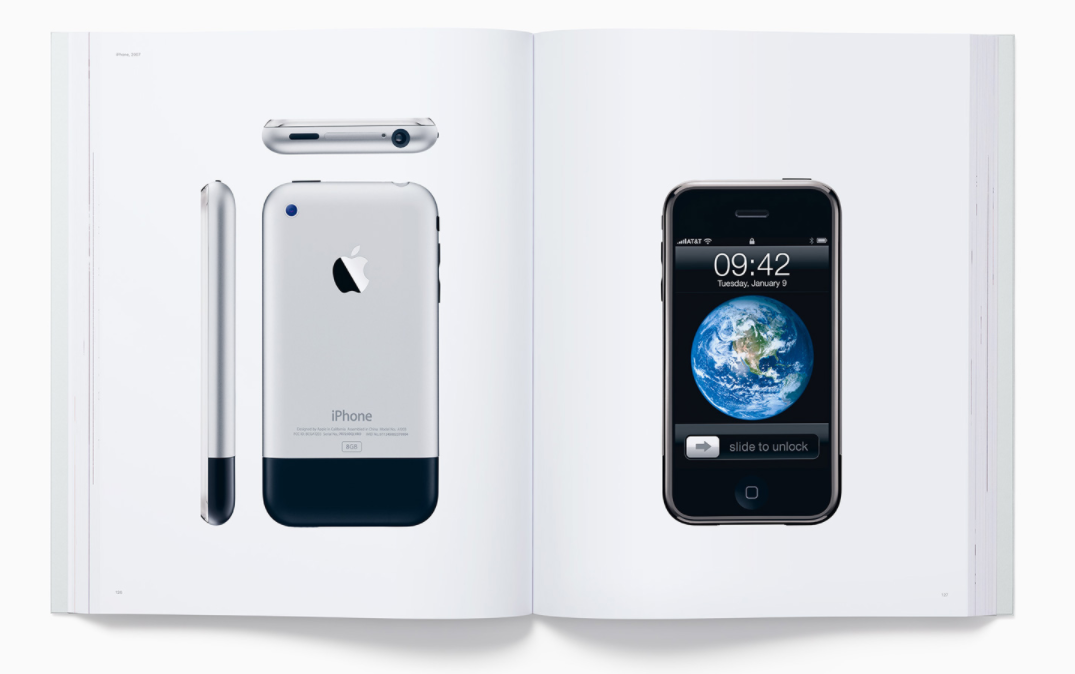
While many looked the book as Apple designers getting intoxicated by nostalgia, the book ends up being the clearest expression of what makes Apple a design company. Apple is focused on creating products that can change the world. The secret to accomplishing this goal is to place a bet that technology alone is not enough.
Receive my analysis and perspective on Apple throughout the week via exclusive daily updates (2-3 stories per day, 10-12 stories per week). Available to Above Avalon members. To sign up and for more information on membership, visit the membership page.
The Mac Is Turning into Apple's Achilles' Heel
Apple's decision to change course and develop a new Mac Pro has received near-universal praise from the company's pro community. While developing a new Mac Pro is the right decision for Apple to make given the current situation, it has become clear that the Mac is a major vulnerability in Apple's broader product strategy. The product that helped save Apple from bankruptcy 20 years ago is now turning into a barrier that is preventing Apple from focusing on what comes next.
Apple's Mac Meeting
There were three takeaways from Apple's recent on-the-record meeting with five journalists in Cupertino to discuss the Mac.
Apple is sorry about the lack of Mac updates targeting pro users.
The current Mac Pro suffers from a fatal design decision (although the device will continue to be sold).
Management debated the Mac Pro's future and decided to change strategy and begin work on an entirely new Mac Pro. The company will also work on an Apple-branded pro display to go along with a new Mac Pro.
(My complete review of Apple's emergency Mac meeting is available for members here.)
It is easy to look at this highly unusual meeting as being just about the Mac Pro and Apple trying to prevent influential content creators from jumping to a competing platform. However, read between the lines, and it becomes clear that Apple has a much bigger problem on its hands than simply an outdated Mac Pro.
The Mac has become a major headache for Apple, and management is on the verge on going down the Mac rabbit hole, funneling an increasing amount of resources and attention into a product category that doesn't represent the future of personal computing. The risk is that Apple will be stuck with a $25B legacy business and corresponding user base that will threaten the company's increasingly ambitious product strategy.
Tale of Two Apples
Apple is like a novel where two characters are battling each other in the post-PC era. When it comes to mobile, Apple's success is unmatched. The company is connecting with the mass market like never before. The iPhone is bringing more than 100M new people into the Apple ecosystem each year. Apple Watch momentum is building with a user base surpassing 20M people. Early AirPods sales trends look even more promising. More importantly, Apple executives have been on the same page with each other when it comes to strategy.
This cohesion in strategy extends to how Apple continues to place big bets in an effort to control its own destiny in mobile. Recent news of Apple developing its own GPU solution is the latest step in the company's quest to ship a single system-on-the-chip (SOC) powering a range of mobile and wearable devices. This will give Apple a competitive advantage measured in decades. The company is also placing big bets on mobile services such as mapping and payments, items that will serve to create a competitive advantage in the changing tech landscape.
In stark contrast, Apple's Mac strategy looks like a slow-motion train wreck. While Apple has made some progress with bringing elements of mobile such as Touch ID, multi-touch displays, and ARM processors, to the Mac, years of sporadic updates have overshadowed the positives. Apple's relationship with its pro Mac user community has deteriorated and can now be described as toxic. To make matters worse, there appears to be a growing rift among Apple executives concerning Mac strategy.
As for why Apple's problematic Mac strategy hasn't caused too many issues for the company up the now, the business has become niche. As seen in Exhibit 1, Apple is selling more than 250M iOS devices per year. In comparison, they are selling fewer than 20M Macs. The Mac accounts for just 11% of Apple's overall revenue. More importantly, the Mac is no longer the primary way new users enter the Apple ecosystem. In addition, one can also argue that pro Mac users haven't had much in the way of alternative platforms up until recently, although this is still being debated.
Exhibit 1: The Post-PC Era at Apple
The Achilles' Heel
Apple's Achilles' heel is becoming visible. As Apple gets better at making technology more personal for the mass market, the company is losing touch with its legacy pro users. The situation came to a head last week with Apple announcing that it began work on a new Mac Pro. While one can chalk up a new Mac Pro as a one-off cost for keeping iOS app developers engaged in the platform, Apple's vulnerability extends much deeper than one Mac model.
There appears to be a growing rift among Apple executives when it comes to Mac strategy. Apple Industrial Design and Apple management have spent the better part of the past 10 years focused on devices designed to move hundreds of millions of people beyond the Mac. However, this strategy did not address 30M Apple users dependent on pro Mac hardware and software. While this segment only accounts for 4% of Apple's user base, it is responsible for creating content consumed by the other 96% of Apple users. These content creators have played a major role in Apple's mobile success.
Apple's Achilles' heel is found with the niche devices at the tail end of the business. As seen in Exhibit 2, when compared to smaller screen unit sales, devices targeting pro users barely register. Apple has come to the realization that these niche devices, instead of being cast off or ignored, need ongoing attention and resources.
Exhibit 2: Apple Device Sales Mix (Screen Size)
Path to Today
It is fair to ask how Apple got into this predicament.
The Mac isn't like the iPod, a device cleanly and quickly cannibalized by a newer Apple product. iOS and multi-touch are not able to handle all of the tasks given to Mac. This is one reason why Apple has been extremely vocal about continuing to invest in the Mac despite running forward with iPhone and iPad. The debate was never about whether or not Apple will continue to sell Macs, but rather about how best to bring the Mac into the future.
One path forward was for Apple to consolidate resources and place a bet that higher-end MacBook Pros and iMacs would be able to handle the needs of most Mac Pro users. Apple ended up being partly right. A majority of pro Mac users have transitioned their workflows to MacBooks and iMacs without incident.
Apple ran into an issue when it came to addressing the niche of the niche. Millions of pro users could not make the jump from Mac Pros or other high-end PCs to a MacBook Pro or iMac. Apple needed to support these users for no other reason than they create the content consumed by the rest of the user base.
Issues
Apple's decision to work on a new Mac Pro raises a number of red flags.
Resource strain. Even though Apple has $246B of cash and cash equivalents, the company is resource-constrained when it comes to time and attention. Apple's functional organizational structure produces a constant battle among products and teams to grab that finite amount of management's attention. For management to dedicate attention to new pro Mac hardware, the company may need to take its foot off the accelerator with other products. This may seem like a major flaw, and judging from the amount of criticism directed towards Apple's organizational structure, such an opinion is widely held. However, Apple's structure is put in place in order for the product to be put ahead of everything else. It is not a disadvantage or weakness, but rather one of Apple's secrets to success. There is value found in having Apple's Industrial Design team, along with Tim Cook and his inner circle, move from product to product throughout the year in order to place a select few big bets.
Broader cultural differences. Some may argue that Apple is capable enough to develop mobile and wearable devices while selling pro Macs at the same time. This ignores the much more complicated aspect of Apple satisfying vastly different user needs with pro Macs. Apple would not only be developing a new Mac Pro or standalone display, but also sustaining a small but influential base of pro users dependent on macOS. Similar to how the iPhone user base is changing, Apple's overall user base has become quite heterogeneous in terms of technology wants and needs. It may be nearly impossible for Apple to satisfy all of its users.
Product strategy hole. According to consensus, the biggest challenge Apple is facing is finding a business as profitable and influential as the iPhone. This extends to Apple not being able to expand its developer and app success to newer product platforms. It has become clear that Apple's inability to move beyond the Mac poses a much bigger long-term risk.
There may be a hole developing in The Grand Unified Theory of Apple Products (shown below). The idea behind the theory is that Mac portables and desktops are positioned as the most powerful machines in Apple's product line. These machines will then serve to push the rest of Apple's product line forward. However, there isn't much evidence of this actually taking place. Instead, iPhones and iPads are being used to decide where to bring MacBooks and iMacs. There is also the awkward situation of iPad Pro beginning to give Mac a run for its money in terms of performance.
Meanwhile, there isn't much evidence of MacBook or iMac features serving as inspiration for Apple's smaller screens. This is a sign of value destruction occurring with larger screens found at Apple's tail end of the business. We are giving more of our time to the smaller screens in our lives. Where does this leave Macs within Apple's broader product strategy? It increasingly looks like an odd fit as the Mac becomes a legacy platform.
Additional Concerns
The need to have a highly unusual private, on-the-record briefing with five journalists to explain a complete reversal in Mac strategy signals a management team on defense. Apple is afraid of influential Mac content creators jumping ship. This is the exact opposite of the aggressiveness Apple has shown with mobile and wearables. The more one looks into the topic, the more worrying things appear.
In an attempt to explain Apple's new Mac strategy, Apple SVP Phil Schiller wiped the dust off the old quadrant product grid. At the same time, Schiller has been increasingly vocal about the Mac being around for the next quarter of a century. Here's Schiller in late 2016:
"The new MacBook Pro is a product that celebrates that it is a notebook, this shape that has been with us for the last 25 years is probably going to be with us for another 25 years because there’s something eternal about the basic notebook form factor. You have a surface that you type down on with your hands, with a screen facing you vertically. That basic orientation, that L shape makes perfect sense and won’t go away."
Schiller is likely guided by the desire to calm pro Mac users' fears. Arguing that the Mac will be around for 25 years means that these users won't need to worry about transitioning away from the Mac during their careers. However, this stance places Apple in an awkward situation. Nowhere is this seen more clearly than in Apple's recent iPad Pro ad campaign. On one hand, Apple is saying it thinks the laptop form factor will be around for 25 years. However, Apple then launches a marketing campaign positioning the iPad Pro as a better computer than MacBook.
The Way Forward
My suspicion is that instead of trying to get around its Achilles' heel, Apple will try to be more cognizant of it. It is likely that a majority of Apple's senior executives, including Apple's Industrial Design group, still view the iPad and iOS as the more promising platform than Mac and macOS for the next 25 years of computing. Apple is pushing iPad like never before. New pro Mac hardware will not change this dynamic. However, it has become clear that Apple realizes its previous Mac strategy fell short as there was no viable path forward for tens of millions of pro Mac users.
Apple disclosed a few facts about its pro Mac users as measured by pro software usage. The data contains clues as to where Apple's product strategy may be headed. According to Apple, 70% of the Mac user base does not use pro software and would not classify as pro users. This is another way of saying that the iPad Pro could do quite well serving the needs of 70M Mac users. Meanwhile, the other 30% of the Mac user base wants and needs the power and flexibility that Apple has historically had trouble selling.
Apple will likely position the Mac as a computing platform for legacy pro users while iOS will be targeted to everyone else. This will entail a few steps:
1) Triple down on iPad. The writing is on the wall. Apple will not be able to address its Achilles' heel until iPad can be used for developing apps. This will involve Apple ramping investment and resources into iPad software, hardware, and accessories. While consensus assumes Apple should look to the Mac for iPad software inspiration, the more appropriate course of action is to look at the iPhone for inspiration. There is a reason that the iPhone is outselling the Mac by 10x. People enjoy iOS as a computing platform. After all, the iPad is just a bigger iPhone.
2) Continue to be aggressive with Mac design. Apple Industrial Design will continue to be aggressive in bringing the Mac experience forward. There have been some controversial Mac design decisions taken recently, including decisions about the Touch Bar and the insistence that multi-touch does not make sense on vertical Mac displays. Some may argue that Apple needs to look at a new Mac Pro as a hardware engineering problem and have the Industrial Design team take a back seat. This may be a recipe for disaster. It just goes to show how tricky of a proposition pro Mac hardware is for this management team.
3) Running fast with new endeavors. The Mac does not represent Apple's future. Instead, the changing tech landscape will require Apple to play in new industries. The company needs to be extra aware of the long-term damage done by the Mac becoming a resource strain and jeopardizing other initiatives.
Figuring Out What Comes Next
Apple still needs the Mac. Tens of millions of users aren't able to pack away their large displays and embrace iPhones and iPads. However, the Mac debate has never been about whether or not Apple will stop selling Macs. Instead, the question has been, how will management be able to retain the value of the laptop and desktop form factors in today's mobile world?
The most important thing for Apple to do when it comes to the Mac is to think about what comes next. Apple's broader mission is to use devices capable of making technology more personal to inspire a new generation of content creators. It is clear that iPhone and iPad are already inspiring tomorrow's content creators. Apple Watch and AirPods are not far behind in terms of being able to inspire.
When taking into consideration new technologies such as augmented reality, it is fair to wonder just how important large screens will even be in our lives in the future. Small screens are going to transition from being just tablets, smartphones, and smartwatches to being augmented reality navigators. In such a world, large screens will look like relics. The path forward for Mac looks bumpy.
Receive my analysis and perspective on Apple throughout the week via exclusive daily updates (2-3 stories per day, 10-12 stories per week). Available to Above Avalon members. To sign up and for more information on membership, visit the membership page.
Apple Is Pushing iPad Like Never Before
Apple is pulling out all the stops when it comes to selling iPad. We are seeing the company take its most aggressive stance yet in getting existing iPad owners to upgrade. For the first time, Apple is also making a concerted effort to reach prospective iPad owners by targeting PC users. On the surface, these efforts seem like a last ditch effort to save iPad, which faces continued sales declines. However, Apple is guided by a different motive. There are signs of Apple pushing iPad like never before in order to solve its growing Mac dilemma.
Initial Look at iPad Sales
A quick look at overall iPad sales reveals an ominous trend. Sales have declined for 12 consecutive quarters. After topping out 74M units in 1Q14, the annualized iPad sales rate has declined by 42% to 43M units.
Exhibit 1: iPad Unit Sales (TTM)
When iPad is compared to iPhone and Mac, its sales weakness becomes even more pronounced. The sales gap between iPad and Mac continues to shrink. This has drawn into question Apple's vision for iPad and whether or not the device is the best representation of the future of personal computing. There are even people beginning to question some aspects of the post-PC era as steady Mac sales suggest consumers aren't moving away from laptops and desktops.
Exhibit 2: iPhone, iPad, Mac Unit Sales (TTM)
For the past four years, we have seen various theories put forth to explain the significant drop in iPad sales. Longer upgrade cycles, larger iPhones, inferior software, lack of professional apps, and even poor Apple storytelling have been given as factors driving iPad sales weakness.
iPad Strategy Changes
As sales have declined, Apple has implemented a number of significant changes in its iPad strategy. Many of these changes have occurred within the past year and a half. The latest changes were unveiled last week when Apple announced the new 9.7-inch iPad. (My complete review of Apple's new product announcements is available for members here.)
iPad Pro. The most obvious change relates to the iPad Pro line. The defining features of the iPad Pro are the Apple Pencil and Smart Keyboard support, which were introduced in 2015. One of the biggest criticisms facing the iPad over the past few years is that it is a consumption device used primarily for watching video. The iPad Pro seeks to change that narrative. The overall strategy with the iPad Pro is to release higher-priced SKUs offering additional functionality and capability.
Additional Simplicity. The iPad Air era is officially over at Apple. By positioning the new 9.7-inch iPad as the iPad Air 2 successor, the overall iPad line is much simpler. In fact, the iPad line contains the most simplicity in years. The "iPad Air" nomenclature had lost much of its meaning last year following the 9.7-inch iPad Pro unveiling as each device shared similar dimensions and identical weight.
As seen below, Apple reduced the iPad line by 20% (five models down to four) and simplified the branding.
By removing the iPad Air from the line, Apple made the iPad buying equation that much easier for consumers. This simplicity is a sign of Apple doubling down on the 9.7-inch iPad as the flagship iPad size. (The actual screen size may change slightly going forward depending on the screen to bezel ratio.) The choice is either between an iPad Pro or an iPad. Meanwhile, the iPad mini will become niche, available for consumers wanting an iPad with a smaller footprint.
Aggressive Pricing. Apple slashed the entry-level price for the 9.7-inch iPad to $329 from $399. Special $299 pricing for education institutions is also available. This is an aggressive pricing strategy considering that Apple was selling the 9.7-inch iPad Air 2 for $499 as recently as 12 months ago. The iPad mini had represented the entry-level iPad model when it came to pricing. Since the company is now positioning the smaller iPad as a niche device, the new distinction comes with a higher price.
Clearer Storytelling. Apple recently launched its largest iPad ad campaign to date. In what is called "Real Problems... answered," Apple showcases real tweets depicting computing problems and then demonstrates how the iPad Pro offers solutions. The ad campaign is a big deal for Apple and a sign of management directly reaching out to PC users as potential iPad purchasers. The company has been quite aggressive with its airing of the ads in recent weeks.
One of the more interesting observations about the ads is how they end up making long-time MacBook users nervous. Apple is positioning iPad Pro as a better computer than laptops, and by extension, MacBooks.
Closer Look at iPad Sales
In order to properly assess all of the recent changes to iPad strategy, a closer look at sales is needed. While overall iPad sales have been in decline for years, reports of iPad's death have been greatly exaggerated. There is much more going on behind the scenes.
iPad sales have faced one major headwind in recent years. This item explains a significant portion of the sales decline. It's not inferior software, weak storytelling, or even a longer upgrade cycle. Instead, the iPad's problem has been the iPad mini.
People aren't buying as many iPad mini devices these days. Excluding 7.9-inch iPad mini sales from overall iPad sales results in a completely different sales picture. As seen in Exhibit 3, iPad mini unit sales have declined 70% after peaking in 4Q13 and 1Q14. The product's value proposition has been permanently reduced due to larger iPhones. Apple has clearly experienced Peak iPad Mini. It's not that the iPad mini form factor is going away, but rather that it will play a smaller role going forward.
iPad mini sales weakness has masked stronger sales trends for larger iPads. In what will come as a surprise to many, the iPad Air 2 has been the best-selling iPad to date. In addition, more than half of people buying an iPad Air 2 were new to iPad. These are very promising signs for the iPad business. Not only are large screen (9.7-inch and 12.9-inch) iPad sales relatively unchanged over the past four years, but they actually have increased year-over-year this past holiday quarter. The iPad Pro line played a major role in this sales rebound.
Exhibit 3: iPad Unit Sales by Screen Size (TTM)
Given iPad mini sales weakness, management is placing a big bet on larger iPad screens. By lowering the entry-level cost of the 9.7-inch model to $329, Apple is looking to make the most appealing iPad size more accessible. At the same time, the company is offsetting margin and ASP pressure by moving up market with more capable iPad Pro SKUs and accessories. The Apple Pencil accessory is one of the most underrated Apple products in years.
Solving the Mac Dilemma
Since large screen iPads having shown much more resiliency over the past few years, Apple's recent iPad changes seem peculiar. Why double down on the iPad now?
Apple is pushing the iPad like never before in order to solve its Mac dilemma.
Ultimately, management has two options for the Mac:
- Double down. From a product perspective, there is a clear path forward for the laptop and desktop form factors at Apple. The company could continue bringing elements of mobile to the Mac. Apple can control more of the core technologies powering the Mac, and this would include bringing a version of iOS to the laptop and desktop form factors. The effort would take years to accomplish and utilize a significant amount of resources.
- Move beyond the Mac. This option would begin with more sporadic updates to the Mac line and then eventually lead to Apple placing less and less attention on the category as other products gain priority and resources. While Apple would still sell Macs, it would become clear that the company's focus is on newer products designed to handle the tasks currently given to the Mac.
Management faces a difficult choice between the two options as the Mac is still selling very well. The product category is bringing in nearly $23B of revenue per year, $4B more than iPad thanks to a much higher ASP. Some companies are powered by Macs (although Apple executives seem to rely quite a bit on their iPads these days). Tens of millions of users rely on Macs to get work done every day. A portion of these users are adamant that a move away from Mac is nearly impossible given their current workflows.
My suspicion is that Apple is pushing larger screen iPads because management is determined to move beyond the Mac. Apple thinks now is the time to raise awareness that the iPad is a legitimate PC alternative for hundreds of millions of consumers.
A move away from the Mac goes against much of the public commentary from Apple management. Tim Cook, Phil Schiller, and others have been quick to mention Apple's long-term commitment to the Mac with Phil Schiller even saying the laptop form factor will be around for another 25 years. However, management's recent actions speak louder:
- Tim Cook calling the iPad the clearest expression of Apple's vision of the future of personal computing.
- The new iPad Pro ad campaign elevating the iPad at the expense of Mac.
- Aggressive iPad pricing highlighting Apple's desire to position the device for mass market consumption, while Mac pricing is more reflective of a niche product.
The iPad Strategy
As seen in Exhibit 4, the sales gap between large screen iPads and Mac peaked five years ago. The gap has since closed, with large screen iPad sales bouncing around 30M units annually and Mac sales seeing a slight improvement to 19M units. If Mac were to outsell iPad, this would certainly make Apple's goal in moving beyond the Mac that much more difficult. It would demonstrate how Apple has a serious problem on its hand as the iPad is not able to entice users away from Mac. Management is interested in avoiding that outcome.
Apple wants to push iPad sales now like never before in order to widen the sales gap between iPad and Mac. Large screen iPads have experienced some momentum in recent months. Management is building off that strength to unveil a broader campaign to boost iPad sales. If Apple is successful in increasing large screen iPad sales to a 40M unit sales annual pace (a 30% increase from current levels), iPad would be outselling Mac by 2x. This would certainly help change the iPad versus Mac narrative in the marketplace, giving Apple that much more motivation to dedicate attention and resources to other products.
Exhibit 4: Mac, Large Screen iPad Unit Sales (TTM)
Apple is making its iPad sales pitch to two groups: existing iPad users and long-time PC users. According to my estimates, there are 100M users still using older iPads (iPad 1, iPad 2, iPad 3, iPad 4, iPad mini). A significant portion of these users are using devices that don't even support the latest iOS release. Management thinks simpler storytelling and an aggressively low $329 price will entice these users to upgrade to the new 9.7-inch iPad.
The fact that 100M people are still using older iPads demonstrates that the product provides value. Apple is also confident that users will see the significant improvement between the latest iPads and models from five to seven years ago. As for PC users, Apple thinks the iPad Pro line is capable of handling the vast majority of tasks currently given to laptops. Apple looks at the iPad Pro line, which includes Apple Pencil and Smart Keyboard, as a better solution for consumers than even the Mac. This is quite telling as to management's long-term motivation.
While the iPhone has likely reduced the iPad's long-term sales trajectory, the iPad category is being underestimated. Apple thinks that now is the time to become much more aggressive in selling iPad. Fortunately, we will be able to judge Apple's progress by monitoring quarterly iPad sales. With a dramatic price cut, simpler sales pitch, reduced headwind from iPad mini sales, and a differentiated product line, Apple is confident the iPad will return to growth. A growing iPad business will then make it that much easier for Apple to move beyond the Mac and focus on creating a new breed of personal gadgets that make technology more personal.
Receive my analysis and perspective on Apple throughout the week via exclusive daily emails (2-3 stories a day, 10-12 stories a week). To sign up, visit the membership page.
The Curious State of Apple Product Pricing
As Apple pushes deeper into luxury brand territory, the company is making its products more accessible through lower pricing. At $159, Apple is underpricing AirPods. The same can be said for Apple Watch, priced at $269. In just ten years, we have moved from the "Apple Tax" days, when Apple was accused of pricing products artificially high, to Apple products being priced below the competition. Apple is using its balance sheet and scale to grab new users, and in the process, redefine luxury.
Underpricing AirPods
After using AirPods for the past three months, one takeaway relates to pricing. It is clear that Apple is underpricing AirPods. While this statement may sound outlandish considering that a pair of EarPods is included in every iPhone box, AirPods are not just any pair of headphones. The combination of accelerometers, optical sensors, Apple's new W1 chip, and a well-designed charging case, position AirPods as Apple's second wearables product. AirPods are computers for your ears. This distinction does a better job at framing the device's surprisingly low $159 price.
Contrary to the conclusions found in most headphone buying guides, AirPods should not be compared to lower-priced, wired headphones. These buying guides not only lean on sound quality to unfairly shortchange truly wireless headphones, but also misidentify why consumers want to buy wireless headphones in the first place. AirPods' primary value proposition isn't found with sound quality but rather with not having any wires. Accordingly, the product should be compared to other truly wireless headphones.
It is very difficult to find a pair of wireless headphones priced lower than AirPods. In the run-up to Apple unveiling AirPods this past September, the wireless headphone market consisted of the following players:
Kanoa: $300
Bragi Dash: $299
Erato Apollo 7: $289
Skybuds: $279
Earin: $249
Motorola VerveOnes+: $249
Samsung Gear IconX: $199
Bragi Headphone: $149
Given the preceding list, a strong case could have been made for Apple to price its new wireless headphones at $249, or even $299. The fact that Samsung priced its Gear IconX at $199 seemed to suggest a sub-$200 retail price for AirPods was unlikely. Instead, Apple sent shockwaves pulsing through the market by pricing AirPods at only $159. The action instantly removed all available oxygen from the wireless headphone space. The idea of Apple coming out with a new product that would underprice nearly every other competitor was unimaginable ten years ago.
Many wireless headphone companies have been forced to cut pricing in an attempt to better compete with AirPods. Even after price cuts, competitors are still unable to come close to AirPods pricing. While some of these competing headphones include additional capabilities and functionality, much of this benefit is overshadowed by the lack of Apple's W1 chip. When it comes to contributing to the premium experience found with AirPods, the W1 chip is near the top of the list.
Underpricing Apple Watch
A similar pricing dynamic is found with Apple Watch. After cutting the entry-level price $50 to $299 in March 2016, Apple unveiled a new Apple Watch pricing strategy last September. Apple upgraded the first generation Apple Watch device with a new dual-core processor, the same processor found in the higher-priced Apple Watch Series 2 models. In addition, Apple gave the Watch a new name, Apple Watch Series 1, and a $30 price cut to $269.
At $269, Apple Watch Series 1 is one of lowest-priced smartwatches worth buying in the marketplace. Attractive pricing was one key factor driving record Apple Watch sales this past holiday quarter. In fact, even the Apple Watch Series 2, at $349, is one of the lowest-priced smartwatches in its class:
Fossil Fenix 5: $599
Garmin Forerunner 630: $399
Michael Kors Access: $350
Samsung Gear S3: $349
Fossil Q Founder: $275
Apple's aggressive pricing strategy has also gone a long way in shrinking the price gap between Apple Watch and dedicated health and fitness trackers. There is now only a $70 difference between an Apple Watch Series 1 and Fitbit Blaze.
Three Pricing Theories
There are three theories to explain Apple's AirPods and Apple Watch pricing strategy.
A) iPhone as Hub. Instead of making a profit on Apple Watch and AirPods, Apple is underpricing the devices in an effort to boost iPhone sales. The logic is that since Apple Watch and AirPods are being positioned as iPhone accessories, Apple views the devices as tools to keep consumers attached to their iPhones. Apple compensates for the lack of Apple Watch and AirPods profit by selling high-margin iPhones and Services.
B) Manufacturing Scale. This is the most straightforward theory. Apple has simply gotten better at making products at a lower cost. With a sizable production ramp (millions of units), Apple management can use scale and its existing supply chain to quickly bring down component and manufacturing costs for a new breed of personal tech gadgets.
C) Consumer Segmentation. Management is using product pricing to grow Apple's user base. On one end, management cuts entry-level pricing in an effort to make products more accessible. However, management then pushes at the other end of the pricing spectrum with premium SKUs targeting a different part of the user base. The higher-priced SKUs help boost Apple's overall margin profile.
History
On the surface, each of the three preceding theories seem to contain some logic. The iPhone is not only Apple's best-selling product, but also the most effective tool for growing the user base. At the same time, Apple has seen much progress in keeping component costs contained across its product line.
However, upon further examination, there is a serious flaw found with Theory A (besides the fact that Apple is moving beyond the iPhone as Hub product strategy). AirPods and Apple Watch pricing doesn't reflect a new strategy designed to juice iPhone sales. Instead, Apple has actually been traveling down this pricing path for years. Apple's decision to unveil the initial iPad at $499 in 2010, and then come out with a $329 iPad mini just two years later, marked a sea change in the way Apple approached product pricing.
In the mid-1990s, Apple made a series of strategic mistakes related to the Mac. Instead of trying to grow market share, management chased profit. Apple introduced a variety of high-priced Macs targeting existing Mac users. Apple was having difficulty targeting new users in the face of the strengthening Windows empire. Apple was doubling down on niche instead of chasing mass market.
Apple took a completely different strategy with iPad. With iPad, Apple cared much more about grabbing market share. This attitude was born from motivation to not repeat Apple's dark days from the 1990s. Up until last year, there was thought to be one major caveat to Apple's market share ambition. Apple was interested in initially grabbing share in the premium segment of the market and then gradually working its way down market. There is evidence to suggest this attitude is now changing a bit as Apple is selling wearables.
Apple's Pricing Strategy
AirPods and Apple Watch pricing demonstrate how Apple is looking to own not only the premium segment of the wearables market, but rather the entire market. As Apple runs deeper into luxury, the company is reducing entry-level pricing. This is a curious development as one assumes the opposite would have occurred - Apple would keep prices high to maintain a certain level of exclusivity or scarcity. Instead, Apple is redefining the concept of luxury in order to sell mass-market products.
Consider Apple's approach to Apple Watch pricing. With $269 and $369 Apple Watch options, Apple is very competitive with nearly every smartwatch. However, at the other end of the product line with Apple Watch Hermès and Edition starting at $1,149 and $1,249 respectively, Apple is selling different materials, and a different kind of experience, at much higher prices. Apple is segmenting the product line to appeal to a wider variety of users.
With Apple's entry-level Apple Watch pricing, management isn't necessarily targeting a premium segment of the smartwatch market, but rather its going after the entire market. AirPods represents an even more extreme case study of this mass-market appeal.
Apple is able to sell product at low prices by utilizing its strong balance sheet and powerful supply chain to secure very attractive component orders. In addition, the company's efforts to own its own silicon and other core technologies are starting to pay dividends from both a performance and pricing perspective. Apple's growing vertical integration is allowing the company to run with lower pricing yet still maintain historically high margins. The growing legal battle between Apple and Qualcomm isn't just about Apple being unhappy with Qualcomm's business model. Rather, it's about Apple wanting to eventually get into the baseband processor business. (A full primer related to the lawsuit is available for members here.) This will come in handy when selling a cellular Apple Watch down the road as Apple can create its own system on a chip (SOC) containing its own AX processors, GPU, and an LTE modem chip.
Lower-priced Apple products result in increased sales, which leads to Apple's ability to place even larger component orders. Apple will soon be on pace to sell 20M Apple Watches per year. For AirPods, annual unit sales will likely be even higher. These sales numbers provide Apple flexibility to reduce the pricing of older models even further. Meanwhile, competitors are unable to get a foot in the door. We saw a version of this dynamic unfold in the tablet market during the early 2010s. The same thing is now taking place in the smartwatch market, and it could even expand to the wireless headphone industry.
Things to Monitor
Given Apple's revised pricing strategy, there are a few developments worth monitoring:
Apple Watch. A $199 Apple Watch is inevitable at this point. On the other end of the pricing spectrum, new partnerships with luxury brands similar to Hermès seem likely.
AirPods. It is not unreasonable for Apple to eventually have an entire AirPods platform comprised of lower-priced models with certain features and components as well as higher-end options targeting a more premium segment of the market. Interestingly, Apple started towards the low end and may work its way up market as additional functionality is added.
iPhone. Stronger than expected demand for the higher-priced iPhone 7 Plus tells us that higher-priced iPhones are coming. Higher prices will be justified as iPhones morph from being computers that fit in one’s pocket into personal augmented reality navigators utilizing the most capable cameras to ever fit in a pocket. Meanwhile, Apple continues to reduce entry-level iPhone pricing. The most recent example is Apple bringing back the iPhone 6 in a few select markets and pricing it a bit lower than iPhone SE.
iPad. Given the iPad's position within Apple's broader product line, the product category is following the iPhone in terms of higher-priced models. On the other end, there may not be much room left for Apple to lower iPad's entry-level pricing to significantly less than $269.
Redefining Luxury
Apple's pricing strategy is ultimately about bringing new users into the Apple ecosystem. While the iPhone remains the most effective tool for accomplishing this, Apple wearables will increasingly represent another new user tool at management's disposal. It may be difficult to believe, but AirPods likely represent the first Apple product for more than a few people. Additional value will flow to companies selling multiple wearables products to the same user. As it currently stands, the average Apple user owns more than one Apple product. This trend will only intensify as time goes on when considering Apple Watch and AirPods.
The trickiest aspect of Apple's pricing strategy is running with lower prices while at the same time, becoming more of a luxury brand. In essence, Apple is redefining luxury. While other luxury brands have utilized lower-priced items to serve as brand entry points, Apple is taking the practice to an entirely new level by pricing products below the competition. Apple is making luxury much more accessible with the idea that low-priced gadgets can create an experience just as luxurious as that of premium gadgets. It's going to be difficult for other consumer tech companies to play in this game.
Receive my analysis and perspective on Apple throughout the week via exclusive daily updates (2-3 stories per day, 10-12 stories per week). Available to Above Avalon members. To sign up and for more information on membership, visit the membership page.